The Request for Proposal for detailed design and construction of new Heavy Polar Icebreaker(s) (HPIB) has been issued. You can see it here. I have only taken a quick look at the first few pages of the 197 page document, but it does include, not just a request for costs to construct one icebreaker, but also prices for numbers two and three as well.
This paragraph is worth noting.
To enable ongoing program planning and responses to Congressional inquiries, the Coast Guard and Navy HPIB IPO desire input from prime offerors related to the benefits of Congressional authorization of Block Buy and/or Economic Order Quantity. Submission of this information is voluntary and will not be used to evaluate any proposal submitted by the offeror in response to this RFP. Email submissions providing dollarized estimated savings per ship for authorization provided for 1) all three cutters and 2) only the second and third cutters should be emailed to the Bidders Question contacts identified below with the email title “HPIB Block Buy/EOQ Input – Contractor Name.” Submissions within 60 days of RFP release are preferred.
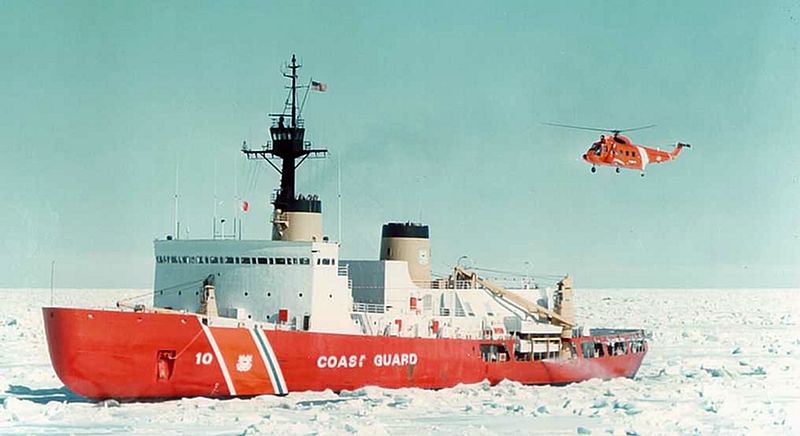
USCGC Polar Star will be 47 years old by the time we see a replacement. USCGC photo.
The Navy has issued a Request for Proposal with options for up to three heavy polar icebreakers. Its not a block buy, but it is a bit of a surprise. I have copied and pasted the brief summary below. (Thanks to Tups for bringing this to my attention.)
Solicitation Number:
N00024-18-R-2210
Notice Type:
Presolicitation
Synopsis:
Added: Feb 14, 2018 2:17 pm
The Naval Sea Systems Command plans to issue an unrestricted solicitation for the procurement of the Detail Design and Construction (DD&C) of up to three (3) Heavy Polar Icebreakers (HPIB) under a Fixed Price Incentive Firm (FPIF) Contract. This contract will award Advance Procurement and Detail Design, and include option line items to procure three (3) Heavy Polar Icebreakers. The contract will also include options for Provisioned Items orders to outfit the ships and purchase spares, repair parts, and other special equipment; Engineering and Industrial Services in support of Government systems installation and post-delivery activities; Special Studies for Government-directed engineering tasks; and Crew Familiarization. The HPIB will be procured utilizing full and open competition in accordance with the Federal Acquisition Regulation (FAR) Part 15, Contracting by Negotiation. Award is anticipated to be made to a single Offeror who offers the Best Value to the Government as determined by the tradeoff process as defined in Sections L and M of the Solicitation. The solicitation is anticipated to be posted within 30 days, this synopsis is provided as an advance notice.
This synopsis and any updates and/or changes for this planned procurement, the posting of the RFP, and any future Amendments to the RFP, will appear at the Federal Business Opportunities (FBO) website located at http://www.fbo.gov. Inquires/questions concerning this announcement may be e-mailed to the Naval Sea Systems Command, Shipbuilding Contracts Division representatives listed below.
The points of contact for this posting are Ms. Melissa Donnelly, Contract Specialist, e-mail Melissa.Donnelly@navy.mil AND Mr. James Platner, Contracting Officer, e mail, James.Platner@navy.mil. Please send inquiries via e-mail to both points of contact. No telephone inquiries will be accepted and requests for solicitation packages will not be honored, as a solicitation is not prepared at this time. This notice does not constitute an Invitation for Bid or Request for Proposal and is not to be construed as a commitment by the Government.
The contracting agency is: Naval Sea Systems Command, 1333 Isaac Hull Ave SE, Washington Navy Yard, DC. 20379-2020
Contracting Office Address:
SEA 02
1333 Isaac Hull Avenue SE
Washington Navy Yard, District of Columbia 20376
United States
The following is a news release quoted in full. Frankly I think it is a good thing that we are reporting the problems rather than just happy news. The public and our law makers in particular need to understand that we are putting people, and the mission, in danger because we are making do with overage systems that should have been replaced long ago. Incidentally, USAP is apparently U.S. Antarctic Program.
This additional note was attached to the release, “Editor’s Note: All dates and times are in New Zealand Daylight Time, which is 21 hours ahead of Pacific Standard Time and 24 hours ahead of Eastern Standard Time. Video of the Cutter Polar Star’s operations are available by clicking the thumbnails above or clicking here and here. Photos from the cutter’s operations by clicking the thumbnails above or clicking here. ”
MCMURDO STATION, Antarctica – The crew of U.S. Coast Guard Cutter Polar Star completed their mission Tuesday in support of National Science Foundation (NSF) after cutting a resupply channel through 15 miles of Antarctic ice in the Ross Sea and escorting supply vessels to the continent.
The Polar Star sailed from Seattle to assist in the annual delivery of operating supplies and fuel for NSF research stations in Antarctica during Operation Deep Freeze by carving a navigable path through seasonal and multi-year ice sometimes as much as 10-feet thick. Operation Deep Freeze is the logistical support provided by the U.S. Armed Forces to the U.S. Antarctic Program.
“Although we had less ice this year than last year, we had several engineering challenges to overcome to get to the point where we could position ourselves to moor in McMurdo,” said Capt. Michael Davanzo, the commanding officer of the Polar Star. “Our arrival was delayed due to these challenges, but the crew and I are certainly excited to be here. It’s a unique opportunity for our crewmembers to visit the most remote continent in the world, and in many respects it makes the hard work worth it.”
On Jan. 16, Polar Star’s shaft seal failed causing flooding in the cutter’s engine room at a rate of approximately 20-gallons per minute. The crew responded quickly, using an emergency shaft seal to stop the flow of freezing, Antarctic water into the vessel. The crew was able dewater the engineering space and effect more permanent repairs to the seal to ensure the watertight integrity of the vessel. There were no injuries as a result of the malfunction.
Flooding was not the only engineering challenge the crew of Polar Star faced during their trek through the thick ice. On Jan. 11, their progress was slowed after the one of the cutter’s three main gas turbines failed. The crew uses the cutter’s main gas turbine power to breakup thick multi-year ice using its propellers. The crew was able to troubleshoot the turbine finding a programing issue between the engine and the cutter’s 1970s-era electrical system. The crew was able to continue their mission in the current ice conditions without the turbine.
“If the Polar Star were to suffer a catastrophic mechanical failure, the Nation would not be able to support heavy icebreaker missions like Operation Deep Freeze, and our Nation has no vessel capable of rescuing the crew if the icebreakers were to fail in the ice,” said Vice Adm. Fred Midgette, commander, U.S. Coast Guard Pacific Area in Alameda, California. “The crewmembers aboard Polar Star not only accomplished their mission, but they did so despite extreme weather and numerous engineering challenges. This is a testament to their dedication and devotion to duty.”
The cutter refueled at McMurdo Station Jan. 18 and continued to develop and maintain the ice channel in preparation for two resupply ships from U.S. Military Sealift Command, Ocean Giant and Maersk Peary. The crew of Polar Star escorted the vessels to the ice pier at McMurdo Station, an evolution that requires the cutter to travel about 300 yards in front of the supply ships to ensure they safely make it through the narrow ice channel. The crew escorted the Ocean Giant to the ice pier at McMurdo Jan. 27 and conducted their final escort of the Maersk Peary to Antarctica Feb. 2. The crew escorted Maersk Peary safely out of the ice Feb. 6 after supply vessel’s crew transferred their cargo.
The Polar Star departed their homeport in Seattle Nov. 30, 2017, and are expected to return to the U.S. in March 2018. The 399-foot Polar Star is the only operational heavy icebreaker in the U.S. fleet. The cutter, which was built more than 40 years ago, has a crew of nearly 150 people. It weighs (displaces–Chuck) 13,500 tons and uses 75,000 horsepower to break ice up to 21 feet thick.
The U.S. military is uniquely equipped to assist the National Science Foundation in accomplishing its USAP mission. This includes the coordination of strategic inter-theater airlift, tactical intra-theater airlift and airdrop, aeromedical evacuation support, search and rescue response, sealift, seaport access, bulk fuel supply, port cargo handling, and transportation requirements supporting the NSF, the lead agency for the USAP.
The nuclear-powered icebreaker Arktika in the Kara Sea. RIA Novosti archive, image #186141
We have had the “Bomber Gap”, the “Missile Gap”, and the “Cruiser Gap.” None of which were ever real, but they were effective in putting more money into a program.
Now we have the “Icebreaker Gap” which is real, but largely irrelevant. Hopefully it will get money for the Coast Guard.
It is certainly true that the Russians have far more Icebreakers than the US, but shouldn’t it enough that we really need these ships, regardless of what the Russians may be doing?
I hate to see fear replacing logic, but perhaps the ends justify the means. Is there a military dimension to the Russia/US icebreaker fleet comparison? Certainly neither country is going to invade the other over the poles. We are not likely to see fleets of icebreakers shooting at each other, the Russians already have plenty of missile carrying aircraft and submarines in the Arctic. But we may need to place sensors, bases, or other assets in high latitudes even when others don’t like it. That may be impossible without icebreakers. The US has fewer icebreakers than any other type of critically important vessel. We have far more carriers, SSBNs, destroyers, amphibious warfare ships, underway replenishment ships. The loss of any one of them would not mean the end of a capability. The loss of even one of our icebreakers could.
Marine Link reports award of a $320M contract for construction of a 30,000 gross ton 150 meter Polar Class 2 expedition vessel to be powered by a hybrid LNG/electric power plant. “The vessel can accommodate 270 passengers in 135 staterooms, in addition to a crew of 180 persons.”
It is expected to host two helicopters and 16 Zodiac dinghies.
They think they can take it to the geographic North Pole.
Federal News Radio has an interview with the Commandant. There is a short written summary here or you can listen to it on their page or above. Some interesting developments with regard to drug interdiction in the Eastern Pacific. Sea story about actual employment of a sea based Unmanned Air System.
Interestingly he again refers to Russia arming Icebreakers so I think perhaps we may see some movement to arm or at least make provision for arming our new icebreakers.
RRS Sir David Attenborough. Proto from Rolls-Royce
Thought I had posted about this ship earlier, but when I went to add an update from MarineLink on installation of the engines, I found that was not the case. RRS Sir David Attenborough is perhaps most famous as the subject of a social media search for a ship name that resulted in the most votes going to Boaty McBoatface.
It is expected to provide logistics support to support a British presence in Antarctica as well as break ice to a thickness of 1.5 meters at a minimum speed of 3 knots.
Displacement: 15,000 Gross Tons (only a little smaller than USCGC Healy, a little larger than Polar Star)
Length: 128.9 meters (423 feet)
Beam: 24 m (79 ft).
Draft: 7 m (23 ft)
Integrated propulsion and ship service engines/generators: two 3,600 kW (4,800 hp) 6-cylinder Bergen B33:45L6A and two 5,400 kW (7,200 hp) 9-cylinder Bergen B33:45L9A main diesel generators, a 885 kW (1,187 hp) harbor generator and two 2,500kW battery systems.
Propulsion motors: four 2,750 kW (3,690 hp) for 11,000kW or 14,760 HP (about half that of USCGC Healy and less than 20% that of Polar Star on turbines)
Range: 19,000 nautical miles (35,000 km; 22,000 mi) at 13 knots
Accommodations for 90 with a crew of 28.
Facilities to land a helo, but I have seen no indication of a hangar.
Despite the title, don’t expect a recitation of Coast Guard priorities. Most of the material is familiar, but there were a few interesting comments, including some that might be surprising. A number of things the Commandant said here made news.
That the NSCs could be made into frigates.
That the Polar Icebreaker would cost less than $1B
His support of transgender CG personnel.
I’ll give a quick outline of what was talked about. At the end I will rant a bit about some of my pet peeves.
The Commandant’s prepared statement is relatively short beginning at time 2m45s and ending about 11m.
6m00 In our listing of missions, the Commandant said Defense Operations should be listed first. He noted that there are 20 ships chopped to Combatant Commanders including eleven ships operating under SOUTHCOM.
Q&A begins at 11:00.
16m20s The Commandant noted there is a Chinese ship rider on a USCG cutter off Japan and that Coast Guard aircraft are flying out of Japan.
17m30s Boarder protection/drug interdiction
20m Called the OPCs “light frigates”
22m As for priorities the Commandant noted a need to invest in ISR and Cyber
23m Cyber threat.
24m Expect return to sea duty because of length of training.
26m30s “Demise of the cutterman”/Human Capital Plan–fewer moves–removed the stigma of geographic stability
29m25s Highest percentage of retention of all services–40% of enlisted and 50% of officers will still be in the service after 20 years
30m Law of the Sea. Extended continental shelf in the Arctic.
32m30s Need for presence in the Arctic.
36m ISR, 38m15s Firescout. An interesting side note was that the Commandant seemed to quash any possibility of using the MQ-8 Firescout. He noted when they deployed on a cutter 20 people came with the system. He called it unoccupied but not unmanned.
40m Icebreakers
43m30s Comments on transgender members
45m15s Icebreakers–will drive the price down below $1B.
47m NSC as frigate–no conversations with the Navy about this. Performance of Hamilton.
49m50s Count the NSCs toward the 355 ship Navy.
50m30s Illegal migration and virulent infectious disease
53m35s CG training teams in the Philippines and Vietnam to provide competency to operate platforms to be provided by Japan. Two patrol boats going to Costa Rica. Other efforts to build capacity.
56m DHS is the right place for the CG.
The Commandant touched on a couple of my pet peeves, specifically
He called the OPCs “Light Frigates,” so why aren’t they designated that way? WMSM and WMSL are just wrong in too many ways. Give our ships a designation our partners and politicians can understand. A WLB is a cutter and also a buoy tender. The OPC can be both a cutter and a light frigate. I have suggested WPF. Maybe WFF for the Bertholfs and WFL for the Offshore Patrol Cutters. If we want to be thought of as a military service, we need to start using designations that will be seen and understood as military.
He mentioned the possibility of including the Bertholfs in the 355 ship fleet total. Coast Guard combatants should be included when the country counts its fleet. No, the cutters are not aircraft carriers or destroyers, but the current fleet of about 275 ships includes about 70 ships that have no weapons larger than a .50 cal. These include eleven MCM ships and about 60 ships manned by civilian crews such as tugs, high speed transports, salvage ships, underway replenishment ships, and surveillance ships. Counting the Cutters as part of the National Fleet would raise our profile as a military service. The Navy might not like it, but it does give a better idea of our actually available assets for wartime, which is the point of such a listing.
The House Subcommittee on Coast Guard and Maritime Transportation hearing recorded above is a follow-on to one already discussed. The video does not actually begin until minute 10:40. It is basically done in two parts as indicated below.
Panel I
Admiral Paul F. Zukunft, Commandant, United States Coast Guard | Written Testimony
Panel II
Rear Admiral Michael J. Haycock, Assistant Commandant for Acquisition and Chief Acquisition Officer, United States Coast Guard | Written Testimony
Ms. Marie A. Mak, Director of Acquisition and Sourcing Management, Government Accountability Office | Written Testimony
Rear Admiral Richard D. West (Navy Ret.), Chair, Committee on Polar Icebreaker Assessment, National Academy of Sciences | Written Testimony
Mr. Ronald O’Rourke, Specialist in Naval Affairs, Congressional Research Service | Written Testimony
Elsewhere the Coast Guard reported on the Commandant’s testimony, but what we really need to listen to is what the Congressional Sub-Committee members are telling us. They seem to love and respect the Coast Guard (you may have noticed Congress keeps giving us more than we ask for), but they are not pleased with the planning documents they are getting from the Coast Guard. I would particularly recommend you watch the opening comments of Representatives Hunter (10:40 to 13:30), Garamendi (to 17:00), and DeFazio (to 21:20). It will probably make you mad. You should be mad. We have to identify the problem and fix it.
If you want only a taste, here is a short version:
So what is discussed?:
27:00 Great Lakes icebreakers, line item for design of a Great Lakes Icebreaker is being budgeted but no plan for buying one.
29:30 Five Year plan “reflects Fiscal guidance.” That is, we are being told, we have to fit our budget request into predetermined ceilings, so it is less than we really need.
35:00 We are asking DOD to fund six FRCs CENTCOM has requested to replace the 110s currently assigned.
37:00 Graph comparing AC&I funding as requested, authorized, and funded.
39:00 Twenty year plan which was due to Congress at the end of June has not been submitted to Department.
44:00 DOD does not see icebreakers as a National Defense resource. Navy will not pay for the first icebreakers.
54:00 Strong support for icebreakers among the representatives.
57:30 Question on icebreaker lease. Ice trials issue still on the table.
1h02:00 Discussion of Cyber.
1h09 Why not a block buy on the first ship?
1h18m Commandant’s testimony ended
1h34m.Particularly watch Ronald O’Rourke’s testimony, he suggests accelerating the OPC program may be an alternative to WMEC life extension program.
1h43m Sub-Committee liked getting the fleet mix study, but that was several years ago.
Block Buy Report due in Dec.
Expected cost of heavy icebreaker has dropped about $200M.
2h07m again, “no military requirement for an icebreaker.” Representatives feel that question should be studied.
2h15m if we wait a number of years between the first and second WAGB contract results in loss of expertise and additional cost.
The discussion was dominated by three topics,
Coast Guard long term planning,
block buys for the OPC and Icebreakers,
whether we should build three or four heavy icebreakers.
Three or four heavy icebreakers: The proposal to build four heavy icebreakers rather than three came from a study by the National Academies of Sciences, Engineering, and Medicine. It is largely based on the reasonable assumption that heavy icebreaker #4 will cost less than medium icebreaker #1, as a result of the learning curve savings on heavy icebreakers and first of class costs for the medium icebreakers. I have not read the study but they don’t seem to have addressed the question, of the need for a total of six icebreakers found in the high altitude study. Assuming we build four of a single class of icebreakers, should we then start on a new class of two medium icebreakers with its attendant start-up costs or should we go ahead and build six heavies?
Block Buys for OPC and Icebreakers: The Congress has authorized the Coast Guard to use “Block Buy” funding for its shipbuilding programs. The Coast Guard seems hesitant to even ask to do this. In the case of the OPC, it might save us more than $1B. We could have (and I believe should have) asked to use multi-year procurement for the second phase of the Webber class WPC buy, but we did not.
The National Academy of Sciences study recommends we use block buy procurement for four icebreakers. The current contract for the OPCs is a contract for the first with options for eight more to be funded through FY2023. Until the options are executed we have the option of seeking a block buy contract for future construction.
Block buys commit Congress to fully fund all vessels included in a program to the extent of the contract. If they back out there are penalties incurred. From the Coast Guard’s point of view it would seem a commitment from Congress would be a good thing.
Because of that commitment, shipyards are likely more willing to invest in productivity improvements, resulting in lower costs.
The Commandant’s remarks on the Icebreaker seem to indicate we will wait until we finish and evaluate operations of the first new Polar Icebreaker before seeking funding for a second. If that happens not only will we miss the potential savings of the a block buy, we will also lose the experience the shipyard gained building the first. Long delays between the first few NSCs was largely why we did not see a significant price drop after the first ship.
Coast Guard long term planning: Our current program of record is a continuation of the “Deep Water” program which originated in 2002 and updated in 2005 following 9/11. A fleet mix study (apparently completed in 2009) confirmed that the Program of Record, if executed, would be an improvement of the fleet as it existed in 2007, but it also showed that it fell well short of meeting all the Coast Guard’s statutory requirements with many missions at risk. Additionally the fleet mix study assumed 230 days away from homeport for both the NSCs and the OPC using the “Crew Rotation Concept.”
We still have a very long way to go before we can achieve the Program of Record. There has been no meaningful test of the “Crew Rotation Concept” in spite of the fact that virtually every test of rotating multiple crews among multiple ships has proven problematic and has failed to realize the claimed benefits. Aircraft are also not achieving utilization hours planned. The OPCs, if constructed as currently planned, will not be completed until 2034.
In short our planning is out of date and the current planning seems to be limited to answering the question, “What will fit in the predetermined, but inadequate budget?”
If five-year plan is subject to “fiscal guidance” then why would the 20 year plan not also be subject to “fiscal guidance.” If we are to provide a true picture of what we need we need to change what we are doing.
What do we need to do?:
We need to know what we need.
We need to know the consequences of not getting what we need.
We need to be able to communicate both what we need and the consequences of inadequate funding to the Congress and Administration.
As noted in the introduction to the executive summary of the Offshore and Aviation Fleet Mix Analysis.
To support its role as Systems Integrator (SI), the Coast Guard (CG) needs to establish and continually update a strategic plan for the acquisition, operation, and sustainment of capabilities necessary in achieving organizational goals. Key to this strategic plan is a repeatable, comprehensive process that identifies alternative capabilities and Fleet mix solutions that will meet future mission requirements in an efficient, effective, and affordable manner.
This should not be a one time thing. We need to do this regularly as a repetitive process that is improved over time. We also really need to look at alternatives, not just already chosen solutions.
Once we know where we want to go we can come up with a 20 year (or better yet a 30 year) plan, beginning with what are we going to lose.
It might be best if the long-term plan did not include cost figures. Then we don’t have to comply with preconceptions of cost limits. Identify generic platform types with the capabilities we need.
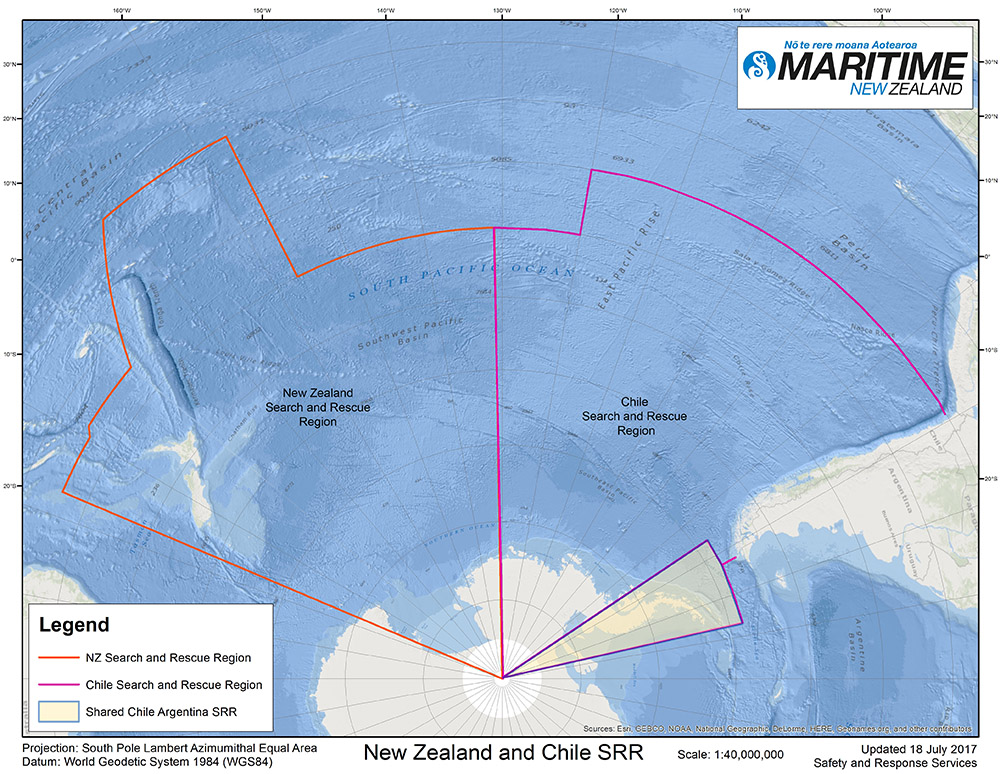
NavalToday reports New Zealand and Chile have concluded an agreement delineating SAR responsibility over an area of roughly 60 million square kilometers that extends all the way to the South Pole and includes area Coast Guard Polar Icebreakers will routinely transit on the way to Antarctica.
Ultimately this may have some impact on territorial claims to Antarctica.






 Chuck Hill's CG Blog