The Era of Coast Guards in the Asia-Pacific is Upon Us–Rand Corp

The Rand Corporation has issued an interesting post regarding the increased use and aggressiveness of Asian Coast Guards. It is based on a study of the Chinese, Japanese, Vietnamese, and Philippine Coast Guards. The full text of the study is here. in pdf format.

The growth of these four Coast Guards has been remarkable. According to the report, between 2010 and 2016 the China Coast Guard vessel tonnage has increased 73%, the Japan Coast Guard increased 50%, the Vietnamese CG by 73%, and the Philippine CG by 100%.

The growth is largely driven by China’s pushiness using its newly formed Coast Guard, but it is also because of Japan’s new willingness to provide security assistance, at least in the form of Coast Guard vessels, to nations who, like them, must confront Chinese aggressiveness.

There also seems to have been a tacit acceptance of the idea that gray hulls should not mix it up with white hulls. This has played into the hands of the Chinese who have by far the largest fleet of white hulls in the world. In fact there are really only two kinds of vessels, private and government, and when fishing vessels act under government orders they are defacto government vessels

The full report has some figures I had not seen before.
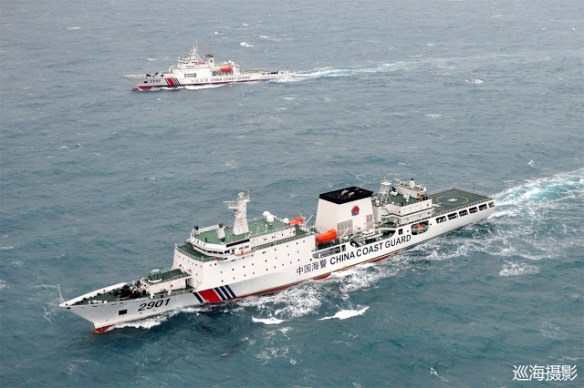
Despite the fact that its missions apparently do not include Aids to Navigation, China’s CG is by far the largest:

“China’s investment has yielded a total fleet size of around 215 vessels, of which 105 are considered large (more than one-thousand-tons displacement) and 110 small (less than one thousand tons). In terms of total tonnage, China boasts the largest coast guard in the world at roughly 190,000 tons, enjoying substantial quantitative overmatch over its Asian competitors.” (The CCG reportedly has 17,000 members.)

Japan Coast Guard had a head start, it has grown less but still has more ships than the USCG.

In terms of fleet size, the U.S. Office of Naval Intelligence estimates that Japan has approximately fifty-three large and twenty-five small vessels in operation. The largest vessels in the JCG fleet include two PLH-class vessels with a displacement of 6,500 tons (9,000 tons fully loaded) and two Mizuho-class vessels of 5,200 tons. For comparison, the largest and most capable destroyers in the JMSDF, the Kongo-class vessels, displace approximately 9,500 tons. Most of the medium-to-high-endurance JCG vessels are equipped with deck-mounted autocannon that range in caliber from 20 to 40 mm, and most JCG officers carry light firearms for self-defense. Notably, the PLH-class cutters are only equipped with two Oerlikon 35–40 mm autocannon and two M61 Vulcan 20 mm six-barrel Gatling-style guns, compared with the 76 mm cannon on China’s largest cutter, Haijing 3901.

In terms of aviation assets, the JCG has by far the largest fleet in Asia, second only to the U.S. Coast Guard in the world, boasting twenty-six fixed-wing aircraft and forty-eight helicopters. Finally, the JCG has roughly 13,500 personnel, second most among coast guards in Asia.

Vietnam has also recently formed a Coast Guard.

The VCG has approximately fifty vessels: five large (the largest displaces 2,500 tons) and forty-five small. Soon after the Haiyang Shiyou 981 (HYSY 981) incident in 2014, Vietnamese prime minister Nguyen Tan Dung announced the allocation of U.S.$540 million to build thirty-two new coast guard ships and hundreds of aluminum fishing vessels that can withstand ramming better. With the delivery of two five-hundred-ton TT400TP-class patrol vessels in January 2016 and the addition of six one-thousand-ton patrol craft pledged from Japan, Vietnam will boast the largest coast guard fleet in Southeast Asia. Most VCG vessels have light-caliber deck-mounted autocannon or machine guns (ranging in size from 14.5 to 23 mm) or both, and most crewmembers carry light firearms for self-defense. The VCG has three fixed-wing CASA C-212 Aviocar patrol aircraft. The VCG has approximately 5,500 total personnel.

The Philippine Coast Guard:

The PCG maintains a small fleet of eight medium-endurance patrol craft, mounted with 50 mm autocannon; four buoy tenders; and roughly thirty-two small patrol vessels. Japan’s announcement that it plans to sell eight medium endurance cutters to the Philippines will mean an almost doubling of the PCG medium-endurance-cutter fleet. The PCG has only two operational aircraft— one fixed wing and one helicopter—but it is slated to receive two helicopters from France within the next few years. Finally, there are roughly 9,000 personnel in the PCG, with plans to expand to 13,500 by 2020.

A final note: 

It is not clear what type of displacement the study used. I try to consistently use full load, but Asian nations tend to try to minimize displacement and frequently report only light displacement.

The total displacement of the US Coast Guard’s ships is also going up, but it is not because of more ships, it is because the ships are larger. The total full load displacement for the program of record, 8 NSCs (36,000 tons), 25 OPCs (about 100,000 tons), and 58 FRCs (21,170 tons) is about 157,170 tons. The NSCs are 50% larger than the 378s. The OPCs are a third larger than the 378s and four times the size of the 210s. The FRCs are three times the size of the 110s they replace.

It might be assumed that a Country’s Coast Guard’s size should be related to the size of the country’s EEZ. It doesn’t seem to have worked that way. The size of the EEZs for the countries is

China: 877,019 km2 (plus disputed claims for 3,000,000 km)

Japan: 4,479,388 km2

Philippines:  2,263,816 km2

Vietnam: 748,875 km2

USA: 11,351,000 km2


Malaysia Builds 6 WPC w/sUAS, 3 Cutter X, and Gets 2 JCG cutters

Malaysia‘s counterpart of the USCG, the Malaysia Maritime Enforcement Agency (MMEA), or APMM in Malay, was formed in 2005 and has approximately 7,000 members.

Malaysia has an EEZ of 334,671 sq km, or about 3% of that of the US. In addition they have a substantial continental shelf of about the same size. The country itself is in two main parts, one on the Malay Peninsula and one part on the island of Barneo. It borders the busiest waterway in the world, the Straits of Malacca.

They have recently begun to replace the vessels incorporated in the service when the agency was formed.

The first new class is the “New Generation Patrol Craft.”

Malaysia's New Generation Patrol Craft.

Malaysia’s New Generation Patrol Craft (NGPC)

It is in many ways similar to the Webber class in size and function. It is a FASSMER design. It is a little smaller (44.5 meters or 146 feet) and a little slower at 24 knots, but it is a bit better armed, having a 30mm gun and it has one trick we do not. It will have a small Unmanned Air System and associated launch and recovery system.

The Malaysian Maritime Enforcement Agency has selected to the Fulmar UAV to equip their NGPC. The Fulmar is similar in most respects to the ScanEagle.

Aerovision Fulmar UAV, 5 May 2008, by Txema1

Aerovision Fulmar UAV, 5 May 2008, by Txema1

MalaysianDefence reports they expect to build three Offshore Patrol Vessels, at least 80 meters in length.  The RM740 Million reported allocated equates to about $167M each .

Reportedly the new OPVs will be a version of the Damen 1800 (ton) design (similar to those being built for South Africa, but with a conventional bow) 83 meters (272 feet) in length and 22 knots from 4×2350 kW diesels providing 12,600 HP.

Damen 1800 OPV, from the rear.

Damen OPV 1800 Concept Illustration

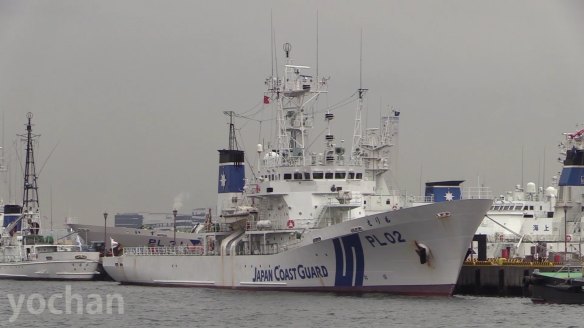
As part of their effort to build capacity among their neighbors, the Japanese are transfering two Japan Coast Guard cutters to the MMEA. The first of these, Erimo (PL-02) is, by USCG standards, still young, having entered service in 1991. She is 91.4 meters in length over all, 2,006 tons full load and capable of 20 knots with a crew of 38. The second ship wll be of the same class.

Japan CG Cutter Erimo (PL-02)

Japan CG Cutter Erimo (PL-02)

References:


UAE’s New, and very well Armed OPV

UAE offshore patrol vessel Arialah

UAE offshore patrol vessel Arialah (note the concept above is incorrect in that the gun is a BAE 57mm rather than the 76mm illustrated).

DefenseNews reports first impressions of a new Offshore Patrol Vessel (OPV) built for UAE’s Critical Infrastructure and Coastal Protection Agency (CICPA) shown at the NAVDEX (naval) portion of the IDEX international Defense Exposition in Abu Dhabi.

The ships are 67 meters (220 feet) in length, 11 meters (36 feet) of beam, and 5.4 meters (18 feet) of draft, with a speed of 20+ knots provided by four MTU engines driving four propellers.

Most of the armament is typical OPV, a 57 mm gun and two 30mm auto-cannon in remote weapon stations. What really sets it apart, is the Mk49 Rolling Airframe Missile launcher.

On the other hand, the UAE is just across the Straits of Hormuz from Iran and their shore based anti-ship cruise missiles.

https://i0.wp.com/upload.wikimedia.org/wikipedia/commons/2/2c/RIM-116_Rolling_Airframe_Missile_Launcher_3.jpg

Photo: Mk49 guided missile launch system for Rolling Airframe Missile

An earlier post provides a bit more detail on the program but it appears to have a couple of errors regarding the weapon systems (indicates a 76mm as seen in the first illustration vice 57mm and says the Mk49 launcher has 11 cells rather than the actual 21). There are to be two of this class, both to be delivered this year.

“The ships themselves will be delivered from Damen’s Galati shipyard in Romania in 2017; they will then go to ADSB’s facility in Abu Dhabi’s Mussafah industrial area for combat systems installation and integration prior to delivery to the CICPA.”

This looks like a straight forward adaptation of one of Damen’s designs for Offshore Industry Support Vessels with boats, helo deck, ESM/ECM, weapons and sensors added.

According to this older source, the Coast Guard was involved in the development of the SEA AXE Bow.

“Damen … has developed the sea axe bow design in partnership with the University of Delft, Royal Netherlands Navy, US Coast Guard and the Maritime Research Institute Netherlands.”

USCG in Packistani Naval Exercise?

USS Hurricane (PC-3)

USS Hurricane (PC-3)

Interesting note from the German Navy Blog, “Marine Forum”

“10 February, PAKISTAN, Opening ceremony in Karachi for Pakistan-hosted multinational naval exercise „Aman 2017“ … until 14 Feb, three phases in and off Karachi: in-port, at-sea maritime, anti-terror (special forces/naval infantry) … participants from 37 countries, 9 of which with naval units … 24th Chinese task group (destroyer „Harbin“, frigate „Handan“, replenishment ship „Dongpinghu“), Russian Northern Fleet task group (destroyer „Severomorsk“, tanker „Dubna“, salvage tug „Altay“), USA with patrol boat „Typhoon“, AKE „Amelia Earhart“ plus two USCG vessels (emphasis applied–Chuck) … frigate „Arunta“ (Australia), frigate „Sultan Iskandar Muda“ (Indonesia), OPV „Samudra“ (Sri Lanka), frigate „Gelibolu“ (Turkey), destroyer „Daring“ (UK) … and, of course, hosting Pakistan Navy”

I can only think that since the Navy PC “Typhoon” is there, the two USCG vessels might be 110s out of Bahrain. Kind of surprising we have not seen any press releases on this.

110 foot WPB USCGC Jefferson Island

110 foot WPB USCGC Jefferson Island

Breaking Defense Interviews the Commandant

Coast Guard Commandant Adm. Paul Zukunft (right) meets with then-Southern Command chief Gen. John Kelly, now Trump’s nominee for Secretary of Homeland Security.

Coast Guard Commandant Adm. Paul Zukunft (right) meets with then-Southern Command chief Gen. John Kelly, now Trump’s nominee for Secretary of Homeland Security.

Breaking Defense’s Robbin Laird has an Interview with the Commandant and speculates on the prospects for the Coast Guard under the new administration and DHS selectee General John Kelly.

Trump, Kelly, & The Coast Guard: Exclusive Interview With Adm. Zukunft

Its a good one, and even the comments are worth reading. There is much of the same we have heard before. The Commandant has a clear and consistant message and agenda, but there is more detail about a possible role in the far Western Pacific.

“I have discussed with the CNO (Chief of Naval Operations Adm. John Richardson, the senior officer in the Navy) the concept that we would create a permanent USCG presence in the South China Sea and related areas,” Zukunft said. “This would allow us to expand our working relationship with Vietnam, the Philippines, and Japan. We can spearhead work with allies on freedom of navigation exercises as well.”

This is the first time I have seen the phrase “permanent USCG presence in the South China Sea and related areas.” Does that mean we will have a CG patrol squadron working out of Sinagpore or Okinawa (or Cam Ranh Bay), like the one in Bahrain? Or are we just looking at the Webber class WPCs we already know are going to Guam? (Must be more to it than that.) I do think we should put some OPCs in Guam, if only to patrol the EEZ in the Western Pacific.

Until recently we might have considered the possibility of basing in the Philippines, but that no longer looks like a possibility.

What ever you may think of the incoming administration, for the Coast Guard at least, it looks promising.

Thanks to Luke for bringing this to my attention. 

Philippines/China to form Joint Coast Guard Committee

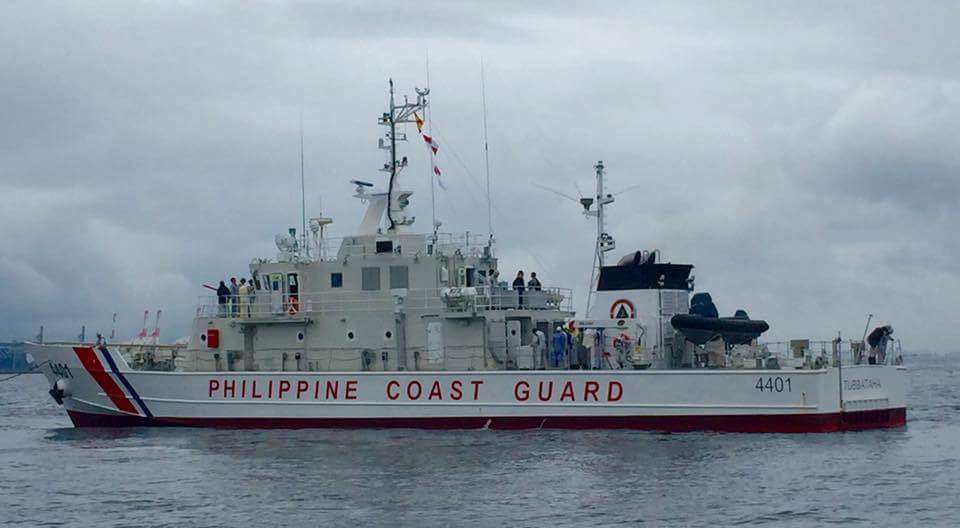
BRP Tubbataha during its delivery to the Philippine Coast Guard, Philippine CG PAO photo

BRP Tubbataha during its delivery to the Philippine Coast Guard, Philippine CG PAO photo

The Diplomat is reporting, that China and the Philippines will be forming a Joint Coast Guard Committee on Maritime Cooperation,

“Substance-wise, according to the joint statement released by both sides, the coast guards “had a friendly exchange of views” on the establishment of the JCGC, getting down to the specifics of the entity including its organizational structure, terms of reference, and operational procedures, as well as potential areas of collaboration such as marine environmental protection, maritime search and rescue, combating maritime crimes including drug trafficking, and, most interestingly, “capacity-building in related areas.” Following these discussions, both sides aim to hold a second organizational meeting as well as the inaugural meeting of the JCGC in February 2017.”

China Seizes US Unmanned Underwater Vehicle

lbs-glidersystem

A U.S. Navy glider similar to one seized by Chinese forces. US Navy Photooceanglider

The US Naval Institute News Service is reporting,

“A U.S. Navy unmanned buoyancy glider was taken by Chinese forces in international waters earlier this week, two defense officials confirmed to USNI News on Friday.

“The glider was operating with U.S. Military Sealift Command ship USNS Bowditch (T-AGS-62) about 50 miles off of Subic Bay in the Philippines when a People’s Liberation Army Navy ship took the glider both defense officials said.”

Perhaps this will prompt some rethink on the Anti-Submarine Warfare Continuous Trail Unmanned Vehicle, or ACTUV. Maybe a self destruct option is in order.

Coast Guard Bound for the South China Sea?

South China Sea claims map by Voice of America, 31 July, 2012

South China Sea claims map by Voice of America, 31 July, 2012

The Voice of America is reporting,

The top U.S. Coast Guard official is eyeing a unique role for his fleet in maintaining peace and stability in the East and the South China seas under the incoming presidential administration.

By mirroring the role of China’s Coast Guard in parts of the Asia-Pacific, said Coast Guard Commandant Admiral Paul Zukunft, the U.S. Coast Guard could be the face of U.S. military presence in disputed waters without appearing too threatening.

“When you look at the East and South China seas, look at China’s Coast Guard, it is really the first face of China,” he told VOA. “So I’ve proposed to the Department of Defense that if they were to leverage the U.S. Coast Guard, I would look at providing resources to provide the face of the United States behind a Coast Guard ship, and should that be a consideration for our approach to the East and South China seas with the next administration.”

The post has more background.

This is a major change to Coast Guard tasking and there should be no doubt it will require some trade-off against existing tasking. In all probability our contribution will be a National Security Cutter. Keeping one in the Western Pacific probably means one less in the Eastern Pacific.

Perhaps the Navy will compensate by putting a ship under SOUTHCOM.

Thanks to Luke S. for bringing this to my attention. 

S. Korean CG Fires on Chinese F/Vs

This is one of numerous reports that the South Korean Coast Guard has fired into Chinese fishing vessels as a result of increasingly aggressive and non-compliant behavior.

Apparently the S. Korean CG seized two Chinese F/V but other Chinese vessels attempted to free them by ramming the S. Korean vessels. Apparently there were no deaths or injuries as a result of the machinegun fire.

The China, of course, objected to the use of force.

China Acknowledges Building Cutter to be Upgraded to Frigate in Crisis

type818ccgc

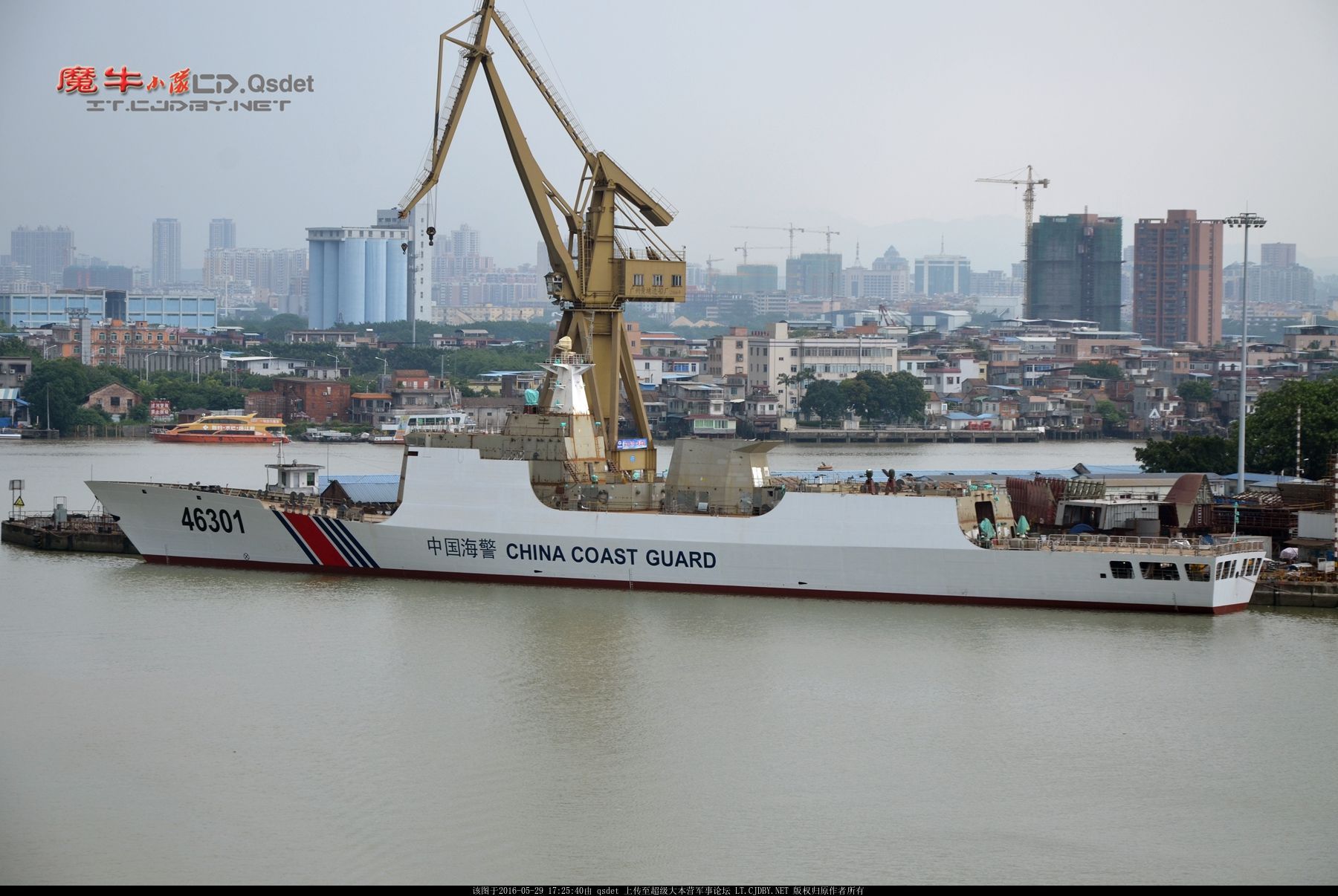
The National Interest reports that the Chinese have openly acknowledged that their newest Coast Guard cutter is being built with provision for upgrading to frigate status should a need arise.

Moreover they were apparently influenced by the example of the USCG during WWII.

In the same issue of this magazine, published by the major Chinese shipbuilding conglomerate China State Shipbuilding Corporation (CSSC), builder of the Type 818, there is not coincidentally a very detailed article about U.S. Coast Guard cutters in combat during the Second World War. That article explains that both USCGC Campbell and also USCGC Spencer were able to sink German U-boats (U-606 and U-175 respectively) during the pivotal Battle of the Atlantic. Most of the article examines the operations of 10 American USCG cutters that were 76.2 meters in length and built between 1928 and 1932. These ships were transferred to the hard pressed Royal Navy (RN) during 1941-42 and achieved an enviable war record in RN service, sinking both U-522 and U-954 – the latter with Germany Navy Commander Karl Donitz’s son aboard. The analysis notes that, according to UK naval records, the American cutters were viewed so favorably as to be rated as “surpassing each kind of comparable British designed frigate.” These ships are labeled as an “ideal anti-submarine escort ship” [理想的反潜护航舰] and the implications for the CCG going forward are obvious.

They actually sold the cutters a bit short. The 327s actually sank at least three and probably four U-boats and the ten 76.2 meter cutters, the 250 foot Lake Class, sank three submarines (two U-boats and an Italian). Six subs sunk by 17 ships may not sound particularly impressive, but in fact by comparison, it was spectacular.

The new Type 818 cutters are based on the Type 054 frigates. Its not too much of a stretch to expect them to be upgunned with the same weapons found on the “parent craft,” but if the time ever comes, there may be better systems available for upgrading the cutters or they might be given different capabilities to support emerging missions. That can be an advantage of having ships with unused upgadability.

The Type 054 are only slightly smaller than the Bertholf class, displacement 4,053 tons full load, length 134.1 m (440 ft), beam 16 m (52 ft), 30,400 HP, 27 knots, compared to the Bertholf’s 4,500 tons, 127.4 m (418 ft), 16.46 m (54 ft), 49,875 HP, and 28 knots. They actually appear to be the same size as the Offshore Patrol Cutters, but their design leans more toward higher speed. Their range is not as great as the OPC at about 8,000 miles compared to the OPCs’ 10,200, but it is a greater range than USN frigates enjoyed.

The Chinese have learned a lesson from USCG experience in World War II. I wonder if it is a lesson we may have forgotten.

Thanks to Luke for bringing this to my attention.