“Coast Guard Will Get A New MH-60 Variant To Replace MH-65 Helicopters” –The War Zone

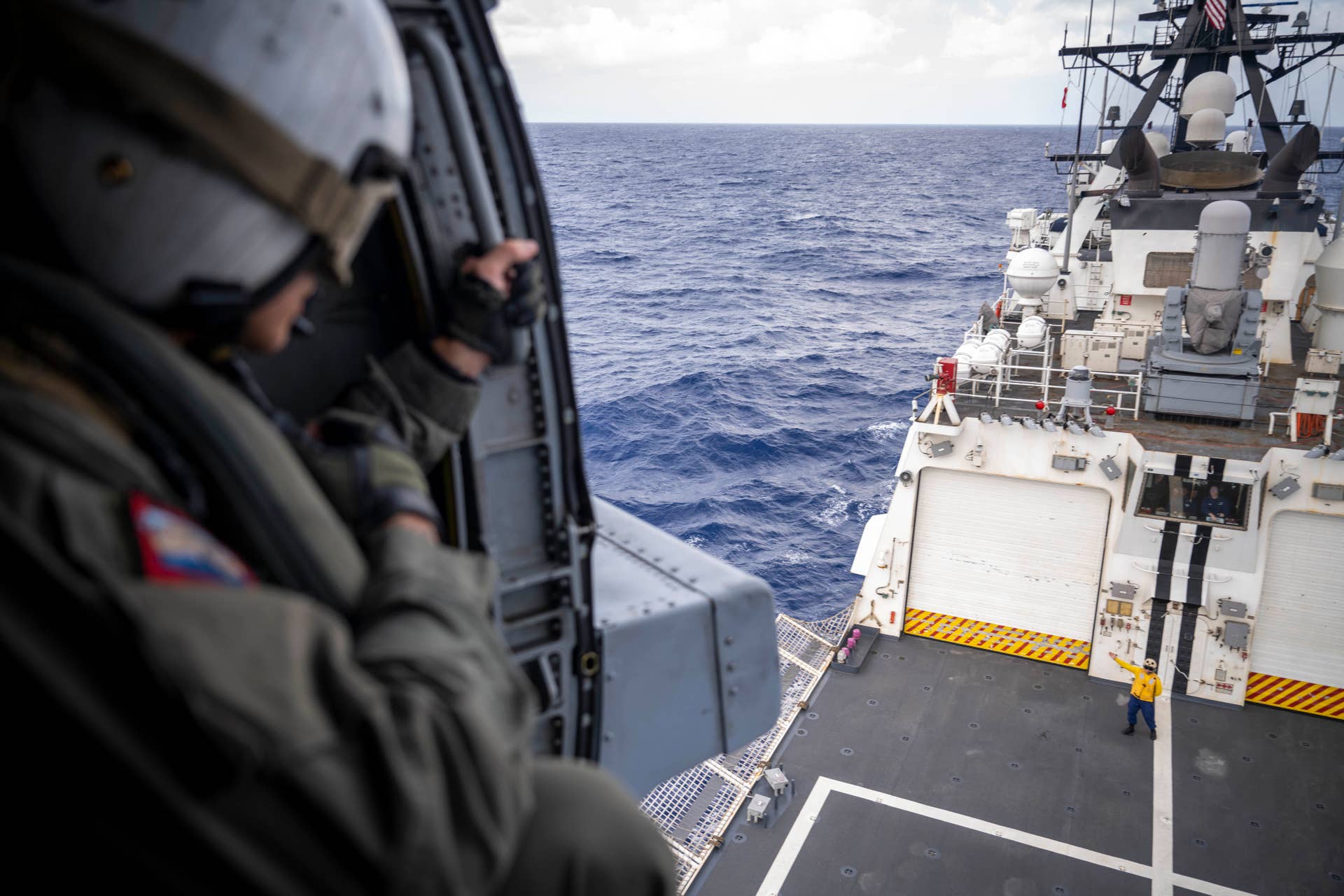
PACIFIC OCEAN (July 30, 2022) U.S. Navy Petty Officer 1st Class Humberto Alba, a naval aircrewman tactical-helicopter, attached to Helicopter Maritime Strike Squadron (HSM) 37, deployed on U.S. Coast Guard Legend-class cutter USCGC Midgett (WMSL 757), looks down at a USCGC crewmember after taking off during flight operations during Rim of the Pacific (RIMPAC) 2022. (U.S. Coast Guard photo by Petty Officer 3rd Class Taylor Bacon)

The War Zone reports,

The U.S. Coast Guard is in line to get a new version of the H-60 helicopter based on the MH-60R Seahawk, which is in service with the U.S. Navy and other armed forces globally. The additional helicopters will supplement, at least initially, the Coast Guard’s aging MH-60T Jayhawks. The Coast Guard also plans to boost its overall capabilities by replacing its fleet of smaller MH-65s with H-60 variants.

Earlier this week, Naval Air Systems Command (NAVAIR) put out a contracting notice announcing its intent to award Lockheed Martin Rotary and Mission Systems a sole-source deal to design and produce an unspecified number of “MH-60R variant aircraft for the United States Coast Guard.”

The Contracting notice makes no commitment as to the numbers involved. One thing is clear. The Coast Guard is still also adding MH-60Ts so we are going to have a mixed fleet.

So how many of the new type, and how much of the Navy’s mission equipment will be retained? Will they be used much as the MH-60T or will they replace only the H-65s that provide air borne use of force (I can’t remember ever seeing a MH-60T deployed on a cutter for a drug enforcement patrol).

They could just not install any of the ASW and ASuW equipment. That would reduce weight and provide more interior room. It has a highly regarded radar that would be very useful for drug interdiction.

I think it is interesting that they chose the “Romeo” version rather than the MH-60S. The closely related MH-60S is the Navy’s combat search and rescue aircraft, but he MH-60S does not have radar that the “Romeo” has.

Probably not, but could this be a step in bringing back an ASW mission for the Coast Guard? In addition to operating from cutters, there is probably a good case to be made for giving Coast Guard Air Stations an ASW capability to keep submarines from being able to concentrate near US ports. Then we might actually guard the coast. Sorry, I couldn’t help myself.

“MQ-9B SeaGuardian Showcased at RIMPAC 2024” –News Release

An MQ-9 Sea Guardian unmanned maritime surveillance aircraft system flies over the Pacific Ocean during U.S. Pacific Fleet’s Unmanned Systems Integrated Battle Problem (UxS IBP) 21, April 21. UxS IBP 21 integrates manned and unmanned capabilities into challenging operational scenarios to generate warfighting advantages. US Navy Photo

The Coast Guard has an unfilled requirement for a shore based Uncrewed Air System (UAS) to provide Maritime Domain Awareness.

Below is a news release from General Atomics Aeronautical Systems, Inc.

Reading the news release, I see the system incorporated an “integrated Minotaur Mission System.” Minotaur is a system currently being installed on all Coast Guard fixed wing search aircraft as well as US Navy and Marine Corps platforms. It went on to say “For RIMPAC, the MQ-9B effectively passed ISR&T (Intelligence, surveillance, reconnaissance, and targeting–Chuck) information to various surface and air units, such as the Nimitz-class carrier USS Carl Vinson, Guided Missile Destroyers (DDGs), Littoral Combat Ships (LCS), frigates, patrol boats, P-8s, P-3s, and numerous other U.S. and foreign units that took part in the exercise.” Could that have included Midgett and her task force? The use of the MQ-9B to drop sonobuoys for the task force and their embarked ASW helicopters would have been an interesting experiment.


GA-ASI’s MQ-9B SeaGuardian® Showcased at RIMPAC 2024

Sonobuoy Dispensing System and LRASM Among the New Capabilities Featured

SAN DIEGO – 14 August 2024 – With the completion of the U.S. Navy’s Rim of the Pacific (RIMPAC) flight operations on July 28, 2024, the MQ-9B SeaGuardian® Unmanned Aircraft System (UAS) supplied by General Atomics Aeronautical Systems, Inc., self-deployed back to its home base in El Mirage, Calif., but only after introducing an array of new capabilities. The flight home followed close to 100 flight hours supporting RIMPAC 2024 over the four-week exercise in and around the Hawaiian Islands.

RIMPAC is the world’s largest international maritime exercise. RIMPAC 2024 featured 29 nations, 40 surface ships, three submarines, 14 national land forces, more than 150 aircraft, and 25,000 personnel.

SeaGuardian provided real-time Intelligence, Surveillance, and Reconnaissance (ISR) data feeds to the U.S. Pacific Fleet Command Center using Signals Intelligence (SIGINT) parametrics and full-motion video to the watch floor and intelligence centers for real-time dynamic tasking — just as it did for the RIMPAC 2022 exercise. This year, SeaGuardian delivered some new features and capabilities, including Long Range Anti-Ship Missile (LRASM) targeting and a new Sonobuoy Dispensing System (SDS) to support its Anti-Submarine Warfare capability. SeaGuardian was configured with a prototype SDS pod capable of deploying 10 A-size sonobuoys per pod (SeaGuardian can carry up to four SDS pods or up to 40 sonobuoys) and the SeaVue Multi-role radar from Raytheon, an RTX business. Upon dispensing, the sonobuoys were successfully monitored and controlled by the SeaGuardian’s onboard Sonobuoy Monitoring and Control System (SMCS).

SeaGuardian is a maritime derivative of the MQ-9B SkyGuardian® and remains the first UAS that offers multi-domain Intelligence, Surveillance, Reconnaissance, and Targeting (ISR&T) as an internal payload that can search the ocean’s surface and depths in support of Fleet Operations. At RIMPAC 2024, SeaGuardian showcased all operational payloads, which includes the SeaVue, SNC’s Electronic Support Measures (ESM) solution, an Automatic Identification System (AIS), and a self-contained Anti-Submarine Warfare (ASW) system.

SeaGuardian’s multi-domain capabilities allow it to flex from mission to mission and pass real-time sensor data directly to the Fleet. For RIMPAC 2024, SeaGuardian added Link 16 Joint Range Extension Application Protocol (JREAP) “C” (internet protocol) and an integrated Minotaur Mission System to provide real-time sensor data for the various Maritime Operations Centers, ships, and aircraft with Minotaur nodes.

“For RIMPAC, the MQ-9B effectively passed ISR&T information to various surface and air units, such as the Nimitz-class carrier USS Carl Vinson, Guided Missile Destroyers (DDGs), Littoral Combat Ships (LCS), frigates, patrol boats, P-8s, P-3s, and numerous other U.S. and foreign units that took part in the exercise,” said GA-ASI President David R. Alexander.

On July 31, 2024, SeaGuardian self-deployed back to GA-ASI’s Desert Horizon Flight Operations Facility in El Mirage, Calif.

About GA-ASI

General Atomics Aeronautical Systems, Inc. (GA-ASI), an affiliate of General Atomics, is a leading designer and manufacturer of proven, reliable RPA systems, radars, and electro-optic and related mission systems, including the Predator® RPA series and the Lynx® Multi-mode Radar. With more than eight million flight hours, GA-ASI provides long-endurance, mission-capable aircraft with integrated sensor and data link systems required to deliver persistent situational awareness. The company also produces a variety of sensor control/image analysis software, offers pilot training and support services, and develops meta-material antennas.

For more information, visit www.ga-asi.com     

Avenger, Lynx, Predator, SeaGuardian, and SkyGuardian are registered trademarks of General Atomics Aeronautical Systems, Inc.


“Navy To Explore Arming Other Ships With Missiles Amid Constellation Frigate Woes” –Coast Guard, Raise Your Hand

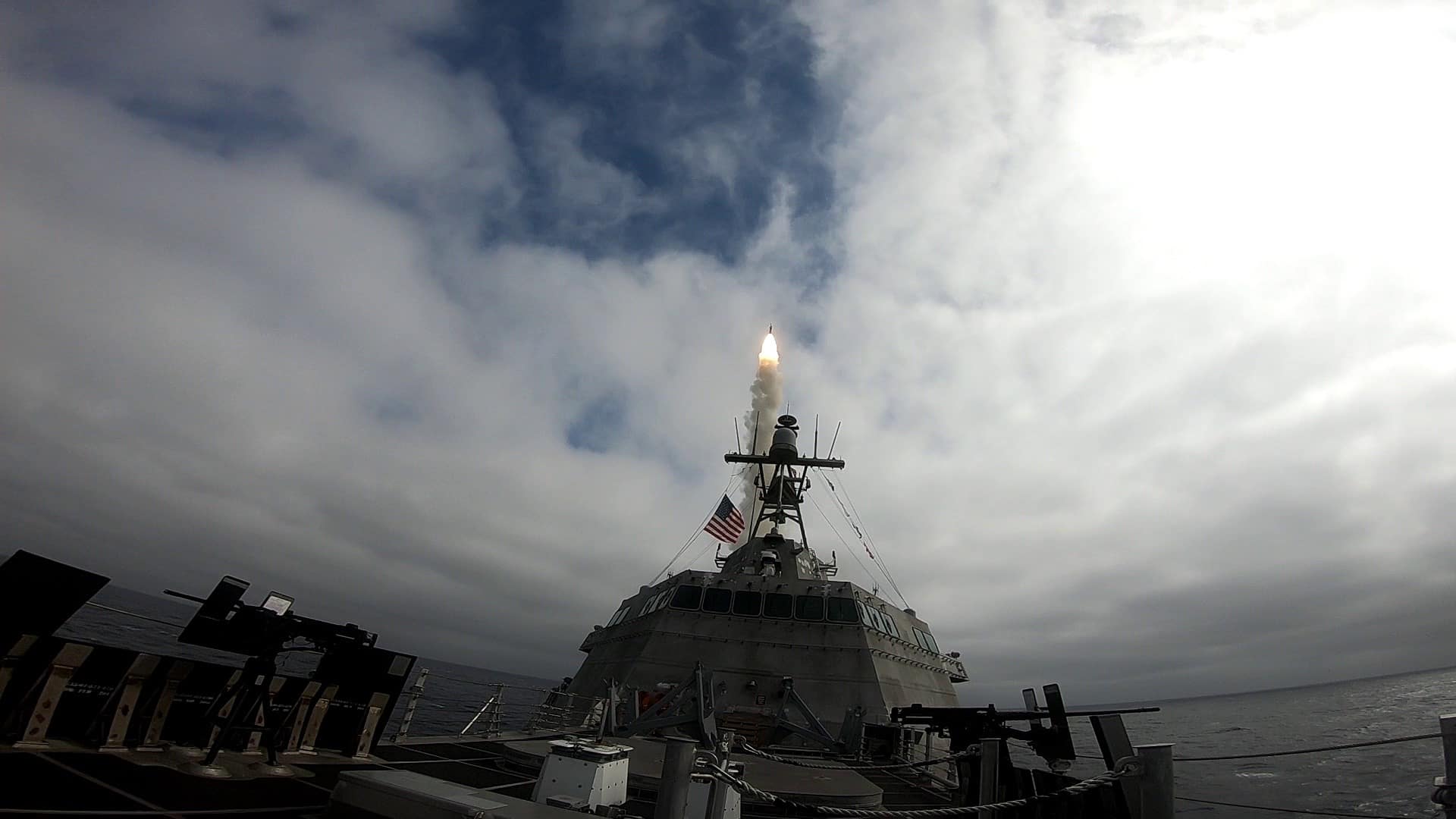
USS Savannah (LCS 28) conducts a live-fire demonstration in the Eastern Pacific Ocean utilizing a containerized launching system that fired an SM-6 missile from the ship at a designated target. 

The War Zone reports,

“Congress has demanded the U.S. Navy look into buying a new class of small warships loaded with missiles or adding bolt-on launchers to existing vessels…to help increase its combat capacity. Lawmakers ordered the study in response to major delays in work on the Navy’s future Constellation class frigates…”

The problem is simple. The Navy has been shrinking. Without a replacement in sight, they are rapidly decommissioning cruisers, each of which has 122 Vertical Launch Missile (VLS) tubes and eight Harpoon missile launch tubes. New DDGs, equipped with 96 VLS cells are coming online slowly and the new class of frigates, each of which has 32 VLS and 16 launchers for Naval Strike Missiles are long delayed and will also come out slowly.

Put simply, too few ships, with too few launch tubes.

It has been frequently proposed that missiles be mounted on Navy auxiliary ships. This is not likely to happen. These ships are not even armed for self-defense, beyond occasional crew served machinegun mounts. Most are limited to 20 knots, and they are busy scuttling supplies.

Few of the Navy’s MSC civilian manned auxiliary ships, are as well equipped for fitting into a Surface Action Group as the ten (soon to be eleven) National Security Cutters, with their higher speed, secure communication systems, data links, and Sensitive Compartmented Information Facility (SCIF). The Offshore Patrol Cutters will be only slightly less appropriate for the role.

The Coast Guard alone can’t fix this problem, but the Coast Guard can certainly help. It may not be necessary to mount missile launchers all the time. The Navy could build kits that could be quickly mounted on cutters. There are at least two options already available:

The Navy has already demonstrated use of the Mk70 containerized missile launcher on the flight deck of a Littoral Combat Ship.

The cutters would probably need a cooperative engagement capability (CEC), but that is probably also true of other platforms that might be used.

Each cutter could carry three or four containerized systems providing 12 or 16 launch tubes. Mk41 VLS mounted forward of the bridge, either conventionally or as Adaptable Deck Launchers could add eight more. Upon mobilization, there is potential for Navy or Marine Reservist to augment the cutter crews and operate the missile systems.

USS Savannah (LCS 28) Independence-variant littoral combat ship leaving San Diego with a U.S. Army MK 70 missile launcher on its deck – September 18, 2023. Photo Credit: WarshipCam.

“Pakistan’s New OPV – PNS Yarmook – Is At NAVDEX 2023” –Naval News

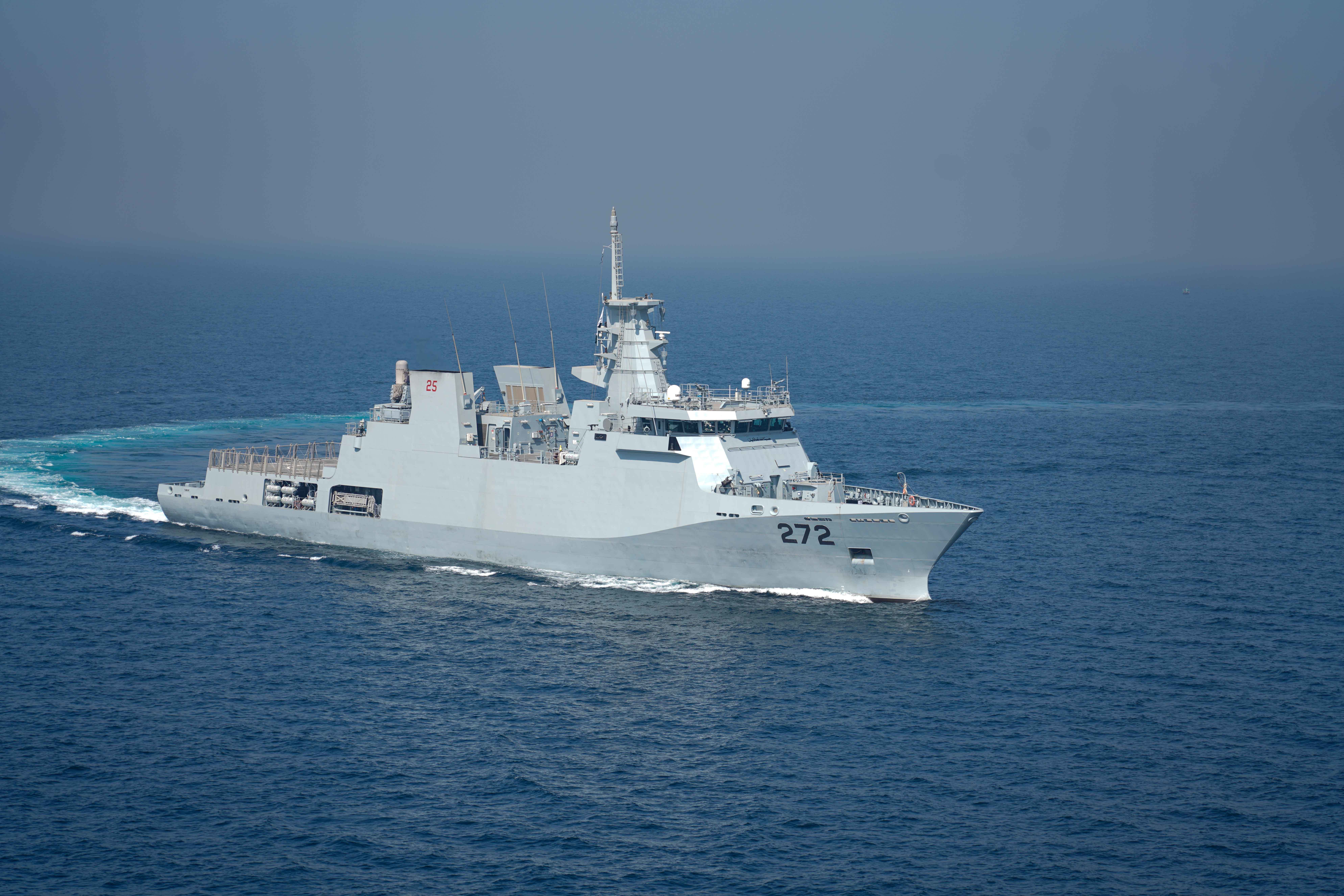
Sister ship: GULF OF OMAN (Nov. 11, 2021) Pakistani corvette PNS Tabuk sails alongside amphibious dock landing ship USS Pearl Harbor (LSD 52) during a passing exercise in the Gulf of Oman, Nov. 11, 2021. (U.S. Navy photo by Mass Communication Specialist 3rd Class Sang Kim)

Naval News reports on a tour of a recently completed Damen designed Offshore Patrol Vessel. The vessel itself, PNS Yarmook (271), is a very typical modern OPV. What is not typical is the way it is being armed.

A medium caliber gun (57-76mm) and a pair of auto-cannon (20-30mm) seems to be the norm. Instead, it is to be a 30 mm Aselsan SMASH remote weapon station, two Aselsan STAMP remote weapon systems, (presumably with .50 cal. machine guns) and a Phalanx Block 1B close-in weapon system, and eight Harbah sub-sonic, anti-ship cruise missiles (ASCM) with land attack capability. This missile, at 1350 kg, is about twice as large as Harpoon (1523 lbs / 691 kg) and 50 kg or 110 pounds heavier than the Tomahawk. It is more than three times larger than Naval Strike Missile.

Pakistan is building another, slightly larger class of OPVs. Presumably, they will also be armed with ASCM. These, like the Yarmook class, are being built by the Damen yard in Galati, Romania.

“Hellfire Missile With Roughly Three Times More Range Tested…” –The Drive

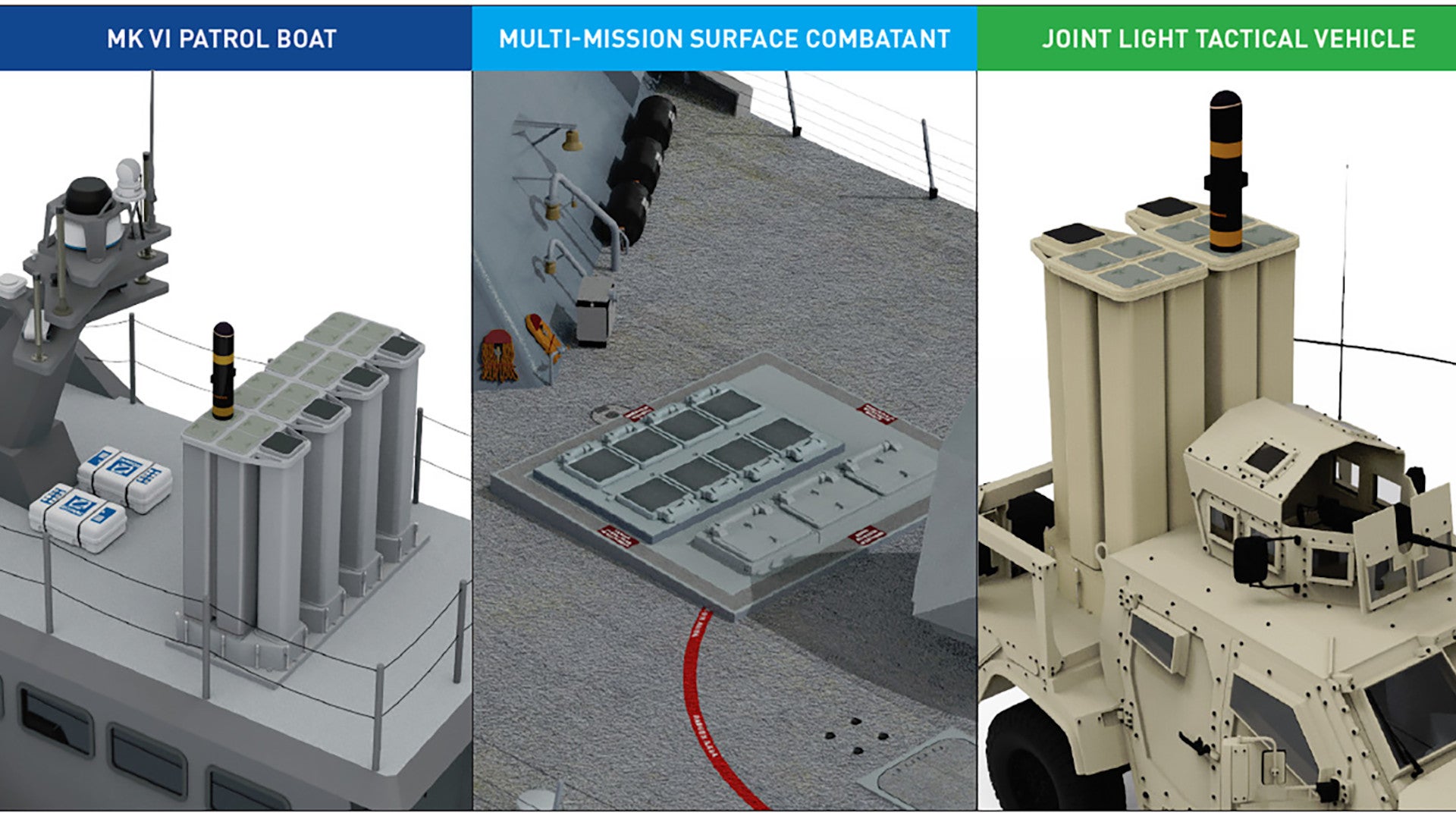
New Lockheed Hellfire/JASM launcher discussed earlier

The Drive reports an exercise that claimed to employ an enhanced version of Hellfire with a range about three times as great as that of the previous versions. Hellfire’s replacement, JASM, perhaps more accurately an upgraded Hellfire, has now been approved for full rate production and there have been reports that a longer range version was in the works.

Beyond the air-launched advantages, this missile would be hugely beneficial for sea-launched applications, such as the LCS. Beyond that, it could be extremely beneficial in servicing Hellfire’s growing surface-to-air role, as well.

Since the typically reported surface to surface range of the Hellfire is 8 km, three times that would be 24 km or over 26,000 yards (equal to the longest ranged battleship hit in WWII). In most cases, that means it can reach anything within the visual horizon. It would also mean, it would out range our 57 and 76mm guns. If this longer ranged Hellfire/JASM is mounted on the new 30 mm Mk38 Mod4, it could mean even Polar Security Cutters will have a potentially more potent weapon than the 57mm Mk110, with a much smaller footprint and lower maintenance requirements.

The weapon would certainly be a welcomed addition to the Webber class patrol craft of PATFORSWA because it would give them greatly enhanced capability against swarming small inshore attack craft, helicopters, and UAS, threats common in their operating area.

As I noted earlier, JASM could provide Coast Guard vessels as small as patrol boats, with a much more accurate, more powerful, and longer ranged response to the need to be able to forcibly stop vessels both small and large, while also providing counter UAS, a degree of anti-aircraft protection, and should it ever be required, a naval fire support ashore capability.

Why Did USCGC Midgett Embark an ASW Helicopter For RIMPAC 2022?

PACIFIC OCEAN (July 30, 2022) U.S. Navy Petty Officer 1st Class Humberto Alba, a naval aircrewman tactical-helicopter, attached to Helicopter Maritime Strike Squadron (HSM) 37, deployed on U.S. Coast Guard Legend-class cutter USCGC Midgett (WMSL 757), looks down at a USCGC crewmember after taking off during flight operations during Rim of the Pacific (RIMPAC) 2022. (U.S. Coast Guard photo by Petty Officer 3rd Class Taylor Bacon)

The Drive reported on Cutter Midgett’s participation in RIMPAC 2022 with a look at flying Navy MH-60R ASW helicopters from the National Security Cutters. I wanted to talk about why this might have been done, but first let’s clarify something.

This and other reports may have left the impression that a Coast Guard Officer leading a task force at RIMPAC was a first and that it was the first time a Navy H-60 had flown from an NSC. Neither is not really the case.

  • During RIMPAC 2020, USCGC Munro embarked a Navy MH-60S, the surface warfare and logistics counterpart to the MH-60R. It is not clear if they ever hangared it.
  • Reportedly USCGC Bertholf headed a Task Force during RIMPAC2018.
  • In RIMPAC 2014 USCGC Waesche also headed a task force. “The maritime interdiction operation involving the Chinese destroyer, frigate and oiler was referenced in December by the Navy as being under the Coast Guard cutter Waesche and including two Royal Brunei Navy ships, a French frigate, a U.S. frigate and the Pearl Harbor-based cruiser USS Port Royal.”

Since NSCs are skippered by Captains, while the US Navy and our allies captain Burke class DDGs and similar ships with commanders, it is not uncommon for the Coast Guard commanding officer to be the senior officer among the captains of a group ships, if there is no commodore assigned. So, frequently, the Coast Guard CO is task force commander by default. This happened to 327 skippers early in WWII as well. For a period, Spencer’s CO was an escort group commander until the Navy assigned a Commodore. Fortunately Spencer got some good training allowing her to sink two of the less than 40 U-boats sunk by US surface ships.

So what was the reason an ASW helicopter was embarked on Midgett? The Coast Guard’s motivation and the Navy’s?

Could be as simple as because they could, but I don’t think so. Both services expected to get something out of this.

Interoperability is always nice, so Navy helo on CG cutter allows both to get some training. Still think there must be more to it than that.

The Navy wants to more widely distribute their forces so this might have been something of a dry run to see what they could do in terms of command and control from a Frigate sized ship and crew.

For the Coast Guard, it could have been an opportunity to get used to operating an H-60 with folding tail from a Bertholf class. It was certainly a rare opportunity to exercise LINK 16. We might have wanted to find out if a system included in the MH-60R should also be included in Coast Guard H-60s.

Or it might have been a first small step toward reviving a Coast Guard ASW mission. Unless the National Security Cutters could operate an ASW helicopter there would be no point in trying to add an additional ASW capability such as a towed array. Confirming ship/helo compatibility would be a first step, along with identifying what changes might be necessary to provide for the helicopters’ additonal needs for weapons, sonobuoys, etc.

Maybe Supporting MH-60R helicopters is reason enough

The US Navy has alot of H-60s. The numbers I have seen are 237 MH-60S (the surface warfare and logistics type) and 291 MH-60Rs (the multi-mission/ASW type). It is probably a bit less than that now, but about 500 plus the MQ-8 helicopter drones that they will also want to take to sea.

The Navy obviously does not have as many ships capable of hosting H-60s as they would like. Every US Navy surface combatant commissioned in the 21st century (DDG and LCS–there have been no cruisers or frigates) has had the capability to hangar two H-60s, and the planned FFGs will have this capability as well.

Navy requirements seem to be always changing,

  • The proposed 355 ship navy included 104 large surface combatants (cruisers and destroyers) plus 52 small surface combatants (frigates and LCS).
  • The latest from July 2022 calls for 96 large and 56 small.

Let’s say a minimum of 116 ASW capable escorts, probably about 120. Right now they have about 90 with no ASW capable LCS, 22 cruisers all now 22 to 36 years old (five of which are slated for retirement in the current budget), and about 70 Burke class DDGs of which 13 will reach 30 years old by the end of 2025 while the first FFG is not expected until 2026. Clearly the number is ASW capable escorts is unlikely to increase significantly any time soon and number may actually decline.

So how many MH-80R/MQ-8 spots are there?

The ten carriers typically host about six MH-60R. The cruisers and Burke class flight IIA and III have two each, but 28 of the Burke class DDGs (Flights I and II), almost a third of our large surface combatants, have flight decks and LAMPS ASW electronics, but no hangar. So roughly 72 ships with 204 spots. Eleven National Security Cutters would provide 22 additional spots, about a 11% increase. The Offshore Patrol Cutters protentially offer another 25 spots about 12% more.

With the Navy hoping to more widely distribute their surface combatants, rather than keeping them firmly attached to a carrier, a couple of additional MH-60Rs could substantially improve ASW capabilities of a small surface action group (SAG).


“Taiwan’s Coast Guard Tests Its Ability To Turn Cutters Into Ship Killers” –The Drive

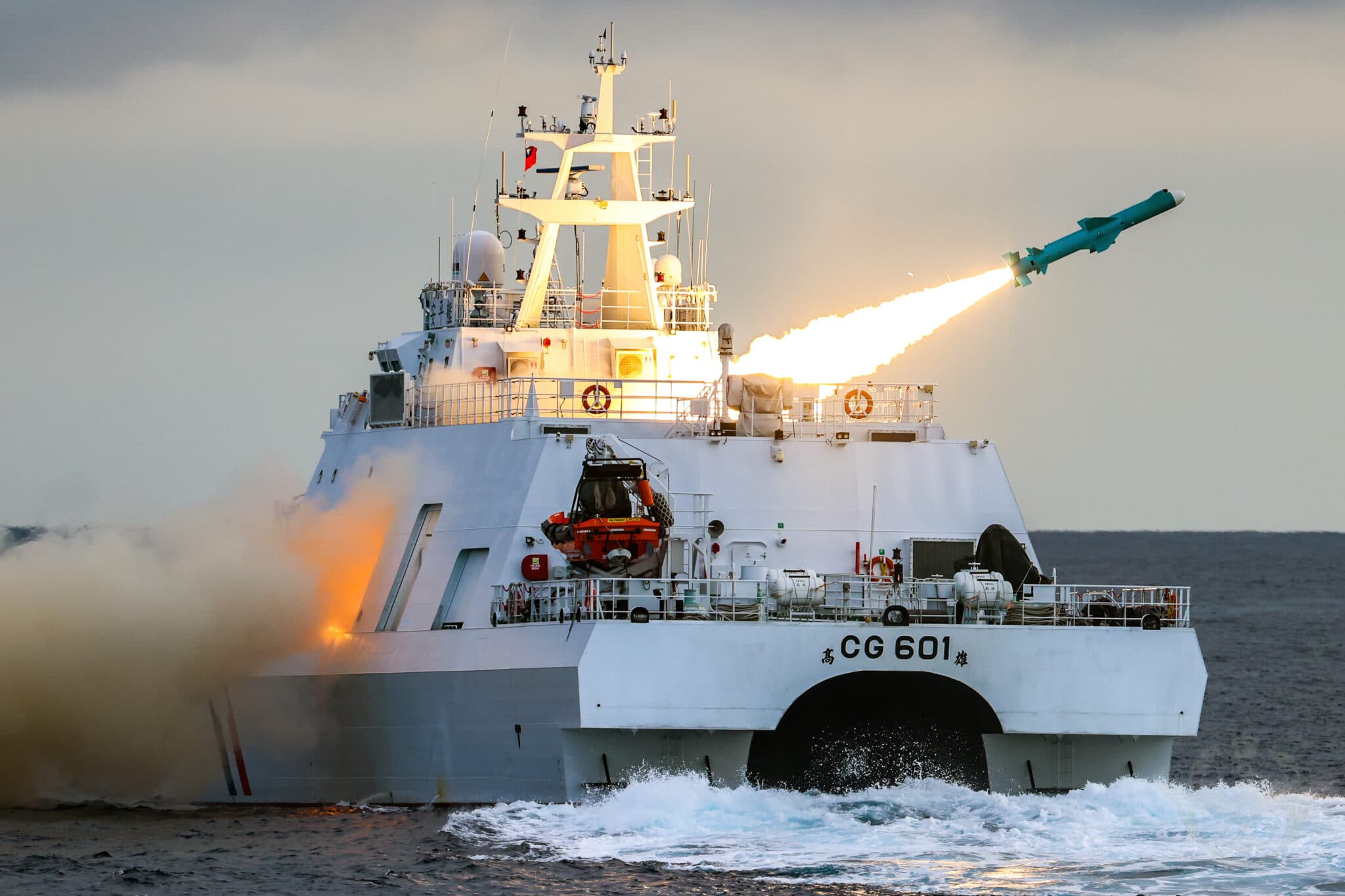
Taiwan Coast Guard Vessel Anping firing missile

The Drive/The War-Zone reports,

During the test conducted on May 23, officials said that the HF-2 missiles were launched from the cutter off the coast of the Jiupeng Base and successfully hit a target ship that was located 62 miles off the coast of Lanyu, near Orchid Island. According to Taiwan’s Liberty Times Net reporter Zheng Jingyi, “this live ammunition firing specifically verifies the integration of the naval forces and sea cruisers under the ‘peace-to-war conversion.’”

This was a test and the missile launch equipment was removed immediately after the test. The launch and control was conducted by Taiwanese Navy personnel, temporarily assigned for the test.

Since the cutters are a version of a missile equipped Taiwanese Navy corvette, there would seem little reason to believe the test would not have been successful.

Reportedly twelve corvettes and twelve cutters are planned, but the prototype Navy corvette was commissioned in 2014, the second not until 2021, and none since. On the other hand four of the cutters have entered service beginning 2020 with two more under construction.

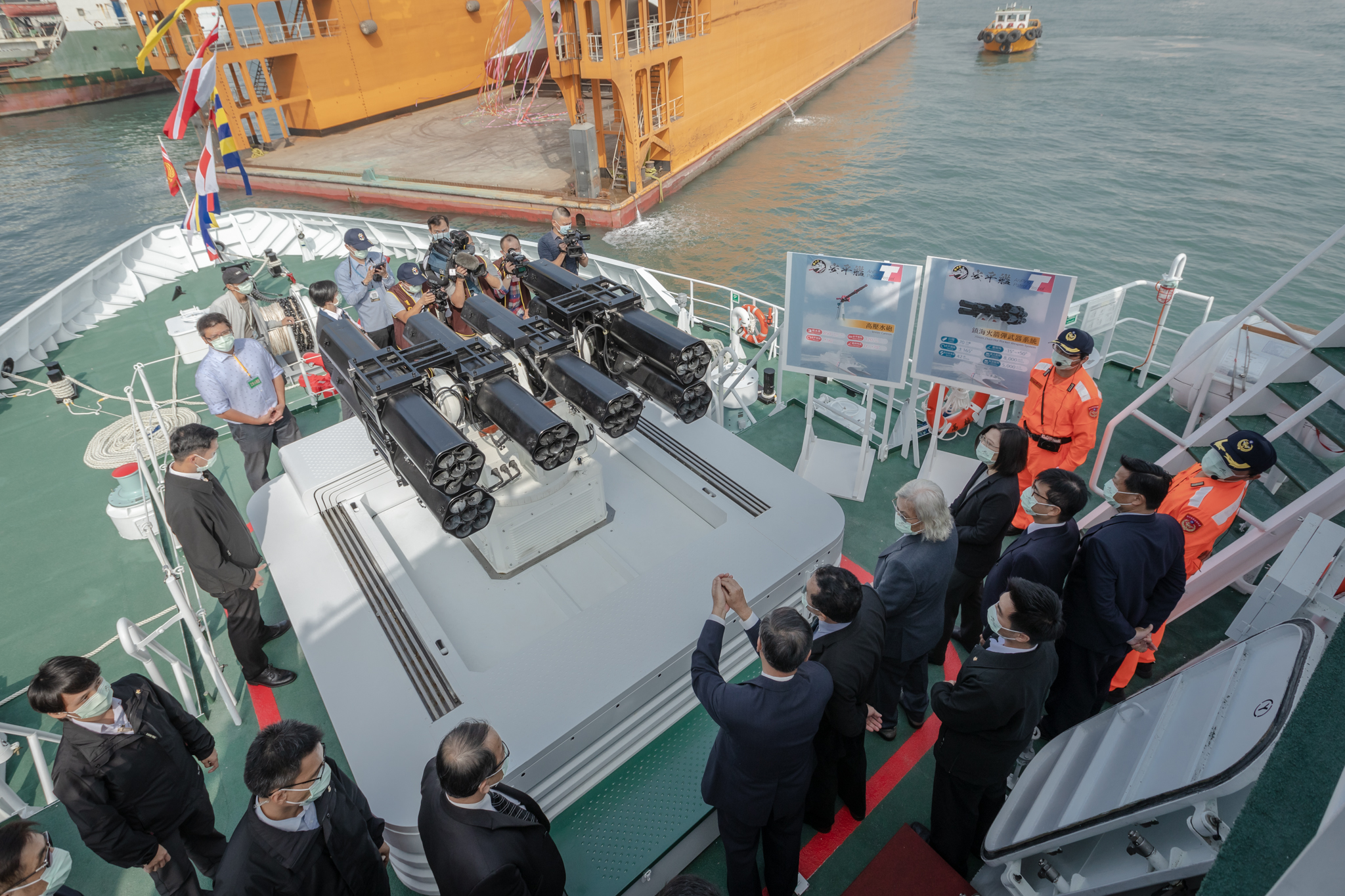
The normal armament of these and other Taiwanese cutters includes an unusual 42 round, remote controlled, “Zhenhai” 70mm/2.75″ rocket launcher. It is unclear if these rockets have a guidance system like APKWS. Photos below from Wikipedia.

Taiwan Anping-class offshore patrol vessel onboard multi-barrel Zhenhai rocket system

Anping-class offshore patrol vessel onboard 42-barrel Zhenhai rocket system, looking forward

Video: Northrop Grumman Showcases Very Light Weight Torpedo At Sea Air Space 2021″ –Naval News

Our friends at Naval News have an update on the Very Light Weight Torpedo program. It seems to be progressing rapidly. Apparently this is seen as an urgent requirement.

The discussion in the video talked about the anti-torpedo and anti-submarine capabilities, but no discussion of use against surface targets. I suspect this is because those capabilities are the primary selling points for the Navy. It may not be that it is incapable of attacking surface vessels, which should be easier targets.

We talked about this weapon earlier, in greater depth, including potential Coast Guard use.

Full scale production should drive to price down to a point, it might even find its way into the Coast Guard.

(There does seem to be an error in the written portion of the Naval News post in that it says the diameter of the weapon is 121 mm while the video discussion indicates 171 mm. The figures I had seen earlier were:  6.75″ in diameter (171.45mm), about 85″ in length, and weighs about 220 pounds or about 100 kilos).


Advanced Precision Kill Weapon System (APKWS) –the Video

As I have suggested several times, there is a place for this system in the Coast Guard, here, here, and here, as a weapon that would allow even small units like patrol boats and FRCs to quickly and accurately deal with a range of threats, while minimizing the risk of collateral damage inherent in the use of our current weapons, e.g. 7.62mm, .50 cal., 25mm.

These weapons are not exotic. tens of thousands are produced annually.

Interesting to see how simply the pulse repetition frequency code is set to match it to the laser designator.

(I would also argue that the Coast Guard needs to have available laser designators in order to allow us to specifically identify threats for DOD aircraft that might be called in to help the Coast Guard deal with a threat.)

The first place to mount APKWS is on the FRCs going to PATFORSWA.

It is probably possible to mount launchers on the Mk38 gun mount. There is also the four round FLETCHER  launcher (see below) that can be fitted in place of a .50 cal.

“China Coast Guard to be allowed to use force in case of territorial infringement” –People’s Liberation Army Daily

This Chinese People’s Liberation Army Daily post concerning use of deadly force, linked here, may be particularly interesting for its call out of the US Coast Guard.

Law enforcement on land, sea and in airspace under its own jurisdiction, with the use of weapons on necessary occasions, are the rights granted to sovereign states by international law. The Japan Coast Guard (JCG) also stipulates that lethal weapons can be used when enforcing the law in waters under its own jurisdiction. For the US Coast Guard (USCG), the use of force is even more common, and it is even planning to apply long-arm jurisdiction to China.

Admiral Karl Schultz, Commandant of the USCG, claimed to strengthen deployment in the Asia-Pacific region and participate in security patrols in the waters surrounding China in response to Chinese maritime militia’s declaration of sovereignty in the South China Sea in April last year. Robert O’Brien, US National Security Advisor, announced on October 24 that the USCG would deploy Enhanced Response Cutters in the Western Pacific. . Without providing any evidence, he accused Chinese fishing boats of illegal fishing and claimed that the sovereignty of the United States and its neighbors in the Pacific had thus been threatened.

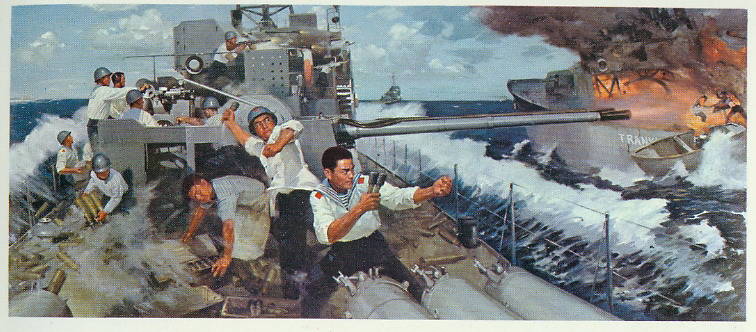
If they should choose to employ force against one of our cutter in their claimed “Nine Dash Line,” it is likely they would attempt to get several units in at very close range before opening fire, as they did in this engagement.

Chinese depiction of the fighting Battle of Paracels Islands

Next time we send a cutter into this area, it might be a good idea to have a squad of Marines along armed with shoulder fired missile or rocket launchers.

Might also be a good idea to provide a bit of ballistic protection (and here) for our .50 cal. gun crews. Not too difficult because you can buy it on the GSA catalog.

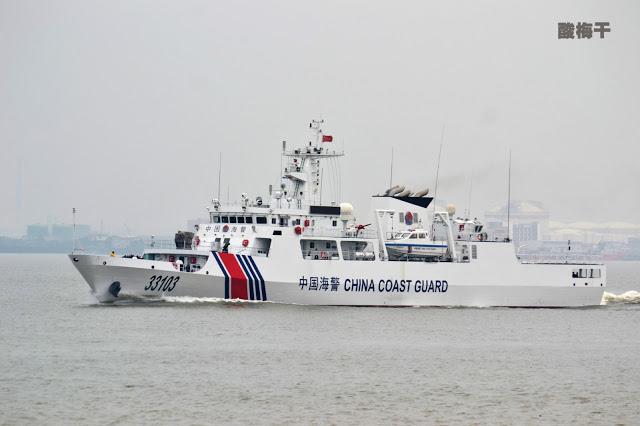
Most China Coast Guard Cutters are not as well armed or as fast as the Bertholfs, but there are exceptions. In all likelihood they would be more interested in causing casualties and chasing us off, than actually sinking a cutter. This is more likely to serve their purpose without getting themselves in a war. Not that I think such an attack would go unanswered, but they, or a mid-level commander, might be foolish enough to think they could get away with it. Still probably better not to have a lone cutter doing “Freedom of Navigation Operations,” although air cover might be sufficient. Really I would like to see an international repudiation of their claims in the form of an multi-national demonstration.

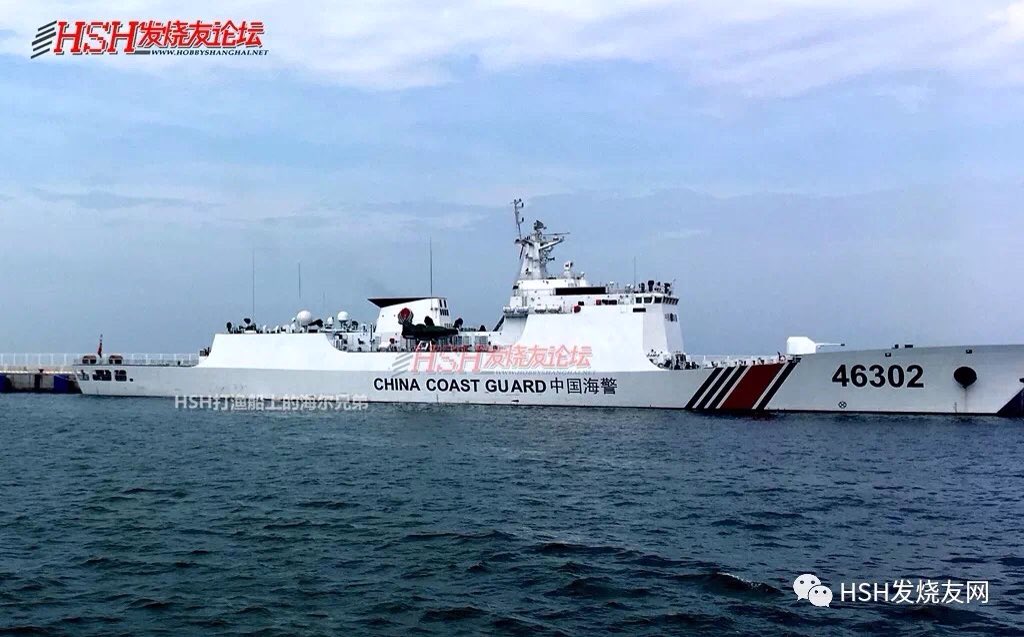
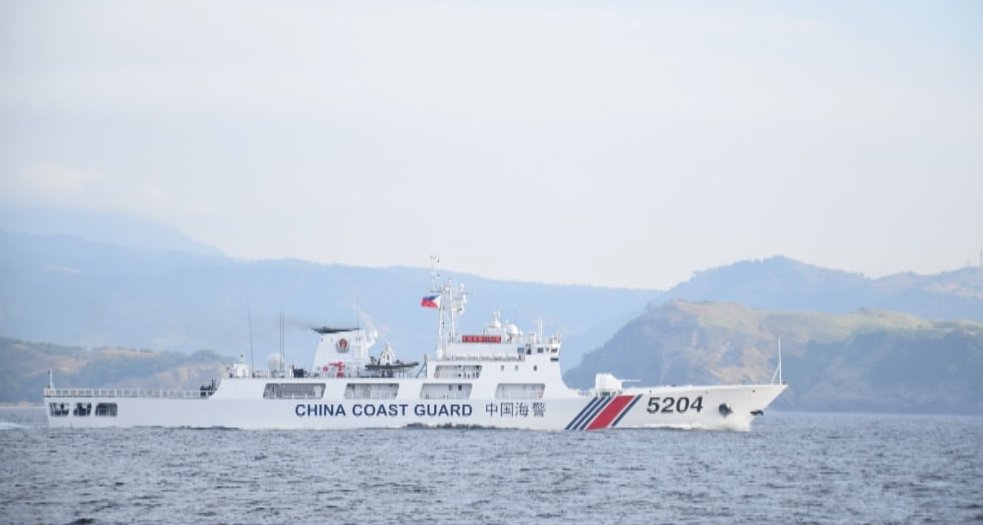
Combinations of CCG cutters with weapons larger than 14.5mm machine guns could be extremely dangerous at close range. Some of those are shown below.

The China CG version of the Type 056 Corvette


China Coast Guard Cutters Converted  from Type 053H2G frigates