“VIDEO: Colombian Navy intercepts largest narco sub yet” –Marine Log

MarineLog reports,

“…On May 12, the Columbian Navy reported it had intercepted the largest narco sub seized since its first capture of one of the semi-submersible low profile vessels in 1993…the substances seized were cocaine hydrochloride and had a net weight of 3,058 kilograms.

“To put that in perspective, in one of the largest narco sub interdictions by U.S authorities, in April 2021 a U.S. Customs and Border Protection (CBP) Air and Marine Operations (AMO) aircraft assisted the U.S. Coast Guard seizure of approximately 2,500 kilograms of cocaine from a semi-submersible vessel.”

PATFORSWA’s USCGC Glen Harris, 2 Busts, May 8 and May 10, Heroin and Meth

Below are a pair of news releases from NAVCENT.


NEWS | May 10, 2023

U.S. Seizes $80 Million Heroin Shipment in Gulf of Oman

By U.S. Naval Central Forces Command Public Affairs

A U.S. Coast Guard fast response cutter seized $80 million worth of heroin from a fishing vessel transiting the Gulf of Oman, May 10, during the ship’s second drug bust this week.

USCGC Glen Harris (WPC 1144) was operating in support of Combined Task Force (CTF) 150 when a boarding team discovered 1,964 kilograms of heroin on a vessel transiting international waters after departing Chah Bahar, Iran. Glen Harris also seized $30 million worth of methamphetamine and heroin two days ago from another fishing vessel that departed the same port.

“I’m very proud of my crew and all we’ve been able to accomplish as a team this week,” said Lt. Nick Jabs, Glen Harris’s commanding officer. “We’re out here to work with regional partners and disrupt any destabilizing maritime activity at sea. We will continue getting after it.”

Glen Harris’s previous seizure on May 8 included 580 kilograms of methamphetamine and 35 kilograms of heroin.

The ship arrived in the Middle East last year as part of a contingent of U.S. Coast Guard cutters that are forward-deployed to the region under Patrol Forces Southwest Asia.

CTF 150 is one of four task forces that form the world’s largest multinational naval partnership, Combined Maritime Forces. Naval forces supporting CTF 150 have now seized illegal drugs worth a combined estimated U.S. street value of more than $250 million in 2023. These efforts help ensure legitimate commercial shipping transits the region free from non-state threats.


NEWS | May 8, 2023

U.S. Coast Guard Seizes $30 Million in Drugs with International Task Force

By U.S. Naval Central Forces Command Public Affairs

A U.S. Coast Guard fast response cutter seized more than $30 million of heroin and methamphetamine from a fishing vessel transiting the Gulf of Oman, May 8.

Operating in support of Combined Task Force (CTF) 150, USCGC Glen Harris (WPC 1144) seized 580 kilograms of methamphetamine and 35 kilograms of heroin from a vessel transiting international waters after departing Chah Bahar, Iran.

CTF 150 is one of four task forces that form the world’s largest multinational naval partnership, Combined Maritime Forces. Naval forces supporting CTF 150 have seized illegal drugs worth a combined estimated U.S. street value of nearly $200 million in 2023.

Glen Harris arrived in the Middle East last year and operates from the U.S. Navy base in Bahrain where CMF is headquartered with U.S. Naval Forces Central Command and U.S. 5th Fleet.

The fast response cutter is part of a contingent of U.S. Coast Guard ships forward-deployed to the region under Patrol Forces Southwest Asia (PATFORSWA). PATFORSWA deploys Coast Guard personnel and ships alongside U.S. and regional naval forces throughout the Middle East.

“The dedication and expertise of Glen Harris’s leadership and crew embody our commitment to interdict and remove illicit narcotics from the sea, denying malign actors the ability to destabilize the region,” said Capt. Eric A. Helgen, PATFORSWA’s commander. “I could not be more proud of our fast response cutter crews.”

Currently led by the United Kingdom, CTF 150 conducts maritime security and counter-terrorism operations in the Gulf of Oman and Indian Ocean to disrupt criminal and terrorist organizations and their related illicit activities, including the movement of personnel, weapons, narcotics and charcoal. These efforts help ensure legitimate commercial shipping transits the region free from non-state threats.

U.S. and international naval units in the Middle East seized illegal drugs totaling $1 billion in value from 2021 to 2022.

“USCGC Forward returns home following counterdrug patrol in the Caribbean Sea”

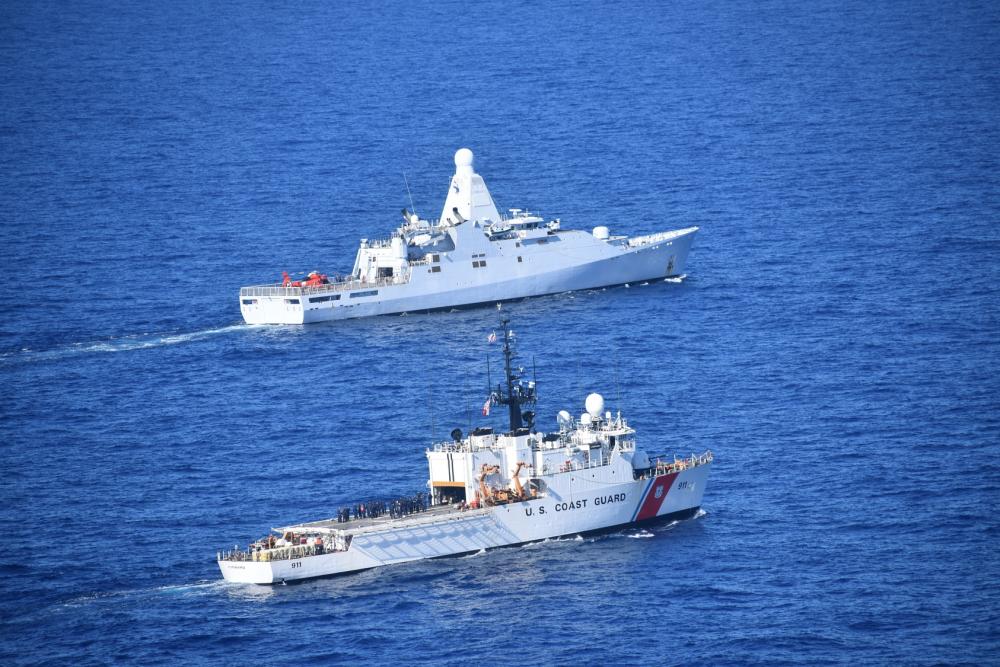
USCGC Forward (WMEC 911) and Royal Netherlands Navy ship HNLMS Holland (P840) steam in formation for a transfer of contraband cocaine in the Atlantic Ocean Nov. 4, 2022, presumably a previous patrol.  (U.S. Coast Guard photo by Petty Officer 3rd Class Amy Rodriguez)

Below is a news release found on United States Coast Guard News. Generally, it is pretty normal drug interdiction news release.

I did kind of question this.

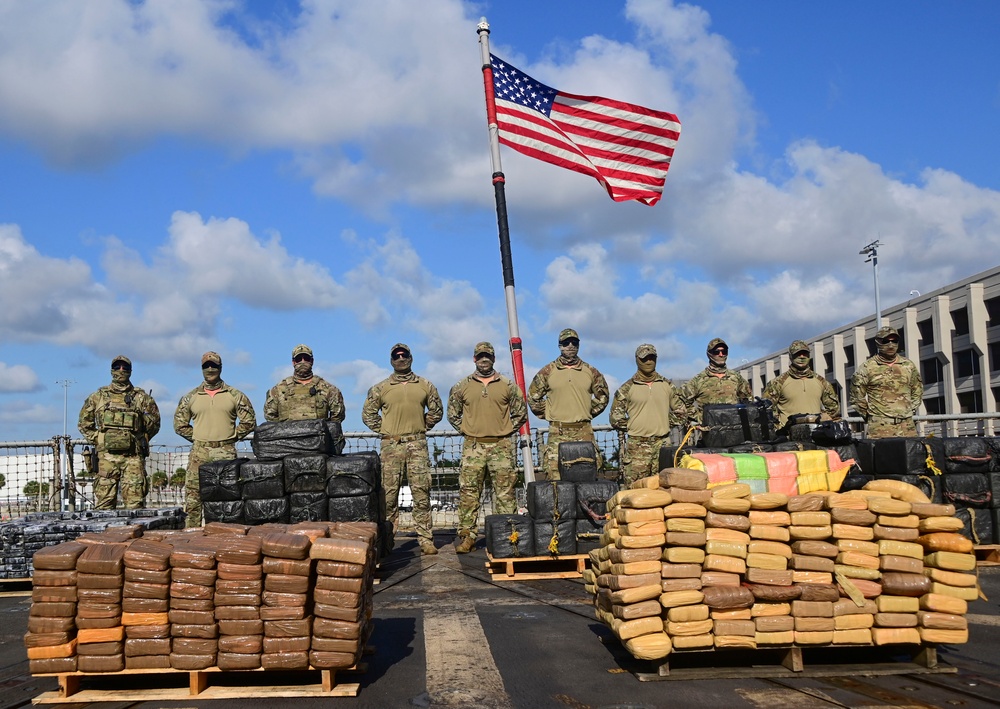
Throughout the patrol, Forward held approximately 4,700 pounds of cocaine on deck worth an estimated $81 million. Forward intercepted three suspected narcotics smugglers earlier this month and held nine others throughout the patrol. On Tuesday, the crew conducted a further offload to partner agencies in Port Everglades, Florida.

Nowhere does it say how long the patrol was other than “multi-week,” kind of important and not something we can keep secret. Why would prisoners be transferred on board a cutter that has just arrived? The service has been criticized in the past for holding prisoners on board for long periods in conditions that are considered by many to be inhumane. I won’t get into that, but it does seem we would want to get them ashore as quickly as possible. Maintaining custody of prisoners is a strain on the ship that it is not designed or billeted for.

Also, there is an error in the news release I cannot let pass.

Part of this effort included international partnerships with the HNLMS Holland (P840) of the Royal Netherlands Navy and other U.S. military vessels, including USCGC Campbell (WMEC 909), USCGC Margaret Norvell (WPC 1105), and USS Little Rock (CL 92).

USS Little Rock (CL 92) is a museum ship moored in Buffalo, NY, a Cleveland class light cruiser first commissioned in 1945, converted to a guided missile cruiser, she was decommissioned in 1976. I am pretty sure they intended to reference USS Little Rock (LCS-9). We need to do better. If you don’t know the proper designation, just leave it off. Can’t imagine how they made this mistake, unless they just googled USS Little Rock and saw a designation without reading anything about the ship it was associated with.

 April 24, 2023

USCGC Forward returns home following counterdrug patrol in the Caribbean Sea

PORTSMOUTH, Va. — The crew of the USCGC Forward (WMEC 911) returned to their home port in Portsmouth, Saturday, following a multi-week training exercise and counterdrug deployment in the central Caribbean Sea.

While underway in the Seventh Coast Guard District’s area of responsibility and in support of Joint Interagency Task Force–South, Forward traveled more than 6,000 miles conducting counterdrug operations as part of a multi-faceted approach to combatting illicit narcotics trafficking across maritime borders.

Part of this effort included international partnerships with the HNLMS Holland (P840) of the Royal Netherlands Navy and other U.S. military vessels, including USCGC Campbell (WMEC 909), USCGC Margaret Norvell (WPC 1105), and USS Little Rock (CL 92).

Throughout the patrol, Forward held approximately 4,700 pounds of cocaine on deck worth an estimated $81 million. Forward intercepted three suspected narcotics smugglers earlier this month and held nine others throughout the patrol. On Tuesday, the crew conducted a further offload to partner agencies in Port Everglades, Florida.

“The crew lived up to our namesake ‘Ever the Sentinel’ and was ready to take on any mission,” said Cmdr. Staci Rutsch, Forward’s commanding officer. “Forward’s crew demonstrated the Coast Guard’s resiliency and adaptability by maintaining proficiency in interagency and international operations while upholding the ability to meet the nation’s maritime demands. I am truly impressed and thankful for their devotion to duty.”

Forward is a 270-foot, Famous-class medium endurance cutter. The cutter’s list of mission sets include law enforcement, search and rescue, protection of living marine resources, homeland security and defense operations, international training and humanitarian operations throughout the Western Hemisphere.

For information on how to join the U.S. Coast Guard, visit http://www.GoCoastGuard.com to learn more about active duty and reserve officer and enlisted opportunities. Information on how to apply to the U.S. Coast Guard Academy can be found at http://www.uscga.edu. For more, follow us on Facebook, Instagram and Twitter.

“FACT SHEET: The Biden Administration Launches New Efforts to Counter Transnational Criminal Organizations and Illicit Drugs” –Expect Changes In Drug Interdiction

The administration has issued a new fact sheet reflecting the growing problem of street use of synthetic opioids, particularly Fentanyl. This is in conjunction with a larger effort against the supply chains for synthetic opioids and the international criminal enterprises that control and use them.

Inevitably the emergence a different “drug of choice” is going to affect the Coast Guard. It probably means a greater role for marine inspection and greater competition from other DHS agencies for drug interdiction dollars.

While the Coast Guard has been the primary agency for interception of cocaine shipments, the importation pathways for synthetic opioids are likely to be different and more diverse.

Interception of precursors will get more attention. Intelligence targets will change.

The system the Coast Guard has developed to track what cargoes are loaded and where, will take on additional importance and may require more detail.

I can only speculate on the changes we will see, but changes are coming.

“USS Farragut, Coast Guard offloads more than $69 million in illegal narcotics” –D7

190914-N-KK394-029.MAYPORT, Fla. (Sept. 14, 2019) The Arleigh Burke-class guided-missile destroyer USS Farragut (DDG 99) departs Naval Station Mayport. (U.S. Navy photo by Mass Communication Specialist 2nd Class Anderson W. Branch/Released)

Below is a District Seven News Release. Just wanted to point out a couple of things.

Unlike most of these offloads, this one involved only drugs seized by a single ship. Second it is unusual that drugs are offloaded from a Navy ship. Probably a good idea to let them get the more visible credit that comes with the offload once in a while. 

This destroyer did four intercepts, so they certainly deserve a lot of credit, along with the HSM-60 helicopter and CG LE detachments.

Would have been nice to know how many days they were doing the drug interdiction mission.


 April 5, 2023

USS Farragut, Coast Guard offloads more than $69 million in illegal narcotics

Seventh Coast Guard District

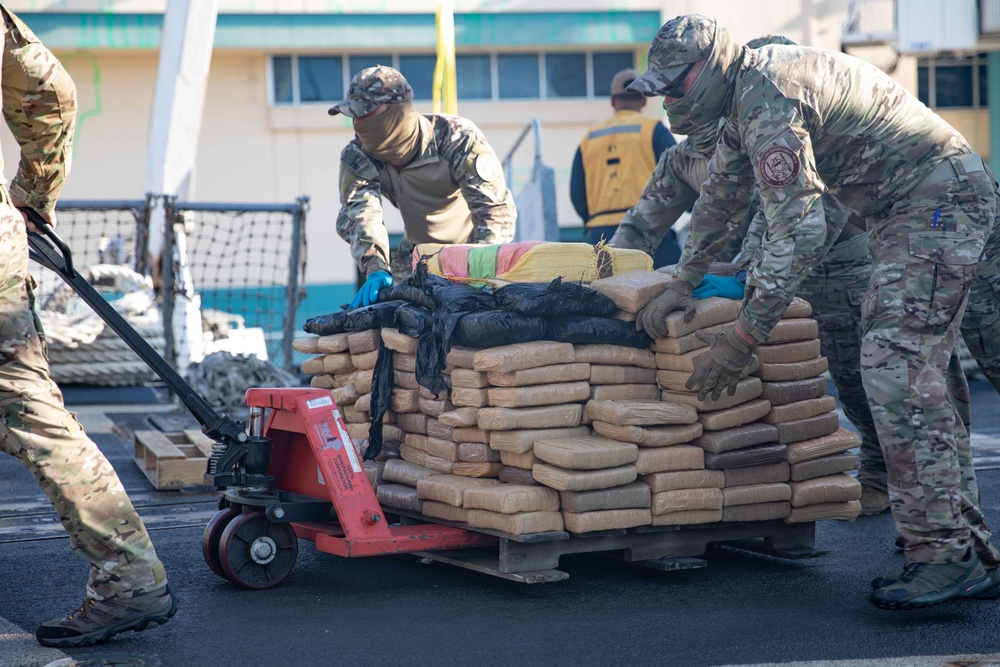
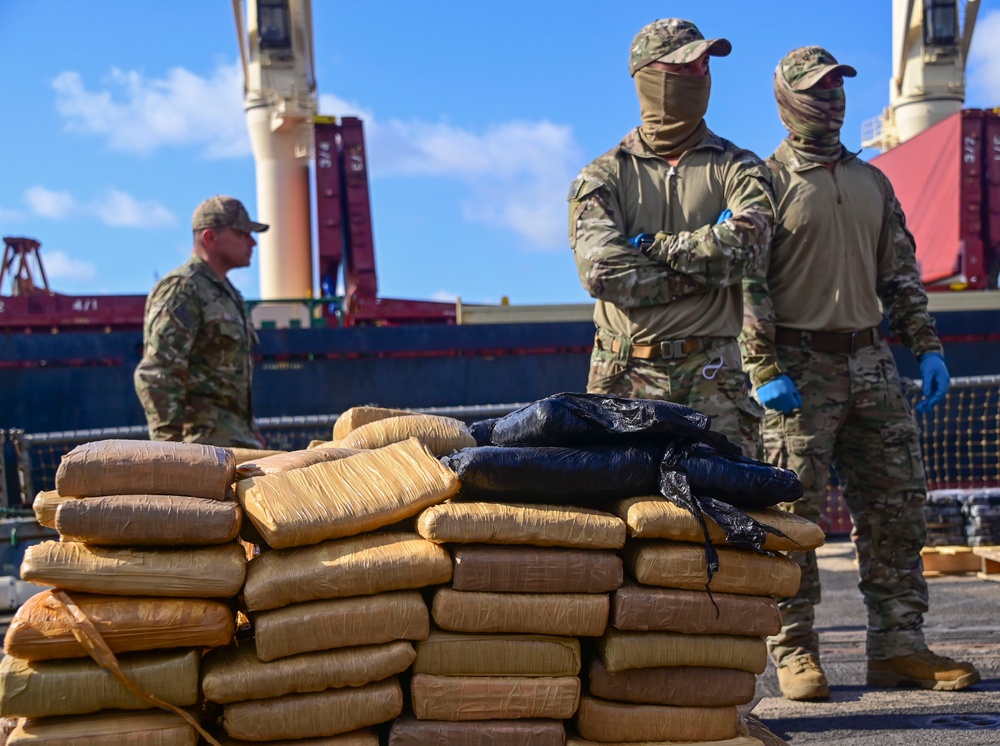
A member of U.S. Coast Guard Law Enforcement Detachment 406 offloads interdicted narcotics aboard USS Farragut (DDG 99) in Port Everglades, Florida, April 4, 2023. The offloaded drugs were seized from four go-fast smuggling interdictions by crew members of Coast Guard LEDET 406, Navy Combat Element (CEL) and Helicopter Maritime Strike Squadron Six Zero (HSM-60) in the Eastern Pacific Ocean. (U.S. Coast Guard photo by Petty Officer 2nd Class Laticia Sims)Members of U.S. Coast Guard Law Enforcement Detachment 406 pose for a photo with $69 million in illegal narcotics aboard USS Farragut (DDG 99) in Port Everglades, Florida, April 4, 2023. The offloaded drugs were seized from four go-fast smuggling interdictions by crew members of Coast Guard LEDET 406, Navy Combat Element (CEL) and Helicopter Maritime Strike Squadron Six Zero (HSM-60) in the Eastern Pacific Ocean. (U.S. Coast Guard photo by Petty Officer 3rd Class Eric Rodriguez) Members of U.S. Coast Guard Law Enforcement Detachment 406 push bales of illegal narcotics aboard USS Farragut (DDG 99) for a drug offload in Port Everglades, Florida, April 4, 2023. The offloaded drugs were seized from four go-fast smuggling interdictions by crew members of Coast Guard LEDET 406, Navy Combat Element (CEL) and Helicopter Maritime Strike Squadron Six Zero (HSM-60) in the Eastern Pacific Ocean. (U.S. Navy photo by Mass Communication Specialist 2nd Class Chelsea Palmer) https://d1ldvf68ux039x.cloudfront.net/thumbs/photos/2304/7724658/1000w_q95.jpg Bales of illegal drugs, worth an estimated $69 million, are offloaded off USS Farragut (DDG 99) in Port Everglades, Florida, April 4, 2023. The offloaded drugs were seized from four go-fast smuggling interdictions by crew members of Coast Guard LEDET 406, Navy Combat Element (CEL) and Helicopter Maritime Strike Squadron Six Zero (HSM-60) in the Eastern Pacific Ocean. (U.S. Navy photo by Mass Communication Specialist 2nd Class Chelsea Palmer)


MIAMI — The crew of USS Farragut (DDG 99) offloaded approximately 2,314 kilograms of cocaine and 1,986 pounds of marijuana worth a combined $69 million in Port Everglades, Florida Tuesday. The suspected smugglers will face prosecution in federal court by the Department of Justice.

The offloaded drugs were seized from four go-fast smuggling vessel interdictions by the Farragut crew with an embarked Coast Guard Law Enforcement Detachment (LEDET) 406 and Navy Combat Element (CEL) One from the “Jaguars” of Helicopter Maritime Strike Squadron Six Zero (HSM-60) in the Eastern Pacific Ocean.

“We were proud to work with the U.S. Coast Guard on the frontline of the threat that transnational drug trafficking presents to national security,” said Cmdr. Nicholas Gurley, commanding officer of USS Farragut. “Our experienced crew, HSM-60 CEL One and the members of our LEDET were essential to the success of this operation.”

Numerous U.S. agencies from the Departments of Defense, Justice, and Homeland Security, along with allied and international partners, cooperate in the effort to combat transnational organized crime. The fight against drug cartels in the Caribbean and Eastern Pacific Ocean is coordinated by Joint Interagency Task Force-South, based in Key West, and requires a unity of effort in all phases, from detection and monitoring to interdiction and apprehension and finally to criminal prosecution by international partners and U.S. Attorneys’ Offices. The law enforcement phase of counter-smuggling operations in the Eastern Pacific Ocean is conducted under the authority of the Eleventh Coast Guard District, headquartered in Alameda, California. The interdictions, including the actual boardings, are led and conducted by members of the U.S. Coast Guard.

The Coast Guard is both a military service and the nation’s primary maritime law enforcement agency. For information on how to join the U.S. Coast Guard, visit www.GoCoastGuard.com to learn about active duty and reserve officer and enlisted opportunities. Information on how to apply to the U.S. Coast Guard Academy can be found at http://www.uscga.edu. For breaking news, follow us on Twitter. For additional information, find us on Facebook and Instagram.

Pacific NW WMEC-210s Doing Drug Interdiction

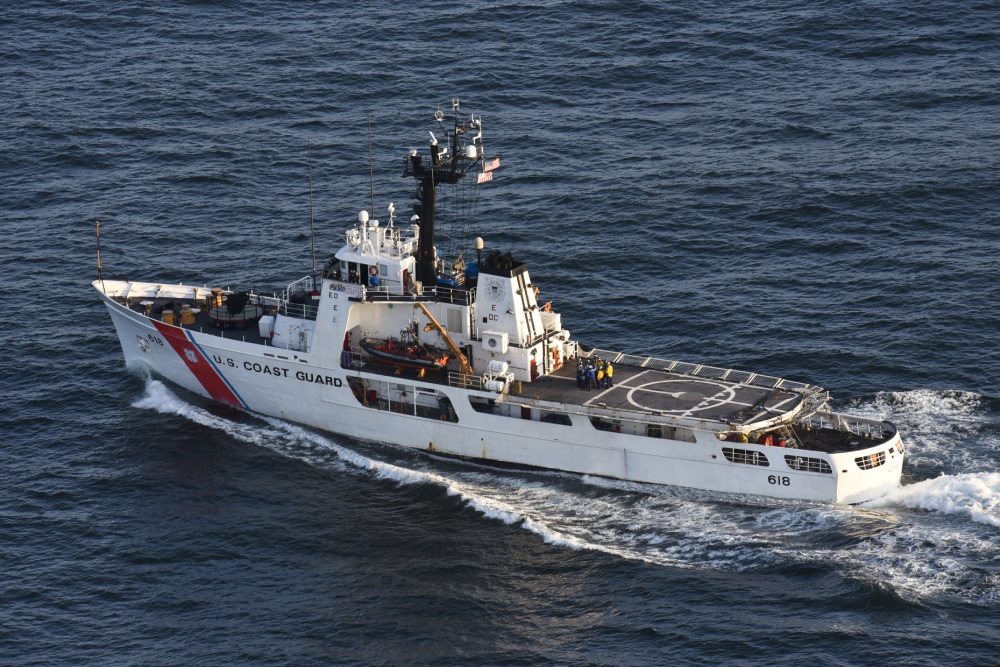
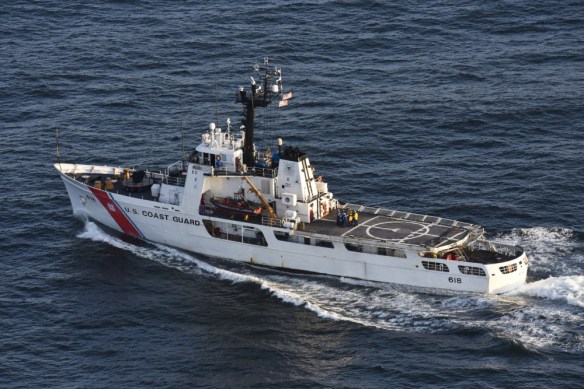
USCGC Active (WMEC 618) Aug. 16, 2019. Active is a 210-foot Medium Endurance based out of Port Angeles, Wash. (U.S. Coast Guard photo by Petty Officer 2nd Class Steve Strohmaier)

Below is a news release from the Coast Guard News website. What I would like to talk about is here:

  • The Waesche’s crew was responsible for two interdictions seizing approximately 881 pounds of cocaine and 9,500 pounds of marijuana. 
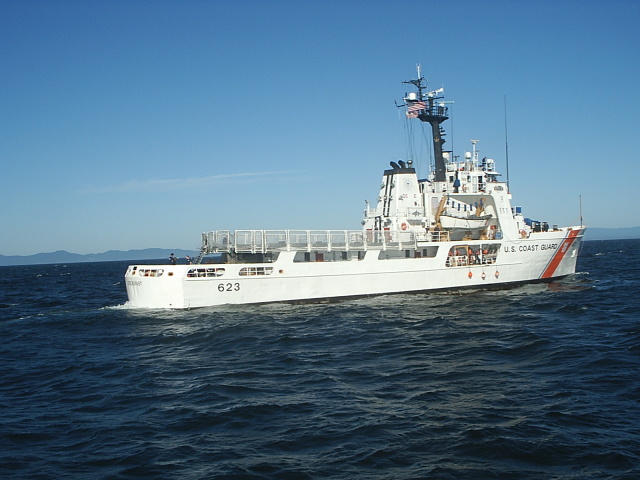
  • The crew of the Coast Guard Cutter Steadfast (WMEC 623) was responsible for one interdiction, seizing approximately 3,300 pounds of cocaine. 
  • The crew of the Coast Guard Cutter Active (WMEC 618) was responsible for two interdictions seizing approximately 2,116 pounds of cocaine and 3,716 pounds of marijuana.

The two WMECs, each over 50 years old, probably each seized drugs of higher street value than the 13-year-old National Security Cutter (NSC) that is about four times as large. No, they are not necessarily better at drug interdiction than the NSC. There is a lot of luck involved, but it does seem to suggest that, as the saying goes, “quantity has a quality all its own.

There are simply not enough cutters (or Navy ships) to interdict all the known smugglers being tracked.

Earlier, when the current Commandant was Commander PACAREA, we saw some attempts to use Webber class Fast Response Cutters (FRC) in the Eastern Pacific drug transit zones. For some reason those efforts don’t seem to have been continued. Perhaps their endurance was a problem.

There can be little doubt the Coast Guard needs more cutters, yet the current program of record will supply 8 fewer large cutters than we had in the year 2000. We need more large cutters, but they don’t all have to be 4500 tons.

Frankly, I do think they should be bigger than 210s. You can make a very capable cutter of around 2,000 tons with a crew smaller than that of the 210s, but we don’t seem to have been doing the analysis that would clearly identify our needs.
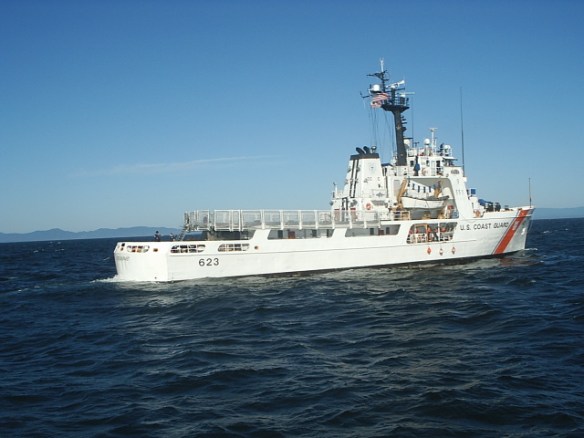
USCGC Steadfast (WMEC-623) (This is an old photo, given the hard sided boat and davits.)

 March 28, 2023

MEDIA ADVISORY: Coast Guard to offload approximately 6,325 pounds of cocaine and more than 13,000 pounds of marijuana in San Diego

WHO: Capt. Robert Mohr, commanding officer, Coast Guard Cutter Waesche, Alexandra (Sasha) Foster is the Criminal Chief in the Southern District of California U.S. Attorney’s Office

WHAT: The crew of the Coast Guard Cutter Waesche is scheduled to offload approximately 6,325 pounds of cocaine and more than 13,000 pounds of marijuana, worth more than $166 million, seized from the drug transit zones of the Eastern Pacific Ocean.

WHEN: Wednesday at 9:30 a.m.

WHERE: 10th Avenue Marine Terminal, 1150 Terminal St., San Diego, CA 92101

Editor’s Note: Media interested in attending should arrive no later than 9 a.m., and bring a government-issued photo ID, press credentials, proof of vehicle registration and insurance. Media will be escorted to the event location following security screening.

SAN DIEGO — The crew of the Coast Guard Cutter Waesche (WMSL 751) offloaded more than 6,325 pounds of cocaine and more than 13,000 pounds of marijuana estimating a value worth more than $166 million on Wednesday, in San Diego.

The interdictions were made late February and early March during four separate joint effort interdictions:

  • The Waesche’s crew was responsible for two interdictions seizing approximately 881 pounds of cocaine and 9,500 pounds of marijuana.
  • The crew of the Coast Guard Cutter Steadfast (WMEC 623) was responsible for one interdiction, seizing approximately 3,300 pounds of cocaine.
  • The crew of the Coast Guard Cutter Active (WMEC 618) was responsible for two interdictions seizing approximately 2,116 pounds of cocaine and 3,716 pounds of marijuana.

U.S. agencies from the Department of Defense, Department of Justice and Homeland Security coordinated in the effort to combat transnational organized crime. The U.S. Coast Guard, U.S. Navy, Customs and Border Protection, FBI, Drug Enforcement Administration, and Immigration and Customs Enforcement, along with allied and international partner agencies, served a vital role in counter-drug operations. The fight against drug cartels in the Eastern Pacific requires unity of effort in all phases from detection, monitoring and interdictions, to criminal prosecutions by U.S. Attorneys in districts across the nation

The U.S. Coast Guard Cutter Waesche (WMSL-751) is the second Legend-class cutter of the United States Coast Guard and is homeported at Coast Guard Island in Alameda, Calif. Waesche, the second of eight planned National Security Cutters, is 418 feet long with a top speed of 28 knots and a range of 12,000 nautical miles. The cutter is equipped with a flight deck and hangars capable of housing two multi-mission helicopters, and outfitted with the most advanced command, control, and communications equipment.

“U.S. Coast Guard Cutter Interdicts Illegal Drugs Shipment in Arabian Sea” –NAVCENT

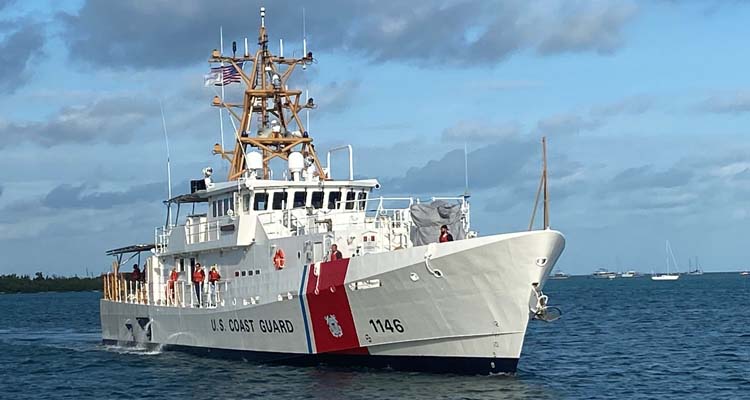
The 46th fast response cutter (FRC), John Scheuerman, was delivered to the Coast Guard Oct. 21, 2021, in Key West, Florida. One of six FRCs stationed in Manama, Bahrain. U.S. Coast Guard photo.

 Feb. 26, 2023

U.S. Coast Guard Cutter Interdicts Illegal Drugs Shipment in Arabian Sea

By U.S. Naval Forces Central Command Public Affairs

A U.S. Coast Guard ship seized illegal drugs worth $20 million in U.S. street value from a fishing vessel with four mariners transiting international waters in the Arabian Sea, Feb. 25.

Crewmembers from USCGC John Scheuerman (WPC 1146) discovered 1,350 kilograms of hashish, 276 kilograms of methamphetamine and 23 kilograms of amphetamine pills upon interdicting the vessel during a routine patrol.

“This is the result of excellent teamwork and multinational collaboration. It is important that we continue relentlessly pursuing any destabilizing maritime activity,” said U.S. Navy Capt. Anthony Webber, commander of Task Force 55, the staff responsible for U.S. 5th Fleet surface forces in the region. “The crew clearly demonstrated John Scheuerman’s motto of ‘selflessness and strength’ during this seizure and I couldn’t be more proud.”

John Scheuerman was operating in support of Combined Task Force (CTF) 150 at the time. Currently led by the United Kingdom Royal Navy, CTF 150 is one of four task forces organized under the Combined Maritime Forces (CMF).

CMF is the largest international naval partnership in the world, consisting of 38 member-nations and partners, and has interdicted over $1 billion worth of illicit narcotics during maritime patrols.

USCGC Emlen Tunnell Seizes Illegal Drugs In Gulf Of Oman

230130-N-NO146-1001 GULF OF OMAN (Jan. 30, 2023) Illicit drugs interdicted by USCGC Emlen Tunnell (WPC 1145) sit on the deck of a fishing vessel for inventory as the U.S. Coast Guard cutter sails in the Gulf of Oman, Jan. 30. (U.S. Coast Guard photo) (Photo by U.S. Coast Guard)

Below is a U.S. Naval Forces Central Command news release. More information on Combined Maritime Forces, Task Force 150, Coast Guard PATFORSWA interdiction efforts, and why I think it is a great model for other areas here.

U.S., International Forces Seize Illegal Drugs in Gulf of Oman, By U.S. Naval Forces Central Command Public Affairs | January 31, 2023

MANAMA, Bahrain —

A U.S. Coast Guard vessel seized illegal drugs worth a total estimated U.S. street value of $33 million from a fishing vessel transiting international waters in the Gulf of Oman, Jan. 30.

U.S. Coast Guard cutter USCGC Emlen Tunnell (WPC 1145) was patrolling regional waters in support of Combined Task Force (CTF) 150 when it seized 4,000 kilograms of hashish and 512 kilograms of methamphetamine from the smuggling vessel.

Currently led by the United Kingdom Royal Navy, CTF 150 is one of four task forces organized under the Combined Maritime Forces (CMF). This was the first drug seizure in 2023 for CMF.

“This is just the beginning of our work in delivering maritime security operations in the region to stop illicit activities and drug smuggling,” said UK Royal Navy Capt. James Byron, the CTF 150 commander. “This comes as a result of a valued partnership between CTF 150 and all partner nations in Combined Maritime Forces.”

Byron assumed command of the multinational task force Jan. 18 after Royal Saudi Navy Rear Adm. Abdullah Al-Mutairi led the unit for six months.

Under Al-Mutairi’s leadership, CTF 150 ships logged more than 10,000 hours on regional patrols and intercepted six shipments of illegal drugs that included opium, heroin, hashish and amphetamines. The combined estimated value of the seized drugs totaled more than $250 million.

Since 2021, CMF has interdicted $1 billion worth of illicit narcotics during maritime patrols. CMF is the largest international naval partnership in the world consisting of 38 member-nations and partners.

USCGC Spencer (WMEC 905) arrives in Praia, Cabo Verde” –LANT Area

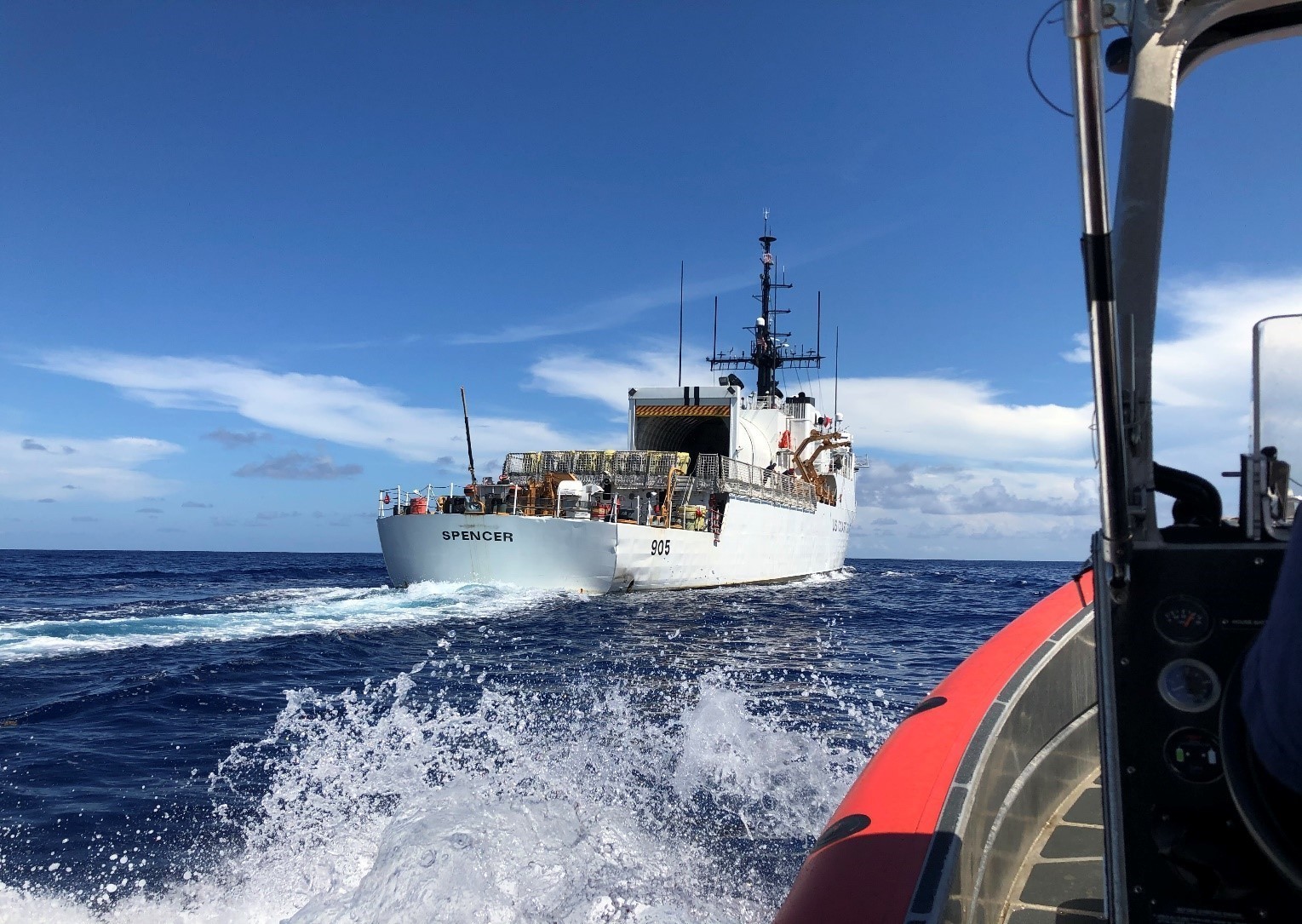
U.S. Coast Guard Cutter Spencer (WMEC 905) underway on patrol in the Eastern Pacific, January 2021. The crew covered over 11,000 miles seizing over $10 million of drugs and assisted in disrupting transnational crime organizations. (U.S. Coast Guard courtesy photo/Released)

Below is an Atlantic Area news release reporting the arrival of Cutter Spencer for operations off West Africa. This is getting to be almost routine, and it seems to have become a regular assignment for 270 foot WMECs. As can be seen by these previous reports, Spencer was preceded by Mohawk, Bear, and Thetis.

These operations, as well as those in the Western Pacific and SW Asia, demonstrate a recognition of the Coast Guard’s utility as an instrument of foreign policy and show that smaller cutters can be used in some of these roles, in some cases, reaching ports larger vessels might not be able to enter.

News Release

U.S. Coast Guard Atlantic Area

USCGC Spencer (WMEC 905) arrives in Praia, Cabo Verde

Download Image Link

Editors’ Note: To view more or download high-resolution imagery, click on the photo above

By U.S. Naval Forces Europe and Africa/U.S. Sixth Fleet

PRAIA, Cabo Verde – The Famous-class medium endurance USCGC Spencer (WMEC 905) arrived in Praia, Cabo Verde for a scheduled port visit Monday.

This port visit marks the first stop for Spencer, while employed by U.S. Sixth Fleet in the U.S. Naval Forces Europe and Africa (NAVEUR-NAVAF) area of operations. Spencer’s visit to Praia demonstrates NAVAF and the U.S. Coast Guard’s commitment and longstanding partnership to work with our African partners to counter illicit maritime activity in the Atlantic Ocean. During the port visit, Spencer will embark maritime counterparts from Cabo Verde, Senegal and The Gambia.

“The crew is excited for this unique opportunity, and we look forward to working with our partners to regulate fisheries and combat illegal, unreported, and unregulated fishing,” said Cmdr. Corey Kerns, Spencer’s commanding officer.

The U.S. Coast Guard regularly integrates and operates within the NAVAF area of operations. The U.S. Coast Guard’s authorities and capabilities provide the Joint Force with unique tools that bridge the cooperation-to-conflict continuum.

Cabo Verde is an important partner of the United States in promoting peace and security in Africa. In December 2022, the U.S. and Cabo Verde signed a memorandum of understanding for defense cooperation between the two countries, which will focus on continuing to counter illicit maritime activities through security cooperation. Later this month, Cabo Verde will participate in the NAVAF-led exercise Obangame Express 2022, the largest annual maritime security exercise in Western Africa. These types of exercises strengthen partnerships and allow countries to work more closely on shared transnational maritime challenges.

“The U.S. Embassy in Praia proudly welcomes the arrival of U.S. Coast Guard Cutter Spencer to Cabo Verde.  This ship visit is yet another example of the growing cooperation between U.S. and Cabo Verdean maritime forces, which is improving safety and security for our two nations and the entire region,” said Jeff Daigle, U.S. Ambassador to Cabo Verde.

The U.S. shares a common interest with African partner nations in ensuring security, safety, and freedom of navigation on the waters surrounding the continent, because these waters are critical for Africa’s prosperity and access to global markets.

In April 2022, as part of the African Maritime Law Enforcement Partnership (AMLEP), the U.S. and African maritime forces, led by Cabo Verde, worked in coordination with the Maritime Analysis and Operations Centre – Narcotics (MAOC-N), the International Police (INTERPOL), and Cabo Verde’s national Maritime Operations Center (COSMAR) to conduct a compliant boarding of a fishing vessel, which led to the seizure of approximately 6,000 kilograms of suspected cocaine with an estimated street value of more than $350 million.

The Famous-class medium endurance cutters support the U.S. Coast Guard’s maritime law enforcement and search and rescue missions. These cutters are capable of supporting flight operations with either a MH-65 Dolphin or a MH-60 Jayhawk.

U.S. Coast Guard Atlantic Area, headquartered in Portsmouth, Virginia, oversees all Coast Guard operations east of the Rocky Mountains to the Arabian Gulf, spanning across five Coast Guard districts and 40 states.

For over 80 years, U.S. Naval Forces Europe-U.S. Naval Forces Africa (NAVEUR-NAVAF) has forged strategic relationships with allies and partners, leveraging a foundation of shared values to preserve security and stability.

Headquartered in Naples, Italy, NAVEUR-NAVAF operates U.S. naval forces in the U.S. European Command (USEUCOM) and U.S. Africa Command (USAFRICOM) areas of responsibility. U.S. Sixth Fleet is permanently assigned to NAVEUR-NAVAF, and employs maritime forces through the full spectrum of joint and naval operations.

-USCG-

“Navy’s Digital Horizon exercise showcases power of ‘mesh networks,’ AI” –Defense News

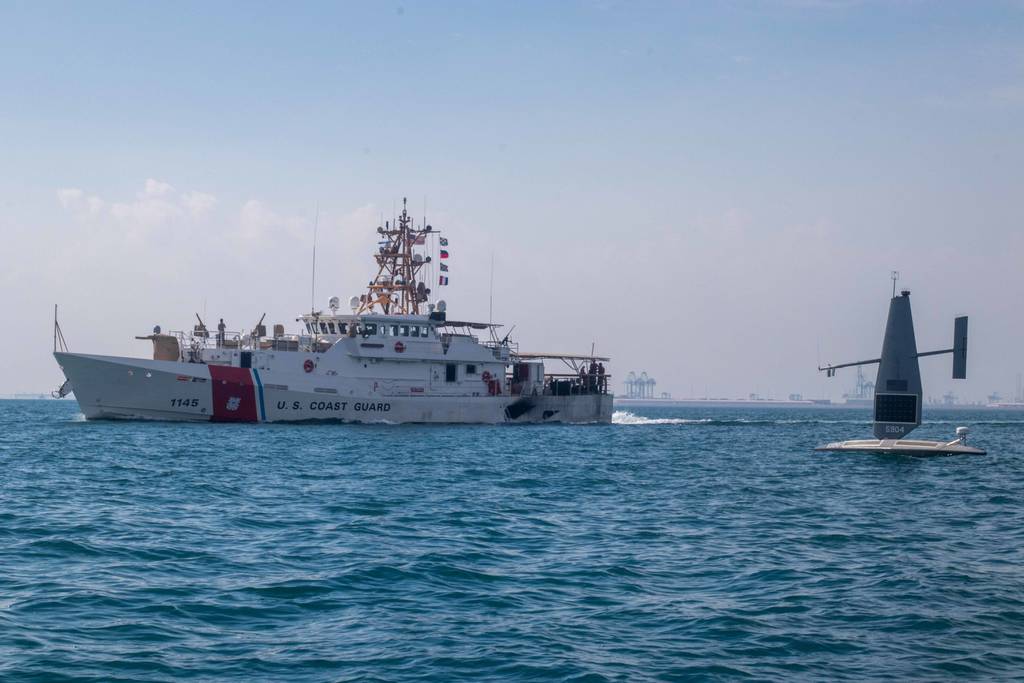
A Saildrone Explorer unmanned surface vessel operates alongside U.S. Coast Guard fast response cutter USCGC Emlen Tunnell (WPC 1145) in the Arabian Gulf, Nov. 29, during Digital Horizon 2022. (Sgt. Brandon Murphy/US Army)

Defense News reports on 5th Fleet’s “Digital Horizon” exercise.

“We have done a lot of work with AI previously, and we’ve done computer vision, we’ve done anomalous behavior detection, we’ve done AI-enabled [command and control], but we’ve done all of those separately,” the commodore explained. “At Digital Horizon, for the first time ever, we did that together on a single stack, and that’s all integrated on a single pane of glass.”

They have been trying a number of new systems, “10 of which are being operated in 5th Fleet for the first time.” We got a look at a portion of this exercise earlier, “Task Force 59 Launches Aerial Drone from Coast Guard Ship in Middle East” –NAVCENT. Also, among the systems they tested was V-Bat UAS.

There is also confirmation here that a similar effort will be going into 4th Fleet (Latin American/Caribbean Waters); that it will involve partner nations; and that it will look at IUU fishing as well as drug interdiction.

Fortunately, it looks like Coast Guard personnel and assets have been intimately involved in this effort and it looks like it will benefit our Maritime Domain Awareness (MDA) efforts.

(Will the Coast Guard’s next class of ships be USV tenders?)