Fisheries Regulation Coming to Waters Beyond the EEZ?

File:Irish fishing boat.jpg

Photo: The John B a fishing trawler with drum winches at Howth, Dublin, by William Murphy

Bryant’s Maritime Consulting points us to an announcement. 

In its resolution 69/292 of 19 June 2015, the General Assembly decided to develop an international legally binding instrument under the United Nations Convention on the Law of the Sea (UNCLOS) on the conservation and sustainable use of marine biological diversity of areas beyond national jurisdiction.

To that end, it decided to establish, prior to holding an intergovernmental conference, a Preparatory Committee, to make substantive recommendations to the General Assembly on the elements of a draft text of an international legally binding instrument under UNCLOS, taking into account the various reports of the Co-Chairs on the work of the Ad Hoc Open-ended Informal Working Group to study issues relating to the conservation and sustainable use of marine biological diversity beyond areas of national jurisdiction.

This raises a number of questions. Who establishes the rules? Who is going to enforce this? How will the enforcer (whoever it may be) deal with uncooperative flag states? If a perpetrator is caught, where will they be jailed? Who will try the crewmembers? The owners? Where wil they serve their sentence?

Considering the lack of success with enforcement of the ban on drift nets and China’s refusal to follow the decision of the Permanent Court of Arbitration’s decision regarding the South China Sea, is this just political theater? Or will someone step up and give, what I presume will be an agreement, some teeth?

UN mandates have authorized the use of force in the past. Could maritime law enforcement wear a blue beret?

“Fisheries as a Strategic Maritime Resource”–Midrats

HMNZS Wellington intercepts suspected toothfish poachers

HMNZS Wellington intercepts suspected toothfish poachers

CIMSEC “Midrats” blog radio show has an online interview with a State Department employee I was lucky enough to meet earlier, Scott Cheney-Peters, LCDR, USNR about international fisheries issues. You can find it here. Nominally it is an hour, but it took me a little longer than that because download was not seamless.

The discussion also touches on international networking/cooperation/enforcement, maritime domain awareness, human traffic, drug enforcement, and the ship rider program.

Sea Glider Unmanned Surface Vehicles for MDA

Liquid_Robotics_Wave_Glider

There is an interesting bit of technology here, with implications for Maritime Domain Awareness.

The Wave Glider began its mission on November 27, 2015 in the South Pacific, where it helped the UK FCO protect the Pitcairn Island Marine Sanctuary against illegal fishing activities. After successfully completing its mission, the Wave Glider was remotely piloted more than 2,808 nautical miles (5200 km) — through strong equatorial currents, doldrums, and challenging sea states — back to port in Hawaii. Along the way, it collected 9,516 measurements of meteorological, oceanographic, and marine biodiversity data over expanses rarely traveled. This data was recently used to support the worldwide Fishackathon, a program sponsored by the U.S. Department of State to promote innovative ways to stop illegal and unregulated fishing. Altogether, the Wave Glider was continuously at sea, untouched, for 213 days while traveling a total of 7,205 nautical miles (13,344 km).

There is more about the Pitcairn Island mission here, but its potential is not limited to fisheries. Check out the segment of the video below beginning at 4m24s to 5m20s.

Thanks to Mike for bringing this to my attention. 

Fallout from the Philippines vs China SCS Case on US EEZ

Pacifci Marine Reserve
Photo Credit: Marine Conservatory Institute, Click to enlarge.

gCaptain reports,

“Largely overlooked in the tribunal’s July 12 decision was a strict interpretation of which dry land is entitled to a 200-nautical-mile exclusive economic zone—the surrounding ocean where a nation has sole rights to fish, drill for oil, and search for minerals.”

“The United Nations Convention on the Law of the Sea doesn’t allow nations to declare exclusive economic zones around “rocks which cannot sustain human habitation or economic life of their own.” What that’s meant has never been clear. Many countries, including the U.S. and Japan, have claimed exclusive economic zones around tiny atolls and outcroppings of rock.”

“The tribunal concluded that having people live on an island doesn’t prove habitability if food and water comes from elsewhere.”

The result could mean large stocks of fish in the Pacific including at least parts of the newly expanded Pacific Remote Islands Marine National Monument could loose the protection of US regulation  This could have long term implications for the US fossil fuel industry as well as the future of Offshore Thermal Energy Conversion.

UN Command doing Fisheries in S. Korea

I find this report from MarineLink a bit curious.

South Korea and the U.N. Command, which overseas the Korean War armistice, said on Friday they had begun a joint operation to keep Chinese fishing vessels from operating illegally off the west coast.”

Why would the UN command be interested in enforcing fisheries regulation? It maybe because the area in question has been a flash point in the conflict between North and South Korea. Still seems a little strange.

Status of (Fish) Stocks, 2015–NOAA

468px-NOAA_logo.svg

NOAA has published their annual report on the status of fish stocks for 2015 (pdf), and the news is generally good. The number of stocks “Over Fished” or subject to “Over Fishing” remain near all time lows. Some highlights:

  • Of 313 stocks with known status, nine percent are subject to overfishing (e.g. the harvest rate is too high).
  • Of 233 stocks with known status, 16 percent are over fished (e.g. the population is too small).
  • The number of stocks rebuilt to maximum sustainable yield since 2000 increased from 37 to 39 over the last year. Two Pacific coast groundfish stocks, canary rockfish and petrale sole have been found to have been rebuilt.
  • Forty-four stocks and stock complexes are currently under rebuilding plans.

The report is only seven pages and very readable with well done charts and graphics.

The report refers to their partners, but we know the Coast Guard should get a great deal of credit for making this success happen.

Still, US efforts have limits. “More than half of the stocks added to the overfishing list in 2015 were international stocks,” subject to fishing outside US jurisdiction.

Document Alert: Cutter Procurement–Another Report to Congress

Once again, the Congressional Research Service’s Ronald O’Rourke has revised his “Coast Guard Cutter Procurement: Background and Issues for Congress” with the new edition issued April 15. This has got to be a hot topic because previous revisions were issued March 22, January 27, and December 14, 2015. That is four revisions in four months, on average every six weeks, but the latest is only 24 days after the previous edition. I have begun to sense, we may have turned a corner. The tone of the reports has changed over these four months, from, how long will it take us to reach the “Program of Record” (POR), to consideration of, if we should perhaps go beyond the POR.

The NSC, OPC, and FRC programs pose several issues for Congress, including the following:

“whether to fund the acquisition of a 10th NSC in FY2017;

“whether to fund the acquisition of four FRCs in FY2017, as requested, or some other number, such as six, which was the number projected for FY2017 under the Coast Guard’s FY2016 budget submission;

“whether to use annual or multiyear contracting for procuring FRCs;

“whether to use annual or multiyear contracting for procuring OPCs;

“planned procurement quantities for NSCs, OPCS, and FRCs;

“the cost, design, and acquisition strategy for the OPC;

“initial testing of the NSC; and

“rotational crewing of the NSC.”

The latest revision includes three substantial Appendices:

  • Appendix A. Planned NSC, OPC, and FRC Procurement Quantities (pp 17-22)
  • Appendix B. Funding Levels in AC&I Account (pp 23-26)
  • Appendix C. Additional Information on Status and Execution of NSC, OPC, and FRC Programs from March 2016 GAO Report (pp 27-34)

Appendix C is entirely new and appears to have been the reason for the revision.

Appendix A (p. 17-22) is a fairly detailed discussion of the results of the Fleet Mix Study and asks why we so seldom hear that the program of record is not enough to assure the Coast Guard to successfully accomplish its assigned missions.

The Fleet Mix Study was made public in 2012 long after its completion in 2009. It is due for a reexamination and the Commandant has said another will be done. When that happens, we seriously need to look at more than just more of the same assets. We need to look at additional technology, equipment, and weapons that might allow us to accomplish these missions without a major increase in personnel.

Looking at “Table A-3. Force Mixes and Mission Performance Gaps” (document page 18) I would note that if we get to Fleet Mix Analysis Phase 1 (FMA-1, an increase over the POR including 9 Bertholf class NSCs, 32 OPCs and 63 Webber Class FRCs, for a total of 104 vessels), we will have addressed all the “Very High Risk Gaps” found in the Fleet Mix Study that included SAR capability, “Defense Readiness Capacity,” and “Counter Drug capacity.” What will remain are “High” or lower risks in Ports, Waterways, and Coastal Security (PWCS) and Living Marine Resources (LMR), and a low to very low risk to the Alien Migrant Interdiction Operations (AMIO) mission. This total of more than 40 NSCs and OPCs certainly should not be out of the question, after all the Coast Guard has included over 40 ships larger than a thousand tons for the last several decades.

Still, I would note that, no matter how many ships we have, the Ports, Waterways, and Coastal Security (PWCS) mission will always be at risk, unless weapons are available to quickly and reliably stop terrorists’ exploitation of a larger merchant vessel to make an attack. Guns alone are simply not up to the task. I have identified two weapons that might address this threat, (1) equipping our WPCs and possibly WPBs with light weight torpedoes that target a ships propellers or (2) equipping our larger ships with the Long Range Anti-Ship Missile (LRASM) which might allow our larger cutter to effectively support our smaller cutters and respond to an attack, even if the large cutter 200 miles from the targeted port. Either would also make our ships much more capable of making a meaningful contribution to Defense Readiness.

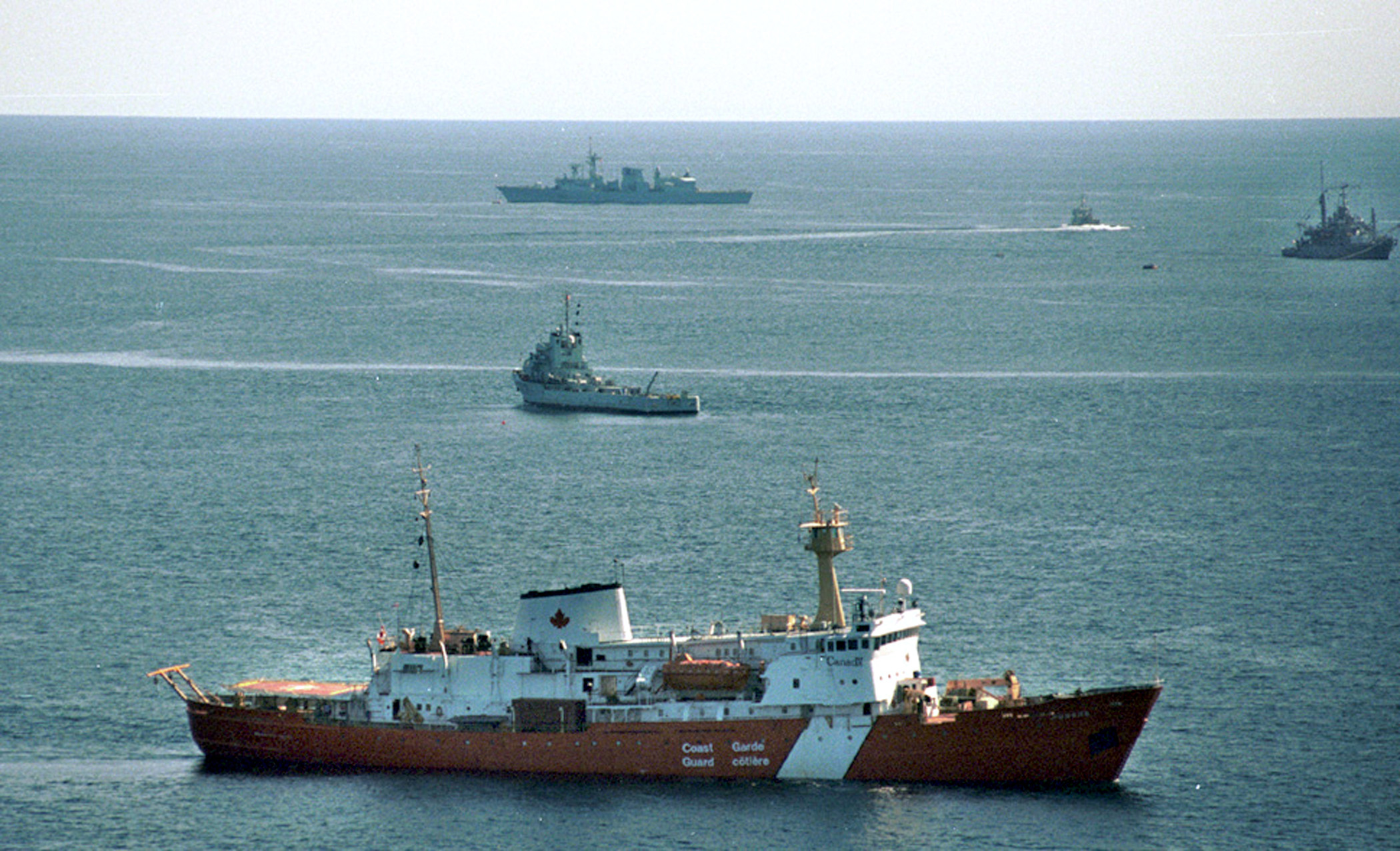
Canadian Coast Guard (also) Undermanned and Underfunded

980914-N-8492C-005 PEGGYÕS COVE, Nova Scotia (Sept. 14, 1998) Ð- Canadian Coast Guard Cutter CCGV Hudson (front) conducts Laser Line Scanning (LLS) operations with the lasted in US Navy developed high-tech equipment at the crash site of SwissAir Flight 111. US Navy photo by PhotographerÕs Mate 1st Class Todd P. Cichonowicz. (RELEASED)

980914-N-8492C-005
PEGGYÕS COVE, Nova Scotia (Sept. 14, 1998) Ð- Canadian Coast Guard Cutter CCGV Hudson (front) now the oldest major vessel in the Canadian Coast Guard, conducts Laser Line Scanning (LLS) operations with the latest in US Navy developed high-tech equipment at the crash site of SwissAir Flight 111. US Navy photo by PhotographerÕs Mate 1st Class Todd P. Cichonowicz. (RELEASED)

Professional Mariner has reported that a Transport Canada report found the Canadian Coast Guard ” …fleet is undermanned and desperately in need of new ships” and “that unplanned maintenance on aging Coast Guard vessels skyrocketed in 2014.”

My first reaction was of course that they have the same problems we do, but looking at the history of Canadian Coast Guard ship building it is apparent that while none of their ships are over 53 years old, with those built in the 80s the largest group, so maybe they are slightly better off. On the other hand, there was almost no large ship construction in the 1990s or later so they are facing block obsolescence.

I took a look at the documents. I have to admit, I did not read them all. They cover all modes and aspects of transportation. Volume One (pdf) is the basic report and it is 286 pages, and Volume Two (pdf) is the Appendices and it is 230 pages. However, I did use the search function to find every mention of Coast Guard and there were some interesting aspects.

For one thing, the Canadian Coast Guard is partially funded by user fees. The report then goes on to both complain that the user fees have not been raised since established and consequently have not kept up with rising demand and costs, and then also points out that user fees tend to make Canada less competitive. There is not a clear recommendation on this point.

“The government introduced user fees to recover part of the costs for navigation services, which have not changed since 1998. Approximately 15 to 30 percent of the Canadian Coast Guard’s operating costs ($27 million out of $190 million) are recovered from industry (see Figures 9 and 10); icebreaking fees are separate.”

They have a strong justification for the Coast Guard in claiming its inadequacies hurt Canada’s economic competitivenes.

“The underfunding of the Coast Guard seriously hampers its ability to discharge its mandate, which adversely affects Canada’s international competitiveness and trade. (p.13)”

The report finds that the Canadian Coast Guard’s lack of law enforcement authority (and implicitly weapons to back up that authority) results in inefficiencies.

“The Canadian Coast Guard As noted above, the Canadian Coast Guard is responsible for the safe and efficient movement of ships in Canadian coastal and inland waters. Canada is unusual in having a civilian coast guard. In other northern jurisdictions, such as Denmark, Greenland, Norway, Iceland, Finland, and Russia, and in the United States, the coast guard is a military or security organization. As a civilian body, the Canadian Coast Guard does not have the authority to enforce international and national laws and regulations pertaining to the sea, the environment, and sovereignty without RCMP officers present, even though Canadian Coast Guard vessels and staff may be the best placed to respond to critical events and detect illegal activity. This has resulted in an inefficient enforcement regime. Canada has also been slow to use maritime transport to promote development and strengthen sovereignty. Canada must ensure that it meets the challenges of increased maritime traffic in the Arctic, the St. Lawrence, the Great Lakes, the Seaway, the Pacific and the Atlantic. Because of existing governance arrangements and inadequate funding, the Canadian Coast Guard is not currently well equipped to do so.” (p.220)

The report found that current ship building plans including the requirement to buy Canadian would not addressing the problem of an aging fleet.

“As noted above and as depicted in Figures 1, 2 and 3, the Canadian Coast Guard fleet is aging, which has implications for maintenance as well as procurement. Given that 29 percent of the large vessels are more than 35 years old and close to 60 percent of small vessels are older than the design life of 20 years, it is not surprising that the number of major systems repairs required is increasing, vessel days are decreasing, and the number of ships out of service is increasing over time. The decrease in 2009 was as a result of money dedicated for repairs paid by the Economic Action Plan. Indeed, for such a critical piece of transportation infrastructure, the Canadian Coast Guard is not receiving the political attention, or the administrative and financial resources it requires. In 2014, the Commissioner of the Environment and Sustainable Development found that the Canadian Coast Guard’s icebreaking presence in the Arctic is decreasing, while vessel traffic is increasing.26 In response, the Canadian Coast Guard, Transport Canada, and the Canadian Hydrographic Service are currently advancing the Northern Marine Transportation Corridors Initiative to support responsible marine development, enhance marine navigation safety, and guide future Arctic investments.27 In addition, the 2015 Report of the Independent Review of the M/V Marathassa Fuel Oil Spill Environmental Response Operation found that the Canadian Coast Guard lacked adequate staff to respond in any part of its region at any time.28 Not only is it understaffed, but its fleet is one of the oldest in the world and urgently requires renewal (individual ships average nearly 34 years of age).29 Without such renewal it will have to pull ships from service, further reducing reliability. However, under the National Shipbuilding and Procurement Strategy, which requires the Canadian Coast Guard to purchase ships from Canadian shipyards, it can only replace one ship a year, at most. At that rate, the median age of the fleet will not decrease. Other strategies, such as outsourcing or leasing, are not part of the strategy and thus cannot be deployed to meet short-term requirements. (p.221)

There may be beaurocratic power grab here, in that Transport Canada seems to want the Canadian Coast Guard transferred under it purview rather than the Department of Fisheries and Oceans. In fact the Canadian Coast Guard had been an agency of the Department of Transportation until 1994 when it was moved to Fisheries and Oceans.

“We have been concerned for some time that the separate and distinctive roles of Transport Canada and the Canadian Coast Guard [make for] a less than efficient model for a coordinated and timely response to a maritime emergency. The situation is further compounded by CCG having been placed under the administration of the Department of Fisheries and Oceans whose role has little in common with that of CCG.” “p.231)

The Canadian Coast Guard is organizationally a mid-point between the single agency multiple tasked broad authority USCG model and the multiple specialized agencies UK model. In some respects it also incorporates elements that would correspond to duties performed in the US by NOAA and National Marine Fisheries. Apparently it, like the USCG has had a problem fitting in any one department because of its multiple missions. While it is under the Department of Fish and Oceans, since 2005 it has been designated a “special operating agency” with greater autonomy.

Notably the prevailing Canadian attitude seems to be that, if anything, the CCG needs to be given weapons and law enforcement authority, bringing it closer to the USCG model, so perhaps it is an endorsement of sorts, for the way the USCG is structured.

Perhaps the USCG needs to be a “special operating agency” or “independent agency” as it is called in the US, as well; after all, there are already 27 (or more) of them, but that is a topic for another day.

Thanks to Lee for bringing this to my attention.

Argentine Coast Guard Sinks Chinese Fishing Vessel

This Video does not appear to show the sinking of the fishing vessel. Speckles on the hull of the F/V seen at time 0:20 and 0:50 may be bullet holes. The video does appear to show the participants.  

We have reports (here and here) that the Argentine Coast Guard (Prefectura Naval Argentina (PNA)) fired on and sank a Chinese fishing vessel (F/V), the Lu Yan Yuan Yu 010, believed to have been fishing illegally, after the F/V failed to stop after shots were fired across its bow and it allegedly attempted to ram the Coast Guard vessel. The crew reportedly was rescued, without fatalities, four by the Argentine vessel and the rest of the crew by another Chinese F/V.

ArgentineCutter

Photo by Diegoventu: PNA Doctor Manuel Mantilla (GC-24), a sistership of the Argentine vessel involved.

The PNA vessel seen in the video, Prefecto Durbes (GC-28) is one of five offshore patrol vessels (OPVs) built in Spain for Argentina. The Mexican Navy also has six similar vessels with larger flight decks and more powerful engines. In size they slot between the Reliance Class and the Bear Class, being 67 meters (220 feet) overall. Unlike the Reliance class, they have a hangar for their version of the H-65.

In addition to machine guns, these ships are reportedly armed with a Bofors 40mm/70, but looking at the video, the location where the gun was mounted (on the platform forward of the bridge and one deck above the foc’sle) is vacant. This suggest that the damage was probably done by .50 cal. machine guns. We know from our Vietnam experience that .50 cal. can sink fishing vessels, but the ranges are very short. Looking at the video the ships appeared to be no more than 300 yards apart.

It is a bit surprising no casualties were reported, although the reports say no fatalities, they do not say no injuries so that is still a possibility. Did the crew of the OPV order the Chinese crew to abandon before sinking the F/V, or did they perhaps tell them where they were not going to shoot so that the crew could assemble safely? It does not sound like it. We have only this statement from an Argentine representative that after actions by the Chinese vessel,  “…the order was given to fire on different sections of the vessel, damaging it,” It is unlikely, but not impossible, the crew helped the ship sink to destroy any evidence of wrong doing.