US Navy Securing the Southern Border?

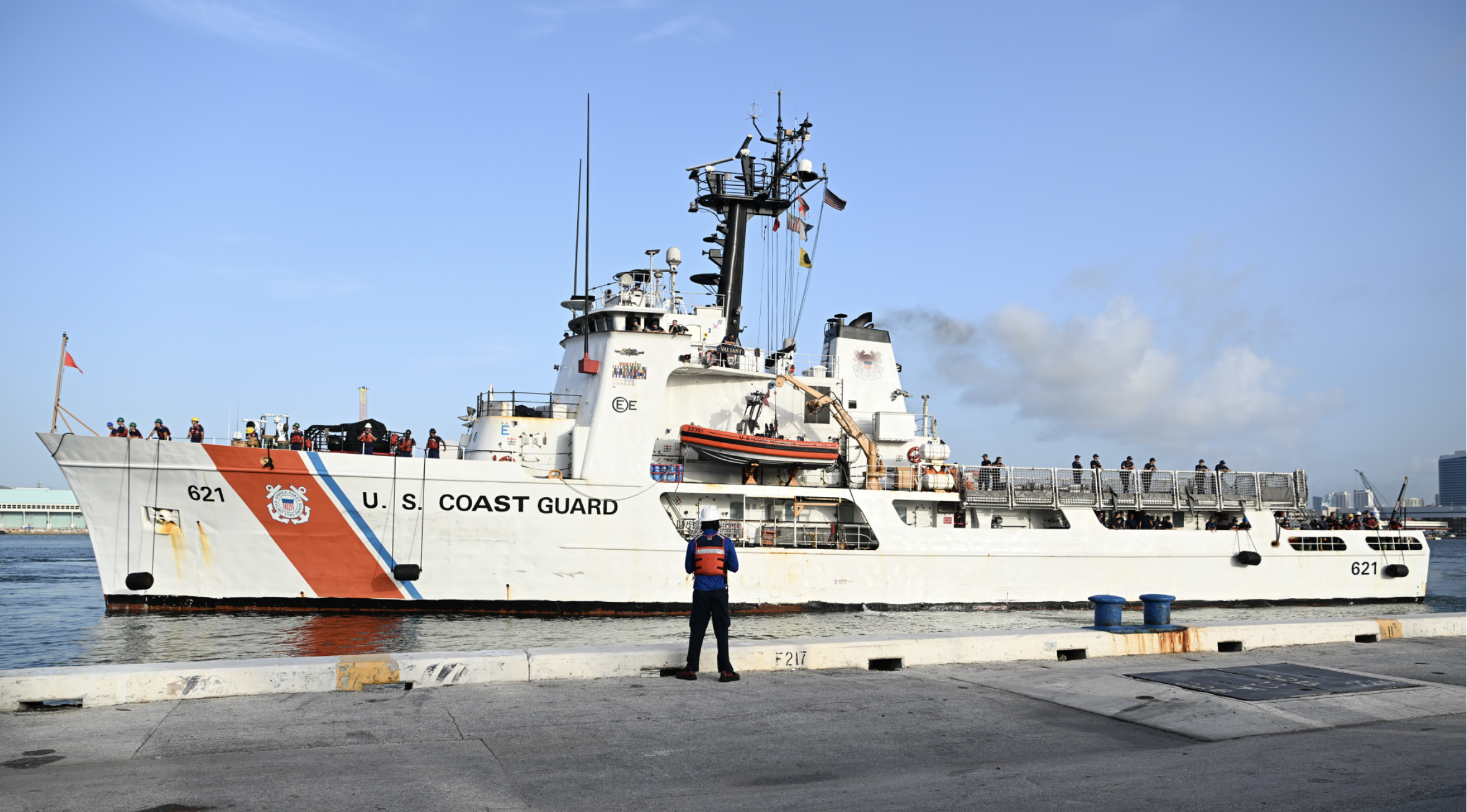
USCGC Valiant (WMEC 621) crew moors at Port Everglades in Fort Lauderdale, Florida, June 6, 2025. The Valiant crew offloaded more than $132 million in illicit drugs interdicted in the Caribbean Sea. (U.S. Coast Guard photo by Petty Officer 1st Class Diana Sherbs)

Below the line is a Coast Guard News release. 

It includes a report of offload of drugs seized by USS Gravely.

Since March the Navy has kept two or three ships deployed to “secure the Southern Border” against illegal immigration and drug smuggling.

Departures of US Navy destroyers were widely reported, frequently with implications that the Coast Guard had not been paying attention to the Southern border or that the Coast Guard was incapable. Center for Strategic and International Studies stated,

First and foremost, the deployments send a powerful signal that the United States is taking border security, and the Western Hemisphere more broadly, seriously. In a statement from U.S. Northern Command (NORTHCOM) upon deployment of the Spruance, the ships will “restore territorial integrity at the U.S. southern border” and will support operations related to “combating maritime related terrorism, weapons proliferation, transnational crime, piracy, environmental destruction, and illegal seaborne immigration.” The tasking of some of the United States’ most exquisite naval capabilities to support Southwest border operations accordingly provides yet another indicator that a strategic pivot to the Western Hemisphere in general, and the U.S.-Mexico border in particular, is well underway.

The DDGs are marvelous ships as demonstrated by their performance against the Houthis in the Red Sea. Their more sophisticated sensors were also touted, but the results have been underwhelming.

Results:

So what happened? Let’s give credit where credit is due.

Guided missile destroyers involved, as far as I can determine, have been USS Gravely, USS Spruance, USS Stockdale which replaced Spruance in mid April, USS Cole which very recently replace Gravely, and Sampson which just replaced Stockdale.

As far as I can tell, the interdiction of 840 pounds of cocaine valued $13.7M by USS Gravely, which deployed March 15, reported below, is the only interception of drugs reported by a destroyer in the almost three months since their intervention began.

By comparison:

USS Minneapolis-Saint Paul (LCS-21) which deployed March 25 has made three interdictions. USS Charleston Deployed May 21. I presume she is replacing Minneapolis-Saint Paul. The first two resulted in seizure of 580 kilograms (1,279 pounds) of cocaine valued at $9,463,860 and 1,125 kilograms (2,480 pounds) of marijuana valued at $2,807,360. I was not able to find similar figures for the third.

In an earlier post I posted the results of drugs landed on thirteen different occasions from February 13 to May 2, 2025 comparing interdictions in the Eastern Pacific with those made in the Atlantic, Gulf, and Caribbean. In total 168,574 pounds or more than 84 tons, valued at $1,702.9 million. There have been additional offloads since then including the one below.

That is 196 times as much as was seized by Navy Destroyers. Only a very small part of which was marijuana rather than cocaine, none of which was seized in the Eastern Pacific. Notably no Fentanyl was included.

Our Canadian and Netherlands Navy partners each seized more contraband than the US Navy this period.

Why the poor showing?:

Functionally the DDGs should have been at least as effective as other units doing this mission, so why weren’t they more effective?

I think because they were looking in the wrong place.

Early announcements seem to indicate they primarily being deployed primarily to interdict immigrants with drug interdiction a secondary mission, but as I noted in the earlier post,

Perhaps surprisingly, cutters in the Western Atlantic areas looking for drugs don’t intercept many migrants and cutters looking for migrants don’t find much in the way of drugs or even migrants. There were four WMEC patrols identified as looking for migrants. None of the four found any drugs. One intercepted no migrants. The three remaining patrols intercepted a total of 184.

The West coast deployment seems to have been in vicinity of San Diego. Most drug interdictions in the Pacific happen off the Central and South American coast.

There has been something of a surge in maritime illegal migrant interdictions on the West Coast but they have been concentrated close to shore near San Diego and the Mexican border, using recreational style small craft, but the totals are still relatively small.

As far as I have heard (and I think I would have) none of the US Navy ships have intercepted any immigrants.

Other thoughts:

Any assistance the Navy might provide is always welcome, but any implication that the Coast Guard has not been working the problem with considerable success, limited only by resources available, is unfair. There simply is no such thing as 100% secure.

The Navy has also provided additional ISR resources. Both the Navy and Coast Guard can only benefit from better Maritime Domain Awareness even if the information is used for different purposes.

Having an alert, active DDG positioned off US naval bases (like San Diego) might be a good idea since, as yet, we really have no land based missile defenses capable of countering cruise missiles that might be launched from container ships in an initial surprise attack.


June 6, 2025

Coast Guard offloads more than $138 million in illicit drug interdictions in Caribbean Sea

Coast Guard Seventh District – 786-367-7649

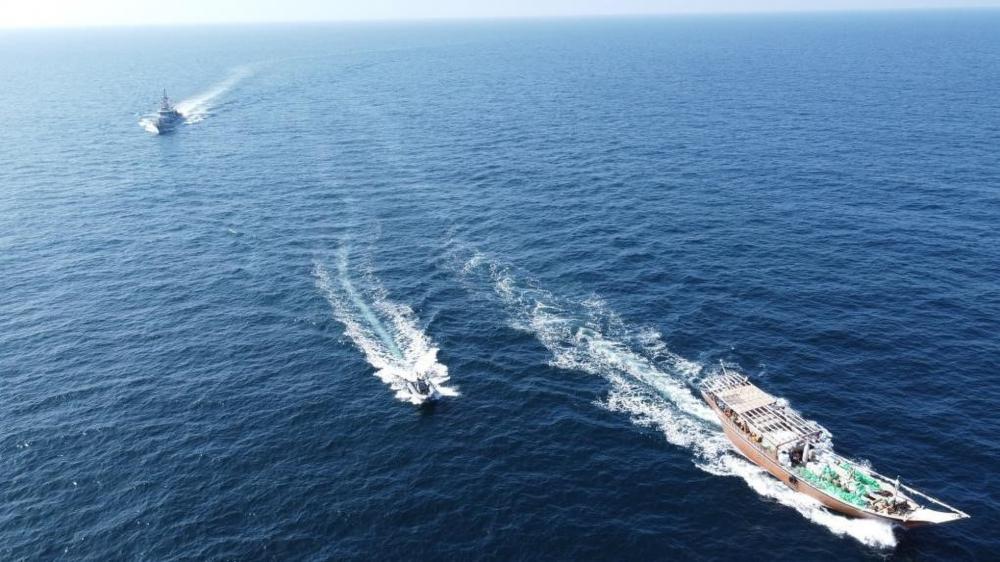
MIAMI –U.S. Coast Guard Cutter Valiant’s crew offloaded 17,450 pounds of cocaine and 2,585 pounds of marijuana worth $132 million, Friday, at Port Everglades.

U.S. Coast Guard Cutter Vigorous crew offloaded approximately 840 pounds of cocaine worth an estimated $6.2 million, Thursday, at Coast Guard Base Miami Beach.

The seized contraband was the result of six interdictions in the Caribbean Sea by Coast Guard and interagency partners.

“I am incredibly proud of our Valiant team and how they exemplify American values. They sacrifice time away from their families and when necessary, put themselves in harm’s way to secure our borders and protect the American people,” said Cmdr. Matthew Press, commanding officer of Valiant. “Collaborating with the United States Navy, Royal Canadian, and Royal Netherlands Navies, our multinational team disrupted transnational criminal organizations making the world a safer place.”

On May 19, a maritime patrol aircraft located a suspicious vessel approximately 85 miles north of Aruba. Valiant’s crew interdicted the vessel and seized approximately 2,645 pounds of cocaine.

On May 22, a maritime patrol aircraft located a suspicious vessel approximately 170 miles north of Aruba. Valiant’s crew interdicted the vessel and seized approximately 7,750 pounds of cocaine.

On May 25, a maritime patrol aircraft located a suspicious vessel approximately 290 miles south of the Dominican Republic. USS Gravely’s crew and embarked U.S. Coast Guard Law Enforcement Detachment 401 interdicted the vessel and seized approximately 840 pounds of cocaine. The narcotics were transferred to the Vigorous.

On May 29, a maritime patrol aircraft located a suspicious vessel approximately 140 miles south of the Dominican Republic. His Majesty’s Canadian Ship William Hall’s crew and embarked Coast Guard LEDET 103 interdicted the vessel and seized approximately 750 pounds of cocaine. The narcotics were transferred to the Valiant.

On May 29, a maritime patrol aircraft located a suspicious vessel approximately 15 miles north of Venezuela. The Royal Netherlands Navy ship HNLMS Friesland crew and embarked Coast Guard LEDET 404 interdicted the vessel and seized approximately 4,050 pounds of cocaine and 2,585 pounds of marijuana. The narcotics were transferred to the Valiant.

On May 31, a maritime patrol aircraft located a suspicious vessel approximately 185 miles north of Colombia. HMCS William Hall’s crew and embarked Coast Guard LEDET 103 interdicted the vessel and seized approximately 2,250 pounds of cocaine. The narcotics were transferred to the Valiant.

The following crews assisted with interdiction operations:

Detecting and interdicting illicit drug traffickers on the high seas involves significant interagency and international coordination. Joint Interagency Task Force-South, in Key West, conducts the detection and monitoring of aerial and maritime transit of illegal drugs. Once an interdiction becomes imminent, the law enforcement phase of the operation begins, and control of the operation shifts to the U.S. Coast Guard for the interdiction and apprehension phases. Interdictions in the Caribbean Sea are performed by members of the U.S. Coast Guard under the authority and control of the Seventh Coast Guard District, headquartered in Miami.

These interdictions relate to Organized Crime Drug Enforcement Task Forces’ Strike Force initiatives and designated investigations. OCDETF identifies, disrupts, and dismantles the highest-level criminal organizations that threaten the United States using a prosecutor-led, intelligence-driven, multi-agency approach. Additional information about the OCDETF program can be found at https://www.justice.gov/OCDETF.

USCGC Valiant is a 210-foot medium endurance cutter homeported in Jacksonville under U.S. Coast Guard Atlantic Area Command.

USCGC Vigorous is a 210-foot medium endurance cutter homeported in Virginia Beach, Virginia under U.S. Coast Guard Atlantic Area Command.

For breaking news, follow us on X (formerly Twitter). For additional information, find us on Facebook and follow us on Instagram.
“U.S. Navy Expands Maritime Border Security Mission with USS Stockdale Deployment” –gCaptain

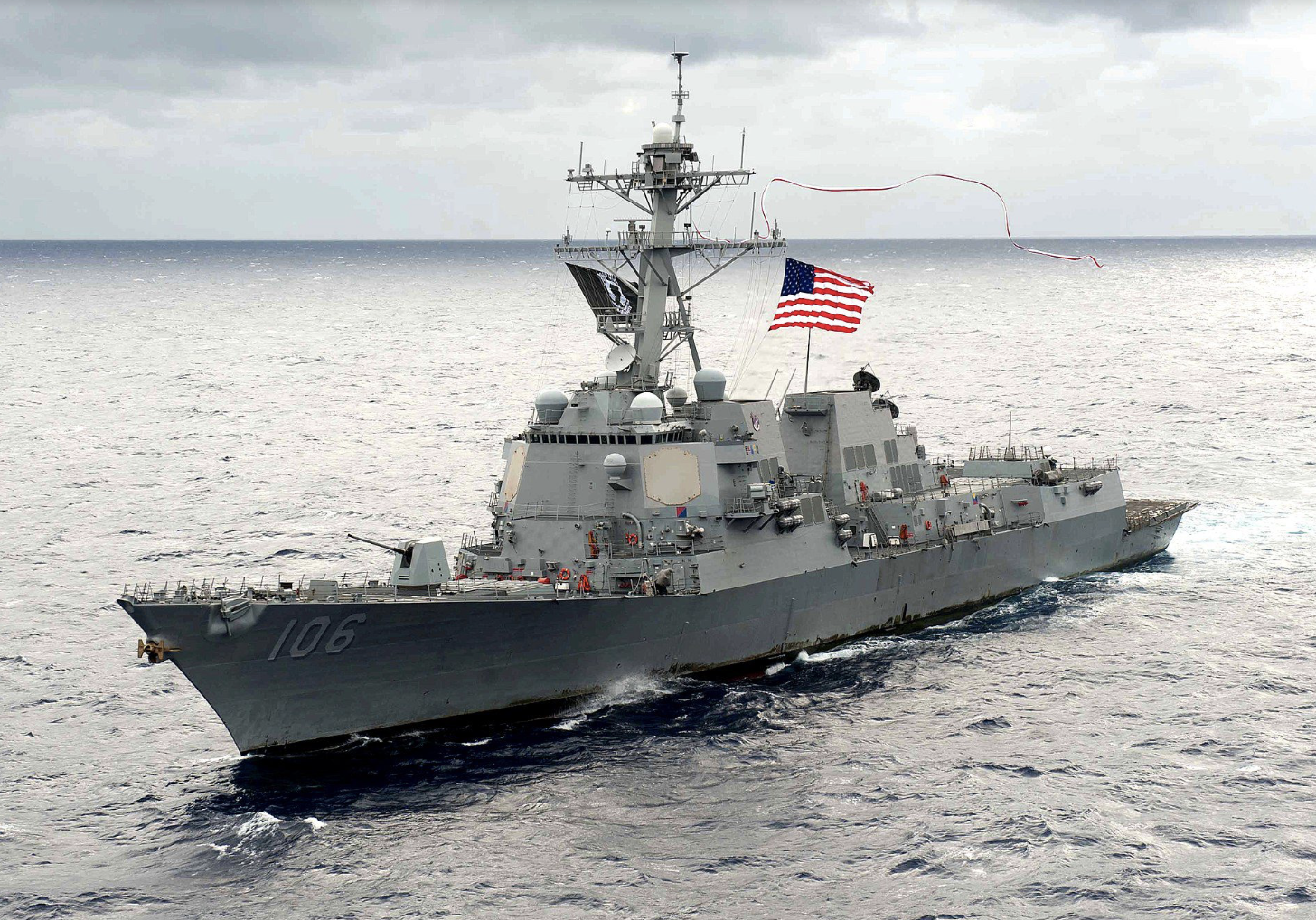
USS Stockdale (DDG 106). U.S. Navy File Photo

gCaptain reports,

“The US Navy continues to strengthen its southern border security presence with the deployment of USS Stockdale (DDG 106), which departed Naval Base San Diego on April 11, 2025. The Arleigh Burke-class guided-missile destroyer takes over duties from USS Spruance in supporting U.S. Northern Command’s (USNORTHCOM) border security operations.”

There has been a long standing pattern of cruisers and destroyers deploying with and staying close to carriers, but increasingly it seems, the Navy is also using cruisers and destroyers as independent units and not just in support of Coast Guard interdiction efforts.

In addition to USS Spruance (DDG-111) and its replacement, USS Stockdale (DDG-106) on the West Coast and USS Gravely (DDG-107) on the Gulf coast supporting the Coast Guard, on March 15 USS Truxtun (DDG 103) departed Norfolk for independent operations. USS Chosin (CG-65) was in Panama and USS Normandy was off Guyana.

These are large and powerful ships, each with 90 to 122 vertical launch cells, some of which may be loaded with Tomahawk land attack cruise missiles.

Those operating off the US coast also provide a degree of protection US ports do not normally have.

“Navy’s Digital Horizon exercise showcases power of ‘mesh networks,’ AI” –Defense News

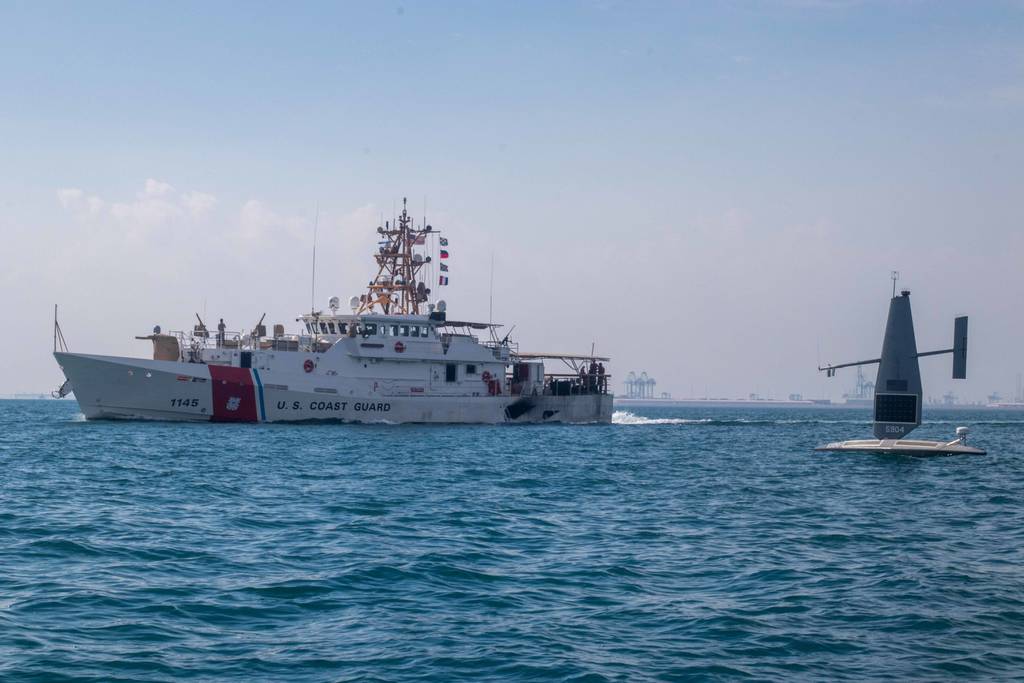
A Saildrone Explorer unmanned surface vessel operates alongside U.S. Coast Guard fast response cutter USCGC Emlen Tunnell (WPC 1145) in the Arabian Gulf, Nov. 29, during Digital Horizon 2022. (Sgt. Brandon Murphy/US Army)

Defense News reports on 5th Fleet’s “Digital Horizon” exercise.

“We have done a lot of work with AI previously, and we’ve done computer vision, we’ve done anomalous behavior detection, we’ve done AI-enabled [command and control], but we’ve done all of those separately,” the commodore explained. “At Digital Horizon, for the first time ever, we did that together on a single stack, and that’s all integrated on a single pane of glass.”

They have been trying a number of new systems, “10 of which are being operated in 5th Fleet for the first time.” We got a look at a portion of this exercise earlier, “Task Force 59 Launches Aerial Drone from Coast Guard Ship in Middle East” –NAVCENT. Also, among the systems they tested was V-Bat UAS.

There is also confirmation here that a similar effort will be going into 4th Fleet (Latin American/Caribbean Waters); that it will involve partner nations; and that it will look at IUU fishing as well as drug interdiction.

Fortunately, it looks like Coast Guard personnel and assets have been intimately involved in this effort and it looks like it will benefit our Maritime Domain Awareness (MDA) efforts.

(Will the Coast Guard’s next class of ships be USV tenders?)

“Navy to establish additional unmanned task forces inspired by Task Force 59” –Defense Scoop

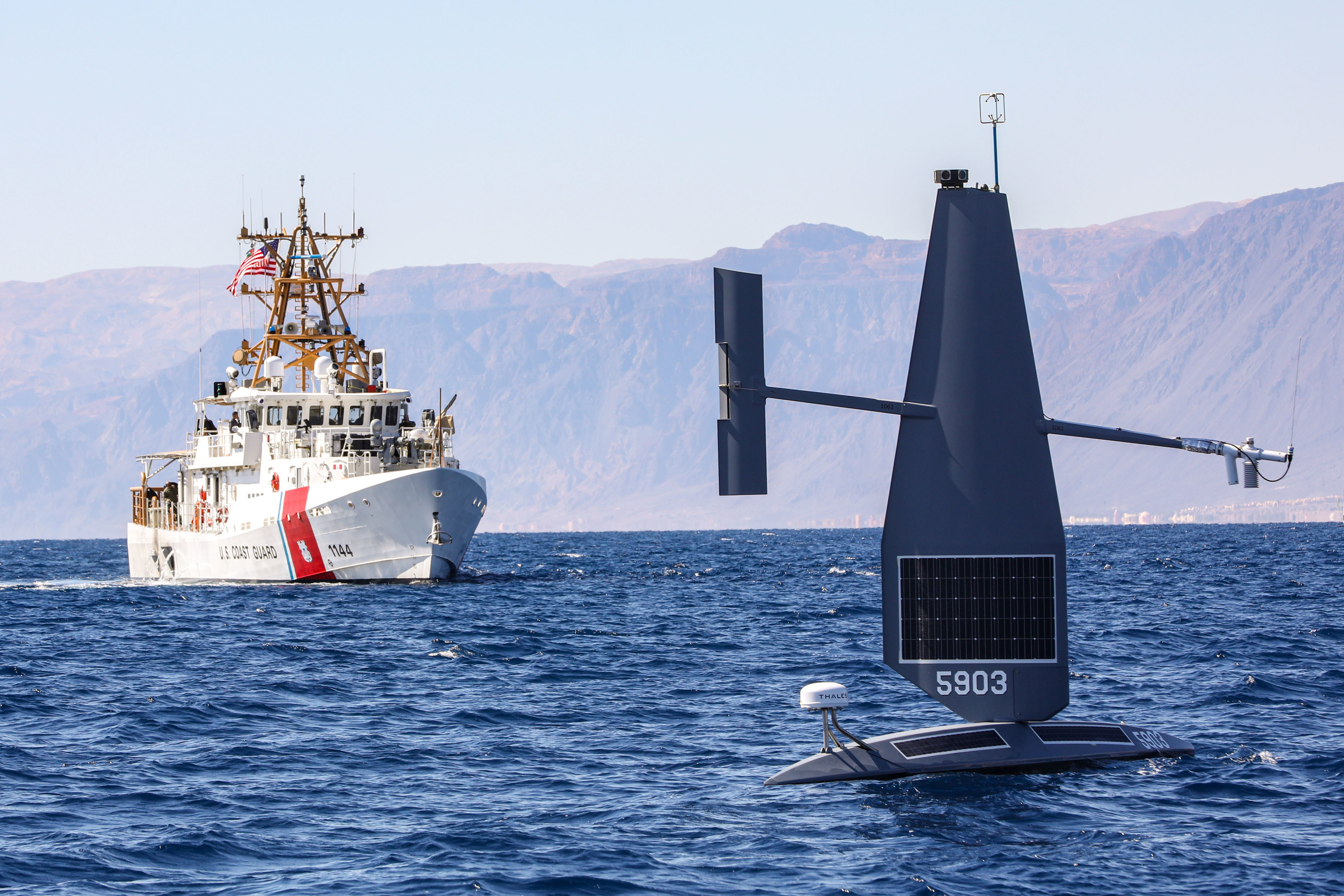
GULF OF AQABA (Feb. 13, 2022) The U.S. Coast Guard Sentinel-class cutter USCGC Glen Harris (WPC 1144) sails near a U.S sail drone explorer during the International Maritime Exercise/Cutlass Express (IMX) 2022, Feb. 13, 2022. IMX/CE 2022 is the largest multinational training event in the Middle East, involving more than 60 nations and international organizations committed to enhancing partnerships and interoperability to strengthen maritime security and stability. (U.S. Army photo by Cpl. DeAndre Dawkins)

Defense Scoop reports:

“The Navy plans to stand up additional unmanned task forces around the globe modeled after Task Force 59 in the Middle East, Navy Secretary Carlos Del Toro told reporters Saturday…“We’ve demonstrated with Task Force 59 how much more we can do with these unmanned vehicles — as long as they’re closely integrated together in a [command and control] node that, you know, connects to our manned surface vehicles. And there’s been a lot of experimentation, it’s going to continue aggressively. And we’re going to start translating that to other regions of the world as well,” Del Toro said during a media roundtable at the Reagan National Defense Forum.”

The report goes on to mention 4th Fleet and Oceana specifically, both regions of intense interest to the Coast Guard in regard to drug interdiction and Illegal, Unregulated, Unreported (IUU) fishing respectively.

This could be a big boost to our Maritime Domain Awareness. In the Eastern Pacific Drug Transit Zone we might need uncrewed surface vessels with passive acoustic sensors since the targets of interest are poor targets for radar and optical sensors. That could lead to practical experience that could improve our ASW capability.

“U.S. Naval Forces Intercept Explosive Material Bound for Yemen” –CENTCOM

USCGC John Scheuerman (WPC-1146) and USCGC Clarence Sutphin Jr. (WPC-1147) enroute PATFORSWA

Below is from the U.S. Naval Forces Central CommandCombined Maritime Forces – U.S. 5th Fleet website

U.S. Naval Forces Intercept Explosive Material Bound for Yemen

By U.S. Naval Forces Central Command Public Affairs | November 15, 2022

MANAMA, Bahrain —

On Nov. 8, U.S. 5th Fleet intercepted a fishing vessel in the Gulf of Oman smuggling lethal aid, including a large quantity of explosive material, from Iran to Yemen.

U.S. Coast Guard ship USCGC John Scheuerman (WPC 1146) (emphasis applied–Chuck) and guided-missile destroyer USS The Sullivans (DDG 68) interdicted the vessel as it transited international waters. Patrol coastal ship USS Hurricane (PC 3) and Navy explosive ordnance disposal technicians from U.S. 5th Fleet’s Task Force 56 also assisted during a weeklong effort to fully search the vessel and verify the type of material found.

U.S. forces discovered more than 70 tons of ammonium perchlorate, a powerful oxidizer commonly used to make rocket and missile fuel as well as explosives. This is U.S. 5th Fleet’s first ever interdiction of ammonium perchlorate.

“This was a massive amount of explosive material, enough to fuel more than a dozen medium-range ballistic missiles depending on the size,” said Vice Adm. Brad Cooper, commander of U.S. Naval Forces Central Command, U.S. 5th Fleet and Combined Maritime Forces. “The unlawful transfer of lethal aid from Iran does not go unnoticed. It is irresponsible, dangerous and leads to violence and instability across the Middle East.”

The search also found more than 100 tons of urea fertilizer. Urea is a chemical compound with agricultural applications that is also known for use as an explosive precursor.

The vessel and its four Yemeni crewmembers were intercepted while transiting from Iran along a route historically used to traffic weapons to the Houthis in Yemen. The direct or indirect supply, sale or transfer of weapons to the Houthis violates U.N. Security Council Resolution 2216 and international law.

U.S. forces sank the vessel Nov. 13 in the Gulf of Oman after determining it was a hazard to navigation for commercial shipping. The four crewmembers were transferred to Yemen for repatriation Nov. 15 when The Sullivans completed an at-sea exchange in the Gulf of Aden with the Yemen Coast Guard.

“Alongside our partner forces, CENTCOM is committed to security and stability of the region and to deterring the illegal and destabilizing flow of lethal material into the region over land, in the air, and the sea,” said Gen. Michael “Erik” Kurilla, U.S. Central Command (CENTCOM) commander.

U.S. 5th Fleet previously seized 40 tons of urea fertilizer Jan. 18 when guided-missile destroyer USS Cole (DDG 67) and patrol coastal ship USS Chinook (PC 9) interdicted a another fishing vessel in the Gulf of Oman that had attempted to smuggle illicit weapons off the coast of Somalia months earlier.

The U.S. 5th Fleet operating area includes 21 countries, the Arabian Gulf, Gulf of Oman, Red Sea, parts of the Indian Ocean and three critical choke points at the Strait of Hormuz, Bab al-Mandeb and Suez Canal.

“U.S. forges maritime technology collaborations to improve domain awareness” –Indo-Pacific Defense Forum

The Indo-Pacific Defense Forum brings us news of a Navy sponsored Maritime Domain Awareness program that may be very useful to the Coast Guard.

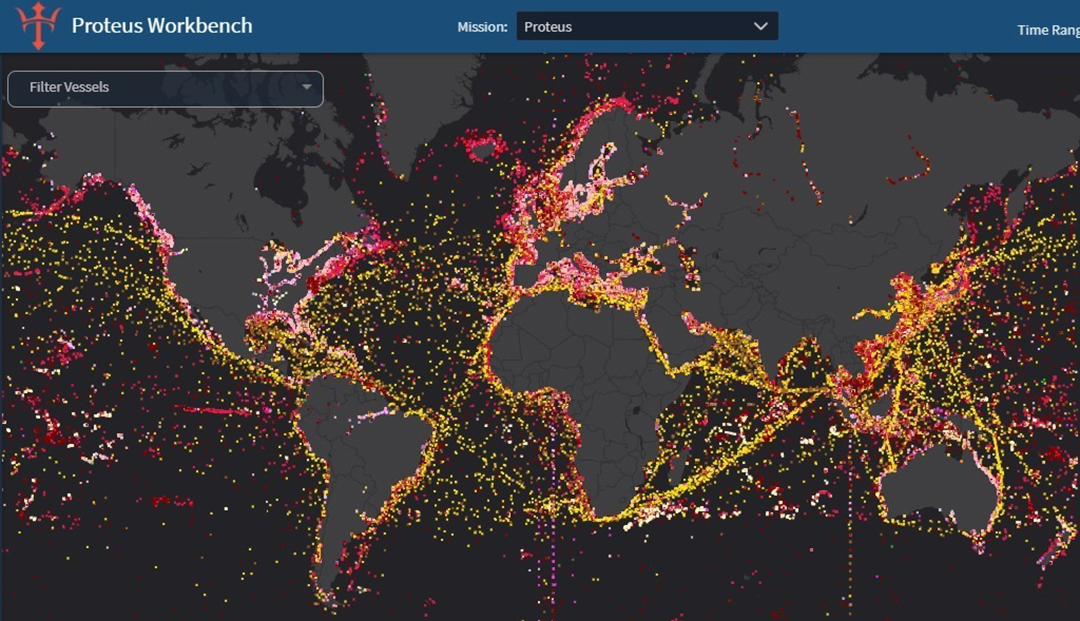
Recent successes include the U.S. Naval Research Laboratory’s (NRL’s) new program, called Proteus, to identify, query and filter maritime vessels based on user-defined criteria and the Defense Innovation Unit’s (DIU’s) international competition, known as xView3, to create machine learning models to locate and distinguish maritime vessels with synthetic aperture radar.

“Artificial intelligence combined with satellite imagery provides a new capability to detect suspected IUU fishing vessels that may otherwise elude U.S. and partner nations fisheries enforcement agencies. This increased maritime domain awareness can be shared with like-minded partner nations to enable them to protect their sovereignty.”

The NRL’s Proteus software, pictured, monitors sea vessels so stakeholders can “collaboratively discover and investigate suspicious and illegal maritime activity throughout the world in ways never before possible,” said Cameron Naron, the U.S. Maritime Administration’s maritime security director.

A description here by the US Naval Research Laboratory.

“PROTEUS is an exciting new U.S. government Maritime Domain Awareness (MDA) system providing a powerful array of MDA information and analysis tools,” said Cameron Naron, Director of Maritime Security, US Maritime Administration. “This system enables MDA stakeholders to collaboratively discover and investigate suspicious and illegal maritime activity throughout the world in ways never before possible.”

  • Additional actions supported by PROTEUS include: Counter Illegal, Unreported, and Unregulated Fishing (IUUF)
  • Maritime Protected Areas (MPAs)
  • Search and Rescue (SAR)
  • Critical Infrastructure Protection
  • Environmental Protection & Response
  • Maritime Law Enforcement
  • Counter smuggling (drugs, weapons, money, people)

This could be of assistance to any nation attempting to counter Illegal, Unregulated, Unreported fishing, including the island nations of the Western Pacific, who are desperately short on resources to monitor their ocean assets.

“Want to stop a Drug Smuggling Boat? Try out a High Power Microwave Weapon Systems” –Marine Link

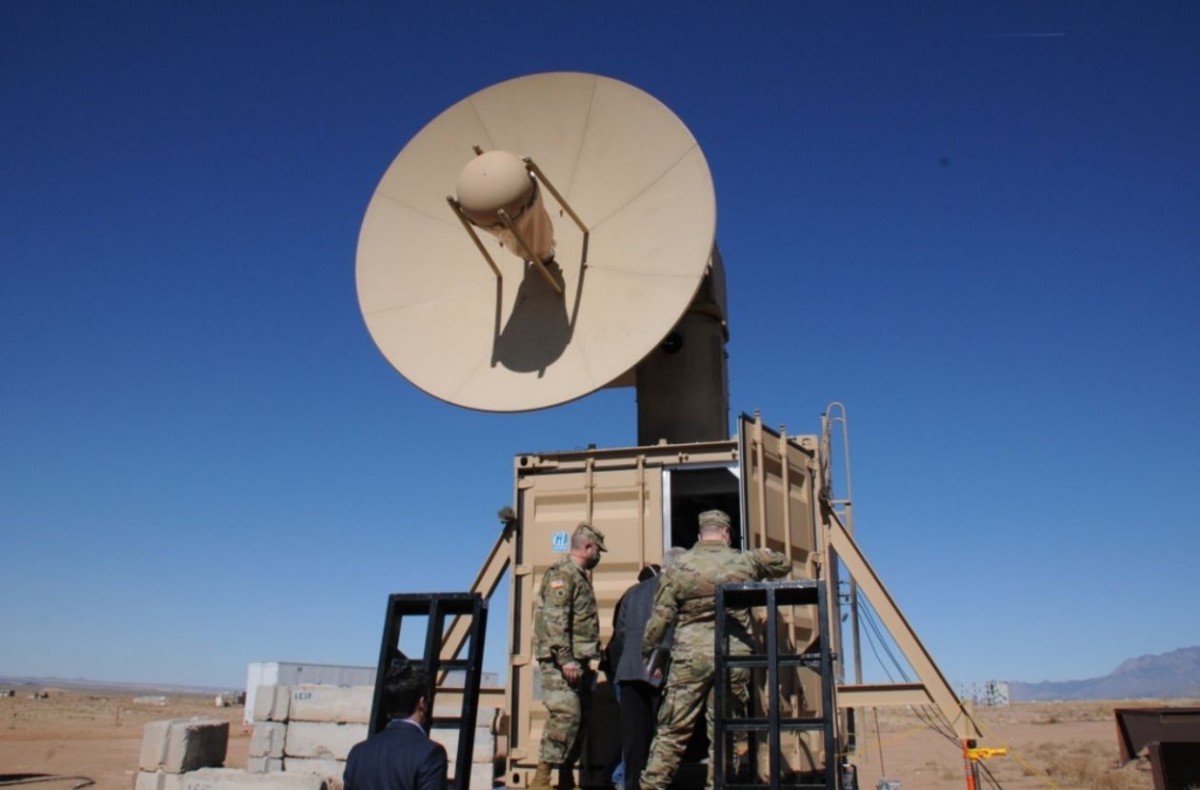
MarineLink reports that the Naval Surface Warfare Center Dahlgren Division has been working on high power microwave systems as a way to stop no compliant vessels, and they want the Coast Guard to try it out.

“We are looking to provide the U.S. Coast Guard with an HPM system for a one-year operational utility assessment,” said Pete Cacciola, a project lead for vessel stopping efforts in the HPM Weapon Systems Division. “Our goal is to give them another tool in their toolbox for noncompliant vessel interdiction.”…HPM weapon systems, a type of directed energy weapon system, operate by generating and transmitting extremely high electrical power levels, focused on specific frequencies and directed by steerable antenna systems. The result to a target is disruption or destruction of key components, rendering the target inoperable with little or no effect on personnel.

Such systems are also likely to be useful against unmanned air systems (drones), also an emerging Coast Guard concern.

“US Navy Seizes Weapons from Fishing Vessel in the Arabian Sea” –DVIDS

U.S. Navy Seizes 1,400 Assault Rifles During Illicit Weapons Interdiction

NORTH ARABIAN SEA (Dec. 20, 2021) U.S. service members from patrol coastal ship USS Typhoon (PC 5) interdict a stateless fishing vessel carrying illicit weapons while transiting international waters in the North Arabian Sea, Dec. 20. (U.S. Navy photo)

Below is a press release from Defense Visual Information Distribution Service (DVIDS). The boarding team was apparently Coast Guard. It’s likely the Webber class WPCs assigned to PATFORSWA will be doing this sort of work since the Navy PCs are being decommissioned.


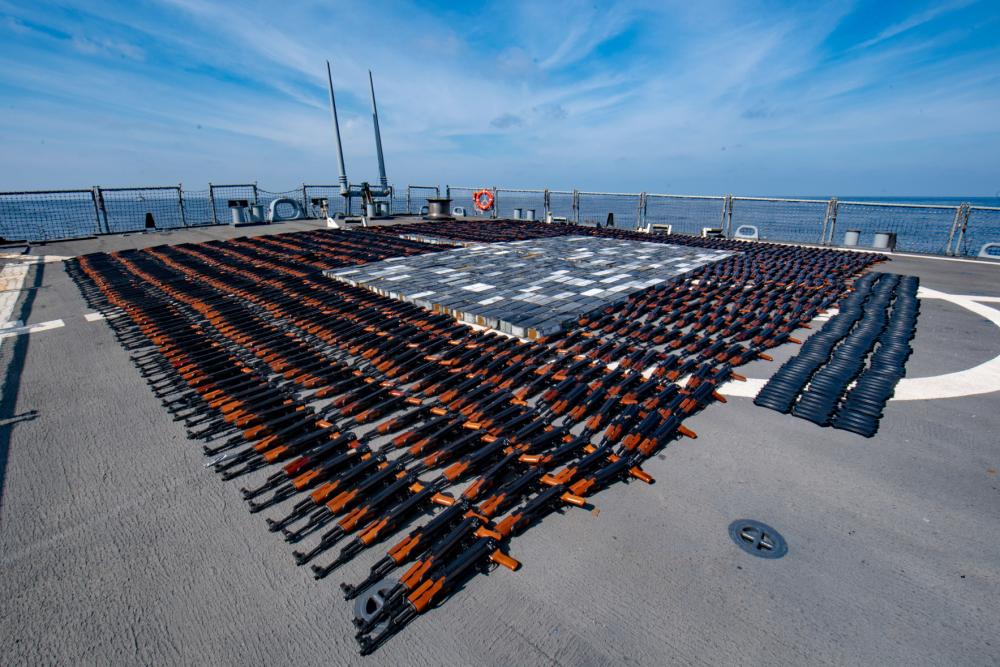
U.S. 5th Fleet ships seized approximately 1,400 AK-47 assault rifles and 226,600 rounds of ammunition from a stateless fishing vessel during a flag verification boarding in accordance with customary international law in the North Arabian Sea, Dec. 20.

U.S. Navy patrol coastal ships USS Tempest (PC 2) and USS Typhoon (PC 5) found the weapons during a search conducted by embarked U.S. Coast Guard personnel. The illicit weapons and ammunition were later transported to guided-missile destroyer USS O’Kane (DDG 77) where they await final disposition.

The stateless vessel was assessed to have originated in Iran and transited international waters along a route historically used to traffic weapons unlawfully to the Houthis in Yemen. The direct or indirect supply, sale or transfer of weapons to the Houthis violates U.N. Security Council Resolutions and U.S. sanctions.

The vessel’s five crew members identified themselves as Yemeni nationals and will be returned to Yemen.

After removing the crew and illicit cargo, U.S. naval forces determined the stateless vessel was a hazard to navigation for commercial shipping and sank it.

U.S. naval forces regularly perform maritime security operations in the Middle East to ensure the free flow of legitimate trade and to disrupt the transport of illicit cargo that often funds terrorism and other unlawful activity. U.S. Navy warships operating in the U.S. 5th Fleet region have seized approximately 8,700 illicit weapons in 2021.

Guided-missile cruiser USS Monterey (CG 61) seized dozens of advanced Russian-made anti-tank guided missiles, thousands of Chinese Type 56 assault rifles, and hundreds of PKM machine guns, sniper rifles and rocket-propelled grenade launchers from a stateless vessel transiting the North Arabian Sea in May.

In February, guided-missile destroyer USS Winston S. Churchill (DDG 81) seized a cache of weapons off the coast of Somalia, including thousands of AK-47 assault rifles, light machine guns, heavy sniper rifles, rocket-propelled grenade launchers and crew served weapons. The inventory also included barrels, stocks, optical scopes and weapon systems.

The U.S. 5th Fleet area of operations encompasses approximately 2.5 million square miles of water area and includes the Arabian Gulf, Gulf of Oman, Red Sea, parts of the Indian Ocean and three critical choke points at the Strait of Hormuz, Suez Canal and Strait of Bab al Mandeb.

U.S. Navy Seizes 1,400 Assault Rifles During Illicit Weapons Interdiction

NORTH ARABIAN SEA (Dec. 21, 2021) Illicit weapons seized from a stateless fishing vessel in the North Arabian Sea are arranged for inventory aboard guided-missile destroyer USS O’Kane’s (DDG 77) flight deck, Dec. 21. (U.S. Navy photo by Mass Communication Specialist Seaman Elisha Smith)

“TIAR 21: MARITIME SECURITY, THE TIAR, AND IUU FISHING IN THE WESTERN HEMISPHERE” –CIMSEC

CIMSEC has what I believe could be a significant proposal for how the Americas could respond to the large fleets of fishing vessels that present a threat of Illegal, Unregulated, Unreported fishing that can overwhelm the resources of the individual nations. The US Coast Guard recently assisted Ecuador in monitoring one of these fleets.

The author suggests that collective action could be taken under the Inter-American Treaty of Reciprocal Assistance (commonly known as the Rio Treaty, the Rio Pact, the Treaty of Reciprocal Assistance, or by the Spanish language acronym TIAR from Tratado Interamericano de Asistencia Recíproca), perhaps modified as necessary, but he also notes that it already includes this provision,

“…Article 11 mentions how “the High Contracting Parties recognize that, for the maintenance of peace and security in the Hemisphere, collective economic security for the development of the Member States of the Organization of American States must also be guaranteed.” It goes without saying that economic security for coastal nations includes the fishing industry.

What typically happens is that a huge international fleet will follow the fishery. Most will be in international waters, but at least some may be tempted to enter the EEZ of coastal states. This year we have seen them move from off Ecuador, past Peru, down to Chile, and they are expected to transit to waters off Argentina. The size of the fishing fleet may successively overwhelm fisheries enforcement resources of these individual countries, but a collaborative approach could allow more effective enforcement.

The author refers to the US Coast Guard Shiprider Program as a model of how cooperative enforcement might work. Enforcement operations could be conducted under the authority of a representative of the nation whose resources are under threat.

Since the threat is primarily to violations of the Exclusive Economic Zone there would be no need for these collaborating units to even enter the territorial sea of the country under threat.

If such a collaborative operation is successful in the Americas, it could serve as a model for enforcement off Africa and Southeast Asia, leading perhaps to regional Combined Maritime Security Task Forces.

“Coast Guard enforces North Korea sanctions in the East China Sea” –CoastGuardNews

The crew of the U.S. Coast Guard Cutter Bertholf (WMSL 750) is on patrol of the Western Pacific Ocean Jan. 22, 2019. The crew aims to improve regional governance and security and enhance partner nations’ maritime capabilities. U.S. Coast Guard photo by Chief Petty Officer John Masson

Photo: The crew of the U.S. Coast Guard Cutter Bertholf (WMSL 750) on patrol in the Western Pacific Ocean Jan. 22, 2019.  U.S. Coast Guard photo by Chief Petty Officer John Masson

Coast Guard News reports,

The U.S. Coast Guard Cutter Bertholf pulled into Sasebo March 3 following a deployment in the East China Sea where the crew assisted in United Nations Security Council Resolutions (UNSCR) enforcement against illicit ship-to-ship transfers that violate North Korea sanctions.

Thought something unusual was going on when Bertholf departed. Plus we have the Commandant’s Thursday State of the Coast Guard address is to include, “Coast Guard deployments to the western Pacific Ocean in support of U.S. national security and foreign policy objectives.”

Thought we might get into this. 

Note, Bertholf was enforcing sanctions in the East China Sea. It may have been less upsetting to China that this was being done by a white hull, than by a gray hull with a Coast Guard detachment on board. Probably the same would be true about upsetting the Russians on the Eastern side of the Peninsula.