“U.S. Coast Guard authenticates keel for offshore patrol cutter Pickering” –News Release

USCGC Pickering Artist rendering starboard quarter. Credit: Austal

Below is a Coast Guard news release. Good to see progress on the Austal portion of the OPC program.


Dec. 9, 2025

U.S. Coast Guard authenticates keel for offshore patrol cutter Pickering

WASHINGTON — The Coast Guard authenticated the keel for the future Coast Guard Cutter Pickering during a ceremony Monday in Mobile, Alabama.

Keel authentication is a time-honored shipbuilding tradition marking the formal start of a vessel’s construction. During the ceremony, the sponsor’s initials are applied to a ceremonial keel plate that will be installed on the cutter, symbolically indicating the keel is “truly and fairly laid.”

Adm. Kevin Lunday, acting commandant of the Coast Guard, attended the event along with Rep. Mike Ezell of Mississippi, chairman of the House Transportation and Infrastructure Subcommittee on Coast Guard and Maritime Transportation; Michelle Kruger, president of Austal USA; and more than 100 guests.

“This event highlights the progress made towards delivering this much-needed asset to the nation,” said Rear Adm. Chad Jacoby, deputy commandant for systems and chief acquisition executive. “With OPC design and modeling activities fully complete and production underway, we are gaining speed towards recapitalization of our medium endurance fleet.”

Ravi Khamsourin, an advanced welder with Austal USA, placed the initials of the sponsor, Dr. Meghan Pickering Seymour, on the ceremonial keel plate. Pickering Seymour is Pickering’s great-great-great-great-great-granddaughter.

Pickering is named after a revenue cutter built in 1798 that bore the same name. The vessel was named in honor of Timothy Pickering, the second secretary of war. Pickering fought in the American Revolution as a colonel and served as adjutant general of Gen. George Washington’s army in 1777. He later served as secretary of state, a U.S. senator and a member of the House of Representatives from Massachusetts. He advocated for construction of the first frigates built to enforce tariff and trade laws and prevent smuggling.

Pickering will be the third Coast Guard vessel to carry the name. In addition to the original revenue cutter Pickering, the Coast Guard operated a concrete-hull floating base bearing the name Pickering during the 1920s.

The OPC acquisition program addresses the Coast Guard’s long-term need for cutters capable of deploying independently or as part of task groups. The cutters provide essential capability for the Coast Guard to control, secure and defend U.S. borders and maritime approaches, facilitate maritime commerce vital to economic security and strategic mobility, and respond to contingencies. Acquisition of 25 OPCs will complement the service’s national security cutters, fast response cutters and polar security cutters as part of the Department of Homeland Security’s layered security strategy.

Delivery of Pickering is scheduled for 2027.

“Coast Guard Cutter Spencer completes service life extension program” –CG-9

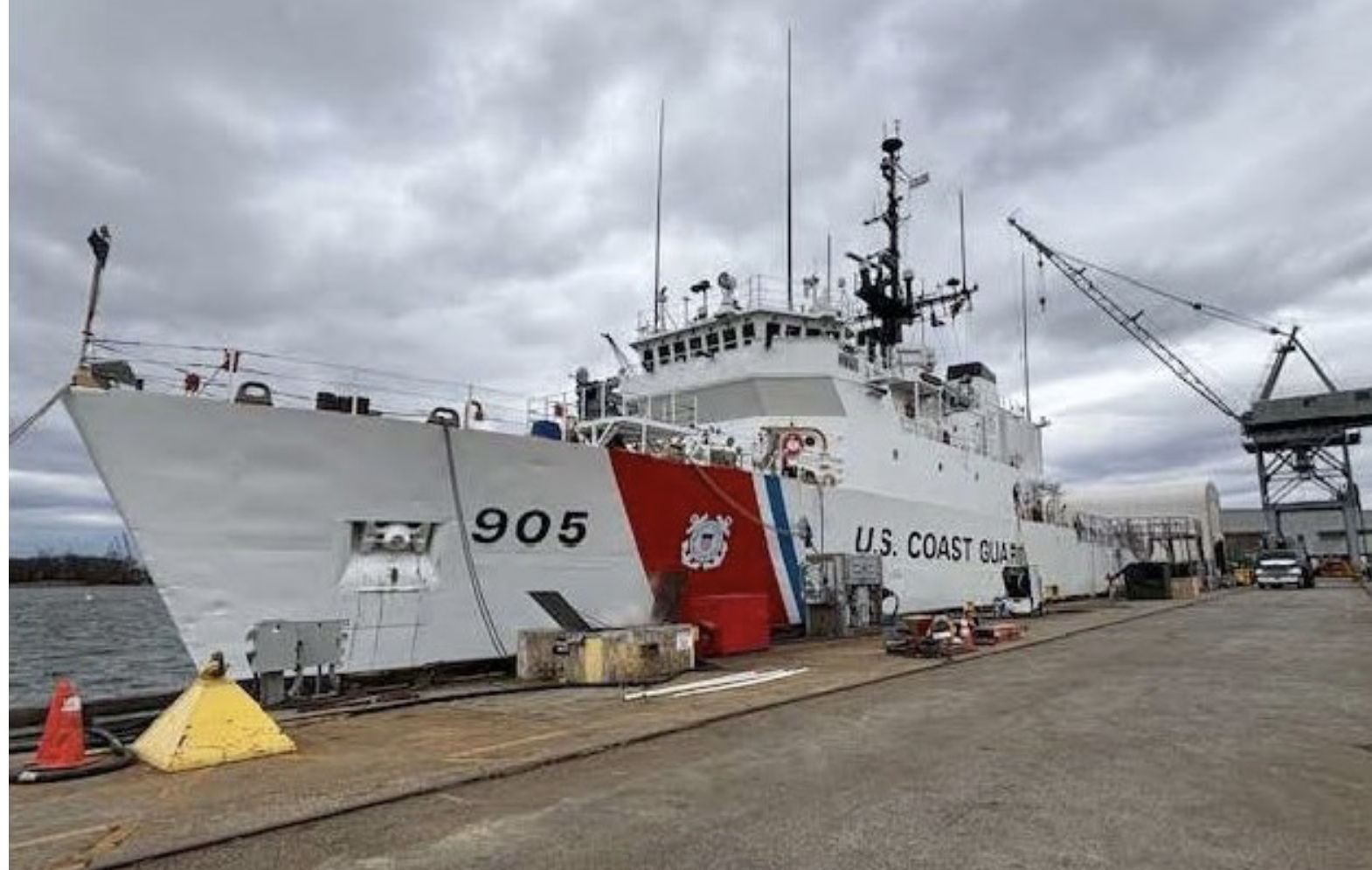
Coast Guard Cutter Spencer, at Coast Guard Yard in Baltimore, prepares for sea trials at the conclusion of its service life extension work. U.S. Coast Guard photo.

Below is a news release from the Acquisition Directorate (CG-9).

As can be seen in the accompanying photo, the 76mm Mk75 gun and Mk92 fire control systems have been removed, replaced by a 25mm Mk38, presumably a Mod3. The AN/SLQ-32 antennas remain. There is now, apparently, no multi-function/air search radar capability.

All six ships chosen for SLEP were “B Class” 270s built by Robert Derecktor Shipyard. Unlike the four “A Class” ships they are able to operate MH-60 helicopters.

USCGC Spencer had been home-ported in Portsmouth VA, but I suspect she like USCGC Harriett Lane will be transferred to the Pacific Area.


Coast Guard Cutter Spencer completes service life extension program

Coast Guard Cutter Spencer, a 270-foot Famous-class medium endurance cutter, departed Coast Guard Yard in Baltimore on March 8, 2025, having successfully completed its 20-month service life extension program (SLEP).

Managed by the Coast Guard’s In-Service Vessel Sustainment (ISVS) Program, the SLEP ensures mission readiness, improves reliability and reduces maintenance costs of the Coast Guard’s operational fleet. The program extends the service life of legacy cutters by replacing obsolete, unsupportable or maintenance-intensive systems, enabling the cutter to continue meeting mission demands in the most cost-effective manner.

The SLEP for the medium endurance cutters includes updates and replacements of electrical power generation and distribution systems, main diesel propulsion engines, and gun weapon systems. Spencer is the first of six medium endurance cutters scheduled to receive all major system overhauls including new main propulsion engines. This intensive work, which began in July 2023, will allow the cutter to operate for an additional decade, sustaining operational capability as the Coast Guard transitions to the offshore patrol cutter (OPC) fleet.

“These cutters have been essential for Coast Guard operations for over four decades, conducting missions from drug interdiction and fisheries enforcement to search and rescue,” said Kenneth King, ISVS program manager. “Investing in their sustainment is critical to ensuring these cutters remain operationally relevant and capable of executing the service’s most demanding missions until the next generation – the OPCs – are fully deployed.”

Five additional medium endurance cutters – Legare, Campbell, Forward, Escanaba and Tahoma – will complete SLEPs by 2030. Seneca and Harriet Lane previously served as prototypes for the electrical and structural work but did not receive new engines. Harriet Lane also served as the prototype for the MK38 gun weapon system.

For more information: In-Service Vessel Sustainment Program page and Offshore Patrol Cutter Program page

“Coast Guard to send 3 more cutters to Guam, has no plans to escort Philippine ships” –Stars and Stripes

A U.S. Coast Guard boat crew and boarding team from U.S. Coast Guard Cutter Oliver Berry (WPC 1124) approaches a foreign fishing vessel to conduct a joint boarding inspection with members of the Western and Central Pacific Fisheries Commission on the high seas in Oceania, Sept. 22, 2024. U.S. Coast Guard Cutter Oliver Berry’s crew recently completed a 45-day patrol in Oceania in support of Operation Blue Pacific, promoting security, safety, sovereignty, and economic prosperity in the region.

Stars and Stripes reports,

The Coast Guard will double its Guam fleet to six cutters but doesn’t plan to accompany the Philippine coast guard as it struggles to maintain territorial claims in the South China Sea, the service’s Pacific-area commander said Friday.

This is based on a video news conference by Pacific Area Commander Vice Adm. Andrew Tiongson speaking from Japan.

“The Coast Guard will not escort Philippine resupply missions to the BRP Sierra Madre, a grounded warship garrisoned by Filipino troops at the Second Thomas Shoal in the South China Sea, according to Tiongson.”

The Philippines has not asked for escorts, Tiongson said. “We do advise, and we do assist,” he said. “We provide what we would do in this situation.”

He also said, “It’s possible we may get another Indo-Pacific support cutter,” using the description applied to USCGC Harriet Lane, recently arrived in the Pacific Area to support operations in the Western Pacific.

There is more in the article.

Atlantic Area Cutter Back in the Eastern Pacific Drug Transit Zone

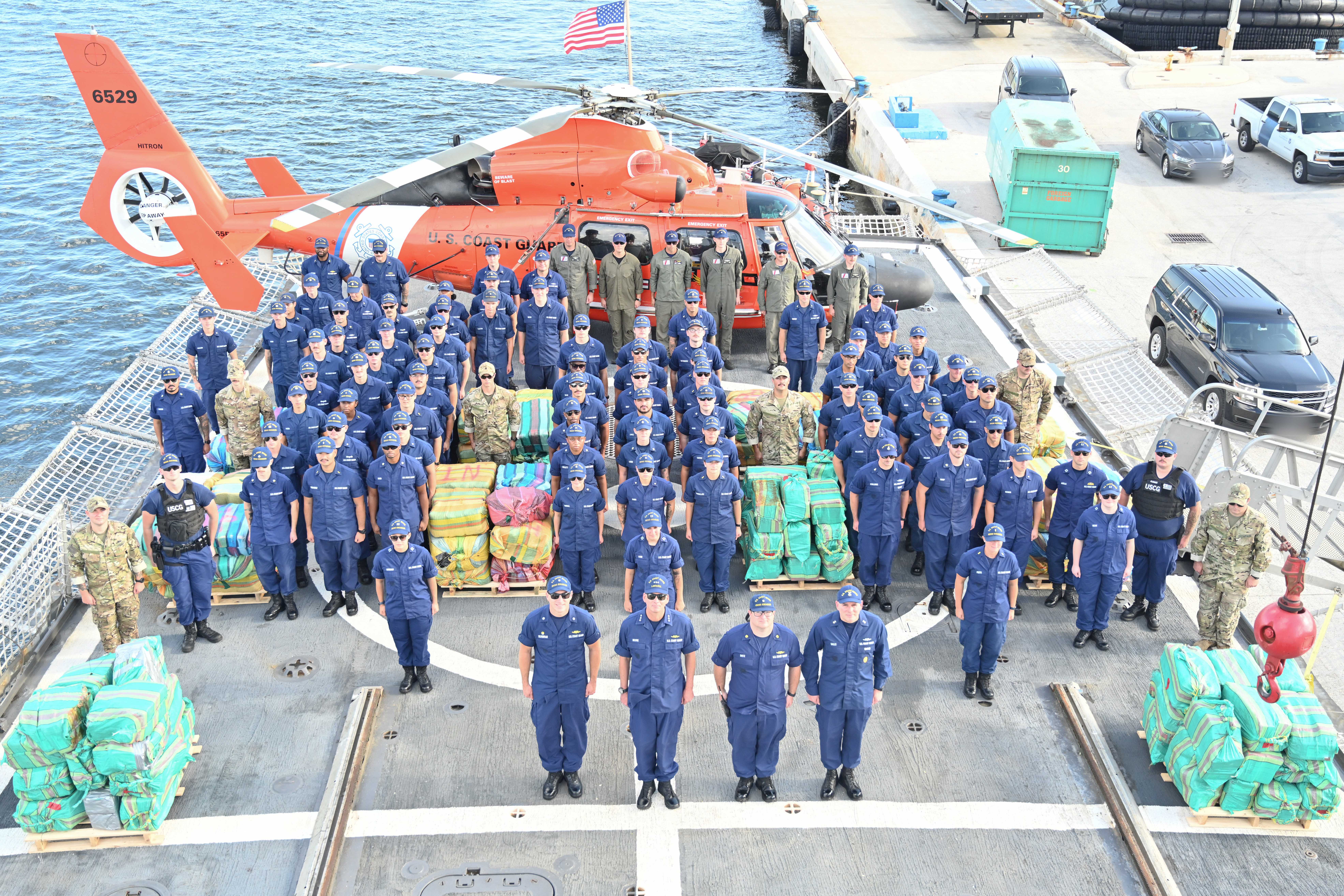
The crew of Coast Guard Cutter Escanaba (WMEC 907) poses for a group photo on the cutter’s flight deck during a contraband offload, Aug. 23, 2024, alongside select personnel from Coast Guard Cutters Spencer (WMEC 905), Legare (WMEC 912), Coast Guard Helicopter Interdiction Tactical Squadron, Pacific Area Tactical Law Enforcement Team, and Coast Guard Atlantic Area Command while moored to the pier in Fort Lauderdale, Florida. Escanaba conducted a 46-day counter-drug patrol in the Eastern Pacific Ocean. (U.S. Coast Guard photo by Petty Officer 2nd Class Brandon Hillard)

Below is a news release from Coast Guard News.

Two things of note in what would normally be a routine report:

First, despite the fact that most Atlantic Area cutters are closer to the Eastern Pacific drug transit zone than those based on the West coast, recently they have been too busy with migrant interdiction to do drug enforcement in the Pacific. This patrol marks a return to previous practice of having LANTAREA cutters, as well as those from the Pacific Area, working the drug problem in the Pacific.

Second, reading the caption of the photo above, you may note that the crew included “...select personnel from Coast Guard Cutters Spencer (WMEC 905), Legare (WMEC 912)…” Spencer and Legare are at the Coast Guard yard as the first and second of six Bear class WMEC270s that will receive full Service Life Extension Program (SLEP) upgrades.  The crews are reassigned after the ships enter SLEP, so it appears some were temporarily assigned to Escanaba to make up for shortfalls in the crew. The shortfalls may have been exacerbated because the patrol was over the summer transfer season.


 Aug. 29, 2024

Coast Guard Cutter Escanaba completes 46-day counter-drug patrol in Eastern Pacific Ocean

PORTSMOUTH, Va. — The crew of the Coast Guard Cutter Escanaba (WMEC 907) returned home to Portsmouth, Wednesday, following a 46-day counter-drug patrol in the Eastern Pacific Ocean.

While deployed, crew members supported the Coast Guard Eleventh District, headquartered in Alameda, California, and Joint Interagency Task Force – South, headquartered in Key West, Florida.

During the patrol, Escanaba’s crew disrupted illegal narcotics smuggling, interdicting 3,408 pounds of cocaine and 4,418 pounds of marijuana valued at nearly $50 million during two separate interdictions. The drugs were offloaded in Port Everglades, Florida on Aug. 23. Additional information about Escanaba’s drug offload, including photos and video, can be found here.

Escanaba’s drug seizures contributed directly to furthering Coast Guard objectives to combat transnational criminal organizations and enhance regional stability and security.

While at sea, Escanaba’s crew was assisted by members of Helicopter Interdiction Tactical Squadron (HITRON), based in Jacksonville, Florida and members of Tactical Law Enforcement Team (TACLET) Pacific – Law Enforcement Detachment (LEDET) 107, based in San Diego, California.

HITRON crew members delivered air support for the use of force and enhanced long-range detection capabilities while deployed aboard Escanaba. The TACLET Pacific LEDET supplied skilled boarding personnel critical for mission execution and served as a force multiplier for other law enforcement activities.

“The crew of Escanaba and our shipmates from HITRON and TACLET are to be commended for executing a demanding mission with professionalism and precision,” said Cmdr. Jared Silverman, commanding officer of Escanaba. “In concert with the Coast Guard’s partner agencies and with support from Joint Interagency Task Force – South, the accomplishments of Escanaba serve as a reminder of how vital this mission is.”

Escanaba is a 270-foot, Famous-class medium-endurance cutter homeported in Portsmouth, Virginia. The cutter’s primary duties are counter-narcotics operations, migrant interdiction, living marine resources protection, and search and rescue in support of U.S. Coast Guard operations throughout the Western Hemisphere.

For information on how to join the U.S. Coast Guard, visit GoCoastGuard.com to learn about active duty, reserve, officer, and enlisted opportunities. Information on how to apply to the U.S. Coast Guard Academy can be found here.

For more, follow us on Facebook, Instagram and X.

“Q&A: Vice Admiral Andrew J. Tiongson, Commander, Pacific Area and Commander, Defense Force West, U.S. Coast Guard” –Seapower

Tiongson speaks at a press conference before the crew of the Coast Guard Cutter Waesche offloads 18,219 pounds of cocaine, worth more than $239 million, on Dec. 6, 2023. U.S. Coast Guard

The Navy League’s on-line magazine, Seapower, has an interview with the Pacific Area Commander. There is a lot of good information here.

HC-130Js (and C-27Js):

CGAS Sacramento will “transition” to HC-130Js. Pacific Area certainly needs the long range aircraft because, while 84% of the US EEZ is in Pacific Area they have only three fixed wing air stations (Kodiak, Barbers Point, and Sacramento) while Atlantic Area has five fixed wing air stations to cover only 16% of the US EEZ.

What will happen to the C-27Js? No mention was made of these. They might go to Guam. That would be helpful in providing fixed wing search aircraft in the Western Pacific. Recently there was a SAR case in the Western Pacific. A C-130 was dispatched from Barbers Point, but the flight was so long the crew needed a day’s rest before the aircraft could be used in the search. On the other hand, Guam might not be an optimal location since it is so far West. There are other options.

Fast Response Cutters:

As I read the statement, the intention is to have a total of six FRCs in Guam and add a fourth in Hawaii.

His discussion about these little ships clearly indicates that their nominal five-day endurance (same as the preceding 110 foot WPBs) is being exceeded regularly.

“The FRCs, first off, are game changers for the Coast Guard in general. Back in the day, we had patrol boats that were limited in terms of the sea states they could handle, the food that they could carry, the number of crew members and certainly their duration at sea. The FRCs have changed that.”

Six WPCs in the same port is not unusual. District 7 has three different ports, each homeport to six or seven Webber class, but this may be a move toward replicating a PATFORSWA type organization to support 7th Fleet in the Western Pacific.

Large Patrol Cutters:

There was a brief discussion of the Offshore Patrol Cutters, but no indication of when they are expected to arrive in PACAREA.

A second “Harriet Lane or Indo-Pacific support cutter” is on PACAREA’s unfunded priority list. For some reason, I think this may happen.

Commercial Icebreaker Procurement:

Plans for the commercial icebreaker (Aiviq) were discussed. It will be homeported in Juneau, as reported here in March, but still has not been purchased and it will take two years to complete changes to make it fully operational.

The admiral was asked, “Is the commercial icebreaker going to be crewed by Coast Guardsmen or by a contract crew?” and there was no definitive answer. Should the Coast Guard adopt a hybrid crew, as has been done by some Navy vessels it would be a major change in Coast Guard policy.

The Eastern Pacific Drug Transit Zone: 

Atlantic Area cutters are not assisting in Eastern Pacific drug transit zone interdiction efforts, as they normally would, because they are heavily engaged in migrant interdiction operations.

Trusted Partner:

The Area Commander talked a lot about what being a trusted partner meant, about partnerships with Asian coast guards, and the outsized effect of having a few good people in liaison positions.

WMEC 270 SLEP / USCGC Legare Begins Service Life Extension Program at Coast Guard Yard

The Coast Guard Cutter Legare (WMEC 912) weighs anchor near the Statue of Liberty in New York City, New York, March 17, 2024. (U.S. Coast Guard photo courtesy of Legare)

The Acquisitions Directorate (CG-9) website includes a photo of USCGC Legare (WMEC-912) and the caption “270- foot medium endurance cutter Legare begins service life extension program at Coast Guard Yard.” Normally clicking on the caption would lead to a post expanding on the title, but in this case, it takes you to the In-Service Vessel Sustainment Program page. That page gives us this information about the 270 SLEP.

“Service life extension program for the 270-foot medium endurance cutters involves targeted system replacement to address system reliability, supportability, obsolescence and in­teroperability. This work will include upgrades or replacements to the electrical power generation and distribution system as well as the main propulsion engines. The mission is to facilitate continued operations during transition to the offshore patrol cutter by extending the service life of 270-foot cutters for up to 10 years. Work began on one prototype vessel at the Coast Guard Yard in July 2021 and on the second cutter in April 2022. Full production is scheduled to begin in 2023.”

The intention is not to SELP all 13 WMEC270s, rather they did two limited prototype SLEPS (Seneca, WMEC-906, and Harriet Lane, WMEC-903), and plan to do six full production SLEPs. These 270s should be the last WMECs in commission as they are replaced by Argus class Offshore Patrol Cutters. Harriet Lane’s most visible change was removal of her 76mm Mk75 gun and Mk92 fire control system. A 25mm Mk38 remote weapon station was mounted on the bow on an elevated position. This change is to be applied to all subsequent 270 SLEPs.

Spencer, (WMEC-905) was the first full production 270 SLEP. Spencer was the first 270 to receive new engines. Spencer’s old engines were to be remanufactured and reinstalled on a subsequent WMEC270 SLEP, presumably the newly arrived Legare.

This is a long process. Work on Harriet Lane lasted 15 months, so I expect we will have at least one 270 in the Yard being SLEPed for the next five years.

The Félix Éboué class, a Modern, Minimalist, Medium Endurance Cutter

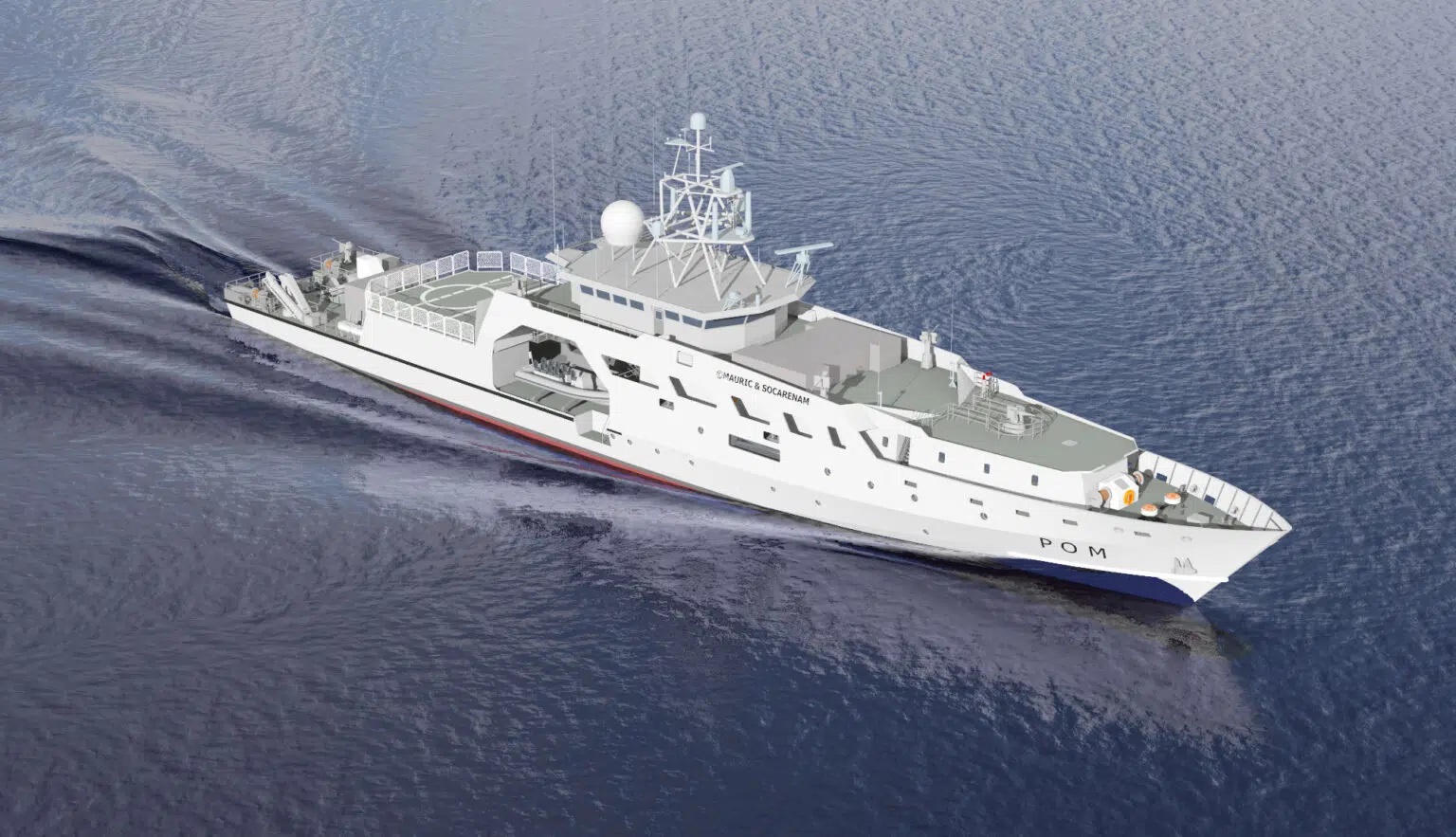
An artist’s rendering, Félix Éboué class or Patrouilleurs Outre-mer (POM)

The Offshore Patrol Cutter (OPC) is described as, “…a capability bridge between the national security cutter, which patrols the open ocean in the most demanding maritime environments, and the fast response cutter, which serves closer to shore.”

That may have been the intention, but that is not what we got.

While the National Security Cutter is better than the WHECs they replaced in almost every way, the OPCs are not only better than the WMECs they will replace, but they are also, in every way except maximum speed, better than the WHECs as well. Instead of a high/low mix of cutters, they all turned out high end. We should not be surprised the OPCs construction and operating costs approach those of the NSCs.

Construction costs are typically proportional to displacement. The OPCs’ displacement is 98% that of the NSC and 1232.8% (more than 12 times) that of the Fast Response Cutters.

This would not be a bad thing, if we had enough NSCs and OPCs to meet our large patrol cutter needs, but I don’t think we will ever get there.

We are expected to ultimately end up with only 36 large patrol cutters, fewer than we have had in decades and fewer than other Coast Guards with far smaller EEZs.

A new fleet mix study has been completed, but the results have not been made public (Why not? This is not transparency). I suspect it shows a need for substantially more than 36 large patrol cutters.

If we look at the previous “Fleet Mix Study,” now over a dozen years old, which minimized requirements because it did not consider “High Latitude regions of the ice shelf and Deployable Operations Group (DOG),” and assumed that NSCs would use the “Crew Rotation Concept” that was expected to allow them to operate 230 days per year, to meet all statutory requirements, the study indicated the Coast Guard needed 66 large cutters, 30 more than currently planned, and 91 FRCs.

If we want significantly more large patrol cutters than currently planned, perhaps we need a smaller, cheaper alternative to the OPCs that requires a smaller crew and are more economical to operate. In previous posts, I have referred to this alternative as (Cutter X).

Thinking Ahead: 

Getting funding for more than two OPCs per year is probably unrealistic. The last OPC is not expected to be commissioned until 2038, 14 years from now. If we continue to build only two large patrol cutter a year, will not be able to grow the fleet until after 2038 and then it will grow slowly because the National Security Cutters will start aging out.

We might not be able to continue to build OPC sized patrol cutter after 2038. The Coast Guard will want to build Arctic Security Cutters (or perhaps Arctic Patrol Cutters). Both the Juniper class WLBs and Keeper class WLMs will need to be replaced.

(Where is our long-range shipbuilding plan?)

If we started in the next year of two, we could be producing true medium endurance cutters in significant numbers before the planned completion of the OPC program. On a 3 for 1 or even 2 for 1 exchange for the last few OPCs, if we tried, we could start to grow the fleet perhaps as early as 2032.

That is why the Félix Éboué class is worth a look. It is, what I believe may be, the absolute minimum fully capable Offshore Patrol Vessel. It covers all the bases. It is good enough for most operating areas. That is not to say, there are no good reasons for some add–ons, but I think it is a kind of benchmark. It is also a good representation of Cutter X. There are reasons we might want to go bigger, but before you increase the quality of the individual cutters, first we need to have enough.


The French Experience

France, like the US has a huge Exclusive Economic Zone (EEZ), the largest in the world, 11,691,000 km2 (4,514,000 sq mi). The US EEZ is 11,351,000 km2.

Unlike the US, the French don’t have a coast guard that operates ocean going ships to enforce laws and protect sovereignty. The French Navy does this, and uses a fleet of Offshore Patrol Vessels, some of which are referred to as frigates.

The Félix Éboué class is their newest class of OPVs. They are intended specifically to patrol the waters of French overseas territories in the Pacific and Indian Oceans. They will be based, two each, at NouméaTahiti and La Réunion. They replace the P400 class, which are slightly larger than the Webber class WPC, which were found to be inadequate.

I have found some very good photos of the second ship of the class being fitted out, that show details I had not seen before, and would like to share them. I will also bring forward some of my earlier commentary with updates, so as to consolidate information on this interesting class.

Comparison with Webber class WPC (FRC):

Below is a comparison between the FRC and the Félix Éboué class (POM) that was included in an earlier post, updated with information about the propulsion system on the French ships.

French overseas patrol vessel (POMs) Auguste Bénébig. Photo: http://www.meretmarine.com

Like an FRC:

I always thought these looked like oversized Webber class, the proportions are similar, and the much larger POM is not much more complicated than the Webber class. The crew of the POM is 30, only six more than that of the FRC. Both have a bridge with a 360-degree view positioned well aft, minimizing vertical acceleration. Both have an 8 meter boat in a stern ramp. The armament is similar with four .50 cal. machine guns and a single medium caliber gun in the bow, a 20mm on the POM and a 25mm on the FRC. The POM uses slightly less powerful diesel engines, 2x ABC 16V DZC medium speed diesels 3.7MW each @ 1,000rpm, for a total of about 9924 HP compared to 11,600 for the FRC. (I am told the POM’s engines are also more economical and simpler to maintain.) But the French ships still manage to make 24 knots, a couple of knots more than claimed for the OPC. With similar crew and systems, they should not cost much more than the FRCs to operate.

Unlike an FRC:
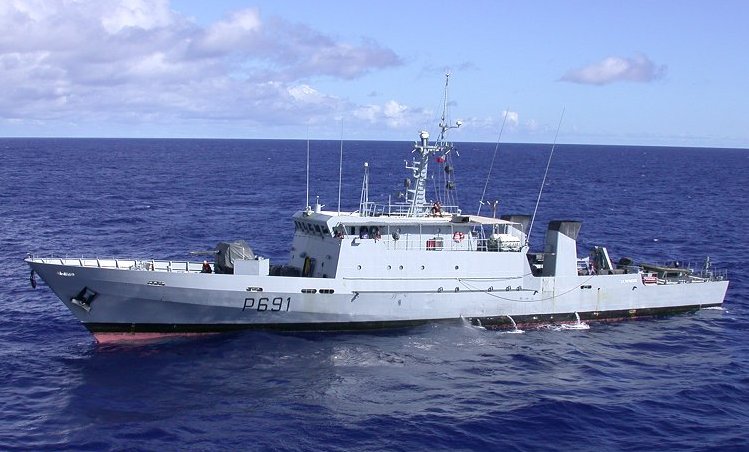
P400 patrol ship Tapageuse at sea near Tahiti (18 June 2003). Photographer: Jean-Michel Roche

While they would have been thinking of their existing 373 ton P400 class pictured above, it might appear to us that they wanted a ship to do the same sorts of missions the Webber class Fast Response cutters (FRC) are doing out of Guam, but they recognized that these ships would be far from any major naval base and that they would need to travel great distances and would be exposed to extreme weather conditions, so they needed to be larger (1300 tons vs 353 tons for the FRC) and have greater range (5500 miles vs 2500) and endurance (30 days vs 5 days).

Having chosen a larger hull, they took advantage of the greater volume and deck space to add a second RHIB, a multimode radar, space for 29 passengers (roughly a platoon of Marines), a sickbay, a dive locker, space for a 20 foot containerized mission module, a flight deck and hangar for a 700-kilogram-class rotor-blade drone (not yet deployed), and a holding area for up to six prisoners.

Some sources also indicate the French ships also have electric motors that would allow them to cruise on the ship’s service generators and secure the main propulsion engines, but I have seen no specifics.

The Photographs: 

The second of the French Navy’s six new overseas patrol vessels (POM), the Teriieroo a Teriierooiterai, which will be based in French Polynesia and has been named in tribute to a Companion of the Liberation native of this Pacific territory, Photo: http://www.meretmarine.com

The Teriieroo at Teriierooiterai fitting out at the end of July, 2023 in Boulogne. Photo: http://www.meretmarine.com

Stern ramp for 8 meter RHIB. French Navy overseas patrol vessel (POM), Teriieroo a Teriierooiterai, fitting out 2023. Photo: http://www.meretmarine.com

Second 8 meter RHIB and davit (only) on starboard side. French Navy overseas patrol vessel (POM), Teriieroo a Teriierooiterai, fitting out 2023. Photo: http://www.meretmarine.com

Aliaca aerial drone on its launch catapult. French Navy overseas patrol vessel (POM), Teriieroo a Teriierooiterai, fitting out 2023. Photo: http://www.meretmarine.com

Recovery System for Unmanned Air System, French Navy overseas patrol vessel (POM), Teriieroo a Teriierooiterai, fitting out 2023. Photo: http://www.meretmarine.com

Changing of the Guard, WPC for WMEC

USCGC ALERT departing Astoria

Passing this along from the “Coast Guard Sea Duty Veterans” Facebook page. The post was by Bill James.


On Friday, 10 May, Cutter ALERT sailed beneath the Astoria-Megler bridge, crossed the Columbia River Bar, and proceeded south enroute to her new homeport of Cape Canaveral, Florida.
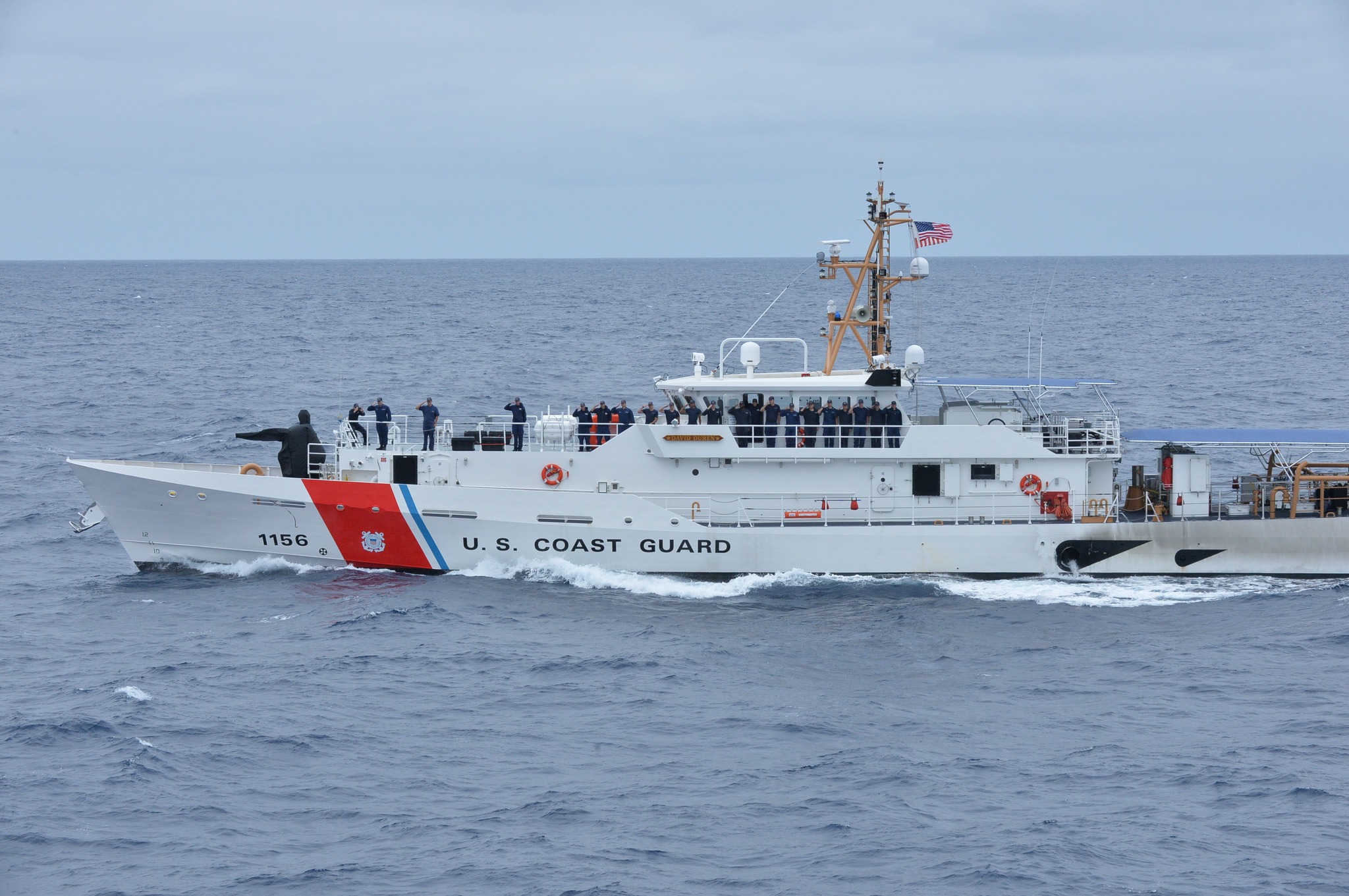
Simultaneously, the newly built CGC DAVID DUREN, one of the two 154’ USCG Sentinel Class cutters proceeded northward on its journey from Key West to its new homeport of Astoria, OR.
This Thursday, 16 May, the two cutters passed close abroad in the Eastern Pacific Ocean. DAVID DUREN rendered passing honors and ALERT returned the salute, thereby properly relieving ALERT’s 30-year watch to the first of two Sentinel Class Cutters to be stationed in Astoria.

USCGC DAVID DUREN (WPC-1156) Renders Passing Honors

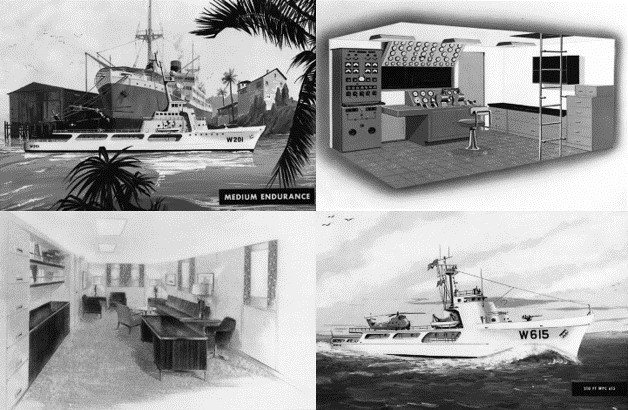
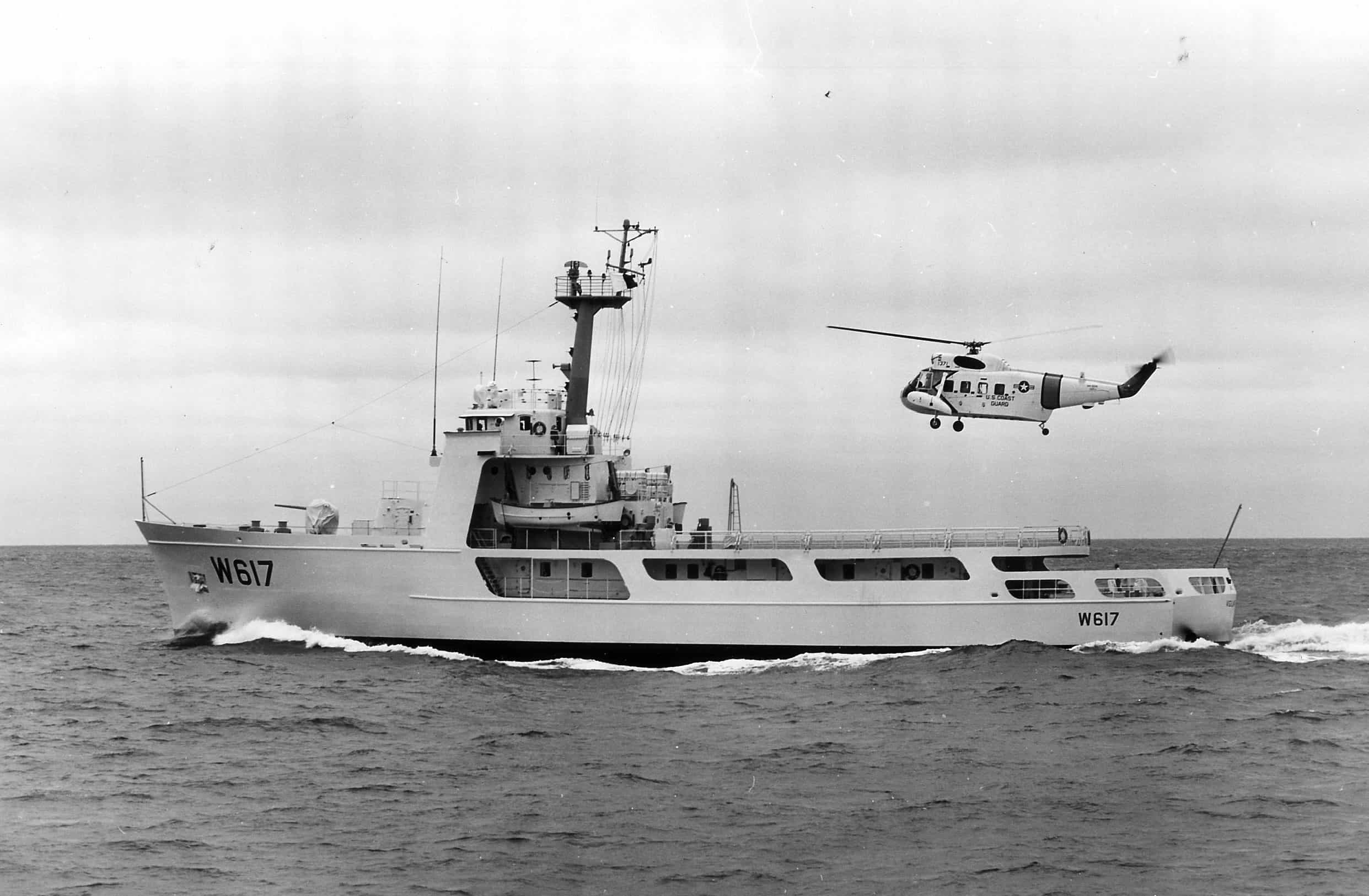
WMEC 210s in Retrospect

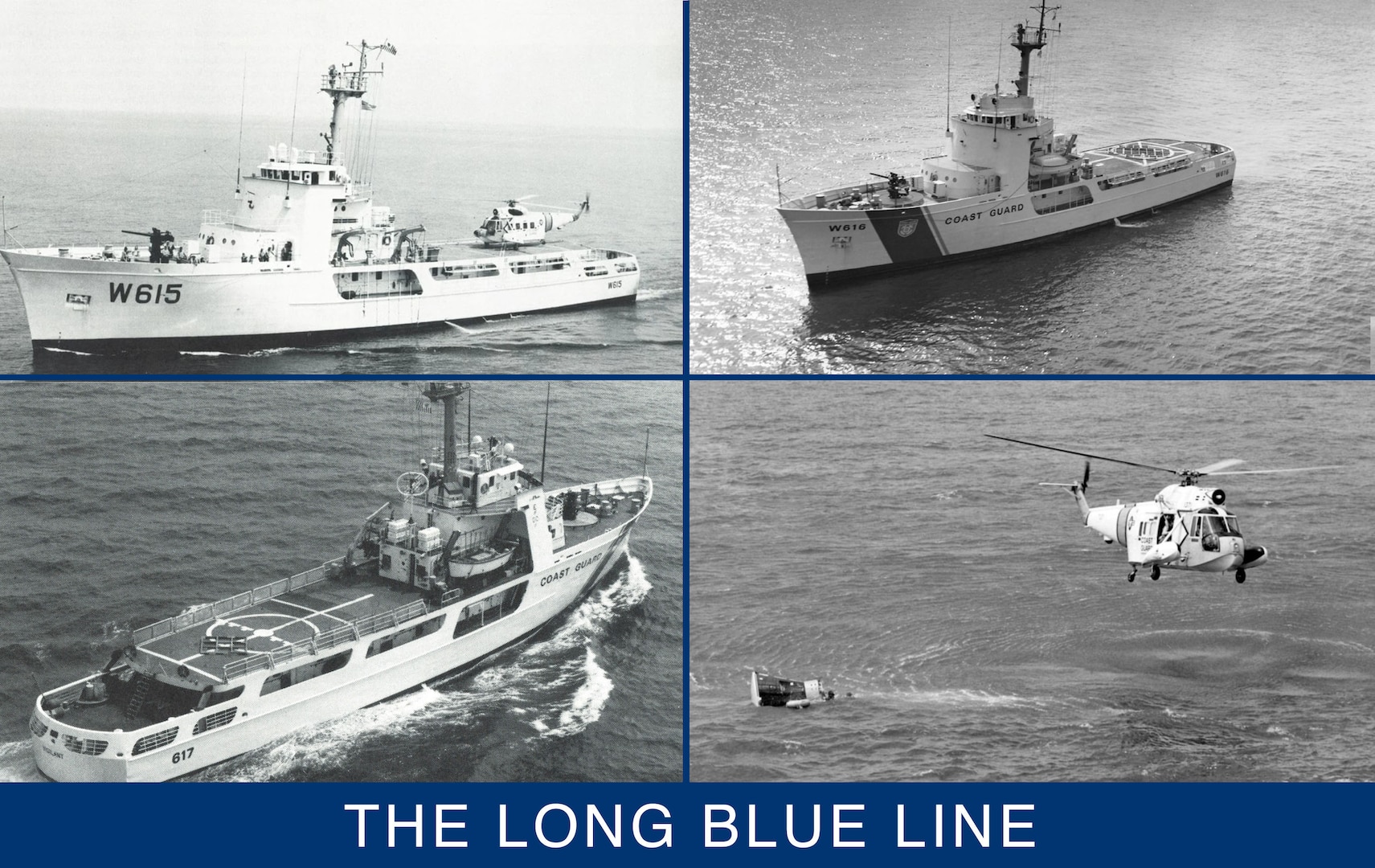
Coast Guard cutter Reliance conducting helicopter operations circa 1964. (U.S. Coast Guard photo).

Coast Guard cutter Diligence shown with the prototype “racing stripe” painted on the bow in December 1966. (Coast Guard Historian’s Archive).

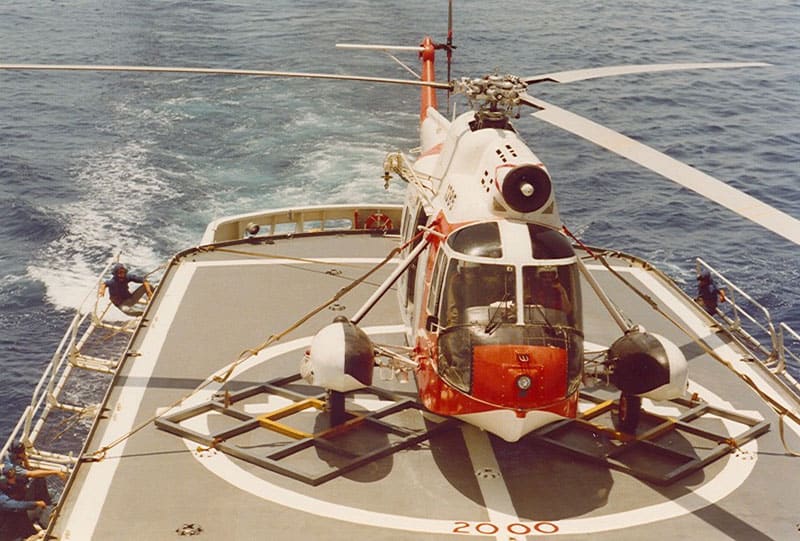
The extensive accommodation for helicopter operations is shown by this photo of third-in-class 210 cutter Vigilant. (U.S. Coast Guard photo)

A Coast Guard HH-52A launched from Diligence hovers over the Gemini III space capsule in 1965. (U.S. Navy National Museum of Naval Aviation photo)

“Coast Guard to SLEP, Expand MH-60T Helicopter Fleet as Sikorsky Delivers First New Airframe” –Seapower / Implications for Cutters

Coast Guard to SLEP, Expand MH-60T Helicopter Fleet as Sikorsky Delivers First New Airframe

The Navy Leagues on line magazine, Seapower, reports,

“The U.S. Coast Guard has confirmed plans to expand is MH-60T Jayhawk helicopter fleet and make it the standard service-wide helicopter. The service life-extension of the current MH-60T fleet is being highlighted as Sikorsky, a Lockheed Martin company, delivers the first of 45 replacement MH-60T airframes to the Coast Guard.”

There is a lot of information here.

  • The Coast Guard currently has 48 MH-60T.
  • Generally, six are being overhauled.
  • 45 of these will receive new hulls.
  • 12 new hulls will be delivered annually.
  • Electric tail folding will be added to MH-60s beginning in 2024.

That suggests the SLEP program for the existing Fleet will go through FY 2027, but there is also an intent to replace all H-65s with H-60s. Ultimately the Service expects to have 127 H-60s. That is 79 additional H-60s. Growth will involve both new construction and additional Navy conversions. Sounds like we may still be as much as 13 years from full conversion to a full H-60 fleet, about 2036, but perhaps earlier.

H-65s will continue to operate from cutters for some time.

So, what about the H-65s and the smaller cutters that may not be able to operate the H-60? The nine “B class” 270s should be able to operate H-60s, but the 210s and four “A Class” 270s cannot. The last of those will probably be decommissioned about 2032, certainly no later than 2035.

Aviation Logistics Center (ALC), CGAS Elizabeth City should be wrapping up the MH-65E SLEP program about now, having begun full rate production in November 2019 at a rate of 22 aircraft a year. The SLEP reportedly added 10,000 hours to the life of each aircraft, so the H-65s will probably outlast the cutters that can only operate the smaller helicopter.