Mark Retiring Cruiser MK41 VLS and 5″/62 Mk45 Mod4s for Possible Future Installation on Cutters

151014-N-GR120-152
INDIAN OCEAN (Oct. 14, 2015) The guided-missile cruiser USS Normandy (CG 60) prepares to come along side for a fueling-at-sea with the aircraft carrier USS Theodore Roosevelt (CVN 71). Theodore Roosevelt is operating in the U.S. 7th Fleet area of operations as part of a worldwide deployment en route to their new home port in San Diego to complete a three-carrier homeport shift. (U.S. Navy photo by Mass Communication Specialist 3rd Class Anna Van Nuys/Released)

If we ever have another major conventional naval war, as appears increasingly likely, the Navy is going to need a lot more ships, including a lot more missile shooters. Defense News reports the Navy is considering how to add additional capability. The Navy is even considering putting missiles on cargo ships. As Rep. Elaine Luria (D-VA, Cdr. USN, ret.) pointed out, a number of cruisers equipped with MK41 VLS are being retired. The 22 remaining cruisers each have 122 Mk41 vertical launch cells as well as two 5″/62 Mk45 Mod4 guns.

Five of the cruisers have been approved for decommissioning in the 2022 budget. It is likely the remaining 17 will follow in the next few years.

I suggest that some of these VLS sets be stored and earmarked as mobilization assets for possible future installation on the National Security Cutters (NSC) should the need arise. Studies have shown that the NSCs could accept up to 16 Mk41 VLS. These VLS might be recycled to the new Constellation (FFG-62) class too, but since the planned 20 ships will only use 640 VLS, it would only require seven cruisers to donate enough VLS to arm both 20 FFG and 11 National Security Cutters.

It should not be too difficult to integrate the Mk41 VLS on the National Security Cutters since their combat systems use Aegis software.

Potential Mk41 VLS weapons load outs for tactical and strike length launchers.

In addition, it might be wise to earmark the cruisers 5″/62 Mk45/Mod4 guns for possible upgrades for both National Security and Offshore Patrol Cutters as well.

The Navy’s entire Naval Gun Fire Support (NGFS) capability is about 114 Mk45 5″ guns on 22 cruisers with two guns each and about 70 DDGs with only one gun. By the time the cruisers are gone, we may have perhaps 80 DDGs. That means the loss of about 30% of the current capability. Equipping the 36 NSCs and OPCs with 5″/62 Mod4 guns from the retiring cruisers could entirely replace the lost capability and importantly provide it in ships that are not likely to be deployed out of position to provide NGFS because they are needed elsewhere to provide AAW protection.

To ensure we can make these changes quickly when needed, it might be prudent to equip at least one ship of each class as a prototype for future upgrades. Upgrading one ship of each class would probably cost less than one FFG and would provide a template for future upgrades if necessary. The OPC prototype might attempt something like I described here.

Since this is preparation for war, the prototypes and storage of the weapons could come from the Navy’s budget.


“BEWARE BUYER’S REMORSE: WHY THE COAST GUARD NEEDS TO STEER CLEAR OF THE LCS” –CIMSEC

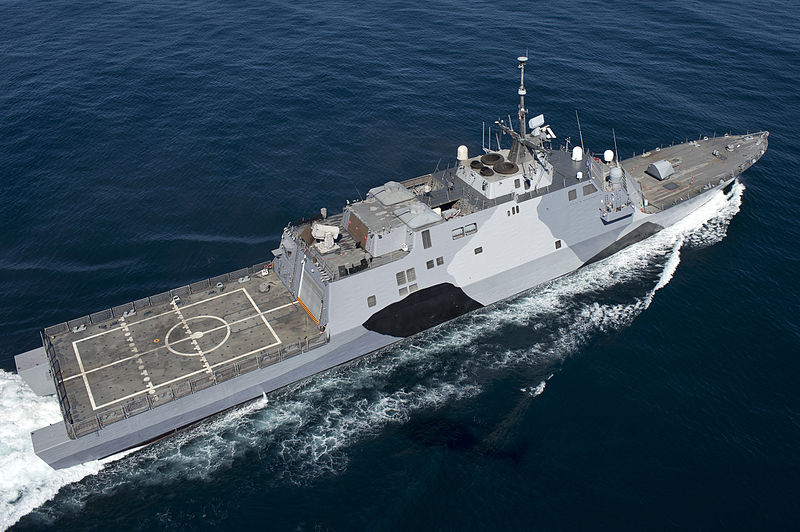
USS Freedom (LCS-1), decommissioned 29 Sept. 2021.

CIMSEC has a post, written by a serving USCG engineer, about why the Coast Guard should not take on the Navy’s unwanted Littoral Combat Ships (LCS). For this discussion, it may be important that you see the author’s qualifications.

“Lieutenant Joey O’Connell has served aboard two Coast Guard cutters as an engineer. He is currently a Medium Endurance Cutter (MEC) port engineer, planning and overseeing depot-level maintenance on the aging MEC fleet. He holds a bachelor’s degree in mechanical engineering from the U.S. Coast Guard Academy and two masters degrees—one in naval architecture and the other in mechanical engineering from the Massachusetts Institute of Technology. “

It appears the author makes a convincing case, but I would add additional caveats.

The maximum range of the Freedom class, on their installed diesels, is about one third that of the Offshore Patrol Cutter and about half that of the over 50+ year old 210 foot Reliance class WMECs. That is totally unacceptable for typical Coast Guard operations.

The semiplaning hull required to allow the Freedom class to make its exceptionally high speed does not handle rough seas well. The resulting fatigue will limit the performance of the crew, and ship’s motion can preclude helicopter and boat operations in demanding environments. Earlier evaluation found that the OPC could conduct boat and helicopter operations in conditions when the LCS could not.

While the Freedom class have spacious aviation facilities, I have seen very little about their boat handling facilities and these are a cutter’s main armament for law enforcement. They might require extensive rework. Video from USS Fort Worth (LCS-3) below:

Why It Would Make Sense to Award Two OPC Contracts.

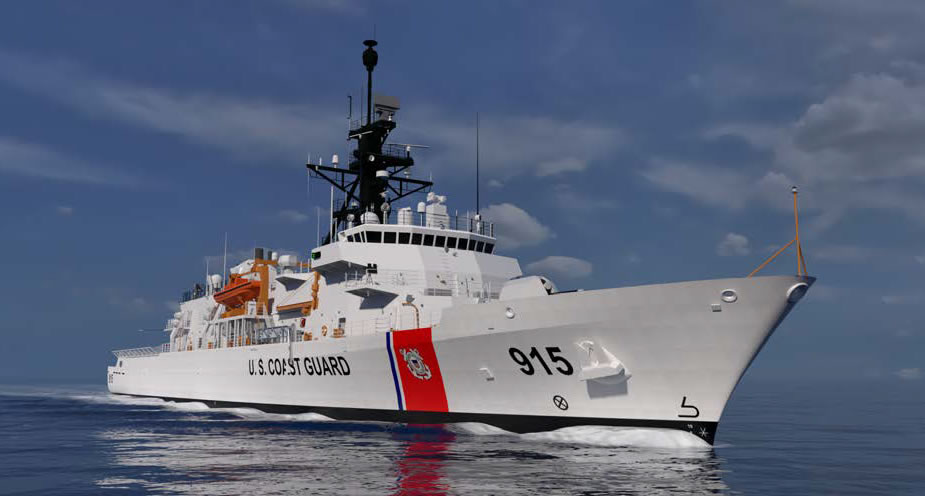
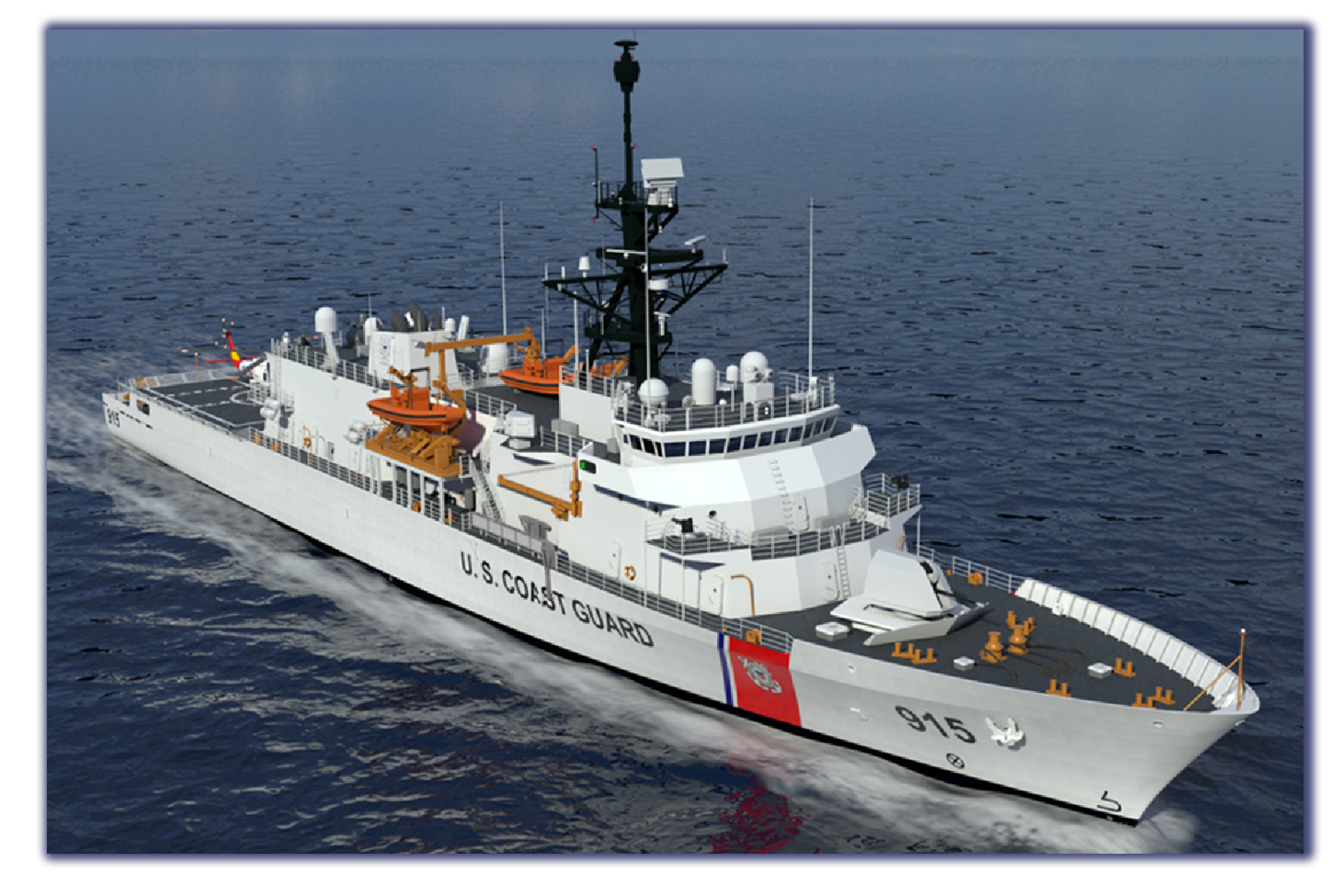
Artists rendering from Eastern Shipbuilding Group

The Navy League’s online magazine “Seapower” reports,

 Bollinger Shipyards submitted on March 18 its final proposal to the United States Coast Guard to build Stage 2 of the Heritage-class Offshore Patrol Cutter program. If chosen, Bollinger would construct and deliver a total of 11 vessels to the U.S. Coast Guard over the next decade, helping to sustain the Bollinger workforce through 2031.

It is obviously a Bollinger press release, talking about how much good it would do for the local economy, but it does occur to me…

If we have two truly competitive bids, this could be an opportunity to have two shipyards building Offshore Patrol Cutters.

The program is already too long delayed. The phase II contract proposals are likely to be very competitive. In March 2020, contracts for industry studies were awarded to nine different yards.

  • Austal USA of Mobile, AL
  • General Dynamics/Bath Iron Works (GD/BIW) of Bath, ME
  • Bollinger Shipyards Lockport of Lockport, LA
  • Eastern Shipbuilding Group (ESG) of Panama City, FL
  • Fincantieri Marinette Marine (F/MM) of Marinette, WS
  • General Dynamics/National Steel and Shipbuilding Company (GD/NASSCO) of San Diego, CA
  • Huntington Ingalls Industries/Ingalls Shipbuilding (HII/Ingalls) of Pascagoula, MS
  • Philly Shipyard of Philadelphia, PA
  • VT Halter Marine Inc. of Pascagoula, MS

I know at least three yards, Eastern, Huntington Ingalls and Bollinger, and probably more, are submitting proposals for building first a single OPCs with options to build ten more. With Eastern already building the first four, this gives the Coast Guard the opportunity to contract for the remaining 21 ships based on the bids that will be received this year.

We could have the entire program completed by 2032 instead of 2038 and avoid the complication of a probably much less competitive phase III competition to build the last ten ships. Six years earlier completion would also probably allow us to avoid the expense of the life extension program planned for six of the WMEC 270s.

It would cost more in those years but this project really should have been funded ten to twenty years ago. It would be a big plus up for the PC&I budget but only a few percent increase compared to the Coast Guard’s total budget, small compared to the DHS budget and microscopic to the entire federal budget. It would align with the national objective of growing our naval shipbuilding capabilities, and further stimulate the economy. It might not be too hard to get Congressional support.

It would also provide a hedge against a natural disaster further delaying construction.


“State of the Coast Guard 2022” (Updated)

Vice Adm. Karl L. Schultz, commander, Coast Guard Atlantic Area, speaks at the Coast Guard Cutter Benjamin Dailey commissioning ceremony in Pascagoula, Miss. Coast Guard Photo

ADM K.L Schultz delivered his “State of the Coast Guard 2022” at Air Station Clearwater, today, 24 February 2022.

You can read the prepared speech here.

There is an awful lot in the 13 pages. Much of it deals with how the Coast Guard hopes to provide a better life for its members and their families. I will not attempt to summarize. I will mention a couple of revelations that I think may be new.

Three FRCs will be homeported in Tampa Bay with Sector Saint Petersburg. This will bring the final number of FRCs in the 7th District up to at least 23. We repeatedly see these little ships doing fisheries and drug and migrant interdiction missions in the waters off Florida, the Gulf of Mexico and the Caribbean that would have previously been performed by WMECs. This frees the larger cutters to perform missions in more demanding environments.

We have seen a growing tendency to group long range assets. Apparently, this will continue.

We’re developing geographic centers of gravity, creating more Coast Guard hubs like Portsmouth and Alameda… These new or improved operating hubs will be in  Charleston, Seattle, Pensacola, Los Angeles, and Newport, Rhode Island… These operating hubs will allow us to better support our operational assets, and to further support the geographic stability of our workforce.

To some extent these centers of gravity exploit infrastructure built by the Navy but now considered excess. This applies to at least Charleston, Pensacola, and Newport.

These “centers of gravity” suggests expansion or creation of additional Support Centers. It may also suggest where Offshore Patrol Cutters (OPCs) will be homeported. We already know at least two OPCs each are going to San Pedro (Los Angeles), Kodiak, and Newport. Alameda already has four National Security Cutters (NSC) and Charleston will have five when all are completed. Seattle will most certainly be the homeport for three Polar Security Cutters. This suggest that at least Portsmouth, Pensacola, Los Angeles, and Newport will host large numbers of OPCs, perhaps as many as six. If that were to be the case, it would mean 14 large patrol cutters in Pacific Area (6 NSCs and 8 OPCs) and 22 in Atlantic Area (5 NSCs and 17 OPCs).

That would be close to the historic split of resources, but recent developments, including the success of the FRCs and IUU concerns in the Pacific, suggest we may have more large ships in the Pacific, perhaps a third OPC in Kodiak and up to three in Seattle or more likely Honolulu. That would make the split 18 in PAC Area and 18 in LANT Area.

(Updated: Corrected number of NSCs in each area.)

“USCG Provides Information on OPCs’ Speed and Machine Gun Armament” by Peter Ong

Comments on an earlier post here, “Updated: “U.S. Coast Guard Provides Information On The Offshore Patrol Cutter” –Naval News” prompted friend and journalist Peter Ong, author of the referenced Naval News story, to enquire further. Results below: 


The comments posted on Chuck Hill’s CG Blog in response to my story published 13 January 2022 on Naval News about the U.S. Coast Guard’s Offshore Patrol Cutter (OPC) had a running discussion as to the maximum speed of the OPCs and how many .50 caliber M2HB heavy machine gun mounts the OPCs will be outfitted with.

Some commentators believe that the OPCs can sail faster than 22.5 knots, which according to specifications is the sustained speed of the OPCs.  Furthermore, the number of .50 caliber (12.7mm) M2HB mounts is relatively unknown with some believing that the mounts will be a mixture of remote weapons stations and handheld crew-served pedestal mounts.  (The OPCs are armed with a Mark 110 57mm turret cannon at the bow and a Mark 38 MOD 3 with 7.62mm coaxial chaingun over the hangar).

I inquired to the U.S. Coast Guard’s Public Affairs Department seeking more information on the maximum OPC’s speed and the quantity of small caliber weapon mounts.  Brian Olexy, Communications Manager with the U.S. Coast Guard Acquisition Directorate, replied via email at the end of January 2022.

Question: Some believe that the OPC’s maximum sprint speed, or emergency Flank Speed, is more than 22.5 knots as rated by the specifications.  Can the USCG settle this dispute and provide the maximum “all engines at 100% or more” speed that the OPCs can safely sail at?

Brian: “The contract requires the [Offshore Patrol] cutter to be capable of maintaining a sustained speed through the water of 22 knots in full load condition at delivery.  Sustained speed is not “flank speed,” but rather the speed that the cutter can maintain in trial conditions. While the cutter design is required to meet the capability requirement of 22 knot sustained speed, the Coast Guard expects to obtain greater clarity on the actual speed range of the vessel during pre-acceptance sea trials.”

Question: How many 7.62mm M240 or 12.7mm M2HB mounts will the OPCs have in total?

Brian: “Final armament of the cutter will not be determined until the Coast Guard takes delivery, but the cutter has been designed with six different small caliber weapon mounts.”

Thanks to Peter for the follow-up.

Updated: “U.S. Coast Guard Provides Information On The Offshore Patrol Cutter” –Naval News

OPC “Placemat,” Notice planned delivery has slipped considerably from 2021 to 2023. 

Naval News and writer Peter Ong bring us an update on the status of the Offshore Patrol Cutter Program.

I did not see any particular surprises, but there may be a hint of how the 30mm Mk38 Mod4 is viewed in this question and answer.

Naval News: Will the Mark 38 MOD2 be changed out now that the US Navy is planning for Mark 38 MOD4s with 30mm?

Brian Olexy: The OPC program includes each cutter receiving one MK 38 MOD 3 with 7.62 mm co-axial gun. There is no plan at this time to change to a MK 38 MOD 4d for UAS operations. (emphasis applied–Chuck)

My immediate reaction was–what did the gun have to do with UAS operations? There was nothing about UAS in the question. Then I recognized a possible connection. The 30mm has a demonstrated counter-UAS capability using air burst ammunition that the 25mm does not have. The response may reflect the author’s comments that were not recounted in the post, or it may be that the Coast Guard has recognized the use of the 30mm as a counter UAS weapon.


UPDATE: I was contacted by the author and informed that an error had occurred in the publication of his story and that the correct quotation included no reference to UAS. It should have read.

7. Will the Mark 38 MOD2 be changed out now that the US Navy is planning for Mark 38 MOD4s with 30mm?

A. The OPC program includes each cutter receiving one MK 38 MOD 3 with 7.62 mm co-axial gun. There is no plan at this time to change to a MK 38 MOD 4. 

“Delivery Of The U.S. Coast Guard’s New Heavy Icebreaker Has Been Delayed Yet Again” –The Drive

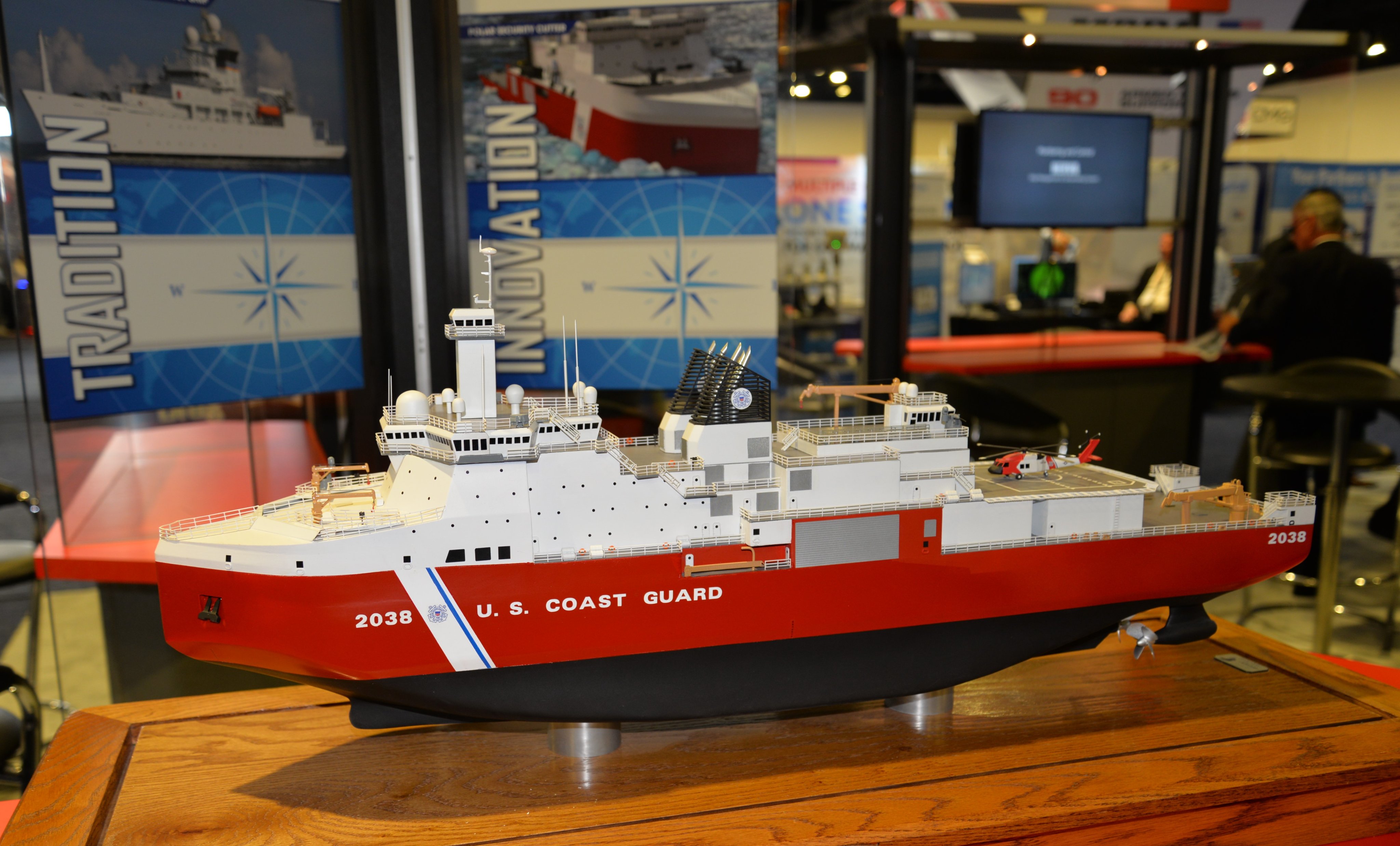
Photo of a model of Halter Marine’s Polar Security Cutter seen at Navy League’s Sea-Air-Space Exhibition have surfaced. Photo credit Chris Cavas.

The Drive/The Warzone reports that the delivery of the first Polar Security Cutter (PSC) has been pushed back to 2025. As recently as October, delivery was expected in 2024. This raises questions about why this is happening, and will Polar Star be able to continue to meet at least our minimum icebreaker requirements? In fact, the plan was to retain Polar Star until the second PSC was completed.

The article points to the decision to use the proposed Polarstern II as a basis for the design, when that ship was in fact never completed and the maturity of its design remains unclear.

More to the point, for whatever reason, the Coast Guard once more, waited too long to start a complex replacement program, and as a result, has risked creation of a capability gap.

The OPC program, poster child for this tendency, was repeatedly delayed. From the CRS report on cutter procurement,

“The posting for the RFP for the Stage 2 industry studies included an attached notional timeline for building the 25 OPCs. Under the timeline, OPCs 1 through 7 (i.e., OPCs 1-4, to be built by ESG, plus OPCs 5-7, which are the first three OPCs to be built by the winner of the Stage 2 competition) are to be built at a rate of one per year, with OPC-1 completing construction in FY2022 and OPC-7 completing construction in FY2028. The remaining 18 OPCs (i.e., OPCs 8 through 25) are to be built at a rate of two per year, with OPC-8 completing construction in FY2029 and OPC-25 completing construction in FY2038.
“Using these dates—which are generally 10 months to about two years later than they would have been under the Coast Guard’s previous (i.e., pre-October 11, 2019) timeline for the OPC program—the Coast Guard’s 14 Reliance-class 210-foot medium-endurance cutters would be replaced when they would be (if still in service) about 54 to 67 years old, and the Coast Guard’s 13 Famous-class 270-foot medium-endurance cutters would be replaced when they would be (if still in service) about 42 to 52 years old.

We know, from recent experience, that our ships may be able to continue functioning effectively, if perhaps not economically or reliably, when over 40 years old, but to base plans on an assumption that replacement can be delayed until they well passed 40 years old is irresponsible–and we are still doing it, by not advocating acceleration of the OPC build rate.

To Lee and Walter who pestered me about this after I initially failed to recognize the significance of the post, Thanks.

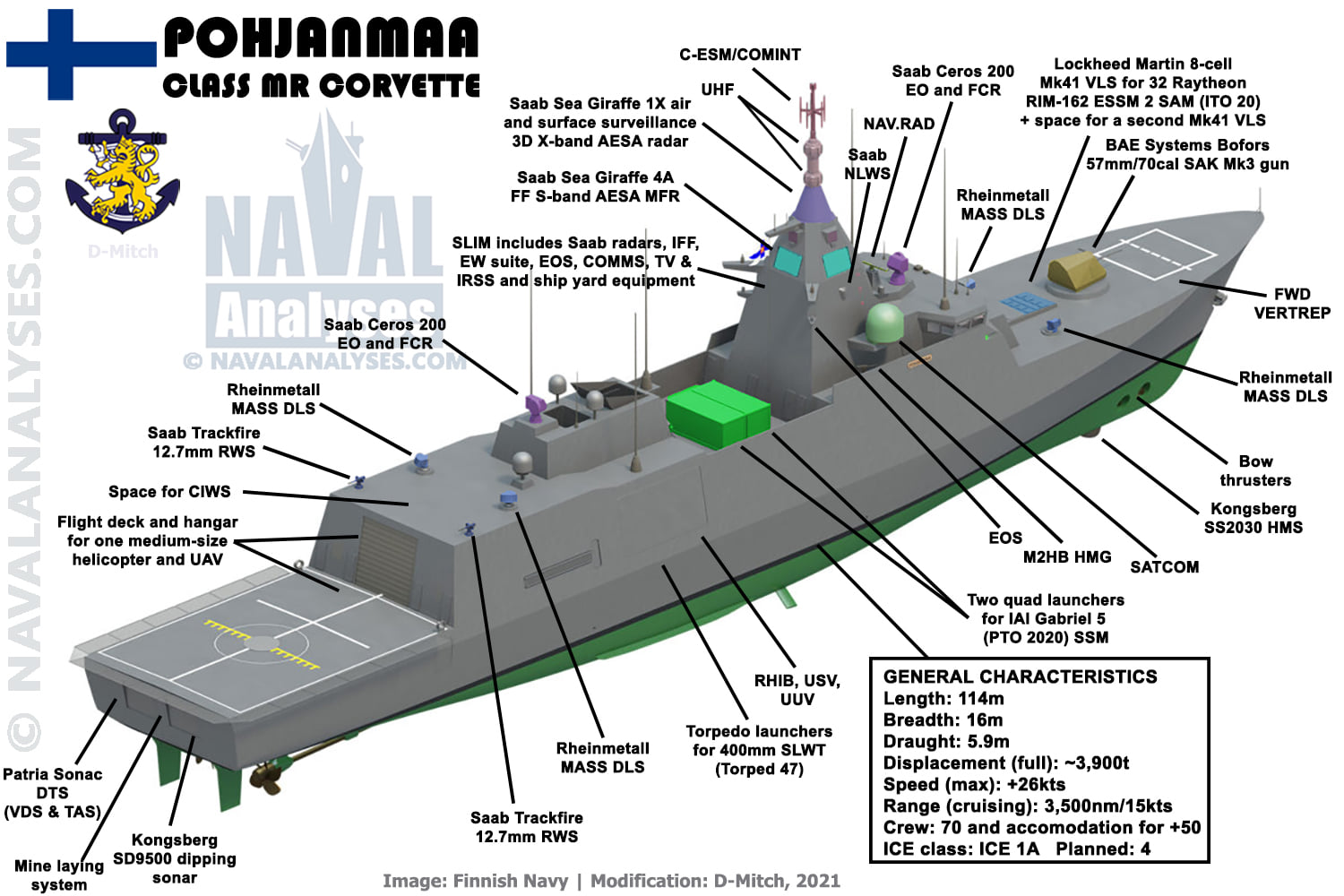
Finnish Navy Ice Strengthened Corvette

We began talking about this class of rather unique warships about six years ago. Since then, a lot of comments have been added. I wanted to pass along this info graphic.

What makes these really unique, and perhaps of interest to the USCG, is the Ice Class requirement which translates to non-consolidated (refrozen) ice channels with a thickness of 1.0 meter (3.3 ft) in the middle.

Compared to the Offshore Patrol Cutters, these ships will be a little longer (374 feet vice 360), but also a little lighter displacement (3900 tons vs 4500). They will have a much shorter range (3500 nautical miles vs over 10,000) and a much smaller crew (70 vs over 100), although the total accommodations are similar.

Predictably the Finnish ship is much more heavily armed.

“Eastern Shipbuilding looks to win Coast Guard cutter contract — again” –Defense News

Defense News has a report of Eastern Shipbuilding’s hopes and efforts regarding phase two of the Offshore Patrol Cutter program.

“the Coast Guard expects to award the OPC second stage detail design and construction contract in spring 2022.”

I am a little surprised, it is taking as long as it is, to make a decision, two years after award of contracts to nine ship builder for industry studies (March 20, 2020), and about a year after the deadline for submission of proposals (May 28, 2021), but it certainly is an important choice.

Start of the OPC program contract was too long delayed in the first place. Then a hurricane delayed Eastern’s efforts about a year, and raised the cost. The decision to recompete the contract resulted in more delays, in that previous plans to move to funding two OPCs a year were pushed even further into the future. Instead of delivering the first three OPCs, one per year 2021-2023 and delivering two per year beginning 2024 through 2034; the current notional deliver schedule is one per year 2022-2028 and then two per year 2029-2037.

One potential benefit, if Eastern should be chosen for Phase II, is that they might be able to transition more quickly to building two ships per year. To some extent, that may be true of other yards as well, but Eastern’s product will presumably remain the same and a decision about its suitability to proceed to full rate production can be made years before the same is true of OPCs produced by other yards that will not be built to the same detail plans.

“Report to Congress on Coast Guard Cutter Procurement” –CRS, Updated October 19, 2021″ –CRS

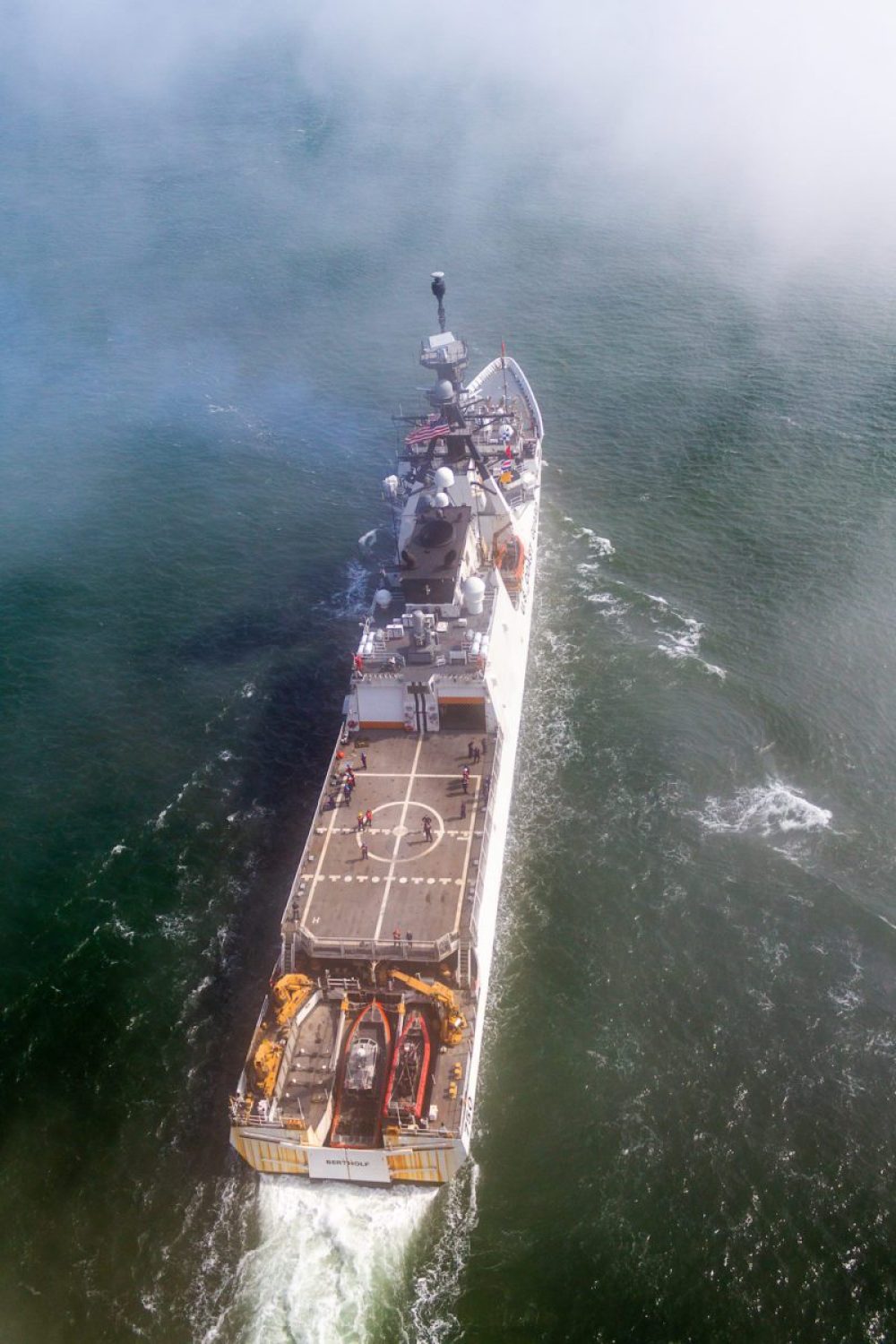
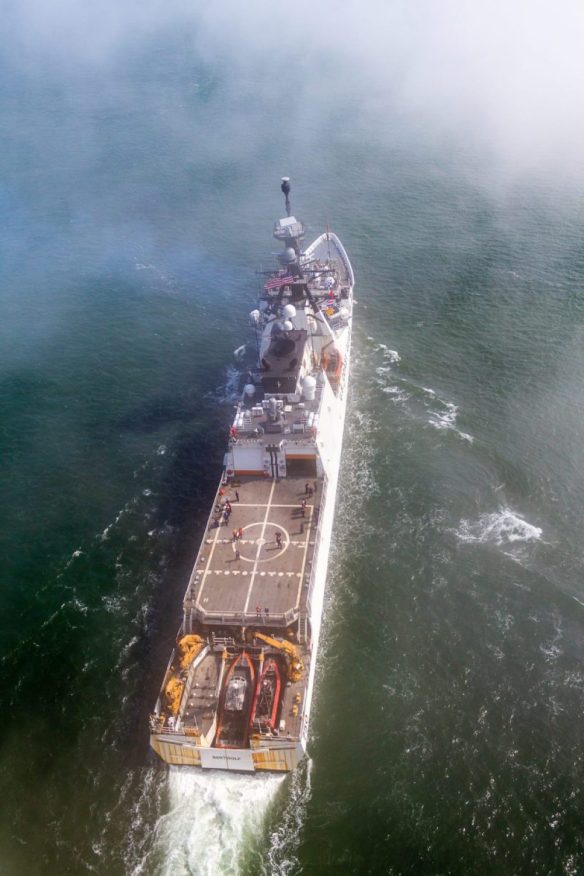
The Coast Guard Cutter Bertholf enters the San Francisco Bay en route to their Alameda, California homeport following a three-month multi-mission patrol, Oct. 3, 2020. Bertholf is one of four Legend-class national security cutters homeported in Alameda. (Photo by Pablo Fernicola)

The Congressional Research Service has again updated their “Report to Congress on Coast Guard Cutter Procurement”. (This link will always take you to the most recent edition of the report.) My last post on this evolving document was in reference to a 15 September, 2021 update. The questions raised in that report remain largely unanswered. I have reproduced the one page summary in full below. The summary does not appear to have changed, except to reflect the commissioning of the 45th FRC. But first I will highlight what I believe to be the changes since the last update. The significant changes reflect the Senate’s actions reported on pages 27 and 28.

Senate

The Senate Appropriations Committee, in the explanatory statement it released on October 18, 2021, for the FY2022 DHS Appropriations Act (S. XXXX), recommends the funding levels shown in the SAC column of Table 2. (PDF page 144 of 160) The explanatory statement states:

Offshore Patrol Cutter [OPC].—The Committee provides the requested amount of $597,000,000 for the construction of the fourth OPC and LLTM for the fifth OPC. While the Committee supports OPC procurements, the Committee remains concerned about costs for the program and continues the requirement for the Coast Guard to brief the Committee within one week prior to taking any procurement actions impacting estimated costs for the OPC program.

Fast Response Cutter [FRC] Program.—In accordance with the Coast Guard’s recapitalization plan, the Committee has completed funding for the replacement of legacy 110-foot Island Class patrol boats with FRCs that will operate similarly in the coastal zone. The Coast Guard is encouraged to notify the Committee if additional FRCs are necessary to support the Department of Defense in Patrol Forces Southwest Asia. (PDF page 69 of 160)

The explanatory statement also states:

Fleet Mix Analysis.—The Committee recognizes ongoing acquisition programs for various cutter classes that are responsible for many of, but not all, Coast Guard missions. While programs have correctly been prioritized around recapitalizing the oldest vessels in the fleet, several cutter classes are rapidly approaching the end of their service lives, while others have long surpassed their service lives. In order to best understand future capital investment needs, the Coast Guard shall provide to the Committee within 180 days of the date of enactment of this act, a comprehensive analysis that provides a fleet mix sufficient to carry out the assigned missions of the Coast Guard and other emerging mission requirements. The Coast Guard shall brief the Committee within 60 days of the date of enactment of this act on its plans to carry out this requirement.

Full-Funding Policy.—The Committee again directs an exception to the administration’s current acquisition policy that requires the Coast Guard to attain the total acquisition cost for a vessel, including long lead time materials [LLTM], production costs, and postproduction costs, before a production contract can be awarded. This policy has the potential to make shipbuilding less efficient, to force delayed obligation of production funds, and to require post-production funds far in advance of when they will be used. The Department should position itself to acquire vessels in the most efficient manner within the guidelines of strict governance measures.

Domestic Content.—To the maximum extent practicable, the Coast Guard shall utilize components that are manufactured in the United States when contracting for new vessels. Such components include: auxiliary equipment, such as pumps for shipboard services; propulsion equipment, including engines, reduction gears, and propellers; shipboard cranes; and spreaders for shipboard cranes. (PDF page 68 of 160)


Summary

The Coast Guard’s program of record (POR), which dates to 2004, calls for procuring 8 National Security Cutters (NSCs), 25 Offshore Patrol Cutters (OPCs), and 58 Fast Response Cutters (FRCs) as replacements for 90 aging Coast Guard high-endurance cutters, medium-endurance cutters, and patrol craft. The Coast Guard’s proposed FY2022 budget requests a total of $695.0 million in procurement funding for the NSC, OPC, and FRC programs, including $597 million for the OPC program.

NSCs are the Coast Guard’s largest and most capable general-purpose cutters; they are replacing the Coast Guard’s 12 Hamilton-class high-endurance cutters. NSCs have an estimated average procurement cost of about $670 million per ship. Although the Coast Guard’s POR calls for procuring 8 NSCs to replace the 12 Hamilton-class cutters, Congress through FY2021 has fully funded 11 NSCs, including the 10th and 11th in FY2018. In FY2020, Congress provided $100.5 million for procurement of long lead time materials (LLTM) for a 12th NSC, so as to preserve the option of procuring a 12th NSC while the Coast Guard evaluates its future needs. The Coast Guard’s proposed FY2022 budget requests $78.0million in procurement funding for activities within the NSC program; this request does not include further funding for a 12th NSC. The Coast
Guard’s proposed FY2022 budget also proposes rescinding $65.0 million of the $100.5 million in FY2020 funding for LLTM for a 12th NSC, “allowing the Coast Guard to focus investments on building, homeporting, and crewing Polar Security Cutters and Offshore Patrol Cutters.” The remaining $35.5 million appropriated in FY2020 for LLTM would be used to pay NSC program costs other than procuring LLTM for a 12th NSC. Nine NSCs have entered service; the ninth was commissioned into service on March 19, 2021.

OPCs are to be less expensive and in some respects less capable than NSCs; they are intended to replace the Coast Guard’s 29 aged medium-endurance cutters. Coast Guard officials describe the OPC and PSC programs as the service’s highest acquisition priorities. OPCs have an estimated average procurement cost of about $411 million per ship. The first OPC was funded in FY2018. The Coast Guard’s proposed FY2022 budget requests $597.0 million in procurement funding for the fourth OPC, LLTM for the fifth, and other program costs. On October 11, 2019, the Department of Homeland Security (DHS), of which the Coast Guard is a part, announced that DHS had granted extraordinary contractual relief to Eastern Shipbuilding Group (ESG) of
Panama City, FL, the builder of the first four OPCs, under P.L. 85-804 as amended (50 U.S.C. 1431-1435), a law that authorizes certain federal agencies to provide certain types of extraordinary relief to contractors who are encountering difficulties in the performance of federal contracts or subcontracts relating to national defense. The Coast Guard is holding a full and open competition for a new contract to build OPCs 5 through 15. On January 29, 2021, the Coast Guard released a Request for Proposals (RFP) for this Stage 2 contract, as it is called. Responses to the RFP were due by May 28, 2021. The Coast Guard plans to award the Stage 2 contract in the second quarter of FY2022.

FRCs are considerably smaller and less expensive than OPCs; they are intended to replace the Coast Guard’s 49 aging Island-class patrol boats. FRCs have an estimated average procurement cost of about $65 million per boat. A total of 64 have been funded through FY2021, including four in FY2021. Six of the 64 are to be used by the Coast Guard in the Persian Gulf and are not counted against the 58-ship POR quantity for the program, which relates to domestic operations. As of October 19, 2021, 45 of the 64 have been commissioned into service. The Coast Guard’s proposed FY2022 budget requests $20.0 million in procurement funding for the FRC program; this request does not include funding for any additional FRCs