Basing for Larger Patrol Cutters

W B Young asked,

“I was wondering if they are going to base these two WMSM in R.I., what base/homeport is losing ships to make up for this? What with 25 tentative WMSM replacing 28 current WMEC some homeport(s) were already going to be losing a currently based ship{s}”

Trying to answer this turned out to be a bit more than I wanted to put in just a comment. I am going to look at homeports for the larger patrol cutters, WHECs, WMECs, OPCs, and NSCs, breaking it down by district, as we move toward 36 large patrol cutters (11 NSCs and 25 OPCs).

Keep in mind these changes will not happen quickly. First OPC is not expected to be delivered until 2022 and then only one per year through 2028. Then only two per year, so we are looking at #25 arriving in 2037.

TRENDS:

There are some trends that seem to be playing out here:

  • Fisheries, Alien Migrant interdiction, and D7 drug interdiction are increasingly being done by Webber class WPCs.
  • Ships of a class are increasingly being based in groups of three or more for better support.
  • 210s are being moved South where they are closer to the Caribbean and Eastern Pacific drug interdiction areas and where the weather is less demanding.

LOOKING BACK: 

When I looked at homeports in 2015:

  • There were six large cutters in CGD1, three in Portsmouth, NH/Kittery, ME (two 270s and one 210) and three 270s in Boston.
  • There were nine in D5, six 270s and three 210s.
  • Nine in D7, two NSCs, two 270s, and five 210s.
  • D8, two 210s
  • A total of 26 in LANTAREA
  • In PACAREA, 14 total, three NSCs, seven 378s, one 282, and three 210s (That is really 11 “high endurance cutters” (NSCs, 378s, and Alex Hailey, rated a WMEC but really an HEC) and three 210s).

WHAT WE HAVE NOW

Currently we have 38 large patrol ships, already down two:

  • D1, five 270s
  • D5, Total of eight, six 270s and two 210s
  • D7, no change, Total of nine, two NSCs, two 270s, and five 210s
  • D8, Four 210s
  • LANTAREA total 26
  • PACAREA total twelve, six NSCs, two 378, one 282, three 210s

The LANT total has not changed, but D1 and D5 have each donated a 210 to D8.

PACAREA is down two ships. One from D11 and one from D13.

What we know about the future:

The last two 378s, both in PACAREA, will not last much longer.

Three more Bertholf class NSCs are going to be based in D7 at Charleston. As unlikely as it may seem, this is actually closer to the Eastern Pacific drug transit zone than San Diego.

The First two OPCs will go to San Pedro. The second pair will go to Kodiak. The third pair will go to D1 in Newport, RI.

What will happen to Alex Haley when the two OPCs arrive in Kodiak is not clear, but there is a good chance it has more life in it than many of the 210s. It is newer and more capable than any of them. In many ways it is close to a SLEPed 270. Hopefully it will be kept on.

Six 270s will undergo life extension program renovations. My presumptions are that,

  • These will probably last about a year, but hopefully less for later ship after we acquire some experience.
  • We will do only one at a time,
  • That the crew that brings it to be renovated will be reassigned, and
  • That a new crew will be assigned, much as if it were new construction.
  • After renovation it is likely that the ship will be assigned to a new homeport.

These renovations will need to start relatively soon. We need to complete the project by 2027, if we are going to get at least 10 years service out of all six before the 25th OPC is completed in 2037. (Wonder if perhaps we can install more powerful engines to get a bit more speed.)

The four OPCs going to PACAREA are really replacing four WHECs not WMECs. There used to be 10 WHECs on the West coast. When the two Webber class currently planned to be homeported in Astoria arrive, they may effectively start to replace the West Coast 210s in PACAREA.

PURE SPECULATION: 

This is what I think we will see, as all the WHECs and WMECs disappear and we are left with eleven NSCs and 25 OPCs.

We will certainly see homeport changes as the healthier ships are moved to ports vacated by those being decommissioned.

As their SLEPs are completed, 270s will replace 210s in D7 and/or D8. Those 210 will then be decommissioned or moved to replace other 210s that are decommissioned. Will be interesting to see if we simply decommission a 210 whenever an OPC is commissioned, or will we do a sequence for the first few ships, commission an OPC, but wait until a 270 completes SLEP before decommissioning a 210. It would be a way to maximize cutter days. The SLEP is going to cost us some ship years.

First District will end up with four OPCs. All probably in Newport, RI. Boston and Kittery will probably loose all their large patrol cutters.

Fifth District will end up with six OPCs. All homeported close together in Virginia, in one or two locations.

Seventh District will, we know, have five NSCs in Charleston, I suspect five OPCs for a total of 10 ships. Currently D7 has large patrol cutters based in five ports: Charleston, Mayport, Cape Canaveral, Key West, and St. Petersburg. Likely only two or three will continue to host this class of ship. Charleston is a certainty. My guess is that Mayport and Cape Canaveral will loose their patrol Cutters. Key West and possibly St. Petersburg (less likely) will have OPCs. Charleston could host OPCs as well, which would probably mean none in St Pete.

The Eight District will have four OPCs, probably all in Pensacola.

The number of large cutters in PACAREA will soon drop to 10 but will ultimately work back to 12, a total of six NSCs and six OPCs. Where do those last two OPCs go? Best guess–to San Pedro for a total of four, but it could be two to San Diego (still close to San Pedro) or one each to San Pedro and Kodiak.

Eleventh District will end up eight, four NSCs and four OPCs.

Thirteenth District will end up with no large patrol cutters, but will host three Polar Security Cutters. Could be wrong. Those last two PACAREA OPCs could end up in D13.

Fourteenth District will have two NSCs.

Seventeenth District will have two OPCs.

Readers with rationale why my suppositions are wrong, please weigh in.
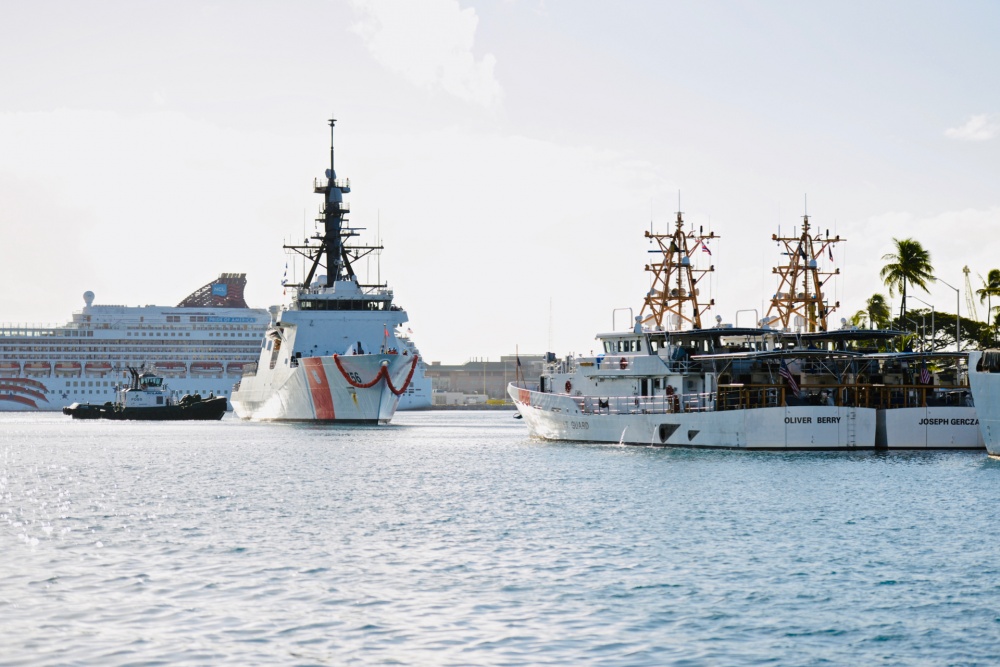
The crew of USCGC Kimball (WMSL 756) arrive in Honolulu for the first time Dec. 22, 2018. Known as the Legend-class, NSCs are designed to be the flagships of the Coast Guard’s fleet, capable of executing the most challenging national security missions, including support to U.S. combatant commanders. (U.S. Coast Guard photo by Chief Petty Officer Sara Muir/Released)
Seapower’s July/August Coast Guard Issue.

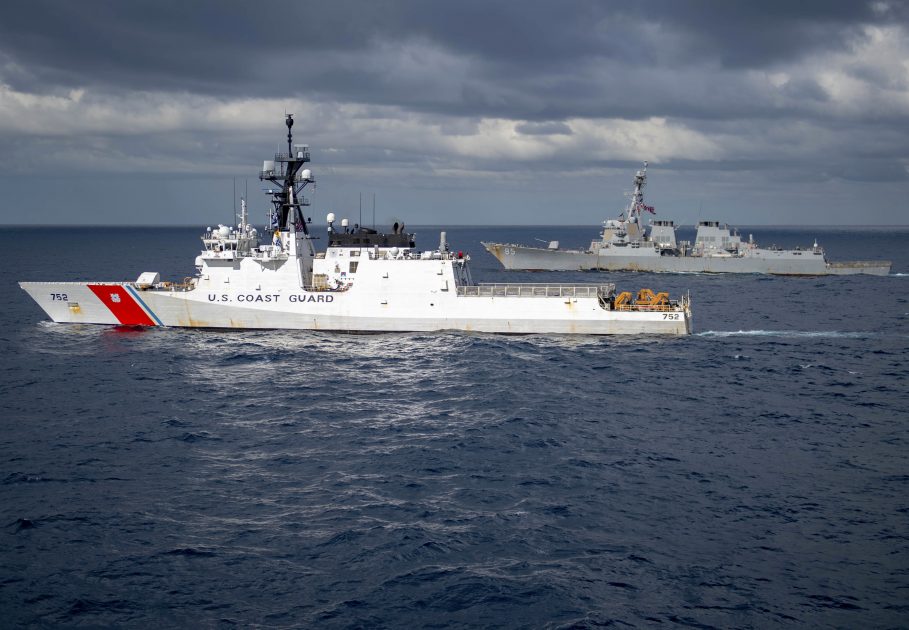
USCGC Stratton (WMSL-752), left, and the U.S. Navy Arleigh Burke-class guided-missile destroyer USS McCampbell (DDG-85) maneuver in formation during Talisman Sabre 2019 on July 11, 2019. US Navy Photo

The July/August issue of the Navy League’s magazine Seapower included a lot of Coast Guard content. I will not try to cover everything included, much of which has already been covered here, but I will mention a few things that stood out for me.

The Commandant’s Interview:

There was an interview with the Commandant, Admiral Schultz, that I found most interesting. There was a fair amount of information that was new to me.

Icebreakers:

Perhaps most significant was a comment regarding the Medium icebreaker.

“We also are looking to build probably a medium breaker, potentially what we’re going to call the Arctic security cutter — a little less capability in terms of icebreaking, but that capability would get us back to being an Atlantic and Pacific icebreaker Coast Guard.(emphasis applied–Chuck)

It may be that, if this ship is intended to transit the St Lawrence Seaway and work part time in the Great Lakes, like Canada’s proposed six “Program Icebreakers,” it would preclude the option of simply building six Polar Security Cutters rather than the three heavy and three medium icebreakers called for in the High Latitude Study. Alternately we might have four heavy Polar Security Cutters (PSC) in the Pacific and two Arctic Security Cutters (ASC) in the Atlantic.

The interview goes on to state, referring to its planned five year long progressive service life extension program, “…we could keep the 44-year-old Polar Star around here probably through the end of the decade if things go well.” (emphasis applied–Chuck)

The Western Pacific:

The Commandant noted that the Coast Guard had advisers in the Philippines, Vietnam, Fiji, and that an additional adviser would go to Malaysia and an attache to Australia to work with Australia and New Zealand. That there would also be an advisor assigned to Guam to work with the Commonwealth of Micronesia and the Federated States of Micronesia.

The Coast Guard is becoming more involved in countering Illegal, Unregulated, and Unreported (IUU) fishing, and will be providing leadership in international forums.

In reference to the forthcoming Tri-Service Maritime Strategy the Commandant said we could expect, “…to see the Coast Guard bring some unique capabilities to that conversation, particularly in the Indo-Pacific region.” 

Unmanned Systems:

Regarding land based systems the Commandant noted, “..we’ve completed prototype deployment of ScanEagle in Puerto Rico and Texas.” and “We teamed with U.S. Southern Command and CBP and employed one of those (MQ-9–Chuck) in an operation out of Panama that proved tremendously successful.”

He also mentions the possibility of using UAS of all sizes and mentioned the possibility of unmanned surface systems as well.

Cyber:

Sighting the FY2021 budget, Admiral Schultz said, “That is one of the biggest growth areas for humans in the Coast Guard here in the past budget cycle or two. There is somewhere north of 150 additional cyber warriors in the budget before the Congress right now.” 

“Insitu’s ScanEagle Performs ISR for Coast Guard”

There is a short one page report on the use of ScanEagle. It notes that ScanEagle is currently installed on six National Security Cutters and will be installed on all NSCs.

“A standard pack-out for a deployment of three ScanEagle UASs. The sensor systems include an electro-optical/infrared camera, a laser pointer, a communications relay, an automatic identification system (AIS), and visual detection and ranging (VIDAR)–a surface search capability.”

Interesting that it includes a laser pointer on the Coast Guard aircraft because that is usually used as a designator for laser homing weapons.

“The Era of the New Cutters”

This was a three page story, most of which is familiar to regular readers of this blog, but there was one nugget I had not seen before. “…the Coast Guard still will need to pursue a service-life extension program on six of the ships to ensure sustained fleet capability until the OPC program is finished.”

This almost certainly refers to the service life extension program (SLEP) for 270 foot WMECs. This is, I believe, the first time I have seen a number of ships mentioned, so not the whole class of 13. Notably it is only six so don’t expect a SLEP for 210s. They will soldier on in their current configuration until their long delayed retirement.

Offshore Patrol Cutters to be Based in Newport, RI

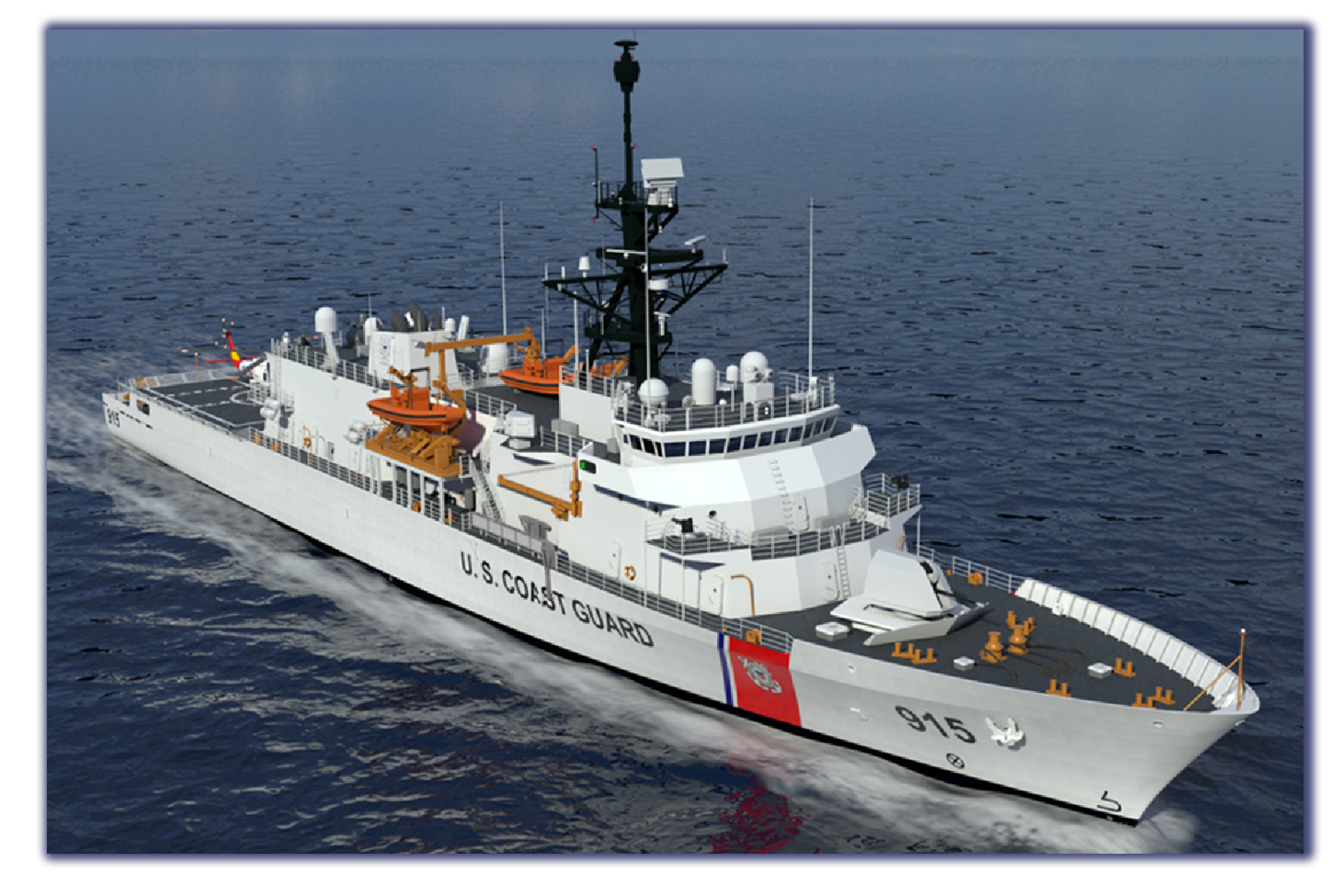
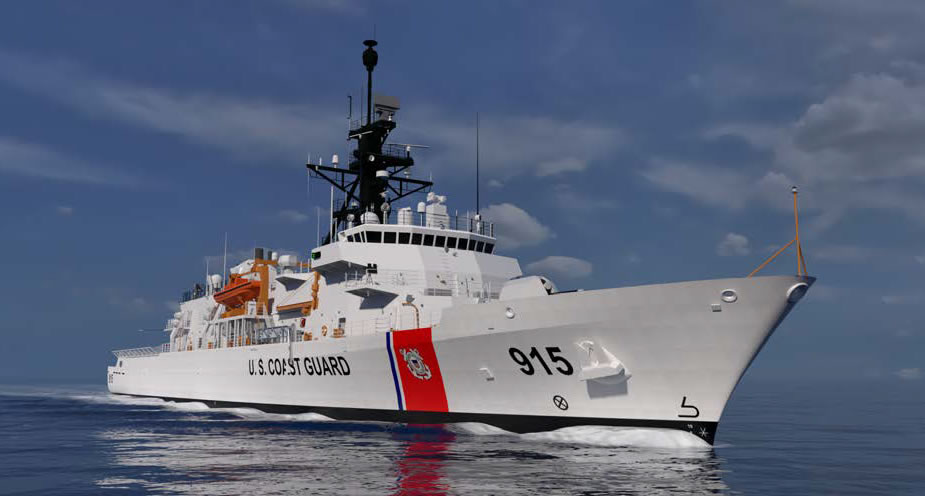
Artists rendering from Eastern Shipbuilding Group

Below is a Coast Guard Headquarters news release reproduced in its entirety, announcing two Off Shore Patrol Cutters (OPCs) will be homeported at Newport. That the first two OPCs would be based in San Pedro (Long Beach) and the second pair in Kodiak has already been announced, so presumably these are numbers five and six. These would be the first OPCs based on the East Coast, and also the first of the OPCs completed under the not yet awarded second construction contract. Delivery is expected in FY2026 and 2027.

Ultimately I would expect that most basing locations would ultimate support at least three ships. There seems to be a trend in this direction, and it makes sense for engineering and technical support. It also seems to follow a trend of the Coast Guard moving into moorings largely vacated at existing or former US Navy bases, e.g. Charleston, Pensacola, and Corpus Christi.

united states coast guard

 News Release  

U.S. Coast Guard Headquarters
Contact: Headquarters Public Affairs
Office: (202) 372-4630
mediarelations@uscg.mil
Headquarters online newsroom


U.S. Coast Guard announces Offshore Patrol Cutter homeport

WASHINGTON – The U.S. Coast Guard announced today that Naval Station Newport, R.I. will be home to future Offshore Patrol Cutters (OPCs).

“I am excited to announce the homeporting of two Offshore Patrol Cutters at Naval Station Newport, Rhode Island,” said Admiral Karl L. Schultz, Commandant of the U.S. Coast Guard. “NAVSTA Newport provides strategic operational reach and significant logistics support to our Service, helping secure our national interests in the Atlantic. I am grateful to the community and its leadership for their continued support of the U.S. Coast Guard and our families assigned to the region”. 

OPCs are the Coast Guard’s top acquisition priority and will provide the majority of the Coast Guard’s offshore presence, bridging the capabilities of the 418-foot National Security Cutters and the 154-foot Fast Response Cutters. OPCs will conduct missions including law enforcement, drug and migrant interdiction, search and rescue, homeland security, and defense operations. Each OPC will be capable of deploying independently or as part of a Task Group, and be capable of serving as a mobile Command and Control (C2) platform for surge operations such as hurricane, mass migration, or other contingency response operations.  

-USCG-

“Navy Frigate (FFG[X]) Program: Background and Issues for Congress,” Updated June 8, 2020, CRS

The Congressional Research Service has updated their analysis of the FFG(X) program. You can view the 38 page pdf here.

The FFG(X) equipment lists, which you might be better able to see here constitutes a list of possibilities for upgrades to the Polar Security Cutters, Coast Guard National Security Cutters, and Offshore Patrol Cutters.


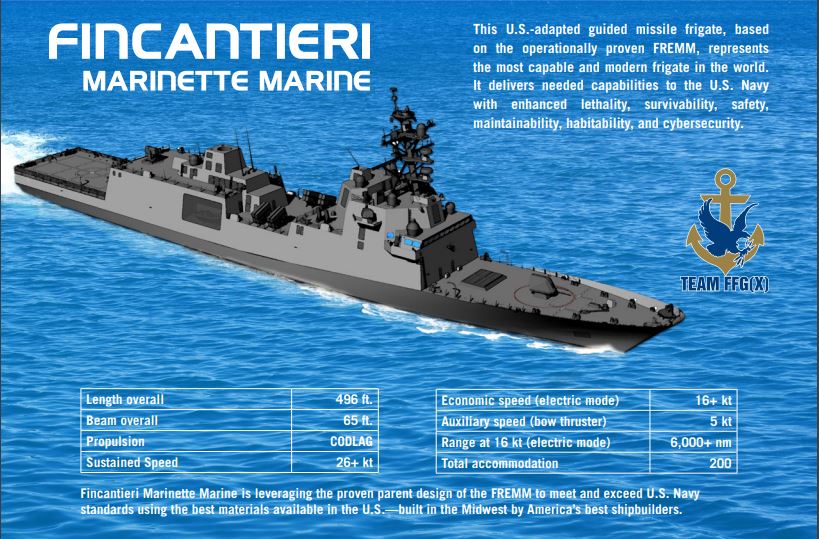
FFG(X) Contract Goes to Marinette, NSC#12 Less Likely?

200430-N-NO101-150
WASHINGTON (April 30, 2020) An artist rendering of the guided-missile frigate FFG(X). The new small surface combatant will have multi-mission capability to conduct air warfare, anti-submarine warfare, surface warfare, electronic warfare, and information operations. (U.S. Navy graphic/Released)

The Navy has announced that the contract for the first of the new FFG(X) class frigates has been awarded to Marinette Marine.

“Navy awarded a contract to design and produce the next generation small surface combatant, the Guided Missile Frigate (FFG(X)) today.  The contract for detail design and construction (DD&C) of up to 10 Guided Missile Frigates (consisting of one base ship and nine option ships) was awarded to Marinette Marine Corporation (MMC) of Marinette, Wisconsin, officials announced. “

One of the arguments for continuing the construction of the National Security Cutters (NSC) has been that it kept a production line open that might roll into production of the FFG(X). That is now no longer the case. The argument that we are replacing 12 ships, so we should build 12 is still valid to a degree.

Currently eleven NSCs are seen as replacing 12 WHECs, but we have yet to hear that 25 OPCs are not enough to replace 32 WMECs: 13 WMEC 270s, 16 WMEC210s, Alex Haley,  Acushnet, and Storis. Maybe what we need is 33 OPCs, to make up for the shortfall in replacing both 12 WHECs and 32 WMECs, 44 ships to replace 44.

Thanks to Secundius for bringing this to my attention. 

“Coast Guard Cutter Procurement: Background and Issues for Congress, Updated April 15, 2020” –CRS

The Congressional Research Service (CRS) has again updated their “Coast Guard Cutter Procurement: Background and Issues for Congress.” The last updated edition of this analysis, that I reported on here, was dated 28 Jan. 2020. The FY2021 PC&I request includes funding for OPC#3 and long lead time material for #4, plus small amounts for the NSC and FRC program. Not addressed here is the second Polar Security Cutter for which funding is also requested, addressed in a separate CRS report. There is a good breakdown of the entire request for vessels here.

As noted earlier, eight Marine Protector class, 87 foot WPBs are to be decommissioned without replacement. 

Congress has routinely added Webber class Fast Response Cutters to previous budgets. I have to believe the Congress will fund four additional FRCs, if not in FY2021 then in 2022, so that we can ccomplete the program of record and replace all six Island class WPBs of PATFORSWA. A 12th NSC seems much less likely, but not impossible. The summary for the 15 April edition is quoted below. 

Summary

The Coast Guard’s program of record (POR) calls for procuring 8 National Security Cutters (NSCs), 25 Offshore Patrol Cutters (OPCs), and 58 Fast Response Cutters (FRCs) as replacements for 90 aging Coast Guard high-endurance cutters, medium-endurance cutters, and patrol craft. The Coast Guard’s proposed FY2021 budget requests a total of $597 million in procurement funding for the NSC, OPC, and FRC programs. It also proposes a rescission of $70 million in FY2020 procurement funding that Congress provided for the NSC program.

NSCs are the Coast Guard’s largest and most capable general-purpose cutters; they are replacing the Coast Guard’s 12 Hamilton-class high-endurance cutters. NSCs have an estimated average procurement cost of about $670 million per ship. Although the Coast Guard’s POR calls for procuring 8 NSCs to replace the 12 Hamilton-class cutters, Congress through FY2020 has fully funded 11 NSCs, including the 10th and 11th in FY2018. In FY2020, Congress provided $100.5 million for procurement of long lead time materials (LLTM) for a 12th NSC, so as to preserve the option of procuring a 12th NSC while the Coast Guard evaluates its future needs. The funding can be used for procuring LLTM for a 12th NSC if the Coast Guard determines it is needed. The Coast Guard’s proposed FY2021 budget requests $31 million in procurement funding for activities within the NSC program; this request does not include further funding for a 12th NSC. The Coast Guard’s proposed FY2021 budget also proposes a rescission of $70 million of the $100.5 million that Congress provided for a 12th NSC, with the intent of reprogramming that funding to the Coast Guard’s Polar Security Cutter (PSC) program. Eight NSCs have entered service; the seventh and eighth were commissioned into service on August 24, 2019. The 9th through 11th are under construction; the 9th is scheduled for delivery in 2020.

OPCs are to be less expensive and in some respects less capable than NSCs; they are intended to replace the Coast Guard’s 29 aged medium-endurance cutters. Coast Guard officials describe the OPC and PSC programs as the service’s highest acquisition priorities. OPCs have an estimated average procurement cost of about $411 million per ship. The first OPC was funded in FY2018. The Coast Guard’s proposed FY2021 budget requests $546 million in procurement funding for the third OPC, LLTM for the fourth, and other program costs. On October 11, 2019, the Department of Homeland Security (DHS), of which the Coast Guard is a part, announced that DHS had granted extraordinary contractual relief to Eastern Shipbuilding Group (ESG) of Panama City, FL, the builder of the first four OPCs, under P.L. 85-804 as amended (50 U.S.C. 1431-1435), a law that authorizes certain federal agencies to provide certain types of extraordinary relief to contractors who are encountering difficulties in the performance of federal contracts or subcontracts relating to national defense. ESG reportedly submitted a request for extraordinary relief on June 30, 2019, after ESG’s shipbuilding facilities were damaged by Hurricane Michael, which passed through the Florida panhandle on October 10, 2018. The Coast Guard intends to hold a competition for a contract to build OPCs 5 through 15.

FRCs are considerably smaller and less expensive than OPCs; they are intended to replace the Coast Guard’s 49 aging Island-class patrol boats. FRCs have an estimated average procurement cost of about $65 million per boat. A total of 60 have been funded through FY2020, including four in FY2020. Four of the 60 are to be used by the Coast Guard in the Persian Gulf and are not counted against the Coast Guard’s 58-ship POR for the program, which relates to domestic operations. Excluding these four FRCs, 56 FRCs for domestic operations have been funded through FY2020. The 36th FRC was commissioned into service on January 10, 2020. The Coast Guard’s proposed FY2021 budget requests $20 million in procurement funding for the FRC program; this request does not include funding for any additional FRCs.

“Coast Guard Modifies Contract to Construct Second Offshore Patrol Cutter, Acquire Long Lead-Time Material for Third Offshore Patrol Cutter” –CG-9

Above: Artists rendering from Eastern Shipbuilding Group

Contract for the Second Offshore Patrol Cutter, the future USCGC Chase, and long lead time items for the third. Presumably this is a contract modification, rather than the  exercise of a contract option, because the price is higher than the original option. Still this does not look a great deal higher than the previous contract ($317.5M), for the first OPC and long lead time items for the second. Following from the Acquisitions Directorate, CG-9:

The U.S. Coast Guard modified its contract with Eastern Shipbuilding Group (ESG) April 2 to begin construction of the second Offshore Patrol Cutter (OPC) and to acquire long lead-time material (LLTM) for the third OPC. Contract delivery of the second OPC, to be named Chase, is scheduled to occur in 2023.

The total value of the construction and LLTM orders is $343 million. In addition to ordering construction of the second OPC, this contracting action also covers the initial order of components and materials necessary to support the future construction of the third OPC by acquiring propeller and steering components, marine diesel engines, the ship integrated control system, switchboards, and generators.

The lead OPC is currently in production at ESG’s shipyard in Panama City, Florida.  Production of the lead cutter, Argus, commenced January 7, 2019. Delivery of Argus is scheduled for 2022.

The OPC meets the Service’s long-term need for cutters capable of deploying independently or as part of task groups and is essential to stopping smugglers at sea, interdicting undocumented migrants, rescuing mariners, enforcing fisheries laws, responding to disasters and protecting our ports. The acquisition of 25 OPCs will complement the capabilities of the Service’s National Security Cutters, Fast Response Cutters and Polar Security Cutters as an essential element of the Department of Homeland Security’s layered security strategy.

For more information: OPC program page

“Coast Guard Awards Nine Contracts for Offshore Patrol Cutter Industry Studies” –CG-9

Interest in building follow-on Offshore Patrol Cutters is definitely alive and well. The Acquisitions Directorate, CG-9, has issued nine contracts for industry studies. All these contracts went to shipbuilder. I have reproduced their report below. Hopefully this will lead to a better and more producible design. 

The Coast Guard announced the award of nine Offshore Patrol Cutter (OPC) industry studies contracts March 20, 2020. These awards support the Coast Guard’s strategy to mitigate OPC program risk and complete the program of record by establishing a new, fair and open competitive environment to complete the OPC program of record. Industry studies contracts were awarded to:

  • Austal USA, LLC of Mobile, Alabama: $2.0 million base award ($3.0 million total potential value)
  • Bath Iron Works of Bath, Maine: $2.0 million base award ($3.0 million total potential value)
  • Bollinger Shipyards Lockport LLC of Lockport, Louisiana: $2.0 million base award ($3.0 million potential value)
  • Eastern Shipbuilding Group, Inc. of Panama City, Florida: $1.1 million base award ($1.2 million potential value)
  • Fincantieri Marinette Marine of Marinette, Wisconsin: $2.0 million base award ($3.0 million total potential value)
  • General Dynamics/NASSCO of San Diego, California: $2.0 million base award ($3.0 million total potential value)
  • Huntington Ingalls, Inc. of Pascagoula, Mississippi: $2.0 million base award ($3.0 million total potential value)
  • Philly Shipyard, Inc. of Philadelphia, Pennsylvania: $2.0 million base award ($3.0 million total potential value)
  • VT Halter Marine Inc. of Pascagoula, Mississippi: $2.0 million base award ($2.9 million total potential value)

Under their respective contracts, the awardees will assess OPC design and technical data, provided by the Coast Guard, and the program’s construction approach. Based on their analyses, the awardees will recommend to the Coast Guard potential strategies and approaches for the follow-on detail design and construction (DD&C). The awardees will also discuss how they would prepare the OPC functional design for production. The awardees may also identify possible design or systems revisions that would be advantageous to the program if implemented, with strategies to ensure those revisions are properly managed.

The Coast Guard will use the industry studies results to further inform its follow-on acquisition strategy and promote a robust competitive environment for the DD&C award. Participation in industry studies is not a pre-requisite for submitting a DD&C proposal.

The OPCs will replace the service’s aging medium endurance cutters, which are becoming increasingly expensive to maintain and operate. The OPCs will bridge the capabilities of the national security cutters, which patrol the open ocean, and the fast response cutters, which serve closer to shore.

The current OPC DD&C contract is for up to four hulls. The contract was adjusted as part of a request made by the incumbent, Eastern Shipbuilding Group (ESG), for extraordinary relief under the authority of Public Law 85-804 was granted by the Department of Homeland Security. The request was a result of devastation caused when Hurricane Michael – a Category 5 storm – made landfall in Panama City, Florida, on October 10, 2018. Hurricane Michael caused extensive damage to the ESG’s shipyard and the Panama City region.

For more information: Offshore Patrol Cutter program page

All Currently Commissioned NSC to Have Small Unmanned Air Systems by the End of the Year

A small unmanned aircraft system operator recovers an sUAS (Scan Eagle–Chuck) after a flight from Coast Guard Cutter Stratton in the South China Sea Sept. 16, 2019. The sUAS is capable of flying for more than 20 hours and has a maximum speed of about 60 mph. U.S. Coast Guard photo by Petty Officer 1st Class Nate Littlejohn.

The Acquisitions Directorate (CG-9) has announced that all eight currently commissioned National Security Cutters should have small unmanned aircraft systems but the end of the calender year (quoted below). Presumably these will be Scan Eagle systems. Intention is to have these on the Offshore Patrol Cutters as well. 

“The Coast Guard’s small unmanned aircraft system (sUAS) for national security cutter (NSC) program reached a milestone March 4 when Rear Adm. Michael Johnston, assistant commandant for acquisition and chief acquisition officer, approved a move to full production, called ADE-3. This allows the program to move forward with outfitting the remainder of the Service’s operational NSCs with sUAS capability.

“The Coast Guard awarded a contract June 6, 2018, to Insitu for the procurement of sUAS capability on three NSCs and options to outfit the rest of the NSC fleet in future years. In 2019, the Commandant expressed the service’s intent to accelerate delivery of the capability. The sUAS program office, aided by Naval Information Warfare Center-Atlantic, developed an aggressive strategy to install and employ the sUAS capability onboard all operational NSCs by the end of calendar year 2020. The ADE-3 approval allows the newly implemented schedule to continue as set. The program is currently on track to meet guidance to double installation rates by the end of calendar year 2020.

“Coast Guard Cutters Stratton, James, Munro, Kimball and Waesche are fully outfitted with sUAS capability. Coast Guard Cutters Bertholf, Hamilton and Midgett are all currently being outfitted with the sUAS capability. Coast Guard Cutter Bertholf is scheduled to be fully mission capable in summer 2020 with Hamilton and Midgett on track to be completed before the end of the calendar year.

“A UAS consists of an unmanned aircraft, its mission payloads, launch and recovery equipment, ground support equipment, and data and control links. The Coast Guard requires a UAS that can remain on station for extended periods, expand maritime domain awareness and disseminate actionable intelligence on maritime hazards and threats.

“For more information: Unmanned Aircraft Systems program page”

Insitu ScanEagle small Unmanned Air System (sUAS)

“Coast Guard Cutter Procurement: Background and Issues for Congress Updated January 28, 2020” –CRS

The Congressional Research Service has again updated its look at cutter procurement. (Note, this link will take you to the latest version of the report and is subject to change with each update.) While I cannot be sure there are no other changes, I believe the significant changes are a reflection of the result of the House and Senate Conference Committee. From page 25.

Conference In final action, the FY2020 DHS Appropriations Act became Division D of H.R. 1158, the Consolidated Appropriations Act, 2020. The explanatory statement for Division D of H.R. 1158/P.L. 116-93 of December 20, 2019, provides the funding levels shown in the appropriation conference column of Table 2. The explanatory statement for Division D of H.R. 1158 states: The agreement [for the Coast Guard’s Procurement, Construction, and Improvements account] provides an increase of $537,850,000 above the request, including … $260,000,000 for a total of four FRCs…. The bill makes available $100,500,000 for long lead time material for a twelfth National Security Cutter, consistent with the direction in the House Report….

I have reproduced Table 2 from page 21 of the report below. The following explanatory note is quoted from the CRS report:

“Source: Table prepared by CRS based on Coast Guard’s FY2020 budget submission, HAC committee report, and SAC chairman’s mark and explanatory statement on FY2020 DHS Appropriations Act. HAC is House Appropriations Committee; SAC is Senate Appropriations Committee.”

Summary of Appropriations Action on FY2020 Acquisition Funding Request

Table 2 summarizes appropriations action on the Coast Guard’s request for FY2020 acquisition funding for the NSC, OPC, and FRC programs.

Table 2. Summary of Appropriations Action on FY2020 Acquisition Funding Request Figures in millions of dollars, rounded to nearest tenth

  • Request______Request______HAC_______SAC_____Final
  • NSC program ____60 _______160.5 _______60 _____160.5
  • OPC program ___457 _______457 _______457 ______312
  • FRC program ___140 _______290 _______240 ______260
  • TOTAL _________657 ______907.5 ______757 ______732.5

So again Congress is providing funding above that requested by the administration.

The increase from two to four Webber class is consistent with previous Congressional action, and should actually result in a savings over the life of the program, in that it is in line with the current contract options and will not require a renegotiation that might have raised the cost of individual cutters by up to $10M. That means a total of 62 Webber class will have been funded. Only two additional in FY2021 are planned, for a total of 64, 58 in the program of record plus six for PATFORSWA to support CENTCOM, but I would not be surprised to see four in the final FY2021 budget.

The addition of $100.5M for Long Lead Time items for a twelfth National Security Cutter looks like a strong commitment to fund another Bertholf class National Security Cutter.

Relative to the OPC program, from page 26:

OPC Program.- The contract awarded to construct the OPC was recently amended to address increased cost estimates after the Acting Secretary determined that relief permitted under Public Law 85-804 was appropriate and necessary to the national defense. An associated delay in delivery of the first two hulls reduced the fiscal year 2020 requirement for the OPC by $145,000,000. Funds included in the agreement continue necessary program requirements. The agreement maintains the commitment to ensuring the Coast Guard can continue the program of record for these critical vessels. As a condition of the granted relief, the vendor will be subject to increased oversight, including additional scrutiny of the costs borne by the Coast Guard. The Coast Guard shall brief the Committees quarterly on the metrics used to evaluate adherence to production timelines and costs, including those attributed to reestablishing the production line and maintaining the skilled workforce required to ensure contract performance.

So Congress is going to let the decision to allow extraordinary relief to Eastern Shipbuilding go ahead. The reduction of OPC funding that had been requested is only due to delays in the program and presumably the deletion of long lead time materials for OPC #5 from the payments that had been planned for Eastern.