Above is a YouTube video, talking about the pier that is expected to be built to bring supplies into Gaza as announced in the President’s State of the Union address.
Reportedly this will not involve putting US “boots on the ground” in Gaza, but…the Coast Guard may be involved in providing waterside security, states-side load out, and perhaps in the processing of shipments through Cyprus.
U.S. Army Vessel General Frank S. Besson (LSV-1) from the 7th Transportation Brigade (Expeditionary), 3rd Expeditionary Sustainment Command, XVIII Airborne Corps, departed Joint Base Langley-Eustis, Va., March 9, 2024, en route to the Eastern Mediterranean carrying the first equipment to establish a temporary pier to deliver vital humanitarian supplies. (U.S. Central Command photo)
Meanwhile, World Central Kitchens is working on its own possible solution. It is not unlikely other non-government organizations will want to bring in supplies as well. Presumably these supplies will also have to be processed through Cyprus where the Israelis have set up a check point.
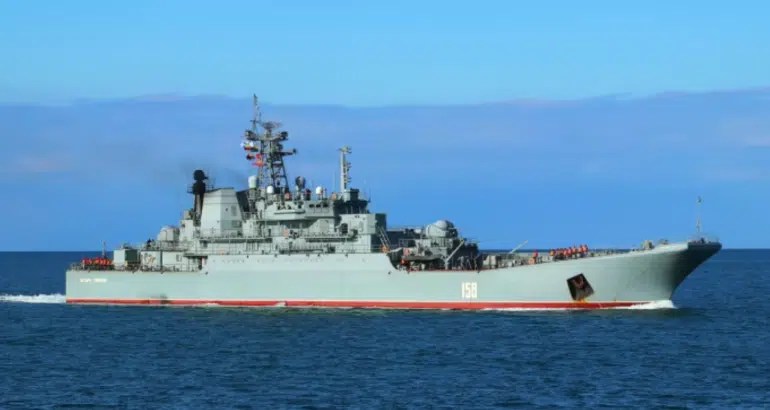
“Ukraine has claimed the destruction of another warship of the Russian Black Sea Fleet, the Ropucha class landing ship Cesar Kunikov (also written as Tsezar Kunikov) being the latest victim of explosives-laden naval drones off the coast of Crimea. Ukrainian officials claim that the landing ship was sunk in the overnight attack and available imagery shows the vessel capsized.”
I applaud what the Ukrainians are doing, but the Coast Guard needs to anticipate that we might someday be on the receiving end of this sort of attack. What are the Russians doing and could we do better?
So far, the Russian Black Sea Fleet has reportedly lost 24 surface units and a submarine to various forms of attack. But let’s look specifically at landing ships in the Black Sea which the Russians are using to transport supplies and reinforcements to Crimea.
Ropucha-I class landing ship Caesar Kunikov (Russian MoD photo)
Russia has been able to add some small combatants to the Black Sea Fleet using its River systems, but they are unable to add large ships, including landing ships because Turkey has closed access to the Black Sea by warships from the Mediterranean, so Russia cannot expect reinforcements. Apparently anticipating closure of the Dardanelles, the Russian Navy moved six additional landing ships into the Black Sea. Wikipedia reports,
In February 2022, prior to the full-scale Russian invasion of Ukraine, the landing ships Korolev, Minsk, Kaliningrad, Pyotr Morgunov, Georgy Pobedonosets, and Olenegorsky Gornyak from the Baltic Fleet and Northern fleets departed their bases and passed through the Dardanelles Strait for claimed Military exercise in the Black Sea.
In addition, a Ukrainian ship of this type was added to the Russian Black Sea Fleet when Russia occupied Crimea, but that ship is reportedly inactive. The Russians are apparently having difficulty maintaining these approximately 40 year old ships.
“According to Ukrainian Navy spokesperson Dmytro Pletenchuk, the Black Sea Fleet now has only fiveRopucha class ships remaining in service out of a previous total of 13 (additional units were transferred from the Baltic and Northern Fleets ahead of the full-scale invasion of Ukraine).” –This may refer to all types of LSTs, not just Rapucha class. They also lost a Tapir class LST.–Chuck
Ship Self-Defense:
Looking at this video, I could not help but think that the Ukrainians would have had a harder time if the Russian ship had enforced darken ship. At the very least the attackers might have had less time to coordinate their attack. The attacks are clearly made at night using electro optics, and a lighted target helps them. All that lighting also degrades the night vision of lookouts that might otherwise recognize that an attack is underway.
The Russian LST was well armed. The Rapucha class ship reported sunk, had two twin 57mm guns with a 200 round per minute rate of fire, so, theoretically, about four times the firepower provided by an NSC or OPC’s 57mm Mk110. You might think these would be effective against unmanned surface vessels, but I have yet to see any evidence in any of the videos of main gun systems being used against such attacks. They always seem to be pointed on the centerline.
It seems that in successful attacks, the target is late in recognizing it is under attack. I have to wonder if their weapons and sensors were manned and ready? Were lookouts posted? Were lookouts equipped with night vision devices?
Apparently, the attack occurred near the end of its voyage from Novorossiysk to Sevastopol. The ship was close enough to Sevastopol that smoke from wreck was visible on shore.
If you are intending to intercept a ship that may use evasive courses. The most logical place to intercept it would be near the known starting and ending points and in this case the ending point would have been an easier place to stage an ambush. It would also be the easiest place to provide protective units.
In an earlier attack, we saw the attacking USVs engaged by a helicopter. In this case, there seems to have been no overwatch.
Small boat escorts might help, even if all they did was provide eyes and ears away from the light and noise of the target vessel that could recognize the threat.
It would of course be critical that they escorting vessels not be fired upon by the targeted vessel, so recognition signal lights would probably be appropriate.
Pairs of boats ahead and on either side of the escorted vessel could alternately sprint and drift so as to minimize noise.
I would estimate escorting boats would want to patrol about 4,000 yards from the escorted vessel, but this is something that could be tested using watercraft with similar characteristics to the kamikaze USVs.
If armed with machine guns, escorting boats could attempt to engage the threats. If using tracer ammunition, even if unable to destroy the threat, they would be pointing out the threat to the target ship.
In many of these videos, it appears that the first hit which immobilizes the target occurs with USV in a pursuit curve coming up the stern of the vessel. An escorting boat in the wake of target vessel would be in a good position to prevent that first immobilizing hit.
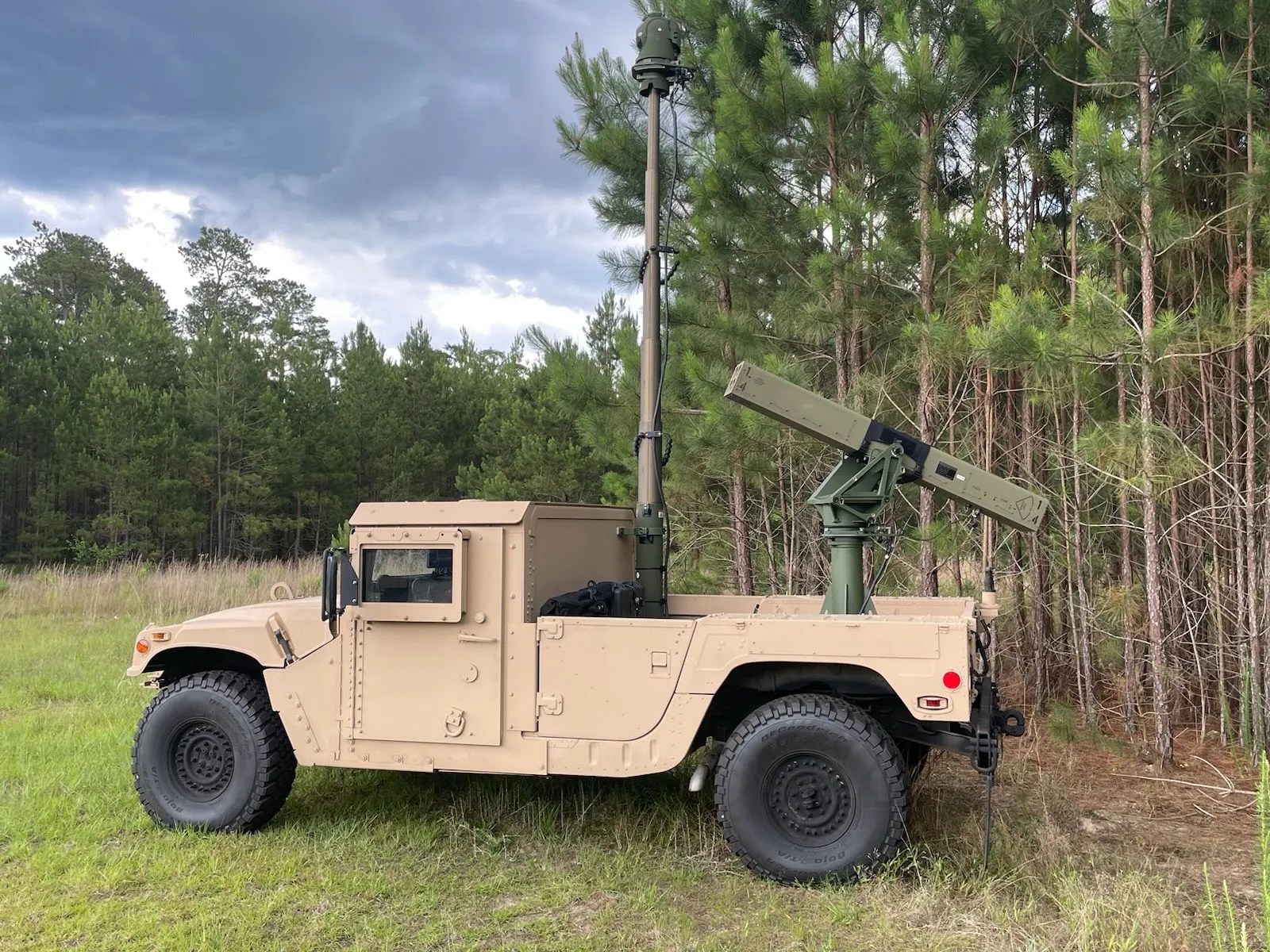
The Ukrainian Navy’s press service recently released footage showcasing the combat effectiveness of their air defense units, marking the confirmed debut of a new Counter-Unmanned Air System (UAS) weapon system developed by L3Harris for Ukraine.
The video captured the moment when a Russian kamikaze drone, identified as the Shahed-136, was successfully shot down by an Advanced Precision Kill Weapon System (APKWS) laser-guided rocket launched from the Vampire weapon system.
It is probably less maintenance intensive than a .50 caliber machine gun.
It has a very small footprint and light weight.
Because it is a precision weapon, it minimizes the probability of collateral damage.
It is a proven counter Unmanned Air System.
It can employ a variety of warheads for different purposes including air burst with the M429 proximity fuse. It has even been tested successfully against cruise missiles.
It is effective against small, fast, highly maneuverable surface threats.
It has an effective range greater than that of our M38 gun mounts and a similar effective range to that of the 57mm and 76m guns.
While I would not count on its ability to stop medium to large ships, it can inflict damage at effective ranges beyond that of most weapons a terrorist organization might equip a vessel with. It is likely to be a lot more effective against small ships than the Mk38.
And it is cheap.
Without much additional effort, it could make Coast Guard assets much more capable in the Ports, Waterways & Coastal Security and Defense Readiness missions.
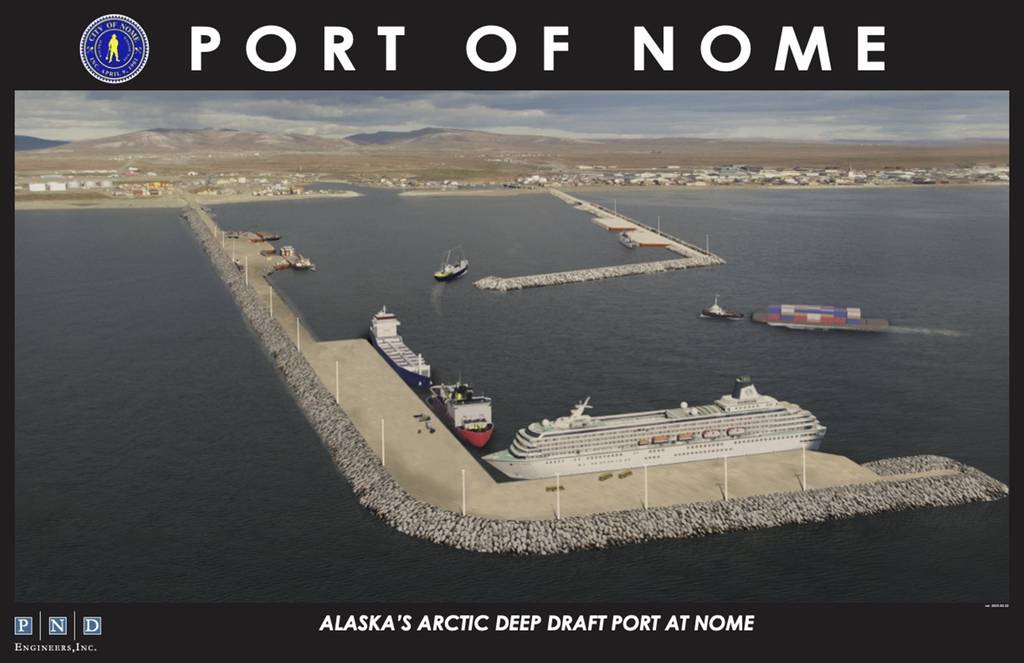
This rendering provided by the City of Nome shows how the Port of Nome, Alaska, will appear following an expansion project that will cost more than $600 million. Shipping lanes that were once clogged with ice for much of the year along Alaska’s western and northern coasts have relented thanks to global warming, and the nation’s first deep water Arctic port should be operational in Nome by the end of the decade. (PND Engineers Inc./City of Nome via AP)
Without offering much detail, the NORTHCOM on-line magazine “The Watch” reports the intention to invest in improvements in three Alaska ports, Port of Alaska (Anchorage), Valdez, and Nome.
None of these ports are above the Arctic Circle, but Nome is very close.
Only the development of a deepwater port at Nome appears to be driven by national security considerations, though modernization in Anchorage and Valdez may offer incidental logistical benefits.
We have been talking about a deepwater port in or near Nome since 2018.
I would not be surprised to see Nome as a future Coast Guard buoy tender homeport and seasonal air station.
Nome’s proximity to the Bering Strait and Russia, all within 150 miles, makes it strategically important.
Port of Alaska (Anchorage). Traveler photo submitted by 2013TravelinFool (Jul 2017)
Port of Alaska (Anchorage) is the only designated Strategic Port in Alaska. It appears the upgrades are replacements for existing facilities including updated technology.
There is a comprehensive, 121-page plan for Valdez on-line here. It includes some upgrades of the container port but envisions minimal Corps of Engineers support and involvement. Most of the work seems to be in support of tourism, fishing, and local marine industry.
The “Poniard” Korean-Low cOst Guided Imaging Rocket (K-LOGIR) is closely related to the APKWS, both being based on the 70mm Hydra unguided rocket. Unlike the semi-active laser homing APKWS, the K-LOGIR is a fire-and-forget system allowing multiple simultaneous engagements.
Most of the reports I have read on this exercise are unclear if six missiles hit a single target or if six missiles hit six different targets, but this Defense Mirror report, “Textron’s Unmanned Boat Uses South Korean Weapon to Engage Multiple Targets.” makes it clear that multiple targets were engaged in a single salvo.
I don’t fully understand how they designate different targets for the missiles in the salvo, but it may be that they are sending them to different waypoints before they initiate their search.
The ability to engage several targets simultaneously makes this system attractive for countering surface swarm tactics like those that might be encountered by PATFORSWA, but for the Ports, Waterways, and Coastal Security mission, the APKWS’ semi-active laser homing might be a better solution, in that we are unlikely to have to engage numerous targets in a single salvo and we may want to target particular parts of an adversary’s vessel or perhaps engage low-level air targets such as UAS, helicopters, or general aviation aircraft. Presumably, APKS could be fired from the same launcher.
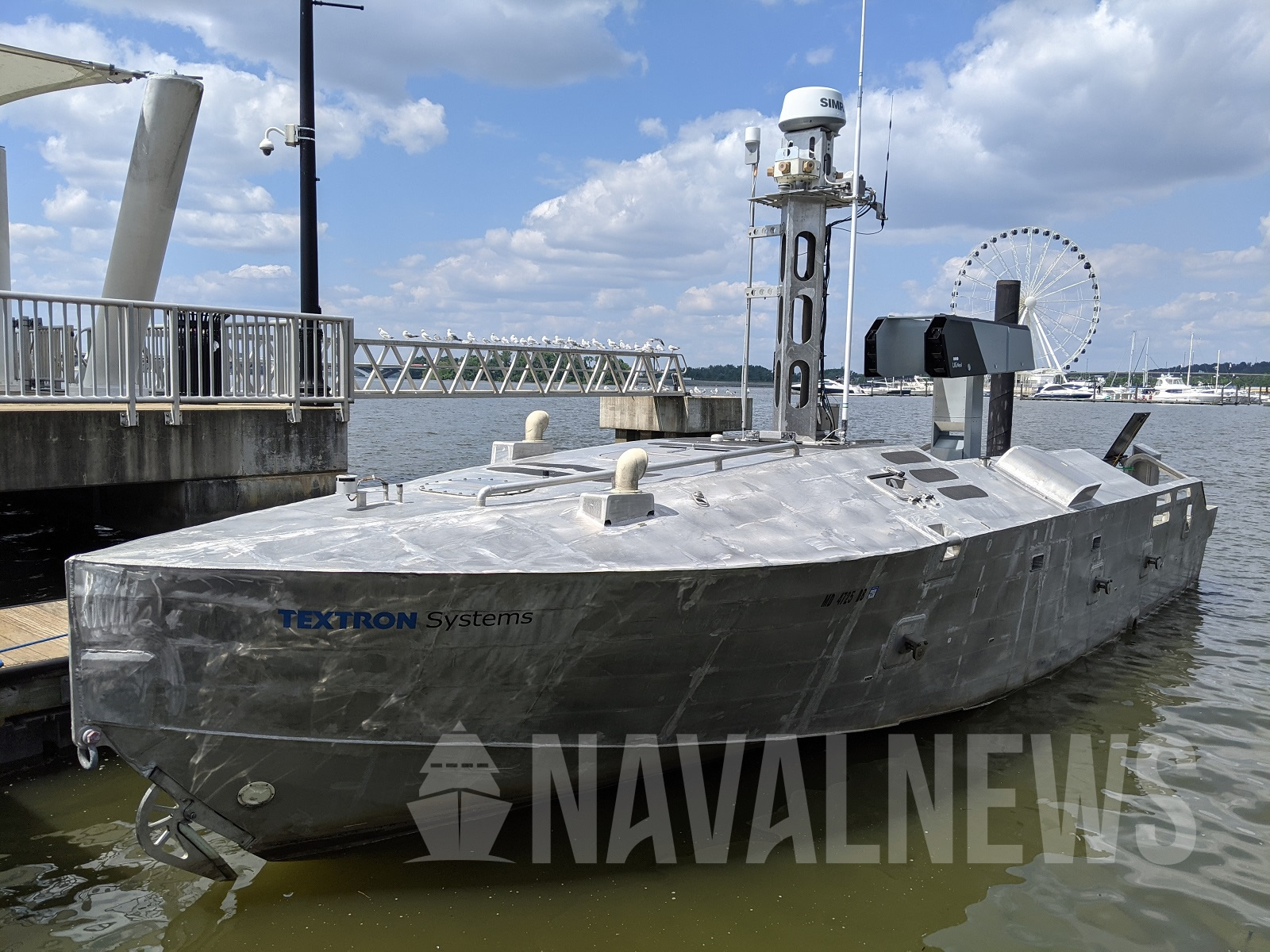
Textron USV fitted with LIG Next1’s Poniard guided rocket. Textron photo.
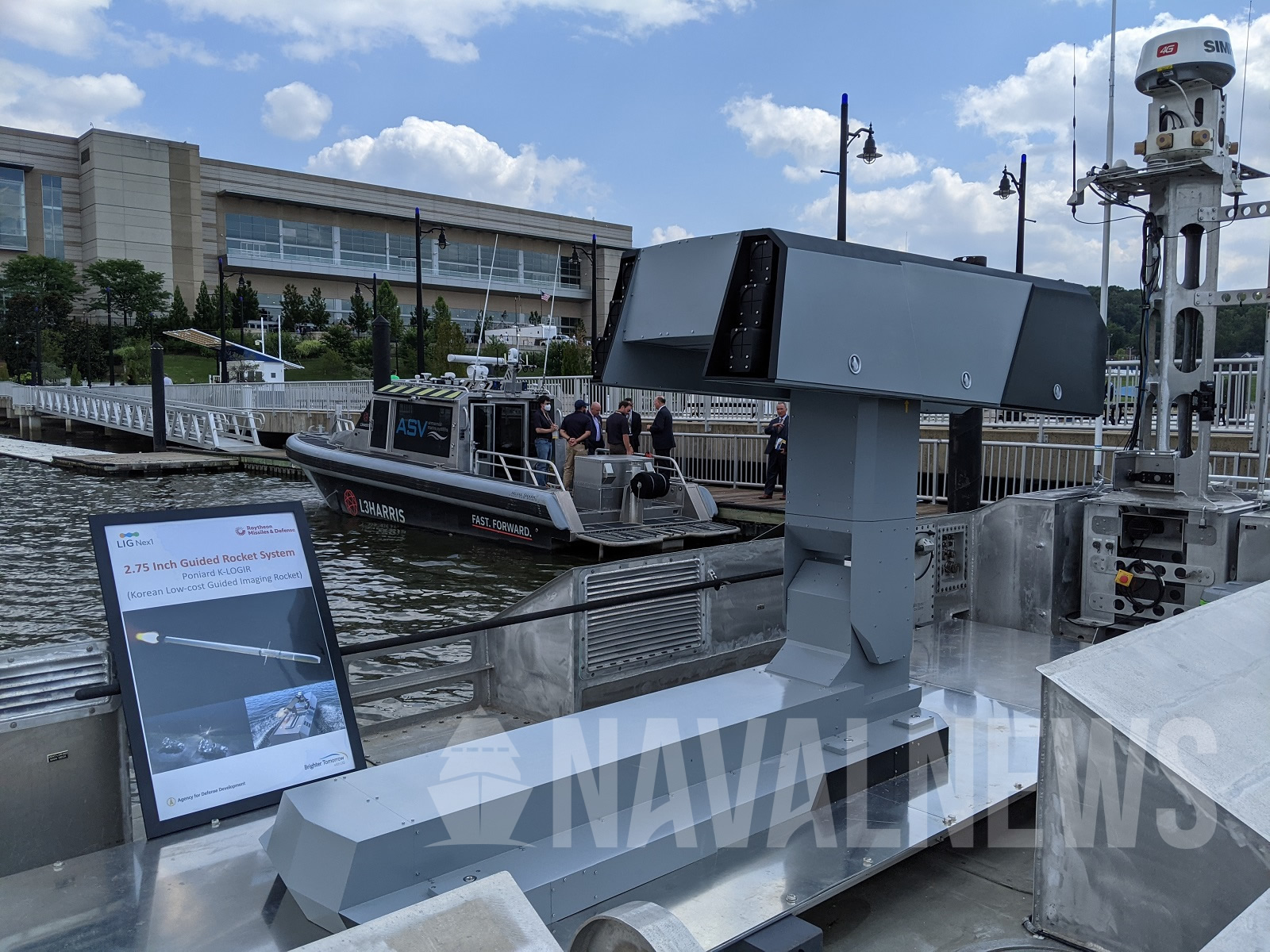
Take a look at the launcher above and below. Here it is mounted on an unmanned 39-foot boat. In the photo above you can see that it traverses and elevates. It appears to hold up to six rockets. It might be an appropriate way to arm Coast Guard patrol boats and larger cutters with APKWS, but “Vampire” might be even simpler.
K-LOGIR launcher fitted on a Textron CUSV USV at Sea Air Space 2021. The system was showcased by Raytheon and LIG Nex1.
I would really like to see 4th Fleet make more effort to publicize their experimentation efforts. I’m surprised I was not able to find a YouTube video that documented this test and I have seen no mention of it on the 4th Fleet website.
I am also curious to know if the Navy’s 39′ CUSV could be operated from the stern ramp of a National Security Cutter. Interoperability?
Israel Shipyards Shaldag MK V. Israel Shipyards Ltd. picture
For some time, I have thought that the Webber class, “Fast Response Cutter” (FRC), program was misnamed. Webber class cutters don’t generally sit in port waiting for some alarm to call them to rush to the scene. Rather they are used more like small Medium Endurance Cutters. This has proven especially fortuitous in view of the delays in replacing the existing WMECs. It is only because of the versatility of the Webber class that the Coast Guard will be able to maintain its drug and alien migrant interdiction efforts in the 7th District and extend fisheries protection and counter IUU efforts into the Western Pacific while decommissioning WMECs before their replacements are completed.
Still, I do believe there is a need for true Fast Response Cutters for those rapidly developing missions that require more range and capability than a Response Boat, Medium, for protection of high value units, and to respond in the event of a maritime terrorist attack–units for which SAR and particularly Ports, Waterways, and Coastal Security are their primary missions.
The “Marine Protector” 87-foot patrol boats have had this job, but they are approaching the end of their service life (the oldest are now 25 years old). Four of them are particularly tasks with protecting Fleet Ballistic Missile submarines during surface transit from their bases to open sea. They have never been well prepared to deal with terrorist threats and aren’t really particularly fast.
We have discussed characteristics for a WPB replacement, a true Fast Response Cutter, before (here and here) and why nothing we have currently is suitable for the mission. The Shaldag Mk. V looks like a good candidate for the job, but first let’s look at where and why we might need vessels of this type.
The Webber class as Fast Response Cutters:
In some places, the Webber class might take on the functions of a “fast response cutter.” Where there are three or more based in a single location, it should be possible to have one on standby virtually at all times. Though better armed than the 87 footers, they are not particularly well prepared to deal with the terrorist threat, but it is possible to increase their armament to make them more effective in the role.
Even if the Webber class could be used in the FRC role, their basing, concentrated as it is to improve maintenance, would leave many ports with no similar protection.
Where Do We Need Fast Response Cutters:
In an earlier post, “A Reevaluation, Ruminating on Homeports While Playing the Red Cell,” Part 1 and Part 2, I identified 31 critical ports that required protection from unconventional attack.
I will assume that if the Coast Guard recognizes the need for a true Fast Response Cutter, a well-armed interceptor, and does build such a class, that they will also increase the armament of at least some of the Webber class, so that they could also be effective in this role at critical ports where they are based.
Webber class are based in 9 of the 31 critical ports: Moorehead City/Atlantic Beach, NC; Miami; San Juan; Pascagoula; Galveston; LA/Long Beach/San Pedro; Honolulu; and Guam.
That leaves 22 port complexes without resident Fast Response Cutters:
CCGD1:
Bath, Me–Major Naval shipbuilder
Kittery, ME/Portsmouth, NH –Naval Shipyard
Groton, CT–Submarine base
Hudson River complex, New York, NY/Elizabeth and Bayonne, NJ–a major cultural target, #3 US Port by tonnage, #3 Container port, #4 Cruise ship port (NYC) and #13 cruise ship port (Cape Liberty, NJ)
CCGD5:
Chesapeake Bay Complex, VA–Base for aircraft carriers and submarines, Major naval shipbuilder, Strategic Port, #9 port by tonnage, #5 container port; plus water route to Washington, DC (major cultural target) and Baltimore, MD–#14 port by tonnage, #13 container port, #12 cruise ship port
Jacksonville complex, FL (including Kings Bay, GA)–SSBNs, Navy Base Mayport, #14 cruise ship port, Strategic Seaport/ Mayport, FL
Port Canaveral, FL–#3 Cruise Ship port/ Cape Canaveral, FL:
Port Everglades/Fort Lauderdale, FL–#11 container port, #2 Cruise Ship port
Tampa, FL–#7 Cruise Ship port/
CCGD8
Mobile, AL–major naval shipbuilder, #11 port by tonnage
Gulfport, MS–Strategic Seaport
Mississippi River Complex, LA–New Orleans #6 port by tonnage, #14 container port, +#10 Cruise Ship port; South Louisiana #1 port by tonnage; Baton Rouge #8 port by tonnage; Port of Plaquemines #13 port by tonnage.
Lake Charles, LA–#12 port by tonnage
Sabine Pass complex (Beaumont/Port Author/Orange, TX)–#4 port by tonnage (Beaumont), Strategic Seaport (both Beaumont and Port Author), It also has an LNG exporting terminal.
Corpus Christi, TX–#7 port by tonnage, Strategic Seaport
CCGD11:
San Diego, CA–Base for aircraft carriers and submarines, major naval shipbuilder (NASSCO), Strategic Seaport
San Francisco Bay complex,, CA–A major cultural target, #6 container port (Oakland), Strategic Seaport (Oakland and Concord)/Alameda, CA
CCGD13:
Puget Sound Complex, Seattle/Tacoma, WA–Base for aircraft carriers (Bremerton), SSBNs (Bangor), and submarines, major naval bases, #8 container port (Seattle), #10 container port (Tacoma), #8 Cruise ship port (Seattle), Strategic Seaport (Indian Island and Tacoma, WA)
CCGD17:
Anchorage, AK–Strategic Seaport
Assuming we need two boats to maintain one on standby or underway at all times this suggests we need 44 Fast Response Cutters. Fewer than the 73 patrol boats of the Marine Protector class.
The Shaldag MkV as a Fast Response Cutter:
Navy Recognition reports delivery of a third batch of Israeli built Shaldag Mk. V fast attack craft to the Philippine Navy. In the Philippine Navy, these are referred to as Acero class coastal patrol interdiction craft (CPIC).
The Shaldag Mk. V seems to be a true Fast Response Cutter that checks many (but not all) of the boxes that could make it effective in this role. The Shaldag Mk V shows what can be done on even a modest sized vessel. They are:
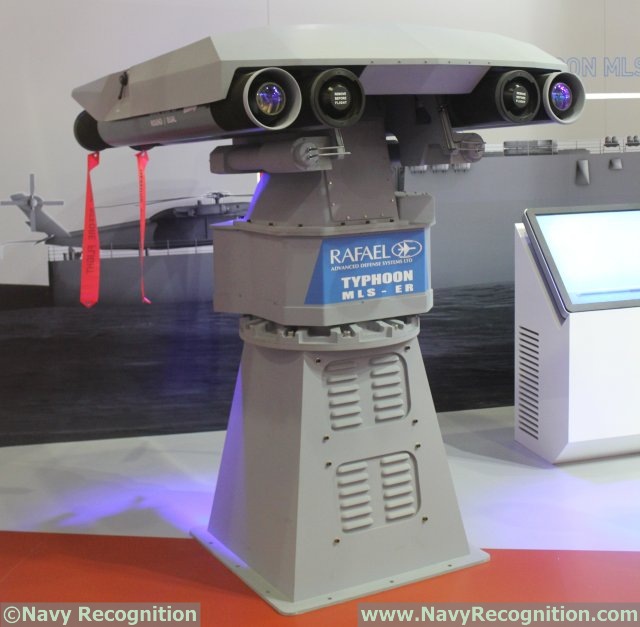
1 x Rafael Typhoon MLS-ER missile launcher for 4 x Spike ER surface-to-surface missiles, a weapon similar to Hellfire/JAGM (on at least four of the Acero class)
2 × M2HB Browning 12.7 mm/50-cal. heavy machine guns mounted on Rafael Mini Typhoon remote-controlled weapon stations
2 × M60 7.62 mm/30-cal. GP machine guns
What we might do differently:
The Shaldag Mk. V is certainly not the only possible solution for a true Fast Response Cutter, but its speed and equipment does represent some but not all the capabilities that should be incorporated in an FRC.
The Shaldag Mk. V has a capability against Unmanned Air Systems (UAS) and small, fast, highly maneuverable surface threats. As threat vessel increase in size their effectiveness diminishes substantially. They don’t need to sink large ships, but they do at least need to be able to immobilize them to keep terrorists from reaching their objective and to allow time for a DOD response.
The Shaldag’s boat handling facilities appear more difficult to use than those on the 87 foot cutters. We could do better, and it is likely we would need better boat handling equipment for day-to-day SAR missions.
The Missiles used on the Shaldag Mk. V are not used by the US Navy or Marine Corps, but comparable weapons–Hellfire, JAGM, or APKWS–could be used instead.
The 30mm Mk38 Mod4 would replace the Israeli 30mm Typhoon gun mount.
The Chinese-flagged Zhong Yuan Yu 16 sails near Ecuador’s Galapagos Islands in July 2021. The CCP uses thousands of distant-water fishing vessels as part of its military-civilian fusion strategy. THE ASSOCIATED PRESS
If there are hostilities between China and the US, the US Coast Guard is likely to have a lot of interaction with nominally civilian Chinese merchant and fishing vessels, but China is blurring the distinction between civilian and military.
Will we have to start hunting them down? Are they innocent or acting on behalf of the Chinese military? They might lay mines, scuttle their ship in an important channel or just report intelligence. Maybe no way to tell without boarding. Will they resist? How do we keep our boarding parties from being attacked or held hostage? Are there circumstances where sink on sight is justified? If they are unexpectedly heavily armed, can we call in backup? What about Chinese vessels in US ports?
Five white 311-foot cutters of Coast Guard Squadron Three, assigned to support Operation MARKET TIME tied up alongside Navy repair ship USS Jason (AR-8) at Naval Station Subic Bay in the Philippines, 4 August 1967. From inboard to outboard: USCGC Half Moon (WHEC-378); USCGC Yakutat (WHEC-380); USCGC Gresham (WHEC-387); USCGC Barataria (WHEC-381) and USCGC Bering Strait (WHEC-382) U.S. Coast Guard Historian’s Office. Photo by CDR Richard Morse, USCG, Commanding Officer USCGC Barataria (WHEC-381)
First that he Coast Guard has no similar long-term plans, and second,
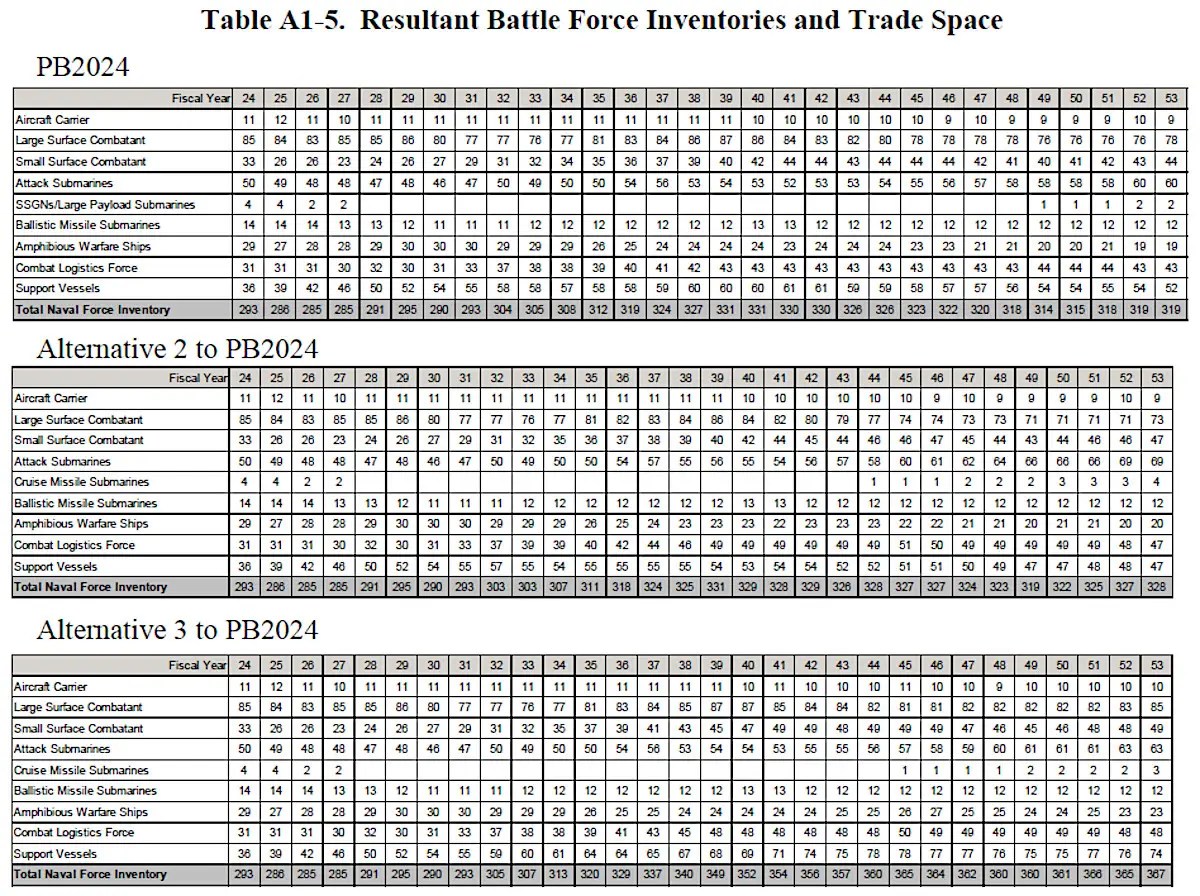
Coast Guard assets are not considered in as part of the “Battle Force.”
A good part of the reason our ships soldier on long after they should have been replaced may be because we have not been informing the executive branch and congress about our long-term needs.
I can imagine an adverse reaction to my suggestion that cutters should be part of the “Battle Force”, but you need to understand what the Navy includes in that category. These are not all high-powered warships. Currently the US Navy “Battle Force” is 299 ships. Of those, 59 are USNS ships that are almost completely unarmed, have civilian crews, and no electronic countermeasures. They include oilers, logistics ships, expeditionary fast transports, towing salvage and rescue ships, and ocean surveillance ships. In addition, it includes some commissioned ships that are not really warships, like command ships and expeditionary base ships. The relatively small future Landing Ship Medium is expected to be included as well.
If we have a naval conflict with a major power (e.g., China) the Navy is going to need the Coast Guard’s help. Cutters will help enforce blockades, round up hostile merchant shipping and fishing vessels, rescue crews from sunken ships, play host to unmanned systems, provide harbor defense and force protection, and probably ultimately be equipped as second line warships.
Cutters count, so they should be counted.
Vessels I would include in the count would include at least all the Icebreakers, National Security Cutters, Offshore Patrol Cutters, and Medium Endurance Cutters and possibly ocean-going buoy tenders and Webber class WPCs.
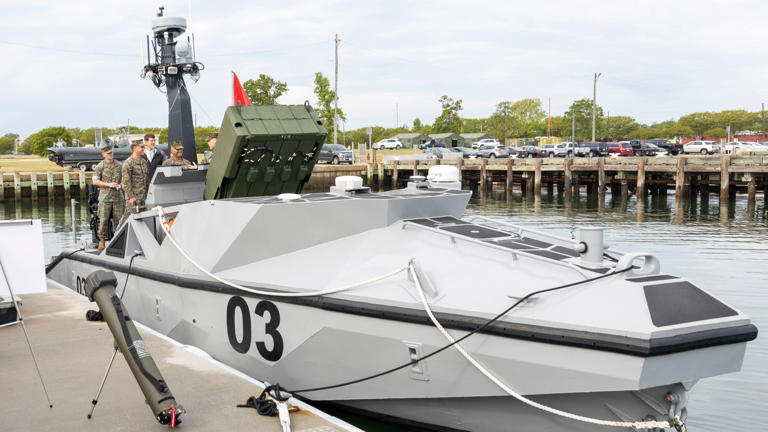
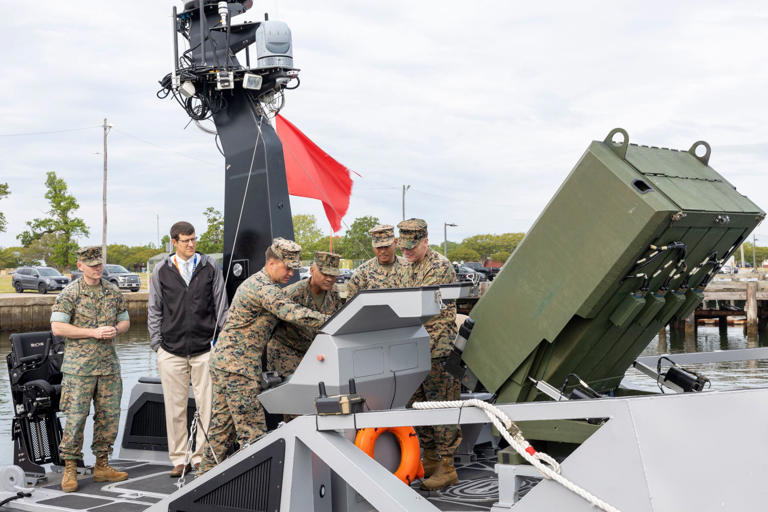
HERO 120 launcher on Long Range Unmanned Surface Vessel (LRUSV)
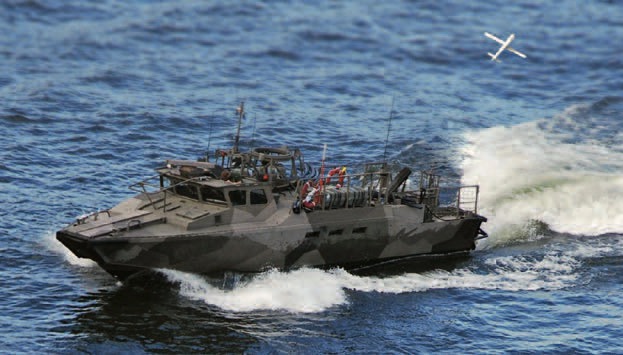
We talked about the HERO 120 loitering munition before. I noted it might be just what the Coast Guard needs to deal with the potential threat of small, fast, highly maneuverable craft.
While man portable single round launchers are probably all Coast Guard units might need (other than perhaps Bahrain based PATFORSWA Webber class cutters), we now have photos of an eight-cell launcher mounted on a Metal Shark optionally manned 40-foot, Long Range Unmanned Surface Vessel (LRUSV).
The Hero 120 is the largest offering in UVision’s “tactical” line of loitering munitions, weighing around 27 and a half pounds, including a 10-pound warhead. It uses an electric motor to drive a propeller at the rear and has a maximum endurance of around 60 minutes.
While it looks increasingly likely this system will become common in the Navy/Marine Corps inventory, it is perhaps important to remember that this eight-round launcher is not necessary to launch these. Loaded single round launchers are small enough to be man portable and would impose no heavy loads on the platform at launch. Certainly, some training would be required, but they could be stored in a group, station, or ship’s armory and be issued when needed.

:quality(70)/cloudfront-us-east-1.images.arcpublishing.com/archetype/L43PK7AJW5DTXFUD5SEA7DEY2E.jpg)





 Chuck Hill's CG Blog