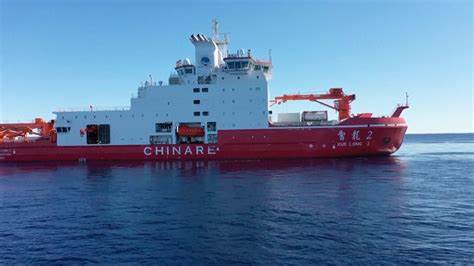
“China to build icebreaker with submersible to reach Arctic seabed” –Interesting Engineering

Chinese Icebreaker

Interesting Engineering has a story about China’s third polar icebreaker expected to be ready in 2025.

It appears to be a relatively light polar icebreaker,

“The proposed length of the vessel is 338 feet (103 meters) and is being built for a displacement of over 10,000 tons (9,200 tonnes). It can accommodate a crew of 80 people and travel at speeds of up to 16 knots…”

That is about the length of the Canadian Arctic and Offshore Patrol Ship, but about 50% heavier. I appears to be a bit smaller than M/V Aiviq that the Coast Guard apparently intends to buy.

Given the relatively small size, it is unlikely this is the nuclear icebreaker that has been talked about.

The article makes much of the ability to support a deepsea submersible, but it does not make clear what special provisions will be provided. Will it have a stern launch or moonpool or just cranes?

Why the submersible, when remotely operated vehicles are now so capable, is also not clear.

I think Russia has at least as much reason to be concerned about China’s icebreaker capabilities as the US, since Russia wants to monetize passage through the Northern Sea Route, and I doubt the Chinese will stand for that in the long run.

Thanks to Mike for bringing this to attention.

“Navy makes sure helicopters cannot land on new Offshore Patrol Vessels” –The Australian

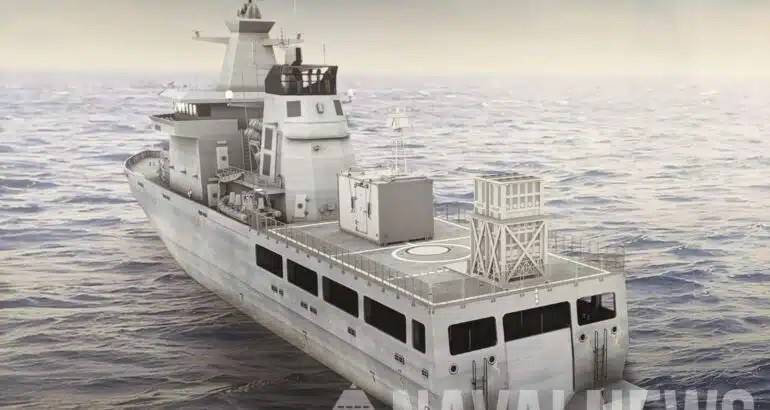
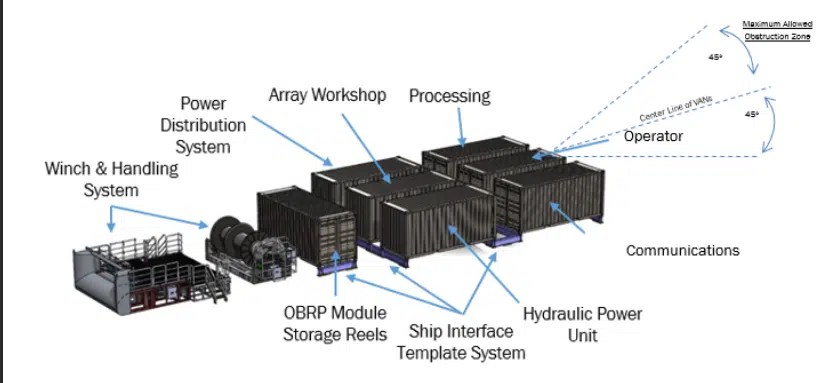
Australia Considering Modular C-Dome For Arafura OPVs
Illustration of Arafura-class OPV fitted with C-DOME

The Australian reports,

“Normally when a navy acquires a new ship, they want it to be as capable as possible. Not so the Royal Australian Navy, which has down-designed the Arafura class Offshore Patrol Vessels (OPVs) so that they can no longer support the weight of a helicopter on the large rear deck.”

The article goes on to criticize this and other decisions regarding the ship, but there may be method to this madness.

I would assume the Australian Navy is putting some thought into these decisions and it may be related to my observations in a post only two days ago, “When is a Flight Deck Not a Flight Deck?”

The intention may be to save topside weight so that an additional load or loads, heavier than an 11 ton helicopter, can be placed high on the ship.

A helicopter deck must be very strong everywhere, because it may be required to take high dynamic loads concentrated on just a few square inches, that may occur unpredictably, almost anywhere on the deck. By contrast even a large load like SURTASS-E, that spreads the load over a much larger area, requires less deck strength.

SURTASS-E. (U.S Department of Defense)

It may be that the Australian Navy has decided to use the “flight deck” as a mission load area where they anticipate placing heavy loads. The weight savings from weakening the flight deck may also permit additional topside weight for other systems, like weapons, if it is not required for loads on the flight deck.

Canada’s Multi-Purpose Vessels

Canadian CG MPV. Credit Aker Arctic.

Canada has a project to replace a large part of the Canadian Coast Guard fleet with up to 16 Multi-purpose Ships at an estimated cost of $14.2 billion (Canadian), with the first ship to be delivered in 2029.

There has not been a lot of reporting about this class, but frequent contributor Walter pointed me to two sources, Seaspan Shipyards and designer Aker Arctic. It appears they have very concrete ideas about what the class will look like.

Canadian CG MPV. Credit Aker Arctic.

MISSIONS:

According to Aker Arctic,

The MPVs will also perform cargo missions, bringing supplies to northern communities, carry out search & rescue and patrol missions, in addition to icebreaking. Most of their time will be spent on the St Lawrence River, the Great Lakes, and along the Canadian East Coast. Additionally, they will have a summer Arctic mission leaving from Victoria in British Columbia and travelling north around Alaska to the Canadian Arctic.

Due to the wide variety of tasks, the long-distance mission to the western Arctic, and the fact that some of the waterways have a limited depth, the vessel needed to be compact with a shallow draught, narrow beam, high endurance, and with a large cargo capacity.

CHARACTERISTICS:

  • Displacement: about 8,500 tons
  • Length, overall: 99.9 meters (328′)
  • Beam: 20.3 meters (66.7′)
  • Draft: 6.2 meters (20’4″)
  • Propulsion: diesel-electric; two azimuthing propulsion units

As is the case with all Canadian Coast Guard cutters, they have no fixed armament. It does look like it could host a medium sized helicopter and containerized systems, including perhaps below the hangar deck.

RANGE:

To me the most surprising characteristic of the ship is its range, 12,000 nautical miles. This was apparently driven by a summer Arctic mission from Victoria in British Columbia, north around Alaska to the Canadian Arctic.

ICE CLASS: 

These ships will be Canadian Ice Class 4, meaning they will have the capability to maintain a speed of 3 knots through ice 4 feet thick. The Canadian Coast Guard will consider these heavy icebreakers. We don’t have any figures on horsepower, but they probably will have less than 20,000 HP which, in the USCG system, would classify them as light icebreakers.

Compared to the US Coast Guard’s “heavy” Great Lakes icebreaker, Mackinaw (3,500 tons and 73m), these will be more powerful and more than twice as large. These might be a good design for the planned second USCG Great Lakes icebreaker.

IMPLICATIONS FOR THE USCG:

Aside from possible use of the design for Great Lakes icebreaker, these might be pretty close to what the USCG needs for their planned medium icebreakers. Certainly, consultation with Canadian counterparts will sharpen the focus of the US design effort. We might also have reasons to limit beam and draft.

“Vard Unveils New ‘Vigilance’ OPV Design” for Canada –Naval News

Vigilance OPV design for Canada by VARD

Naval News reports,

Tailored to the needs of the Royal Canadian Navy’s future fleet, Vigilance strikes the balance between flexibility, adaptability, and size, while maintaining the life-cycle cost advantages VARD’s naval designs are known for.  The vessel has been conceived for high-tempo sovereignty missions and engineered for global deployment and forward basing abroad.

There is not really a lot of information here.

They are to replace the Kingston Class Maritime Coastal Defence Vessels, which have been used to do drug interdiction in the Caribbean with USCG Law Enforcement teams doing the boardings. It is a class of twelve ships so there may be that many replacements, but also possibly fewer.

USCGC Escanaba (WMEC 907) and USCGC Richard Snyder (WPC 1127) practice maneuvering with the Royal Canadian Navy’s Kingston Class Maritime Coastal Defence Vessel HMCS Goose Bay (MM 707) in the Davis Strait on Aug. 13, 2021.  (Photo courtesy Royal Canadian Navy)

There is no indication of size but there is a clue in the identification of the rendering that accompanied the post, “VARD-7-075-Vigilance-Offshore-Patrol-Vessel-770×410.jpg”. Using VARD’s naming convention this is a “7 series” ship meaning “Naval and Security” that is about 75 meters (246 feet) long. Given the intention to employ them “forward basing abroad,” particularly as a Pacific nation, limiting the size to only 75 meters may be unwisely parsimonious. A larger ship would be both more capable in adverse weather conditions and more adaptable to future requirements. The Kingston class are only 55.31 m (181 ft 6 in) overall, so 75 meters would be an upgrade, but it is still a very small OPV, particularly if it is to operate helicopters. It would be similar in size to Malta’s P71 or the Danish Knud Rasmussen class.

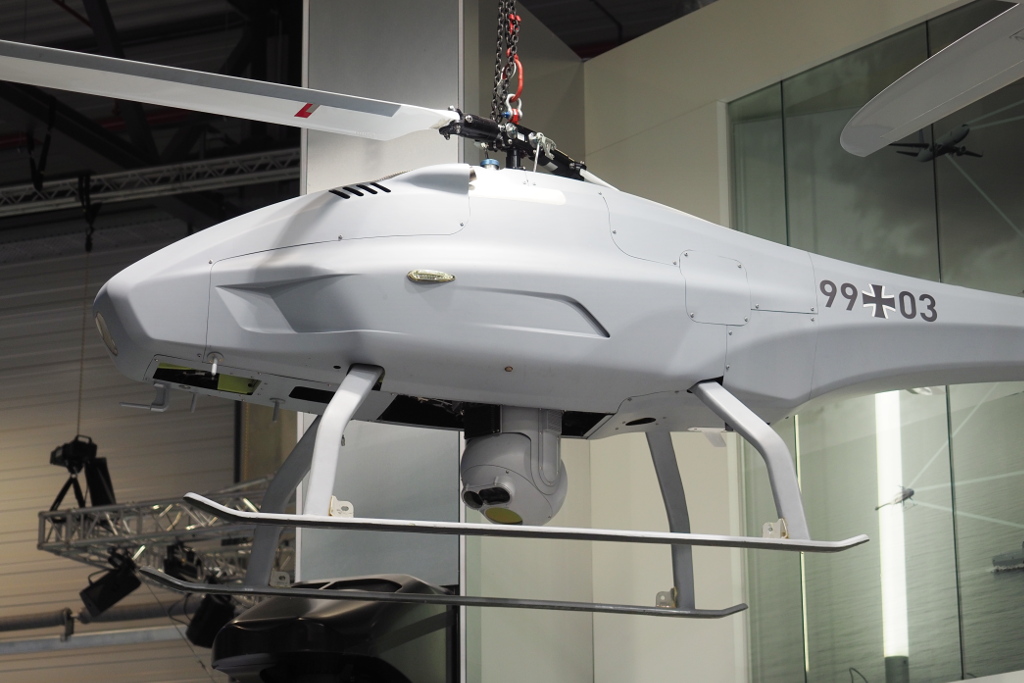
If the ship is in fact 75 meters in length, then the flight deck seen in the fendering does appear relatively short for landing a helicopter, especially since Canada’s Navy and Air Force do not operate any small helicopters that might be operated from the ships. The logo that accompanies the post may suggest that the flight deck is for unmanned air systems rather than helicopters. The UAS in the logo appears to be the Swedish built UMS Skeldar V-200known as CU-176 Gargoyle in Canadian Service. This UAS is also in service with the Belgian, German, Netherlands, and Spanish Navies.

UAV SKELDAR V-200 in German service, tail marking 99+03, at ILA Berlin Airshow 2022. Photo credit: Boevaya mashina.

The gun seen in the rendering suggest a 30mm Mk38 Mod4. In view of the fact the Arctic Offshore Patrol Ship is armed only with a 25mm Mk38 Mod2/3 that would to conform to past policies. The same gun is expected to be on the new Canadian frigate.

Looking at VARD’s design catalog, I see some resemblance to their 72 meter and 85 meter designs.


Video below added as late addition, thanks to Dave. 

“Canadian Coast Guard Plans to Order Up to 61 Small Vessels” –Marine Link

Marine Link reports,

“…the Canadian Coast Guard, on Thursday announced $2.5 billion CAD (roughly $1.8 billion USD) for the construction of up to 61 new small vessels and the ongoing replacement of small craft, barges and workboats within the Canadian Coast guard fleet… These include six Mid-shore Multi-Mission Vessels; one Near-Shore Fishery Research Vessel; 34 Cape Class Search and Rescue Lifeboats; and 16 Specialty Vessels, including two Special NavAids Vessels, four Special Shallow Draft Buoy Tenders, four Inshore Science Vessels; four Special Enforcement Vessels, two Lake Class Vessels, and four Air Cushion Vehicles.”


“Shipbuilder Austal executives accused of inflating earnings” –MSN

Future USCGC Pickering (Image: Austal USA)

MSN reports,

“Three current and former former executives of a shipbuilder that constructs vessels for the U.S. Navy have been indicted on accounting fraud charges accusing them of falsely inflating the company’s reported earnings, federal prosecutors said.”

Austal also has the second phase contract to build Offshore Patrol Cutters. Their alleged actions, which were reputedly intended to mislead shareholders and investors, even if proven, don’t necessarily affect the shipbuilder’s pricing or product, but the report goes on to note,

The U.S. Securities and Exchange Commission said in a news release that the three “engaged in a scheme to artificially reduce the cost estimates to complete certain shipbuilding projects for the U.S. Navy by tens of millions of dollars.”

Could they mislead shareholders and investors without also falsifying publicly available contract information?

Coast Guard’s FY2024 Unfunded Priority List

The crew USCGC Oliver Henry (WPC 1140) visit Ulithi Atoll on Oct. 31, 2022, the first time a fast response cutter visited the atoll and delivered 20 boxes of supplies, 50 personal floatation devices, and sporting equipment donated by the cutter crew, the extended U.S. Coast Guard Guam family, Ulithi Falalop Community Action Program, Guam Island Girl Power Foundation, and Ayuda Foundation. Ulithi was a central U.S. staging area during World War II, and home to a U.S. Coast Guard Loran-C communications station from 1944 to 1965 before operations relocated to Yap and ultimately shuttered in 1987. (U.S. Coast Guard photo by Petty Officer 3rd Class Zena Suzuki)

The Coast Guard has published its FY2024 Unfunded Priority List. The ten page document includes 26 line items totaling $1.6B. Much of it is infrastructure improvement, but there are also items to expand capabilities.

Four Additional Fast Response Cutters:

The single largest item is four additional Webber class WPCs. I think this will be approved and that this includes funding of facilities for a new base in American Samoa.

$400M “Funds the acquisition of four FRCs to further the Indo-Pacific Strategy of the United States through expanded presence and engagement to promote a free an open Indo-Pacific. Additional FRCs will begin to transform the Coast Guard from an organization which currently provides episodic presence, to be persistent and visible, strengthening coordination with Allied and partner nations to bolster regional security.”

Historically FRCs have been funded at about $65M each, and even that included support costs in addition to construction costs. There has been inflation, but the list gives us some information about that effect in a separate line item.

$34M “Fast Response Cutter (FRC) Economic Price Adjustment (EPA). Funding aids in reducing unfunded EPA growth resultant from the unprecedented rise in material and labor indices associated with contractual costs for production of hulls 1145 -1164 and procurement of spares. This amount provides the $34 million necessary for the projected EPA liability in FY 2024.

That is $34M spread over 20 ships or an increase of less than $2M per ship, so there is probably at least $120M for support costs over and above construction costs.

Aviation Improvements (note the third item indicates C-27Js will be assigned to CGAS Clearwater, FL, presumably replacing the C-130Hs there now)

  • $138.5M One Missionized HC-130J Aircraft. rovides funding to purchase one missionized HC-130J aircraft in the Block Upgrade 8.1 configuration, manufactured by Lockheed Martin, and currently missionized by L3 Technologies. This funding supports acquisition costs for one of the unfunded three missionized C-130Js required to achieve the Coast Guard’s current program of record of 22 airframes and initial sparing.
  • $113M Four MH-60T Aircraft. Provides funding to outfit and assemble 4 MH-60T aircraft that would facilitate a future Air Station transition from MH-65s to MH-60s in FY 2026. These aircraft would be assembled at the Coast Guard’s Aviation Logistics Center in Elizabeth City, NC.
  • $25M Sparing for Fixed-Wing Aircraft Transitions. Provides initial sparing to establish on-site inventory for HC-130J and HC-27J aircraft planned for delivery to Barbers Point, HI, ($10 million) and Clearwater, FL ($15 million). This funding includes spare parts for aircraft, sensor suites, depot maintenance material, and ground support equipment necessary for aircraft operations as well as LLTM required to accelerate the missionization of HC-27J aircraft. (Scalable)

Infrastructure improvements are requested for:

  • Polar Security Cutter (PSC) Homeport Seattle (Phase 1-2), $130M
  • FRC Homeport Astoria (Phase 2), $30M
  • Waterways Commerce Cutter (WCC) Homeports – Sault Ste Marie, MI and Memphis, TN, $48M
  • NSC and Ocean-Going Buoy Tender (WLB) Homeport – Honolulu, HI (Phase 2), $15M
  • Offshore Patrol Cutter (OPC) Homeport – NAVSTA Newport, RI (Phase 2), $100M
  • Training Center Cape May -Multipurpose Recruit Training Facility, $130M
  • Alaska Housing (Kodiak), $26M
  • Sector Facilities – Sector Sault Ste Marie, MI, $35M
  • Consolidated Base Facilities – Base Charleston, SC, $22.6
  • Coast Guard Yard Upgrade: Ship Handling Facility – Baltimore, MD (Phase 1), $60M
  • Sector Facilities – Sector Lower Mississippi River – Memphis, TN, $37M
  • Station Waterfront – Station Rockland, ME, $40.7M
  • Mission Support Facility (MSF) – Joint Base Andrews, MD (Phase 3), $20M

Miscellaneous:

  • Great Lakes Icebreaker – Long Lead Time Material (LLTM), $20M
  • Special Purpose Craft (MLB)– Heavy Weather Recapitalization, $24M
  • Mariner Credentialing Program, (Navita) Acquisition, $11M
  • National Security Cutter (NSC) –Follow-On Acquisition Funding, $50M
  • National Security Cutters Operational Support Initiatives, $9.7M
  • Operations and Defense Industrial Base, $42M
  • Recruiting & Retention, $9m
  • Modernized Learning Management System, $3M

What does it all mean:

None of these items are in the current budget request, but Congress has historically added to the Coast Guard request. The Coast Guard has been shy about providing an unfunded priority request in the past. Several years there was no unfunded priority list. This is the first time I have seen mention of the Coast Guard’s list in industry news publications (here and here). The new CG administration is making public a good case for increased funding.

We shouldn’t expect everything on the list to be approved, but I think we will definitely see the additional C-130 and at least three additional FRCs. Some of the other items will probably be approved as well. Those items not funded in FY2024 will likely be included in the FY2025 budget.

Pacific NW WMEC-210s Doing Drug Interdiction

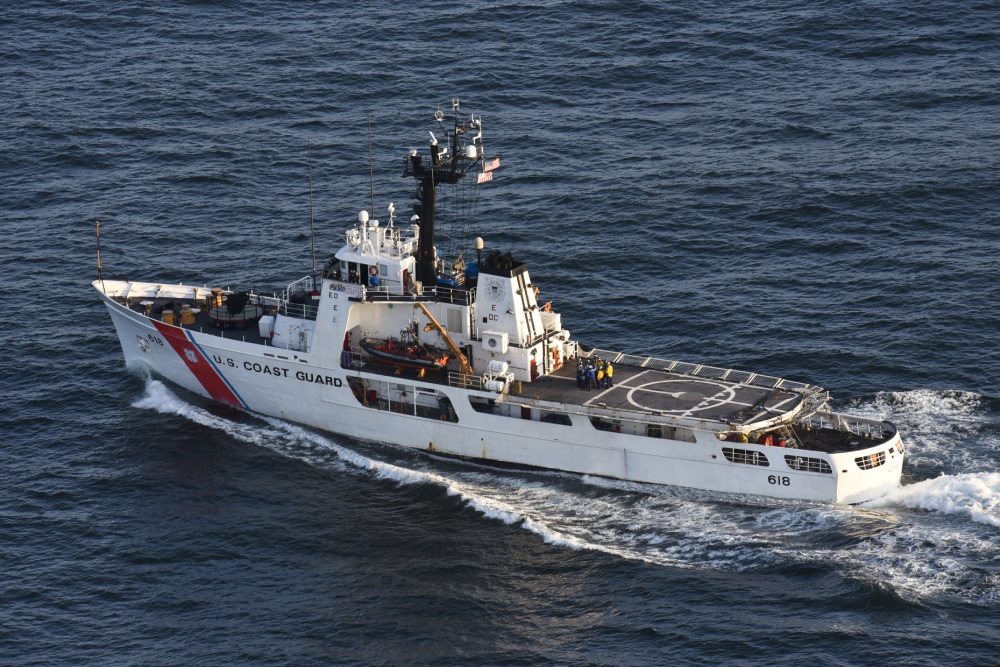
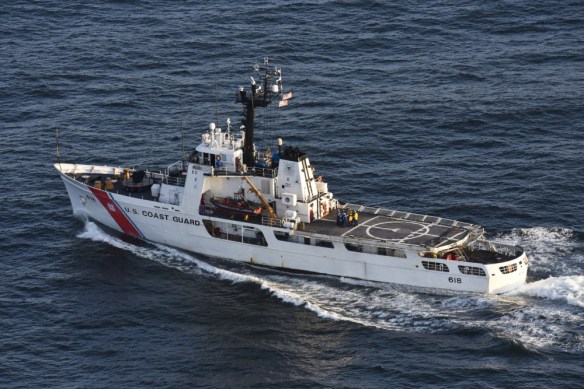
USCGC Active (WMEC 618) Aug. 16, 2019. Active is a 210-foot Medium Endurance based out of Port Angeles, Wash. (U.S. Coast Guard photo by Petty Officer 2nd Class Steve Strohmaier)

Below is a news release from the Coast Guard News website. What I would like to talk about is here:

  • The Waesche’s crew was responsible for two interdictions seizing approximately 881 pounds of cocaine and 9,500 pounds of marijuana. 
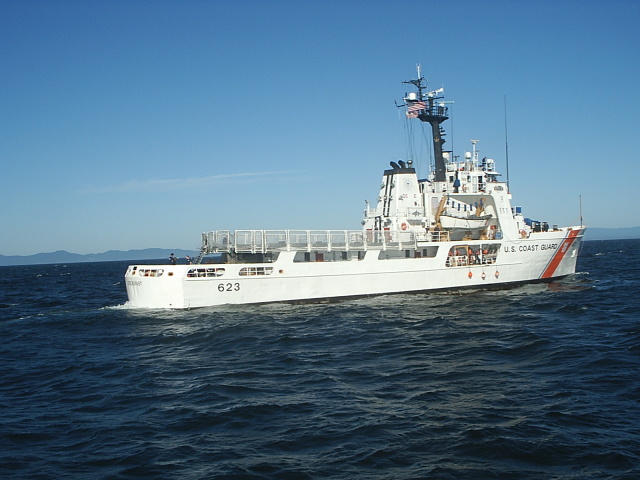
  • The crew of the Coast Guard Cutter Steadfast (WMEC 623) was responsible for one interdiction, seizing approximately 3,300 pounds of cocaine. 
  • The crew of the Coast Guard Cutter Active (WMEC 618) was responsible for two interdictions seizing approximately 2,116 pounds of cocaine and 3,716 pounds of marijuana.

The two WMECs, each over 50 years old, probably each seized drugs of higher street value than the 13-year-old National Security Cutter (NSC) that is about four times as large. No, they are not necessarily better at drug interdiction than the NSC. There is a lot of luck involved, but it does seem to suggest that, as the saying goes, “quantity has a quality all its own.

There are simply not enough cutters (or Navy ships) to interdict all the known smugglers being tracked.

Earlier, when the current Commandant was Commander PACAREA, we saw some attempts to use Webber class Fast Response Cutters (FRC) in the Eastern Pacific drug transit zones. For some reason those efforts don’t seem to have been continued. Perhaps their endurance was a problem.

There can be little doubt the Coast Guard needs more cutters, yet the current program of record will supply 8 fewer large cutters than we had in the year 2000. We need more large cutters, but they don’t all have to be 4500 tons.

Frankly, I do think they should be bigger than 210s. You can make a very capable cutter of around 2,000 tons with a crew smaller than that of the 210s, but we don’t seem to have been doing the analysis that would clearly identify our needs.
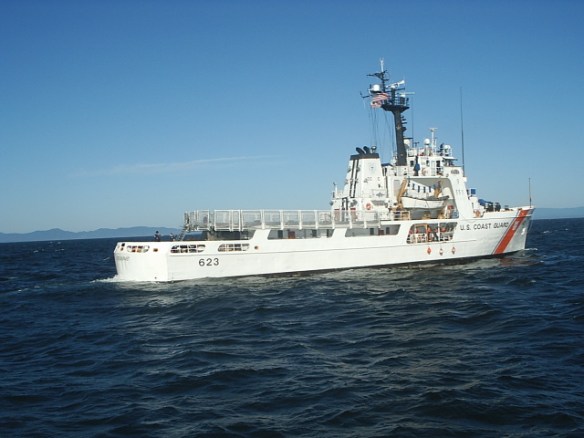
USCGC Steadfast (WMEC-623) (This is an old photo, given the hard sided boat and davits.)

 March 28, 2023

MEDIA ADVISORY: Coast Guard to offload approximately 6,325 pounds of cocaine and more than 13,000 pounds of marijuana in San Diego

WHO: Capt. Robert Mohr, commanding officer, Coast Guard Cutter Waesche, Alexandra (Sasha) Foster is the Criminal Chief in the Southern District of California U.S. Attorney’s Office

WHAT: The crew of the Coast Guard Cutter Waesche is scheduled to offload approximately 6,325 pounds of cocaine and more than 13,000 pounds of marijuana, worth more than $166 million, seized from the drug transit zones of the Eastern Pacific Ocean.

WHEN: Wednesday at 9:30 a.m.

WHERE: 10th Avenue Marine Terminal, 1150 Terminal St., San Diego, CA 92101

Editor’s Note: Media interested in attending should arrive no later than 9 a.m., and bring a government-issued photo ID, press credentials, proof of vehicle registration and insurance. Media will be escorted to the event location following security screening.

SAN DIEGO — The crew of the Coast Guard Cutter Waesche (WMSL 751) offloaded more than 6,325 pounds of cocaine and more than 13,000 pounds of marijuana estimating a value worth more than $166 million on Wednesday, in San Diego.

The interdictions were made late February and early March during four separate joint effort interdictions:

  • The Waesche’s crew was responsible for two interdictions seizing approximately 881 pounds of cocaine and 9,500 pounds of marijuana.
  • The crew of the Coast Guard Cutter Steadfast (WMEC 623) was responsible for one interdiction, seizing approximately 3,300 pounds of cocaine.
  • The crew of the Coast Guard Cutter Active (WMEC 618) was responsible for two interdictions seizing approximately 2,116 pounds of cocaine and 3,716 pounds of marijuana.

U.S. agencies from the Department of Defense, Department of Justice and Homeland Security coordinated in the effort to combat transnational organized crime. The U.S. Coast Guard, U.S. Navy, Customs and Border Protection, FBI, Drug Enforcement Administration, and Immigration and Customs Enforcement, along with allied and international partner agencies, served a vital role in counter-drug operations. The fight against drug cartels in the Eastern Pacific requires unity of effort in all phases from detection, monitoring and interdictions, to criminal prosecutions by U.S. Attorneys in districts across the nation

The U.S. Coast Guard Cutter Waesche (WMSL-751) is the second Legend-class cutter of the United States Coast Guard and is homeported at Coast Guard Island in Alameda, Calif. Waesche, the second of eight planned National Security Cutters, is 418 feet long with a top speed of 28 knots and a range of 12,000 nautical miles. The cutter is equipped with a flight deck and hangars capable of housing two multi-mission helicopters, and outfitted with the most advanced command, control, and communications equipment.

“How Big is Big?”

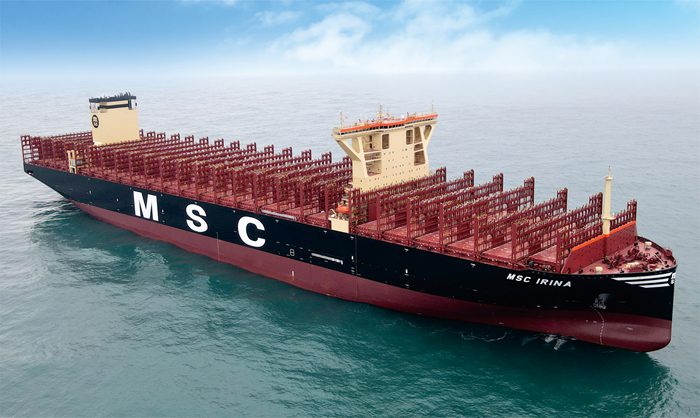
Yangzijiang Shipbuilding Photo

gCaptain reports,

Chinese Shipyard Delivers ‘World’s Largest Containership’ at 24,346 TEUs… 399.99 meters in length…61.3 meters in beam…”

So, if you put a Reliance class WMEC 210 on deck cross wise, it would only overhang about 9.4 feet. It is more than six times the length of a 210. You could put six 210s side by side across the beam of the ship. It would take almost 36 WMEC210s just cover the deck.

Think the Coast Guard could forcibly stop one of these? Just food for thought.