Canada’s Coast Guard, Same Song, Different Accent

CBC reports that the Canadian Coast Guard is in bad shape.

  • Their ships are old.
  • Increased maintenance is eating into their budget and restricting asset availablity.
  • Their new Polar Icebreaker is still a decade away.
  • They have been under funded for decades.

Sounds familiar doesn’t it. In fact, as if to excuse the problems they say, look the USCG has the same problems.

Mexican Navy OPVs

MexNavyOPV

NavalToday reports the Launch of the sixth and last Offshore Patrol Vessel of the Oaxaca Class, the ARM (Armada Republica Mexicana) Hidalgo, for the Mexican Navy. These ships were designed and built by and for the Mexican Navy, but they would look quite at home painted white with USCG stripes and WMEC hulll numbers. Statistically they are very close to Coast Guard 270s.

Mexican-Navy-launches-final-Oaxaca-class-patrol-vessel-Hidalgo-1-768x491

  • ___________________Oaxaca Class_______________WMEC 270
  • Displacement (full load)  1,680 tons_________________1829 tons
  • Length                    282.2 feet (86.0 m)_______________270 feet (82 m)
  • Beam:                      34.4 feet (10.5 m)_______________38 feet (12 m)
  • Draft                         11.8 feet (3.6 m)________________14.5 feet (4.4 m)
  • Speed:                      20+ knots_____________________19.5 knots

The occasion prompted me to take a look at the Mexican Navy. While the Mexican Navy does have six former USN frigates, most of their missions are closer to what we do in the USCG, and most of their ships are offshore patrol vessels. They have 21 ships (soon to be 22 with Hidalgo) in five classes that look an awful lot like WMECs. These ships have evolved over time, with each class an incremental improvement over the previous ships. Only the oldest of these, the Uribe class ships were built in Spain by Navantia, the remaining 17 were built in Mexican Navy shipyards in Tampico and Salina Cruz with the first of the Mexican built ships being commissioned in 1991.

Photo: Uribe class OPV ARM Jose  Aueta (P-122)

The Uribe class were very similar in size and concept to the 210s, with a similar configuration of the foc’sle and flight deck on the O-1 deck. They did include a hangar, were 10 feet longer (67 m overall), and had more than twice the horsepower at 13,320 allowing a maximum speed of 21 knots. Its main gun was a single 40mm/7

The Holzinger or Aquila class were the first class built in Mexico. They stretched the design 24 feet to 244 feet (74.4 m), provided two main machinery spaces vice one, and retaining the same horsepower, achieved 22 knots. Originally they were to have had a 57mm, but because of stability consideration a twin 40mm/60 was used instead.

Holzinger-class patrol vessel

Sierra Class OPVs of the Mexican Navy


The Sierra, Mendz, or Holzinger 2000 class retained essentially the same dimensions as the preceding class, but introduced a number changes. The hull aft was extended upward to create a flush main deck at what had been the O-1 deck. A stern ramp was incorporated in the transom for launching a “chase boat.” The superstructure was given a more “stealthy” form with the RHIBs placed in enclosed pockets.  A Vosper fin stabilization system was also provided, and a 57 mm main gun was included. A max speed of 18 knots is claimed, but it is likely to be more than 22.

ARM_Durango

ARM Durango, Mexican Navy, 8 October 2008, photo by Apodemia.

The four ships of the Durango class were originally intended as units of the preceding Sierra class but the design was modified and is now considered a separate class although statistically they appear little different.

The Oaxaca are a bit larger. They seem to have decided that the “stealthy” superstructure is not worth doing. The 57 mm gun of the preceding class has been replaced by a 76 mm gun, but it is not the newest type so this may have been a case of the guns being available on favorable terms rather than a reflection of dissatisfaction with the 57 mm. There is also a auto-cannon aft (variously reported as 25 or 30 mm) and two remote weapon stations with .50 cal. Like US WMECs the range is substantial at 8,500 nautical miles. They have a crew of 77 and accommodations for 39 special forces and/or marines.

Given that the USCG is now responsible for maintenance of all US 76 mm guns and also operates the 57mm, the Mexican Navy’s choice of weapons suggests this may be an area of potential cooperation.

Auk class minesweeper

Auk class minesweeper now used as an Offshore Patrol Vessel by the Mexican Navy

Unfortunately not all of Mexico’s OPVs are relatively modern. They still have ten Auk  class 1,250 ton (fl), 221 foot, WWII vintage, steel hulled minesweepers that continue to function as patrol vessels. The ships are referred to as the Valle class in Mexican service. They are the same class as USCGC Tanager (WTR-885) that served as a CG Reserve training ship 1964 to 1972. They will certainly need to be replaced soon. Obviously their building program is not complete.

I find it interesting that Mexico with an EEZ of 3,144,295 km2,, with less than a third of the EEZ of the US (11,351,000 km2) has a fleet of OPVs that approaches that of the USCG.

China to Build Nuclear Icebreaker, Ready in 2018

512px-Antarctica_CIA_svg

Maritime Executive is reporting China will build a nuclear powered Polar Icebreaker.

“The vessel will feature higher ice capabilities, better research capabilities and be more comfortable and environmentally friendly than Xue Long. It is expected to be 122.5 meters (400 feet) long and will be able to break ice of up to 1.5 meters (five feet) thick at a speed of around two knots. It will be able to operate bow or stern first using two ABB Azipod units with combined power of 15MW.”

This is what the Coast Guard would call at best a medium icebreaker. 15MW or about 20,000 HP is far less than even the Healy’s 22.4 MW, but while we don’t expect a new icebreaker for a decade, they expect theirs will be finished in two years.

Chile Christens Its Forth 80 meter OPV

On of our most popular posts has been “Three Nations Share German OPV Design” written by Andrés Tavolari, a lawyer, and Chilean Marine Reserve Officer. Andrés has written to say that Chile will christen their fourth Fassmer 80 class, OPV 84, “Cabo Odger” on August 3rd. Above is a Time Lapse of her construction.

As you can see from the diagram, this one will have a 76 mm gun.

New South Korean Patrol Craft

According to the local news agency Yonhap, South Korea's Navy launched a new fast patrol boat to help counter North Korea's hovercraft force along its maritime demarcation line, the military said Thursday July 28, 2016.
An artist rendering of South Korea’s new Chamsuri-211 fast patrol boat
(Credit: Yonhap)

NavyRecognition is reporting the South Korean Navy will be getting the first of a new class of Patrol Craft in late 2017. It is a bit smaller than the Webber class at 44 meters in length and 210 tons. It is designed specifically to counter North Korean Hovercraft. It is armed with a 76 mm gun and a pair of remotely operated, radar controlled 12.7mm (.50 cal.) machine guns. The unusual weapon seen on the stern is a launcher for 130mm (5.1″) guided rockets (apparently twelve) . (I suspect these are actually guided versions of the 5″ Zuni rocket, much like the APKWS is a guided version of the Hydra rocket. )

The vessels is expected to have a max speed of about 40 knot and will apparently be powered by waterjets. I don’t see any boat on the artist impression above.

Polar Icebreaker Operational Requirements Document, Industry Version

ice-breakers-540688_1280

If you would like to take a look at the Operational Requirements Document (ORD) for the proposed polar icebreaker (PIB in the document), you can find it here (pdf). (Sorry I did not publish this earlier.)

The bad news is that it does not look like it will be fully operational until 2028.

I”1.3.1 Initial Operational Capability Date: The Initial Operational Capability (IOC) date is anticipated to occur during or before FY-2026. IOC is defined as the delivery of the vessel. ”

1.3.2 Coast Guard Support Date The Coast Guard Support Date (CGSD) is the formal transition from CG-932 to Surface Forces Logistics Center Product Line (SFLC PL) and is anticipated to occur during or before FY-2028.”

1.4 Full Operational Capability Date: The Full Operational Capability (FOC) date occurs upon the successful completion of operational testing and evaluation and is anticipated to occur during or before FY-2028.

Here are the basics. I have cherry picked the list. There are many more requirements, but I think these are the most significant:

  • “The PIB will operate worldwide and will be exposed to extreme environmental conditions found in the Polar, Tropical, and Temperate regions. The PIB will experience ice up to large concentrations of multiyear consolidated pack ice with ridging, air temperatures ranging from -72 degrees Fahrenheit (°F) to 114°F, sea water temperatures ranging from 28.8°F to 87°F, wind speeds that can exceed 100 miles per hour (mph) (87 knots (kts)) and sea conditions up to sea state 8. …
  • “The PIB shall be capable of independently breaking through ice with a thickness > 6 ft (threshold) / > 8 ft (objective) at a continuous speed > 3 kts.
  • “The PIB shall be capable of independently breaking through ridged ice with a thickness of 21 ft.
  • “The PIB shall have a fully mission capable (in accordance with Table 20) cutter endurance per deployment without replenishment (subsistence and fuel) > 80 days underway (threshold) / > 90 days underway (objective).
  • “The PIB shall have the capability to exchange information (voice and data) with: USCG, DoD, DHS, NATO, DoS, NSF and NOAA.
  • “The PIB shall be capable of breaking a single-pass channel to a width of at least 83 ft.
  • “The PIB shall have a sustained speed of 15 kts.
  • “The PIB shall have a minimum range of 21,500 nautical miles at 12 kts in ice free waters
  • “The PIB shall have the capability of performing 3,300 Operational Hours (threshold) / 4,050 Operational Hours (objective) per year. (The USCG is currently transitioning from the use of DAFHP to Operational Hours as the metric for operational tempo. The threshold and objective figures contained in this requirement represent 185 and 225 DAFHP respectively.)
  • “The PIB shall be capable of delivering aviation fuels, diesel fuels, and potable water while underway from storage and service tanks to United States Navy (USN)/USCG/North Atlantic Treaty Organization (NATO) vessels 240 feet or less in length in either astern tow or alongside
  • “The PIB shall be capable of receiving underway replenishment of fuel and water from USN/NATO/Allied Navy vessels, Military Sealift Command or other designated vessels.
  • “The PIB shall be able to pump aviation fuels, diesel fuels, and water to shore facilities, including U.S. Scientific Research Stations.
  • “The PIB shall have a designated topside cargo area capable of transporting (not simultaneously): 3.1.9.7.1 Three 9 ft x 35 ft buoys including associated buoy mooring equipment (or) 3.1.9.7.2 Six twenty foot equivalent units (TEU) with a maximum weight of 20 tons each.
  • AVIATION: “The PIB shall be able to hangar a total of two of any combination of the following aircraft: 3.1.10.2.1 USCG H-65 with blade-folding capability. 3.1.10.2.2 USCG/USN H-60 with blade-folding capability. 3.1.10.2.3 UAS (not to exceed the footprint of an USCG H-60 with blade folding capability). (plus  meet certification criteria for Level I, Class 1 aviation operations for those aircraft–Chuck) The PIB shall have the capability for an H-65 to be mechanically secured to the flight deck immediately after landing without the use of tie-down personnel. The PIB shall have the capability to support mobile mechanical traversing of the USCG/USN H-60. The PIB shall have the aviation fuel capacity to operate an H-60 for 250 flight hours with 24 flight hours of fuel capacity in service tanks. (also TACAN equipped–Chuck)
  • BOATS: The PIB shall have the capability to independently launch, recover, fuel, maintain and operate two assigned boats with over-the-horizon (OTH) capability. The PIB shall have the capability to launch, recover, fuel, maintain, and operate at least one assigned cargo landing boat capable of landing a minimum capacity of 4,500 pounds (e.g., people, cargo, and equipment). The PIB shall have the capability to launch and recover on both port and starboard sides.
  • The PIB shall have the capability to deliver, support, and recover one 8-person boarding team and their gear, trained and outfitted in accordance with the Maritime Law Enforcement Manual, COMDTINST M16247.1 (Series) via cutter boat operated by a boat crew in accordance with USCG policy.
  • The PIB shall have the capacity to tow astern a vessel not exceeding an equivalent displacement to that of the PIB. (Shouldn’t this say the ability to tow a vessel of equivalent tonnage to the PIB or perhaps some minimum?–Chuck)
  • The PIB shall have the capability to support a DIVEDET of 7 personnel and their equipment, in accordance with the USCG Diving Policies and Procedures Manual, COMDTINST M3150.1 (Series) and the USN Diving Manual, SS521-AG-PRO-010 (Series).
  • The PIB shall provide dedicated location(s) and reserved space, weight, power, hotel services, data network and phones to accommodate six 10 ft x 20 ft science vans that do not interfere with flight deck operations. (Shouldn’t this be 8x8x20 foot vans?–Chuck)
  • WEAPONS: The PIB shall have the capability to employ removable weaponry. The PIB shall have the ability to conduct disabling fire against surface targets.
  • The PIB shall have a heavy lift capability with a minimum capacity of 20 tons extending to at least one lift point 25 feet past the widest point of the ship’s beam on both the port and starboard side of the  ship.
  • The PIB shall provide messing, berthing, sanitary facilities, and workspaces for all permanently attached crewmembers and 50 embarked personnel. Includes DIVEDET and LEDET deployed with 20 person AVDET (if LEDET is embarked, SCIDET (Science) will remain ashore).
  • The PIB shall be capable of wintering over for a minimum of 210 days.
  • The PIB shall be designed to provide airspace management for organic aircraft operating in controlled and uncontrolled airspace by providing installed organic systems.

Additionally it should be able to conduct boat and helo operations to Sea State Four (8.2 feet/2.5 meters)

COMMENTS: I would like to offer some comments on the document.

CONTAINERS:

Inclusion of “dedicated location(s) and reserved space, weight, power, hotel services, data network and phones to accommodate six 10 ft x 20 ft science vans that do not interfere with flight deck operations.” (3.1.16.6 page 29) is promising. It offers an avenue to address emerging requirement or the need for capabilities that might might have been unrecognized. In addition to scientific support they might be used for humanitarian assistance/disaster relief, as holding cells, as class room space, for upgraded communications, accommodations, or medical facilities.

AVIATION:

If we are going to be able to operate, hangar, and service Navy H-60s, we also need to be able to store their associated weapons and equipment including sonobuoys and torpedoes. I suspect this means we will need more space (and perhaps specialized space) than required to support CG H-60s (which I doubt will ever deploy on the PIB anyway). The containerized mission modules might be one way to address this if the need arises.

WEAPONS:

Polar Icebreakers will undoubtedly go to Antarctica so the Antarctic Treaty will apply.  Contrary to what you may have heard, the treaty does not require that ships entering the area be unarmed, only that they be open to inspection. Article VII para. 3. “All areas of Antarctica, including all stations, installations and equipment within those areas, and all ships and aircraft at points of discharging or embarking cargoes or personnel in Antarctica, shall be open at all times to inspection by any observers designated in accordance with paragraph 1 of this Article.”

Obviously we do not want to send the PIB down there mounting classified weapons. The document addresses this by saying, “The PIB shall have the capability to employ removable weaponry.” This might mean only .50 caliber machine guns like the Polar Class, but there is also an operational requirements in table 6 (PIB Activities, page 11) is “Stop/neutralize a vessel through the use of force continuum.” Notably this is in the group “Boarding Operations” rather than Defensive/Offensive Operations.

If  we are going to enforce US sovereignty and ” the ability to conduct disabling fire against surface targets” is not limited to surface targets powered by outboard motors, the ship will need something more. There is also a strong possibility that the target could outrun a 15 knot PIB so we either need to be able to do this at a distance, or using the ship’s boats or helicopters.

Ultimately all weapons are removable. In some cases, like missiles or torpedoes the launchers themselves may be unclassified as long as the weapon itself is not installed.

The LCS classes have incorporated removable weapons in their design with reconfigurable weapon stations. We might consider something similar for the PIB,

In wartime, if fighting is in the Arctic or Antarctic, the polar Icebreakers will be unique high value naval auxiliaries that may become critical to naval operations. They will need to be adequately protected. We might consider fitting them “for but not with” defensive weapons. A minimum of two Mk38 25 mm and two SeaRAM CIWS appears to be appropriate, while requiring a minimum impact on command and control and manning requirements.

Photos: A removable weapon system. The Mk46 Gun Weapons System. This is used in the LCS anti-surface mission module. The armor piercing, fin stabilized discrding sabot round would probably be effective as a disabling round against even large diesel engines. 

CONCLUDING OBSERVATIONS

It is a pretty large document, running 89 pages total. The last 17 pages are appendices. Reportedly it was the product of a “46-member, 11-Agency Integrated Product Team (IPT)” There is a lot of detail, but there are also a lot of statements that are so nebulous as to be meaningless and as far as I can see do not contribute to an understanding of the requirements. This applies to most of the capabilities listed in Table 5 on page 9 and virtually all of the following,

  • “6 CRITICAL OPERATIONAL ISSUES Critical Operational Issues (COIs) are the operational effectiveness and operational suitability issues (not characteristics, parameters, or thresholds) that shall be examined during Operational Test and Evaluation (OT&E) to evaluate/assess the system’s capability to safely perform its mission.6.1 Operational Effectiveness COIs 6.1.1 Protection Response (PR) 6.1.1.1 Can the PIB perform USCG Emergent Response for Search and Rescue (SAR) and National Emergency Response Operations (NERO)?
  • 6.1.2 Law Enforcement Response (LER) 6.1.2.1 Can the PIB perform USCG Enforcement Response for Law Enforcement and Homeland Security?
  • 6.1.3 Surveillance and Reconnaissance (SR) 6.1.3.1 Can the PIB contribute to Maritime Domain Awareness?
  • 6.1.4 Defense Readiness (DR) 6.1.4.1 Can the PIB provide Defense Readiness to Combatant Commanders?
  • 6.1.5 Maintain Mobility (MM) 6.1.5.1 Can the PIB provide USCG services to maintain movement of vessels and equipment in civil and military maritime environments
  • 6.1.6 Transport (TRAN) 6.1.6.1 Can the PIB provide USCG organic transportation of people and equipment?
  • 6.1.7 Force Movement (FM) 6.1.7.1 Can the PIB be prepared for operational employment and move from ready locations to the intended area of operations?
  • 6.1.8 Information Management (IM) 6.1.8.1 Can the PIB perform Information Management in support of USCG Missions?
  • 6.1.9 Force Protection (FP) 6.1.9.1 Can the PIB provide Force Protection?”

Perhaps I have missed something or these will be clarified in the future.

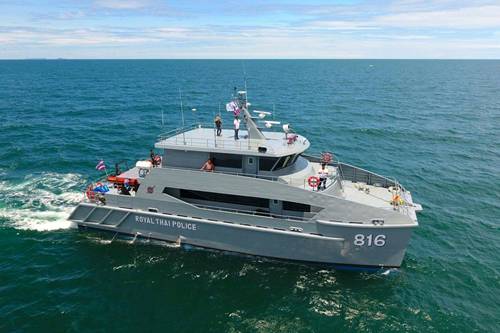
Australian Designed Catamaran Patrol Boat for Royal Thai Police

ThaiCatamaranPB_IncatCrowther

MarineLink reports the delivery of two locally built catamaran patrol boats to the Royal Thai Police, based on an earlier Australian designed vessel.

  • Length Overall: 86’ / 26.2m
  • Max Speed: 34 knots
  • Crew: 2 + 12

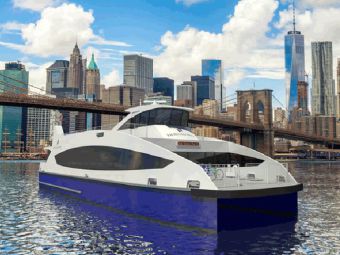
Actually these sound an awful lot like 19 new 26 meter ferries being built by Horizon Shipbuilding, Inc., Bayou La Batre, AL, and Metal Shark Aluminum Boats, Jeanerette, LA for New York City also designed by Incat Crowther.

InnatNYCferries


Will the Navy Be Funding and Managing Our Next Icebreaker Procurement?

PolarisAzipodsLookingAft

Azipods, state of the art propulsion technology for icebreakers. 

The Senate Appropriations defense subcommittee has proposed that $1B be added to the Navy’s shipbuilding budget for the construction of an icebreaker for the Coast Guard.

This sounds like good news, and there is precedence for this, in the form of USCGC Healy. Still, there are reasons, this may not be the best approach for the project, for the Coast Guard, or for the Navy, particularly since this should not be a one time procurement, it should be the first of a series.

The Navy contracted for the Healy and it did not turn out so badly, but there were difficulties as discussed here.

There are really two issues.

  • Who gets the money?
  • Who should manage the project?

Who gets the money?

The Coast Guard has been trying to get the government to recognize that it needs an AC&I budget of $2-2.5B/year. It needs to be a new norm. Funding icebreakers is part of that. Putting the money in the Navy budget is deceptive, and it does nothing to address the true needs of the Coast Guard..

Because of sequestration it is easier to add money to a DOD budget than to the Coast Guard budget, but if they can make exceptions for one military service, you would think they could make an exception for the Coast Guard as well.

Who would be the best project manager?

The Coast Guard got a black eye for the Deepwater project, but that was largely the result of a misguided Reagan era directive that project management be outsourced to the private sector that was followed by a gutting of in-house expertise in DOD as well as the Coast Guard. NAVSEA also lost much of its in house expertise. Since then, the Coast Guard’s Acquisitions Directorate has been rebuilt into an award winning organization. In fact, while I don’t necessarily think it is true, the GAO has suggested that the Coast Guard’s procedures may be superior to those of the Navy.

The Coast Guard has been preparing for this acquisition for years. If the Navy is to manage it, the Coast Guard will have to spend time bringing them up to speed.

There is also the question of who will procure the follow-on icebreakers. We have been saying we need three heavy and three medium icebreakers. the Coast Guard needs to continue to increase its icebreaker procurement expertise to build these vessels as well.

If the project is given to NAVSEA, it may be low on their priority list. NAVSEA is currently building or planning:

If NAVSEA were to divert their personnel from these projects to the procurement of an icebreaker, it would hurt supervision of these projects.

All of these projects are far larger than construction of one icebreaker. So, if they are given the icebreaker project, will they put their best people on it? Do they have any icebreaker expertise? Will they have to hire new people who will need to go through a time consuming clearance process and take the time to be brought up to speed?

NAVSEA may want to do their own lengthy and costly study & review process. They may impose requirements that the Coast Guard would not. These would add to the cost and these costs would likely be added on to any future icebreakers that would probably be built to the same design.

A troubling “encouragement”:

There was a particularly troubling requirement quoted on page 31 of the  Congressional Research Service’s report, “Coast Guard Polar Icebreaker Modernization: Background and Issues for Congress.” from the FY2017 DOD Appropriations Act (S. 3000) apparently from pages 98-99.

“While the effort to speed polar icebreaker acquisition by 2 years is commendable, the Committee believes more must be done now to expand our capabilities and to defend interests in the Polar Regions. In addition to concerns about our current fleet, the Committee notes that Russia has roughly 40 operational icebreakers and 11 icebreakers either planned or under construction. Therefore, to further accelerate production, the Committee recommends $1,000,000,000 in the “Shipbuilding and Conversion, Navy” account to construct domestically the first U.S. Coast Guard operated ship for the Polar Icebreaker Recapitalization Project. In order to achieve an earlier start on this project and to reduce cost and schedule risk, the Committee encourages the selection of an in-service U.S. hull design and the setting of limitations on overall ship specifications and requirements. The Committee directs the Secretary of Defense in coordination with the Secretary of Homeland Security to submit a report to the appropriate congressional committees not later than September 30, 2016 which provides polar icebreaker requirements, preferred design, overall acquisition strategy, and a breakout of funds necessary to support the acquisition.”

I find the direction to forego an opportunity to improve on the designs we have, in favor of decades old hull designs that no longer represent the best in current icebreaker design troubling, particularly since this may be the first of three heavy icebreakers, not just a single stop-gap design.

USCGC Polar Sea

USCGC Polar Sea

There are of course only two large, in service, US hull designs.

ice-breakers-540688_1280

USCGC Healy (foreground)

Our most modern, but frequently forgotten Great Lakes Icebreaker, USCGC Mackinaw (WLBB-30), is a few years younger but still designed about two decades ago, was built by Marinette Marine, which is at least still an operational shipyard, producing Freedom Class LCS for the Navy.

Would it be enough to simply say we are going to scale up the Mackinaw hull (say double all the dimensions) so that we could have a ship that at least uses azipods like most modern icebreakers?
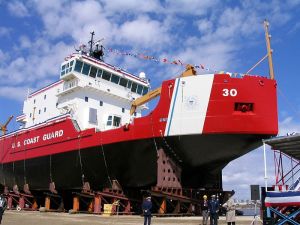
Launch of USCGC Mackinaw (WLBB-30) on April 2, 2005. Photo by Peter J. Markham.

Launch of USCGC Mackinaw (WLBB-30) on April 2, 2005. Photo by Peter J. Markham.

Do we need the Navy?:

I would note that the Coast Guard’s intention had been to fund the Icebreaker in FY2018 not 2022, but somehow we had an unannounced delay of four years which was reduced by a much publicized decision to accelerate construction to 2020. Not only does this strike me as dishonest, but it also seems to suggest that the Coast Guard, given supporting funding, could be ready to contract for the Icebreaker on its own prior to 2020.
If the money were given to the Coast Guard instead of the Navy, I believe the icebreaker would be ready earlier, be delivered cheaper, and will be more in line with our true needs.
If we have to live with this:
As much as I dislike the prospect, we may have to live with this, because of the Congress’ self imposed “sequestration” silliness. If so, how the Navy/Coast Guard team that manages the procurement will be important. The Coast Guard needs to continue to grow its icebreaker expertise.

Perhaps NAVSEA could sub-contract the Coast Guard Acquisitions Directorate (CG-9) to procure the icebreaker.

Thanks to Tups for bringing the encouragement to select an in-service U.S. hull design to my attention.


Commandant’s Strategic Intent, Mid-Term Report

Coast Guard Capt. Douglas Nash, commanding officer of Coast Guard Air Sation Sacramento, salutes a Coast Guard C-27J pilot during a change of watch ceremony at Air Station Sacramento's hanger in McClellan Park, Thursday, July 1, 2016. The ceremony marked the final day that an HC-130 Hercules crew stood the watch at Air Station Sacramento and introduced the newest aircraft. Coast Guard photo by Petty Officer 3rd Class Loumania Stewart

Procurement of 14 C-27J aircraft was one of the achievements sited. C-27Js replace C-130s at CGAS Sacramento. 

The Commandant has issued a mid-term update on his earlier published “Strategic Intent, 2015-2019” (pdf). The new document is available in pdf format. You can find it here: “United States Coast Guard Commandant’s Strategic Intent, 2015-2019, Mid-Term Report.”

It is relatively short and readable at 21 pages. The recurring themes of the Commandant’s administration are all there, starting with TOC (transnational organized crime) and its deleterious effect on Western Hemisphere governance and prosperity. It does read a little like an Officer Evaluation Report input.

There is nothing particularly surprising here, but even for me, the enumeration of the scope the Coast Guard’s authorities, responsibilities, and international contacts is still mind boggling.

I am not going to try to summarize the report, but there were a few things that struck me.

The Commandant mentions service life extension programs for the seagoing buoy tenders (already begun), the 47 foot MLBs, and the 87 foot WPBs (in the future), but there is no mention of what we will do about the inland tender fleet. There will also be a life extension program for helicopters before they are finally replaced.

“Extend the service life of our rotary wing assets and align with DOD’s Future Vertical Lift initiative.”

There is mention of a program I was not aware of, the “Defense Threat Reduction Agency National Coast Watch System project.” The Defense Threat Reduction Agency attempts to track and reduce the WMD threat. It is not really clear what our role is here. We know about the container inspection programs in foreign ports. Is that it, or is there more to this? (that can be discussed at an unclassified level.)

Innovation for Inland Tenders

Photo: BAE systems

We don’t hear about it often, but the Coast Guard also needs to recapitalize its inland fleet, WLI, WLIC, and WLRs. There are 35 of these. One entered service in 1944, another in 1945. The two newest entered service in 1990, but all the rest are much older. Two entered service in the ’50s. 23 in the ’60s, and six in the 70s. .

Whenever we belatedly get around to replacing these, there is an innovation we might want to look at, high-lift flap rudders. These were recently used on a Jones Act Articulated Tug Barge (ATB). Reportedly it provides much improved maneuverability.