It includes an interview with the Commandant, a story about the 100 year history of Coast Guard Aviation, one about the Coast Guard in Vietnam, and another about the Offshore Patrol Cutter, along with several others.
When I first brought it up, the print was too small to read comfortably on my laptop, but you have two ways to get a larger view. Clicking on the page twice enlarges it (maybe too large). There is also a slider at the lower left that changes the size of the page you are viewing. Unfortunately neither adjustment is carried over when you go to the next page.
If you are interested in being up to speed on the Russian Navy, the US Naval Institute has provided access to an Office of Naval Intelligence (ONI) briefing book on the Russian Navy.
Unfortunately I did not see anything about the Russian Coast Guard in my initial scan of the document. It is a not insignificant force.
On page 5, where you see the 1000 mile rings that the document suggest the Russians have a special interest in, you might notice that one includes most of Alaska.
The US Naval Institute News Service has provided a copy of the Dec. 14, 2015 Congressional Research Service report, “Coast Guard Polar Icebreaker Modernization: Background and Issues for Congress,” by Naval Ronald O’Rourke.
This updates a series of earlier reports.
It is quite clear from the report that even if things go as planned, which I doubt it will, we will have a period of two to six years when we will have only one medium icebreaker and no heavy icebreakers.
If we do as currently planned, we will not see a new icebreaker until at least 2024.
We have looked at alternatives that might carry us through until the US can truly recapitalize its current fleet.
We can renovate Polar Sea. Clearly Congress is running out of patience waiting for a decision about what to do with this ship. We ought to ask for the funds to renovate it one way or the other.
We can lease one or two of these excess icebreakers. We could put one in the Great Lakes to satisfy those interests and it could in worst case exit the Great Lakes and go to the assistance of a polar icebreaker or break into resupply Thule airbase in Greenland.
Both of these are relatively low cost options. They deserve serious consideration.
Artist impression of nuclear powered dual displacement icebreaker “Arktika” (project 22220)
Image: Atomflot
NavyRecognition reports that Russia claims they will have three more nuclear powered icebreakers by 2020 (when the US plans to start building it first new heavy icebreaker since 1977). They also announced plans for two more classes of nuclear icebreakers and a floating nuclear power plant.
The new icebreakers are expected to have a power of 120 MW or more than twice the power of the Polar Star.
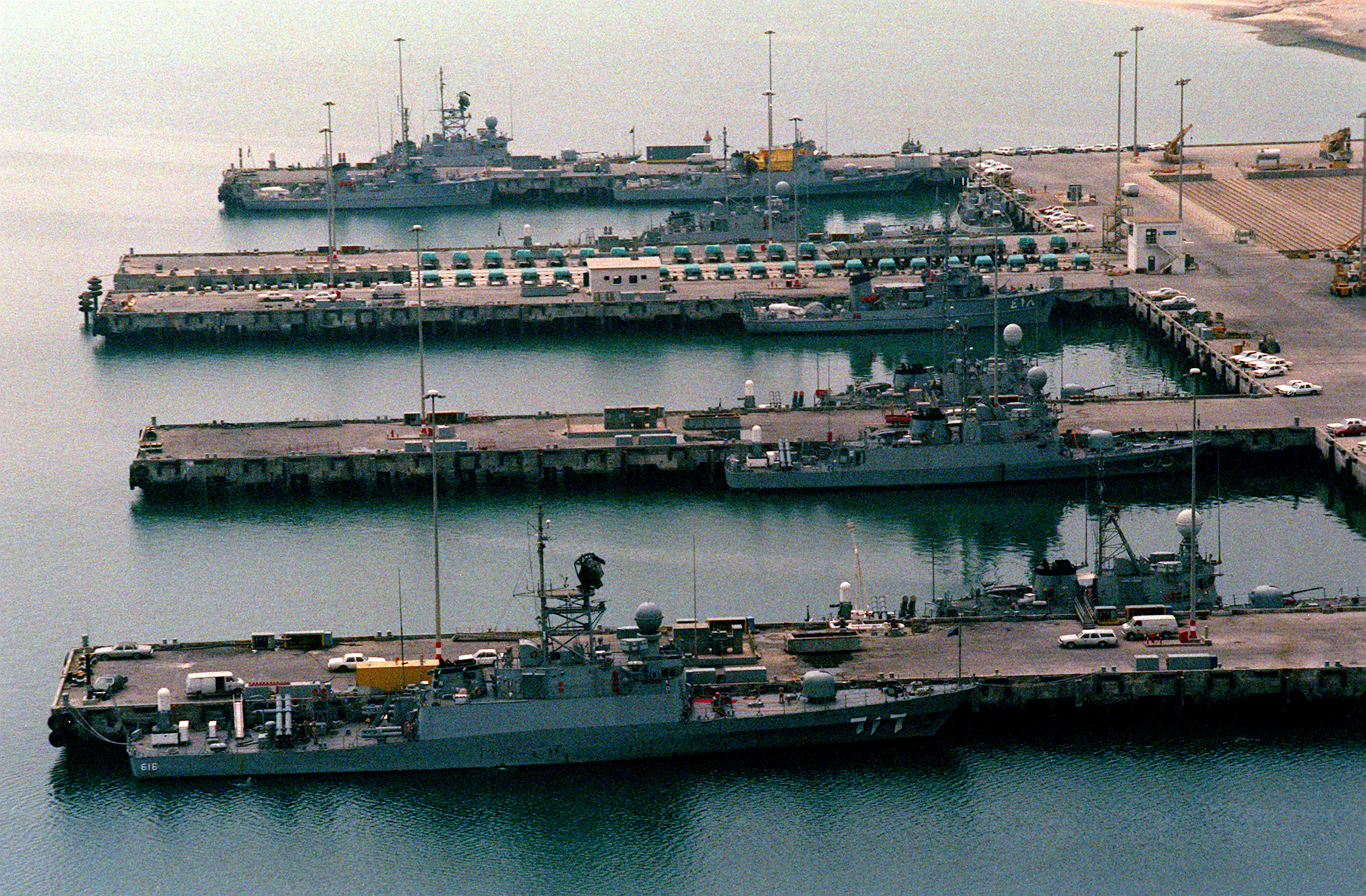
DOD Photo. Ships of the Saudi Arabian Navy are docked at the base PORT JUBAIL
Below is a post I prepared for CIMSEC. It began at Lyle’s suggestion several months ago, to be published here, considering if perhaps some of the new Coast Guard assets, the National Security Cutter, the Offshore Patrol Cutter, or the Fast Response Cutter might serve as the basis for something the Saudis would buy. It seems clear now that will probably not be the case. The Saudi’s have a very different set of priorities than those that shaped the Coast Guard’s specifications. Distances are relatively short. The likely enemy, Iran, is close at hand, and primarily uses small vessels with limited seakeeping so even moderately good seakeeping is better than that of the apparent enemy. .
The Royal Saudi Navy is planning to replace virtually all of its Eastern Fleet. The expected price tag has been variously reported as between $11.25 and $20B. One of Saudi Arabia’s two fleets, the Eastern Fleet is based in the Persian Gulf and faces off squarely against Iran’s Navy and Revolutionary Guard Corp. The Western Fleet is based in the Red Sea and includes seven French built frigates.
The existing Eastern fleet, all American built, includes four 75 meter (246 foot), 1,038 ton corvettes and nine 58 meter (190 feet), 495 ton guided missile boats. All are nearing the end of their useful lives, having entered service in the early ’80s.
In February Defense News reported that Saudi Arabia had sent a letter of request to the US Navy that outlined the entire program. It specified:
Four 3,500-ton “frigate-like warships” capable of anti-air warfare, armed with an eight-to-16-cell vertical launch system (VLS) capable of launching Standard SM-2 missiles; fitted with an “Aegis or like” combat system using “SPY-1F or similar” radars; able to operate Sikorsky MH-60R helicopters; with a speed of 35 knots.
Six 2,500-ton warships with combat systems compatible with the frigates, able to operate MH-60R helos.
20 to 24 fast patrol vessels about 40 to 45 meters long, powered by twin diesels.
10 “maritime helicopters” with characteristics identical to the MH-60R.
Three maritime patrol aircraft for coastal surveillance.
30 to 50 UAVs, some for maritime use, some to be shore-based.
This shopping list sounds remarkably specific. This suggest that they already have a good idea what they expect to buy.
Four 3,500-ton “frigate-like warships”
Plans have firmed up for the four frigates. While they will not have the Aegis like radars they will have a, “…16-cell (Mk41) VLS installation able to launch Evolved Sea Sparrow missiles, and will carry Harpoon Block II surface-to-surface missiles in dedicated launchers, and anti-air Rolling Airframe Missiles in a SeaRAM close-in weapon system. The MMSC will also mount a 76mm gun… a Lockheed Martin COMBATSS-21 combat management system, which shares some commonality with the much larger Aegis combat system, and feature the Cassidian TRS-4D C-band radar.”
Six 2,500-ton warships with combat systems compatible with the frigates, able to operate MH-60R helos.
The design for the six smaller ships hasn’t been discussed openly, so this is a bit of speculation, but at least I think we can expect something like this. The video below, from Swiftship, recently appeared without much explanation. The similarity in design to the Freedom class is striking and it claims to be a proven hull form. If Marinette Marine is too busy to build these smaller ships in addition to the LCS and the Saudi Frigates, having Swiftships build them might be a way have having them delivered relatively quickly and it looks like it might fit the description. Note there is no mention of an ASW capability for these ships (other than the ability to embark an MH-60R). This parallels the current fleet structure where only the four largest vessels have an ASW capability and the next largest class vessels do not.
Swiftships has a record of selling vessels through “Foreign Military Sales” and the vessel in the video shares a number of systems in common with the projected Saudi frigates including a 76mm gun, RAM missiles, MH-60s, and possibly Harpoon (they show only a generic representation of an ASCM).
20 to 24 fast patrol vessels about 40 to 45 meters long, powered by twin diesels.
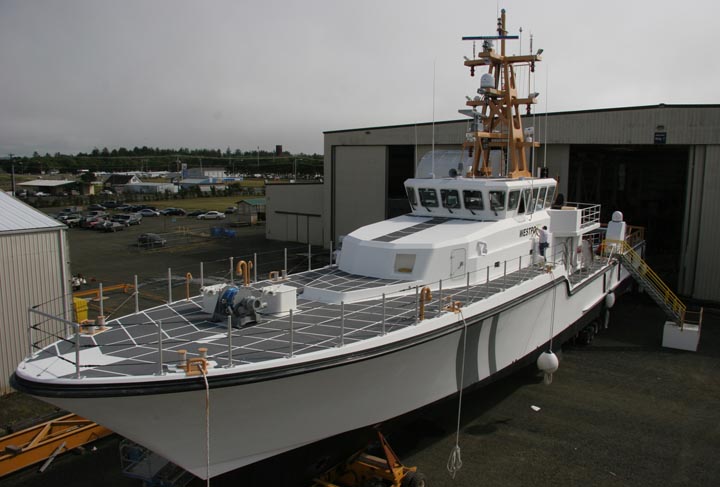
A likely choice for the patrol boat is this one, eight of which were sold to Pakistan. Reportedly these 43 meter, 143 foot vessels can make 34 knots and operate a ScanEagle UAS.
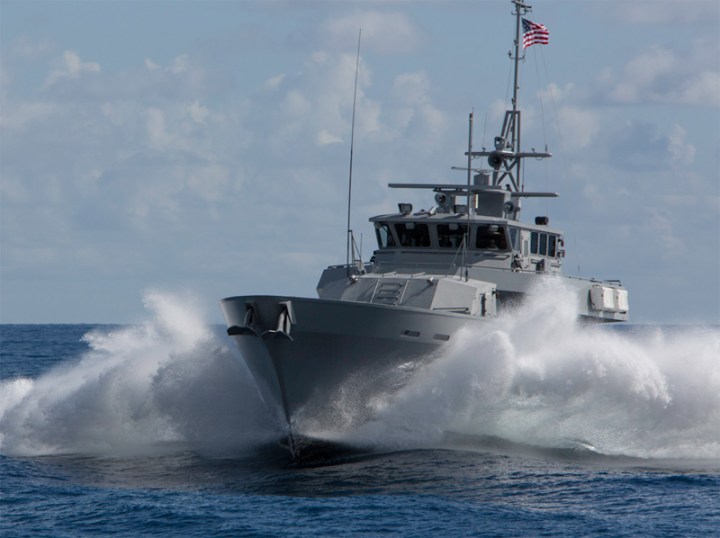
Another possibility is this 43.5 meter vessel that was provided to Lebanon under FMS.
Both of these PCs have the capability to stern launch an RHIB.
10 “maritime helicopters” with characteristics identical to the MH-60R.
Included in the buy of the helicopters are, “one-thousand (1,000) AN/SSQ-36/53/62 Sonobuoys; thirty-eight (38) AGM-114R Hellfire II missiles; five (5) AGM-114 M36-E9 Captive Air Training missiles; four (4) AGM-114Q Hellfire Training Missiles; three-hundred eighty (380) Advanced Precision Kill Weapons System rockets; twelve (12) M-240D crew served weapons; and twelve (12) GAU-21 crew served weapons.”
I note that the 380 Advanced Precision Kill Weapons System (APKWS) semi-active laser homing 70mm rockets is exactly the number to fill twenty 19 round launchers. These weapons are probably an ideal counter to the much vaunted Iranian “swarm.”
Three maritime patrol aircraft for coastal surveillance:
These are almost certainly P-8s.
30 to 50 UAVs, some for maritime use, some to be shore-based:
While there is no indication which system is favored. This sounds like too many systems for Firescout.
ScanEagle or one of Insitu’s slightly larger systems seems more likely, and if the Swiftships Offshore Patrol Vessel video is any indication, it includes a ScanEagle launch and recovery.
Conclusion:
This will be a major upgrade to the Saudi fleet that should allow them to maintain an advantage relative to the Iranian Fleet.
The ships and patrol boats will be three to five times larger than those they replace and far more survivable.
Fleet air defense systems which have been limited to 76mm guns and Phalanx CIWS will get a basic local area defense in the form of Evolved Sea Sparrow Missile, which will be backed up by rolling airframe missiles.
ASW capability will take a quantum leap with the addition of the three Maritime Patrol Aircraft (MPA), the ten MH-60R.
The Eastern fleet was relatively well equipped to target larger surface targets with a total of 68 Harpoon launch tubes on the existing ships, but they were less well equipped to deal with numerous Iranian small craft. MH-60Rs armed with Advanced Precision Kill Weapon System guided rockets should provide an effective counter to Iran’s swarm strategy.
MPA and Unmanned systems will enhance ISR capability.
The larger patrol craft should significantly improve maritime security.
According to my “Combat Fleets of the World,” the Saudi Navy has a Marine Corp of 3,000, but their only Amphibious Warfare ships are four LCUs and two LCMs. The addition of at least 30 ships with RHIBs, assuming the patrol craft have this capability, should allow the Saudi Navy to consider at least small scale raids and other forms of maritime Special Ops. If the six 2500 ton ships are configured like the ship in Swiftships video, with four RHIBs, it would seem particularly appropriate for this role. The addition of ten helicopter decks where there were none before also opens up options for these types of operations.
Late Note: Unfortunately I let my frustration with the slowness of out cutter replacement and my natural snarkiness color this report, leaving the impression that the Mexican Navy was replacing its ships faster than the Coast Guard, which is not the case. Rather this ship was decommissioned because it had a damaging fire.
The German Navy blog “Marine Forum” reports,
The Mexican Navy has sunk its decommissioned patrol vessel „Uribe“ (P-121) off the Baja California coast where it will become the state’s first artificial reef (divers attraction).
I cannot help but notice this ship compared favorably to our 210s being 18 years newer, larger, faster, and better armed.
MarineLog reports the French are building a new vessel to support their presence in Antarctica. It is to be operated by the French Navy. Not a lot of details–The story is really about their choice of Wärtsilä equipment to power the ship. Looks like a typical offshore industry support vessel.
MarineLog reports that both Senators from Michigan have requested “Robust” funding for a “Heavy Icebreaker” for the Great Lakes.
OK they called the Mackinaw a heavy icebreaker, and we know it really is not, so something less may work.
Looking at the excess Shell icebreakers we talked about earlier, it appears the already built icebreaker Aiviq, with a beam of 80 feet, is a little too large to squeeze through the St. Lawrence Seaway, but if Tups was right, and this is the icebreaking vessel Shell had under construction at Edison Chouest, its beam, 22 meters (72.2 feet) is less than the 78 foot maximum for the Seaway. Maybe something could be worked out.
This is a lot larger and more powerful than USCGC Mackinaw.
Ship Name: LA SHIP 304
Shiptype: Anchor Handling Tug Supply
LR/IMO No.: 9788368
Gross tonnage: 6,000
Year of Build: 2017
Flag: United States Of America
Status: Keel Laid (status changed 2014-11-17)
Operator: Galliano Marine Service LLC
Shipbuilder: LaShip LLC
Length Overall: 94.600 m
Breadth Moulded: 22.000 m
Depth: 11.800 m
Machinery overview: 4 diesel electric oil engines driving, connected to 2 electric motors reduction geared to screw shafts driving 2 Azimuth electric drive units. Total Power: Mcr 20,240kW (27,520hp), Csr 17,204kW (23,392hp)
Prime mover detail: Design: Caterpillar, Engine Builder: Caterpillar Inc – USA, 4 x C280-16, 4 Stroke, Single Acting, Vee, 16 Cy. 280 x 300, Mcr: 5,060 kW (6,880 hp) at 900 rpm
Being somewhat cynical, if this was more than a political gesture, I would have thought they would have gotten signatures from Senators from other states that border the Great Lakes.
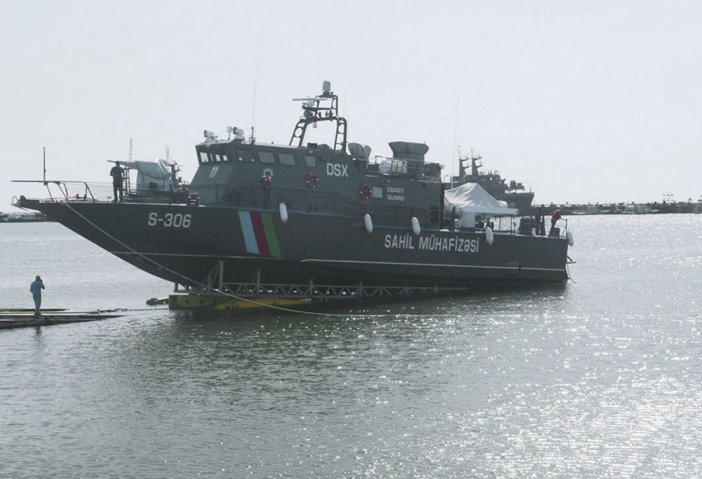
Photo: Azerbaijan Coast Guard’s first Saar 62. Source: President’s Office, Azerbaijan
We have talked about these before, but now we have more details, particularly about how they are equipped.
Janes 360 reports the launching of two new vessels for the Azerbaijan Coast Guard, the first of up to six helo deck equipped, 203 foot, 470 ton, 32 knot Sa’ar 62s based on the Israeli Sa’ar 4.5 missile boat, and a sixth 32.65 m-long, 95-ton Shaldag Mk V.
Photo: Azerbaijan Coastguard’s sixth Shaldag Mk V (Azerbaijan State Border Guard Service)
Both types use the Typhoon gun mount which is basically the same as the Mk38 mod2 used by the Coast Guard, except that, instead of using the 25 mm chain gun, these use a Soviet era 23 mm, with a higher rate of fire. Both use the Toplite Electro-Optic fire control system that is also part of the Mk38 mod2.
Most interesting, they are armed with small missile systems. the larger vessels will have an eight cell launcher for the 25 kM range Spike-NLOS.
TYPHOON MLS NLOS configuration has eight Spike NLOS missile launchers and integrated Toplite stabilized observation and target acquisition system. Photo: RAFAEL via defense-update.com
The smaller vessels have a four tube launcher for the 8 km range Spike-ER.
Azerbaijan’s neighbors on the Caspian Sea are Russia to the North, Iran to the South, and Turkmenistan and Kazakhstan on the other side of the water. They have a small navy in addition to their Coast Guard, but these will constitute a substantial reinforcement. There is appears to be a miniature naval arms race going in the Caspian Sea.
The German Navy Blog, Marine Forum, reports, “7 November, ALGERIA, Polish Gdansk Shipyard launches newly-built sail training vessel EL-MELLAH … regarded as „the largest (110m x 14.5m, 3,000 sqm sails) and fastest (17 knots) sailing ships in the world“ … to be used in training of Algerian Navy cadets … delivery in fall, 2016.”





 Chuck Hill's CG Blog