“Opinion: Coast Guard Budget Reductions Puts U.S. at Risk”–USNI

The US Naval Institute has a nice opinion piece by a retired Navy Rear Admiral, advocating restoration of funding cut from the Coast Guard budget over the last few years, and not incidentally greater number of National Security Cutters (NSC) to replace the High Endurance Cutters.

This is not the Admiral’s first editorial advocating for the Coast Guard. Whatever his affiliation, his opinions are on point, and I would really like to see the Congress add a ninth NSC to the budget

Ramblings on the Russian Naval Attack on Syria

You have probably heard that Four Russian naval vessels based in the Caspian Sea have launched 26 missiles against targets in Syria. This attack demonstrates a capability similar to that of the US Tomahawk missile.

What you might not realize is how small the Russians ships that launched the attack really were. While the US surface vessels equipped with Tomahawk are Burke class destroyers and Ticonderoga class cruisers of 8,000 to 10,000 tons, the Russian operation involved only a one small frigate and three small corvettes. The corvettes were smaller than a 210, and the frigate was less than two thirds the size of a 378. All four were considerably smaller than the projected Offshore Patrol Cutter. All four together displace only slightly more than a single Bertholf class.

The largest ship, Dagestan, is a Gepard class light frigate or large corvette, 1,930 tons (full load), 102.14 m (335.1 ft) in length overall, 13.09 m (42.9 ft) of beam, with eight Kalibr (SS-N-27) anti-surface missiles, SA-N-4 AAW missiles, a 76.2 mm gun, two six barreled 30 mm guns, four 533 mm (21″) heavy weight torpedo tubes, and an RBU-6000 ASW  rocket launcher.

The other three, Grad Sviyazhsk, Uglich, Veliky Ustyug, were Buyan-M class corvettes, displacing 950 tons full load, with a maximum speed of 25 knots, armed with Kalibr (SS-N-27) anti-surface missiles, 100-mm and 30-mm guns, and Igla-1M air defense missiles.

While the US Navy has begun talking about distributed lethality, the Russians are practicing it.

Certainly the Coast Guard is not going to arm their ships like this in peacetime, but we might want to keep the possibility in mind if things start to go south.


Poland looking for OPCs

ProposedPolishCorvette

Rolls Royce proposal

Poland is planning some ships that have many similarities to the Offshore Patrol Cutters. We have talked about these a little already, in the context of an unconventional hull form offered by ThyssenKrupp Marine Systems (TKMS) that promises better fuel economy. Our friend at Thinkdefence talks about another proposal from Rolls Royce. He also provided a link to a more detailed description of the program.

The intention is apparently to produce three “Miecznik” corvettes and three “Czapla” patrol ships (with mine countermeasures) with the two classes sharing a common platform. ThinkDefence reports the key features of Rolls Royce’s corvette version as follows:

“It is 99.7 metres long and displaces just over 2,400 tonnes. Accommodation for 60 crew and an additional 30 personnel is included and the ship is said to have a 28 day endurance. With a CODLOD propulsion system its design top speed is 25 knots. Weapons and sensors include a 76mm Oto Melara gun, twin MSI 30mm automatic cannons, two quad NSM missile launchers, MU90 torpedo launchers and four Sylver A35 cells for quad packed VL-MICA anti-aircraft missiles; Smart-S 3D radar, Thales optronic systems and Kingclip sonar.”

Substituting some equivalent US systems, I think that would represent a good approximation of how a war ready OPC might be equipped.

Apparently they intend to order one ship a year beginning with the corvettes in 2017. That starts them on nearly the same schedule as the OPCs. Which will be finished first? Unfortunately the Poles will probably see their first ship before we see the first OPC.

Rolls Royce CDV 4


Hull Vane on an OPV

This is a company promotional, so it must be approached with some skepticism, but if the results are anywhere close to those claimed it looks like it is worth considering.

This is the results of a study of the effects of adding a “hull vane” to the stern of the Netherlands 108 meter (354 foot) Holland Class OPVs.

Since the operational profile for these ships is likely to similar to those of large Coast Guard cutter, this may be worth a look.

  • They claim a 12.5% reduction in fuel consumption,
  • A 4% reduction in heave,
  • A 7%% reduction in pitch, and
  • A 13% reduction in vertical acceleration at the flight deck.

French Building OPVs

FrenchOPVBSAH

NavyRecognition reports the French have contracted for two OPVs with an option for two more.

In several respects, these ships are very different from most OPVs and particularly the Coast Guard’s Offshore Patrol Cutters (OPC) and Webber class WPCs.

France has a huge Exclusive Economic Zone, very nearly as large as that of the US, which is the largest in the world. These ships are intended to support France’s many island territories far from European France. Disaster Relief and Humanitarian Assistance is expected to be an important mission for these ships.

Structurally they appear much closer to a typical Offshore Industry Support Vessel. At 70.3 meters (231 feet) long, it is sized between the OPC and the WPC. Speed is relatively low at 14 knots. The crew is smaller than that of the Webber class, while the endurance is similar to that of the much larger OPCs.

Significantly, they have no helicopter facilities.

MEKO Energy Saving Hull

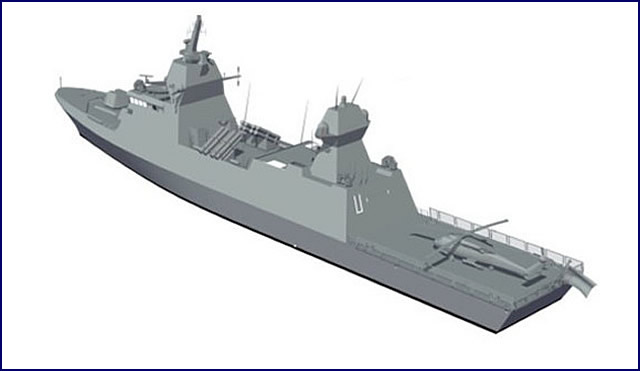
At MSPO 2015, the International Defence Industry Exhibition in Poland which took place in Kielce from the 1 to 4 September 2015, German naval vessels designer ThyssenKrupp Marine Systems (TKMS) unveiled a new variant of the MEKO A-100 PL with a unique
The new MEKO A-100 design unveiled at MSPO 2015. The variant shown here is the Mine Counter Measures (MCM) one.

NavyRecognition is reporting that the German ship builder ThyssenKrupp Marine Systems (TKMS), is offering a new hull form for its OPC- sized MEKO A-100 to meet Poland’s projected requirement for six Offshore Patrol Vessels. It is claimed that the new design will allow the ship to go 1.5 knots faster with no increase in installed power.

Two major differences are apparent,

  1. The raked stem and bulbous bow are replaced by a vertical stem which appears to provide a longer water line length.
  2. The fin stabilizers are missing.

Increasing waterline length does have the effect of decreasing wave making resistance which is predominant at higher speeds. Conversely increased length tends to result in  increased wetted area which would make ships less efficient as slower speeds by increasing skin friction. Deleting the fin stabilizers would have the benefit of reducing wetted surfaces. There may also be some less obvious changes, not apparent in the artist’s rending.

The original post has a nice side by side comparison of the conventional corvette and TKMS’s proposal to meet Poland’s Mine Countermeasures OPV requirement.

President Calls for More Icebreakers

USCGCHealeyCGphoto

The New York Times is reporting that, in a Speech today, the President will call for new icebreakers for the Coast Guard including accelerating the one currently planned and for additional icebreakers beyond that.

“The aging Coast Guard fleet is not keeping pace with the challenge, the administration acknowledged, noting that the service has the equivalent of just two “fully functional” heavy icebreakers at its disposal, down from seven during World War II. Russia, by contrast, has 41 of the vessels, with plans for 11 more. China unveiled a refurbished icebreaker in 2012 and is building another.

“Mr. Obama will propose speeding up the acquisition of a replacement icebreaker that had been planned for 2022, setting a new date of 2020, the White House said. He will also propose that planning begin on the construction of new ones, asking Congress to provide “sufficient resources” to fund them.”

Hopefully these WAGBs and the rumored additional National Security will move the perception of what is a normal AC&I budget closer to a realistic level.

New Sail Training Ship for Vietnam

From the German Navy blog “Marine Forum,” 28 August, “VIETNAM, Full-rigged sail training vessel LE QUY DON, built by Polish shipyard Marine Projects for the Vietnamese Navy, is on its transfer voyage from Poland around the Cape of Good Hope to Vietnam … mixed Polish-Vietnamese crew for final trials and crew training enroute.”

More here.

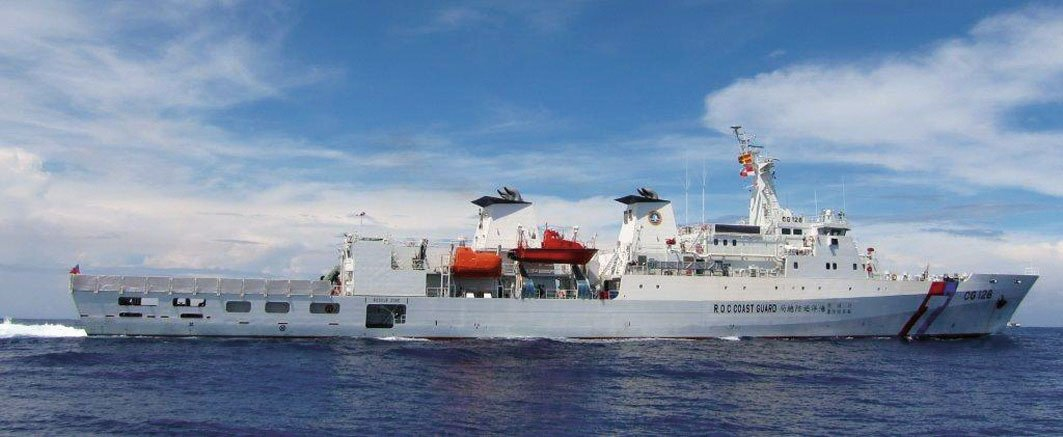
Taiwan Commissioned Two WHECs

ROCcutterYILAN(CG128)

Photo: Yilan (CG 128). (Taiwan Coast Guard Administration)

I mentioned this earlier in a comment on an earlier post, but Jane’s has more detail and much better pictures. Back on June 8, Janes 360 reported that Taiwan’s Coast Guard administration has commissioned two new 3,000 ton, 119 meter (390 foot) helo capable cutters, Yilan (CG 128) and Kaohsiung (CG 129), with a speed of 24 knots and a range of up to 10,000 miles.

Taiwan, along with Mainland China, supports the concept of the Nine Dash Line, but they have a particular beef with Japan. regarding the Senkakus Islands as they are known in Japan or the Diaoyutais as they are known in China and Taiwan, about 120 nautical miles (220km) northeast of Taiwan.

The other area where these might be assigned is protection of the area around Taiping Island, the largest of the Spratly Islands in the South China Sea (at least before the Chinese began reclamation) which the Taiwanese have garrisoned.

ROCcutterKAOHSIUNG(CG129)

Photo: Kaohsiung (CG 129). (Taiwan Coast Guard Administration)

According to the Diplomat,

“Since 2008, Taiwan’s Coast Guard Administration has been engaged in a 37-ship building program totaling 17,000 tons at a cost of  approximately NT$ 24 billion ($782 million).”

Low Noise Patrol Boat

Bairdmaritime reports the Norway has received some new patrol boats (interceptors) that I find remarkable both for their speed (up to 50 knots) and for their quiet operating environments.

“We are proud to have achieved noise levels well below specification. 61 decibels in the wheelhouse and 71 in the transport room at a cruising speed of 40 knots is unique in a fast patrol boat of this size…”

They also have ” a comprehensive heating system to cope with severe Nordic winter conditions (including de-icing of deck areas).”

Things to think about when the Coast Guard ultimately starts to replace its 87 footers.