UK Deploys OPV to Guyana, gCaptain/Reuters

The River-class offshore patrol vessel HMS Trent (P224) passes the Vorontsov Lighthouse while arriving in Odesa, Ukraine to participate in Exercise Sea Breeze 2021, July 2, 2021. Exercise Sea Breeze is a multinational maritime exercise cohosted by the U.S. Sixth Fleet and the Ukrainian Navy since 1997. Sea Breeze 2021 is designed to enhance interoperability of participating nations and strengthens maritime security and peace in the region. (U.S. Navy photo by Damon Grosvenor/Released)

gCaptain reports,

Britain will deploy a naval ship off Guyana later this month, its ministry of defense said on Sunday, as the South American nation faces a border dispute with neighbor Venezuela over the oil-rich Essequibo region.

The deployment follows a visit by a British junior foreign minister to Guyana earlier this month, intended to offer the UK’s support for the country, an ally and former British colony.

We have talked about Venezuela’s claim on territory internationally recognized as part of Guyana. There is a recent BBC report here.

I found it interesting that the Royal Navy is sending an Offshore Patrol Vessel to this region of potential conflict. HMS Trent is about the size of a 270 and is armed with a 30mm gun in what is essentially the same mount the US Navy is calling the Mk38 Mod4.

It is likely 4th Fleet will also have some units (probably CG cutters and maybe an LCS) in the area.

None of these ships is likely to be a match for the Venezuelan Navy, but the US could quickly have overwhelming amounts of airpower over the area.

Buoy Tender, FRC, C-130 Used for International Fisheries Enforcement–Operation Southern Shield

PERU, 10.06.2023, Courtesy Photo, USCG District 11
San Francisco based USCGC Alder (WLB-216) raises the South Pacific Regional Fisheries Management Organization (SPRFMO) flag while patrolling the Eastern Pacific Ocean during Operation Southern Shield in October 2023. The Coast Guard recently completed the first high-seas boardings and inspections off the coast of Peru under a newly adopted multi-lateral agreement to monitor fishing and transshipment operations within the SPRFMO Convention Area, a region which encompasses nearly a quarter of the Earth’s high seas. (U.S. Coast Guard photo by Petty Officer 2nd Class Kenneth Honore)

Below is a District 11 news release. It came with 24 photos. I have included a few here. The captions are informative. I have edited some of the captions to include homeports and minimize duplication. I have also added a few links and the schematic below.

SPRFMO CONVENTION AREA
This schematic is available only to illustrate the Area of application of the SPRFMO Convention, which is described in legal terms in Article 5. The schematic is not part of the Convention text and has no legal status; it is not intended to reflect exactly the maritime spaces of adjoining coastal states.
PERU, 10.07.2023, Courtesy Photo, USCG District 11
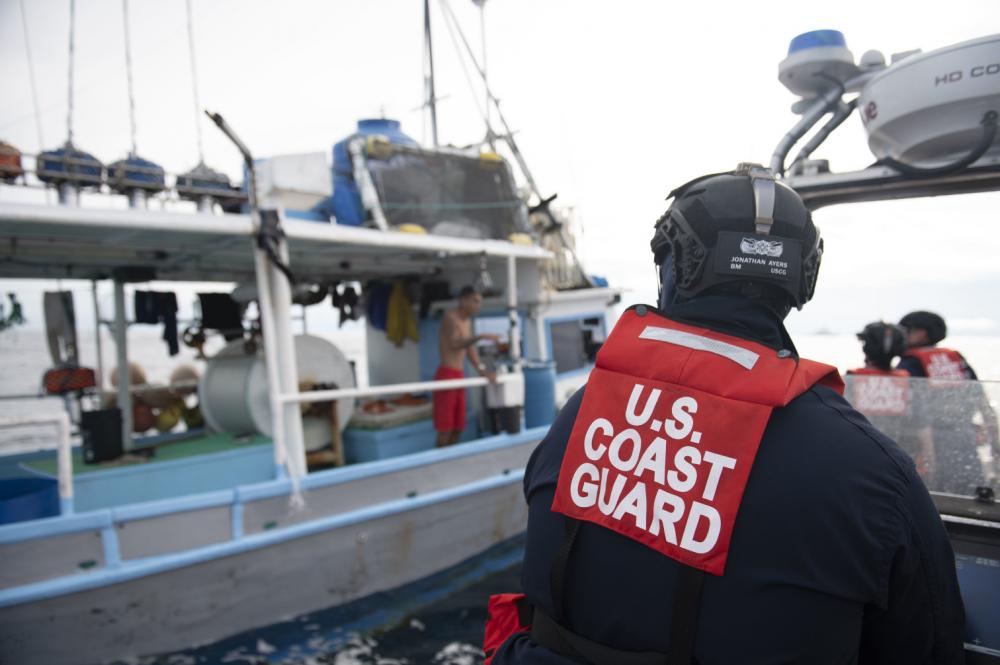
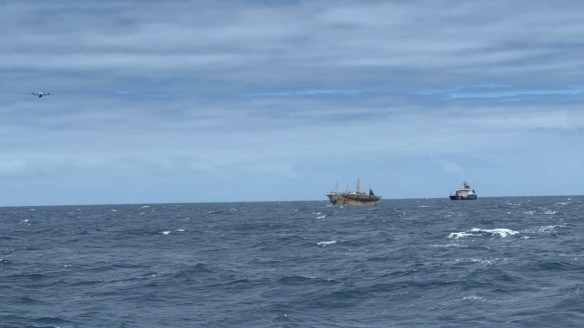
The Coast Guard Cutter Alder approaches a squid fishing vessel while CG-2007, a C-130 from Air Station Barbers Point in Hawaii, flies over (upper left) during Operation Southern Shield 2023, October 2023. The Coast Guard recently completed the first high-seas boardings and inspections off the coast of Peru under a newly adopted multi-lateral agreement to monitor fishing
and transshipment operations within the South Pacific Regional Fisheries Management Organization (SPRFMO)Convention Area. (U.S. Coast Guard photo)

LIMA, PERU, 10.06.2023, Courtesy Photo, USCG District 11
The aircrew of the Coast Guard 2007, an HC-130 based out of U.S. Coast Guard
Air Station Barbers Point, Hawaii, poses for a picture with observers from the Peruvian Navy and Air Force, in Lima Peru, October 2023. During the course of two weeks, Peruvian observers accompanied the USCG aircrew as they conducted overflights of the fishing fleet on the high seas during Operation Southern Shield 2023. (U.S. Coast Guard photo by pilot-in-charge, Lt. Zachary Hunter)

There was a Webber Class WPC involved as well. This follows the pattern of pairing a WLB with an FRC for distant operations that we have also seen in the Western Pacific.
PERU, 10.06.2023, Courtesy Photo, USCG District 11
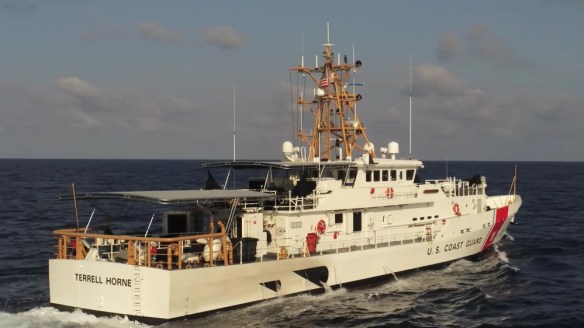
The crew of San Pedro based USCGC Terrell Horne (WPC-1131) conducts a patrol in the Eastern Pacific Ocean in support of Operation Southern Shield 2023, October 2023. (U.S. Coast Guard photo)

These operations followed an international exercise, GALAPEX 2023.

09.23.2023, Courtesy Photo, USCG District 11
Participants in GALAPEX 2023 pose for a group picture following a law enforcement boarding exercise during GALAPEX 2023, Sept. 23, 2023. Coast Guard Cutters Alder and Terrell Horne conducted a boarding of Ecuador Bae Isla Floreana as the first major exercise and introduction to GALAPEX, a recurring multi-national maritime exercise led by Ecuador and included participation with delegates from Argentina, Brazil, Chile, Colombia, Costa Rica, the European Union, France, Italy, Mexico, Panama, Peru, the United Kingdom, and the United States. (U.S. Coast Guard photo by Lt. j.g. Kimberly Byron)
09.25.2023, Courtesy Photo, USCG District 11
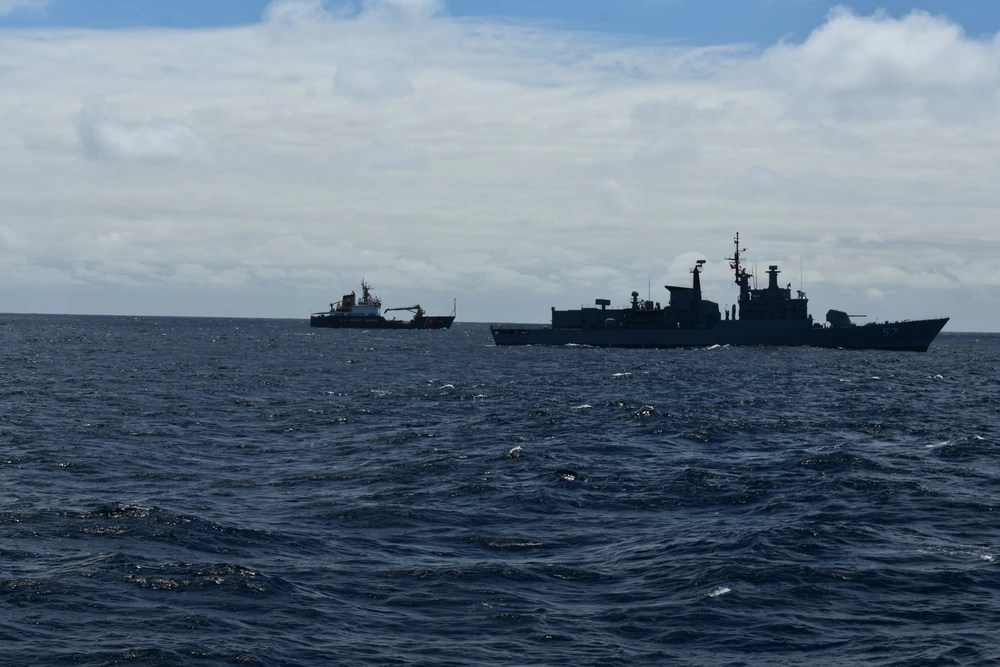
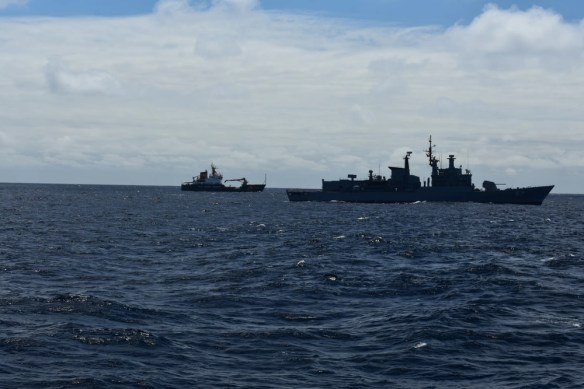
U.S. Coast Guard Cutter Alder (background) transits in formation alongside Peru BAP (Buque Armada Peruana) Bolognesi (FM-57) as it prepares for the next exercise during GALAPEX 2023, Sept.25, 2023. (U.S. Coast Guard photo)


 Oct. 16, 2023

Coast Guard Cutter crews conduct first high-seas boardings off the coast of Peru, under new SPRFMO measure

ALAMEDA, Calif. — The crews of the Coast Guard Cutters Alder, Terrell Horne and an HC-130 Hercules aircraft recently completed the first high-seas boardings and inspections, in the Eastern Pacific Ocean, under a newly adopted conservation and management measure to monitor and inspect fishing and transshipment operations at-sea in the South Pacific Regional Fisheries Management Organization (SPRFMO) Convention Area.

As part of Operation Southern Shield, the Coast Guard conducted boardings and overflights within the SPRFMO Convention Area on the high seas off the coast of Peru. For years, the Coast Guard has executed counter-illegal, unreported, or unregulated (IUU) fishing operations and participated in high seas boarding inspections (HSBI) around the globe. This operation was significant as it was timed to implement newly adopted rules in the SPRFMO Convention Area, which comprises nearly a quarter of the Earth’s high seas. The SPRFMO Commission consists of 17 members from Asia, Europe, the Americas, and Oceania, as well as two cooperating non-contracting parties. The primary species targeted in the Convention area are jack mackerel and jumbo flying squid.

Just prior to Operation Southern Shield, the Coast Guard participated in GALAPEX 2023, a recurring joint and multinational exercise hosted by Ecuador and executed in the vicinity of the Galapagos Islands. The Coast Guard conducted communications exercises, practiced counter-narcotics boarding scenarios, and hosted observers from Peru, Ecuador, and Brazil. GALAPEX culminated with full-scale exercises focused on a coordinated multinational response to counter IUU fishing. At the conclusion of the exercise, the Coast Guard patrolled south to focus on high seas boarding inspections off the coast of Peru.

“The U.S. Coast Guard remains committed to conducting combined maritime operations and exercises throughout the Eastern Pacific and will continue to capitalize on every opportunity to work with, learn from, and coordinate through our partners,” said Capt. James O’Mara, Chief of Enforcement for Coast Guard 11th District.  “The relationships our services build while planning and executing these operations are essential. The logistics required to enable these operations are significant, and it only happens with the tremendous support of partners like Ecuador and Peru.”

IUU fishing has replaced piracy as the leading global maritime security threat. Areas out on the high seas, beyond any country’s exclusive economic zone, can be exploited by fishermen engaged in IUU fishing, as they fish beyond the reach of most law enforcement entities. The Coast Guard’s actions provide inspection presence on the high seas among a distant water fishing fleet made up of more than 400 fishing and transshipment vessels. Much of the fishing in the Eastern Pacific is accomplished by these distant water fishing vessels, some which remain at sea for years at a time, and many of which are supported by transshipment vessels. The Coast Guard’s recent operation directly supported Central and South American partners and their desire to monitor and expand maritime domain awareness of fishing activity near their exclusive economic zones.

Each day during the operation a Coast Guard C-130 aircraft flew sorties over the fishing fleet on the high seas with observers from the Peruvian Navy and Air Force. The crew of the Coast Guard Cutter Terrell Horne also diverted to assist the Peruvian Navy in a search and rescue operation. The Terrell Horne located the vessel, then transported an injured fisherman back to shore to receive further medical care from local Peruvian officials.

“The U.S. Coast Guard is committed to working with our allies and partners to strengthen the international fisheries enforcement regime and stop the pervasive IUU fishing threat,” said Rear Adm. Andrew Sugimoto, commander, Coast Guard 11th District. “Operation Southern Shield is just the latest example of that commitment, and we will continue to model and support rules-based order. We applaud the SPRFMO Commission for adopting these latest inspection guidelines and hope to see additional management measures adopted in the future to ensure the sustainability of our ocean resources. Last year we operated off the Galapagos, this year off the coast of Peru, and we will continue to deploy aircraft, cutters, and personnel to support our partners and monitor these distant water fleets wherever they roam. These operations help bring like-minded countries closer together to protect vulnerable fish stocks, support the economic stability of coastal nations, the livelihoods of small-scale and artisanal fishermen, and safeguard ocean resources that fuel global populations and economies.”

Saildrones Set Sail in Support of U.S. 4th Fleet’s Operation Windward Stack” –4th Fleet

Below is a 4th Fleet News Release. Ten Saildrones will be operating in the Caribbean.

NEWS | Sept. 13, 2023

Saildrones Set Sail in Support of U.S. 4th Fleet’s Operation Windward Stack

By U.S. Naval Forces Southern Command/U.S. 4th Fleet Public Affairs

Commercial operators began deploying 10 Saildrone Voyager Unmanned Surface Vessels (USVs) out to sea today, a critical first step in U.S. 4th Fleet’s Operation Windward Stack.

Launched from Naval Air Station Key West’s Mole Pier and Truman Harbor, the Saildrones’ mission once on station is to improve maritime domain awareness, or MDA, by detecting and quantifying targets that pass within range of the Saildrones’ sensors.

Operation Windward Stack is a long-term operation of unmanned and manned forces working together, also known as a hybrid fleet, as envisioned by the Secretary of the Navy and the Chief of Naval Operations. Windward Stack is part of 4th Fleet’s unmanned integration campaign, which provides the Navy a region to experiment with and operate unmanned systems in a permissive environment, develop Tactics, Techniques, and Procedures (TTPs) against near-peer competitors, and refine manned and unmanned Command and Control (C2) infrastructure, all designed to move the Navy to the hybrid fleet.

First, operators and watchstanders at U.S. 4th Fleet will conduct tests and coordinate information flow as the solar-powered Saildrones sail into the Caribbean. “Operation Windward Stack begins with testing as we integrate the information we receive from the Saildrones into our fleet command center to further increase maritime domain awareness in the U.S. Southern Command Area of Responsibility (AOR),” said Lt. Cmdr. John Clark, U.S. 4th Fleet’s Current Operations (COPS) Director. “We will eventually have the opportunity to work through the command and control of both manned and unmanned forces operating throughout our region.”

The 10 Saildrones will serve as the initial unmanned vessels in the operation. Plans are to add additional USVs, unmanned aerial vehicles (UAVs) and manned maritime forces over the next few months to further challenge C2 integration and to expand the MDA coverage.

“We were able to demonstrate coordinated operations of manned and unmanned forces during UNITAS LXIV, a multinational maritime exercise, but that was for a relatively short time,” said Capt. David Fowler, U.S. 4th Fleet Maritime Operations Center (MOC) Director. “With Windward Stack, we’re going to coordinate these operations for many months. That is how we will truly learn what these unmanned vessels can do for us on a day-to-day basis.”

U.S. Naval Forces Southern Command/U.S. 4th Fleet supports USSOUTHCOM’s joint and combined military operations by employing maritime forces in cooperative maritime security operations to maintain access, enhance interoperability, and build enduring partnerships in order to enhance regional security and promote peace, stability and prosperity in the Caribbean, Central and South American region.

Coast Guard Los Angles Looks at MQ-8C

Picked this up off the Coast Guard Aviation Association’s Facebook page. A post by U. S. Coast Guard Los Angeles.

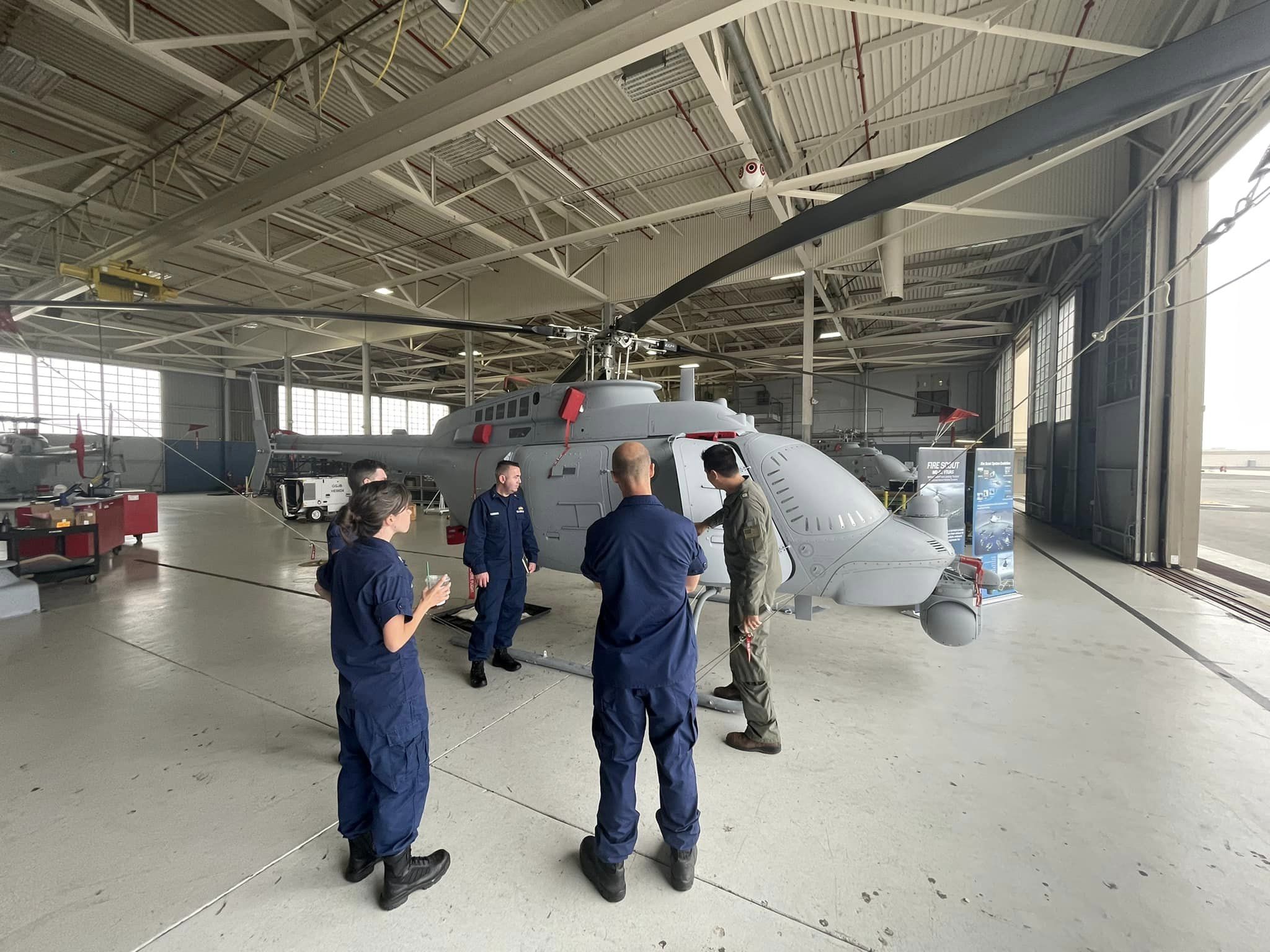
Today, members from Sector Enforcement travelled to Naval Base Ventura County at Point Mugu, Calif. to discuss the possible use of Unmanned Aerial Vehicles to support Coast Guard missions. Pictured is the Navy’s MQ-8C Fire Scout, an unmanned helicopter used for intelligence, surveillance, and reconnaissance.

Is the Coast Guard looking to buy MQ-8C? It is not unlikely, the Navy wants to exercise these assets in an operational environment. Cutters doing drug interdiction are almost perfect for them. This is more likely looking at an opportunity for a Navy Detachment to deploy with a cutter than that the Coast Guard is looking to buy MQ-8C.

The MQ-8C should be able to search a much larger area than the Scan Eagles we are using now. The four National Security Cutters in Alameda have room for one of these in addition to an H-65 and Scan Eagle. There are also two WMEC 210 on the West Coast that might use these, but I would expect to see Scan Eagle on the WMECs before Fire Scout, but it is a possibility.

The First two OPCs are coming to San Pedro, hopefully, beginning next year. They also have ample aviation space, so perhaps they are a possibility as well.

This could be a win-win.

WPB87 transfers

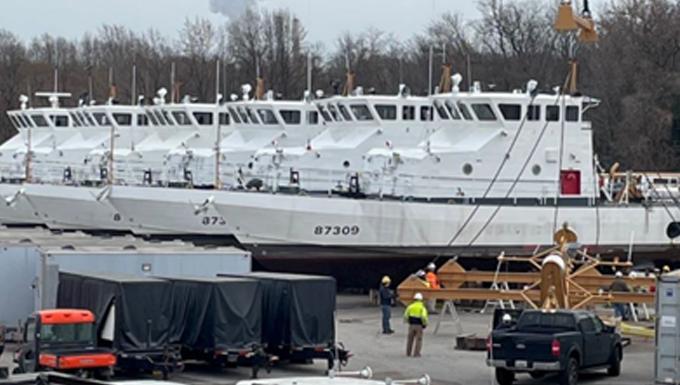
Former Coast Guard Cutters Albacore, Cochito and Gannet are among six cutters currently at Coast Guard Yard awaiting upgrade and outfitting before transfer to Uruguay and Lebanon. U.S. Coast Guard photo.

Just wanted to pass along this photo and its caption which refers to transfers not only to Uruguay but also to Lebanon. The photo was found here.

There was also a report of additional interaction with Lebanese armed forces here.

Coast Guard Cutters Emlen Tunnell and Glen Harris are moored pierside in Beirut, Lebanon, Jan. 31, 2022. The two fast response cutters are deployed to the U.S. 5th Fleet area of operations to help ensure maritime security and stability in the Middle East region. U.S. Army photo by Cpl. DeAndre Dawkins.

“ARGENTINA DEPLOYS NEW PATROL VESSELS TO COMBAT IUU FISHING” –CIMSEC

The former French Ship L’Adroit, now the Argentinian OPV, ARA Bouchard (P-51)

CIMSEC brings us a report on Argentina’s efforts to combat Illegal, Unreported, and Unregulated (IUU) Fishing.

The former L’Adroit and her three new construction ice-strengthened half-sisters are central to the story. I have long thought these ships epitomized a very disciplined approach to the design of an Offshore Patrol Vessel. Defense capabilities aside, they have everything you need in an OPV and nothing you don’t. They are the best example of my Cutter X concept. They are fast enough at 21 knots. They have enough seaworthiness and endurance (7,000-8,000 nmi at 12 knots). They have a helicopter deck and hangar. They have the boats they need. They have a small crew (30) but can accommodate 60.

That is not to say adding additional capabilities for defense does not make sense, but in affect they constitute a baseline for an OPV. When you start adding capabilities you could say, what is the cost/benefit compared to this baseline?

The post also includes an interesting proposal,

“Regional cooperation is vital to solving this security challenge, which can be achieved by modernizing the Inter-American Treaty of Reciprocal Assistance (Tratado Interamericano de Asistencia Recíproca: TIAR) into a 21st-century agreement that is also tasked with combating IUU fishing.”

NSC#9, USCGC Stone, Completes First Patrol Since Commissioning, Spends Time with Colombian Friend

Below is a news release from Atlantic Area reporting USCGC Stone’s return from a patrol in the Eastern Pacific. It seems to have been a successful but fairly routine EastPac with a couple of items of note. In addition to drug interdiction, this patrol put some emphasis on Illegal, Unregulated, Unreported (IUU) fishing.

While this was Stone’s first operational mission since commissioning, she had already completed an unusual South Atlantic mission before commissioning.

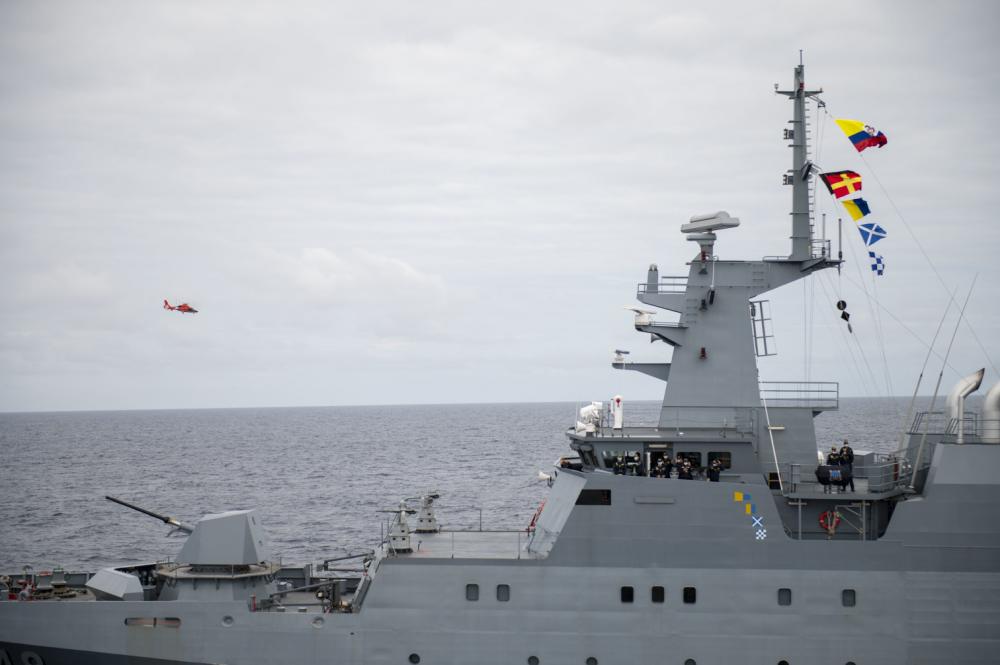
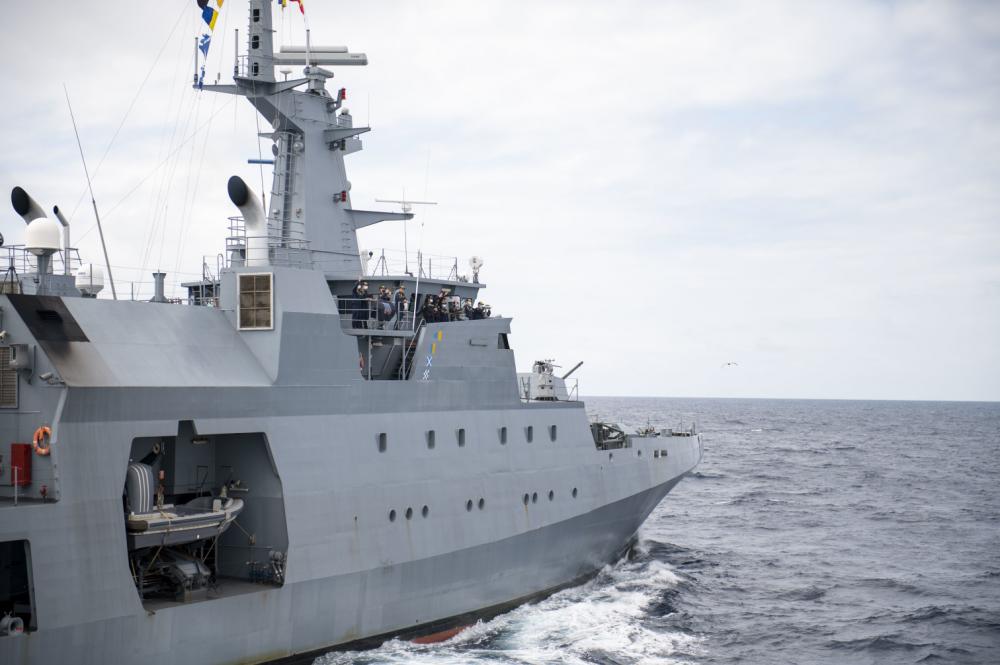
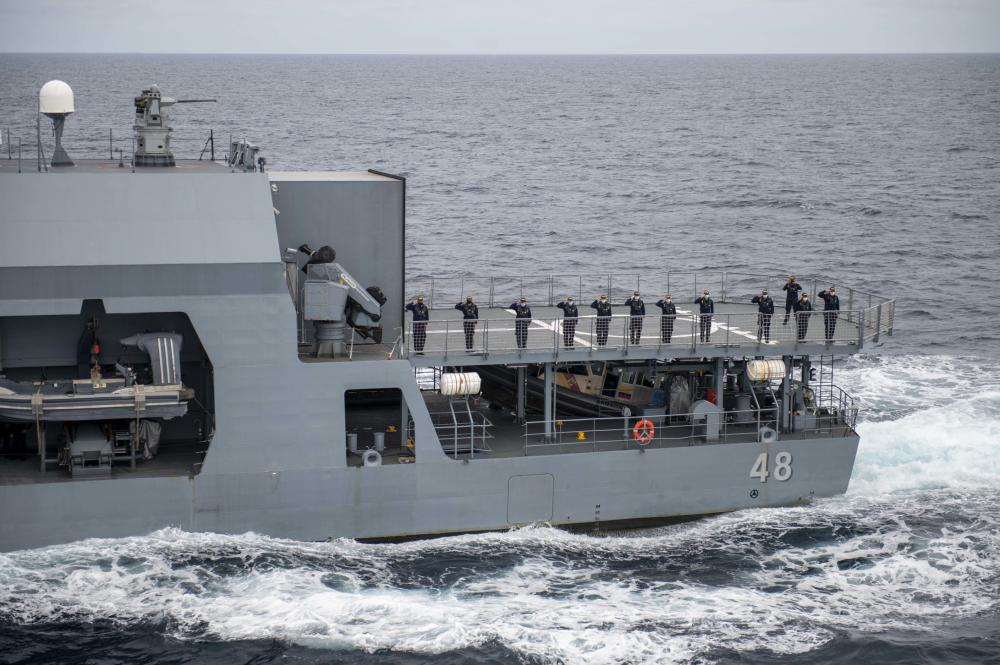
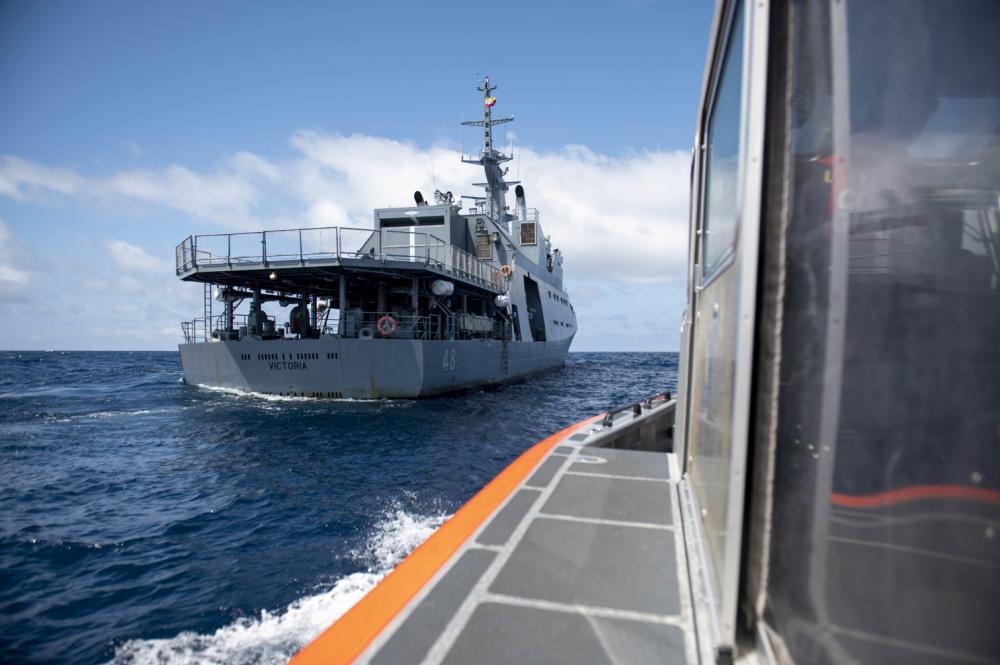
I also wanted to make sure you did not miss the photos of Colombia’s 80 meter Fassmer OPV that operated with Stone. (Some of the photos were found here.) The Fassmer OPV is also operated by Chile and a slightly longer (86 meter) version is operated by Germany. 

As can be seen, this 80.6 meter (264.4′) vesselp ca n operate and hangar a helicopter and has provision for three boats including one on a stern ramp. This one is armed with a medium caliber gun (76mm), what appears to up to 22 knots and have a range of 8,600 nautical miles (15,900 km). These are about the size of Bear class WMECs, and except for EW, equipment and capabilities sound similar to the Offshore Patrol Cutter (OPC). The Fassmer design, is probably not as capable of continuing to operate boats and helicopter in as severe weather and probably does not have as large a hangar. Also, the flight deck does not look as large, but the Colombian ship does include a stern boat ramp not included in the OPC.

Some of the Chilean ships of this class are ice-strengthened.

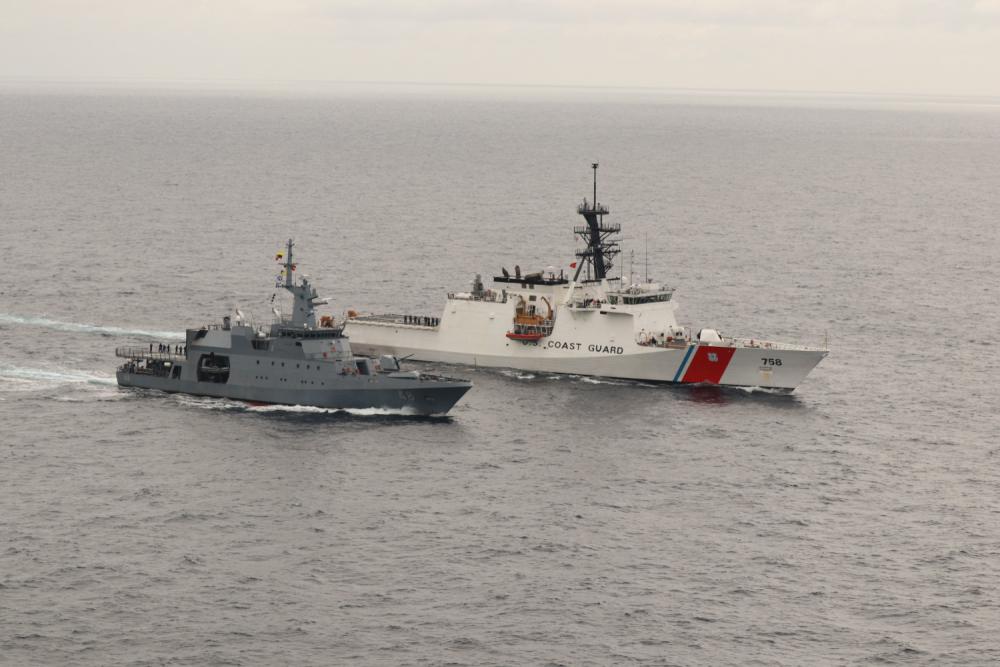
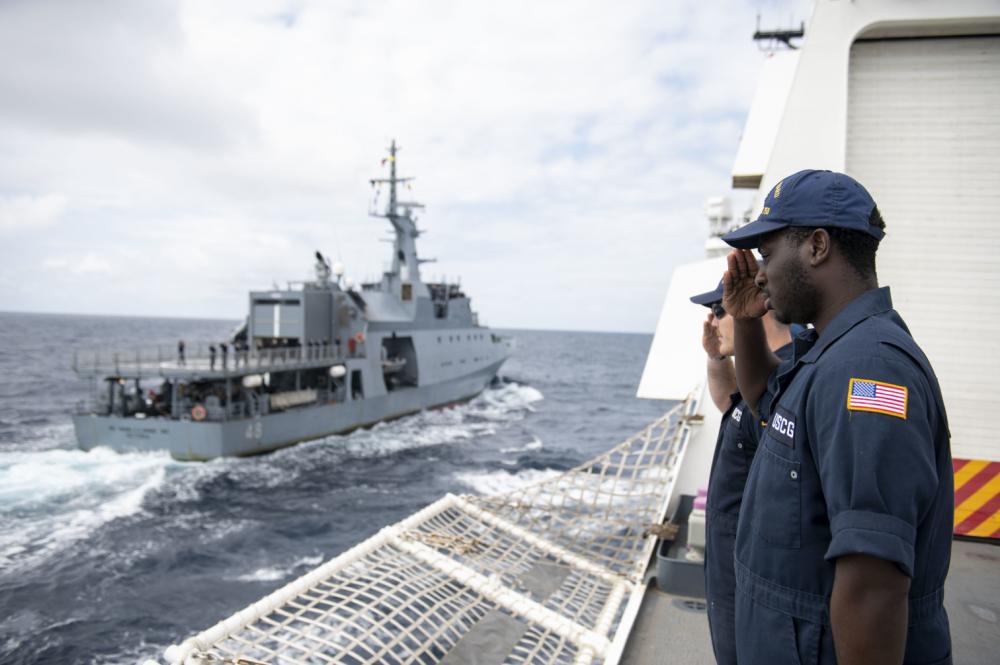
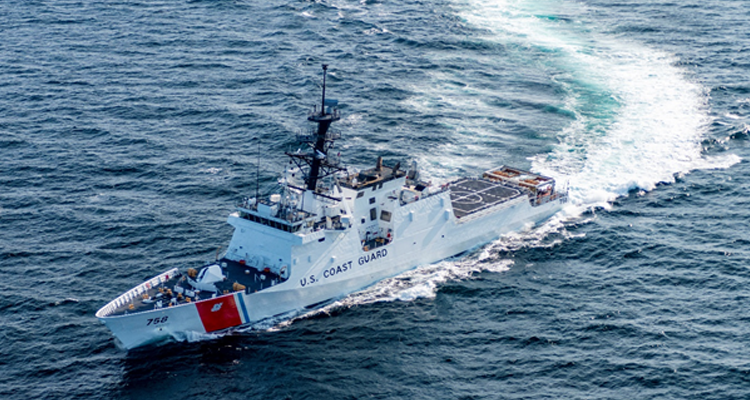
The crews of U.S. Coast Guard Legend-class national security cutter USCGC Stone (WMSL 758) and the Colombian navy OPV-80 offshore patrol vessel ARC Victoria (PZE-48) conduct passing exercises in the Eastern Pacific Ocean, Dec. 4, 2021. The U.S. and Columbia have signed agreements on trade, environmental protection, asset sharing, chemical control, ship-boardings, renewable and clean energy, science and technology, and civil aviation. (U.S. Coast Guard photo by Petty Officer 2nd Class Shannon Kearney)

U.S. Coast Guard, Colombian navy conduct exercises, personnel transfers in Eastern Pacific Ocean

U.S. Coast Guard, Colombian navy conduct exercises, personnel transfers in Eastern Pacific Ocean

U.S. Coast Guard, Colombian navy conduct exercises, personnel transfers in Eastern Pacific Ocean

U.S. Coast Guard, Colombian navy conduct exercises, personnel transfers in Eastern Pacific Ocean

U.S. Coast Guard, Colombian navy conduct exercises, personnel transfers in Eastern Pacific Ocean

U.S. Coast Guard, Colombian navy conduct exercises, personnel transfers in Eastern Pacific Ocean

News Release

U.S. Coast Guard Atlantic Area

USCGC Stone returns to homeport after 61-day patrol working with partners

USCGC Stone partners with US, Panamanian, Costa Rican representatives, fishery experts to conduct Illegal, Unreported, Unregulated fishing patrols U.S. Coast Guard, National Oceanic and Atmospheric Administration attend International Illegal, Unreported, Unregulated Fishing Symposium in Ecuador USCGC Stone (WMSL 758) and the Colombian navy OPV-80 offshore patrol vessel ARC Victoria (PZE-48) 

Editors’ Note: To view more or download high-resolution imagery, click on the photos above.

NORTH CHARLESTON, S.C. — USCGC Stone (WMSL 758) returned to their homeport in Charleston following a 61-day patrol in the Caribbean Sea and Eastern Pacific Ocean in support of the U.S. Coast Guard Pacific Area, the U.S. Coast Guard’s Joint Interagency Task Force South, and the U.S. Coast Guard Eleventh District.

Stone’s crew successfully interdicted two suspected drug smuggling vessels, recovering approximately 2,246 pounds of cocaine and 4,870 pounds of marijuana with an estimated combined street value of $57.1 million. The cutter’s crew subsequently transferred 20 suspected narcotics smugglers to the Seventh Coast Guard District and U.S. Drug Enforcement Administration personnel, signaling the culmination of a successful joint interagency effort in the Eastern Pacific.

The Stone embarked observers from Panama, Costa Rica, Colombia, Ecuador, and the National Oceanic and Atmospheric Administration to perform joint operations to combat illegal, unreported, and unregulated fishing (IUUF) and conduct counter-drug operations off the coast of South America.

An embarked MH-65 helicopter aircrew from the U.S. Coast Guard’s Helicopter Interdiction Tactical Squadron was integral in counter-drug operations. Interagency partners provided additional aerial surveillance and reconnaissance support throughout the patrol.

During the cutter’s port call in Manta, Ecuador, Stone’s commanding officer, Capt. Clinton Carlson, attended an international IUUF symposium with Arthur Young, the embarked National Oceanic and Atmospheric Administration enforcement officer, to share experiences and increase awareness of the regional issue. The crew of the Stone also participated in a friendly soccer match with Cuerpo de Guardacostas de la Armada personnel from the local coast guard station while in Manta.

“This is our crew’s first patrol outside of their initial shakedown cruise, and I am extremely proud of the dedication and pride they have shown toward getting qualified to conduct the missions expected of a national security cutter crew,” said Carlson. “Throughout these past months, everyone aboard displayed enthusiasm during the drills we’ve run every week and have proven that through teamwork and a shared understanding of the mission, we can accomplish even the most difficult tasks. I am honored to lead this impressive crew of Coast Guard women and men.”

The fight against drug cartels in the Eastern Pacific Ocean and the Caribbean Sea requires unity of effort in all phases from detection, monitoring, and interdictions, to criminal prosecutions for these interdictions by United States Attorney’s Offices from the Middle District of Florida, the Southern District of Florida and the Southern District of California. The law enforcement phase of counter-smuggling operations in the Eastern Pacific Ocean is conducted under the authority of the Eleventh Coast Guard District, headquartered in Alameda. The interdictions, including the actual boardings, are led and conducted by U.S. Coast Guard members.

The Stone is the ninth Legend-class national security cutter in the Coast Guard fleet and currently homeports in Charleston, South Carolina. The national security cutters can execute the most challenging national security missions, including support to U.S. combatant commanders.

The Charleston-based Legend-class cutters fall under the command of the U.S. Coast Guard Atlantic Area. Based in Portsmouth, Virginia, U.S. Coast Guard Atlantic Area oversees all Coast Guard operations east of the Rocky Mountains to the Arabian Gulf. In addition to surge operations, they also allocate ships to work with partner commands and deploy to the Caribbean and Eastern Pacific to combat transnational organized crime and illicit maritime activity.

“Top US Commander Warns ‘Front Line’ With China Now South of Border” –Voice of America

Voice of America reports remarks by SOUTHCOM Commander, Admiral Craig Faller, regarding the growth of Chinese influence in the Western Hemisphere, including criminal activity and Illegal, Unreported, and Unregulated fishing.

This isn’t new. Through contributing author, Sanjay Badri-Maharaj (here and here),I have been following what has been happening in Trinidad and Tobago. I am sure similar interaction is happening elsewhere in the Western Hemisphere. Here is some background:

China’s Growing Influence in the Caribbean | Manohar Parrikar Institute for Defence Studies and Analyses (idsa.in)

China, Trinidad and Tobago pledge to consolidate friendship – CGTN

PM and Chinese President Xi Jinping engage in bilateral talks | Loop News (looptt.com)

“US Navy helicopters and Coast Guard snipers are firing on suspected drug traffickers ‘daily,’ top admiral says” –Business Insider

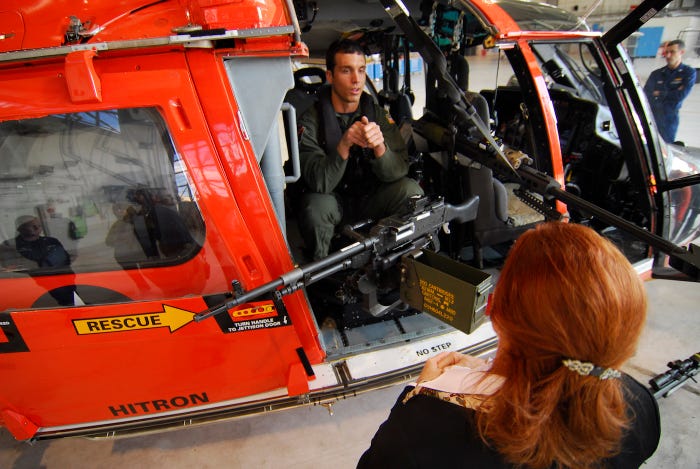
Petty Officer 2nd Class Anthony Phillips, a precision marksman at Helicopter Interdiction Tactical Squadron, displays the weaponry used by a HITRON during missions, February 23, 2010. US Coast Guard/Petty Officer 1st Class Bobby Nash

Business Insider has a story touting the success of the Navy/Coast Guard team effort in drug interdiction. This seems to be a report on Adm. Craig Faller’s (SOUTHCOM) remarks at the Surface Navy Association symposium in mid-January.

There is strong praise for the HITRON personnel.

“Coast Guard HITRON teams, which are sniper teams, have integrated into US Navy helicopters. So our Navy crews are involved in decisions to use … warning shots and disabling fire daily. I mean, it is a daily event,” Faller added. “We average numbers, sometimes large numbers, of events daily, and they’ve done it safely, effectively, completely in compliance with all the law of war and with precision. [I’m] very proud of that.”

I have to believe the “daily” claim is at least a slight exaggeration, since presumably HITRON was involved in all the cases and the report quotes Cmdr. Ace Castle, public affairs officer for US Coast Guard Atlantic Area, as saying they prosecuted 56 in 2020.

In any case, HITRON is getting a workout and proving their value. Worth noting that they and other Coast Guard law enforcement detachments, also serve on foreign ships working for SouthCom, including British, Canadian, Dutch, and French vessels.

“Fresh from Shipyard and Quarantine, Coast Guard Cutter Stone Heads Out for Southern Atlantic Patrol” USNI

Ingalls Shipbuilding successfully completed acceptance trials for the Coast Guard’s ninth national security cutter (NSC), Stone, in October 2020. NSC Stone was accepted Nov. 9, 2020, by the Coast Guard in a socially distanced ceremony. Photo by Lance Davis of Huntington Ingalls Industries.

The US Naval Institute News Service reports that USCGC Stone is being sent on an unusual Latin American South Atlantic patrol, even before she is commissioned. To make a patrol of this length prior to commissioning is almost unheard of, and the location is also something we have not done in a very long time, outside of the UNITAS exercise format.

The inaugural deployment is “a multi-month deployment to the South Atlantic countering illegal, unregulated, and unreported fishing while strengthening relationships for maritime sovereignty and security throughout the region,” according to a Coast Guard news release. “This the service’s first patrol to South America in recent memory, engaging partners including Guyana, Brazil, Uruguay, Argentina, and Portugal.” An observer from the Portuguese navy embarked the cutter for the duration of Operation Southern Cross in the U.S. Southern Command region.

Certainly not the Coast Guard’s “first patrol to South America in recent memory,” but to this part of South America, perhaps.