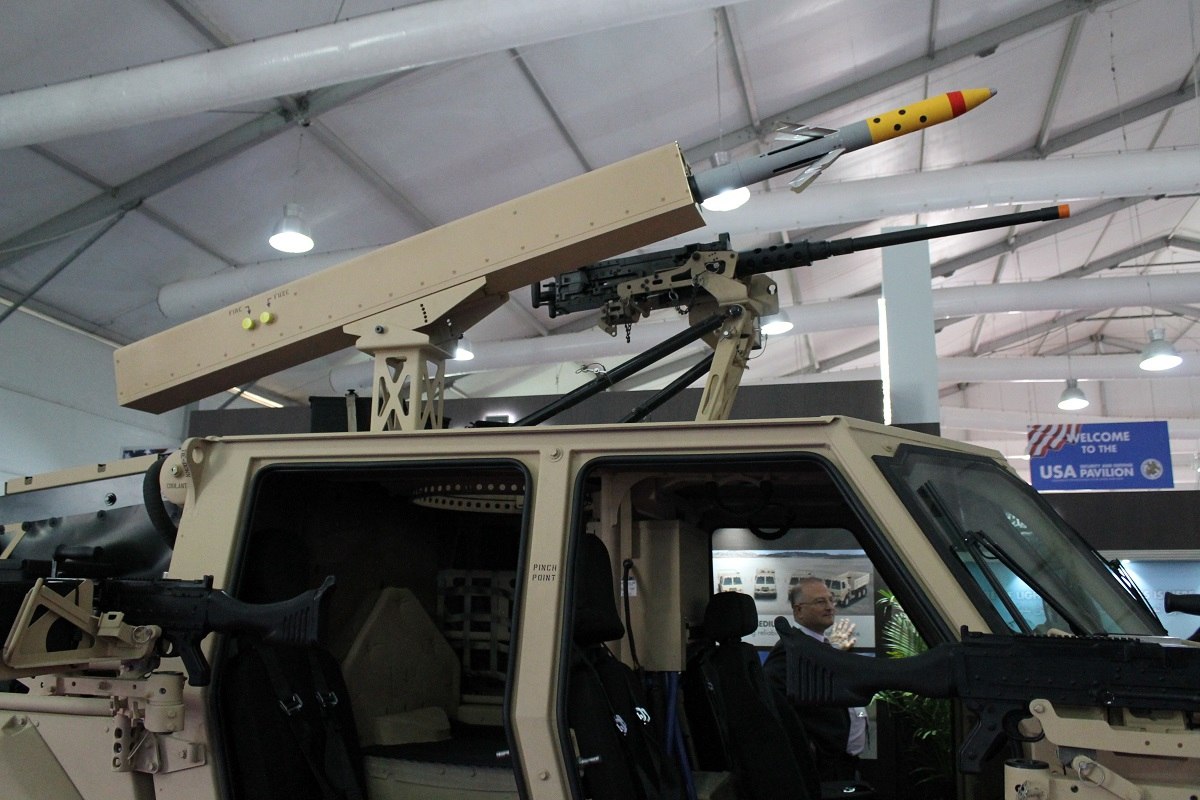
Fletcher Launcher for Advanced Precision Kill Weapon System (APKWS)–Arnold Defense showcased its new rocket launcher for non-air applications at SOFEX 2018 on an Oshkosh S-ATV. (Jen Judson/Staff)
I did a post on this system earlier, Guided Weapons Made Easy, but I had almost forgotten about it, and that would be a shame, because this may be exactly what we need give our small units both precision and a much heavier punch.
APKWS is an upgrade to the long serving (and very numerous) 70 mm Hydra rocket, that adds passive laser homing. Reportedly BAE is working up to providing 20,000 APKWS kits a year.
Current range for this system is about eight kilometer, probably enough for us, but there is also mention of an improved motor to extend the range. Reportedly the seeker is good for up to 14 km, so a motor upgrade might push the range out that far.
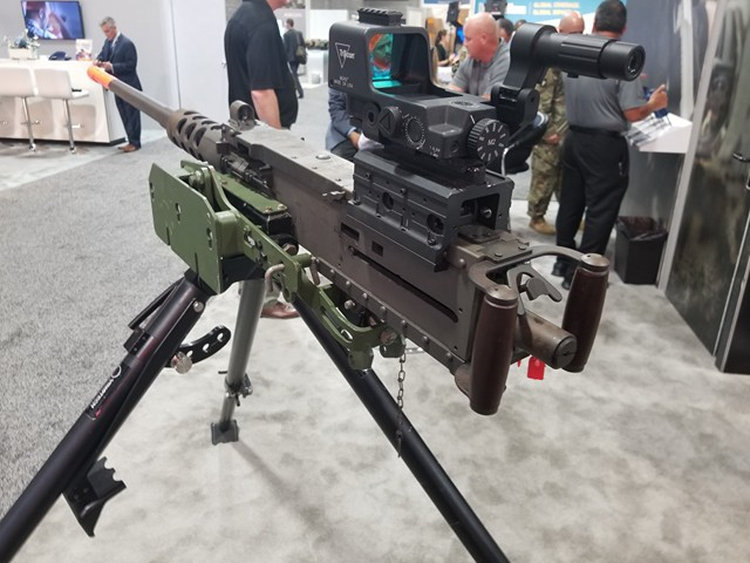
The launcher seems to have similar footprint to a .50 caliber machine gun. The empty launcher weighs only 30 pounds and the individual missiles 32 pounds. If it can fit on a light land vehicle, its likely it will fit on many of the Coast Guard’s smaller patrol assets.
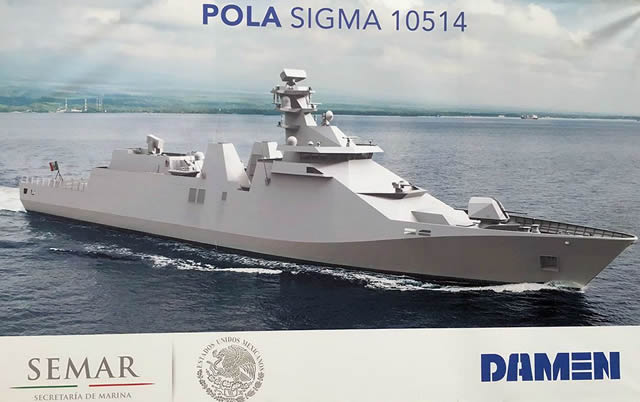
Photo: Sigma 10514 in Mexican Navy configuration, fitted with a BAE Systems Bofors 57Mk3 57mm main guna 12.7mm remote weapon system right behind it. The Mexican Navy opted for the Smart Mk2 radar by Thales. The Mexican “Long Range Patrol Vessel” will not be fitted with VLS cells but a Raytheon RAM launcher will be fitted on top of the helicopter hangar.
How much would it cost to turn one of our new construction cutters into a minimally capable frigate with at least some capability for anti-submarine, anti-surface, and self defense anti-air warfare?
I don’t have a definitive answer but we did get a good indication along with more information about Mexico’s new long range patrol vessel, a Damen 10514 design, that is close enough to our own Offshore Patrol Cutter requirements, that I thought it might have been an OPC contender.
Earlier we had an indication regarding the addition of VLS and Evolved Sea Sparrow Missiles (ESSM) when Chile ordered $140.1M worth of equipment to arm three ships. Plus we had an earlier post based on a 2009 Congressional Budget Office study (apparently no longer available on line) that suggested costs to replace the Phalanx on NSCs with SeaRAM and to add 12 Mk56 VLS and associated equipment, which could have provided up to 24 ESSM ($68M/ship).
The Defense Security Cooperation Agency has issued a news release concerning the sale of weapons for the new Mexican patrol vessel, and the shopping list is a pretty extensive, including anti-surface, anti-air, and anti-submarine weapons.
Mexico –Harpoon Block II Missiles, RAM Missiles and MK 54 Torpedoes
Media/Public Contact: pm-cpa@state.gov
Transmittal No: 17-63
WASHINGTON, Jan. 5, 2018 – The State Department has made a determination approving a possible Foreign Military Sale to Mexico of RGM-84L Harpoon Block II surface launched missiles, Block II Rolling Airframe Missile (RAM) tactical missiles and MK 54 Mod 0 lightweight torpedoes for an estimated cost of $98.4 million. The Defense Security Cooperation Agency delivered the required certification notifying Congress of this possible sale today.
The Government of Mexico has requested to buy six (6) RGM-84L Harpoon Block II surface launched missiles, twenty-three (23) Block II Rolling Airframe Missile (RAM) tactical missiles and six (6) MK 54 Mod 0 lightweight torpedoes. Also included are eight (8) MK 825 Mod 0 RAM Guided Missile Round Packs (GMRP) tri-pack shipping and storage containers; RAM Block 2 MK 44 Mod 4 Guided Missile Round Pack (GMRP); two (2) MK 32 Surface Vessel Torpedo Tubes (SVTT) triple tube launchers; two hundred and fifty (250) rounds of AA98 25 mm high explosive and semi-armor piercing ammunition; seven hundred and fifty (750) rounds A976 25mm target practice and tracer ammunition; four hundred and eighty (480) rounds of BA22 57mm high explosive programmable fuze ammunition; nine hundred and sixty (960) rounds of BA23 57mm practice ammunition; containers; spare and repair parts; support and test equipment; publications and technical documentation; personnel training and training equipment; U.S. Government and contractor representatives’ technical assistance; engineering and logistics support services; installation services; associated electronics and hardware to control the launch of torpedoes; and other related elements of logistics and program support. The estimated cost is $98.4 million.
This proposed sale will support the foreign policy and national security of the United States by helping to improve the security of a strategic partner. Mexico has been a strong partner in combating organized crime and drug trafficking organizations. The sale of these ship-based systems to Mexico will significantly increase and strengthen its maritime capabilities. Mexico intends to use these defense articles and services to modernize its armed forces and expand its existing naval and maritime support of national security requirements and in its efforts to combat criminal organizations.
Mexico intends to use the weapon systems on its Mexican Navy Sigma 10514 Class ship. The systems will provide enhanced capabilities in effective defense of critical sea lanes. The proposed sale of these systems and support will increase the Mexican Navy’s maritime partnership potential and align its capabilities with existing regional navies. Mexico has not purchased these systems previously. Mexico will have no difficulty absorbing this equipment into its armed forces.
The proposed sale of this equipment will not alter the basic military balance in the region.
The equipment will be provided from U.S. stocks. There are no known offset agreements proposed in connection with this potential sale.
Implementation of this proposed sale will require annual trips to Mexico involving U.S. Government personnel and contractor representatives for technical reviews, support, and oversight for approximately two years.
There will be no adverse impact on U.S. defense readiness as a result of this proposed sale.
This notice of a potential sale is required by law and does not mean the sale has been concluded.
All questions regarding this proposed Foreign Military Sale should be directed to the State Department’s Bureau of Political Military Affairs, Office of Congressional and Public Affairs, pm-cpa@state.gov.
The big ticket items certainly made the head lines, but the ammunition for the 57mm is not cheap.
Fortunately for the Coast Guard, the Navy generally pays for our ammunition and weapon systems. The cost to the Coast Guard is installation and integration, plus primarily long term personnel and training costs.
If you want to look primarily at the frigate proposals as well as the proposed weapons modules for the LCS which might also be applicable to the icebreaker, there is this composite video.
The Tanker was probably 20 times as large as the fishing vessel and had a crew on board and operating pumps to address flooding. USCGC ANACAPA began the operation at 13:00 and the RYOU-UN MARU sank at 18:15. It appears that the F/V may have been hit 100 times by 25mm projectiles, and at one point the ANACAPA used a hose to pour water into the fishing vessel.
.
On the video, the Libyan patrol boat fires no more than 20 rounds from its 30mm and I believe it was less than 15. At no time was there sustained fire directed at the tanker. The longest burst was perhaps four rounds.
At the end of the video, the tanker is pumping water, but it is also upright with no significant list and it appears to be making way. I am positive the tanker is underway at least as late as five minutes into the five minute 44 second video.
Perhaps things happened later, but if they recorded the opening shots, it seems they would have recorded the sinking.
This might have been an attempt at deception by the Libyans to discourage smuggling.
It might have been that the patrol boat skipper had been instructed to sink the tanker, and when he failed, he lied about the result of the attack.
It may be that a government information officer simply assumed that because they fired at the ship, that it was sunk. Capsized and sunk does make a much better story than shot at, was annoyed, and sailed away.
It is not impossible the entire thing was theater staged with the cooperation of the tanker, although I think that very unlikely.
Certainly the tanker’s owners may have reasons not to debunk the story.
They don’t want to confirm they were smuggling.
The report may discourage competing smuggling organizations.
They may even rename and reflag the tanker and file a bogus insurance claim.
Certainly, there was nothing in the video to indicate that this ship was sunk.
A final note. The patrol boat is seen firing into both sides of the tanker. If you want to sink a ship, it is usually better to concentrate as much damage as possible on one side. It is more likely to make the ship list and ultimately capsize. As the list increases holes initially made above water start to submerge and take on water.
We have reports from NavalToday and Maritime-Executive that the Libyan Coast Guard, using a 30mm auto-cannon, opened fire on and sank a Russian owned, Comoros-flagged oil products tanker, the GOEAST, believed to have been smuggling Libyan oil.
It is not the first time the Libyan Coast Guard has used deadly force, and apparently not the first time the GOEAST’s parent company has been accused of smuggling.
I found this particularly interesting because it seemed to contradict my long held belief that the Coast Guard is unlikely to be able to forcibly stop, much less sink, a medium to large merchant ship in a timely manner with gun fire if it were employed in a terrorist attack. There are many questions about the sinking for which I have not seen answers. What might this incident say about our own ability to stop a terrorist attack using a merchant ship?
The GOEAST was a small and elderly tanker. Admittedly a terrorist organization is more likely to have control of a ship like this, than a larger and more modern vessel. It displaced 9700 tons and was built forty years ago in 1977. It would have been considered relatively large in WWII, but not now. We don’t know its state of maintenance, but it was probably poor. We don’t know how it was loaded, incomplete or asymmetrical loading, and the resulting free surface effect may have contributed to its loss. We don’t know how long it took to sink or how long it could steer and make way. Even after being damaged, could it have completed a terrorist mission before sinking?
The actions of the Libyan Coast Guard were probably an excessive use of force. We have no information about what happened to the crew of the amount of pollution that resulted. Whatever the justification for the attack on the GOEAST, it is good to see a degree of success in using a relatively small gun to stop a sink a ship, but there are reasons why we may not be able to take much comfort in this example.
The Libyan Coast Guard vessel appears to have been a former Italian Bigliani II class patrol boat equipped with a twin Oto Melara-Mauser 30mm gun.
The Bigliani IIs are not big ships. They are 84.7 tons full load and 27 meters (88.6 feet) in length, 6.95 m (22.8 feet) of beam, with a draft of 1.26 m (4.13 feet). That is actually slightly smaller than our 91 ton full load 87 foot Marine Protector class WPBs. This illustrates that even our small patrol boats could carry much heavier weapons.
The 30mm gun, visible in the video has a relatively high rate of fire, but that is largely irrelevant for our purposes (unless we are being shot at) since even our 180 round per minute chain guns can exhaust their ammunition in only a few minutes.
The 30mm gun fires common NATO rounds which include the armor piercing fin stabilized discarding sabot (APFSDS-T) round that A-10 Warhogs use against tanks. Compared to our 25mm gun’s corresponding APDS-T round, the 30mm has a higher muzzle velocity and weighs 71.6% more. This long rod tungsten penetrator is more likely to be able to disable a ship than even our 57mm rounds, which may penetrate the hull but will likely explode before reaching the engine.
The tanker was not returning fire, which could have kept the patrol boat at a distance, and radially reduced the accuracy of fire.
I still have doubts about the ability of a gun to reliably stop a medium to large merchant ship with a determined crew. There are other alternatives, but an upgrade to a 30mm gun on our patrol boats and larger vessels would certainly increase our chances of success.
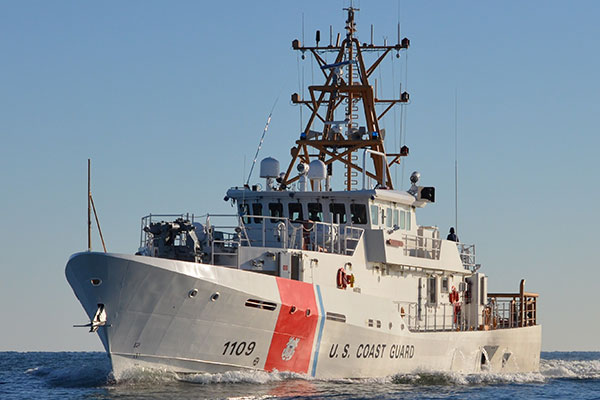
USCGC Kathleen Moore (WPC-1109), Don’t expect future WPCs to look much different.
In October 2015 I reported that the Coast Guard would be getting a new gun mount, the Mk38 Mod3, and at that time it appeared that the gun would be substantially different from the Mk38 Mod2 that was being mounted on the Webber Class WPCs.
–
DefenseMediaNetwork reports the Mk38 Mod3 offers a number of improvements over the Mod2 currently being fitted to the Webber class, including more ready ammunition on the mount (500 rounds vice 165), a coaxial .50 cal. gun (there was already a plan (pdf) to add a coaxial 7.62mm to the Mod2 version), higher elevation (75 degrees vice 40), better weather protection and serviceability, and the ability to simultaneously track up to three targets. There are also improvements to the search function of the ElectroOptic sensor that should make the system more useful in peacetime roles. They also report that BAE and Israeli manufacturer, Rafael, are considering adding the “Advanced Precision Kill Weapon System” APKWSII guided 70mm rocket system to the mount. In fact Israeli versions of this system already support surface to surface and surface to air missiles.
–
It now appears the only improvements will be in the electro-optics and in fact the gun mount itself will be identical to the Mk38 Mod2.
A data sheet on the Mk38 Mod3 indicates there is an option to add a coaxial 7.62mm chain gun with up to 750 rounds on the mount, but otherwise the mount is identical to the existing Mod2 installations, e.g., no greater elevation limits, no more ammunition on the mount, as already anticipated, no 30mm gun, and nothing regarding adding APKWSII guided rockets to the mount. There is no indication yet that the Coast Guard intends to add the 7.62mm machinegun to the mount.
“The Mk 38 MGS is a low cost, stabilized self-defense weapon system that dramatically improves ships’ self-defense capabilities in all weather conditions, day or night. Installed aboard 14 different classes of U.S. Navy ships and U.S. Coast Guard cutters, it is used extensively by the U.S. military as well as by NATO forces.
“A major upgrade to the Mod 3 is the system’s advanced electro-optical/infrared (EO/IR) sensor which provides 330-degree surveillance capability and three fields of view. The superior optics allow sailors to monitor the seas and respond to threats even in extremely low light conditions with the benefits of a low contrast, low light level color day camera and an eye-safe laser range finder. (emphasis applied–Chuck)
“While the EO/IR sensor system is integrated with the Mod 3’s state-of-the-art fire control system, the Mk 38 Mod 3 is unique from other naval weapons because its surveillance system moves separately from the gun system, preventing adversaries from easily knowing they have been detected.
“The Mk 38 Mod 3 also provides a range of 2.5 kilometers and selectable rates of fire from single to 180 rounds per minute, and fires all U.S. Navy-approved 25mm ammunition. It can be remotely operated from the combat information center or other protected ship structures, allowing operators to remain safe and out of harm’s way.”
I am disappointed that we will not see the additional improvements, but the improvements in the optics that make the system useful as more than a weapon system are certainly welcome.
We still really need a system on our WPBs and WPCs capable of forcibly stopping medium to large merchant ships with an effective range of at least 4000 yards.
This is old. It goes back to 1992, but if they knew the results here, it raises a question, why are we still equipping the Mk38s with 25mm guns instead of 30mm (or 35mm or 40mm) guns which also fit the same mount? The results are discussed beginning at time 8:00. The 30mm does nine times the damage to the hull and five times the damage inside the hull.
At the very least we need to make sure we have available rounds that do not detonate on impact. The 25mm rounds, exploding on impact, failed to even penetrate the 1/4 inch aluminum hull of the Mk3 target boat.
Israel Aerospace Industries IAI successfully test ship launch of LORA artillery missile
TheDrive reports that IAI (Israel Aerospace Industries) has successfully tested a long ranged (400 km/216 nautical miles) ballistic artillery missile launched from a container ship.
The missile is called LORA. LORA is a quasi-ballistic missile, meaning, it “has a low trajectory and/or is largely ballistic but can perform maneuvers in flight or make unexpected changes in direction and range.” It is advertised to both Armies and Navies and now has a man in the loop capability against moving targets (like ships). It is comparable to the US Army and Marine Corps’ ATACMS which has been upgraded to use against naval targets and is expected to be replaced by DeepStrike. Deepstrike will have greater range than 160km/86 nmile ATACMS (nearer the treaty limit for such weapons, or about 269 nautical miles) and will require only half the space of ATACMS, permitting four ready missiles on the M270 MLRS and two on the HIMARS launch vehicles.
There is already an indication that the next RIMPAC exercise will include an ATACMS launched from a ship against a ship.
Like most military developments these tactical ballistic missiles may be a blessing or a curse.
They might be used in a terrorist attack against the US, a potential new threat.
If we could call on Marine or Army units equipped with these missiles, they might be used to thwart a terrorist attack.
Coast Guard cutters might take them aboard as temporary, improvised. weapons or they might even be permanently installed in wartime.
It could give the Coast Guard the capability to deal with peacetime terrorist threats in the form of medium to large ships that I had hoped we could provide by using LRASM.
They might be used in a terrorist attack against the US:
Cruise missiles have already fallen into the hands of terrorist. We have seen them used against ships off Lebanon and Yemen. Use of ballistic artillery missiles from ships to land targets would not be much of a stretch. These small ballistic missile are not that different from cruise missiles in their support requirements. The LORA is claimed to require no maintenance for at least five years. Both cruise and ballistic missiles are now commonly truck mounted.
The US has basically no defense against cruise missile attack, and what little defense there is against ballistic missiles is targeted against ICBMs, not these shorter range missiles with their depressed trajectories and short time of flight.
If we could call on Marine or Army units equipped with these missiles, they might be used to thwart a terrorist attack:
Earlier we talked about the difficulties the Coast Guard would have dealing with any terrorist attack that might use a medium to large vessel as the attacking vehicle (here, here, here, and here) .
These weapons might provide a partial solution. At least some of the Army and Marine units armed with these missiles will spend time State-side.
With proper planning, equipment, training, and exercises we might be able to exploit the proximity of some of these units to provide a credible anti-ship capability.
A significant contributor to making this or other forms of cooperation with other military services possible would be to equip Coast Guard surface and air units with laser designators so we can make sure they pick out the right target.
Coast Guard cutters might take them aboard as temporary, extemporised weapons or they might even be permanently installed in wartime:
The option of loading Army or Marine Artillery rocket launchers on ships, including perhaps cutters and icebreakers may provide a quick upgrade.
During war-time, loading these rocket launchers on cutters, perhaps placing them on the flight deck, might be a way to provide more Naval Surface Fire Support or an anti-ship capability.
These tactical ballistic missiles might be particularly effective against the Russian or Chinese Navies that have had decades of effort developing countermeasures against sub-sonic, low altitude anti-ship missiles like the Harpoon, but have never had to deal with ballistic missiles.
If we find ourselves at war, adding several launchers to the flight-deck, might allow cutters to become dedicated Naval Surface Fire Support vessels (with an equally effective anti-ship capability).
Photo: LSM(R)-197 firing rockets at Okinawa, 1945.
It could give the Coast Guard the capability to deal with peacetime terrorist threats in the form of medium to large ships that I had hoped we could provide by using LRASM:
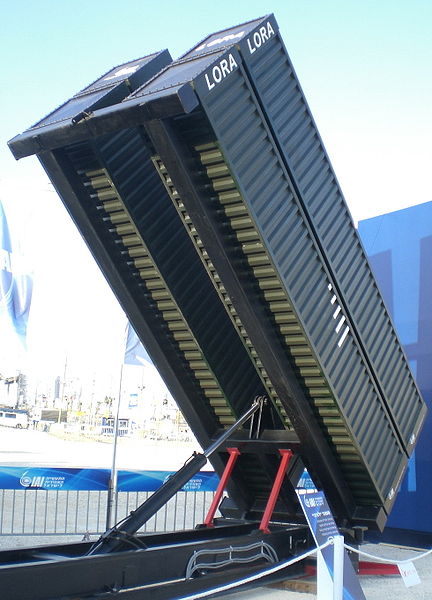
Photo: LORA missile launcher, 14 Sept. 2008, Hebrew Wikipedia, by Tal Inbar (טל ענבר)
Earlier I suggested that equipping our larger cutters with the LRASM missile might provide a means to deal with a medium to large vessel being used by terrorist. While the range and claimed precision of LRASM make it a good choice, the Deepstrike missile may be an alternative, assuming it also receives the ability to hit moving targets. While it isn’t clear that it is going to be accurate enough to target a ship’s propulsion, a penetrating warhead that comes in almost vertically, penetrates the ship from top, goes through the bottom and explodes below hull could be effective. The shorter time of flight of the ballistic missile would also be an advantage.
Another bit of extemporaneous weaponry was seen recently on an Egyptian LPD. These ships had been ordered by Russia from a French shipbuilder. Ultimately the French were convinced that building ships for Russia was not a good idea. Instead the two ships were sold to Egypt, but they never received the self-defense systems that would have come from Russia. NavyRecognition reports the vessel was seen with four Boeing AN/TWQ-1 Avenger short-range air-defense vehicles secured on deck as a stop-gap AAW system.
Boeing AN/TWQ-1 Avenger (fitted with Raytheon FIM-92 Stinger missiles) on the flight deck of the Mistral-class LHD Anwar El-Sadat (L 1020) during the joint French-Egyptian naval exercise “Cleopatra 2017”. Picture: Ministry of Defense of Egypt
India’s OPV mounted ballistic missiles. Really a test rather than an expediency but below you can see that the Indians have launched fairly large ballistic missiles from an Offshore Patrol Vessel.
“According to the German news site Kieler Nachrichten, the navy also plans to asses how asymmetric threats affect the ship. For these tests, the navy plans to use smaller weapons and rockets as they are used by terrorists and pirates.”
I hope we will get access to the results and will apply lessons learned to our new construction.




 Chuck Hill's CG Blog