“Coast Guard releases request for proposal for maritime unmanned aircraft system services” –CG-9

The unmanned aircraft sensor payload capability is varied based on the Coast Guard’s desired mission and search conditions: MWIR 3.5 is a mid-wave infrared for thermal imaging capability, for use at night or periods of low visibility; EO-900 is a high-definition telescopic electro-optical (EO) imager to zoom in on targets at greater distance; and ViDAR is a visual detection and ranging wide-area optical search system that is a comprehensive autonomous detection solutions for EO video. Courtesy Photo.

Below is a news release from the Acquisitions Directorate (CG-9). The solicitation is for Group 2 or 3 UAS.

The minimum performance specifications are not particularly demanding, including:

  • 50 knot cruise speed,
  • 70 knot dash speed,
  • 12 hours daily continuous coverage, but that could include two sorties,
  • Range 40 nmi in clear conditions, 35 nmi in light rain,
  • Operate from a flight deck 80 x 48 feet (Host Cutter drawings provided are for NSC, but also presumably OPCs. Not likely for icebreakers or Alex Haley because they have no air search radar, see below) within limits:  pitch +/- 3 degrees, roll +/- 5 degrees.
  • The UA must have space, weight, and power to concurrently operate vendor
    provided: Electro-Optical (EO) sensor, Infra-Red (IR) sensor, AIS, VHF/UHF
    communications relay, aeronautical transponder, and non-visible IR marker for
    the required flight endurance. (I found no minimum payload weight.)

There are some interesting specifications that may reflect how the systems are used.

  • The UA must provide a non-visible, near-IR marker or FDA approved illuminator to
    aid manned assets using NVDs for target acquisition at night
  • The UAS must be capable of operations in light icing conditions defined as
    accumulation of ¼ inch of ice in 15-20 minutes (Objective)(so not a minimum requirement–Chuck)
  • The UA must have an Infrared (IR) anti-collision lighting subsystem (providing a night visibility range of 3+ statute miles) producing energy emitted in a 360-degree pattern around the UA +30 degrees (above) and -30 degrees (below) the horizontal plane of the UA. The IR-light intensity must be at least of a Class B Night Vision Imaging System (NVIS) radiant intensity (NRIb) of 2.31 E -04 NRI. The Ground Control Station must have the capability to turn the IR anti-collision light on or off.
  • In addition to other sensor requirements identified in this document, when such a
    system is commercially available, the UA must be capable of incorporating a
    collision avoidance system (i.e. Detect and avoid (DAA) or Sense and avoid (SAA)
    systems) to extend the UA’s range beyond the host cutter’s air search radar
    envelope while maintaining compliance with international due regard. (Objective) (Not a minimum requirement. Meaning we will likely be operating these systems without a sense and avoid system, so will have to operate within the range of the cutter’s air-search radar. Also precludes operating these systems on vessels without an air-search until such a system is installed–Chuck)
  • At an operating altitude of 3,000 feet when the UAS is directly overhead of the target of interest (no slant range), the UA must be acoustically non–detectable per MIL STD-1474 (series), Level 1, requirements (quiet rural area with the closest heavily used highway and community noises at least 2.5 miles away)
  • The Contractor provided Datalinks must be capable of operating, with
    unobstructed Line of Sight (LOS), at a minimum range of 40 nautical mile
    (NM) (threshold) / 100 NM (Objective).

This sounds very much like a continuation of the Scan Eagle operations already being conducted on National Security Cutters (here, here, here, here, and here). Forgive me if I point out that I recommended we try this system back in 2011, five years before we actually did.


Coast Guard releases request for proposal for maritime unmanned aircraft system services

The Coast Guard released a request for proposal (RFP) Dec. 12 for maritime unmanned aircraft system (MUAS) services capable of deploying from Coast Guard cutters. The services sought are for contractor-owned, contractor-operated intelligence, surveillance and reconnaissance.

Requirements for the MUAS include fully automated flight operations, a minimum 12 hours of flight time a day, ability to be launched and recovered from the host cutter flight deck, and ability to provide services 24 hours a day, seven days a week. The MUAS must be capable of carrying a payload including electro-optical and infrared sensors and communications relay and be capable of providing surveillance, detection, classification and identification for all of the host cutter’s operational missions.

The Coast Guard plans to award one indefinite-delivery, indefinite-quantity firm fixed price contract. Initially, the contract will be used to continue UAS capability on the national security cutter (NSC) class; however, the contract could be used to support additional cutter classes in the future.

The full RFP is available here. Responses are due by 1 p.m. EST Jan. 11, 2024.

For more information: Unmanned Aircraft Systems Program page

“Head of Royal Canadian Navy Outlines Ottawa’s Pacific Strategy” –USNI

This is starting to get a little old, but I am trying to catch up.

US Naval Institute reports on a Center for Strategic and International Studies (CSIS) interview with Vice Adm. Angus Topshee, Commander, Royal Canadian Navy, Chief of the Naval Staff, that discusses their Navy’s increased emphasis on the Pacific.

I have included the video of the interview above.

Three AOPSs at pier before the commissioning ceremony for HMCS Margaret Brooke (AOPV-431). Canadian Navy photo

He discusses operating with the Coast Guard for drug interdiction, icebreaking, and fisheries beginning about time 9:00. The new Arctic Offshore Patrol Ships are expected to play important roles in these activities.

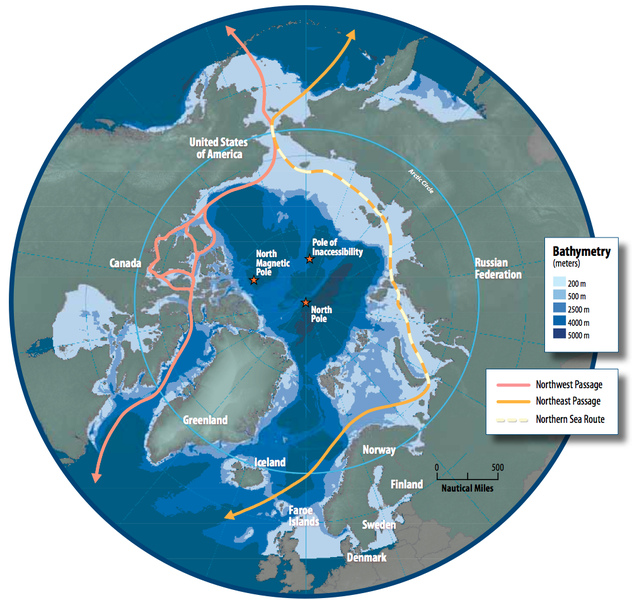
Map of the Arctic region showing shipping routes Northeast Passage, Northern Sea Route, and Northwest Passage, and bathymetry, Arctic Council, by Susie Harder

He explains why he does not see the NW Passage (which includes Alaskan waters) as a future international trade route (12:30).

He anticipates an end to the moratorium on fishing in the Arctic (14:30).

Discusses response to “Gray Zone” threats to undersea infrastructure (15:30).

Discussed war in Ukraine (19:00). Re sinking of Moskva, “Cruise missiles should not sink ships” (20:30). Drones (21:00). AI (24:50).

Where will they concentrate their efforts–Indo-Pacific (27:00). AOPS will be used for Fisheries in the Western Pacific.

Artic is an expeditionary theater, you have to bring everything with you, because there are no port facilities (29:00). Looking to create dual use facilities.

Recruiting (31:30). National Shipbuilding program (35:30), Technology sharing.

“Allies, partners tap into technology to monitor maritime domain” –Indo-Pacific Defense Forum

Winkel Tripel projection, WGS84 datum, central meridian : 150°E. Source Wikipedia Commons, Author: Eric Gaba

The Indo-Pacific Defense Forum reports,

“Maritime domain awareness (MDA) in the Indo-Pacific is moving from an abstract aspiration to a functional collective security approach for managing the region’s dynamic offshore spaces,” noted an April 2023 article in PacNet, a publication of Pacific Forum, a Hawaii-based foreign policy research institute. “Much of the cost-savings in maritime enforcement activities is due to emerging technologies including access to satellites that provide clearer and more accurate images, as well as artificial intelligence and big data platforms dedicated to vessel tracking, prediction, and anomaly detection.”

There are fusion centers in India, Singapore and Vanuatu. These fusion centers would be useful in wartime, but they are essentially a cooperative exchange of information among maritime law enforcement agencies. In addition to its importance in countering IUU and drug smuggling, better maritime domain awareness may give warning of a terrorist attack. Shouldn’t the US Coast Guard have a fusion center in Alameda under Pacific Area? Probably should be one on the West coast of South America too.

“Coast Guard cutter program’s third phase could see rematch between Austal, Eastern Shipbuilding” –Breaking Defense

Future USCGC Pickering (Image: Austal USA)

Breaking Defense Reports,

A senior Coast Guard officer overseeing the Offshore Patrol Cutter program indicated he’d be open to working with either Austal or Eastern Shipbuilding Group for the third phase of the program, potentially setting up a rematch between the two companies with billions of dollars in work on the line.

For the first time, this report seems to reflect a sense of urgency on the part of the Coast Guard procurement team,

“All I want is ships as fast as I can get them,” said Rear Admiral Chad Jacoby when asked about maintaining two shipbuilders for the Offshore Patrol Cutter Program.

It’s about time. Replacement of the WMECs has been dragged out about two decades longer than it should have been.

The current situation is that Eastern was awarded a contract with options for up to nine Offshore Patrol Cutters in September 2016.  That should have kept the company busy into at least 2026. Now it looks like they will not be finished with the first four before 2026. The program was seriously delayed at least partly due to a hurricane that hit the shipyard. Eastern asked for extraordinary relief and relief was granted in the form of higher prices and delayed delivery, but the Coast Guard decided they would only exercises options with Eastern for ships one through four. They embarked on a second competitive bid for up to eleven ships, 5 through 15 which was awarded to Austal in June 2022. That contract should keep Austal busy until 2032 with the last contract to be awarded (I believe) in 2029.

The Coast Guard now says the Offshore Patrol Cutter and Polar Security Cutter are the services highest priority programs, but it has taken too long for the OPC to become a priority. We should have been building them in parallel with the National Security Cutter, just as we built WHECs and WMECs in parallel in the 1960s. The National Security Cutters were funded at a rate averaging about one every two years, so there were several years after the first NSC was funded when no major cutter was funded. At the very least we should have at least been funding one in those years. We might have been able to fund two WMEC replacements in years when we were not funding NSCs. In fact, both programs should have been begun in the 1990s. Why didn’t we? Our operational analysis, contracting, and naval engineering staffs had been gutted and atrophied. We can’t let that happen again.

Phase 3? Are we talking about an award in the near future or perhaps as a follow on to Austal’s contract for OPCs #5 through 15, e.g. about 2030?

If phase 3 is in the near future, would Austal even be able to build additional ships while also completing phase 2? I don’t really think we are ready to award a contract for ten additional ships in the near future.

If phase 3 is to begin following the last Fiscal Year of funding for phase two (about 2030) then Eastern will no longer have a hot production line.

If it is not Eastern or Austal, in the two contracts so far, the contractor was expected to build do a detail design and then begin building one ship each year for the first three years and only then begin building two ships per year. I don’t think we want a third subclass. I don’t think we want to go back to funding a new detail design or funding only one ship per year. Other shipyards probably would not be competitive anyway since Eastern and Austal will have both gone through the learning curve and would have substantial advantages over competitors.

Take another look at Eastern’s Contract. 

If as I believe, we will not be ready to contract for ten more ships in the near future, but we don’t want to wait until after OPC#15 when Eastern’s production line will be cold, to award phase 3, there may be another option.

If we are now confident that Eastern is competent and competitive, maybe we could revisit and renegotiate the original contract to provide at least two and potentially up to five additional OPCs.

Thanks to Lee for bringing this to my attention. 

VTOL System for ScanEagle and RQ-21 / ScanEagle3

A new post from “The Drive,” “RQ-21 Blackjack Can Now Strike With Miniature Precision Munitions,” prompted me to take another look at Insitu’s line of Unmanned Aircraft Systems (UAS). The weapons dropped from the RQ-21 are GPS guided, so not of much use against the moving targets the Coast Guard is more likely to be interested in, but the vertical Takeoff and Landing (VTOL) system (also usable with ScanEagle) and the RQ-21 might be useful.

There are of course other competitive systems from other vendors that also might be worth considering but Insitu’s product line is familiar and representative of possible alternatives.

The Coast Guard is currently using Insitu’s ScanEagle UAS on the National Security Cutters. It is a handy size and has good endurance. New photos show that the design has been modified with a third, central vertical stabilizer added. Still, we might benefit from a more capable UAS.

The area a UAS (or any search aircraft) can cover, looking for a moving target, is a function of the speed of the target, the speed of the search aircraft, the effective sweep width of the sensors, and the duration of the search. Greater endurance, higher search speed and greater sweep width generally allow a greater search area.

Better sensors for greater search width or increased fuel for greater endurance may be possible if the payload of the UAS is increased. In addition to the current tailless ScanEagle, Insitu now makes a ScanEagle3 with separate tail surfaces that is claimed to be capable of carrying double the payload.

The RQ-21A is now a standard US Navy UAS. It is in many ways similar to ScanEagle, but it’s an upgrade in speed, endurance, and with its greater payload, potentially better search width without much increase in footprint.

Effective search radius of a UAS may also be limited by the range of its data link but there are ways to obtain much greater range if sufficient payload is available.


“Coast Guard Polar Security Cutter (Polar Icebreaker) Program: Background and Issues for Congress” –CRS, Updated Dec. 12, 2023

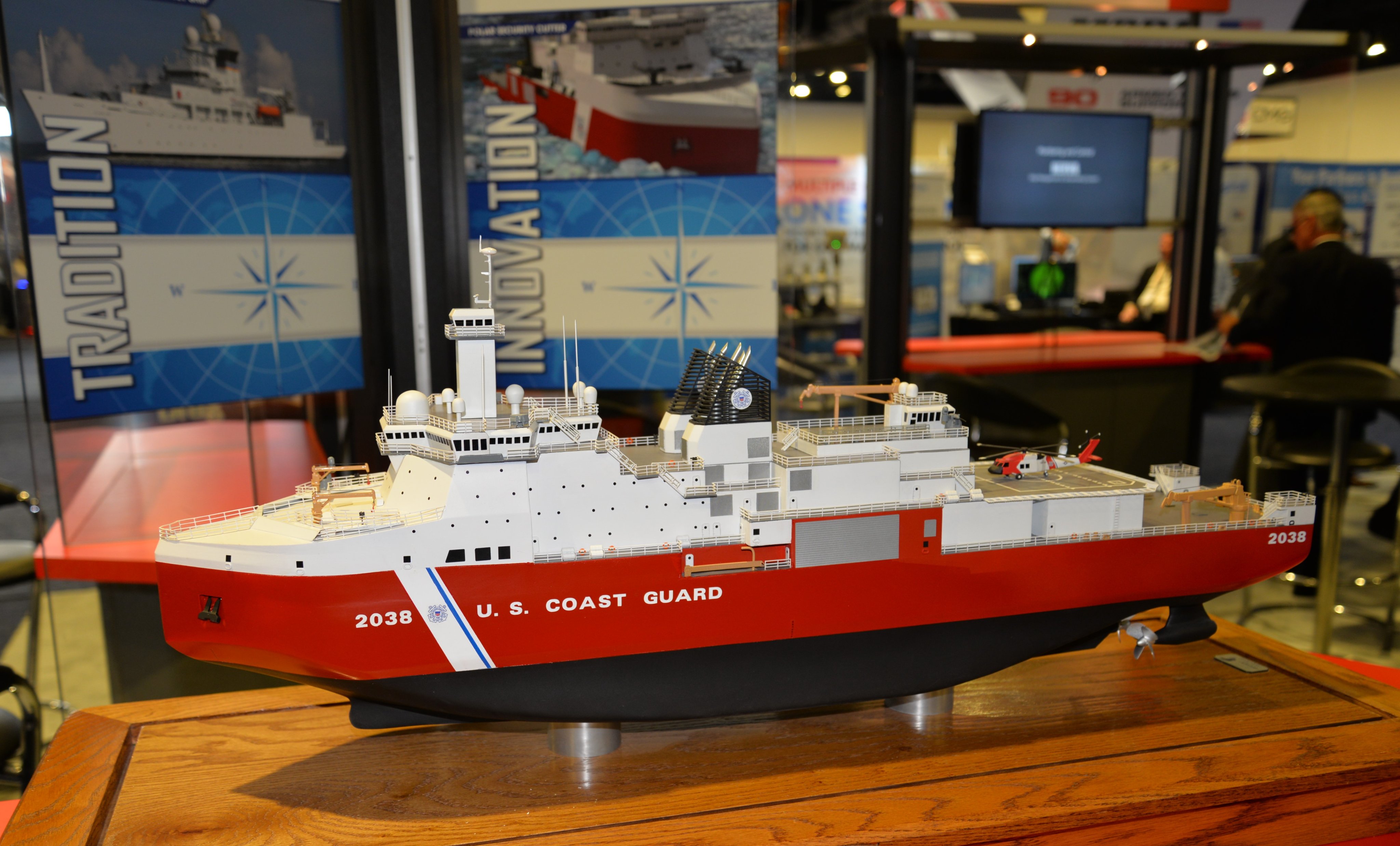
Photo of a model of Halter Marine’s Polar Security Cutter seen at Navy League’s Sea-Air-Space Exhibition have surfaced. Photo credit Chris Cavas.

The Congressional Research Service has once again updated their look at the Polar Security Cutter (heavy icebreaker) program. (See the latest version here.)

I have reproduced the one page summary below.

For me the most important new information is that somewhere there is a new Coast Guard Fleet Mix Study. It has not been made public, but I would sure like to see the results. The last one goes back to 2009. Ever since it was published. it has been an important part of every Congressional Research Service report on the cutter procurement plan and apparently, it has been expanded to include Icebreakers as well as patrol cutters and aircraft. It is an important planning tool. Let’s hope they don’t take three years to make it public like they did the last time.


Summary

Required number of polar icebreakers. The Coast Guard testified in April, June, and November 2023 that a new Coast Guard fleet mix analysis concluded that the service will require a total of eight to nine polar icebreakers, including four to five heavy polar icebreakers and four to five medium polar icebreakers, to perform its polar (i.e., Arctic and Antarctic) missions in coming years. Prior to this new fleet mix analysis, the Coast Guard had stated that it would need at least six polar icebreakers, including three heavy polar icebreakers.

Current operational polar icebreaker fleet. The operational U.S. polar icebreaking fleet currently consists of one heavy polar icebreaker, Polar Star, and one medium polar icebreaker, Healy. In addition to Polar Star, the Coast Guard has a second heavy polar icebreaker, Polar Sea. Polar Sea, however, suffered an engine casualty in June 2010 and has been nonoperational since then. Polar Star and Polar Sea entered service in 1976 and 1978, respectively, and are now well beyond their originally intended 30-year service lives. The Coast Guard plans to extend the service life of Polar Star until the delivery of at least the second Polar Security Cutter (PSC).

Polar Security Cutter (PSC). The Coast Guard Polar Security Cutter (PSC) program is a program to acquire at least three new PSCs (i.e., heavy polar icebreakers), to be followed at some later point by the acquisition of additional new Arctic Security Cutters (ASCs) (i.e., medium polar icebreakers). The Navy and Coast Guard in 2020 estimated the combined total procurement cost of the first three PSCs in then-year dollars as $2,673 million (i.e., about $2.7 billion). The procurement of the first two PSCs is fully funded. The Coast Guard’s proposed FY2024 budget requests $170.0 million in continued procurement funding for the PSC program, which would be used for procurement of long leadtime materials (LLTM) and government-furnished equipment
(GFE) for the PSCs, and for other program expenses. (GFE is equipment that the government purchases and then provides to the shipbuilder for incorporation into the ships.)

On April 23, 2019, the Coast Guard-Navy Integrated Program Office for the PSC program awarded a fixed-price, incentive-firm contract for the detail design and construction (DD&C) of the first PSC to Halter Marine Inc. of Pascagoula, MS, a shipyard that was owned by Singapore Technologies (ST) Engineering. On December 29, 2021, the Coast Guard exercised a fixed price incentive option to its contract with Halter Marine for the second PSC. In November 2022, ST Engineering sold Halter Marine to Louisiana-based Bollinger Shipyards. The former Halter Marine is now called Bollinger Mississippi Shipbuilding.

Commercially available polar icebreaker (CAPI). The Coast Guard’s proposed FY2024 budget also requests $125.0 million in procurement funding for the purchase of an existing commercially available polar icebreaker (CAPI) that would (be) modified to become a Coast Guard polar icebreaker, so as to help augment the Coast Guard’s current polar icebreaking capacity until the new PSCs enter service, and to continue augmenting the Coast Guard’s polar icebreaking capacity after the PSCs enter service.

Great Lakes icebreaker (GLIB). The Coast Guard’s proposed FY2024 budget also proposes to initiate a new procurement program for procuring a new Great Lakes icebreaker (GLIB) that would have capabilities similar to those of Mackinaw, the Coast Guard’s existing heavy Great Lakes icebreaker. The Coast Guard’s proposed FY2024 budget requests $55.0 million in initial procurement funding for the ship, whose total acquisition cost, the Coast Guard estimates, might be roughly $350 million, depending in part on the exact design that is developed for the ship. The Coast Guard’s FY2024 Unfunded Priorities List (UPL) includes an unfunded priority for an additional $20.0 million for the ship that would be used for accelerating initial procurement of LLTM for the ship.

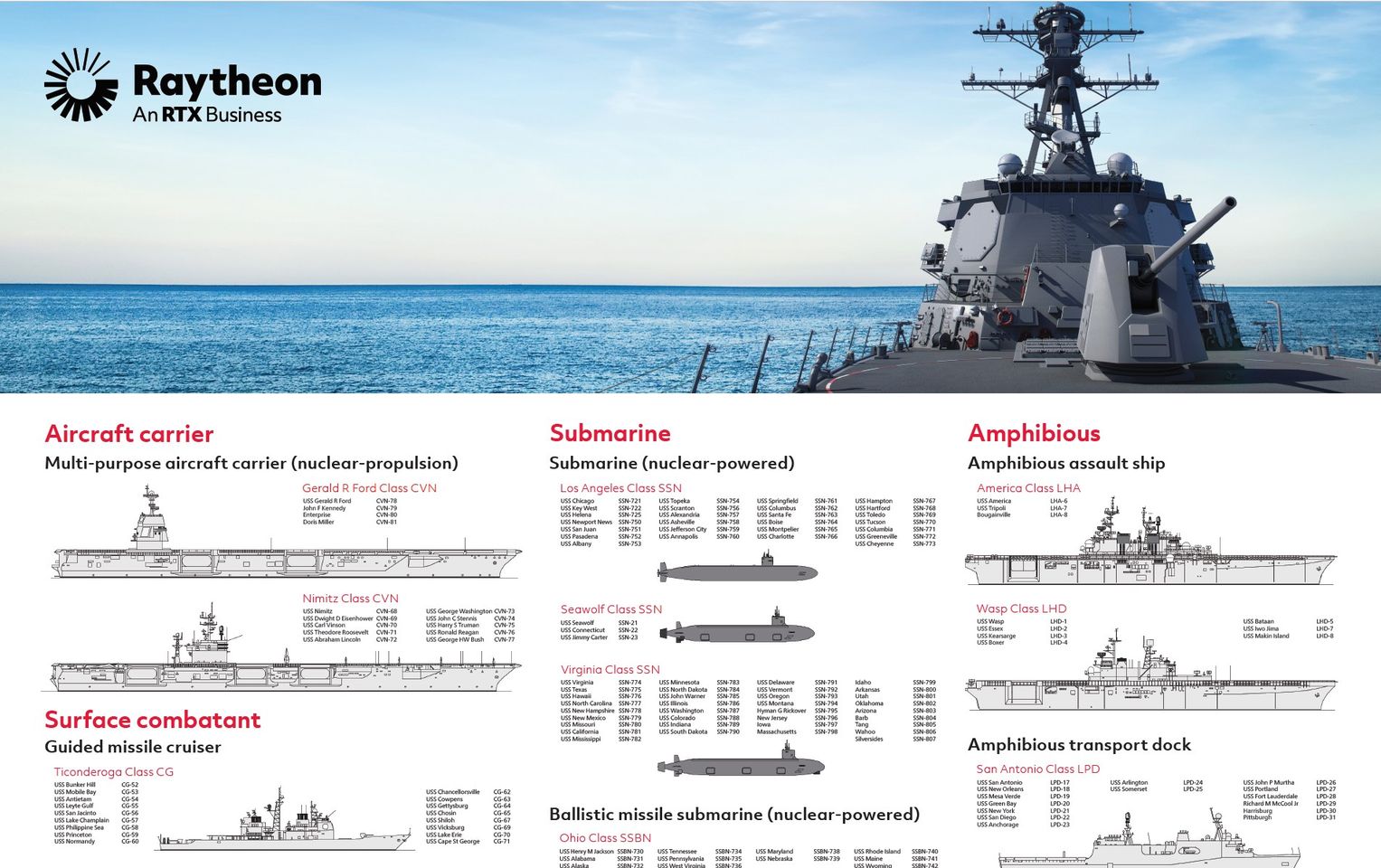
2023 Ships and Submarines of the US Navy –Infographic

Raytheon gives us an infographic of ships and submarines of the US Navy. You can load the full pdf. It is available at the bottom of this linked page that talks about the SPY-6 radars.

It may be somewhat misleading in that it includes ships that are not finished yet, like the Constellation class FFGs and vessels that have been decommissioned like the Cyclone class PCs.

Still, it may be useful.

Thanks to Tom for bringing this to my attention.

“U.S. Coast Guard Cutter Seizes Illegal Narcotics in Gulf of Oman” –NAVCENT

GULF OF OMAN (Dec. 12, 2023) Coast Guardsmen from the U.S. Coast Guard Sentinel-class fast response cutter USCGC Glen Harris (WPC 1144) seize illegal narcotics thrown over the side of the fishing vessel in the Gulf of Oman, Dec. 12. Glen Harris operates in the U.S. 5th Fleet area of operations to help ensure maritime security and stability in the Middle East region. (Photo by U.S. Coast Guard )

Below is a news release from U.S. Naval Forces Central Command Public Affairs. While apparently drugs were seized, there is no indication they seized the smuggling vessel nor arrested its crew. That seems surprising.


MANAMA, Bahrain —A U.S. Coast Guard ship seized illegal drugs worth over $6 million from a fishing vessel in the Gulf of Oman, Dec. 12.

Crewmembers from the Sentinel-class fast response cutter USCGC Glen Harris (WPC 1144) observed individuals on a fishing vessel throw seven bales of material over the side. The material was discovered to be 174 kilograms of heroin.

Glen Harris arrived in the Middle East region last year and operates from Naval Support Activity Bahrain.

The fast response cutter is part of a contingent of U.S. Coast Guard ships forward-deployed to the region under Patrol Forces Southwest Asia (PATFORSWA). PATFORSWA deploys Coast Guard personnel and ships alongside U.S. and regional naval forces throughout the Middle East.

“Unusual AC-130J Gunship Caribbean Training Video Released” –The Drive

As noted recently, there is increased tension in an area where the Coast Guard routinely operates. Also noticed that in a very unusual move, the US Navy expects to have a Carrier operating with 4th Fleet.

Now we have this report of another unusual exercise/demonstration.

Included in the report was this reference to the Coast Guard.

“Yesterday, U.S. SOF [special operations forces] carried out a joint training evolution in the Southern Caribbean which included elements from the Air Force, Navy and Coast Guard,” one post on December 8 on SOCSOUTH’s official account on X, formerly Twitter, read. “The event not only honed readiness and interoperability skills but also demonstrated capability and security for the region.”

It would not be unusual for the Coast Guard to play the opposition force in an exercise, but it may have been more than that. The US Naval Institute Fleet and Marine Tracker has stopped showing how many Navy ships are operating with each fleet, but normally. most of the available naval vessels in 4th Fleet are in fact Coast Guard.

Previous Guyana / Venezuela related posts: