“Royal Navy: Procession of US Coast Guard helicopters land on HMS Prince of Wales in ‘very rare’ event”

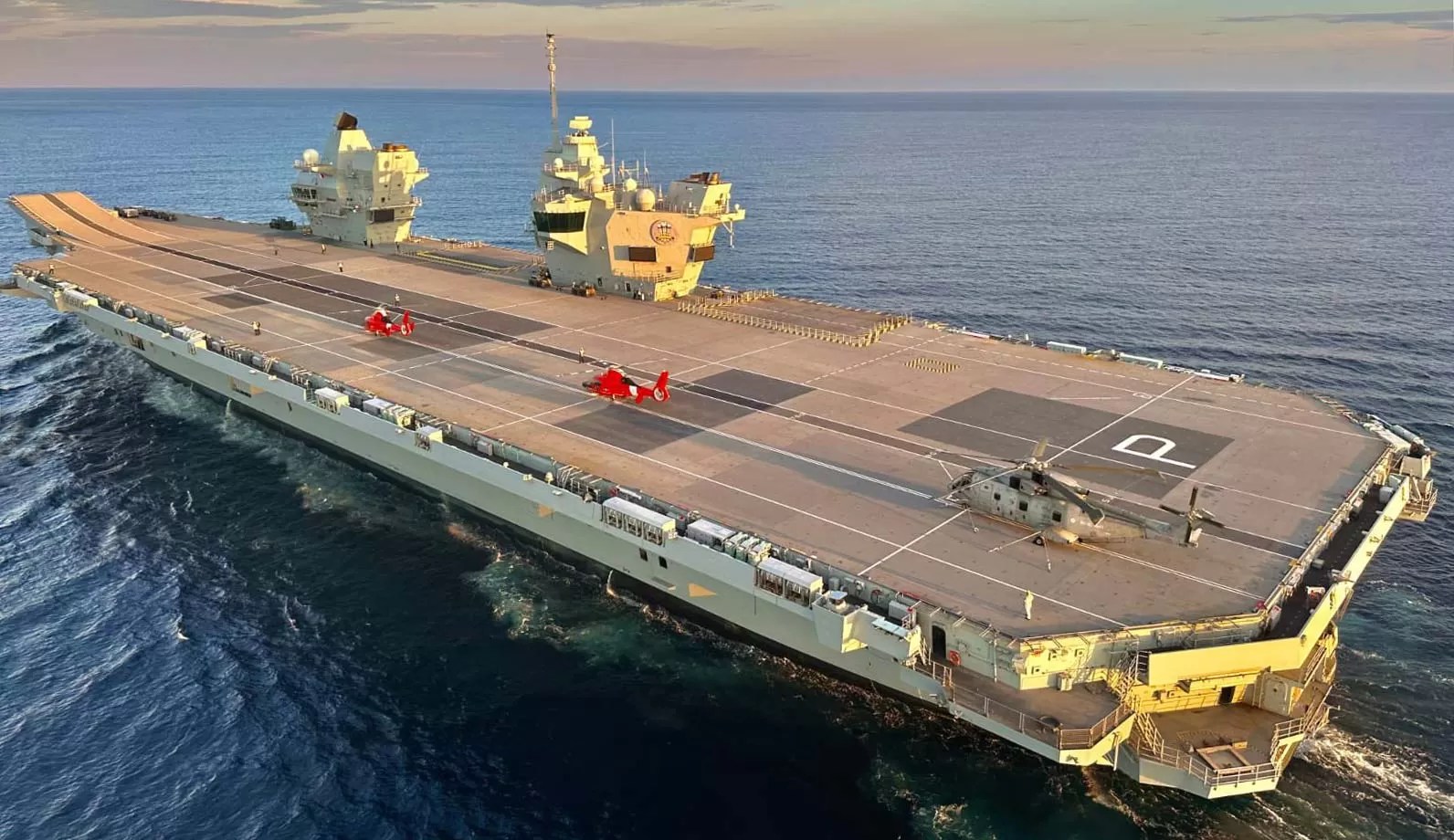
The News, Portsmouth, UK reports three Coast Guard HITRON helicopters landed on the Royal Navy aircraft carrier HMS Prince of Wales. The carrier has temporarily moved her homeport to Naval Station Norfolk.

The three photos below were added October 24, 2023. The came from this post on Navy Lookout, “HMS Prince of Wales crosses the Atlantic and begins developmental flying trials

MH-65E Dolphin helicopter helicopters embarked on 25th September 2023 off the coast of Florida – the first time US Coast Guard aircraft had landed on HMS Prince of Wales. The group were led by Lt Cdr Fleming, RN on exchange with the USCG’s Helicopter Interdiction Squadron (HITRON) based in Miami which usually operate from USCG cutters, tracking and stopping go-fasts smuggling narcotics. Royal Navy photo.

The Dauphin (The USCG call them Dolphins) are the same type of aircraft used by FOST teams under contract with Bristow helicopters. Royal Navy Photo.

Three US Coast Guard Dolphins conduct night flying from the carrier. Royal Navy photo.

Thanks to David for bringing this to my attention. 

Getting Real About the “Global Coast Guard” –USNI

210524-G-N0146-0073 ARABIAN GULF (May 24, 2021) – Patrol boat USCGC Maui (WPB 1304) and fast response cutter USCGC Robert Goldman (WPC 1142) transit the Arabian Gulf en route to Bahrain, May 24. Robert Goldman and USCGC Charles Moulthrope (WPC 1141) are the newest additions to Patrol Forces Southwest Asia (PATFORSWA), which is comprised of six 110′ cutters, the Maritime Engagement Team, shore side support personnel, and is the Coast Guard’s largest unit outside of the U.S. playing a key role in supporting Navy security cooperation, maritime security, and maritime infrastructure protection operations in the U.S. 5th Fleet area of operations. (U.S. Coast Guard photo by Seaman Logan Kaczmarek)

The October issue of US Naval Institute Proceedings has a “Nobody asked me, but…” commentary from Commander Kevin Duffy, U.S. Coast Guard (Retired), about making the Coast Guard’s international engagement more effective and more agile. Among the comments is an explanation of why we have not seen the PATFORSWA model replicated in other areas.

He recommends the Coast Guard:

  • Change its culture and messaging around international missions and engagement.
  • Grow overseas training teams and unchain them from DoD processes and funding.
  • Formalize and improve personnel policies related to overseas assignments, offices, and career paths.

Check out the post for more detail.

Survivable? “U.S. Navy Turns Away From Small Warships Despite Growing Demand, Tactical Relevance” –Forbes

USS Newcomb (DD-586), named after Revenue Cutter Service officer Frank H. Newcomb, who captained the cutter Hudson during the Spanish American War, was awarded eight battlestars, was struck by five Kamikazes off Okinawa, but survived.

Forbes has a recent post by Craig Hooper, about a topic close to my heart,

While small ships jostle in the South China Sea, the U.S. Navy is celebrating their departure from the messy business of managing small combatants. After shedding fourteen long-unloved Cyclone class (PC-1) coastal patrol ships, the Navy has effectively handed the responsibility for managing small ship operations, engagement and training to the already overtasked and poorly-funded U.S. Coast Guard.

I will interject here that while the Cyclone class were largely seen by “Big Navy,” which tends to be run by aviators (mostly fighter and attack aircraft types) and submariners, to be irrelevant, they were not unloved by those that sailed them. I have communicated with several former PC sailors, and they all loved them. They were also the busiest ships in the US Navy, being underway more than larger Navy ships, so apparently the fleet commanders found them useful.

Hooper says the Navy sees small ships as Unsurvivable. The US Navy has no surface combatants between the 44 foot patrol boats and the 3500 ton Littoral Combat Ships, and they are not really happy with the survivability of the LCS. I think the Navy knows they need a lot more ships and that some of them can be small. Not every ship needs to be able to do everything. They are talking about building more small ships, but mostly they will be unmanned.

A 2015 post addressed small warship survivability, but it appears we need to look at this again.

If the Navy thinks all small ships need to be unmanned because they are not survivable, I will point out that that reasoning is not supported by history. In fact, they have been misled by looking at only part of the survivability question, passive survivability.

Why was this?

Because the enemy gets a vote. They will expend much more effort looking for and attacking the major units. Yes, big combatants can take more hits, but they are also more likely to be hit, and can also expect to be hit more often.

No ship, no matter how large, is unsinkable, especially when the enemy sees it as their primary threat. Carriers in particular have a huge bullseye painted on their flight decks. Given the opportunity, every weapon will be pointed at them until they are all eliminated.

Whether a unit will survive depends on in part on its passive survivability, but also on its self-defense capability, the area defense capability of assets with them, where and how the asset is used, and particularly on how the enemy sees the asset. Is it an immediate threat? Is destroying it key to success?

Historic Context:

Looking at the figures I found researching for my earlier post.

The US fleet at the beginning of the war (WWII), it included 233 major surface combatants of which 46 or 19.7% were sunk by enemy action during the course of the war. If we break it down by type it looks like this:

  • Type: Number in Commission, Dec. 7, 1941 / Number sunk / % lost to enemy action
  • Aircraft Carriers (CV): 7 / 4 / 57.1%
  • Escort Carrier (CVE): 1 / 0 / 0%
  • Battleships (BB): 17 / 5 / 29.4% (of the 5 sunk, all were at Pearl Harbor, 3 were salvaged)
  • Cruisers (CA/CL): 37 / 8 / 21.6%
  • Destroyers (DD): 171 / 29 / 17%

Notably, Carriers had the highest loss rate. Battleships, surface combatants that should have been the most “survivable,” were the second most likely type to be sunk.

I don’t have similar figures across all major types like this for the Royal Navy and the Japanese Navy but a look at only their largest ships shows similar or higher loss rates.

Of the ships that the Royal Navy had in commission when they declared war on Germany in September 1939, four of 15 battleships and battlecruisers were sunk (26.7%), five of seven aircraft carriers were sunk (71.4%).

Of the ships that the Imperial Japanese Navy had in commission at the time of the Attack on Pearl Harbor in December 1941, 8 of 10 Battleships were sunk by enemy action (80%) (one was destroyed by a non-combat related magazine explosion) and nine of ten aircraft carriers (90%) were sunk. Their only surviving aircraft carrier was their oldest and smallest (probably least “survivable”) that had been used only as a training carrier.

Certainly, the British and Japanese experience offers nothing to suggest that larger, supposedly, more “survivable” ships are more likely to survive.

Small ships may not be priority targets.

As I noted in the earlier post, I will add a bit of anecdotal evidence. As part of Operation Overlord, the Normandy Invasion, 60 US Coast Guard 83 foot patrol boats were assigned to rescue those unlucky enough to find themselves in the water or sinking. 30 went to the American beachheads and 30 went to the British and Canadian beachheads. Being wooden hulled and gasoline powered, they certainly would not have been considered “survivable.” Apparently, they were in the thick of it, because they rescued 1438 men from the water and sinking craft. In spite of all the fire from shore, not a single boat was sunk and not a single crewman was killed. Apparently, the German gunners were too busy with the landing craft hitting the beach and the warships that were shelling them. They simply were not a priority target.

Some of the USN’s least survivable ships, 450 and 850 ton subchasers also suffered few losses. Combat losses for the PC-461 class built 1941-44 were miniscule (8 of 343, 2.3%here). For the PCE-842 class, all commissioned between 1943 and the end of the war, losses were non-existent (none of the 68 completed was lost, 0%here). 

Generally small ships don’t confront major of enemy forces alone. They are part of a fleet. Before the LCS got the Mine Counter Measures (MCM) mission, the US Navy’s MCM ships were the Avenger class. Some are still in commission. They had a wood and fiberglass hull and were armed with four .50 caliber machine guns. There was no great cry that they were not survivable. Fleet commanders are not stupid. If ships that are needed to do a job cannot defend themselves, then, crewed or uncrewed, they will be escorted and defended.

Not sunk but damaged:

Damage gets much less attention than sinkings, but many of the “more survivable” ships suffered serious but survivable damage that reduced their capabilities or took them out of the fight.

The two pre-war built fleet carriers that spent the War in the Pacific and survived were both seriously damaged more than once. Saratoga was torpedoed on two occasions and took four kamikaze hits and two bombs on another. Enterprise was hit by bombs four different times and by kamikazes on two others.

Because they are more likely to survive the many hits they are likely to take, the larger, “more survivable” ships are more likely to be out of the fight having their damage repaired, even if they do not sink.

Looking at the Essex class carriers, none of which were lost, only Essex was in commission by the end of 1942, but even she did not reach the Pacific until May 1943. Only seven were commissioned before 1944. Only 14 before 1945. In spite of this, ten ships of the class (CVs 9,10,11,13,14,15,16, 17,18, and 19) were hit on a total of 22 different occasions, CV-11 and CV-13 each five times. In most cases the damage was minor, but it does demonstrate the high priority the enemy placed on neutralizing them. At least in some cases the ships had to terminate combat to address the damage. USS Franklin (CV-13) and USS Bunkerhill (CV-17) had to return to the states to address extensive damage. It is a tribute to the mobile support provided at advanced bases that more time was not lost. 

All four USN fleet aircraft carriers that were sunk were hit by multiple torpedoes. Only two torpedoes hit Essex class carriers, only a single torpedo in each case, USS Lexington, in Dec 1943, that kept her out of action for three months, and USS Intrepid, in Feb 1944, that kept her out of action for seven months.

It appears that the difference between the loss rate of aircraft carriers sunk in the first year of the war (57.1%) and the Essex class during the last two years of the war (0%) had much more to do with improved defensive capabilities (radar, CICs, fighter direction, anti-aircraft guns and firecontrol, proximity fuses, etc.) than improvements in passive survivability.

All the Essex class carriers survived the war, but so did most of the less survivable ships, particularly if they did not see action until the last two years of the war as the Essex class did.

How about now?

In WWII the Navy had an extensive mobile repair and support team that allowed most damage to be corrected close to the scene of action without the long transits to and from yards in the continental US. They could drydock carriers and battleships in advanced bases like Ulithi.

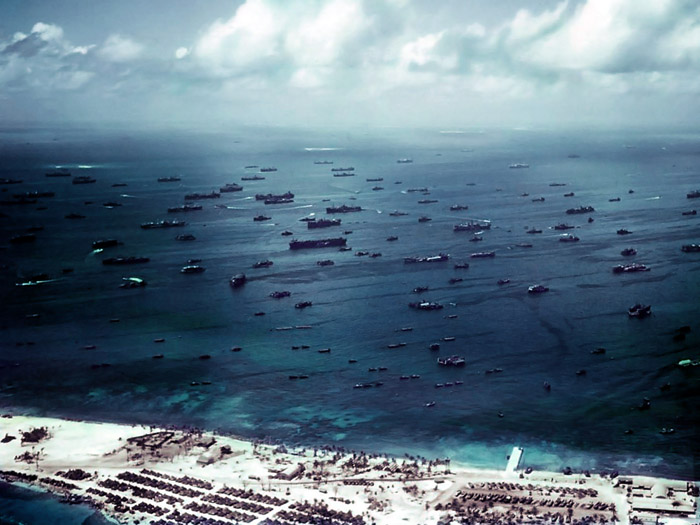
Ulithi Atoll north anchorage and Sorlen Island, late 1944.

Given our current shortage of major ship repair facilities in the US and the near total lack of the capability to quickly establish advanced bases, it is unlikely we would be able to return damaged ships, particularly large ones, to service as quickly as we did during WWII.

In short, smaller, less “survivable” ships that are less likely to be targeted and sunk or damaged and are more easily supported, are more likely to be available for combat operations than larger ships.

“USNI News Fleet and Marine Tracker: Oct. 2, 2023”

Royal Navy vessel HMS Spey (P234) (foreground) conducts coordinated ship maneuvers with U.S. Coast Guard Cutter Munro (WMSL 755) Sept. 17, 2023, in the South China Sea. US Navy Photo

Not much new in the US Naval Institute Oct, 2nd Fleet and Marine Tracker. Still only two Navy ships operating under 4th Fleet. I don’t expect that to change much if at all. With Jacksonville based LCS being decommissioned, it may actually get worse. But the Naval Institute did give us a couple of great photos.

USCGC Healy (WAGB-20) and the Norwegian Coast Guard Vessel Svalbard sail in formation while en route to conduct joint exercises in northern Norway in the Barents Sea. US Coast Guard Photo

USCGC Healy has a long way to go to get back to her homeport, Seattle. Incidentally Svalbard, like Healy has made it to the North Pole. In 2020, when Healy was having difficulty, Svalbard took over a mission for Healy.

“MSI Defence Systems to supply MK 48 Mod 2 EOS to US Navy & US Coast Guard” –Navy Recognition

MK48 Mod2 EOS MSI-DS Electro-Optical Sight System. (Picture source: MSI Defence Systems)

Navy Recognition reports,

According to information published by the US DoD on September 29, 2023, MSI-Defence Systems has been granted a contract worth $29,263,267 for the supply of the MK 48 Mod 2 Electro-Optical Sight (EOS).

This electro-optic system is associated with the 30mm Mk38 Mod4 gun weapon system.

30mm Mk38 Mod4

As far as we know, the first Coast Guard ships to get the Mk38 Mod 4 will be the Polar Security Cutters. I am hoping we will see the weapon on some of the Offshore Patrol Cutters.

I found it interesting that this contract provides not only for the Navy and Coast Guard but also the Military Sealift Command, because, currently, none of their ships have installed weapon systems.

“This initiative is in line with the enhancement of the MK 38 Mod 4 Machine Gun System, which will benefit the Navy, Coast Guard, and Military Sealift Command.”

Navy Integrated Combat System Includes Coast Guard

Defense News services has a post, “Lockheed wins $1.1B contract to design Navy’s Integrated Combat System,” that reports,

“The U.S. Navy awarded Lockheed Martin $23 million to begin creating the Integrated Combat System that may one day connect the Navy’s and U.S. Coast Guard’s surface fleets.”

There is a good background article from US Naval institute that came out in 2020.

This is an essential element of the Navy’s planned distributed operations. It should also facilitate interoperability with current and future users of the Aegis system including Australia, Canada, Japan, Norway, Spain, and South Korea.

The National Security Cutters already have the Aegis combat system which will evolve into the integrated systems.

I have seen no indication the OPC will share this system, but it certainly should. It is to be used on unmanned craft as well, so it could probably be scaled down to work on the Webber class FRC as well.

Shiprider Agreements Go Third Party, “THE CARIBBEAN Bahamas, Turks and Caicos Islands, and U.S. detain Haitian migrants in joint operation” –The Watch

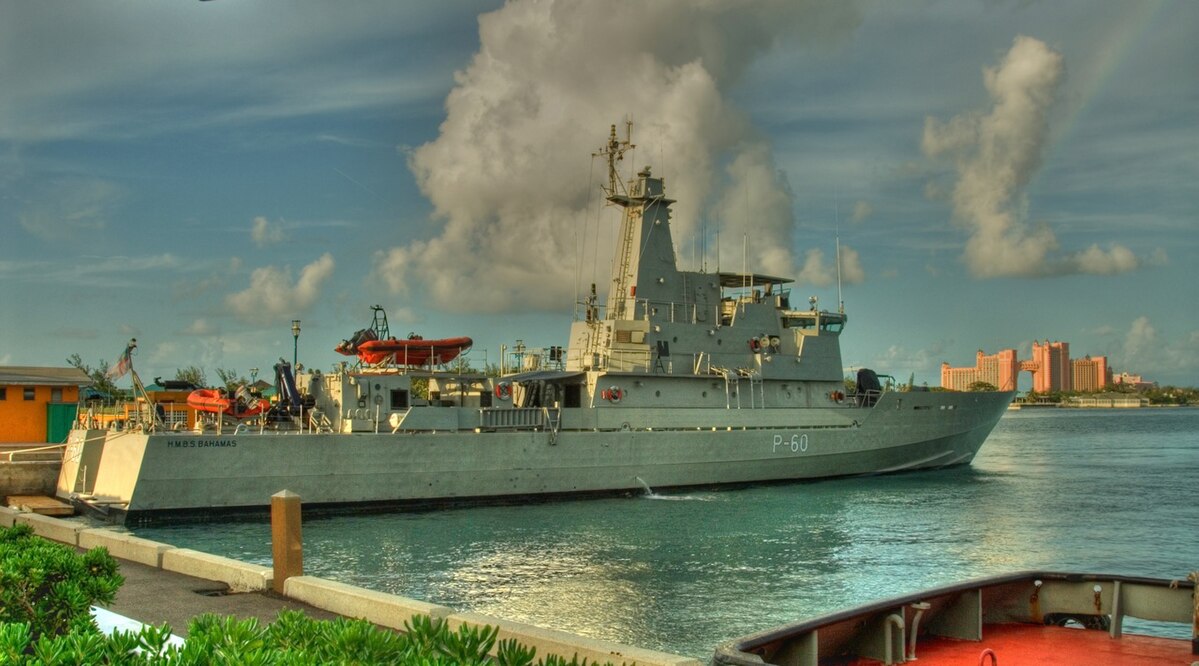
HMBS Bahamas (P 60). Photo credit: “FotoDawg”

USNORTHCOM’s online magazine, “The Watch” reports,

“The Royal Bahamas Defence Force (RBDF), operating jointly with the U.S. Coast Guard and Turks and Caicos Islands personnel, intercepted a ship with 145 Haitian migrants on August 13, 2023.”

What I found surprising here was this,

“The interdiction was the second since the Bahamas and the Turks and Caicos, a British Overseas Territory, signed a ship rider agreement in 2022. The pact allows law enforcement officials from one country to conduct operations on board the vessels of another for specific law enforcement purposes, according to an RBDF Facebook post.”

The Coast Guard, off course, has lots of these bilateral agreements, but this is the first I have heard about where the USCG was not one of the parties. Perhaps the model is spreading to other partnerships.

“US Coast Guard Cutter Forward returns home following 78-day deployment in the high northern latitudes” –News Release + Second Look at Harriet Lane

Below is a news release reporting an unusual 270 foot East Coast WMEC deployment including a high latitude multi-national exercise, deployment of a Navy Unmanned Underwater Vessel (UUV), enforcing fisheries on behalf of an international organization, hosting 40 international guests at the 2023 U.S.-Pacific Island Country Summit, and helping U.S. Navy’s Afloat Training Group Atlantic develop their Arctic training program. (Note–more photos at the link above.)

In the photo above and particularly at the end of this video of the homecoming, you can also see USCGC Harriet Lane (WMEC-903), second from the left in the photo, fresh from its Service Life Extension Program (SLEP) refit, with its Mk92 firecontrol removed and her 76mm Mk75 replaced by a 25mm Mk38 (presume she did not get the newer 30mm). I think I was mistaken earlier, in thinking her AN/SLQ-32 electronic warfare system had been removed. I believe I see it still installed on the video. Harriet Lane is expected to assume duties as a dedicated Central and Western Pacific asset in the near future.

Sept. 26, 2023

US Coast Guard Cutter Forward returns home following 78-day deployment in the high northern latitudes

PORTSMOUTH, Va. – The crew of the U.S. Coast Guard Cutter Forward (WMEC 911) returned to their homeport in Portsmouth, Tuesday, following a 78-day deployment in the North Atlantic Ocean.

Throughout the deployment, Forward supported the U.S. Coast Guard’s Arctic Strategy and partnered with allied nations and agencies during Operation Nanook 2023, an annual Canadian-led military exercise to strengthen maritime objectives in the high northern latitudes.

Alongside Canadian and French forces navigating the waters of the North Atlantic Ocean, Forward’s crew performed training evolutions including towing and formation steaming, replenishment at sea, visual communications tactical signaling, and cross-deck exercises. In addition, an attached team from Coast Guard Tactical Law Enforcement Team Pacific conducted a boarding exercise with French Navy vessel BSAM Garonne to demonstrate at-sea capabilities and assist in enhancing partner training curriculums.

During the deployment, Forward also completed two living marine resources enforcement patrols. The first was carried out in support of the First Coast Guard District’s living marine resources mission. The second, conducted alongside international partners, was focused on commercial fishing vessels inspections as part of the Northwest Atlantic Fisheries Organization. The NAFO fisheries patrol ensured compliance with international fishing norms while safeguarding natural resources and preserving fish stocks, all reinforcing U.S. dedication to combatting illegal, unregulated, and unreported fishing.

Forward collaborated with embarked U.S. Navy personnel from the Unmanned Undersea Vehicle Flotilla-1 team to launch their Razorback UUV. The undersea vehicle, equipped with mapping and sonar capabilities, deployed deeper than any U.S. Navy submersible and traveled to a depth of nearly 2,000 feet (600 meters).

Members from the U.S. Navy’s Afloat Training Group Atlantic were also embarked aboard Forward to help build their service’s Arctic Vision Initiative, which will serve to inform U.S. Navy training entities of seamanship, navigation, engineering, and medical considerations necessary for operating naval vessels in the polar regions.

Forward sailed more than 10,500 nautical miles while the crew liaised with international partners through a series of port calls. Forward visited Halifax, Nova Scotia, Canada, during their Natal Day celebration to observe the province’s birthday. Crew members then traveled to Nuuk, Greenland, and completed a short visit to St. John’s, Newfoundland, Canada, before transiting back to the United States.

Forward ended the deployment by hosting several Indo-Pacific heads of state who were participating in the 2023 U.S.-Pacific Island Country Summit in Baltimore, Maryland. Approximately 40 international guests joined Forward for a tour and reception ahead of the transfer of U.S. Coast Guard Cutter Harriet Lane (WMEC 903) to a Pacific Ocean homeport.

“We had the opportunity to advance objectives of the Arctic Strategy and support the IUU Fishing Strategic Outlook,” said Cmdr. Staci Rutsch, commanding officer of Forward. “Acting as true ambassadors, we represented the nation in diplomatic engagements with NATO partners, reinforcing U.S. interests and solidifying the USCG as being the partner of choice. This crew’s ability to shift to perform highly in our non-standard missions leaves me impressed and motivated every day.”

For information on how to join the U.S. Coast Guard, visit www.GoCoastGuard.com to learn more about active duty and reserve officer and enlisted opportunities. Information on how to apply to the U.S. Coast Guard Academy can be found here.

For more, follow us on FacebookInstagram and Twitter.

“Irish Forces Raid Bulk Carrier and Find ‘Significant Quantity’ of Drugs” –gCaptain

“Irish Forces Raid Bulk Carrier and Find ‘Significant Quantity’ of Drugs”

gCaptain reports, Irish forces forcibly boarded M/V Matthew and found drugs.

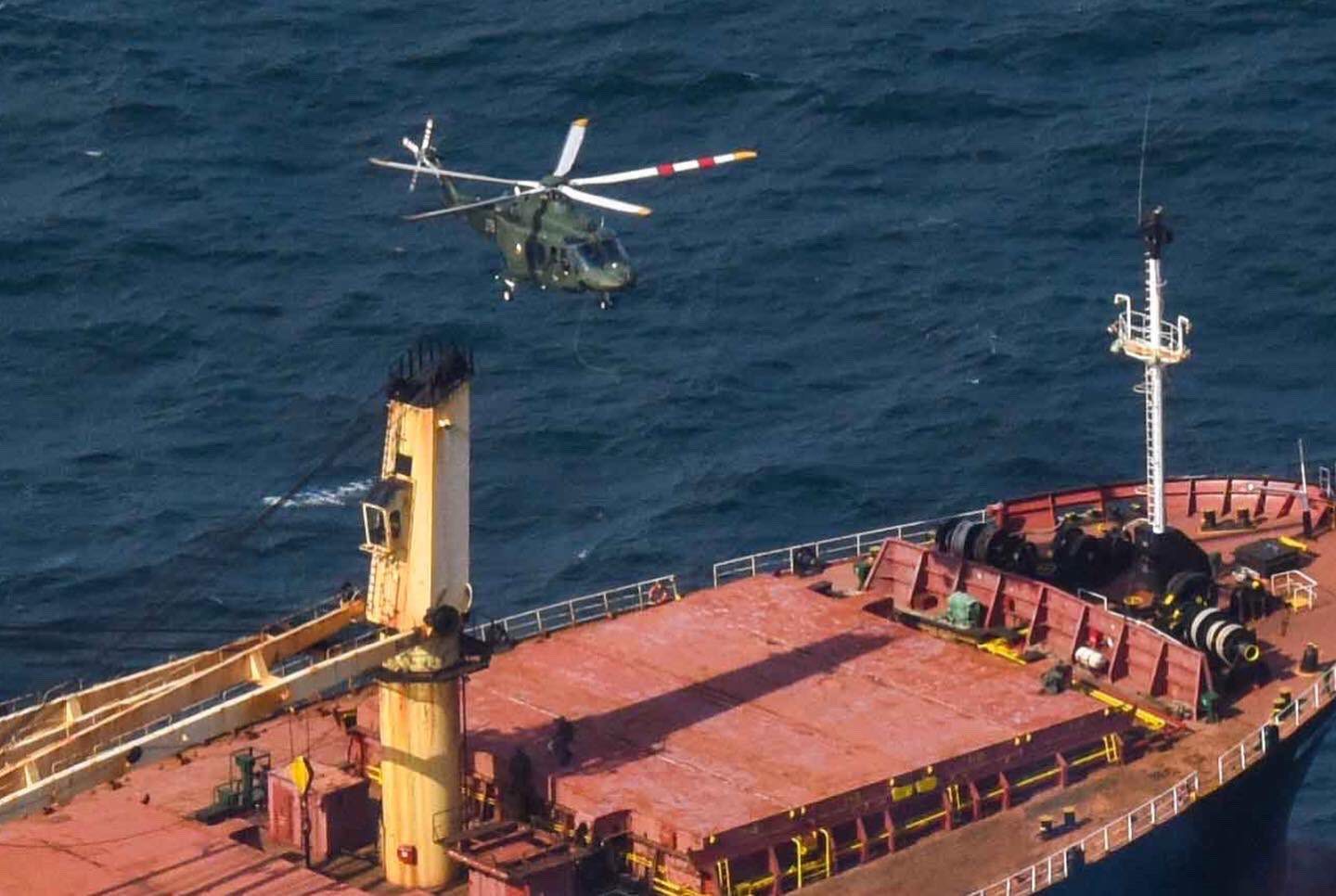
Found it interesting how little detail there is in this story. Did the boarding party fast rope down? Did the helo land? The accompanying video only shows the helicopter hovering nearby. No indication of the type of quantity of drugs.

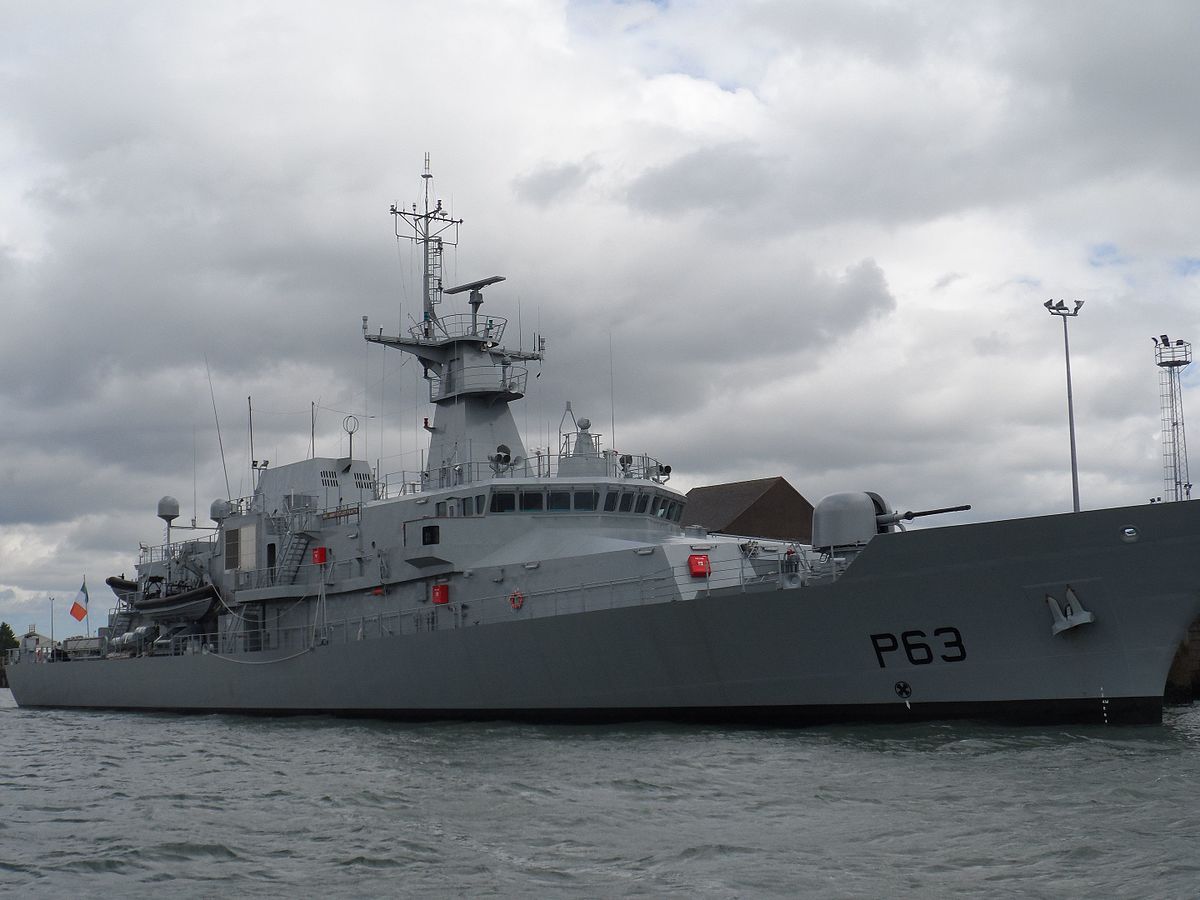
Offshore Patrol Vessel LÉ William Butler Yeats reportedly fired warning shots.

(Much more information in the comments below.)

LÉ William Butler Yeats in Cobh harbour. 24 July 2016. Photo credit Debbiesw

A-10 Attack Aircraft Drilled with PATFOSWA Cutters

A-10 Thunderbolt II Canon, McChord AFB, Washington. Photo credit. mrkoww@gmail.com

The US Naval Institute news service published a report on Sept. 25, 2023, “2 A-10 Warthogs Drill with U.S. Destroyer in Middle East Maritime Exercise.” Interestingly the story also recounted previous instances where A-10s were used in the Maritime environment, including the following,

“On April 28, a U.S. Navy P-8A Poseidon patrol aircraft, two Air Force A-10 Warthogs and three U.S. Coast Guard cutters with embarked U.S. Marine Corps joint terminal attack controllers, trained together in the Persian Gulf.”

The three cutters would have been three of the six 154 foot Webber class cutters assigned to Patrol Forces Southwest Asia (PATFORSWA).

USCGC John Scheuerman (WPC-1146) and USCGC Clarence Sutphin Jr. (WPC-1147) enroute PATFORSWA

You can draw your own conclusions about what this means for how the cutters will be used if there are hostilities with Iran, but I will offer my thoughts.

Iranian swarm tactics provide a “target rich environment,” but those targets are not of equal importance. What the A-10s would see on their own would be very confusing. Priority targets could include command ships, drone carriers, and boats armed with cruise missiles and torpedoes, before taking on the much more numerous vessels armed with only machine guns and unguided rockets that provide a screen for the more important vessels.

The cutters could provide reference points, forward observation posts, from which the P-8 and Marine terminal attack controllers could point the A-10s to the highest priority targets.

Hopefully the Marines would also bring along some extra firepower to defend the cutters as well.

Camera drone’s-eye view of IRGC boats on display, March 2023. A) The air defense boat. B) Light missile boat with Bladerunner hull. C) light missile boats on Interceptor hull. D) light missile boats on Interceptor hull (alternative design). E) Missile boat, with type of missile unclear. F) RIB, possibly explosive boat or uncrewed. G) RIB with lightweight anti-ship torpedoes, can be carried aboard a Shahid Soleimani-class missile corvette. H) Interceptor boat. I) Interceptor boat with new type of missile.