Enlistment Bonuses and other Incentives: ALCOAST 281/23 – AUG 2023 UPDATE 5 – FY23 WORKFORCE PLANNING TEAM RESULTS – ENLISTED MONETARY INTERVENTIONS

Cutter from GI Joe (Hasbro)

I am just passing this along for any who might be interested or know someone who could be. I did do some reformatting to accommodate this platform. Hopefully I did not introduce any errors.

Subject: ALCOAST 281/23 – AUG 2023 UPDATE 5 – FY23 WORKFORCE PLANNING TEAM RESULTS – ENLISTED MONETARY INTERVENTIONS
Reply-To: uscoastguard@service.govdelivery.com

united states coast guard

R 032020Z AUG 23 MID120000346223U
FM COMDT COGARD WASHINGTON DC
TO ALCOAST
BT
UNCLAS
ALCOAST 281/23
SSIC 7220
SUBJ: UPDATE 5 – FY23 WORKFORCE PLANNING TEAM RESULTS – ENLISTED
MONETARY INTERVENTIONS

A. COMDT COGARD WASHINGTON DC 211940Z OCT 22/ALCOAST 403/22
B. Military Bonus and Incentive Programs, COMDTINST 7220.2A
C. 37 U.S.C. – Pay and Allowances of the Uniformed Services
D. Performance, Training and Education (PTEM) Manual, COMDTINST 1500.10D
E. Enlistments, Evaluations, and Advancements, COMDTINST M1000.2C
F. Coast Guard Medical Manual, COMDTINST M6000.1F

1. This ALCOAST announces an update to the results of the FY2023 Military Workforce Planning Team (MWPT). Specifically, this ALCOAST authorizes additional Enlistment Bonuses (EB) and Critical Skills Training Bonuses (CSTB) and increases authorized bonus amounts for specified rates.

2. These policy interventions are applicable to eligible candidates and enlisted active duty members. The bonus offerings in this ALCOAST are for FY2023, effective immediately. All authorized FY2023 interventions terminate on 30 Sep 2023. The EB and CSTB maximum amounts listed in paragraphs 3 and 4 of this ALCOAST supersede their respective maximum EB and CSTB amount listed in REF (A).

3. ENLISTMENT BONUS (EB). An EB is authorized for new recruits enlisting in the Coast Guard for the first time. Each EB is mutually exclusive and cannot be combined with any other EB.
a. Guaranteed A School Enlistment Bonus (GA-EB). A GA-EB is authorized for new recruits, for their first career enlistment, that sign an agreement to attend one of the following critical rating Class A-Schools immediately upon graduation from boot camp. Prior service applicants are not authorized a GA-EB. Applicants agree to enlist and satisfactorily complete a minimum of four years of Active Duty Service Commitment (ADSC) and abide by all requirements and eligibility qualifications of REF (B) and Section 331 of REF (C) to earn a GA-EB entitlement.
(1) Operations Specialist (OS). A $40,000 EB is authorized for OS applicants to enlist.
(2) Electricians Mate (EM). A $20,000 EB is authorized for EM applicants to enlist.
(3) Electronics Technician (ET). A $65,000 EB is authorized for ET applicants to enlist.
(4) Gunners Mate (GM). A $20,000 EB is authorized for GM applicants to enlist.
(5) Machinery Technician (MK). A $20,000 EB is authorized for MK applicants to enlist.
(6) Damage Controlman (DC). A $20,000 EB is authorized for DC applicants to enlist.
(7) Culinary Specialist (CS): A $65,000 is authorized for CS applicants without a degree or certificate to enlist.
(8) Culinary Specialist (CS): A $70,000 EB is authorized for CS applicants with a qualifying culinary certificate to enlist as an E-3.
i. A qualifying culinary certificate is defined as a culinary arts certification from an institution accredited by the American Culinary Federation.
ii. The culinary certificate must be verified by the CS RFMC.
iii. CS members who acquire a culinary certificate after completion of CS Class A-School and members in the Regular Coast Guard who acquire or hold a culinary certificate are ineligible.
(9) Culinary Specialist (CS): A $75,000 EB is authorized for CS applicants with a qualifying culinary degree to enlist as an E-3.
i. A qualifying culinary degree is defined as an Associate of Arts (AA) or Bachelor of Arts (BA) degree in culinary arts from an accredited academic or culinary institution.
ii. The culinary degree must be verified by the CS Rating Force Master Chief (RFMC).
iii. CS members who acquire a culinary degree after completion of CS Class A-School and members in the Regular Coast Guard who acquire or hold a culinary
degree are ineligible.

4. CRITICAL SKILLS TRAINING BONUS (CSTB). A CSTB is authorized for current active duty enlisted personnel who agree to attend and complete Class A-Schools below in subparagraphs (b) – (h), or in the BM Rating Apprenticeship Program (RAP), and agree to extend their enlistment upon graduation to meet obligated service IAW
REF (D).
a. General eligibility requirements:
(1) All CSTBs incur a four (4) year Active Duty Service Commitment (ADSC) from date of Class A-School graduation, advancement to pay grade E-4 through the BM RAP, or receipt of designator, whichever is later. Applicable contract extensions must be executed upon graduation of Class A-School, advancement to E-4 through BM-RAP, or receipt of designator to meet the minimum obligated service requirement;
(2) Members must abide by all requirements and eligibility qualifications IAW REF (B).
(3) Members may not receive a CSTB if they have signed a contract (annex) to receive a GA-EB for the same rate;
(4) Members who qualify for a CSTB, but received an EB, will receive the computed difference between the CSTB and EB;
(5) Members must continuously meet all performance and conduct
standards including additional reenlistment criteria as outlined in REF (E). Members who are eligible to extend are eligible to receive a CSTB; and
(6) Members must apply for the bonus by completing and submitting the Bonus Agreement listed in Paragraph 5.a. of this ALCOAST.
b. A $65,000 CSTB is authorized for CS Class A-School.
c. A $20,000 CSTB is authorized for DC Class A-School.
d. A $20,000 CSTB is authorized for MK Class A-School.
e. A $65,000 CSTB is authorized for ET Class A-School.
f. A $20,000 CSTB is authorized for GM Class A-School.
g. A $40,000 CSTB is authorized for OS Class A-School.
h. A $20,000 CSTB is authorized for EM Class A-School.
i. A $40,000 CSTB is authorized for BM RAP. To be eligible, a member must hold a current Boat Crew certification on any platform (except punts, skiffs, and ice rescue boats). Commands of new prospective applicants who meet the requirements must submit an A-school request form selecting BM RAP.

5. ADMINISTRATION.
The only approved Bonus Agreements to be used per this ALCOAST are as follows:
a. GA-EB: CG Form 7220A (revised Jun 2022 or later).
b. CSTB: CG Form 7220D (revised Aug 2022 or later), “Critical Skills Training Bonus.”
c. CSTB BM RAP: CG Form 5305G (revised Sep 2022 or later), “Enlistment Bonus: Boatswain Mate Rating Apprenticeship Program.”
d. All authorized forms are located at:
(Copy and Paste URL Below into Browser)

https://www.dcms.uscg.mil/ppc/pd/forms/

e. Members must maintain physical and medical standards for continuous retention IAW REF (F).
f. Members considering appointment to the warrant or officer corps may still enlist, re-enlist, or extend their contract in one of the above mentioned ratings without electing to receive a bonus.
g. The Pay & Personnel Center (PPC) receives a high volume of bonus questions and submissions. Unanswered questions must be routed through the member’s SPO before engaging PPC. Payments may take up to two (2) months from the date a member’s SPO has submitted a trouble ticket to PPC. Refrain from contacting PPC
about a bonus until two (2) months have elapsed from a trouble ticket’s submission date. If it is not known whether a ticket has been submitted, designated yeoman should contact PPC Customer Care for investigation. If no ticket is active, submit a trouble ticket with appropriate bonus documentation.
h. COs and OICs are reminded that all members who agree to obligate service and are within the FY of their end of enlistment, or within the FY of their six (6) and ten (10)
year active duty anniversary date will: (1) be counseled on their SRB eligibility; (2) have the opportunity to read REF (B) in its entirety; and (3) sign the appropriate Administrative Remarks, Form CG-3307, for their record.
i. Eligible members are reminded that they ultimately decide the length of contractual obligation and actual date of reenlistment. A reenlistment requires the member’s signature acknowledging they have read and understood the terms of the contract and have had all questions answered to their satisfaction.
j. Members who previously signed contracts IAW REF (D) are prohibited from canceling their existing contract to sign a new contract to meet the requirements of this ALCOAST.
k. Members who were counseled about their SRB eligibility and signed an Administrative Remarks, Form CG-3307, entry IAW REF (D), but have not signed a reenlistment contract, are eligible to receive a bonus in accordance with this message. Members must still meet the remaining requirements of this ALCOAST and REF (B).
l. For questions, members should contact their unit counselors (typically the Command YN/CMC/SCPO/MCPO) well in advance of their reenlistment or extension date. Additional sources of information include servicing personnel officers, work-life staff, and senior Yeoman. For questions that cannot be answered after exhausting all of the above resources, the designated administrative support representative for that specific unit may contact COMDT (CG-133) at: HQS-PolicyandStandards@uscg.mil.
m. Special Assignment Considerations: Members in critical ratings are encouraged to apply for special assignment opportunities; PSC-EPM will work within each rating to ensure a proper balance is achieved between special assignments and rating needs.

6. Questions regarding this ALCOAST may be directed to Office of Military Personnel Policy (CG-133) at: HQS-PolicyandStandards@uscg.mil.

7. This message will be cancelled on 01 OCT 2023.

8. RADM M. W. Raymond, Assistant Commandant for Military Personnel
(CG-1M), sends.

9. Internet release is authorized.

“Northern Fleet ship seriously damaged in drone attack” –The Barents Observer

The Barents Observer provides the most complete report I have seen on a recent attack on a Russian Landing ship (LST). It identifies the ship as the Olenegorsky Gornyak, a Ropucha-class landing ship. It was in serious danger of sinking because a vehicle deck stretches the length of the hull.

I think this type of threat may be something the Coast Guard may want to seriously consider since the Coast Guard is the likely agency to defend against it.

A few comments on the conduct of the attack. It was a night attack. It would be interesting to know if the moon was down when the attack was made. It appears there was a lot of light coming from the bridge of the target ship that may have adversely effected night vision. The UAS appears to have used a slow approach, which would have been less likely to attract attention than a high-speed approach, which would have left a phosphorous wake. The target vessel appears to have been unaware of the approach. I see no defensive fire from the target vessel. The target vessel appears to be stopped or moving very slowly because, when the USV steadies up, there is little or no bearing drift.

“GAO: Polar Security Cutter Design Won’t Complete Until 2024, Delivery of First Hull Estimated in 2028” –USNI

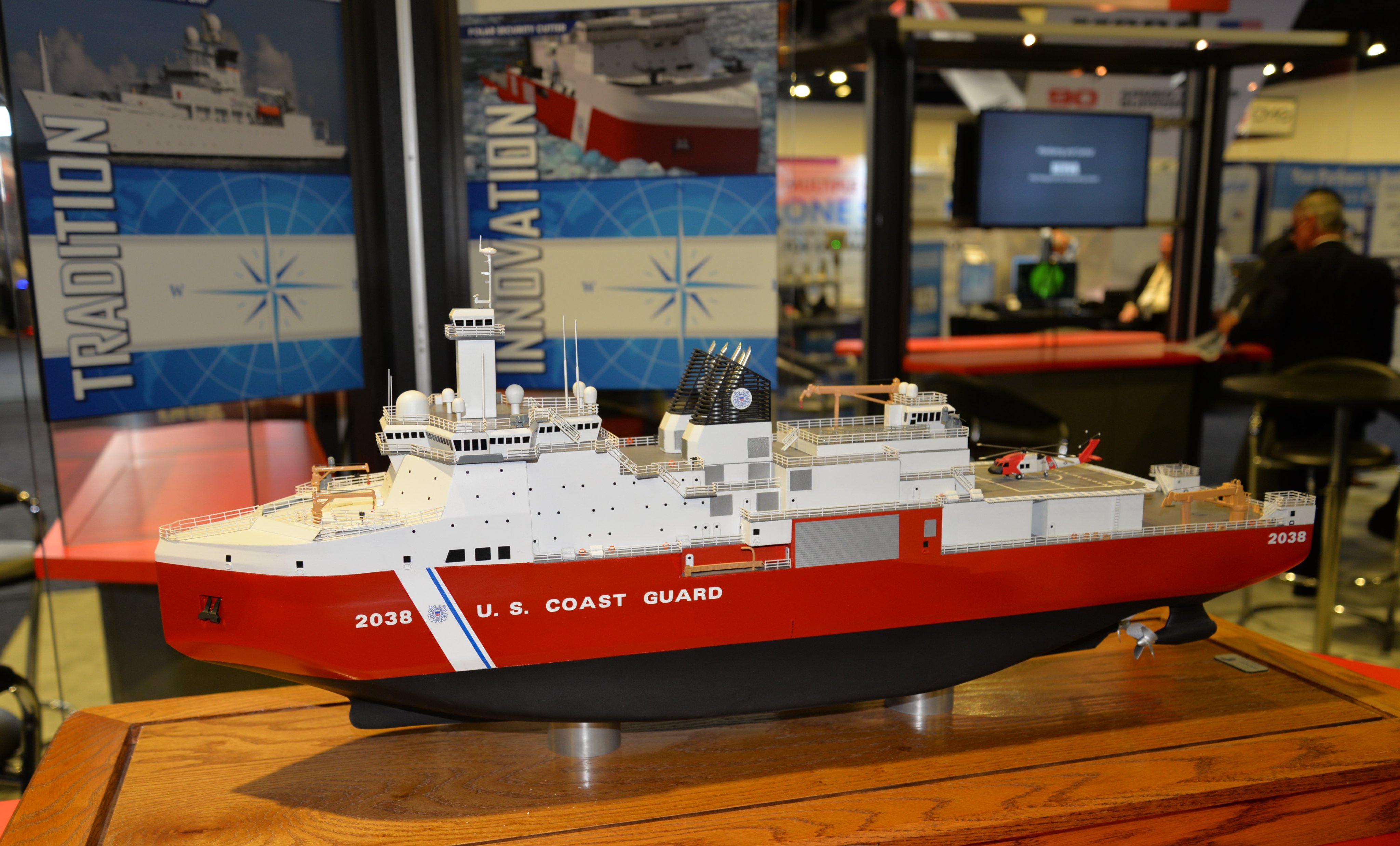
Photo of a model of Halter Marine’s Polar Security Cutter seen at Navy League’s Sea-Air-Space Exhibition have surfaced. Photo credit Chris Cavas.

The US Naval Institute news service reports,

According to the estimate from GAO, which cites Coast Guard and Navy officials, as well as shipbuilders – the final design for the 23,0000-ton ice breaker won’t be complete until next March. Construction is scheduled to start shortly after the design is approved. Coast Guard commandant Adm. Linda Fagan told Congress last month that the delivery of the first hull is expected in 2028.

This goes back to the fact that while the Polar Security Cutter was supposed to have been based on a proven design of a successful icebreaker, in fact the selected shipyard used a design that never got past the preliminary design stage.

But really, the problem goes back much further than that.

Polar Star was commissioned in 1976. A new class of ships typically takes ten years from concept to commissioning. 30 years is a generally expected lifespan for military ships. That suggests the program to replace the Polar class should have begun in 1996. Not even close. A replacement program was not initiated until 2012. By then the High Latitude Study had identified the need for three heavy and three medium icebreakers in 2010. Launching the Polar Security Cutter (PSC) program in 2012 should have given us an icebreaker in 2022. In 2016 a Polar Icebreaker Operational Requirements Document was issued. Arguably the High Latitude Study should have simultaneously launched both a heavy and a medium icebreaker procurement program.

13 years after the High Latitude Study identified the need, we have seen no movement in an effort to procure medium icebreakers.

In the movie “King Richard,” about Richard Dove Williams Jr., father of tennis players Venus Williams and Serena Williams, he is quoted as saying, “If you fail to plan, you plan to fail.”

This was not a problem with Congress.

We have failed to plan.

The only fleet mix plan we have ever done is now 12 years old. In the interim, much has changed.

There is not now, nor has there ever been, a 30 year ship building plan or any kind of comprehensive long range plan comparable to the Navy force structure and shipbuilding plans which the Navy revises every few years.

The first National Security Cutter was ordered in 2001 but was not commissioned until 2008. The first four were commissioned at essentially two year intervals, but even after that, it has taken nine years to complete next six. Looks like the eleventh ship will not be finished until 2025. When the first Hamilton Class WHEC was decommissioned, it was 44 years old. When the last one was decommissioned, it was almost 50 years old.

The Coast Guard currently has 27 WMECs, every single one of them is over 30 years old. 14 of them are over 50 years old. The average age is about 46.4 years. That is the fruit of poor planning.

We did not plan to run ships for 50 to 60 years, but we also have had no plan that defined when they would be decommissioned, that would have informed when replacements had to be completed.

Planning for the Offshore Patrol Cutters (OPC) began with the Deepwater Program. Concepts were revised in light of the terrorist attacks on Sept. 11, 2001. The acquisition process for the OPC began at least as early as 2010. At that time, we thought all would be delivered by 2027 (and here). The first ship was supposed to have been delivered in calendar year 2019. Now we plan on continuing to build them until 2038 meaning this acquisition program is supposed to run 28 years. 28 years building the same ship without looking at mission and technology changes?

We should decide right now that once we get some experience with the first OPCs, we will start looking at the next class of cutters. It might replace the OPC in future year budgets, or it might be built along with additional OPCs. We might even decide the OPC is exactly what we need to continue building, but we need to reevaluate. Cutter design should evolve. There should be improvements. There should be new capabilities.

The Coast Guard enjoys bipartisan Congressional support. We need to educate the administration, the Congress, and the GAO about our needs, but first we need to decide what they are, because we don’t really know.

We can start by identifying when ships will be decommissioned. The prospect of loss can be a strong incentive for funding their replacements.

We need a new Fleet mix analysis, one that actually looks at our missions, geographic distances and a range of possible solutions.

We also need a long term plan for our major capital resources, particularly the ships and aircraft.


“Orizzonte Sistemi Navali Signs Contract For New Italian Navy OPVs” –Naval News

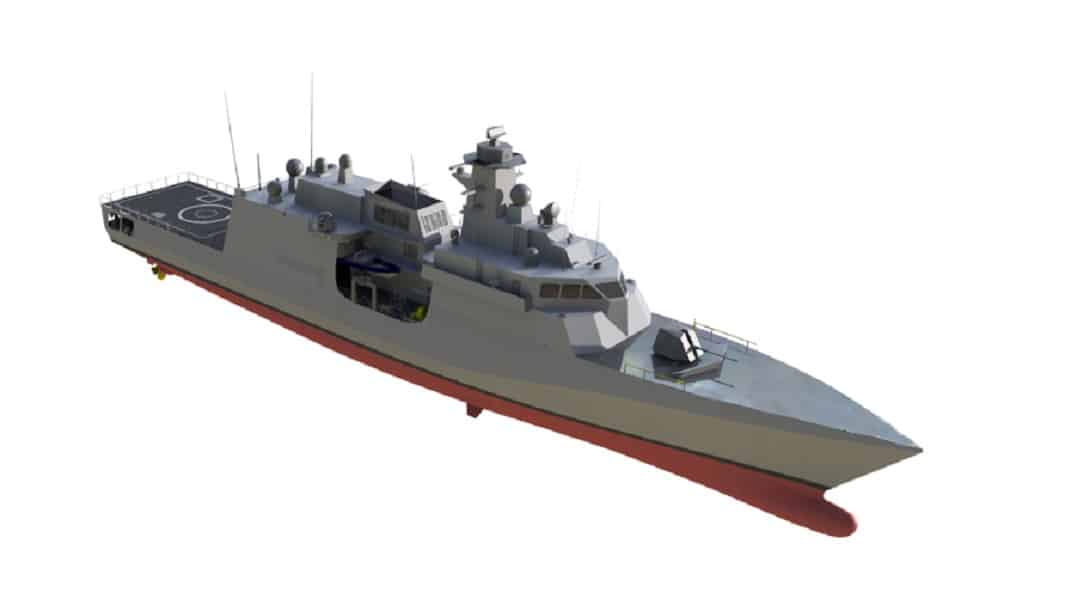
Drawing of the OPV by Fincantieri

Naval News reports,

As part of the Italian Navy OPV (Offshore Patrol Vessel) acquisition programme Orizzonte Sistemi Navali (OSN), the joint venture between Fincantieri and Leonardo… has signed a contract with the Italian Secretariat General of Defence and National Armaments Directorate for the construction of three next generation patrol vessels, with the options for a further three units and infrastructural upgrades required for the naval bases in Augusta, Cagliari and Messina, where the vessels will be based.

Fincantieri is the parent company of the Marinette based shipyard that has been building Freedom class LCS and will be building the US Navy’s new frigates. That shipyard also built USCGC Mackinaw, the 16 Juniper class WLBs, and the 14 Keeper class WLMs.

I am a little surprised by this. It had been reported that the six ships of the Sirio class and Cassiopea class would be replaced by 3,000 ton units of the European Patrol Corvette (EPC) program. This “PPX” program would be the third Italian Navy “patrol” vessel class being built concurrently along with the EPC and the Thaon di Revel class (also known as PPA for ‘Pattugliatore Polivalente d’Altura – Multipurpose Offshore Patrol Vessel’).

The description looks like a pretty typical modern, medium size OPV with an approximate length of 312′ (95 meters), a displacement of 2,300 tons and accommodations for 97. It appears the probable armament is a 76mm gun and a pair of 20 to 30mm mounts (probably the new Lionfish 30mm). That is a size the US Coast Guard might consider for operating in Atlantic Area, if we wanted to increase the total number of larger patrol cutters above the 36 currently planned.

No information was provided about the speed or range. Italian Navy ships tend to have relatively short range because they are designed to operate in the Mediterranean. I would guess range will be about 4,000 miles at about 14 knots. Speed will probably be about 24 knots.

“As Arctic ice melts, NATO plots northern defense tactics” –Video

Wanted to pass along the video above, if for no other reason, for the scenes of the Danish Patrol Frigate HDMS Triton operating in the ice. Notice her ground tackle (equipment used to anchor the ship) is not exposed on the foc’sle, where it would be quickly encrusted with ice. It is well below the main deck.

Triton’s routine peacetime missions and those of her Thetis class sister ships are much the same as US Coast Guard cutters. They do SAR, fisheries, marine environmental protection, and support scientific research. They are ice strengthened and can reportedly operate in 31 inches (80 cm) of ice. They use the STANFLEX modular weapon system, with one slot forward and two slots aft, allowing rapid addition or change out of weapon systems. They have a hull mounted sonar, torpedo tubes, and can support a MH-60R ASW helicopter. They are 3,500 tons full load and 112.3 m (368 ft 5 in) in length with a speed of 22 knots and a range of 8,700 nautical miles at 15 knots and a 60 day endurance. My Combat Fleets of the world reported that they had seven crews to operate the four ships. Perhaps surprisingly, they have only a single shaft, but it is probably well out of the way of ice. The ships of the class are all over 30 years old and the Danes have probably started thinking about replacement.

The Royal Danish Navy (RDN) Thetis-class patrol ship HDMS Triton is pictured operating a Seahawk helicopter during Canada’s Operation ‘Nanook’ exercise in the Arctic in 2022. One element of RDN Arctic capability development is to improve tactical datalinks between the Seahawks and their host frigates and patrol ships. (Canadian Armed Forces)

“Upgun Cutters to Meet Today’s Naval Threats” –USNI

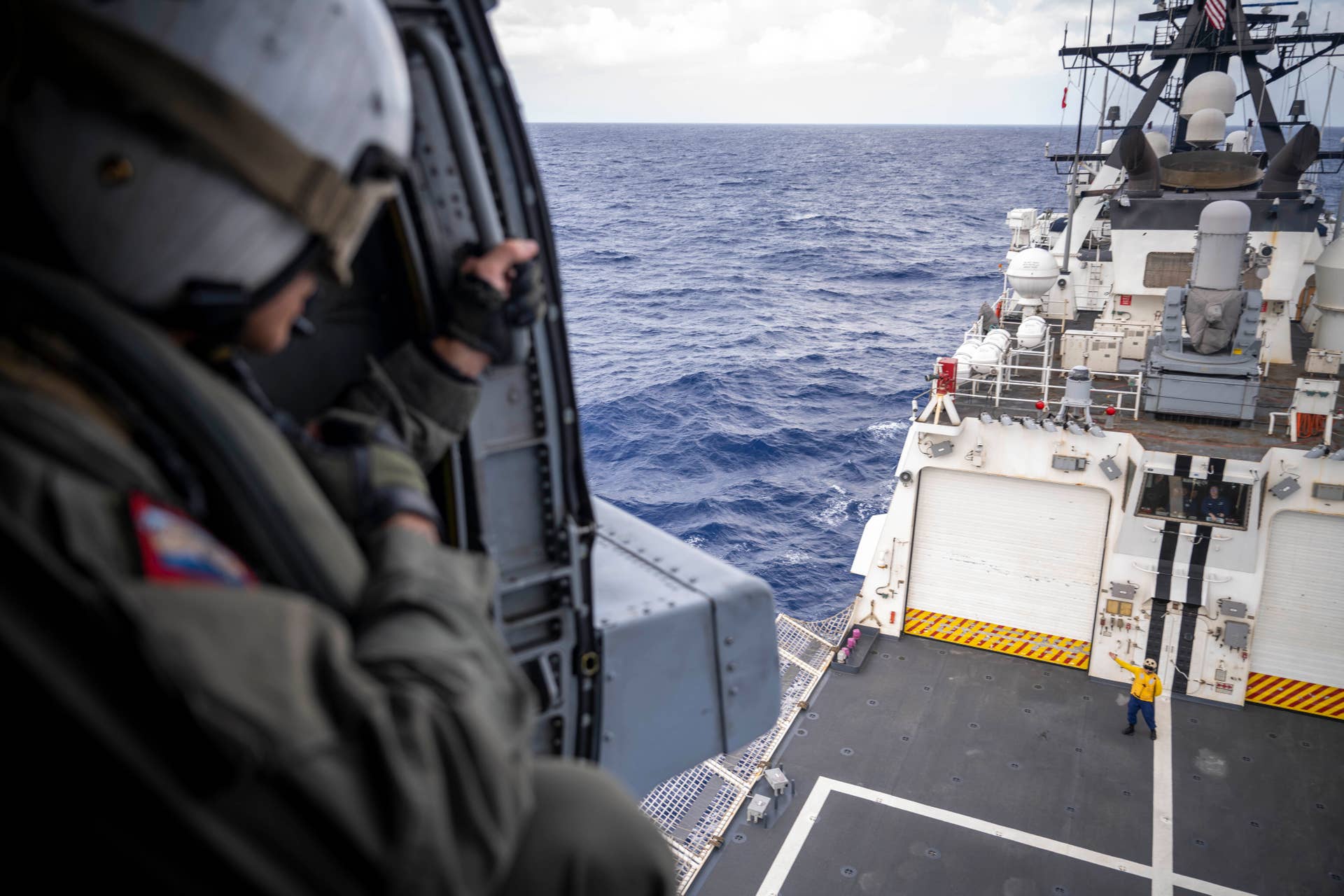
PACIFIC OCEAN (July 30, 2022) U.S. Navy Petty Officer 1st Class Humberto Alba, a naval aircrewman tactical-helicopter, attached to Helicopter Maritime Strike Squadron (HSM) 37, deployed on U.S. Coast Guard Legend-class cutter USCGC Midgett (WMSL 757), looks down at a USCGC crewmember after taking off during flight operations during Rim of the Pacific (RIMPAC) 2022. (U.S. Coast Guard photo by Petty Officer 3rd Class Taylor Bacon)

This essay from the July 2023 issue of Proceedings, is featured on the US Naval Institute Proceedings web site. It won Second Prize in the Midshipmen & Cadets Essay Contest—Sponsored by the U.S. Naval Institute.

This is just one of many such articles that have been published repeatedly over the years. The logic is clear,

If more heavily armed, Coast Guard cutters could better support the Navy and enhance defense readiness.

At small marginal cost, cutters could make a significant contribution to our nation’s naval strength, but it has not happened in the last 30+ years. Why not?

It seems the Leadership of both the Navy and Coast Guard have other priorities, and there is no sponsor in a position of power to push the program.

The Navy is in trouble. The Navy has been shrinking over most of the last 34 years, from down from 592 Sept. 30, 1989, to 299 as of this week. It began with the collapse of the Soviet Union. I’m sure it seemed like good idea at the time, but the “peace dividend” meant there was not much reason to build new ships. Teams that had developed a long string of successful ship designs ceased to exist. Shipyards closed. As a result, they have had difficulty fielding new classes of ships. Their new generation shipbuilding programs have been plagued with problems, while the Chinese navy has been building ships at a furious pace.

The Coast Guard has had its own troubled recapitalization program, beginning with “Deepwater” and while the NSC and FRC programs seem to have been successful, if long delayed, the Offshore Patrol Cutter and Icebreaker programs are still having significant difficulties. But perhaps more importantly, Coast Guard leadership sees the conventional model of a combat ready Coast Guard as counterproductive to other Coast Guard priorities.

Personally, I feel fears that a more heavily armed Coast Guard would not be welcome in many parts of the world is overblown, but the fear does exist and the conventional model of permanently installed weapon systems operated and maintained by Coastguardsmen would require a diversion of assets unless the budget is increased and more assets are provided. There is a cost to the Coast Guard in terms of training and maintenance time for both units and individuals, even if the Navy pays for the systems.

I think there is an alternative that would address the fears of the Coast Guard leadership and create a powerful sponsor in the Navy. 

The Navy Reserve could be that sponsor. It is a reservoir of trained talent, but where do they go upon mobilization? There are only so many ships. Their crews, while they may have some shortages, are essentially at war time manning levels. There are only so many helicopter landing spots on Navy ships. Many Navy Reservists have no really appropriate place to serve upon full mobilization.

Coast Guard units can provide a place where they can be used effectively. Navy helicopters and their crews can fly from Coast Guard cutters. Modularized versions of towed array sonar systems could be operated and maintained by Navy reservists on large cutters.

Initially at least, these reinforced cutters would be best used in the board reaches of the Pacific, beyond the effective range of enemy land based and air-launched anti-ship missiles, where the primary threat would be submarines, protecting the logistics ships that are essential for prosecuting a war in the Western Pacific.

In 2012, Admiral Jonathan W. Greenert, U.S. Navy, advocated,

“We need to move from ‘luxury-car’ platforms—with their built-in capabilities—toward dependable ‘trucks’ that can handle a changing payload selection.”

If the Navy can provide payloads, the Coast Guard can provide some trucks.

“Indonesia, Malaysia, Philippines renew commitment to cooperation” –Indo-Pacific Defense Forum

Coast guard leaders and personnel from member states of the Association of Southeast Asian Nations participate in the June 2023 ASEAN Coast Guard Forum in Jakarta, Indonesia. IMAGE CREDIT: Indonesian Maritime Security Agency

The Indo-Pacific Defense Forum reports,

“Joint sea and air patrols conducted by Indonesia, Malaysia and the Philippines under the 2017 Trilateral Cooperative Arrangement (TCA) continue to demonstrate success and remain critical to Indo-Pacific maritime security, according to officials and analysts. The three countries agreed in June to build on their cooperative efforts going forward.

“Regular patrols, coordination and intelligence sharing established by the TCA are known as INDOMALPHI. The patrols have successfully countered threats including piracy and terrorism with no reported threat events in the first six months of 2023, according to Indonesia’s Ministry of Defense. This compares to 99 reports of piracy and armed robbery in 2017 in the patrol area.”

This sort of cooperation might lead to my proposed Combined Maritime Security Task Force. They don’t need the US Coast Guard to do it, but US participation might add some much-needed gravitas, if they have to face down the Chinese.

“Ukraine’s New Maritime Drone Is A Jet Ski” –Covert Shores

Click to enlarge. Photo credit: hisutton.com

Covert Shores reports,

Both Ukraine and Russia have developed ‘maritime drones’ (USVs – uncrewed surface vessels) with explosive charges. These one-way attack USVs, aka ‘kamikaze’ drones, have been used to attack ships and bridges. The initial design, first seen in September 2022, already employed jet ski parts. However the hull was bespoke. This latest USV is a minimally modified commercial jet ski.

Based on the blurred imagery, the jet ski used appears to be a Kawasaki STX type. The seats, handlebars and some unnecessary casings have been stripped off. Then some communication and control devices have been added.

This seems to show how easy it would be for terrorists to field an offensive unmanned surface kamikaze drone.

“US Coast Guard Seeks Bigger Role to Search, Board Vessels in Pacific” –gCaptain

The USCGC Oliver Henry (WPC 1140) crew arrives in Manus, Papua New Guinea, on Aug. 14, 2022, from Guam as part of a patrol headed south to assist partner nations in upholding and asserting their sovereignty while protecting U.S. national interests. The U.S. Coast Guard is participating with partners to support the Pacific Islands Forum Fisheries Agency-led Operation Island Chief and the larger Operation Blue Pacific through patrols in the Western Pacific in August and September 2022. (U.S. Coast Guard photo by SW3 Victor Villanueva, NMCB-FOUR)

gCaptain reports,

“The United States Coast Guard is in talks with Pacific Island countries to expand its maritime law enforcement role by allowing U.S. officers to board and search vessels suspected of illegal activity within their economic zones, officials said.”

This is about expanding and streamlining the shiprider program. In one case the Coast Guard already have permission to work with a national command center and act on behalf of another nation, Federated States of Micronesia, even if there is no shiprider physically aboard the cutter.

“More specifically, the agreement provides a coordinating mechanism and process for U.S. law enforcement personnel to work with the FSM National Police through command centers to receive approval from the FSM to act.”

Thanks to Lee for bringing this to my attention. 

“GAO Report on Coast Guard Disaster Preparedness” –USNI

The US Naval Institute’s news service reports a GAO study that looked at the Coast Guard’s provision of emergency food and water for their units.

“GAO is making three recommendations, including that the Coast Guard clarifies (1) emergency food and water requirements, and (2) procurement policies and procedures; and (3) ensures that its field units assess and document their emergency food and water needs. The Department of Homeland Security concurred with these recommendations.”

My thought is that this should be a part of a look by the Department of Homeland Security at where emergency food and water should be stored that would include all their agencies along with a catalog of water making and storage resources like ships that might be used in an emergency.