“SELECTION OF THE DIRECTOR OF INTERNATIONAL AFFAIRS AND FOREIGN POLICY ADVISOR (DCO-I)” –News Release

Looks like more evidence of the Coast Guard’s increasing role in international affairs and foreign military sales.

Ms. Haverstick led and completed extraordinary projects valued at over $25B between international partners, the White House, interagency, and military departments for advanced technology acquisitions.”

That sounds pretty heavy weight.

united states coast guard

R 211444Z APR 22 MID200001687843U
FM COMDT COGARD WASHINGTON DC
TO ALCOAST
BT
UNCLAS
ALCOAST 144/22
SSIC 12920
SUBJ: SELECTION OF THE DIRECTOR OF INTERNATIONAL AFFAIRS AND
FOREIGN POLICY ADVISOR (DCO-I)
1. I am pleased to announce the selection of Ms. Holly Haverstick
as the Coast Guard’s Director of International Affairs and Foreign
Policy Advisor.
2. This position serves as the Coast Guard’s key policy advisor on
the complete range of international affairs and engagement
activities. The Director is responsible for developing,
coordinating, and implementing agency strategy, policies, and
programs related to the Coast Guard’s international activities.
In addition, the Director serves as the Executive Agent for the
International Affairs Executive Steering Group (IAESG), which
develops recommended strategies, policies, and direction
regarding the Agency’s international engagement.
3. Ms. Haverstick’s 19 years of federal service have covered
international engagement, security cooperation, strategy, and
foreign military sales (FMS). She has applied her expert knowledge
of global foreign affairs issues to execute national security
priorities and led Department of Defense (DoD) efforts to
develop the 2018 Conventional Arms Transfer (CAT) policy and
associated Implementation Plan. She furthered DoD’s incorporation of
the CAT Policy into overarching security cooperation reform strategy
for the comprehensive security cooperation enterprise. In addition,
she has led U.S. efforts to win numerous multi-billion dollar
international defense competitions resulting in more capable
international partners and a more substantial U.S. defense
industrial base.
4. As the Deputy Assistant Director for Weapons with the Defense
Security Cooperation Agency (DSCA), Ms. Haverstick was responsible
for leading DSCA’s vision of effective and timely technology
security and foreign disclosure aspects of security cooperation,
where she routinely briefed Congressional staff on strategy and
technical aspects of proposed sales. In addition, Ms. Haverstick led
and completed extraordinary projects valued at over $25B between
international partners, the White House, interagency, and military
departments for advanced technology acquisitions. During a
transition for DSCA, Ms. Haverstick served as the Acting Principal
Director for Strategy where she led both military and civilian
members.
5. Ms. Haverstick will become a member of the Senior Executive
Service with the U.S. Coast Guard on 24 APR 2022.
6. USCG Executive Resources POC: Ms. Brianne Alvis
(Brianne.E.Alvis@uscg.mil).
7. ADM Karl L. Schultz, Commandant (CCG), sends.
8. Internet release is authorized.

The New Long Guns

Below is a press release from Sig Sauer, reporting that they have been awarded a contract for two closely related weapons intended to replace the M4/M4A1 carbine and the M249 Light Machinegun. Both use a new 6.8 mm round. There has been concern that the 5.56 mm round is not effective against some of the better body armor. I have not seen the M249 in Coast Guard service, but the Coast Guard does use the M4/M4A1 and the 7.62 mm M240. The new round is reportedly an improvement on both the 5.56 and 7.62mm rounds, so it would not be unreasonable to expect the new weapons to ultimately also replace the M240 in Coast Guard service. This would offer the logistical advantage of requiring only a single rifle caliber round service wide.

According to a report from National Defense, the weapons will be paired with a ruggedized advanced fire control system that increases accuracy and lethality, the XM157, which “integrates a number of advanced technologies, including a variable magnification optic (1X8), backup etched reticle, laser rangefinder, ballistic calculator, atmospheric sensor suite, compass, Intra-Soldier Wireless, visible and infrared aiming lasers and a digital display overlay.”

It probably will take some time before the Coast Guard sees these new weapons.


NEWINGTON, N.H., (April 20, 2022) – SIG SAUER is honored to be awarded the Next Generation Squad Weapons System (NGSW) Contract by the U.S. Army after a rigorous 27-month testing and evaluation process.

“The U.S. Army is taking a bold step toward command of the 21st century battlefield and SIG SAUER is immensely proud to be the selected provider for this historic revolution in infantry weapons. The fielding of the SIG SAUER Next Generation Squad Weapons System will forever change the dynamic of military engagement for America’s warfighters with American innovation and manufacturing,” began Ron Cohen, President and CEO SIG SAUER, Inc.

The SIG FURY Hybrid Ammunition (6.8 Common Cartridge), SIG-LMG (XM250), SIG MCX-SPEAR Rifle (XM5) and SIG SLX Suppressors meaningfully advance soldier weapons technology to meet the emerging requirements of the U.S. Army.

The SIG 6.8×51 FURY Hybrid Ammunition uses a patented lightweight metallic case designed to handle pressures higher than conventional ammunition, resulting in dramatically increased velocity and on-target energy in lighter weapons.

The SIG-LMG lightweight belt-fed machine gun and SIG MCX-SPEAR Rifle are purpose-built to harness the energy of the SIG FURY 6.8 Common Cartridge Ammunition enabling greater range and increased lethality while reducing the soldier’s load on the battlefield.  Both the SIG-LMG and MCX-SPEAR deliver significant weapon and technology advancements to the soldier and provide a solution for battlefield overmatch in comparison to the current M249 and M4/M4A1. 

The U.S. Army’s procurement of the NGSW System marks the beginning of an era where combat weapons are coupled with a suppressor as standard issue equipment.  The SIG SLX Suppressors are designed to reduce harmful gas backflow, sound signature and flash.  SIG SLX Suppressors feature a patented quick-detach design for easy install and removal.

“We commend U.S. Army leadership for having the vision to undertake this historic procurement process to deliver a transformational weapon system to our warfighters.  This award is the culmination of a successful collaboration between SIG SAUER and the U.S. Army, and we look forward to the continuing partnership,” concluded Cohen.

SIG SAUER is a company that is driven by innovation and we are proud to offer the advancements of the NGSW System in the SIG 277 FURY Hybrid Ammunition (the commercial variant of the SIG 6.8×51 FURY Ammunition round), SIG MCX-SPEAR Rifle, and the SIG SLX Series of Suppressors available to the consumer.  For more information about these products visit sigsauer.com.

“2021 Naval Engineering Awards Recipients Announced” –My CG

Coast Guard Cutters Emlen Tunnell and Glen Harris are moored pierside in Beirut, Lebanon, Jan. 31, 2022. The two fast response cutters are deployed to the U.S. 5th Fleet area of operations to help ensure maritime security and stability in the Middle East region. U.S. Army photo by Cpl. DeAndre Dawkins.

MyCG announced special recognition of significant Naval Engineering accomplishments in the form of awards. I would like to point out one element, in one award statement, because it is the only official statement, I have seen so far regarding upgrades to the Webber class cutters that are assigned to Patrol Forces SW Asia.

“CAPTAIN RICHARD D. POORE AWARD…Mr. Michael Parrish, Deputy Product Line Manager, Surface Forces Logistics Center (SFLC) Patrol Boat Product Line (PBPL)…He used innovative financial methods to procure $4.7 million in warfighting packages to outfit six PATFORSWA cutters to help protect the U.S. Fifth Fleet.”

Major Cutter Homeports

“Coast Guard Cutter Forward and Coast Guard Cutter Bear, homeported in Portsmouth, Virginia, finish an at-sea transfer while underway on a two-month patrol. Coast Guard Cutter Forward returned to homeport on April 10, 2021.” (U.S. Coast Guard photo)

Recently I had to look up homeports of WMECs. I found that there did not seem to be a single comprehensive up to date list. Seemed it might be useful to share the list. I have added the Bertholf class and what we know about the basing of the Offshore Patrol Cutters as well. These are not district assets, but I found it convenient to group them by homeport district. The numbers in parenthesis are the hull numbers. First some observations.

OBSERVATIONS:

The intent is to split the Bertholf class, almost evenly between the Atlantic and Pacific Areas: five (45%) to LANTAREA and six (55%) to PACAREA.

The vast majority of medium endurance cutters are assigned to LANTAREA. All 100% of the 270s and 24 (86%) of 28 total.

Despite the fact that the vast majority of the US EEZ and territorial sea (84%) falls under the Pacific Area Commander, the vast majority of large patrol cutters are based in the Atlantic Area. This is, at least in part, due to the Alien Migrant and Drug interdiction missions. It is counter intuitive, but Charleston, SC is closer to the Eastern Pacific Drug transit zones than San Diego, CA.

Once the first four OPCs reach their bases in San Pedro and Kodiak, the Pacific Area will once again have ten “high endurance cutters,” as they did before recapitalization began.

WHO BUILT THEM?:

The entire Bertholf class has been built by Huntington Ingalls of Pascagoula, MS. The lead ship was laid down in 2005 and commssioned in August 2008. The tenth is expected to be delivered 2023. The eleventh, maybe 2024.

The Bear class WMEC270s were built by two different builders. The first four ships (901-904) were built by Tacoma Boatbuilding, Tacoma, WA, with Bear laid down in August, 1979 and the last of the four commissioned in December, 1984. The remaining nine were built by Derecktor Shipbuilding, Middleton, RI. The first of these laid down June, 1982, and the last of the nine completed in March 1990.

The 16 Reliance class WMEC210s were built by four different builders, with the first laid down in May 1963 and the last commissioned August 1969, less than six years and three months later.

  • The first three, 615-617, were built by Todd Shipyards, Houston, TX.
  • The fourth, 618, by Christy Corp., Sturgeon Bay, Wis.
  • Five, 619, 620, and 628-630, were built at the Coast Guard Yard, Curtis Bay, MD.
  • Seven, 621-627, were built by American Shipbuilding, Lorain, OH.

WMEC 622 and 628 have since been transferred to Sri Lanka and Colombia respectively. All underwent a major maintenance availability at the Coast Guard Yard between 1984 and 1998.

THE FORCE LAYDOWN:

FIRST DISTRICT: 2 WMEC270s

  • US Naval Shipyard Portsmouth, Kittery, ME: two WMEC270s: Tahoma (908), Campbell (909)

FIFTH DISTRICT: 9 WMEC270s, 2 WMEC210s

  • Portsmouth, VA: 9 WMEC270s: Bear (901), Escanaba (907), Forward (911), Harriet Lane (903, currently in SLEP at CG Yard), Legare (912), Northland (904), Seneca (906) , Spencer (905), Tampa (902)
  • Virginia Beach, VA: WMEC210s: Dependable (626), Vigorous (627)

SEVENTH DISTRICT: 3 National Security Cutters (2 more under construction), 2 WMEC270s, 5 WMEC210s

  • Charleston, SC: 3 NSCs: Hamilton (753), James (754), Stone (758), (two more NSCs building: Calhoun (759), Friedman (760))
  • Naval Station Mayport: 1 WMEC210: Valiant (621)
  • Cape Canaveral: 2 WMEC210s: Confidence (619), Vigilant (617)
  • Key West: 2 WMEC270s: Mohawk (913), Thetis (910)
  • St. Petersburg: 2 WMEC210s: Resolute (620), Venturous (625)

EIGHTH DISTRICT: 4 WMEC210s

  • Pensacola: WMEC210s: Dauntless (624), Decisive (629), Diligence (616), Reliance (615)

ELEVENTH DISTRICT: 4 National Security Cutters

  • Alameda, CA: 4 NSCs: Bertholf (750), Waesche (751), Stratton (752), Munro (755)

THIRTEENTH DISTRICT: 3 WMEC210s

  • Astoria, OR: 2 WMEC210s: Alert (630), Steadfast (623)
  • Port Angeles, WA: 1 WMEC210: Active (618)

FOURTEENTH DISTRICT: 2 National Security Cutters

  • Honolulu, HI: 2 NSCs: Kimball (756), Midgett (757)

SEVENTEENTH DISTRICT

  • Kodiak, AK: 1 WMEC283: Alex Haley (WMEC-39)

OFFSHORE PATROL CUTTER HOMEPORTS

We have heard where the first six OPCs are expected to be homeported.

  • Argus (915) and Chase (916) will go to San Pedro, CA
  • Ingham (917) and Rush (918) will go to Kodiak, AK
  • Pickering (919) and Icarus (920) will go to Newport, RI


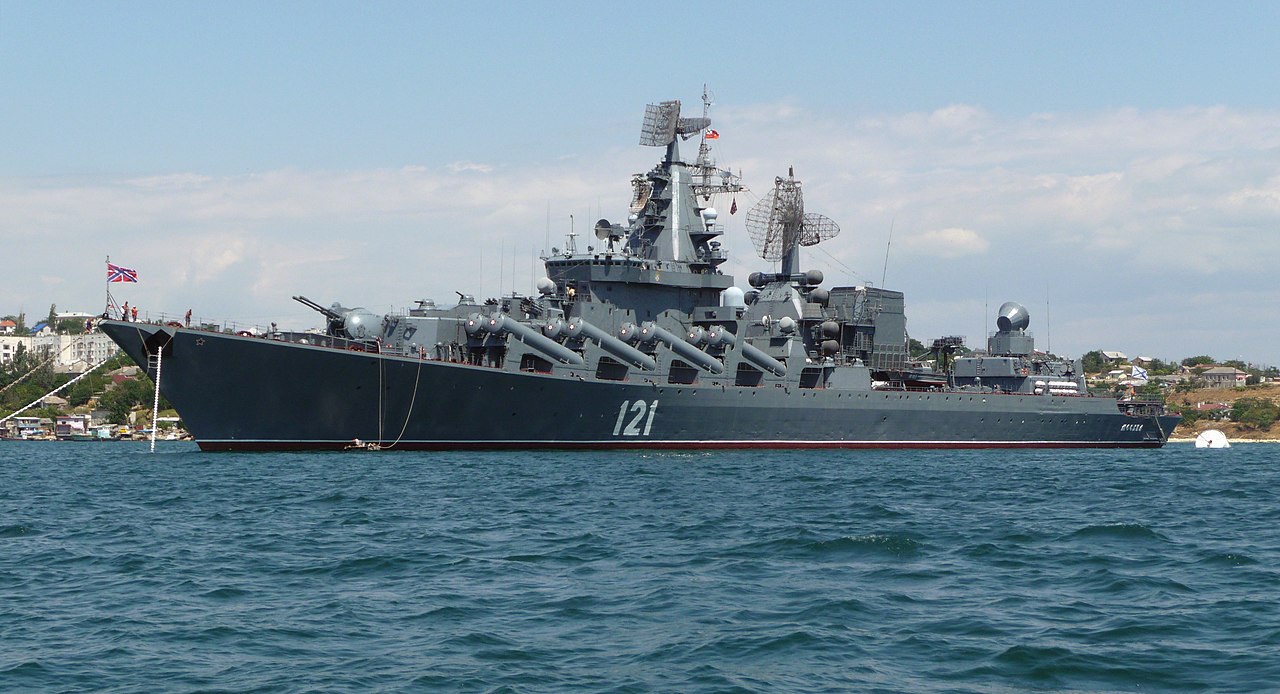
Cruiser Moskva, Flagship of Black Sea Fleet, Severely Damaged, Afire, Abandoned, Possibly Sunk

“Moskva” (“Moscow”) (ex-“Slava”, which means “Glory”) is the lead ship of the Project 1164 Atlant class of guided missile cruisers in the Russian Navy. The Project 1164 Atlant class was developed as “Aircraft carriers killer”. This warship was used in the 2008 Russia-Georgia War. The Black Sea. Sevastopol bay. This photo was taken from a boat. Photo by George Chernilevsky

I have seen several reports that the flagship of the Russian Black Sea Fleet, the 39 year old cruiser Moskva, was so severely damaged that the crew had abandoned ship. This was reportedly confirmed by the Russians according to a report from the US Naval Institute News Service.

There are also reports the ship capsized. Confirmation should come quickly. Ukraine claims they targeted the ship and struck it with two anti-ship cruise missiles. Secondary explosions followed.

“Combined Maritime Forces establishes new naval group to patrol Red Sea region” –Defense News

Royal navy frigate HMS Montrose (F 236), left, Pakistan navy frigate PNS Aslat (F 254), left center, Royal navy of Oman patrol vessel Al-Shinas (Z 21), right center, and USCGC Charles Moulthrope (WPC 1141) sail in formation during International Maritime Exercise/Cutlass Express (IMX/CE) 2022 in the Arabian Gulf, Feb. 13. (Spc. Natianna Strachen/U.S. Army)

Defense News brings us word of the formation of another combined naval task force intended to enforce rules-based behavior, this time in the Red Sea and Gulf of Aden.

It is not unlikely that the Coast Guard’s PATFORSWA will become involved in this, but more importantly, this is the latest in what looks like an emerging trend, and perhaps a way to deal with gray zone operations. It is not a military alliance against an opposing state, rather it is a law enforcement alliance of like-minded nations who wish to prevent the breakdown of order.

This seems to suggest something like my proposal for a “Combined Maritime Security Task Force, Pacific” is looking much more mainstream, if we could spread the concept from the CENTCOM area of operations to INDOPACOM and perhaps AFRICOM and apply it to Illegal, Unreported, and Unregulated fishing.

“Coast Guard to host groundbreaking ceremony at Base Boston for Fast Response Cutter pier construction” –News Release

Below is a First District news release. This is good news for those hoping to see some new cutters in New England. We have known for a while that Webber class FRCs were going to Boston, but the surprise I see here is, “…$35 million recapitalization of current Coast Guard facilities at Base Boston and acquisition of six new Fast Response Cutters (emphasis applied–Chuck) at a cost of $380 million.”

This follows the pattern we have seen lately of these vessels being clustered, rather than being widely distributed in ones and two.

Base Boston (photo above) must certainly have much to recommend it, but as a high-cost area, it seems likely it will host no large patrol cutters in the future. It was once homeport to several High Endurance Cutters. Until recently, it hosted three WMEC270s, Escanaba, Seneca, and Spencer. All three have since moved to Portsmouth, VA. We already know the Coast Guard plans to base OPCs #5 and #6 in nearby Newport R.I. at the former US Navy base, where there had been no large cutters.

Wikipedia has a good list of Webber class WPCs and their homeports. It does not reflect the addition of two more ship to the program of record, FRCs #65 and #66, in the FY2022 budget, but it does list 64 named vessels and homeports for 50 cutters including two expected to be homeported in Boston, USCGC William Chadwick (WPC-1150) and USCGC Warren Deyampert (WPC-1151), expected to arrive in the second half of 2022. Homeports are not yet identified for 16 ships. Four of those are presumably going to Boston so where are the remaining 12 going? One is each is expected to go to Seward and Sitka. Two will go to Kodiak. That leaves eight. Some may be added to already identified homeports. One of the 50 identified includes the first ship going to St. Petersburg, FL. St. Pete will likely get at least two more. Assuming that is the case that leaves six. We also know that two will go to Astoria, Oregon. That leaves four. The recent addition of two was probably with the intention of stationing them in America Samoa. Two there would only leave two which might go to previously identified homeports, so we may not see any additional homeports added.

News Release

U.S. Coast Guard 1st District Northeast

Media Advisory: Coast Guard to host groundbreaking ceremony at Base Boston for Fast Response Cutter pier construction

Editors’ Note: Media interested in attending are requested to RSVP at 617-717-9609 by 4 p.m., April 13, and should arrive no later than 9:45 a.m., Thursday.

FRC

BOSTON —The Coast Guard is scheduled to hold a media event for the Coast Guard Fast Response Cutter Homeport Groundbreaking Ceremony at Base Boston, Thursday.

WHO: Rear Adm. Thomas Allan, commander, Coast Guard First District, Massachusetts Governor Charlie Baker, Congressman Stephen Lynch, and Mayor of Boston, Michelle Wu.

WHAT: Coast Guard Fast Response Cutter Homeport Groundbreaking Ceremony

WHEN: Thursday, April 14, 2022, at 10 a.m.

WHERE: Coast Guard Base Boston, 427 Commercial Street, Boston, MA 02109

This ceremony marks the starts of a large Coast Guard investment in the Northeast with a $35 million recapitalization of current Coast Guard facilities at Base Boston and acquisition of six new Fast Response Cutters at a cost of $380 million. The FRCs are the Coast Guard’s newest cutter class replacing the Legacy Island Class Patrol Boats and will operate throughout the Coast Guard’s First District from New York, to the Canadian border. 

These cutters are designed for missions including:

  • search and rescue
  • fisheries law enforcement
  • drug and migrant interdiction
  • port, waterways, and coastal security
  • national defense

In addition, the Coast Guard will increase personnel presence in the area with 222 new Coast Guard members to crew and maintain the cutters. These new crews are expected to have an annual economic impact of $45 million on the local economy. 

“GA-ASI Selected for Japan Coast Guard RPAS Project” –News Release

MQ-9B SeaGuardian. General Atomic photo.

Below is a news release from General Atomics Aeronautical Systems, Inc. The USCG has yet to select their own shore based unmanned air system. Note, there is as yet no indication Japan Coast Guard is purchasing this system. It appears more likely they are using contractor owned and operated systems as a step toward a more comprehensive JCG owned and operated system. UAS on USCG cutters are still currently contractor owned and operated. 

GA-ASI Selected for Japan Coast Guard RPAS Project

Japan EEZ Surveillance Using SeaGuardian® RPA Scheduled to Begin in October

SAN DIEGO – 06 April 2022  General Atomics Aeronautical Systems, Inc. (GA-ASI), the global leader in Remotely Piloted Aircraft Systems (RPAS), is pleased to be selected to support the Japan Coast Guard’s (JCG) RPAS Project. Operations will feature GA-ASI’s MQ-9B SeaGuardian® and begin in October 2022.

SeaGuardian will be used to conduct wide-area maritime surveillance to support JCG’s missions, which include search and rescue, disaster response, and maritime law enforcement. This project follows a series of successful JCG flight trials in 2020 that used SeaGuardian to validate the same JCG missions in accordance with Japan’s “Policy on Strengthening the Maritime Security Systems,” using unmanned aerial vehicles to perform maritime wide-area surveillance.

“We’re proud to support the JCG’s maritime surveillance mission with our SeaGuardian UAS,” said Linden Blue, CEO of GA-ASI. “The system’s ability to provide affordable, extremely long-endurance airborne surveillance with long-range sensors in the maritime domain is unprecedented.”

SeaGuardian features a multi-mode maritime surface-search radar with an Inverse Synthetic Aperture Radar (ISAR) imaging mode, an Automatic Identification System (AIS) receiver, and High-Definition – Full-Motion Video sensor equipped with optical and infrared cameras. This sensor suite enables real-time detection and identification of surface vessels over thousands of square nautical miles and provides automatic tracking of maritime targets and correlation of AIS transmitters with radar tracks.

SkyGuardian® and SeaGuardian® are revolutionizing the long-endurance RPAS market by providing all-weather capability and full compliance with STANAG-4671 (NATO UAS airworthiness standard). This feature, along with our operationally proven, collision-avoidance radar, enables flexible operations in civil airspace.

About GA-ASI

General Atomics Aeronautical Systems, Inc. (GA-ASI), an affiliate of General Atomics, is a leading designer and manufacturer of proven, reliable, Remotely Piloted Aircraft (RPA) systems, radars, and electro-optic and related mission systems, including the Predator® RPA series and the Lynx® Multi-mode Radar. With more than seven million flight hours, GA-ASI provides long-endurance, mission-capable aircraft with integrated sensor and data link systems required to deliver persistent flight that enables situational awareness and rapid strike. The company also produces a variety of ground control stations and sensor control/image analysis software, offers pilot training and support services, and develops meta-material antennas. For more information, visit www.ga-asi.com

“Sea Air Space 2022” –Naval News Video Coverage

Below I have posted two videos by Naval News, along with the breakdown of topics that accompanied the videos on YouTube. The video of the 30mm Mk38 Mod4 with its included electro-optic fire control system is probably of most immediate interest to the Coast Guard, but the increasing tendency to containerize weapon systems is appears ready to make any cutter (and almost any other ship) a missile carrier.

  • 01:06 – Constellation-class frigate program with Fincantieri Marinette Marine
  • 04:30 – MSI Defence Mark 38 Mod 4 30mm naval gun system
  • 07:53 – Lockheed Martin’s Expeditionary Launching System
  • 09:21 – BAE Systems E-Launcher
  • 09:52 – Kongsberg NSM-HL helicopter launched naval strike missile
  • 00:43 – Kongsberg Hugin Edge UUV
  • 02:27 – General Dynamics Tethered Unmanned Aerial Systems
  • 03:36 – Shield AI’s Hivemind (V-BAT also –Chuck)
  • 05:23 – Saildrone Explorer USV
  • 06:48 – PennState’s 54″ Large Test Vehicle UUV


Mark Retiring Cruiser MK41 VLS and 5″/62 Mk45 Mod4s for Possible Future Installation on Cutters

151014-N-GR120-152
INDIAN OCEAN (Oct. 14, 2015) The guided-missile cruiser USS Normandy (CG 60) prepares to come along side for a fueling-at-sea with the aircraft carrier USS Theodore Roosevelt (CVN 71). Theodore Roosevelt is operating in the U.S. 7th Fleet area of operations as part of a worldwide deployment en route to their new home port in San Diego to complete a three-carrier homeport shift. (U.S. Navy photo by Mass Communication Specialist 3rd Class Anna Van Nuys/Released)

If we ever have another major conventional naval war, as appears increasingly likely, the Navy is going to need a lot more ships, including a lot more missile shooters. Defense News reports the Navy is considering how to add additional capability. The Navy is even considering putting missiles on cargo ships. As Rep. Elaine Luria (D-VA, Cdr. USN, ret.) pointed out, a number of cruisers equipped with MK41 VLS are being retired. The 22 remaining cruisers each have 122 Mk41 vertical launch cells as well as two 5″/62 Mk45 Mod4 guns.

Five of the cruisers have been approved for decommissioning in the 2022 budget. It is likely the remaining 17 will follow in the next few years.

I suggest that some of these VLS sets be stored and earmarked as mobilization assets for possible future installation on the National Security Cutters (NSC) should the need arise. Studies have shown that the NSCs could accept up to 16 Mk41 VLS. These VLS might be recycled to the new Constellation (FFG-62) class too, but since the planned 20 ships will only use 640 VLS, it would only require seven cruisers to donate enough VLS to arm both 20 FFG and 11 National Security Cutters.

It should not be too difficult to integrate the Mk41 VLS on the National Security Cutters since their combat systems use Aegis software.

Potential Mk41 VLS weapons load outs for tactical and strike length launchers.

In addition, it might be wise to earmark the cruisers 5″/62 Mk45/Mod4 guns for possible upgrades for both National Security and Offshore Patrol Cutters as well.

The Navy’s entire Naval Gun Fire Support (NGFS) capability is about 114 Mk45 5″ guns on 22 cruisers with two guns each and about 70 DDGs with only one gun. By the time the cruisers are gone, we may have perhaps 80 DDGs. That means the loss of about 30% of the current capability. Equipping the 36 NSCs and OPCs with 5″/62 Mod4 guns from the retiring cruisers could entirely replace the lost capability and importantly provide it in ships that are not likely to be deployed out of position to provide NGFS because they are needed elsewhere to provide AAW protection.

To ensure we can make these changes quickly when needed, it might be prudent to equip at least one ship of each class as a prototype for future upgrades. Upgrading one ship of each class would probably cost less than one FFG and would provide a template for future upgrades if necessary. The OPC prototype might attempt something like I described here.

Since this is preparation for war, the prototypes and storage of the weapons could come from the Navy’s budget.