“British Navy tests new .50 machine gun mounting system ASP” –Navy Recognition

Russian Vyborg Shipyard laid the Purga ice class coastguard ship of project 23550 925 001

British navy sailor fires burst using gun mounting system ASP (Agile, Small-deflection, Precision) armed with a .50 heavy machine gun. (Picture source British Royal Navy)

If we don’t replace the .50 caliber machine gun and we don’t put it in a remote weapons station, we may still do something to improve its accuracy as a crew served weapon.

Navy Recognition reports the Brits have been testing a new mount.

Over a week of trials, the team put down nearly 5,000 .5 caliber rounds – 3,500 fired using the new mounting, 1,450 from a heavy machine-gun on a traditional ‘soft’ mounting to allow for comparisons. They conducted more than three dozen gunnery shoots in different scenarios and weather conditions to give both mountings a comprehensive workout.

Seven of Argyll’s ship’s companies were taught how to fire a .50 cal loaded onto the new mount. They found it easy to use – and their gunnery improved as the trials went on.

I would at least be curious about their test results.

Steel Cut for DDG Honoring Coast Guard Hero

A graphic illustration of the future Arleigh-Burke class guided-missile destroyer USS Quentin Walsh (DDG 132). (U.S. Navy photo illustration by Mass Communication Specialist 1st Class Paul L. Archer/Released)

Dmitry Shulgin reports,

The U.S. Navy and General Dynamics (GD) Bath Iron Works (BIW) marked the start of fabrication for the future USS Quentin Walsh (DDG-132) with a ceremony at BIW’s Structural Fabrication Facility in East Brunswick, Maine, November 16.

This earlier post tells the story of this Coast Guard Hero.

“Media Advisory: Coast Guard Cutter Healy returns to Seattle from 133-day trip around North America” –D13

Passing along this Press release. There is a link at the bottom to a lot of good photos.

Welcome back home Healy.

united states coast guard

Media Advisory

U.S. Coast Guard 13th District Pacific Northwest

Media Advisory: Coast Guard Cutter Healy returns to Seattle from 133-day trip around North America

WHO: U.S. Coast Guard Cutter Healy and crew.

WHAT: Return to homeport following a 22,000-mile, 133-day deployment circumnavigating North America. The commanding officer will be available for interviews following the cutter’s mooring.

WHEN: Saturday, Nov. 20, 2021 at 12 p.m. estimated ship arrival.

WHERE: Pier 36, 1519 Alaskan Way S, Seattle, WA 98134.

Healy deploys annually to the Arctic in support of oceanographic research and Operation Arctic Shield, the Service’s annual operation to execute U.S. Coast Guard missions, enhance maritime domain awareness, strengthen partnerships, and build preparedness, prevention, and response capabilities across the Arctic domain.

Commissioned in 2000, Healy is one of two active polar icebreakers in the Coast Guard’s fleet. Healy is capable of breaking 4 feet of ice continuously and up to 8 feet of ice while backing and ramming.

The U.S. Coast Guard is recapitalizing its polar icebreaker fleet to ensure continued access to the Polar Regions and protect the country’s economic, commercial, environmental, and national security interests.  The Coast Guard and U.S. Navy, through an integrated program office, on April 23, 2019, awarded VT Halter Marine Inc., of Pascagoula, Mississippi, a fixed-price incentive contract for the detail, design and construction of the lead Polar security cutter with contract delivery planned for 2025.

Additional photos from Healy’s deployment are available here.

“VESSEL REVIEW | KOLACHI – NEW LARGE PATROL VESSEL FOR PAKISTAN MARITIME SECURITY AGENCY” –Baird Maritime

Photo: PMSA

Baird Maritime reports delivery of a Chinese designed Offshore Patrol Vessel to the Pakistan Maritime Security Agency (PMSA), the maritime safety and law enforcement arm of the Pakistan Navy. This second ship was reportedly built in Pakistan while the first was produced in China.

This ship may look a bit familiar. It appears to be a variant of the Type 056 corvette. 72 of the corvettes were inducted into the Chinese PLA Navy between 2013 and 2019. Variants of the class also serve with the Bangladeshi and Nigerian Navies and the China Coast Guard.

There is a Pakistani Coast Guards distinct from the PMSA, but it falls under the authority of the Pakistani Army and functions more like Customs and Border Protection and its Air and Marine Unit, being limited to operations on shore and within the 12 mile limit.

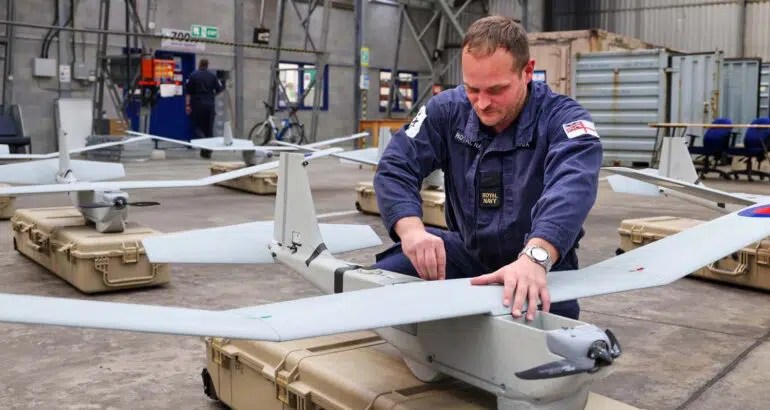
Two About Puma sUAS

Royal Navy Photo

Naval News reports on the Royal Navy’s increasing use of the Puma small Unmanned Air System (sUAS).

And we have this from Seapower, regarding a new night time imaging system.

The Puma is a system the Coast Guard has experimented with more than once, and the Canadians have also adopted it. My last look at this small UAS with comments on its suitability and links to previous posts here.

Now It Is Really Time to Replace the 52 Foot MLBs

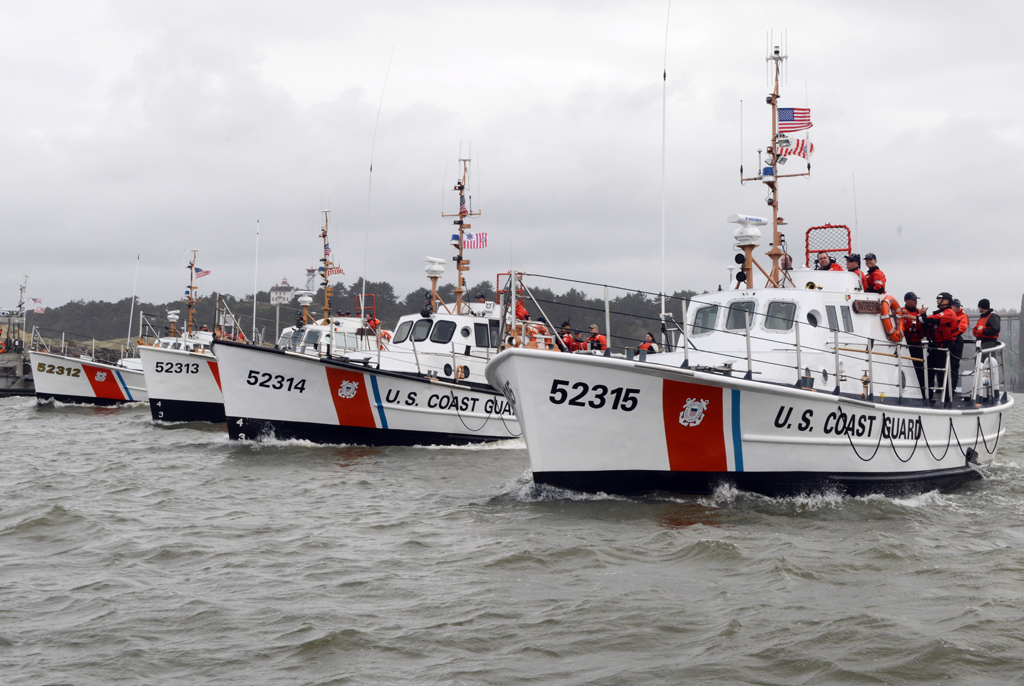
Coast Guard crew members aboard four 52-foot Motor Life Boats and one 47-foot Motor Life Boat transit in formation outbound of Yaquina Bay, Ore., April 9, 2019. The four 52-foot MLBs are the only active vessels of their kind and the crews are assigned to different units across the Pacific Northwest, which is why having all four together for the roundup was a rare occurrence.
(U.S. Coast Guard photo by Petty Officer 3rd Class Trevor Lilburn)

Just got this comment from Peter on an earlier post,

All four 52 footers are officially retired today. They are all currently underway to rendezvous at Station Cape Disappointment. The Intrepid left Coos Bay yesterday, the Victory left Yaquina Bay at 0200 this morning and the Invincible will leave later today.

The end of a era.

This certainly was not unexpected, and we have had some indication the Coast Guard is looking for replacements. My Feb. 2021 post on the topic included a number of comments and referenced earlier posts and possible alternatives.

As seems to be too frequently the case, we have waited too long to look for a replacement for a system obviously approaching the end of its useful life. There should not have been a gap in providing a replacement. Additionally, in many locations, a faster more capable large MLB could also serve as a replacement for 87 foot WPBs–also approaching the end of their useful life.  This could be a larger program than just five boats.

“U.S. upgrades Bahamas’ maritime security” –The Watch

Source: CIA, The World Factbook, 2004.

NORTHCOM’s on-line magazine, “The Watch,” reports,

“The United States recently bolstered maritime security in the Bahamas by delivering a radar system to its partner in the Caribbean region.

“The U.S. $2.4 million-dollar MSS (Maritime Surveillance System–Chuck) is part of a commitment of more than $10 million to empower the Bahamas to better ensure the safety and security of its vast archipelago, the news release said. The radar is the second MSS installed with funding from USNORTHCOM, the first having become operational on the island of Great Inagua in 2019. Third and fourth systems have been proposed for Ragged Island and Great Exuma.”

There is more of course.

Now, do we have comparable systems on Puerto Rico and the American Virgin Islands?

“U.S. Warships Have This Seldom Discussed But Very Powerful Optical Targeting System” –The Drive

USCGC Hamilton with its EOSS (Electro Optic Sensor System) atop its bridge. 

The Drive/The War Zone has a post regarding the Mk20 Mod1 Electro Optic Sensor System (EOSS) that is equipping National Security Cutters and Offshore Patrol Cutters in addition to the Navy’s newest destroyers and the new FFG. The post is in the form of an interview with a company rep.

We have talked about this system before here.

For such an inconspicuous system, it looks to be extremely useful. Other than using it as a firecontrol for ASuW and AAW, this system can be used for:

  • Location and tracking a man overboard
  • Channel position and navigation
  • Detection and identification including looking for the IR signature of low profile vessels
  • Naval gunfire support
  • Safety check-sight
  • Battle Damage Assessment

These will definitely be used on the Offshore Patrol Cutter. The earlier Mk20 Mod0 version was in the Draft Technical Package back in 2012.

“Weapons Effectiveness Testing–25 vs 30mm” Revisited

I am resurfacing this old post from 2017, because our weapons effectiveness is still an issue. I also reformatted a couple of sentences to bold type face, so the points would be harder to miss. Hopefully the Mk38 Mod4 will have at least the 30mm gun, if they don’t decide to recycle 25mm guns, as seemed to have been the case when the Mod3 changes were minimized compared to the Mod2. We really need to upgrade the older mounts to a more effective weapon, otherwise we are planning to fail. Either replace the 25mm with a more effective gun or add APKWS or Hellfire/JAGM small missile systems. Better yet, do both.


This is old. It goes back to 1992, but if they knew the results here, it raises a question, why are we still equipping the Mk38s with 25mm guns instead of 30mm (or 35mm or 40mm) guns which also fit the same mount? The results are discussed beginning at time 8:00. The 30mm does nine times the damage to the hull and five times the damage inside the hull.

At the very least we need to make sure we have available rounds that do not detonate on impact. The 25mm rounds, exploding on impact, failed to even penetrate the 1/4 inch aluminum hull of the Mk3 target boat.

Thanks to Luke for bringing this to my attention. 

“Fincantieri To Design And Build New Multirole OPV For Italian Coast Guard” –Naval News

The future multirole offshore patrol vessel (unità d’altura multiruolo) of the Italian Coast Guard.

Naval News reports the award of a contract for a new Italian CG cutter.

The order, which concludes the tender procedure and has a value of approximately 80 million euros, provides for the construction of a multirole OPV and the related temporary support services for a duration of 5 years. There is also an option for the construction of a further 2 vessels.

The Italian Coast Guard is a quarter the size of the US Coast Guard and is part of the Italian Navy. Historically, offshore Coast Guard functions were frequently performed by the Italian Navy. Their Coast Guard only began building larger specialized coast guard Offshore Patrol Vessels a little over a decade ago.

The new ship(s) appears generally similar to the two earlier Dattilo class OPVs commissioned in 2013 and 2014. At a reported 85 meters in length it will be about ten meters shorter. USCGC Hamilton exercised with a Dattilo class cutter during its European deployment back in April.

This and previous Italian OPVs appear to be derived from Offshore Support Vessel (OSV) practice. There is no indication of speed, but I would expect about 18 knots, this being the speed of previous Italian OPVs. All previous Italian OPVs had provision for taking containers aboard, so that also appears likely. There is no provision for a hangar. No mention is made of armament, but judging from the artist’s renderings and current Italian Coast Guard/Navy practice, it is likely to be an Leonardo Oto Melara/Oerlikon KBA 25 mm/80 remote weapon system which fires the same 25x137mm round as the Mk38 but at up to more than 550 rounds per minute supplemented by 7.62mm machine guns. Following previous practice, the new ship(s) is probably fitted for but not with the OTO Melara 76mm.