“Coast Guard Station Scituate closure will have a ‘dire effect,’ South Shore officials warn” –WickedLocal

Obviously people like having the Coast Guard around. It seems the Coast Guard is again attempting to close “redundant” stations, in this case the seasonal station at Scituate, Massachusetts, situated between Boston and Plymouth. You can see the typical result here.

February 2020, we had a similar story.

Thanks to Paul for bringing this to my attention. 

“The US Coast Guard urgently needs help” –Senator Roger Wicker (R-Miss) in Defense News

The original boathouse for the Toms River Life Saving Station in 1898. Image from Norman McClure of Toms River.

Defense News brings us an editorial in support of increased funding to reduce the Coast Guard’s $3B maintenance and infrastructure backlog, by Roger Wicker, R-Miss., a member of the Senate Armed Services Committee and ranking member of the Committee on Commerce, Science, and Transportation.

“What often goes unreported, however, is the woeful lack of resources supporting the Coast Guard’s missions.

“In too many cases, the Coast Guard operates out of trailers in parking lots, uninhabitable buildings and crumbling piers. It is time to give this branch of our armed forces its rightful attention and support.”

The commentary points out how Coast Guard funding for operations and support has fallen behind.

Since 2010, the Coast Guard has seen only a modest 8 percent increase in operation and support funding. By comparison, all other services have seen increases between 28 and 42 percent. Having the Coast Guard clearly identify its needs will inform Congress about how to modernize and recapitalize our Coast Guard fleet to meet its mission requirements.

That does also seem to suggest, that the Coast Guard has been remiss in identifying what it needs. The old habits of “doing more with less,” which ultimately result in either doing less or pushing the limits of safety, die hard.

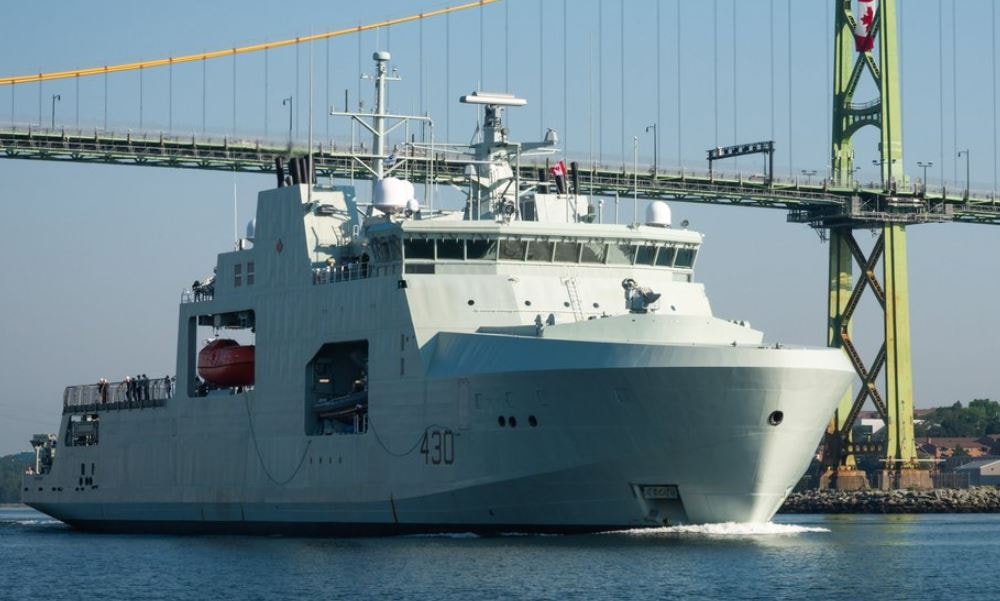
“Royal Canadian Navy HMCS Harry DeWolf Departs On Her Maiden Operational Deployment” –Naval News

HMCS Harry DeWolf, leaving HMC Dockyard in Halifax and steaming under Angus L. Macdonald
suspension bridge crossing Halifax Harbour in Nova Scotia, Canada

Naval News reports the first of Canada’s planned eight Arctic Offshore Patrol Ships (AOPS) (six for their Navy and two for their Coast Guard) departed on its first operational deployment on August 3. The deployment is expected to take four months and will include participation in the annual Nanook Exercise with partners including the USCG, transit of the North West Passage, counter clockwise circumnavigation of North America, and drug operations in the Eastern Pacific transit zone and the Caribbean again in cooperation with the USCG.

USCGC Healy departed for a clockwise circumnavigation of North America on July 10. Presumably these two will arrange to say hello as they pass. Hopefully both crews will be home by Christmas.

“A NEW U.S. NAVY PLANNING MODEL FOR LOWER-THRESHOLD MARITIME SECURITY OPERATIONS” –CIMSEC

CIMSEC has published a two part discussion of planning for Maritime Security Operations written by retired US Coast Guard Captain Andrew Norris.

Much of the discussion is about the inadequacies of the current planning guidance. It picks up in Part 2 with a discussion of the “Constraint-Restraint-Enabler-Imperative (C-R-E-I) Model.”

While written as guidance for the planner, it might also serve as a checklist for the operator, as he prepares execute Maritime Security Operation. Have constraints, restraints, enablers, and imperatives been identified and are they adequately understood? Has training in these consideration been adequate? Do I have everything I need to implement and exploit the enablers?

“Coast Guard to Build Digital Twin for Polar Star” –National Defense

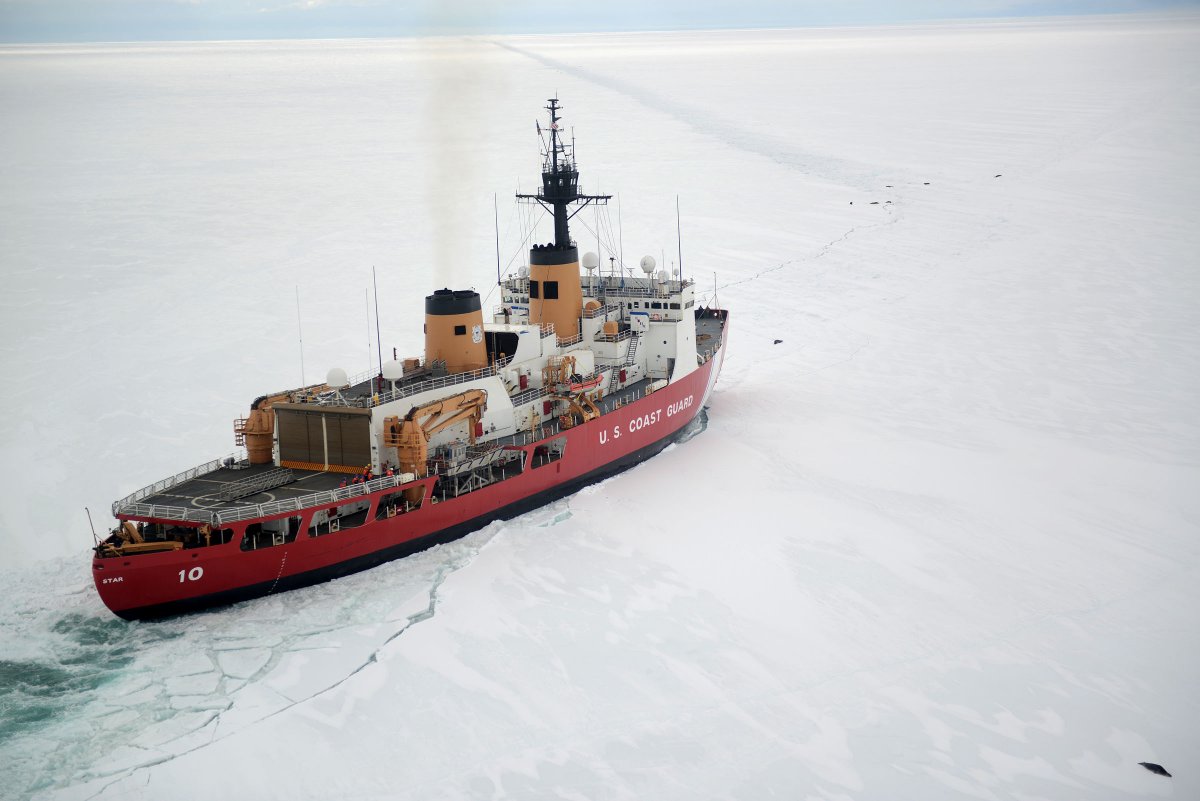
The Coast Guard Cutter Polar Star cuts through Antarctic ice in the Ross Sea near a large group of seals as the ship’s crew creates a navigation channel for supply ships, January 16, 2017. The resupply channel is an essential part of the yearly delivery of essential supplies to the National Science Foundation’s McMurdo Station.US Coast Guard photo by Chief Petty Officer David Mosley

National Defense reports,

“Canada-based manufacturer Gastops will collect data on the USCGC Polar Star — a ship built in the 1970s — to create a computer model that can undergo risk assessments at a relatively low cost, said Shaun Horning, president and CEO of the company.”

Results will feed into the planned service life extension intended to allow Polar Star to continue operating, at least until the second Polar Security Cutter is commissioned.

“…replacing the Polar Star’s 30-year-old analog control system with a digital control system will be one aspect of the refurbishment that will need to be tested extensively, Horning noted.”

This is the first time I have heard of the Coast Guard developing a “digital twin,” but this is becoming increasingly common. We can probably expect to hear of this being applied to other Coast Guard systems.

“Coast Guard to commission new unit in Memphis” –News Release

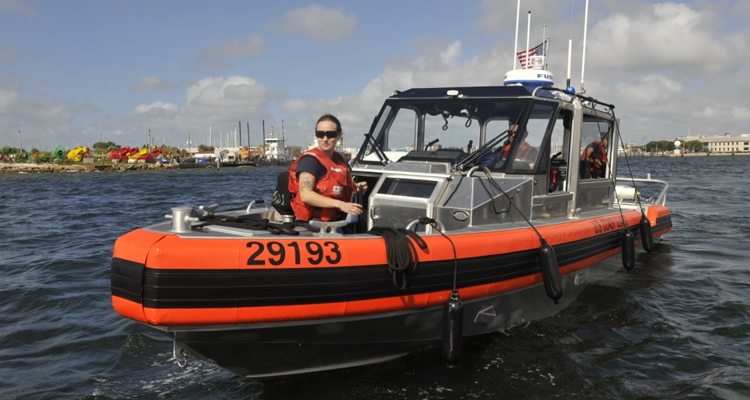
A boat crew from Coast Guard Station St. Petersburg, Florida, conducts training near the station on a new 29-foot response boat-small II Aug. 25, 2014. The Coast Guard placed a delivery order for 20 additional boats Jan. 12, 2018. U.S. Coast Guard photo by Seaman Meredith Manning.

Below is a news release from D8. What I found interesting here is,

“Station Memphis is the second of five new Coast Guard stations to be commissioned in the Coast Guard 8th District’s Western Rivers Sectors.”

The push for new infrastructure seems to be working. Also note the statement, “…. is deployable to the Gulf of Mexico for hurricane flood response.” apparently in response to the repeated need to respond to flooding in the Eight District.

Media Advisory

U.S. Coast Guard 8th District Heartland
Contact: 8th District Public Affairs

Coast Guard to commission new unit in Memphis

WHO: Capt. Ryan Rhodes, Sector Lower Mississippi River commander, Cmdr. Erick Neussl, Sector Lower Mississippi River deputy commander, Lt. Jamal Scarlett, Sector Upper Mississippi River chaplain, Petty Officer 1st Class Matthew Rollins, Station Memphis prospective officer-in-charge.

WHAT: Commissioning ceremony for Coast Guard Station Memphis 

WHERE: FedEx Event Center, 415 Great View Drive East, Cordova, TN 38018 (Suite 103)

WHEN: 10 a.m. Tuesday, Aug. 10, 2021 (Media should arrive no later than 9:30 a.m.)

MEMPHIS, Tenn. — The Coast Guard is scheduled Tuesday to commission its newest station, Coast Guard Station Memphis, during a ceremony at the FedEx Event Center in Cordova, Tennessee.

The station is responsible for search and rescue, recreational boating safety, ports, waterways, flood response, and coastal security. The station’s area of responsibility ranges from mile marker 720 to mile marker 750 on the Mississippi River, numerous lakes in Arkansas, and is deployable to the Gulf of Mexico for hurricane flood response. The station is equipped with two 29-Foot Response Boat-Small II and three shallow-water response boats. 

Station Memphis is the second of five new Coast Guard stations to be commissioned in the Coast Guard 8th District’s Western Rivers Sectors.

For more information follow us on Facebook and Twitter.

“Coast Guard exercises contract option for FRCs 61-64” –CG-9

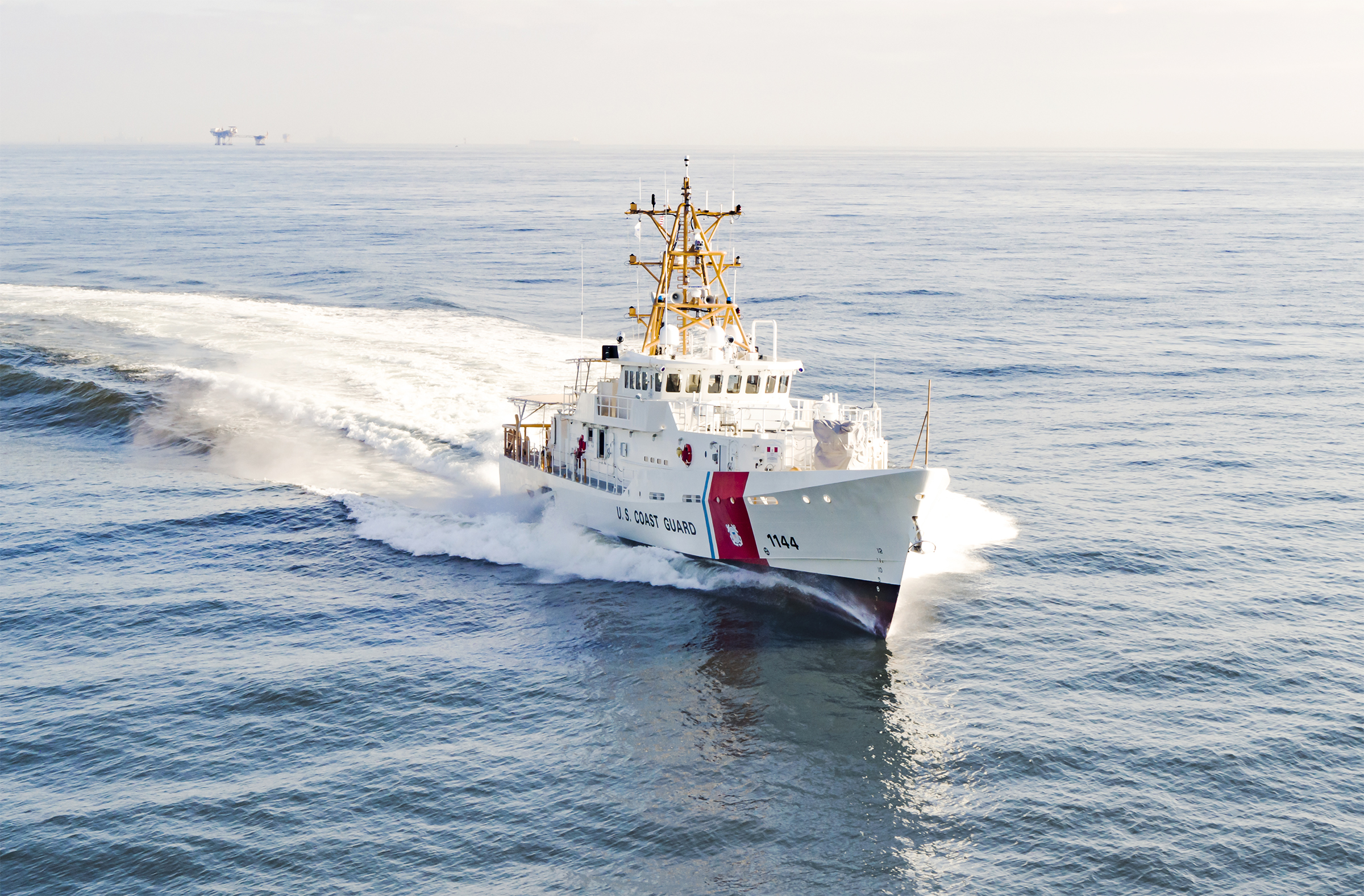
The last of 64 planned Webber class Fast Response Cutters have been funded and contracted. The Acquisitions Directorate (CG-9) reports

The Coast Guard exercised a contract option Aug. 4 for production of four more Sentinel-class fast response cutters (FRCs) and associated deliverables worth about $212.9 million with Bollinger Shipyards of Lockport, Louisiana.

This option brings the total number of FRCs under contract with Bollinger to 64 and the total value of the Phase 2 contract to approximately $1.7 billion. The FRCs built under this option will be delivered between October 2024 and June 2025.

To date, there are 43 FRCs in operational service.

FRCs have a maximum speed of over 28 knots, a range of 2,500 nautical miles and an endurance of five days. The ships are designed for multiple missions, including drug and migrant interdiction; ports, waterways and coastal security; fishery patrols; search and rescue; and national defense. They feature advanced command, control, communications, computers, intelligence, surveillance and reconnaissance equipment; over-the-horizon cutter boat deployment to reach vessels of interest; and improved habitability and seakeeping.

For more information: Fast Response Cutter Program page

Brits To Keep Two OPVs In the Indo-Pacific

The Royal Navy is sending two of their River Class Batch II offshore patrol vessels to serve long term in the Indo-Pacific.

We have talked about the River Class Batch II ships and their close relatives several times, here, here, here, and here.

Interesting to see camouflage applied to these ships. I also note they are commanded by Lt. Commanders. The crews on these ships are about half what we would expect on a comparable Coast Guard Cutter. In all probability crews will be rotated as was done with the crew of the earlier River class OPV, HMS Clyde, stationed in the Falklands.

The video makes it sound like these will both be going to the Pacific, with no British bases in the area, but Indo-Pacific includes the Indian Ocean as well and the British have a base in Bahrain and while it is also a US base, Diego Garcia is a British possession. Still it sounds like they will be making the rounds showing the flag.

These ships will join Britain’s planned Indo-Pacific Littoral Response Group (LRG) when it is formed. Two such groups are planned, one in Northern Europe and a second to be based in Oman.

“Coast Guard Cutter James conducts largest illegal narcotic offload in Coast Guard history worth more than $1.4 billion at Port Everglades” –News Release

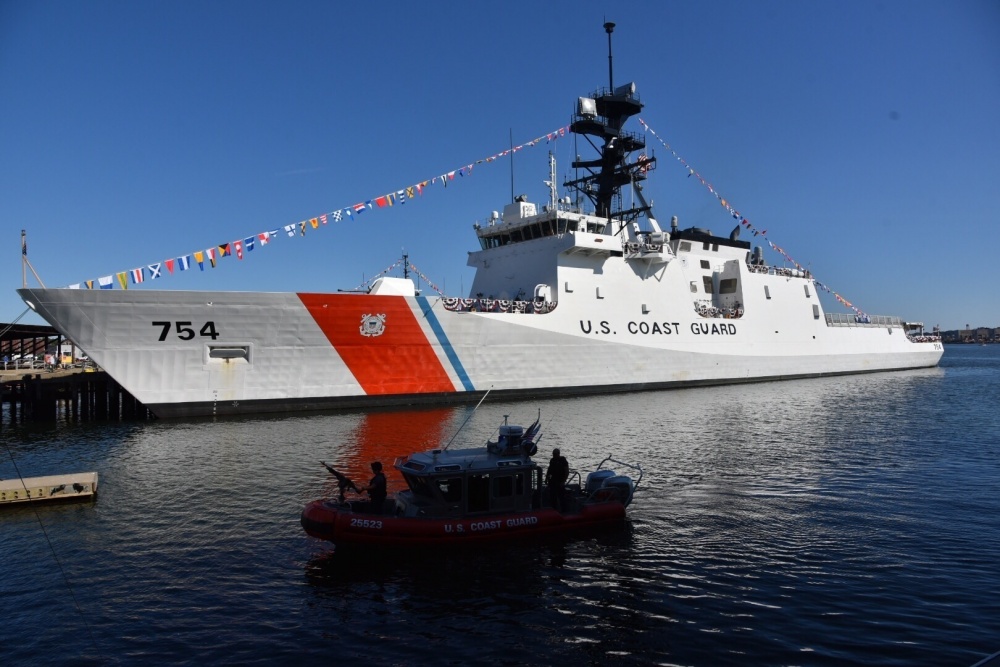
The Coast Guard Cutter Joshua James moored during its commissioning ceremony at Base Boston, Aug. 8, 2015. The Cutter Joshua James is a 418-foot National Security Cutter that will be homeported in Charleston, S.C. (Coast Guard photo by Petty Officer 2nd Class Patrick Kelley)

Below is a news release from District Seven. I don’t normally pass these along, but this one is a bit unusual, in the quantity of the offload and the ships involved in the 27 seizures or recoveries.

Almost 30 tons of Cocaine, plus a bit of Marijuana, and it came from the usual locations, “international waters of the Eastern Pacific Ocean off the coasts of Mexico, Central and South America, and the Caribbean Sea.

All the ships involved here came from the Atlantic side. All four WMECs and the three LCS involved were all based in Florida. This reminds us that, using the Panama Canal, the Eastern Pacific drug transit zones are actually closer to Florida than to California.

It may be significant that the three Navy ships are all Freedom class LCS, which up until now seem to have had more than their share of problems, yet they appear to have succeeded here. On the other hand it may be that this is the least demanding type of deployment they can do.

Nice to see recognition for our Dutch and Canadian friends as well. The Canadian ship is actually smaller than a 210. The Dutch ship is in many ways similar to the Offshore Patrol Cutter, only slightly smaller with a much smaller crew.

united states coast guard 
Multimedia Release U.S. Coast Guard 7th District Southeast

Coast Guard Cutter James conducts largest illegal narcotic offload in Coast Guard history worth more than $1.4 billion at Port Everglades
234      Editor’s Note: Due to Defense Visual Information Distribution Service experiencing technical difficulties, we are unable to provide a full-resolution link to our images.

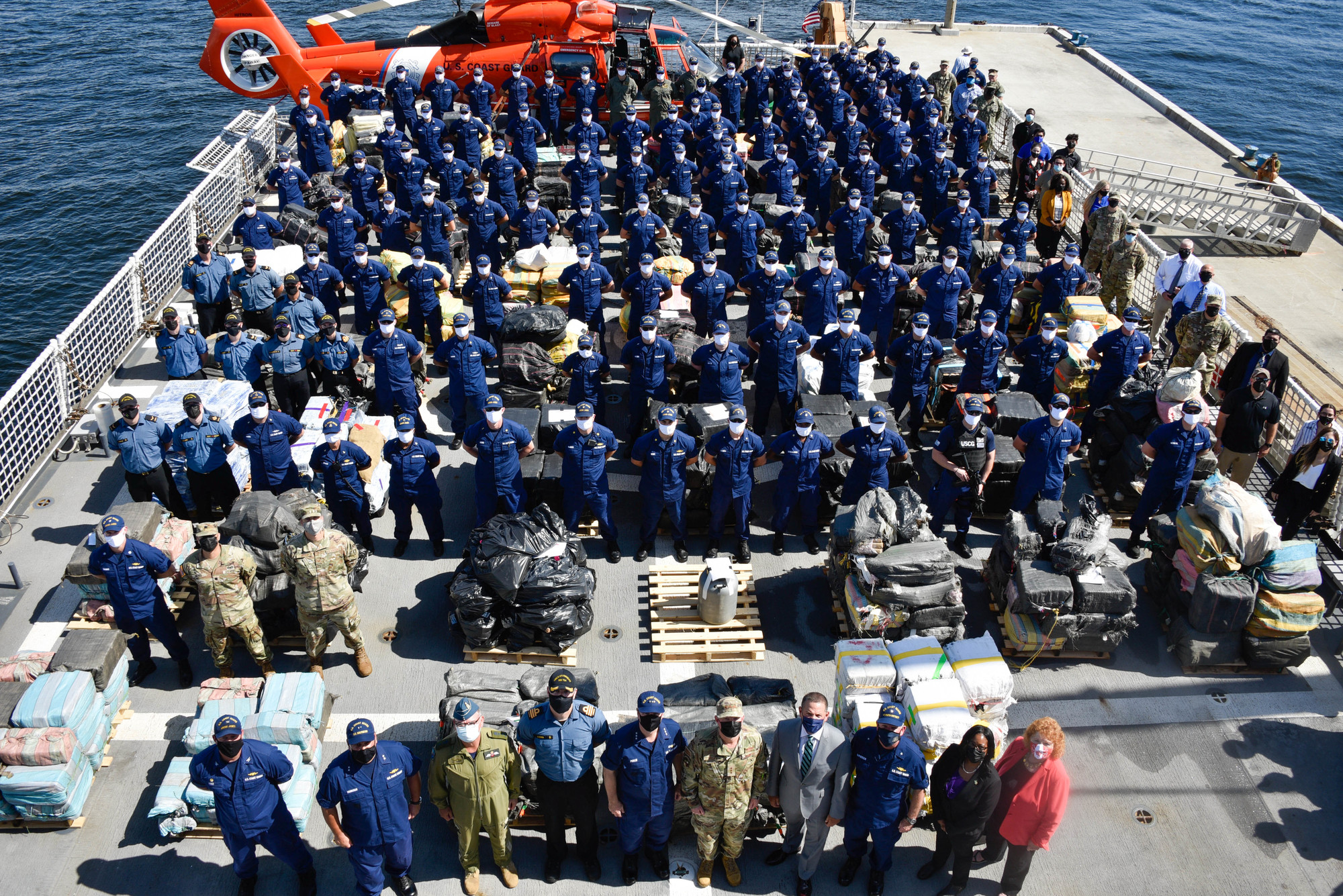
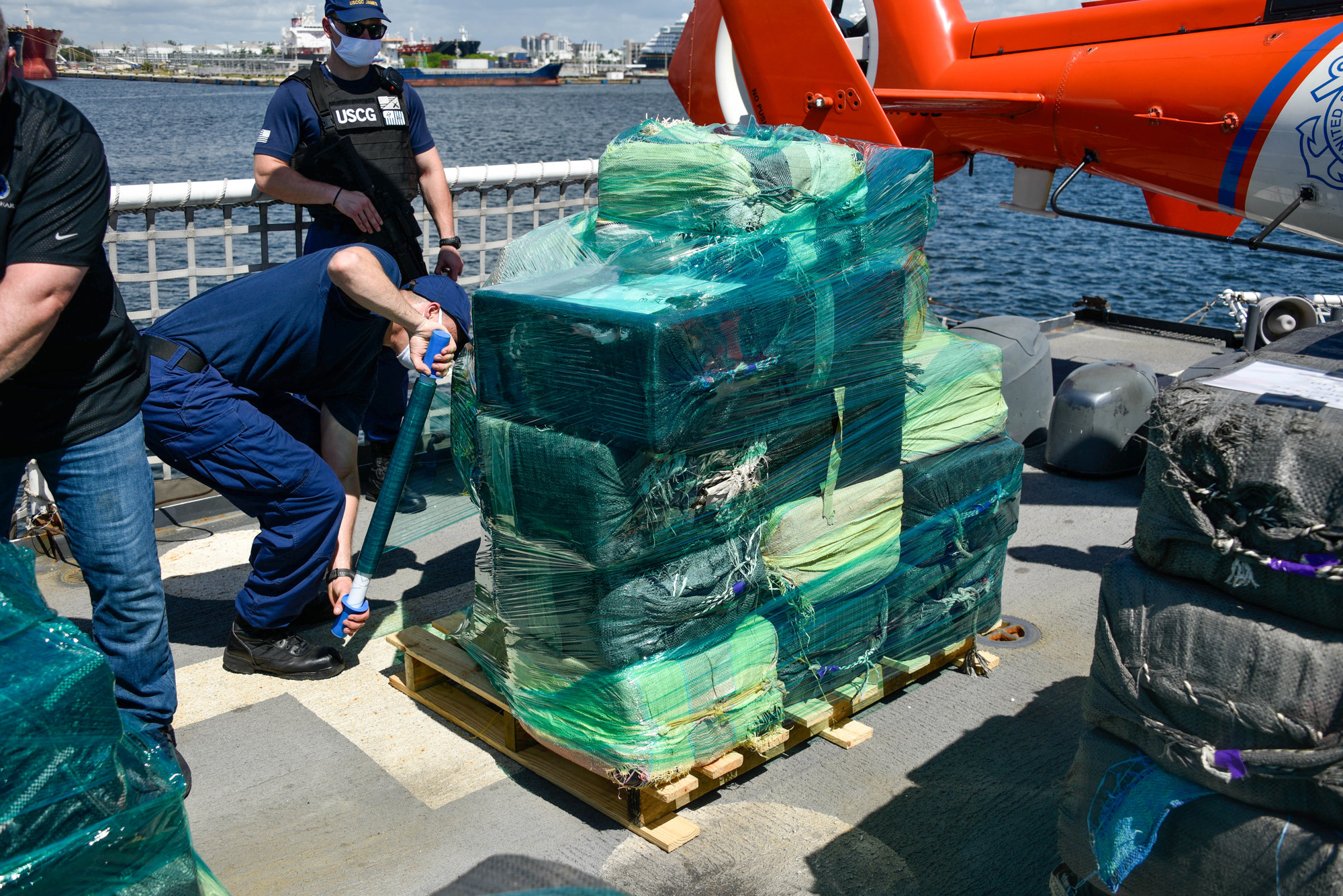
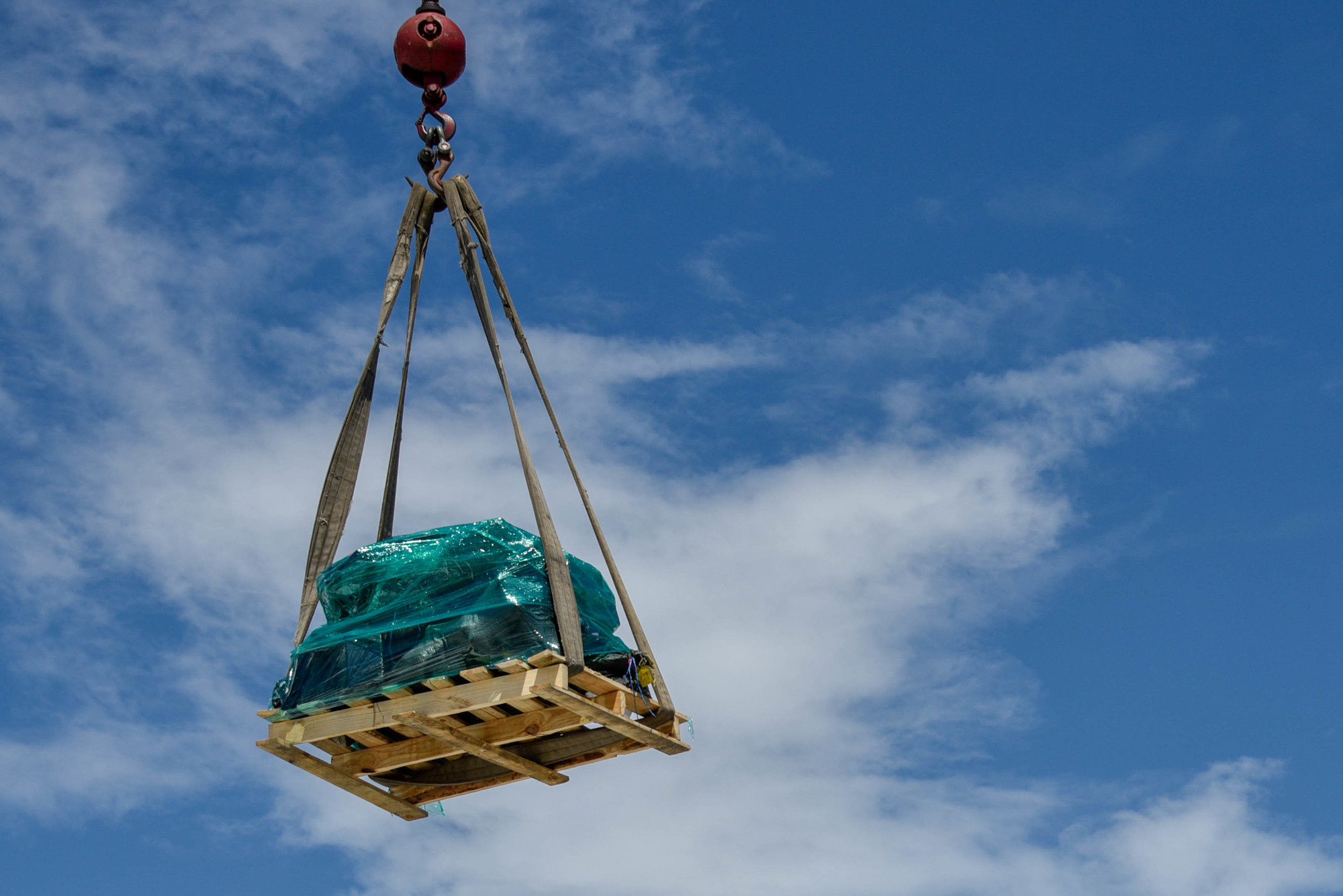
MIAMI — Coast Guard Cutter James’ crew offloaded approximately 59,700 pounds of cocaine and 1,430 pounds of marijuana worth more than $1.4 billion, Thursday, at Port Everglades, which is the largest offload in Coast Guard history.

The Coast Guard’s strong international relationships, with key partners like Canada and the Netherlands, along with our specialized capabilities and unmatched authorities, allow for a unity of effort to disrupt transnational crime organizations, which threaten America and our partner nations.

“Today’s offload is a result of our combined efforts of our inter-agency partners and a dedicated international coalition,” said Vice Adm. Steven Poulin, Commander Atlantic Area. “The Canadian government and Canadian Defence Forces brings an incredible capability in defeating transnational organized crime, and I’m grateful to HMCS Shawinigan to showcase Canada’s commitment. Together we will disrupt, defeat and degrade transnational organized crime. We will strengthen our efforts and continue to build collaboration and capability.”

“Canada and America are committed to expanding cooperation on defending North America against illicit trafficking and transnational crime and working together within our alliances,” said Maj. Gen. Paul Ormsby, Canadian Defence Attache. “We know that no nation can do it alone, and we know that we are stronger together. The kind of cooperation that we see on the pier today is one of the thousands of impressive examples of cooperation every day.

“The drugs were interdicted in international waters of the Eastern Pacific Ocean off the coasts of Mexico, Central and South America, and the Caribbean Sea including contraband seized and recovered during 27 interdictions of suspected drug smuggling vessels by 10 American, Dutch and Canadian ships:

Coast Guard Cutter James
Coast Guard Cutter Mohawk
Coast Guard Cutter Dauntless
Coast Guard Cutter Thetis
Coast Guard Cutter Confidence 
USS Wichita
USS Sioux City
USS Billings
HNLMS Holland (I added the link for this one–Chuck)
HMCS Shawinigan

Numerous U.S. agencies from the Departments of Defense, Justice and Homeland Security cooperated in the effort to combat transnational organized crime. The Coast Guard, Navy, Customs and Border Protection, FBI, Drug Enforcement Administration, and Immigration and Customs Enforcement, along with allied and international partner agencies, play a role in counter-drug operations. The fight against drug cartels in the Eastern Pacific Ocean requires unity of effort in all phases from detection, monitoring and interdictions, to criminal prosecutions by U.S. Attorneys in districts across the nation.

During at-sea interdictions, a suspect vessel is initially detected and monitored by allied, military or law enforcement personnel coordinated by Joint Interagency Task Force-South based in Key West, Florida. The law enforcement phase of counter-smuggling operations in the Eastern Pacific is conducted under the authority of the Coast Guard 11th District, headquartered in Alameda, California. The interdictions, including the actual boardings, are led and conducted by members of the U.S. Coast Guard.

The fight against drug cartels in the Eastern Pacific Ocean and the Caribbean Sea requires unity of effort in all phases from detection, monitoring and interdictions, to criminal prosecutions by international partners and U.S. Attorneys’ Offices in districts across the nation. The law enforcement phase of counter-smuggling operations in the Eastern Pacific Ocean is conducted under the authority of the Coast Guard 11th District, headquartered in Alameda, California, and the law enforcement phase of operations in the Caribbean is conducted under the authority of the Coast Guard 7th District, headquartered in Miami. The interdictions, including the actual boardings, are led and conducted by members of the U.S. Coast Guard. 

The cutter James is a 418-foot national security cutter home ported in Charleston, South Carolina. The cutter Mohawk is a 270-foot medium endurance cutter home ported in Key West, Florida. The cutter Dauntless is a 210-foot medium endurance cutter homeported in Pensacola, Florida. The cutter Thetis is a 270-foot medium endurance cutter homeported in Key West, Florida. The cutter Confidence is a 210-foot medium endurance cutter homeported in Port Canaveral, Florida. The USS Wichita is a 378-foot freedom-class littoral combat ship homeported in Naval Station Mayport, Florida. The USS Sioux City is a 378-foot Freedom-class littoral combat ship homeported in Naval Station Mayport, Florida. The USS Billings is a 378-foot Freedom-class littoral combat ship homeported in Naval Station Mayport, Florida. The Royal Netherlands Navy HNLMS Holland is a 356-foot Holland-class offshore patrol vessel homeported in Den Helder, Netherlands. The HMCS Shawinigan is a 181-foot Kingston-class coastal defence vessel homeported in Halifax, Canada. For more breaking news follow us on Twitter and Facebook.