Mini-torpedo, Torpedo Decoys, and three Gun Systems from Leonardo

Graphic from Leonardo

Naval News reports on a virtual conference expo showcasing five systems presented by Leonardo aimed at Middle Eastern clientele.

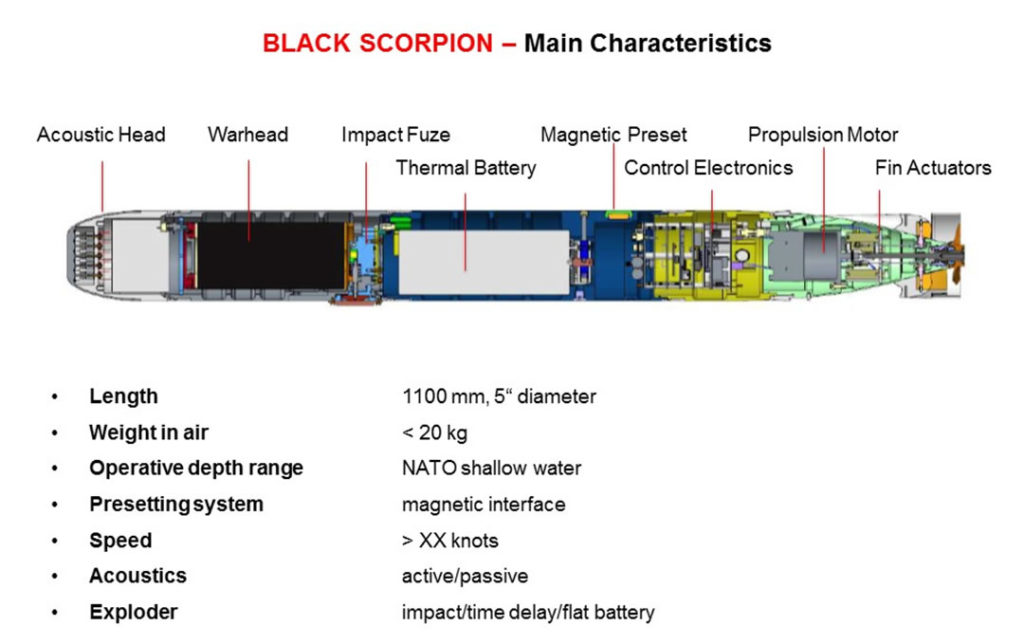
There is information about an anti-torpedo defense system, the 5″/64 gun, the familiar 76mm/62 gun, and the Marlin 40mm gun systems and their associated ammunitions and support systems. But the real surprise was a mini-torpedo, called Black Scorpion.

Graphic from Leonardo

I have a hard time figuring what will be done with this mini(micro)-torpedo. They say it will work from “Unmanned Surface Vessels (USVs), SEAL Delivery Vehicles (SDVs), Patrol Boats, Fast Attack Crafts, helicopter/drones, Unmanned Aerial Vehicles (UAVs), and Unmanned Underwater Vessels (UUVs).”

Launchers are illustrated for submarines, fast inshore attack craft, and helicopters and drones.

There are a lot of unexplained parameters for this weapon. Presumably it can operate at depth some depth if it is to be launched from a submarine but there is specific reference to ASW in the littoral, so it might be relatively shallow. What is its range and speed? Less than 44 inches long and with an all up weight of less than 44 pounds, it is unlikely the warhead is much larger than ten pounds. It unlikely to sink anything of more than about 100 tons, but it might be enough to disable the rudder or propeller on even a large ship. There are warnings in the text not to expect too much.

“The Leonardo conference host presenter stressed that this is a miniature lightweight torpedo and performs as such. Thus, the user should not expect the range, performance, and characteristics of a comparable lightweight, medium, or heavyweight torpedo…”

I sure would like to see some testing of this and the Grumman Common Very Light Weight Torpedo which is about five times larger. One of them might be the ship stopper the Coast Guard needs.


Russia’s New 57mm Remotely Operated Weapon Station for Naval Applications

AU-220М “Baikal” caliber 57-mm remote weapon station. (Picture source Topwar.ru)

Navy Recognition reports that Russia’s Burevestnik scientific-and-research Institute has developed a naval version of their 57mm Remotely Controlled Weapons Station (ROWS).

The baseline AU-220M ROWS weighs 3,650 kg (with a gun mount) (about 8000 pounds–Chuck) and is armed with a 57 mm automatic cannon and a 6P7K 7.62 mm coaxial general-purpose machinegun (GPMG). The main gun’s ammunition load comprises 80 armor-piercing (AP), high-explosive fragmentation (HE-Frag), and guided artillery (GAP) projectiles. (It is not clear if the guided projectile would work against a moving target–Chuck) The weapon produces a rate of fire of 80 rounds per minute and engages ground targets at a distance of up to 14.5 km. The GPMG carries an ammunition load of 500 7.62 mm cartridges. The module’s frontal armor provides Level 5 STANAG 4569 protection against 30 mm rounds; the station also features Level 3 STANAG 4569 all-round protection against 7.62 mm bullets. The AU-220M’s sensor suite comprises a TV camera, a thermal imager, and an independent dual-axis field-of-view stabilizer. The module is also fitted with laser rangefinders.

For comparison, our 57mm Mk 110 weighs 16,535 lbs. (7,500 kg), more than twice as much, and requires a separate, additional fire control system. The 25mm Mk38 Mod3 weighs 2,300 lbs. (1,042 kg).

The Swedish designed USN 57mm does have a higher rate of fire (220 rpm vs 80) and more rounds on the mount. Range and projectile weight are similar. Our firecontrol systems associated with the USN 57mm are certainly more sophisticated than the one included on this stand alone Russian system.

I’m guessing, but the US system probably also has higher train and elevation rates, making it a better anti-aircraft mount, but that would have little effect on its performance against surface target.

It may be used in lieu of the 30 mm/65 (1.2″) AK-630. U.S. Navy Photograph No. DN-SC-93-05853 aboard USNS Hiddensee.

I suspect we may see this mount used much like the 25mm Mk38 Mod 2/3, instead of the AK-630, 30mm Gatling gun (above), currently mounted on many small Russian Combatants (including Russian Coast Guard vessels like these) with only simple optical fire control systems. For these installations, it is primarily an anti-surface system rather than an anti-missile Close In Weapon System.

I do envy their 57mm’s Armor Piercing round. That might be useful in forcibly stopping a vessel.

“PROJECT TRIDENT CALL FOR ARTICLES: REGIONAL MARITIME POWERS AND STRATEGIES” –CIMSEC

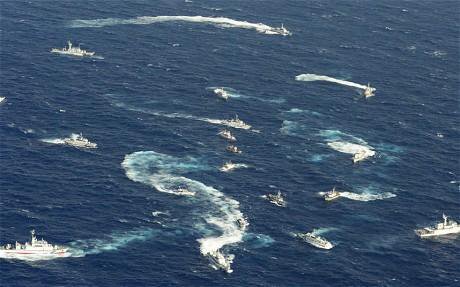
A water cannon battle between Taiwanese and Japanese Coast Guard vessels.

Center for International Maritime Security (CIMSEC) is partnering with  the Yokosuka Council on Asia Pacific Studies, the Institute for Security Policy Kiel University, and the Dominican Command and Naval Staff School in a call for articles addressing the  impact of regional maritime powers and strategies on future international maritime security.

There is certainly no shortage of problems to address. We have Chinese bullying in the South China Sea; piracy in the Gulf of Guinea; transnational criminal organizations; Illegal, Unreported, Unregulated (IUU) fishing; excessive claims of sovereignty by Russia and Venezuela; unresolved claims to mineral resources in the Eastern Mediterranean.

Hopefully some of our readers will have opinions that might address these or other concerns.

“Patria and Kongsberg Teaming Up for U.S. Turreted Mortar Programs” Defense-Aerospace

Defense-Aerospace.com reports that,

Patria and Kongsberg Defence & Aerospace have teamed up for the future U.S. turreted mortar programs.

The news here is simply that the US Army has a program to procure a turreted mortar. I don’t think the US has ever had one, at least not since the 19th century.

They offer some interesting possibilities for arming small naval craft like patrol boats. For our purposes, they are effectively low velocity short range cannon, that can fire a relatively large projectile, while requiring far less of the vessel than a typical higher velocity naval gun.

Looking specifically at the 120mm mortar, it fires a 4.7″ diameter projectile weighing about 30 pounds (I have seen weights quoted from 28 to 31 pounds. Part of the weight would be consumed propelling the projectile since this is both projectile and propellent).  That is less than half the weight of a modern 5″ projectile (70 pounds) but about five times the weight of a 57mm projectile, and the Patria turret has been mounted on some very small vessels. It has even been tested at sea in a standard sized 20 foot container.

Unguided mortar rounds tend to be less accurate than typical naval guns, but guided rounds are changing that. The Army is working on a new round.

The HEGM program objective is to create a round accurate to within one meter CEP, with dual GPS/SAL (Semi-Active Laser–Chuck) guidance to hit targets that have relocated and to function in a GPS-degraded environment.

Range is about 8,000 yards, similar to that of the Hellfire or the effective range of the 57mm Mk110 or 76mm Mk75 guns using unguided projectiles. I have seen ranges double that for smart mortar rounds. In any case, it would have sufficient range to fire from outside the effective range of likely improvised armament for a terrorist controlled vessel.

The Coast Guard is not without experience in the use of mortars on patrol boats, having mounted them on 82 foot WPBs as well as other vessels during the Vietnam era.

Gun crew on board USCGC Point Comfort (WPB-82317) firing 81mm mortar during bombardment of suspected Viet Cong staging area one mile behind An Thoi.(August 1965)

It is behind the pay wall, but the US Naval Institute Proceedings has a short argument for the Navy to look seriously at adding mortars to Its inventory of weapons. In addition to its use as a weapon, the author contends that they could be used to launch decoys or UAS. He suggests:

“The Navy could take an incremental approach to integrating mortars onto ships:

  • “Task the Naval Surface Warfare Center at Indian Head, Maryland, with testing a variety of available mortar rounds for effectiveness against maritime targets, potential for countermeasure launching, and suitability for shipboard use.
  • “Encourage the Marine Corps and the Naval Research Lab to pursue an anti-armor version of the ACERM.
  • “Fire existing Marine Corps and Army mortars from ships during a SinkEx. Assess their effectiveness on the target and their structural impact on the ship.”

This is not as good an answer to the problem of stopping larger vessels, that might be used in a terror attack, as torpedoes (probably the best solution) or missiles like Hellfire (a good solution against small vessel threats with some capability against larger vessels), but it has some capability and would also make our patrol boats more useful in the support of troops in the littorals against targets on land.

As always, this is never going to happen unless the Navy adopts the weapon. That is unlikely for the larger Navy, but the Special Warfare community might be interested.

Diesel Outboard

The video above is from the December 2018 New Orleans International Work Boat Show

MarineLink reports that Cox has announced that they have begun shipping production models of their 300HP diesel outboard motor.

The Coast Guard had a hand in developing this diesel outboard, noted here Feb. 2017.

“The US Coast Guard has entered into a Cooperative Research and Development Agreement (CRADA) with British diesel engine innovator, Cox Powertrain. The CRADA will evaluate and test the advantages, disadvantages, required technology enhancements, performance, costs and other issues associated with diesel outboard engine technology.”

Quoted here from a Marine Log report in November, 2018:

“Delivering 300 horsepower at the propeller, the CXO300 is the world’s highest power density diesel outboard engine. The four stroke V8 diesel CXO300 offers up to 25% more range compared to gasoline outboards and is designed to last up to three times longer. The engine combines the simplicity and economy of an outboard installation with greatly improved safety and reliability achieved by eliminating the need for highly volatile gasoline.”

“Videos – Stellar Banner becomes largest ship to be sunk deliberately” –SWZ Maritime

SWZMaritime reports the intentional sinking of the four year old 300,000 ton ore carrier Stellar Banner, reportedly the largest vessels ever scuttled.

That they chose not to attempt to scrap this vessel tells us a lot about the state of the world wide ship salvage and recycling business. This happened off Brazil. Something similar could happen in a US port. In the future, a Coast Guard Captain of the Port might be asked about the possibility of an intentional sinking.

Thanks to Sven for bringing this to my attention.

Tidbits from the FY2021 Budget

US Capital West Side, by Martin Falbisoner

Thanks to Justin1142, I was prompted to look through the Administration’s proposed Coast Guard FY2021 budget, all 343 pages.

This did clarify some things for me. This is by no means a comprehensive analysis, but just a few things I pickup on a Sunday afternoon.

The total budget request is up very slightly from the FY2020 enacted and less than the FY2019 enacted. The Operations and Support request is up almost 4.84% from 2020 which was up 4.59% from 2019. This is almost the 5% per year growth the CG has been saying they need. On the other hand the FY2021 Procurement, Conversion, & Improvements (PC&I) request was down 7.64% from the 2020 enacted and that was down 21.16% from the 2019 enacted.

Commissionings:

During FY2021, they expect to commission one NSC (#9 to Charleston) and five Webber class “Fast Response Cutters” (FRC), #41-45 (PC&I-33, page 180 of the pdf). Numbers 41, 42, and 45 will go to PATFORSWA. Later they will be joined by numbers 46, 47, and 48 (OCO-7, pdf 328). #43 will join #39 and #40 in Guam. #44 will join six other FRCs in Key West.

Personnel will start reporting to the Pre-Commissioning detail for OPC#1 which will be homeported in San Pedro.

Decommissionings:

They expect to decommission the last two 378s, two 110s currently with PATFORSWA, and eight 87′ WPBs.

“In accordance with the Coast Guard’s patrol boat transition plan and the Congressionally-directed transition of Coast Guard patrol forces in the Arabian Gulf, two WPBs supporting Patrol Forces Southwest Asia (PATFORSWA) will be decommissioned. Following these decommissionings, there will be eleven 110-foot patrol boats in the domestic operational fleet and four supporting PATFORSWA… The two WPBs being decommissioned will be replaced by more capable Fast Response Cutters (FRCs), which will be in-theater and operational before the legacy WPBs are decommissioned.” (O&S-28/29)

Observations: 

There is this interesting snippet from O&S-25 (62 page of pdf), “The San Diego region saw a 100 percent increase of illegal immigration cases in the maritime domain in FY 2018. This trend will likely continue as the land border is reinforced.”

We are going to again see NSCs and FRCs doing fisheries and capacity building in the Western Pacific (Program Change 25, O&S-36)

What’s in the Budget?:

Improved SAT com for cutters is on the way.

Program Change 29 – Overseas Contingency Operations to Base Transition (O&S-38): At the end of the document, there is an explanation of Overseas Contingency Operations (OCO). This has been a separate funding item, but it is being folded into the normal Operations and Support (O&S) budget. In FY2019 it was $165M and $190M in FY2020. This has been zeroed out for FY2021 as funding ($215M) was included in O&S, so the O&S budget increase is not as large as it looks. (OCO-4, pdf 325)

Included are funds for the second Polar Security Cutter, the third OPC, and Long Lead Time Materials (LLTM) for OPC #4, as well as $25M for the Waterways Commerce Cutter program and $20M for FRC program follow up, but no additional FRCs.

There is money for In-Service Vessel Sustainment/Service Life Extension Programs (SLEP) for Polar Star, 270s, 225′ buoy tenders and 47′ motor life boats.

“WMEC SLEP includes electrical system upgrades, remanufactured main diesel engines, structural renewal for stern tube and piping, and installation of a new gun weapon system supplied by the U.S. Navy. “

Regarding the new weapon system for the 270s, I suspect that we are talking about replacing the 76mm Mk75 gun and Mk92 fire control systems with 25mm Mk38 Mod2/3 systems. I heard that at one point, that that they were considering adding the 57mm but had decided against it. Replacing the 76mm and fire control with a Mk38 should significantly reduce maintenance and perhaps crew requirements, but it would mean loss of any air search capabilities. A new multimode radar might be a good idea for control of helicopter and Unmanned Air System such as Scan Eagle (assuming one is added).

As you know, if you have been reading here for any length of time, I don’t have a lot of confidence in the 25mm to forcibly stop anything more than a very small vessel (see  here also). I would feel a lot more comfortable with a larger caliber weapon and, larger or not, with at least two systems to provide a degree of redundancy. 

Don’t expect NSC#10 keel laying until FY2021, so its going to be a while before #10 and #11 are operational (2024 and 2025).

Completion of Polar Security Cutters (PSC) #1 and #2 is expected Q3 FY2024 and Q4 FY2025 (PC&I-41)

There is only $153.6M for aircraft in the FY2021 PC&I budget. Mostly C-27 and H-65 conversion and sustainment. No C-130J in the budget. (PC&I-48, pdf 195)

What will Congress do?:

In the last few years the Congress has consistently give the Coast Guard more than requested in the administration’s budget. Two of their favorite programs have been the Webber class WPCs (FRCs) and C-130Js. I suspect the Congress will add the last two Webber class planned but not yet funded. They will also probably fund an additional C-130J. That will add approximately $250M to the PC&I budget, pushing it slightly higher than enacted in FY2020 but still well below the FY2019 budget.

Will they fund NSC #12? Fully funding OPC #4 might make more sense. Delivery schedule probably would not be much different, but there is still an appealing symmetry to replacing 12 ships with 12 ships. There is not as much price difference between the ship classes as there once was. Eastern has yet to prove they can produce a cutter at the agreed upon price, and the NSC is a proven product. HII also probably has more influence in Congress. However, adding about $600M, along with the more probable additions above, would push the PC&I budget close to $2.5B. That is about 10% higher than I think we have seen before, certainly a huge increase over FY2020. After all the deficit spending in response to COVID-19, it seems unlikely.

The Navy’s New Frigate

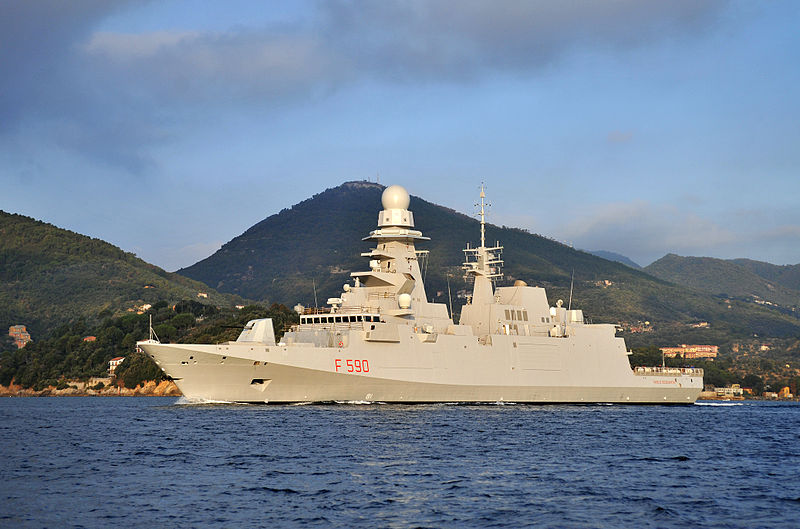
Italian FREMM Bergamini. photo by Fabius1975–no its not going to look like this

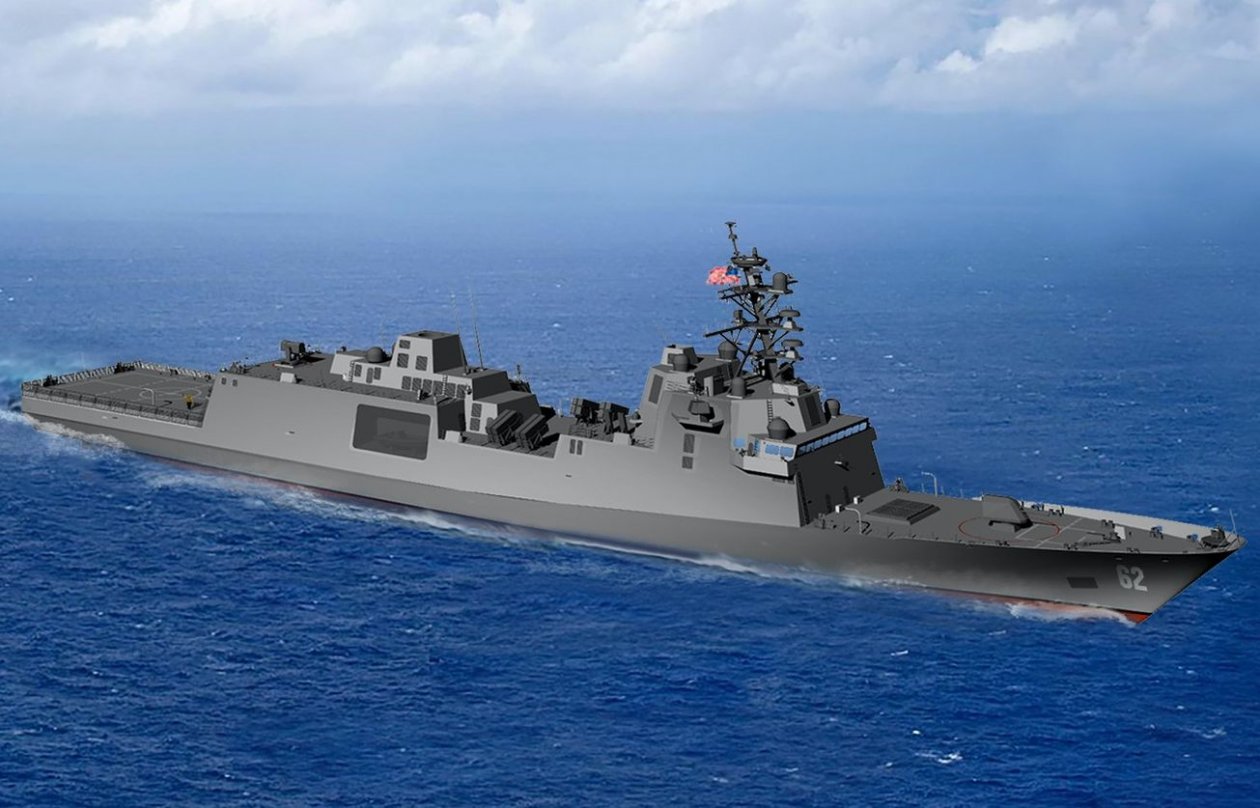
The US Naval Institute has a one page description of the new Navy frigate in the July 2020 issue of Proceedings, including a nicely annotated side view of the ship (you can see it here). Other than the diagram and the intro, the article is behind the paywall. It not only illustrates how the ship is equipped, it also explains the differences between the US version and the Italian version. I will summarize and include some observations.

The already large FREMM frigate grows to 7,400 tons and 496 feet in length, an increase of “more than 500 tons” (700 tons according to Wikipedia) and 22 feet in length. Draft is reduced from 24 to 23 feet, but only because there is no bow mounted sonar, so the draft over the rest of the hull is likely greater.

This large size appears to open the possibility of a smaller combatant class of 2,000-4,000 tons which might be dual service (Navy/Coast Guard) ships, or perhaps simply an upgraded Bertholf class.

It appears the power plant is much the same as the Italian version, combined diesel electric and gas turbine. In the Italian ships, that consists of four diesel generators totaling roughly 15,000 HP, two electric propulsion motors totaling 5 MW or about 6700 HP, plus an LM2500 gas turbine rated at 32 MW or about 42,895 HP. The combination is reportedly good for more than 30 knots in the Italian frigates and the US version should not be much different despite the increase in displacement. The USNI report claims only a sustained speed in excess of 26 knots. I would note that this is slightly less total horsepower than the National Security cutters.

The one characteristic of the design that gives me pause is the cruise speed. For the Italian frigate the reported max is 17 knots, limited by the power of the electric motors. The USNI article reports a cruising range of 6,000 nmi at a speed of 16 knots in electric mode. These ships are likely to, at some point, perform escort duty for convoys or amphibious ready groups. Many modern merchant ships and all amphibious ready group ships can maintain 20+ knots. It is entirely possible that they may need to escort convoys with a base speed of 18 knots or more, which would require them to operate almost continuously on their one turbine engine which would seriously degrade their range. It is possible they have included higher power electric motors which might allow a 20 knot cruise, but there has been no indication of this. When escorting an aircarrier, they would be expected to operate on turbine virtually al the time, but in that case at least a tanker can be expected to be near by.

The systems reported on the new frigate include:

  • .50 cal. machine guns, looks like ten positions: four bow, two stern, four in the superstructure.
  • 57mm Mk110, ALaMO ammunition is mentioned as a capability.
  • 32 cell Mk41 VLS for SM-2 and quad-packed ESSM (no mention of vertical launch ASROC but that should be a possibility)
  • SPY-6(V)3 EASR multi-function radar, a smaller version of the radar being used on the latest Burke class DDGs
  • Mk20 Electro-optic gun fire control system
  • Cooperative Engagement Capability Datalink
  • UPX-29 IFF
  • SLQ-32(V)6 SEWIP EW system
  • Mk 53 Nulka decoy launchers
  • 16 (four quad) RGM-184 Naval Strike missile launchers
  • 7 meter RHIB hangar
  • 21 tube Mk49 RIM116 RAM launcher (on the hangar aft)
  • Hangar space for up to two MH-60R or one MH-60R and one MQ-8C Fire Scout
  • SQS-62 variable depth sonar
  • TB-37 multi-function towed array sonar
  • SLQ-61 lightweight tow or SLQ-25 Nixie towed torpedo decoy

Construction is expected to begin in 2022, first of class delivery 2026, and Initial Operational Capability (IOC) 2030. Apparently this is a contract with options for out years rather than a “Block Buy.”

Late Addition: Contrary to what I think I remember about the supposed equipment, there was no mention of vertical launch Hellfire. Notably there are none of the weapons normally associated with dealing with swarming high speed inshore attack craft e.g. no 25mm Mk38 and no 30mm Mk46, which seems surprising. Also don’t see a position that seems likely for a laser weapon, unless it is the small area elevated one deck forward of the RAM launcher and aft of the stack.


Navy Decommissioning Ships Commonly Used In Drug Enforcement

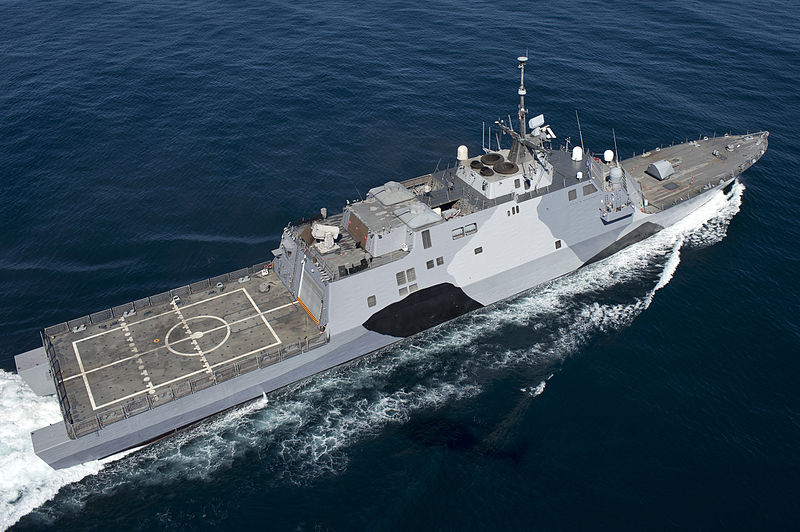
USS Freedom (LCS-1)

Seapower Magazine is reporting that the Navy is planning to decommission nine ships in FY2021, including four LCS three of which have made deployments to the Eastern Pacific drug transit zones and three Mayport based Cyclone class patrol craft that frequently patrol the Caribbean and have patrolled the Eastern Pacific with CG teams embarked.

The recent surge in Navy assets to the Eastern Pacific, while welcome, has been made possible primarily because four escort vessels that were part of a Carrier Strike Group were freed up when the Carrier remained in port to deal with COVID-19. Have to wonder if they will continue a commitment to the mission?

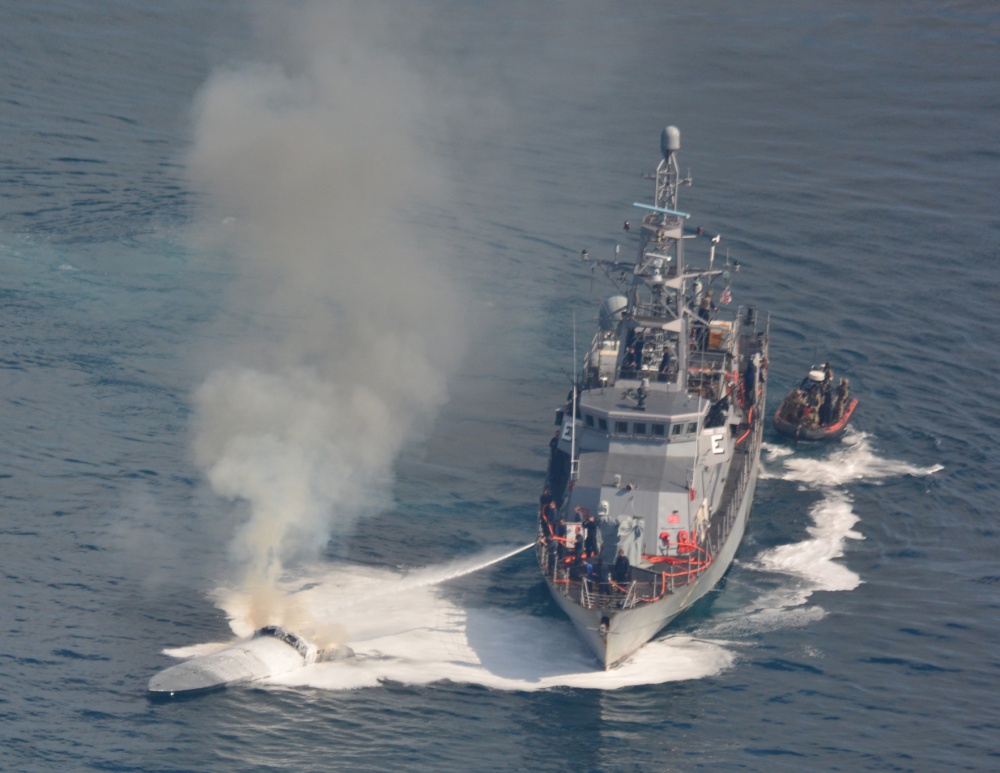
Cyclone-class patrol coastal USS Zephyr (PC 8) crew conducts ship-to-ship firefighting to extinguish a fire aboard a low-profile go-fast vessel suspected of smuggling in international waters of the Eastern Pacific Ocean April 7, 2018. Photo by Petty Officer 1st Class Mark Barney


Philippines’ New 94 Meter Cutter and the Japanese Kunigami Class Cutters

The MRRV has a length of 94 meters, a maximum speed of more than 24 knots and a range of more than 4,000 nautical miles. PCG image.

Naval News has provided computer generated images of new cutters being built in Japan for the Philippines. The first is expected to be delivered in 2022. These will be the largest ships in the Philippine Coast Guard.
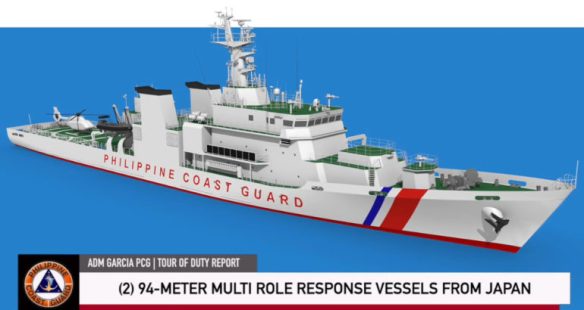
Naval News earlier reported there are to be two of the new class

The deal signed on February 7, 2020, is part of the second phase of the joint Japanese-Philippine Maritime Safety Capability Improvement Project (MSCIP). The contract value is 14.55 billion Japanese yen (132.57 million dollars) with financing via the Japan International Cooperation Agency (JICA).

The Philippine Coast Guard:

The Philippine EEZ is slightly less than 20% the size of that of the US. ThePhilippine Coast Guard (PCG) is a bit unusual. In terms of personnel, if we exclude the Philippine Marine Corp, the Philippine Coast Guard, with 17,000 members, is actually larger than the Philippine Navy (25,000 including 9,500 Marines). The PCG seems to have a large number of small craft, but relatively few aircraft (reportedly two fixed wing and three rotary wing ) and until recently, no large patrol ships.

Currently, all their aircraft are based in Manila. Inclusion of a hangar and flight deck on these new ships suggest they will get more helicopters.

Until the French built 84 meter (275.5′) Gabriela Silang was commissioned in April 2020, the Philippine Coast Guard had no Offshore Patrol Vessels of more than 1000 tons. Their largest ships were buoy tenders. Their largest OPVs were four 56 meter 540 ton full load San Juan class SAR vessels.  These two ships will triple the Philippine CG large OPV fleet.

Interestingly the Philippine Navy also has a current requirement for Offshore Patrol Vessels, that look a lot like coast guard vessels. These vessels, unlike the PCG cutters, will be armed with medium caliber guns.

The Philippine Coast Guard was moved out of the Department of National Defense to the Department of Transportation in 1998. It has prospered as a civilian agency, though one with military ranks and provision for wartime operation with the Philippine Navy. Its civilian nature has allowed the PCG to continue to receive aid from US, France, and particularly Japan, while aid to the Philippine military has been limited due to international reservations about the Philippines human rights record under President Duterte. The Philippine Coast Guard has been enjoying rapid growth. My 16th edition of Combat Fleets of the World, published in 2013, indicated only 3,500 members. If the reported figure of 17,000 is correct, that is a nearly 400% increase in size in seven years.

Japan Coast Guard: 

The Japanese EEZ is about 39.5% that of the US EEZ. The Japan Coast Guard has about 14,000 members, about 34% of that of the USCG. Unlike the USCG their responsibilities also include Hydrographic and oceanographic surveying.

The Japan CG (JCG) is a civilian agency, perhaps even more so than the PCG. Their cooperation with the Japanese Maritime Self Defense Force (the Japanese Navy) appears limited.

Their air wing is a little more than 1/3 the size of that of the USCG and actually includes more different aircraft types than are used by the USCG.

The JCG actually has more large patrol cutters than the USCG.

The Parent Design: 

The Parent design for the new Philippine cutters is the Kunigami class patrol vessel. This class is sometimes referred to as the Kunisaki class, since the first of class was renamed Kunisaki. This class is among the most numerous large coast guard cutters in the world. The first two were commissioned in April 2012 and while there are already 19 in commission, at least two more are planned. While they have a number of larger cutters, the Japan Coast Guard considers these large patrol cutters (PL).

These might be considered examples of Cutter X, relatively simple but sea worthy ships of a type I proposed for those missions that don’t require a 4,500 ton National Security Cutter or Offshore Patrol Cutter, but that would benefit from better endurance and seakeeping than available from the Webber class WPCs. 
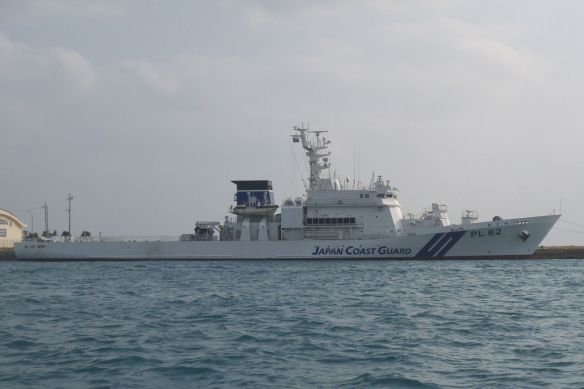
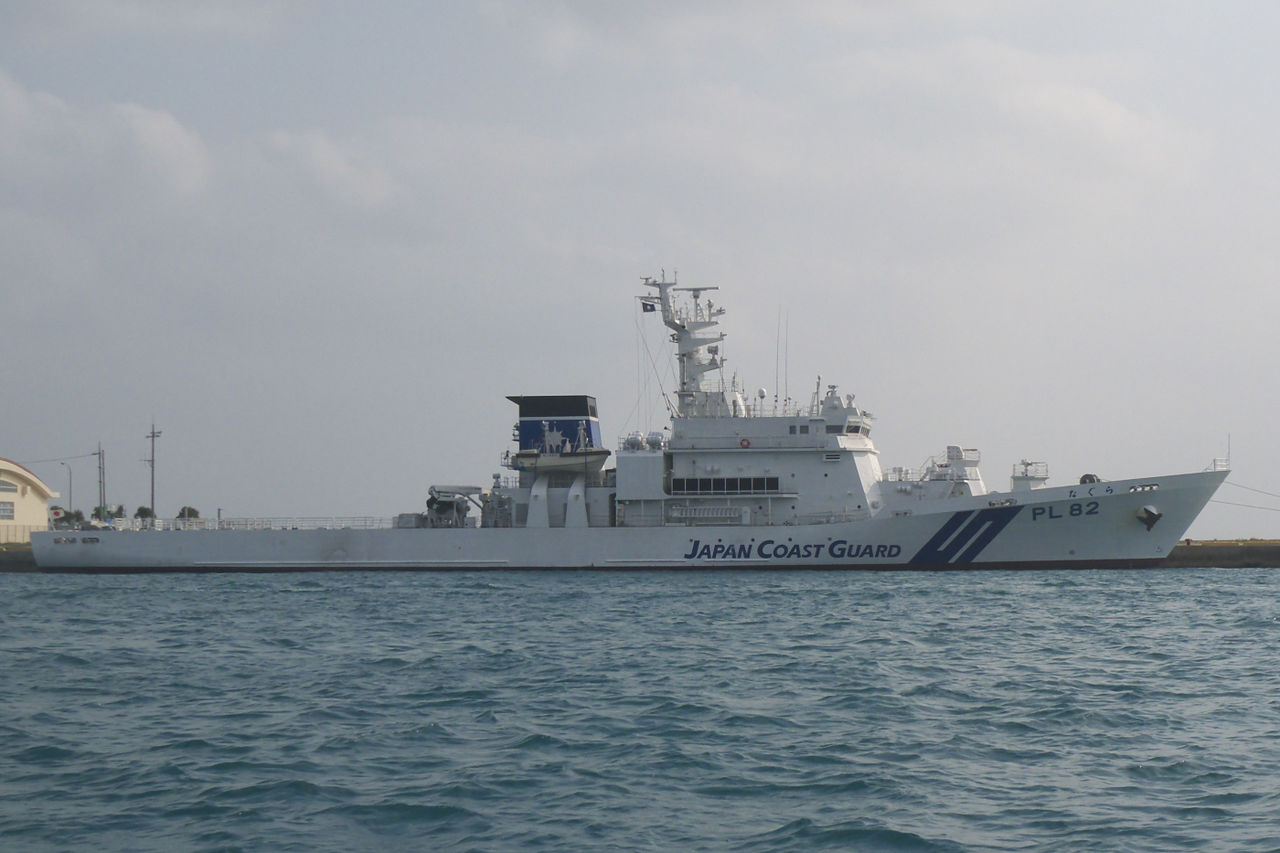
Japan Coast Guard patrol vessel PL82 Nagura at the Port of Ishigaki. Photo from Wikipedia Commons, by Yasu. More photos here.

The notable differences between the Japanese vessels and the new Philippine vessels are that the Philippine cutters have the funnel spit into two separate uptakes to allow for the addition of a helicopter hangar on the centerline, and there is no weapon other than water cannon apparent on the Philippine ship. I have not seen any indication that any Philippine Coast Guard cutters are armed with anything larger than the ubiquitous .50 cal. M2. The Philippine Coast Guard may want to reconsider this, in view of their continuing insurgency, and the rapid growth and militarization of coast guards in neighboring states, particularly China.

Choice of weapons: 

The Japan Coast Guard has been armed since its inception, initially with manual 3″/50s (that used to arm most USCG WMECs) and 40mm guns, but as these became obsolete, they were generally replaced by the 20mm JM-61 Gatling Gun.

The Battle of Amami Oshima in December 2001 suggested that the 20mm was not adequate for stopping even the small vessel encountered in this incident. Still the JCG was not particularly aggressive in moving to a more powerful weapon. Early versions of the Kunigami class were armed with the 20mm M-61 while those ordered in FY2013 and later were armed with 30mm guns. The guns are compared below:

  • The 20mm JM-61 Gatling Gun fires only one type of projectile, a 0.22 lbs. (0.10 kg) Armor Piercing Discarding Sabot rounds at 3,650 fps (1,113 mps) at a rate of 450 rounds/minute out to an effective range of 1,625 yards (1,490 m)
  • The 30mm Bushmaster II fires three types of service projectiles and two types of training rounds, including a 0.94 lbs. (0.425 kg) Armor Piercing Discarding Sabot at 3,225 fps (983 mps) and a 0.79 lbs. (0.362 kg) high explosive incendiary round at 3,543 fps (1,080 mps). Maximum rate of fire is 200 rounds/minute. Effective range about 2,200 yards.

For comparison our 25mm Mk38s can fire a 0.225 lbs. (0.102 kg) Armor Piercing Discarding Sabot that is only slightly larger than the Japanese 20mm round found inadequate at the Battle of Amami Oshima, although it does have a higher muzzle velocity, 4,410 fps (1,345 mps).

While there is no reason the PCG could not use an even larger weapon while retaining its essentially civilian character, after all lots of Coast guards use weapons of up to 76mm; they could certainly follow the example Japanese Coast Guard.

Will the Philippine design become a new Japanese standard?

The design used for the Philippine Coast Guard appears to offer more flexibility than the parent Japanese design. While their larger cutters already have hangars, I have to wonder if follow-on Japanese cutters of this size will also add a hangar?