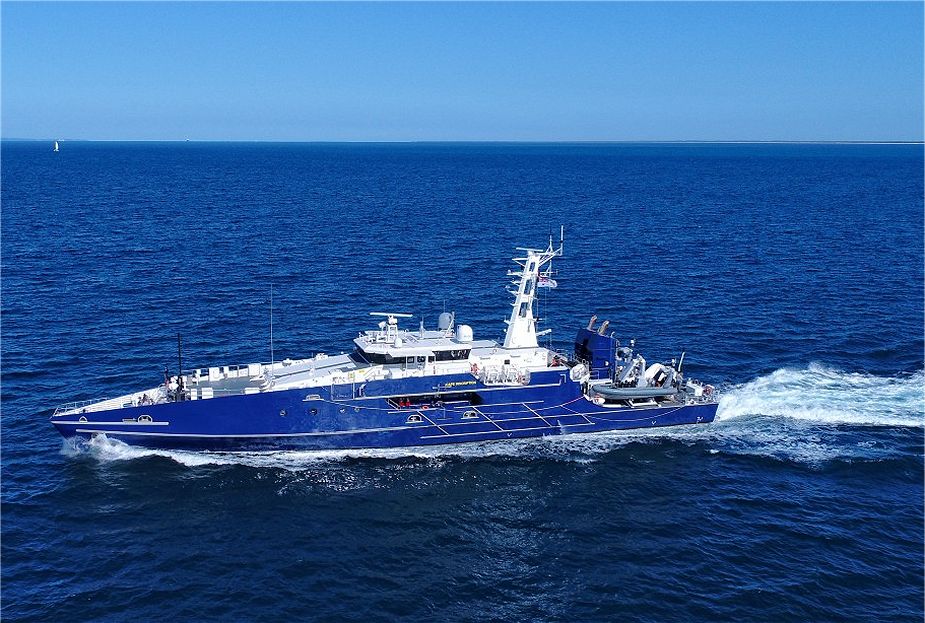
The six new Cape-class patrol boats will extend the fleet of ten ships currently operated by the Australian Border Force and Royal Australian Navy around Australia (Image: ADV Cape Inscription operating with the RAN)
Austal Limited is pleased to announce that Austal Australia has been awarded an A$324 million contract to design and construct six evolved Cape-class Patrol Boats (CCPBs) for the Royal Australian Navy.
These “Cape Class” patrol vessels are a bit unusual in size, slotting between typical “inshore” and “offshore” patrol vessels. We talked about this class when Trinidad and Tobago ordered two of them.
This is the information we had on the class earlier, compared to the Webber class.
Displacement about twice as large: 700 tons vice 353
Length: 57.8 m (190 ft) vice 46.8 m (154 ft)
Beam: 10.3 m (34 ft) vice 8.11 m (26.6 ft)
Draft: 3 m (9.8 ft) vice 2.9 m (9.5 ft)
HP, less: 6,772 vice 11,600
Speed, slower: 25 vice 28
Crew, smaller: 18 vice 24
Boats: two on davits vice one in stern ramp
Range: greater, 4000 vice 2500 nautical miles
Endurance: greater, 28 vice 5 days
These new ships will have some upgrades including accommodation for 32.
I was a little surprised by this procurement. Not too long ago, Australian Navy’s patrol force consisted of only thirteen 300 ton Armidale class patrol boats. These are being replaced by twelve 80 meter OPVs. None of these larger vessels have been completed so far. In the interim they leased two of these Cape Class. Now they are getting six more, improved versions. Presumably they will retain these even after the larger OPVs are completed, giving them 20 vessels.
200430-N-NO101-150 WASHINGTON (April 30, 2020) An artist rendering of the guided-missile frigate FFG(X). The new small surface combatant will have multi-mission capability to conduct air warfare, anti-submarine warfare, surface warfare, electronic warfare, and information operations. (U.S. Navy graphic/Released)
The Navy has announced that the contract for the first of the new FFG(X) class frigates has been awarded to Marinette Marine.
“Navy awarded a contract to design and produce the next generation small surface combatant, the Guided Missile Frigate (FFG(X)) today. The contract for detail design and construction (DD&C) of up to 10 Guided Missile Frigates (consisting of one base ship and nine option ships) was awarded to Marinette Marine Corporation (MMC) of Marinette, Wisconsin, officials announced. “
One of the arguments for continuing the construction of the National Security Cutters (NSC) has been that it kept a production line open that might roll into production of the FFG(X). That is now no longer the case. The argument that we are replacing 12 ships, so we should build 12 is still valid to a degree.
Currently eleven NSCs are seen as replacing 12 WHECs, but we have yet to hear that 25 OPCs are not enough to replace 32 WMECs: 13 WMEC 270s, 16 WMEC210s, Alex Haley, Acushnet, and Storis. Maybe what we need is 33 OPCs, to make up for the shortfall in replacing both 12 WHECs and 32 WMECs, 44 ships to replace 44.
Thanks to Secundius for bringing this to my attention.
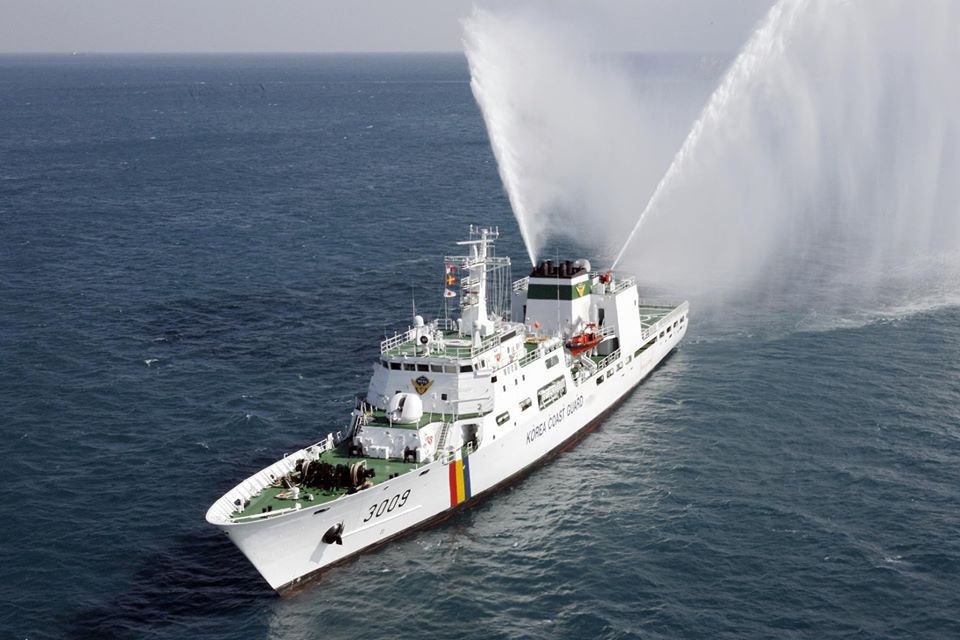
Naval News reports that the Korea Coast Guard will be receiving two new cutters. These are reported to displace 4,200 tons full load, meaning they are slightly smaller, but considerably longer than the 418 foot 4500 ton National Security Cutters and 360 foot Offshore Patrol Cutters of similar displacement.
There is no indication of the speed of the new cutters, but the earlier similar sized cutters, hull numbers 3009, 3010, and 3011 were reportedly capable of 28 knots. Armament seems be being standardized at a twin 40mm mount and 20mm Sea Vulcan Gatling Guns, both locally produced.
The Korean Coast Guard currently has 36 cutters of more than 1500 tons full load, including two of 6,500 tons full load, only one of the 36 is over 26 years old. Their Exclusive Economic Zone is less than 2.7% that of the US, but it is complicated by the proximity of North Korea, China, Russia, and Japan.
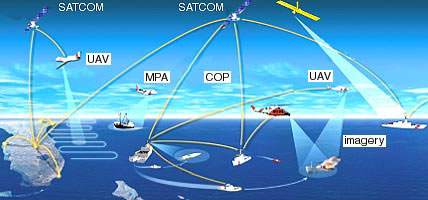
Improvements are planned for both routine reporting and staff work and for Command and Control,
“The Coast Guard was slated to transition to Microsoft Office 365 this spring to increase email reliability. Plans also include making internet speeds 50 times faster this year and improving ship connectivity over the next three years, Schultz noted.”
Plus there will be additional Cyber expertise.
“President Donald Trump’s fiscal year 2021 budget request calls for adding 179 cyber personnel to the Coast Guard’s existing force, Schultz noted. The service currently has about 360 cyber personnel, and about 50 or 60 are coming on board this year.”
However, the Coast Guard isn’t just looking to play defense, he noted. It wants to conduct its own cyber attacks against adversaries.
Presumably all this will include better connectivity in the polar regions. The Healey was reportedly out of contact for long periods during her last trip to the Arctic.
Recently sections of the Rescue 21 system were down for prolonged periods in Alaska. We don’t want that to happen.
We have talked about TRAPS several times before, here, here, and here, but the video above is the clearest representation of how I works I have see so far. You can see the active element coming off the reel at time 23 to 25 seconds on this very short video.
It this works anything like it is claimed to (and the Canadian Navy has tested it), this could be a relatively easy route to reintroducing an ASW capability into the Coast Guard. It could also help detect low profile semi-submersible drug runners.
The April edition of U.S. Naval Institute Proceeding has a short article written by Coast Guard Lieutenants James Martin and Jasper Campbell discussing the recapitalization of the 87 foot WPB fleet and suggesting adaptation of the Navy’s MkVI patrol boat as a replacement.
Any choice of a new class of ships for the Coast Guard must depend on how it will integrate into the legacy fleet. Choices are strongly influenced by the strengths and weaknesses of the other assets available.
Marine Protector class cutter, USCGC Barracuda (WPB-87301), USCG photo
In FY2021 the Coast Guard expects to decommission eight of the 87 foot Marine Protector class without replacement. This change is justified as follows,
This initiative decommissions eight 87-foot Marine Protector Class CPBs. This initiative is based on the acquisition of the Fast Response Cutter (FRC) and Response Boat – Medium (RB-M), both of which are more capable than the legacy assets that they replace. Decommissioning these assets focuses patrol boat funding on operating and supporting new assets, such as the FRCs, as well as other strategic priorities. Forecasted material condition as assessed by the Coast Guard’s Patrol Boat Product Line will be a factor in identifying the specific cutter hulls to be decommissioned, ensuring that the cutters with the best material condition remain operational.
Overall fleet performance degradation will be minimized since FRCs outperform previous patrol boats and RB-Ms are more capable than previous boats. Finally, the decommissionings will focus on areas where the combination of FRCs and RB-Ms provides sufficient capability to remove the operational need for an 87-foot CPB
What they really seem to be saying is that RB-M, unlike the boats they replaced, are able to do some of the missions the WPBs were intended to do. On the other hand the 110 foot Island class WPBs were already more capable than the 87 footers so its not like the 87 footers were doing missions the 110s could not. The real difference here may be that, because we now have more larger patrol craft, both Webber and Island class than we did previously, we don’t need as many Marine Protector Class.
Nevertheless it does appear that the Coast Guard sees a need for some WPBs. The USNI article refers to a 2018 statement by the Commandant that, “Recurring Depot Availability Program (RDAP) is anticipated to extend the service life of the 87s well into 2030.”
The capability gaps between the Marine Protector class and the smaller boats below them in size, now RB-ms, has shrunk, while the gap between them and the larger Patrol craft, soon to be all FRCs, has grown. This suggests that any replacement should be, if anything, more capable than the Marine Protector class, not less. While faster and more heavily armed, than the 87 foot WPBs, it appears that the MkVI is less capable in terms of characteristics the Coast Guard values. They have less endurance, appear less seaworthy, and as currently configured, the only boats they can launch are flat bottomed rubber raiding craft.
It appears, any WPB replacement’s capabilities should move closer to those of the FRC rather than the RB-M. Still I see their role as much different from that of the Webber class. The Webbers would be used primarily on regularly scheduled patrols while the WPB replace would be the true “Fast Response Cutters,” on standby for developing emergencies.
I offered a description of my concept of a WPB replacement earlier, including concepts of operation and manning, explaining why it should be larger, faster, and better armed. There was additional discussion about the concept here. My suggestion was that it should be one and a half to twice as large as the 87 foot WPBs and about half the size of the 353 ton Webber class…136 to 182 tons full load, or roughly 100′ (30.5 meter) to 130′ (39.6 meter) in length, not too much different from the Island class cutter, 110 feet (33.5 meter) loa and 168 tons.
I also saw it being uniquely equipped to fill a current gap in our Port, Waterways, and Coastal Security mission, that of being able to defend our critical ports, by being able to forcibly stop any vessel, regardless of its size, speed, or maneuverability.
Such a ship would also be both of interest for Foreign Military Sales and as a reserve element for potential combat roles.
The Congressional Research Service (CRS) has again updated their “Coast Guard Cutter Procurement: Background and Issues for Congress.” The last updated edition of this analysis, that I reported on here, was dated 28 Jan. 2020. The FY2021 PC&I request includes funding for OPC#3 and long lead time material for #4, plus small amounts for the NSC and FRC program. Not addressed here is the second Polar Security Cutter for which funding is also requested, addressed in a separate CRS report. There is a good breakdown of the entire request for vessels here.
Congress has routinely added Webber class Fast Response Cutters to previous budgets. I have to believe the Congress will fund four additional FRCs, if not in FY2021 then in 2022, so that we can ccomplete the program of record and replace all six Island class WPBs of PATFORSWA. A 12th NSC seems much less likely, but not impossible. The summary for the 15 April edition is quoted below.
Summary
The Coast Guard’s program of record (POR) calls for procuring 8 National Security Cutters (NSCs), 25 Offshore Patrol Cutters (OPCs), and 58 Fast Response Cutters (FRCs) as replacements for 90 aging Coast Guard high-endurance cutters, medium-endurance cutters, and patrol craft. The Coast Guard’s proposed FY2021 budget requests a total of $597 million in procurement funding for the NSC, OPC, and FRC programs. It also proposes a rescission of $70 million in FY2020 procurement funding that Congress provided for the NSC program.
NSCs are the Coast Guard’s largest and most capable general-purpose cutters; they are replacing the Coast Guard’s 12 Hamilton-class high-endurance cutters. NSCs have an estimated average procurement cost of about $670 million per ship. Although the Coast Guard’s POR calls for procuring 8 NSCs to replace the 12 Hamilton-class cutters, Congress through FY2020 has fully funded 11 NSCs, including the 10th and 11th in FY2018. In FY2020, Congress provided $100.5 million for procurement of long lead time materials (LLTM) for a 12th NSC, so as to preserve the option of procuring a 12th NSC while the Coast Guard evaluates its future needs. The funding can be used for procuring LLTM for a 12th NSC if the Coast Guard determines it is needed. The Coast Guard’s proposed FY2021 budget requests $31 million in procurement funding for activities within the NSC program; this request does not include further funding for a 12th NSC. The Coast Guard’s proposed FY2021 budget also proposes a rescission of $70 million of the $100.5 million that Congress provided for a 12th NSC, with the intent of reprogramming that funding to the Coast Guard’s Polar Security Cutter (PSC) program. Eight NSCs have entered service; the seventh and eighth were commissioned into service on August 24, 2019. The 9th through 11th are under construction; the 9th is scheduled for delivery in 2020.
OPCs are to be less expensive and in some respects less capable than NSCs; they are intended to replace the Coast Guard’s 29 aged medium-endurance cutters. Coast Guard officials describe the OPC and PSC programs as the service’s highest acquisition priorities. OPCs have an estimated average procurement cost of about $411 million per ship. The first OPC was funded in FY2018. The Coast Guard’s proposed FY2021 budget requests $546 million in procurement funding for the third OPC, LLTM for the fourth, and other program costs. On October 11, 2019, the Department of Homeland Security (DHS), of which the Coast Guard is a part, announced that DHS had granted extraordinary contractual relief to Eastern Shipbuilding Group (ESG) of Panama City, FL, the builder of the first four OPCs, under P.L. 85-804 as amended (50 U.S.C. 1431-1435), a law that authorizes certain federal agencies to provide certain types of extraordinary relief to contractors who are encountering difficulties in the performance of federal contracts or subcontracts relating to national defense. ESG reportedly submitted a request for extraordinary relief on June 30, 2019, after ESG’s shipbuilding facilities were damaged by Hurricane Michael, which passed through the Florida panhandle on October 10, 2018. The Coast Guard intends to hold a competition for a contract to build OPCs 5 through 15.
FRCs are considerably smaller and less expensive than OPCs; they are intended to replace the Coast Guard’s 49 aging Island-class patrol boats. FRCs have an estimated average procurement cost of about $65 million per boat. A total of 60 have been funded through FY2020, including four in FY2020. Four of the 60 are to be used by the Coast Guard in the Persian Gulf and are not counted against the Coast Guard’s 58-ship POR for the program, which relates to domestic operations. Excluding these four FRCs, 56 FRCs for domestic operations have been funded through FY2020. The 36th FRC was commissioned into service on January 10, 2020. The Coast Guard’s proposed FY2021 budget requests $20 million in procurement funding for the FRC program; this request does not include funding for any additional FRCs.
Crewmembers aboard the U.S. Coast Guard cutter USCGC Adak (WPB-1333) raise the American flag. Adak is assigned to CTF 55, supporting maritime security operations and theater security cooperation in the U.S. 5th Fleet area of responsibility. U.S. Coast Guard photo by Seaman Frank Iannazzo-Simmons
The ships involved in the event included Navy Expeditionary Landing Base ship USS Lewis B. Puller (ESB-3), coastal patrol ships USS Sirocco (PC 6), USS Whirlwind (PC 11), USS Firebolt (PC 10 ), USS Tempest (PC 2), Coast Guard patrol boats USCGC Adak (WPB 1333), USCGC Maui (WPB 1304), USCGC Wrangell (WPB 1332), and guided-missile destroyer USS Paul Hamilton (DDG 60).
In addition, there were Army AH-64 Apache attack helicopters operating from USS Lewis B. Puller. What I found particularly interesting was:
On the ships involved without organic aircraft control capabilities, a Joint Terminal Attack Controller (JTAC) was embarked to communicate directly with the aircraft and provide targeting information.
Does this mean that the Island class WPBs are getting a form of data link to allow them to pass targeting information to the Army attack helicopters? Other DOD aircraft?
Will the Webber class WPCs expected to go to PATFORSWA going to get these?
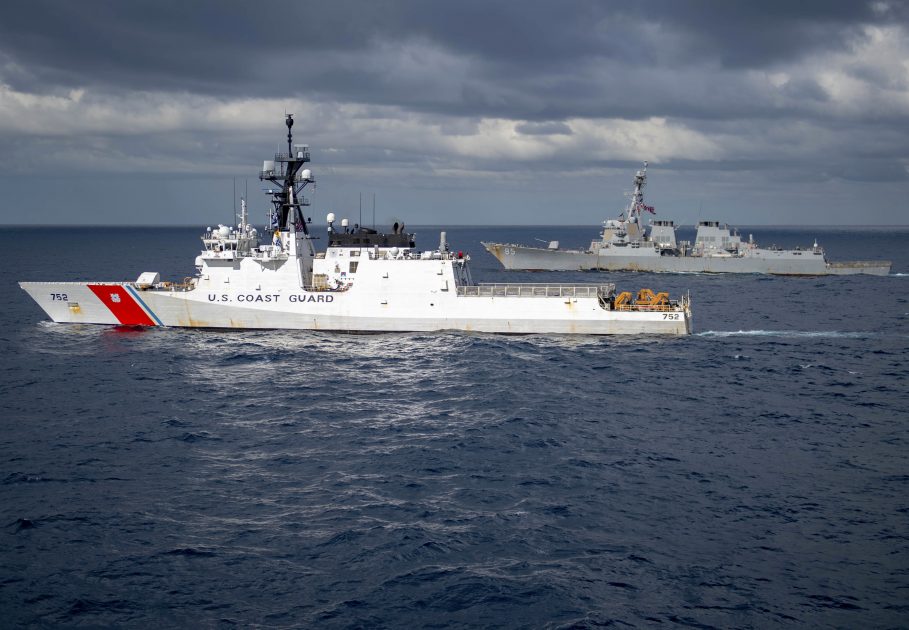
USCGC Stratton (WMSL-752), left, and the U.S. Navy Arleigh Burke-class guided-missile destroyer USS McCampbell (DDG-85) maneuver in formation during Talisman Sabre 2019 on July 11, 2019. US Navy Photo
Having watched the US Naval Institute News’ Fleet and Marine Tracker for some time, I am a bit surprised to see six ship assigned to Fourth Fleet, inspite of the on going COVID-19 problem. Six ships is only 2% of the Navy’s 296 “battleforce” ships (Note, the 3 Mayport based Cyclone class patrol craft that sometimes assist in drug enforcement are not counted among the 296), but it is far more than we typically see in the area. Unfortunately the USNI site gives us no information about what type ships are deployed or where they are. (Pacific or Caribbean?)
This is the first solid evidence I have seen that the Navy is actually going to carry through on their stated intention to surge assets for drug enforcement. There were four ships reported in the area on April 13, also an unusually high number. There were six reported on April 6. March 30, there were two. March 23 there was only one. Prior to that it was ususally one ship, on rare occasions two, sometimes none.
Supposedly additional aircraft and other assets are also being assigned to support the ships.
This December 2001 “battle,” described as a six hour firefight, between a small North Korea (NK) vessel and four Japanese Coast Guard cutters was unusual, but it is interesting for what it can tell us about the difficulties of dealing with a vessel that refuses to stop, as would probably be the case with a terrorist attack.
The incident happened outside Japanese territorial waters but inside their EEZ.
The NK vessel appeared to be a trawler, but this was no trawler. It was reportedly capable of 33 knots.
The Japanese went through the usual procedures trying to get the vessel to stop, flags, loud hailer, warning shots. When these were ignored, at least initially the Japanese apparently chose an aim point forward in the vessel where it was unlikely to hit crew members. Over 1000 shots were fired.
As appears to be standard procedure with the Japanese Coast Guard, it was not a single cutter, but a team of cutters that responded. In this case four. Japan Coast Guard aircraft were on scene, but apparently they had no airborne use of force capability.
Generally in the video, it appears that the cutters remained abaft the beam of the target vessel, minimizing the pursued vessels opportunity to ram a cutter and also insuring that friendly vessels were not in the line of fire.
Tsurugi class cutter PS202 Hotaka. From Wikipedia commons.
The Japanese cutters seen in the video appear to be Tsurugi class “high speed special patrol ships” specifically designed to intercept high speed North Korean vessels engaged in espionage or smuggling. They are longer but lighter than the Webber class, 50 meters (164 feet) in length with a 220 ton full load displacement and three diesels totaling
After the North Korean vessel was disabled the cutters came close aboard (about time 6:30). The wisdom of this was questionable since the vessel had been firing at the cutters. In fact the nearby cutter was fired upon. Subsequently apparently the crew of the NK vessel detonated scuttling charges, which had they been larger, might have damaged a nearby cutter.
15 survivors were seen after the sinking, but the cutters were told to ignore them as there was fear they would respond to rescue attempts with suicidal violence. The Japan CG cutter crews were relatively small. All members of the N. Korean crew were lost. Only three bodies were recovered.
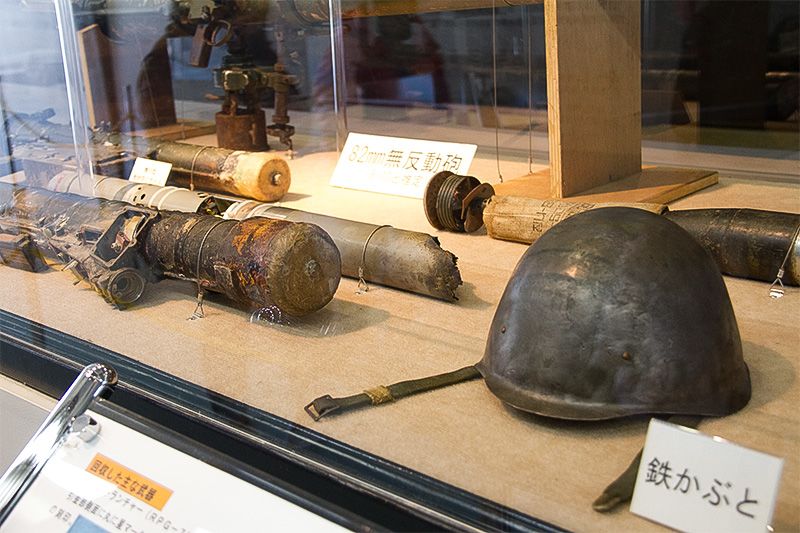
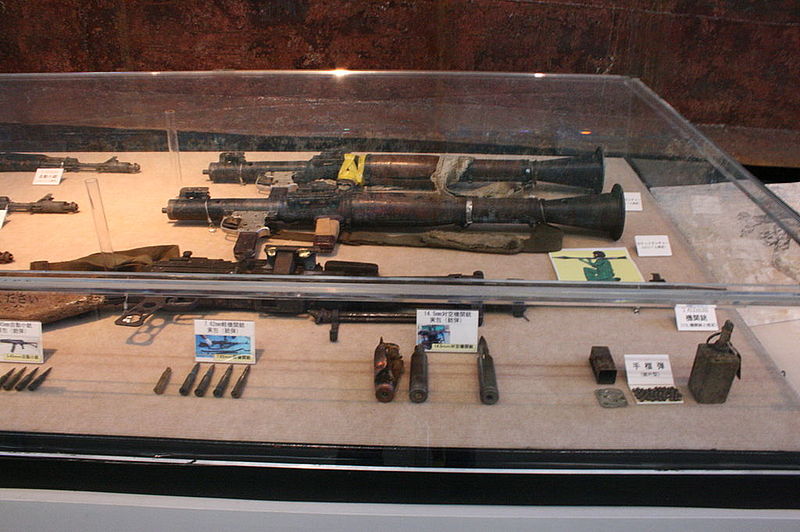
The North Korean vessel was small, 29.7 meters (97.4 feet) in length, but still the weapons used against it were found wanting. Due to the presence of heavy weapons like RPGs, recoilless rifles, and MANPADs on N. Korea spy vessels, the Japanese concluded that the 20mm Gatling gun was not adequate for their purposes and now expect to include vessels with 40mm guns in any similar future operation.
As I have noted before, I believe all Coast Guard vessels, WPB and larger, should be armed to forcibly stop any vessel regardless of size and have an effective range of at least 4,000 yards, so as to be outside the effective range of most potential improvised vessel weapon systems.
The North Korean vessel was subsequently raised to allow investigation of the incident. The vessel and some of its contents are on display at the Japan Coast Guard museum in Yokohama (see below).
ZPU-2 14.5mm anti-aircraft gun found on the North Korean spy trawler sunk by the Japanese Coast Guard in 2001. Transferred from ja.Wikipedia; ja:Image:North-Korea spy-vessel 2.jpg, Author: Bakkai at Japanese Wikipedia
Weapons including RPGs and automatic weapons found when the North Korean vessel was raised. Author: Nomansland511 (a.k.a. nattou)









 Chuck Hill's CG Blog