“France confirms order for six new POM Offshore Patrol Vessels” –Naval News, Another Cutter X

French “POM” Offshore Patrol Vessel. Credit: Socarenam

Naval News reports that the French Navy has ordered six Offshore Patrol Vessels (Patrouilleur d’Outre-Mer – POM). with the intention of basing two each in New Caledonia (Nouméa) and French Polynesia (Papeete) in the Western Pacific and la Réunion (Port-des-Galets) in the Indian Ocean. 

The POM will have an endurance of 30 days without refueling. Each ship will accommodate a crew of 30 sailors and 23 passengers and operate an unmanned aerial vehicle. Their armament will include a 20mm caliber remote-controlled turret (Narwhal by Nexter), as well as 12.7 mm and 7.62mm machine guns. The POM vessel will be 80 meters (262.4′) long and 11.8 meters (38.7′) wide, with a draft of 3.5 meters (11.5′)(I provided the conversion to feet–Chuck)

These ships will replace 180 foot long P400-class patrol boats.

We talked about these ships and also discussed the French Navy’s coast guard type missions and other French OPV projects here. Incidentally all the previous reporting indicated that these would be 70 meters (230′) in length. These really do not look like 80 meter ships. I would prefer a flight deck and hangar suitable for a medium sized helicopter like on L’Adroit, but in any case, it is bigger and, at 22 knots, faster than a 210 with a crew less than half as large.

These ships certainly could be considered as candidates for “cutter X,” taking the crew and equipment of the Webber class cutters and putting them in a larger, more seaworthy hull. Looking at these new CGI images, they look like a supersized Webber class, with the gun on the main foc’sle just forward of the super structure and four crew served .50 calibers sited almost exactly as they are on the Webber class; a very similar 360 degree view pilot house mounted well back where it will experience less vertical acceleration; and a boat launch ramp notched in the stern. Taking advantage of the larger hull it also incorporates a davit launched RHIB starboard, space for a 20 foot containerized mission module, a flight deck and hangar for a 700-kilogram-class rotor-blade drone more berthing, and a holding area for up to six prisoners.
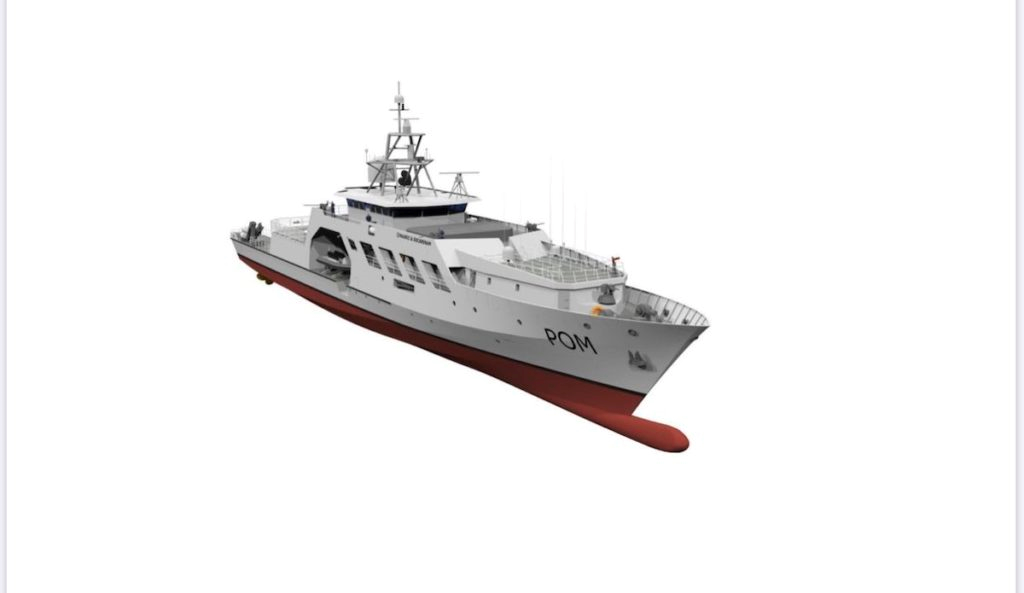
A CGI of the French Navy’s future POM OPVs (Credit : Socarenam)

It is now extremely unlikely the OPCs will be obtained at the low price initially bid by Eastern. They are now seen to be as large as the Bertholf class National Security Cutters. Perhaps if we look ahead to the time when Polar Security Cutter funding will have been completed, we should think about building a true “bridge” between the over 4,000 ton NSCs and OPCs and the under 400 ton Webber class. We might choose to continue building one OPC a year and build three Cutter X for about the same price as a second OPC. We could replace the WMECs that much quicker and perhaps build to a total of over 50 truly ocean going cutters. (11 NSCs, 14 OPC, and 30 Cutter X for about the same price as 11 NSCs, and 25 OPCs)
105th Anniversary of the Formation of the US Coast Guard

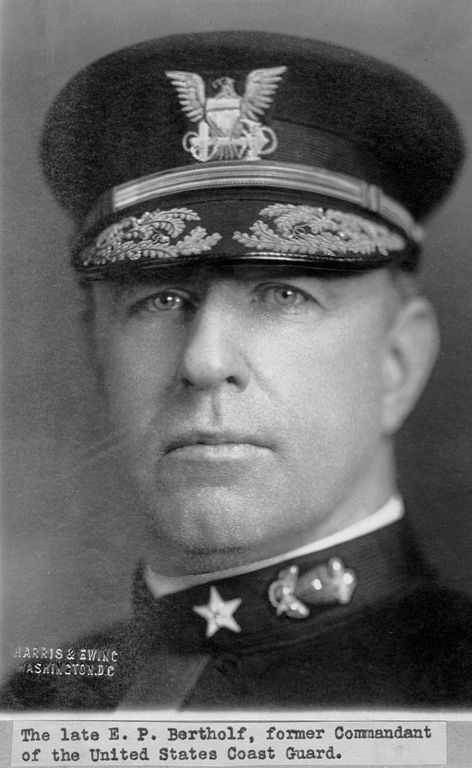
Photograph of Ellsworth P. Bertholf, Commandant of the U.S. Revenue Cutter Service from 1911 to 1915 and Commandant of the U.S. Coast Guard from 1915 to 1919. Coast Guard photo.

Today mark the 105th Anniversary of the formation of the US Coast Guard. “An Act to Create the Coast Guard” (Public Law 239) was signed into law on 28 January 1915.

Credit for this should go to Ellsworth Price Bertholf. First he saved the Revenue Cutter Service from being disassembled and then after WWI saved it from being absorbed by the Navy. He was one of three heroes of the Overland Relief Expedition. He died at age 55.

Did you know he was court marshalled and dismissed while a midshipman at the Naval Academy?

“Call for Articles: A Design for Maintaining Maritime Superiority” –CIMSEC

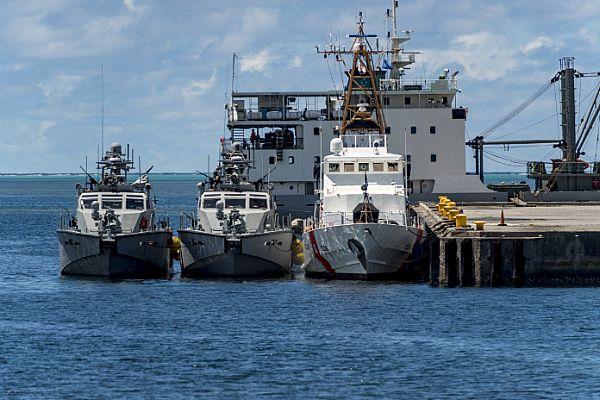
COLONIA, Yap (July 4, 2019) The U.S. Coast Guard Island-class patrol boat USCGC Kiska and Mark VI patrol boats assigned to Coastal Riverine Squadron (CRS) 2, Coastal Riverine Group 1, Detachment Guam, moored in the Micronesia port of Yap. CRG 1, Det. Guam’s visit to Yap, and engagement with the People of Federated States of Micronesia underscores the U.S. Navy’s commitment to partners in the region. The Mark VI patrol boat is an integral part of the expeditionary forces support to 7th Fleet, capability of supporting myriad of missions throughout the Indo-Pacific. (U.S. Navy photo by Mass Communication Specialist 2nd Class Jasen Moreno-Garcia/Released)

CIMSEC has issued a call for articles regarding the CNO’s recently issued “Design for Maintaining Maritime Superiority” the document does not mention the Coast Guard, but I think we have a part to play.

This is a good opportunity for some of those who follow this blog to try your hand at writing for a professional readership.

New Thai Patrol Craft

Graphical rendering of the new patrol craft for the Royal Thai Navy (Image from Marsun)

MarineLog reports that the Thai Navy has chosen MAN 16V175D-MM, IMO Tier II engines, each rated at 2,960 kWm at 1,900 rpm, to power a new class of two Patrol Craft. With two engines for each vessel that is just under 8,000 HP.

This new class is only the latest in a string of patrol craft, indigenously built by Marsun. This class appear to be closely related to the T995 and T996 patrol gun boats. if so it should have a speed of about 27 knots.

It appears to be equipped with a small RHIB, but the boat handling equipment does not appear as convenient as a dedicated davit or stern ramp.

Recently, the Thais seem to have been providing more powerful weapons for their patrol vessels than do most other countries. They recently equipped an Offshore Patrol Vessel with Harpoon Anti-Ship Cruise Missiles in addition to a 76mm gun. The choice of gun for this class appears to be a departure from the weapons that equipped previous patrol craft. The caliber, 30mm, is the same, but the rate of fire and the origin of the weapon are different.

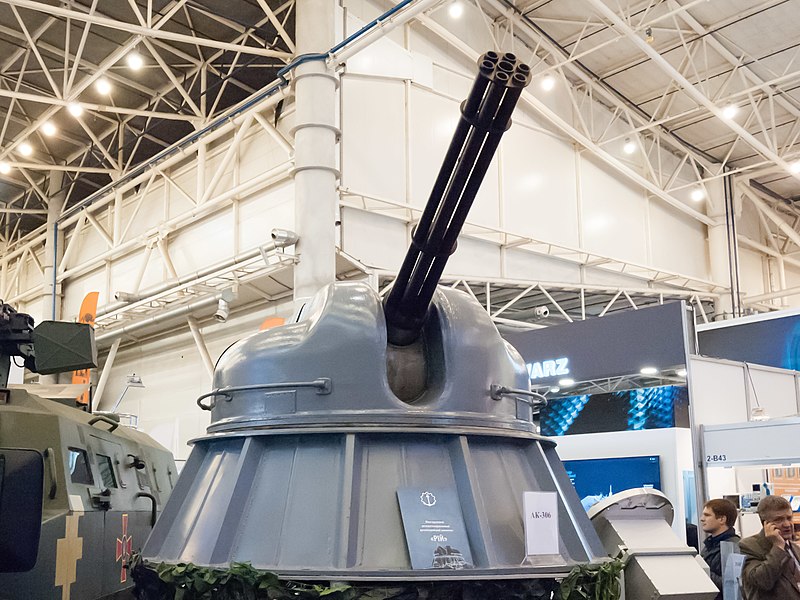
The gun appears to be a Russian 30mm AK-306 barrel rotary cannon, a lighter version of the ubiquitous AK630. Maximum rate of fire is 1,000 rounds per minute. It should be quite effective as a short range anti-surface weapon.

AK-306 rotary cannon, Zbroya ta Bezpeka military fair, Kyiv 2017, Photo from VoidWanderer via Wikipedia Commons


SNA 2020 Virtual Tour

Again, I as many of you, was not able to attend the Surface Navy Symposium. Fortunately a number of videos are available to give us a taste of what went on.

Below are three videos from Naval News followed by a video of a panel discussion provided by Defense News.

The “Day 1” video includes:

01:09 – Austal HSSV high speed support vessel
03:55 – Update on the Littoral Combat Ship program with NAVSEA
05:40 – NSM firing from USS Gabriele Giffords
06:58 – Northrop Grumman SEWIP Block 3 EW system
09:47 – Raytheon SPY-6 family of radars

The “Day 2″ video covers:

00:57 – Fincantieri Marine Group FFG(X) Frigate based on Italian Navy FREMM
04:34 – Fujitsu collaborative table for JMSDF AEGIS destroyers & Japan AEGIS Ashore
05:53 – Raytheon SM-3 Block IIA ballistic missile interceptor

The “Day 3” video reports on:

00:59 – BAE Systems double docking of Arleigh Burke-class destroyers
01:54 – BAE Systems precision guided munition for 5 Inch gun: Hyper Velocity Projectile & Vulcano
02:31 – Fincantieri Marinette Marine shipyard expansion plan for FFG(X) frigate
06:08 – L3Harris FVR-90 future vertical lift VTOL UAV
08:26 – General Dynamics NASSCO John Lewis-class TAO 205
09:23 – Titanium 3D printing

The panel discussion, “Building the Future Fleet” is a bit over 90 minutes. Most of it is Navy of course. If you are a regular reader here, I don’t think you will hear much new about the Coast Guard. Rear Admiral Douglas M. Schofield (CG-9) is on the panel and began speaking at time 6:00–11:00. He also speaks briefly at 1:00:30 and answers the last question at about 1:28:30.

Huntington Ingalls still provided no information on their proposal for the FFG(X) program.

“Coast Guard engages industry on boat acquisitions” –CG-9

Petty Officer 2nd Class Dale Veverka, a boatswains mate, Seaman George Degener, and Petty Officer 2nd Class Joshua Post, a machinery technician, conduct maneuvers on the Coast Guard Cutter Northland’s “over-the-horizon” small boat during transit to Rio De Janeiro, Brazil, April 9, 2008. UNITAS exercise, a multinational naval exercise the helps tests the interoperability of U.S. and foreign naval forces. U.S. Coast Guard photo by PA2 Nathan Henise.

The Acquisitions Directorate made a presentation at the 2019 International WorkBoat Show Dec. 6, 2019, discussing future acquisitions.

The 19 slides that accompanied the presentation provide a good overview of the Coast Guard’s current and planned future fleet of small boats, in addition to covering contracting procedures and considerations. They also offer expectations for the fifth generation Over the Horizon boat, the new trailable navigation boat, and the third generation Long Range Interceptor.

It appears the Coast Guard may not be entirely happy with the existing solutions to the interface between cutter boats and the “notch” in the stern of cutters. The 17th slide (labeled 16 in the lower right corner) is titled “Discussion Topics.” It appears the Coast Guard is seeking improvements including “Decrease failures from notch-impact” and “Notch-Friendly Propulsion, Alternatives to waterjets.”

“French Customs order OCEA FPB 100 MKII patrol boats” –Naval News

A CGI of the OCEA FPB 100 MKII patrol boat ordered by the French Customs (Credit : OCEA) Note UAV landing area aft port side. 

Naval News reports that French Customs has ordered a pair of new patrol boats in the WPB class. They have some interesting features.

These are slightly smaller than the Island class cutters at 32 meters or 105 feet. They are all Aluminum. This newest version includes a night vision device and a larger, faster, 7 meter 35 knot RHIB deployed, like on other OCEA designs, by davit . But most remarkably they are expected to host a rotary wing UAV. 

“Busting Smugglers & Breaking Codes” –Naval History Magazine

Unfortunately the source of this artwork was not available. 

The US Naval Institute’s Naval History Magazine, February 2020 edition, has an interesting article about the many changes that the Coast Guard went through as a result of Prohibition. You can read it online here.The section on code breaking is perhaps the most surprising.

During Prohibition, in its largest law enforcement mission ever, the Coast Guard made thousands of apprehensions. It also experienced its largest fleet expansion outside the world wars. And the service saw many firsts, including the first time Coast Guard crews manned Navy warships, and the permanent establishment of an aviation branch. It also saw extensive use of the radio and RDF and the founding of the Coast Guard Intelligence Office, one of the day’s leading federal intelligence branches. All these factors shaped the service into a force better prepared for its next great challenge—World War II.

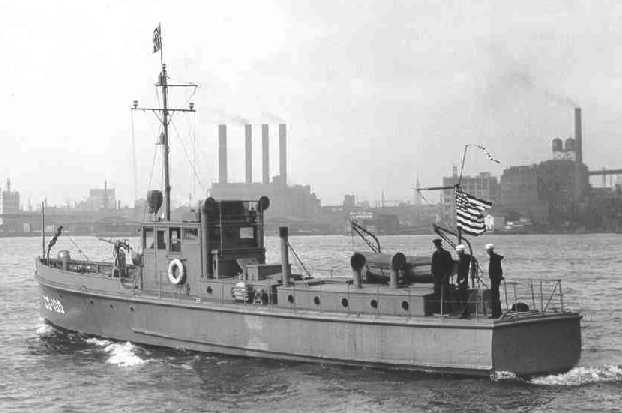
A Coast Guard Sixbitter, 75 foot patrol boat.

“Coast Guard Expedites ScanEagle ISR Services for National Security Cutters” –SEAPOWER

A small unmanned aircraft system operator recovers an sUAS (Scan Eagle–Chuck) after a flight from Coast Guard Cutter Stratton in the South China Sea Sept. 16, 2019. The sUAS is capable of flying for more than 20 hours and has a maximum speed of about 60 mph. U.S. Coast Guard photo by Petty Officer 1st Class Nate Littlejohn.

The Navy Leagues Seapower web site is reporting that the Coast Guard will have Scan Eagle UAV systems installed on all currently operational National Security Cutters by the end of 2020, and in addition that the systems will be installed on the Offshore Patrol Cutters.

There is a lot of significant information in this report. 

Contractors still control the UAVs.

“Insitu installs the UAVs and their launch-and-recovery equipment and ground-control stations on board the ships, he said. Insitu sends four-person teams to deploy with each ship. They operate the entire system once on board. The teams are fully embedded with their ship’s crew.”

The sensor package.

“A standard pack-out for a deployment is three ScanEagle UAVs, he said. The sensor systems include and electro-optical/infrared camera, a laser pointer, a communication relay, an Automatic Identification System interrogator and Vidar (visual detection and ranging, a surface search capability).”

The increased search capability.

Currier said that before deployment of the ScanEagle the NSC had a scan of 35 miles either side of the ship with its organic sensors.

“With ScanEagle on board, for good parts of the day, you’re up to 75 miles either side of the ship as you’re moving through the sea space,” he said. “ScanEagle is a game-changer.”

“We’ve effectively doubled the search area of a national security cutter,” Tremain said. “We’re he only company flying with Vidar, and we’re surveilling up to 1,000 square miles of open ocean per flight hour, and we’re identifying greater than 90% of the targets.”

You might think these would not be much of an improvement over a ship based manned helicopter, but in fact the helicopter would probably not be air borne searching more than four hours a day, while three Scan Eagles could conceivably maintain a watch 24 hour a day. Additionally a helicopters sensors are probably not as effective as the VIDAR on the Scan Eagle.

Using these for search rather than the helicopter, also means less wear and tear on the helicopter, and that the helicopter is more likely to be available when it is really needed.

A New 30mm Round –Maybe a Reason to Upgrade the Mk38 Mounts

Military.com reports that Northrop Grumman is developing a proximity fuse for the 30mm gun that arms the San Antonio class LPDs and is part of the Surface Warfare module on the Littoral Combat Ship. The new round is being developed for use against drones, which are a difficult target to hit directly. It might also make the gun more effective against the small boat threat and should improve its chances against aircraft.

The Coast Guard also has an interest in being able to down drones, but this may also be of interest to the Coast Guard because it may provide the incentive needed to upgrade the guns used on Mk38 gun mounts, not just in the Coast Guard, but in the Navy as well. We have known for a long time that the 30mm round is much more effective than the 25mm round, but there has been no movement toward replacing the 25mm guns.

The Mk44 Bushmaster II, 30 mm chain gun is a derivative of the 25 mm M242 Bushmaster. They share a number of parts. All indications are that there would be no significant problem in replacing the M242 Bushmaster used in the Mk38 gun mounts with the more effective 30mm gun. The Mk38 gun mount is the primary armament of the 210 foot WMECs and Webber class Fast Response Cutters. It is expected to arm our Offshore Patrol Cutters and replace the 76mm on WMEC 270s that go through a planned Service Life Extension Program.

I really would rather see either the 50mm version of the Bushmaster III or the 40mm version of the Bushmaster II, but while none of these options are a complete answer to the Coast Guard’s need to be able to thwart a potential terrorist attack, any increase in projectile size allows both engagement at greater range and increases the probability of success against larger threats, while maintaining equal or better probability of success against smaller craft. The 30mm would be a significant improvement.