Drugs Smuggling By Container

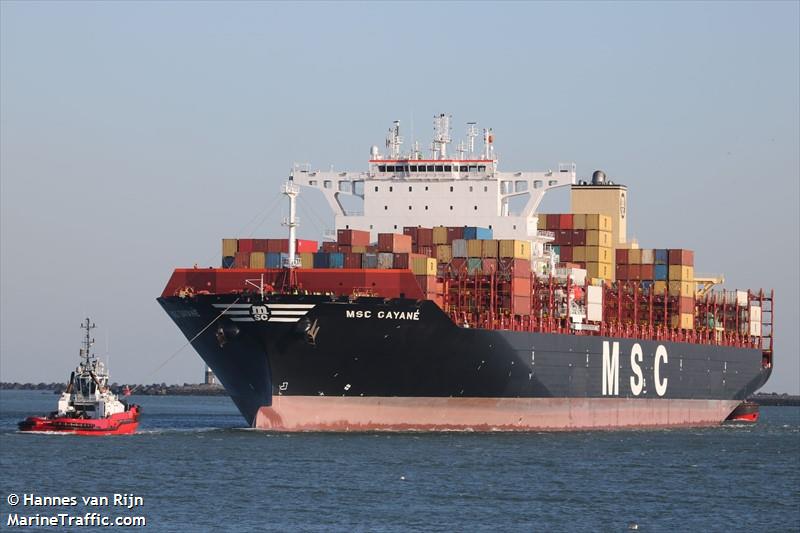
File photo shows the MSC Gayane. Photo: MarineTraffic.com

Three recent incidents of drugs being smuggled by containers aboard ship.

In the US:

June 18 (Reuters) – Federal authorities seized 16.5 tons of cocaine worth more than $1 billion from a ship in Philadelphia in one of the largest drug seizures in U.S. history, the U.S. Justice Department said on Tuesday.

Federal, state and local law enforcement agents on Monday boarded the MSC Gayane, a cargo ship docked in Philadelphia’s Packer Marine Terminal, and found cocaine in seven shipping containers, according to a criminal complaint filed in Philadelphia federal court.

Since then, four additional arrests have been made. The Customs and Border Protection news release is here. Crew members facilitated the loading of the drugs.

August 1, a vessel docked in Felixstowe, UK where the vessel was boarded and authorities found approximately 398 kilograms of heroin hidden among towels and bathrobes.

Germany seized 4.5 tonnes of cocaine from a container at the port of Hamburg, marking that nation’s biggest drugs haul to date. The shipping container in that case was loaded in Montevideo, Uruguay and bound for Antwerp.

“Coast Guard Awards Contract for 47-Foot Motor Lifeboat Service Life Extension Program” –CG-9

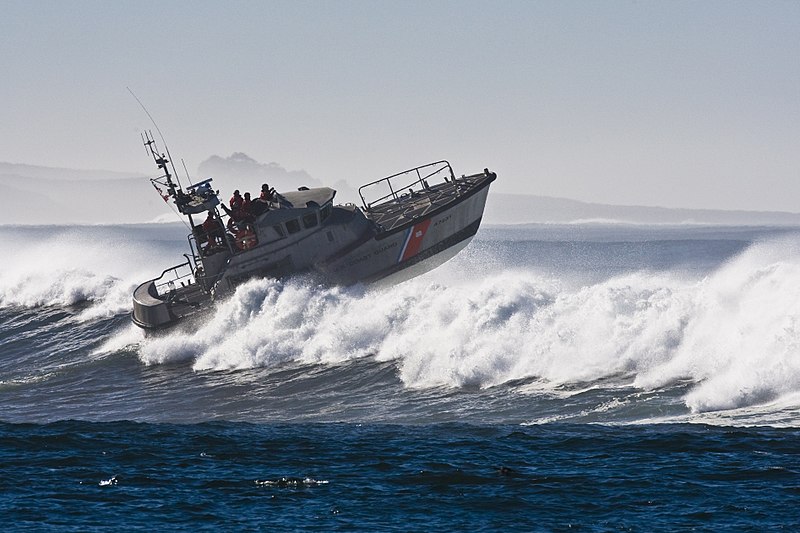
47-Foot Motor Life Boat (MLB) 47231 from Station Morrow Bay, 4 Dec 2007. Photo by Mike Baird

The Acquisitions Directorate (CG-9) reports award of a contract for service life extension work on its 47 foot motor lifeboats. 

—–

The Coast Guard on Aug. 5 awarded a firm fixed price indefinite delivery, indefinite quantity contract to Birdon America Inc. of Denver, Colorado, to perform work supporting the service’s 47-foot Motor Lifeboat (MLB) service life extension program (SLEP). The initial award to complete the detail design and service life extension work on the first vessel is valued near $6.5 million, with a total projected contract value of close to $190 million to complete the MLB SLEP over the 10-year contract period. The initial work for detail design and the first vessel will be performed at a subcontractor facility on the West Coast, Fred Wahl Marine Construction along the Umpqua River in Reedsport, Oregon. Once in full production, a second subcontracted work facility is planned to be opened on the East Coast.

The 47-foot MLB is the Coast Guard’s primary search-and-rescue platform operating in surf and heavy weather conditions. It has self-righting capability and the ability to operate in winds up to 50 knots, seas up to 30 feet, and surf up to 20 feet. The service’s fleet of more than 100 MLBs has been in service for 15 to 21 years and is approaching the end of its planned 25-year service life. The operational need for these unique capabilities in search-and-rescue, maritime law enforcement, and contingency response remains high.

The SLEP will extend the useful life of the MLB by 20 years; SLEP work will be performed on a minimum of 107 MLBs and a maximum of 117 MLBs. The main work will be on systems experiencing technical obsolescence: the main propulsion, electrical, steering, towing and navigation systems, as well as replacement of areas of the hull and structure that have demonstrated high failure rates. Additionally, efforts to enhance human system integration will be made where practical to do so. The original operational capabilities and characteristics of the 47-foot MLB will not change.

CG Exercises Option for Webber Class WPCs #51-56

The Coast Guard Cutter Lawrence Lawson crew mans the rail during sea trials off the coast of Miami, Florida, on Dec. 12, 2016. The ship will be the second fast response cutter stationed in Cape May, New Jersey, and is scheduled for commissioning in early 2017. (U.S. Coast Guard photo by Eric D. Woodall)

The Acquisitions Directorate (CG-9) reports the exercise of a contract with Bollinger for construction of six more Webber class WPCs (Fast Response Cutters or FRCs).

The Coast Guard exercised a contract option for production of six more Sentinel-class FRCs and associated deliverables worth just over $297.4 million with Bollinger Shipyards of Lockport, Louisiana, July 31.

This option brings the total number of FRCs under contract with Bollinger to 56 and the total value of the contract to approximately $1.23 billion. The contract has a potential value of $1.42 billion if options to procure all 58 cutters are exercised. The FRCs built under this option will be delivered beginning late 2022 into late 2023. To date, there are 33 FRCs in operational service.

Things to note.

  • The $1.23B referred to did not pay for all 56 vessels, only those purchased under the most recent contract.
  • Buying in quantity lowers the price. Since this is a long running contract and we have ordered the maximum number Bollinger can build in a year, increasing efficiencies have lowered the per ship price from over $60M to less than $50M.
  • While this program will likely continue to deliver vessels through at least 2024, we are nearing the end of this program, at least in terms of contracting. FY2020 may be the last year that will include money for WPC new construction, if it includes funding for six more vessels and 64 is final number constructed. This would include 58 in the program of record and six to replace the six WPBs in PATFORSWA (four of which have already been funded).

“Meet the neglected 43-year-old stepchild of the U.S. military-industrial complex” –Los Angeles Times

Great article from the Los Angeles Times about the trials, tribulations, (and joys) of being on the Polar Star, recounting her three and a half month 2018/2019 Deep Freeze.

And once again she goes into the dry dock in Vallejo, California, rather than a yard in her homeport (for 5 months). If you add it up, she spends more time in Vallejo than her homeport (3.5 months). Since she is being drydocked every year, maybe it is time to move the families closer to the shipyard. According to the article she is expected to continue in service another seven years.

USCGC Joseph Gerczak (WPC 1126) arrives in American Samoa on patrol

The crew of USCGC Joseph Gerczak (WPC 1126) prepare to moor at the port of Pago Pago, American Samoa, Aug. 3, 2019. They will conduct a joint fisheries patrol with NOAA Fisheries and American Samoa Marine Police members. (U.S. Coast Guard photo by Chief Petty Officer Sara Muir/Released)

Below is a press release from District 14 (Hawaii). It suggest two things.

  • They are paying more attention to the threat of illegal, unregulated, and unreported (IUU) fishing in the Pacific, and
  • They are exploring the limits of recently arrived Webber class “Fast Response Cutters” (FRC).

The Joseph Gerczak is based in Honolulu. The distance from Honolulu to Pago Pago by air is 2259 nautical miles (4184 km). That is less than the nominal 2500 currently being reported as the range for the class and less than the 2950 miles that was claimed for the class earlier, but that appears to leave little in the way of reserve. The nine day transit referred to also exceeds the nominal five day endurance of the FRCs.

The news release also indicates that the USCGC Walnut (WLB-205) is also in the area, so the Walnut may have escorted the FRC and may have refueled and replenished it underway as was done when Walnut provided underway replenishment for Oliver F. Berry (WPC-1124) for a 2200 mile transit to the Marshall Islands.

I would welcome any comments about how the operation was actually done. But could an FRC make the trip unrefueled? As I recall the 2950 nmi range claim was based on a speed of 14 knots. Transiting at a lower speed should increase range. How fast did they go? Nine full days, 216 hours would have averaged about 10.5 knots. Still nine days may have meant a short day at the start and another short day on arrival so it may have been closer to eight 24 hour days or about 192 hours total that would equal an average speed of a little under 12 knots. In any case it is likely the transit could have been made unrefueled with a reasonable reserve. Even if that were the case, CCGD14 probably kept Walnut close in case they ran into trouble. They are pushing the envelope.

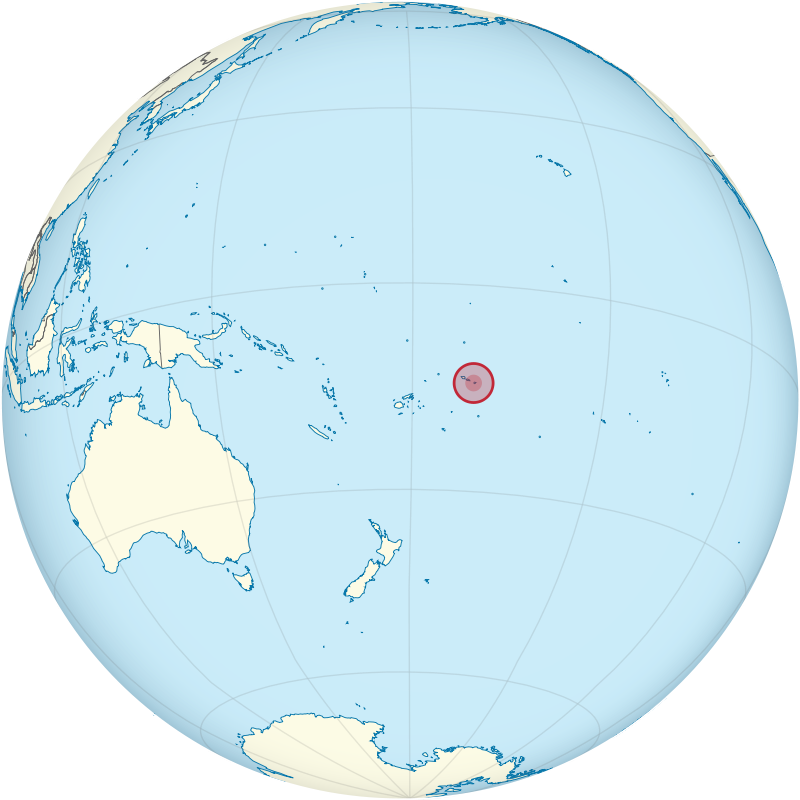
America Samoa location. Author: TUBS

The news release (more pictures here):

—-

PAGO PAGO, American Samoa — The Coast Guard Cutter Joseph Gerczak (WPC 1126) arrived in the Port of Pago Pago, Saturday.

The crew is participating in Operation Aiga to conduct fisheries law enforcement and strengthen partnerships in American Samoa and Samoa throughout August.

“It was a good transit, the longest we’ve conducted yet, nine days at sea and we’re proving the capabilities of these new cutters to operate over the horizon throughout the remote Pacific,” said Lt. James Provost, commanding officer of Joseph Gerczak. “This is the first time a Fast Response Cutter has come to Pago Pago. We’re looking forward to hosting our partners and the public during tours Monday from 1 to 3 p.m. here at the port.”

The U.S. Coast Guard is uniquely positioned to enforce U.S. federal laws and regulations in the territorial waters of American Samoa. Worldwide, tuna is a $7 billion dollar annual industry and roughly 70 percent of that tuna comes from the Western and Central Pacific. These pelagic fish migrate and it is essential the U.S. and its partners protect the resource from illegal, unregulated, and unreported fishing. Estimates place the value of IUU fishing around $616 million annually.

“After this port call, we will be working with NOAA fisheries and the American Samoa Marine Police to enforce fisheries regulations in the region while on patrol. Oceania countries adhering to the rule of law deserve and even playing field. Presence, partnerships, and regular enforcement can deter IUU fishing and safeguard these critical fish stocks,” said Provost.

The Coast Guard Cutter Walnut (WLB 205) crew will also be conducting a fisheries mission with shipriders from Samoa aboard to enforce sovereign laws in their EEZ and deter IUU fishing. This effort is being undertaken in coordination with Australia and New Zealand as Samoa transitions their organic patrol assets, upgrading their fleet. Both cutter crews will also respond to any emergent search and rescue needs in the area and seek out opportunities to work with partner nation assets.

The Coast Guard exercises 11 bilateral shiprider agreements with Pacific Island Forum nations to help ensure regional security and maritime sovereignty.

“The U.S. is committed to supporting our allies and neighbors in the Pacific, which is essential to a free and open Indo-Pacific.”

The Joseph Gerczak is a 154-foot Sentinel-Class Fast Response Cutter homeported in Honolulu. It is one of the newest patrol boats in the fleet, replacing the aging 110-foot Island-Class patrol boats serving the nation admirably since the late 1980s. Three Fast Response Cutters will be homeported in Honolulu, the third arriving in August. Three will also be stationed in Guam and are to begin arriving there in 2020.

The Other Prize Winning USNI Coast Guard Essays

At least for a little while, the three prize winning US Naval Institute Coast Guard Essays are available on line, and they are available whether you are a member or not. 

I did a separate post on the First prize winner earlier. The other two are linked below.

    “Rethink Coast Guard Priorities”—2nd Prize, By Lt Noah Miller, USCG
    “Guard the African Coast”—3rd Prize, By LCdr Stuart J. Ambrose, USCGR
Both are thoughtful efforts, well worth the read.
Lt Miller makes the case for devoting more assets to fisheries enforcement even at the expense of decreased drug enforcement. I think he has a point, particularly in regard to the Central and Western Pacific.
“The Western and Central Pacific region is extremely remote, so it is difficult to detect potential incursions and even more difficult to respond in a timely manner. However, tuna fisheries are present in these waters, and they are among the most valuable pelagic fisheries in the world.”
LCdr Ambrose tells us why the Coast Guard should be engaged in Africa.

Happy Coast Guard Day

It is Coast Guard Day. It is time for picnics and telling your shipmates how you appreciate them. Of course many are still on the job.

For 22 years I had the privilege of being part of the organization. Most of the time it was fun, although there were times when it definitely was not. Don’t expect perfection. Like the nation itself, the Coast Guard is a work in progress. It can be better. Your efforts may not always be appreciated. Be true to the ideals that motivate you, and you and the organization will be better in the end.

“Connectivity Maketh the Cutter” –USNI

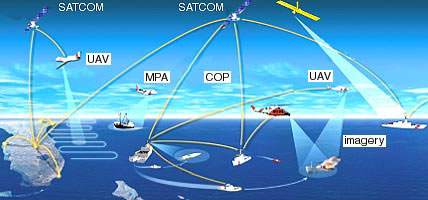
In the August 2019 issue of US Naval Institute Proceedings, their annual “Coast Guard focused” issue, you will find the three prize winning Coast Guard themed essays. First prize went to Cdr. Craig Allen, USCG. The essay contrasts the promise of Networked assets, that was a major feature of the Deepwater Program and still being touted, with the disappointing reality he sees in the actual implementation.

Put bluntly, in the past several years cutter connectivity has climbed in urgency from concern to crisis. The negative impact of poor connectivity on current mission execution already is cause for alarm, but the more important concern is the constraint it will place on the Coast Guard’s ability to shape future operations.

The whole essay is well worth the read.

The common operational picture promised is no where to be found.

As I have been pointing out since at least 2011 (also here), there is no reason our units should not have Link 16. The Navy puts it on helicopters, and I believe on the 85 foot MkVI patrol boat, so it would certainly fit on Coast Guard patrol boats, fixed wing aircraft, and our helicopters. It would improve interoperability not only with other Coast Guard units but also other US armed forces and Allies. It is a proven, widely used system. Link 16 would be very useful if we ever do become part of the US Fleet’s distributed lethality or if we need to call in Navy assets to assist the Coast Guard.

An Offshore Patrol Vessel With Teeth

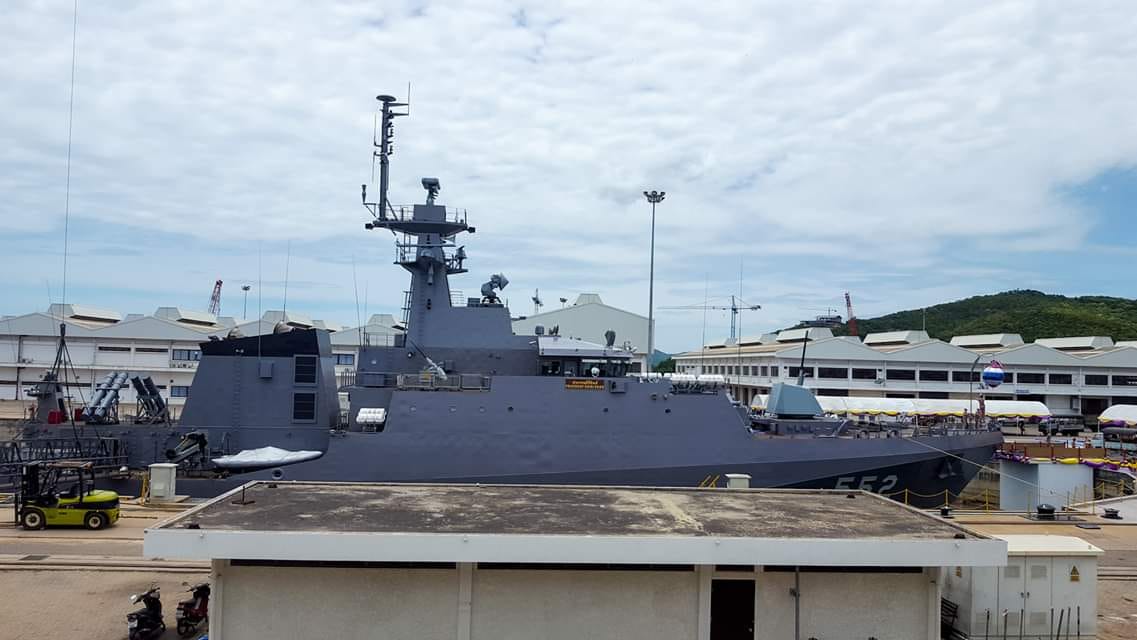
Royal Thai Navy’s second offshore patrol vessel based on the River class, HTMS Prachuap Khiri Khan (OPV 552) constructed by Bangkok Dock Ltd and poised for induction into service. Note RGM-84 Harpoon anti-ship cruise missiles fitted. Photo: http://thaidefense-news.blogspot.com/2019/07/blog-post_31.html

Naval News reports that the Thailand has recently launched a second Krabi class Offshore Patrol Vessel (OPV). (It appears the ship has completed fitting out.) These are a version of the Royal Navy’s BAE designed River class OPVs. The Royal Navy is still building “Batch II” of this class. Three of the class are also in service with the Brazilian Navy and they may build more.

The Thai vessels are clearly the most heavily armed. While the British Royal Navy ships have at most one 30mm gun and the Brazilian ships have one 30mm and two 25mm guns, the first Thai ship emerged with an Oto Melara 76mm and two 30mm. This second OPV has added Harpoon anti-ship missiles. Four missile cannisters are visible in the photo above and they could probably carry as many as eight missiles.

At 90.5 meters (297′) in length and about 2,000 tons full load, they are a little larger than a WMEC 270, and about half the size of an Offshore Patrol Cutter.

Note: Thailand does have a small coast guard squadron, but these ships are not part of it. Naval history buffs might find this naval battle between Thailand and France in 1941 interesting. 

Case for a Second Great Lakes Icebreaker

Launch of USCGC Mackinaw (WLBB-30) on April 2, 2005. Photo by Peter J. Markham.

Recently in response to my post “Great Lakes–St. Lawrence Shipping: We Need Icebreakers” –Marine Link, in which I suggested that the Great Lakes icebreaker might serve as a prototype for the three planned medium polar icebreakers, there was a comment from an Academy classmate, Capt. Fred Wilder, USCG (ret.), that was intended to link to a press release from the Lake Carriers’ Association, but for some reason the link was lost. I requested a copy of the news release from Capt. Wilder which he provided. It is reproduced below.

A week after the post linked above, I posted on why we might need icebreaker assets that could be drawn on by the Atlantic Fleet, in the form of icebreakers that could serve in both the Lakes and in the Atlantic Arctic.

—–

Lake Carriers’ Association For Immediate Release   August 1, 2019

Iced Out: Study Reveals Loss of More Than $1 Billion Due to Inadequate Icebreaking Capabilities on the Great Lakes

CLEVELAND – The U.S. economy lost more than $1 billion in business revenue and 5,421 jobs due to inadequate icebreaking capabilities on the Great Lakes during the 2018-2019 winter season.

Due to this loss of business revenue, the federal government missed out on more than $125 million in taxes and in addition $46 million was lost by state and local governments. For perspective, that loss means the U.S. government could build a new Great Lakes icebreaker and recoup those costs in two years.

“In response to a question at a recent Congressional hearing, we polled our members about the delays they incurred due to inadequate icebreaking this winter,” said Jim Weakley, President of Lake Carriers’ Association. “Once we had the total number of tons delayed and total hours they were delayed, we were able to calculate the additional cargo we could have moved had the Coast Guard been able to meet the needs of commerce. Using the economic model updated in July of 2018 by Martin Associates, it was determined that U.S. Economy lost over $1 billion as a result of the steel not made and the power not generated by the coal and iron ore the U.S.-flag fleet could not move.”

With robust icebreaking capabilities paving the way for commercial shipping, U.S.-flag Lakers could have carried 4 million additional tons of iron ore and 879,210 additional tons of coal. In other words, Lakers could have done an additional 860 trips delivering iron ore to steel mills and 21 trips delivering coal to power generation plants.

“A dynamic fleet of icebreaking assets is absolutely critical for our regional and national economy, especially our domestic steel and power generation industries which were hit hard this past winter season,” says Mark W. Barker, president of The Interlake Steamship Company, which moves nearly 20 million tons annually crisscrossing the Lakes more than 500 times between March and January. “Robust icebreaking capabilities enable the Coast Guard to deliver on its mission to facilitate the flow of commerce across our Great Lakes.”

Mark Pietrocarlo, Lake Carriers’ Association’s board chairman, noted, “The U.S. Coast Guard was down four icebreakers for a significant period of time this past winter and for the first time in memory, no icebreaker was left on Lake Superior when the Soo Locks closed from January 15th to March 25th.  One icebreaker took seventeen months to repair, one was on the East Coast for a major overhaul and two others missed more than a month of icebreaking.”

“The economic impact on our customers and the supply chain they enable is significant and points out the need for a new icebreaker for the Great Lakes,” Pietrocarlo said. “Given the lost tax revenue the economic model calculated for the federal government, the payback period to the Treasury for the vessel is two years.  Infrastructure investment isn’t just about fixing the roads, we also need to maintain our marine highways.”

Beset in ice, the M/V Stewart J. Cort and three other Great Lakes vessels await the assistance of an icebreaker on Lake Superior

About the study:

To estimate the economic impact of inadequate icebreaking during the typical ice conditions experienced on the Great Lakes during the 2018 – 2019 winter season, Lake Carriers’ Association (LCA) asked U.S.-flag carriers to report their delays in hours and the number of tons carried during their delays.

The types of delays included being beset in the ice, at anchor awaiting an icebreaker, having to slow down due to inadequate icebreaking, waiting for Coast Guard permission to proceed, and waiting for a convoy to form.

In addition, hours lost due to repairing ice damage to vessels and the hours lost by vessels that delayed their initial sailing times due to inadequate icebreaking were factored in to the total.

LCA aggregated the fleet’s lost hours and tons delayed and determined that a total of 409,729 tons of coal were delayed for 206 hours.  It also calculated that 2,186,361 tons of iron ore were delayed for a total of 1,586.5 hours. Since the vessels reporting were a combination of “footers” and smaller vessels, we used an average of 42,000 tons per trip. It was also assumed that a typical round trip for a U.S.-flag Laker takes 96 hours.

—–

Economic Impact of Lost Tonnages due to inadequate icebreaking in the average winter of 2018/2019 (Source: Martin Associates)

4,000,000 ton loss of iron ore and 900,0000 ton loss of coal due to ice delays

JOBS 

  • Direct Jobs 1,925
  • Induced 1,666
  • Indirect 1,829
  • Total 5,421

PERSONAL INCOME (1,000)

  • Direct $106,912
  • Re-Spending/Local
  • Purchases $203,098
  • Indirect $80,454
  • Total $390,464

BUSINESS REVENUE  (1,000)

  • $1,044,044

LOCAL PURCHASES  (1,000)

  • $187,193

STATE AND LOCAL TAXES (1,000)

  • $46,429

FEDERAL TAXES (1,000)

  • $125,518

—–

The data, showing tons by commodity, lost by the U.S.-flagged Great Lakes fleet, was supplied by the Lakes Carriers’ Association to Martin Associates. The July, 2018 updated Economic Impact study of the Great Lakes and St. Lawrence Seaway – U.S. Flagged Fleet, developed jobs per ton and economic impact per ton ratios for iron ore, coal, limestone/aggregates and other dry bulk cargo.  These ratios were then applied to the estimated loss of 4,000,000 tons of iron ore and 900,000 tons of coal for the relatively average winter of 2018/2019.  The economic impacts of these delays are presented in terms of jobs and business revenue in table above.  For more information about 2018 Economic Impact study of the Great Lakes, go to http://www.greatlakesseaway.org/resources/reports.

ABOUT LAKE CARRIERS’ ASSOCIATION: Since 1880, Lake Carriers’ has represented the U.S.-flag Great Lakes fleet, which today can move more than 90 million tons of cargos annually that are the foundation of American industry, power, and construction: iron ore, limestone, coal, cement, and other dry bulk materials such as grain and sand. For more information contact Jim Weakley – 440-333-9995 / weakley@lcaships.com.