“World’s Fastest OPV”

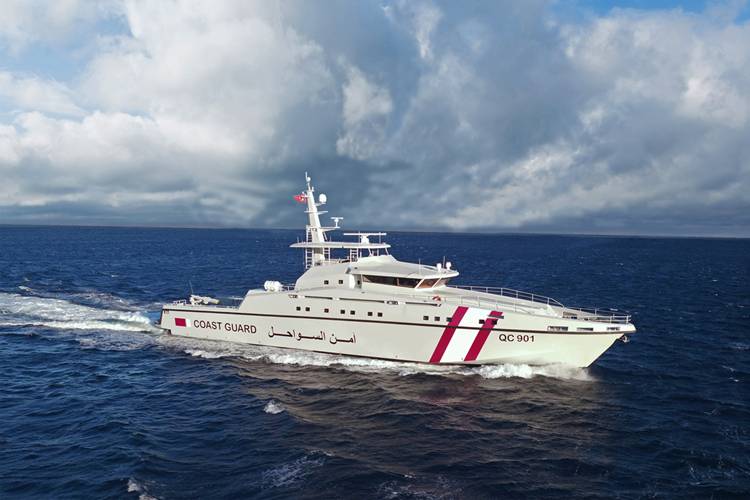
Ares 150, 48 meter OPV built for Qatar Coast Guard

Its fast, its composite construction, and its slightly longer, but lighter, than our Webber class.

MarineLink reports a cooperation between International design and engineering company BMT and the Turkish Ares shipyard (see link for more detail) resulted in an unusual vessel for the Qatar Coast Guard. (Sorry I am a little late in publishing this.)

“These boats break two important records – firstly, they have become the largest composite hull military ship to have ever been built in Turkey and secondly, with its speed of 37 nautical miles an hour (emphasis applied–Chuck), it is the world’s fastest offshore patrol vessel (OPV). It is exciting to also report that the outstanding performance of the first ARES 150 HERCULES has also led to an immediate order for a further three vessels.”

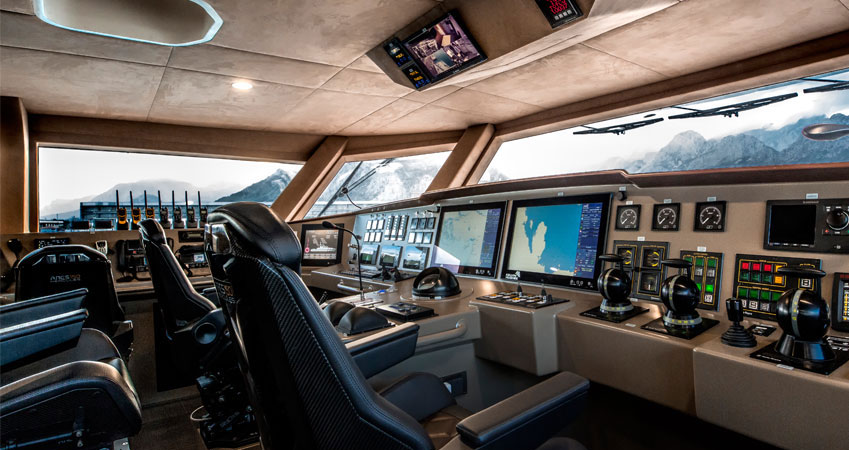
I don’t see either weapons or a boat.

Ares shipyard photo

Including the Coast Guard in Navy Planning

There is a lot going on in Navy Department planning now, prompted by the rise of a real near peer competitor in the form of the Chinese Navy. In fact the Chinese Navy is currently building ships faster than the US Navy. The trend line is not favorable so, its time to think.

Defining a Coast Guard role in a major naval conflict could have major impact on our shipbuilding, our equipment, and our budget.

Force Structure Assessment:

There will be a new “Force Structure Assessment.” It seems we already have an answer for the total number, since 355 some time in the future, has become a law, but this one is expected to better detail the types of ships needed.

The Coast Guard fleet is a significant portion of the “National Fleet” and it needs to be included in the calculus of what will be available and how it will be used.

Surface Forces, the Sea Control Mission:

The Commander Naval Surface Forces has published a new document, “Surface Force Strategy, Return to Sea Control.”

The strategy describes the return to sea control and implementation of Distributed Lethality as an operational and organizational principle for achieving and sustaining sea control at will.

Reading it over, you might notice it says nothing about the Coast Guard. Despite the admission of Cuttermen to the Surface Navy Association, we are still largely invisible to the Navy.

Don’t expect to see a war winning strategy here. This is really an administrative strategy in an attempt to find out what that strategy should be. It is laced with buzz words and power-pointese. It does nothing to tell us how we will find, fix, and kill the other guy before he finds, fixes, and kills us. Still there are some indications.

The big change is that the Navy’s surface forces are saying they will no longer circle the wagons around the carrier and play defense while the aviators provide all the offense. They have begun to see themselves as offensive players. There are even those that now suggest that the carriers should be protecting the surface forces rather than the other way around.

The strategy talks about being Forward, Visible, and Ready.

It talks about the concept of Distributed Lethality:

  • Increase the offensive lethality of each warship
  • Distribute offensive capability geographically
  • Give ships the right mix of resources to persist in a fight

Then they talk about “four Ts”

  • Tactics
  • Talent
  • Tools
  • Training

Hopefully there really is a strategy somewhere in the classified material spaces, but this administrative strategy mostly says we are going to do a lot of good things that we all recognize as good things, and we will do them better than we did in the past. It says nothing about what they will stop doing in order to make time to do these additional things.

What is clear, is that, if the Coast Guard is going to play in the Sea Control game, we are going to need to be part of the network, otherwise, at best we may just get in the way, at worst, we might be road kill in a blue on blue engagement.

Really I think we have a lot to contribute to “sea control.” The Navy has the resources to contend for the opportunity to have control of the seas, but they don’t actually have the platforms to exercise control of the sea. That requires not only excluding enemy combatants–always a hard thing, particularly when those combatants are submarines, but also checking merchant ships to make sure they are not carrying out tasks for the enemy. You also have to protect your own logistics, resupply, and merchant ships and frequently those of your allies. The Chinese have figured out that attacking our logistics is a useful strategy.

Sea Control is many faceted and I have seen few explanations that deal with all aspects. Like a blind man describing an elephant we authors tend to see only certain aspects or elements of the problem.

Cutters will be needed for escort logistics vessels, for open ocean rescue, and for boarding vessels to determine their nature and intent. These are not things you want DDG and cruisers doing.

Even dominant naval powers face the possibility of submarine or unconventional attacks and will want to shutdown the enemies covert as well as overt use of the sea.

Gray Zone Conflicts: 

The Chief of Naval Operations has said that the Navy needs to be able to compete and prevail in ‘Gray Zone” Conflicts.

But is not really just the Navy, the Coast Guard is part of the National Fleet and a potentially important element in any response violations of norms of international conduct, and it can do so without raising tensions to extent use of Navy assets frequently engender

Additional Reading:

If you are interested in an insight into some of the issues shaping the strategy debate, US Naval Institute has published a pair of fictional future history scenarios that highlight some of the issues.

The first, and probably most important of these, is “How We Lost the Great Pacific War.” Like the author, I question the wisdom of having single carrier task groups forward deployed, where they may serve more as bait than deterrent.

The second which takes a different view and looks primarily at the Marine’s role is “How We Won the Great Pacific War.”

CIMSEC just completed a series of eight post on “Bringing Back Sea Control Week.” that was mostly interesting, but still short of comprehensive.

If you really want to get into it, there is a reading list here.

To me the best source is still Julian Corbett’s “Some Principles of Maritime Strategy.” You have to rethink the distribution of roles in light of new technology, but that is itself a useful exercise.

USCG Navigation Center: Steering a steady course for safe, secure, efficient waterways–MarineLink

The above screenshot shows the display of the virtual aid to navigation established in partnership between the U.S. Coast Guard and the U.S. Army Corps of Engineers on the Mississippi River. The virtual aid is significant in that it allows mariners to see a hazard when it is not possible to place a floating aid to mark it. U.S. Coast Guard image.

Marine Link has a very interesting post on the Coast Guard’s Navigation Center. It discusses its role in management of aids-to-navigation, issuance of Notice to Mariners, interface with NOAA and the Army Corps of Engineers, maintenance of GPS including ground based differential GPS equipment, Automatic Information System (AIS) monitoring and quality control, long range tracking of US flag merchant ships, and maintenance of a Maritime Domain Awareness within 1000 miles of the US.

SAG South

Following from the USCGC Hamilton Facebook page.

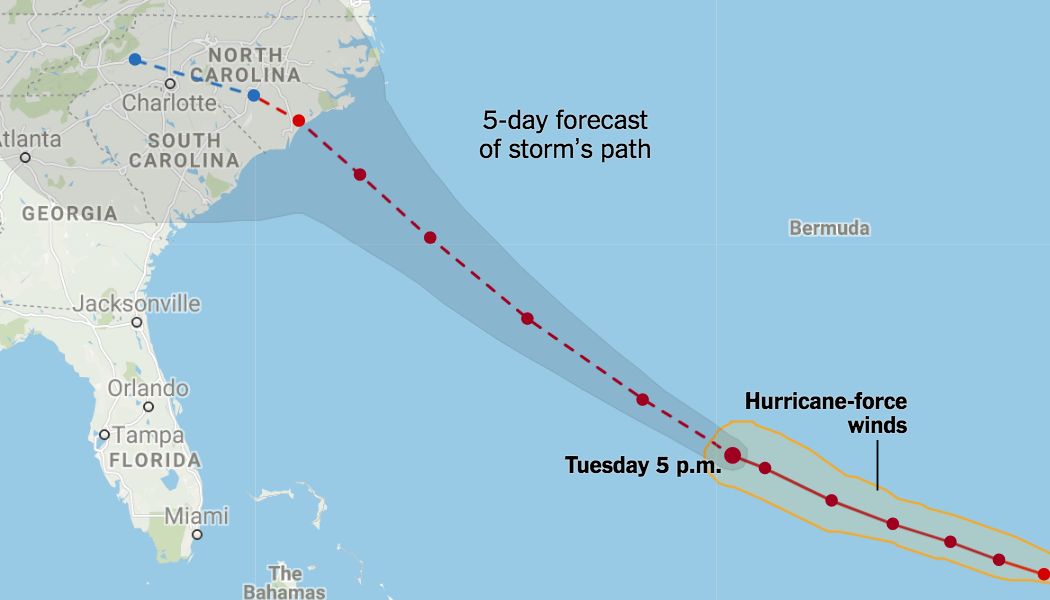
CGC HAMILTON, along with 11 other Coast Guard Cutters and over 500 Coast Guard personnel have moved out of the path of Hurricane Florence in preparation for a swift response to the potential impacts of the dangerous storm. CGC HAMILTON and 5 other cutters have repositioned to Mayport, Florida in preparation to head north following Florence’s landfall. Together, these cutters have formed Surface Action Group (SAG) South, whose mission is to conduct search and rescue, provide humanitarian aid, assist maritime commerce by surveying waterways and maritime aids to navigation, and provide security to insure a prompt recovery of any impacted sea ports.

In addition to Hamilton I see three 270s, a 210, and a Webber class. Other ships in the SAG include Spencer and Harriet Lane.

Reportedly SAG South has begun to move North out of Mayport.

(Does this mean there is a SAG North?)

MH-65 Service Life Extension Program

US Coast Guard photo, by PAC Dana Warr

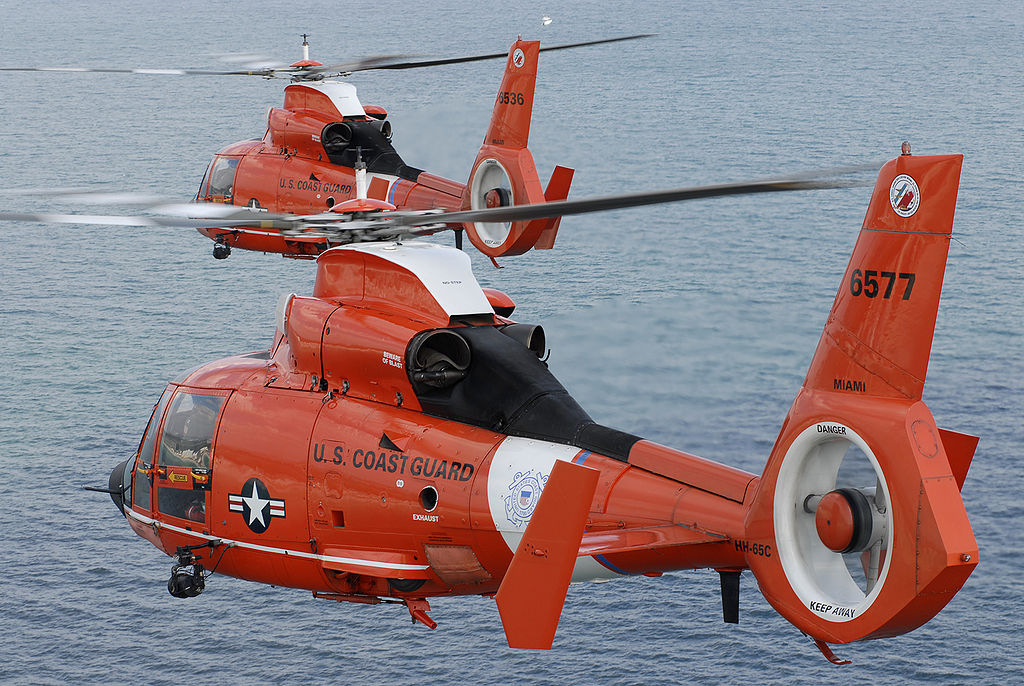
The Acquisitions Directorate (CG-9) is reporting award of a contract to Airbus for components for a Service Life Extension Program for CG MH-65s. I have reproduced the press release in full below. Significantly it indicates the H-65s will continue to serve until phased out between 2035 and 2039. We are also SLEPing the H-60s so their replacement and that of the H-65 may both come due about the same time. In the 2030s we will have an entire fleet of 50 year old helicopters. This could create a huge budgeting problem in the mid 2030s.. At least it appears the “Future Vertical Lift” program should be mature by then. 

———————-

The Coast Guard awarded a $15.9 million contract to Airbus Helicopters Inc. Aug. 22 to procure three critical structural components for its H-65 short range recovery helicopters as part of a Service Life Extension Program (SLEP).

The sole source contract includes the following commercial items; the canopy, center console floor assembly and the lower right nine degree frame. The Coast Guard elected to order 87 canopies in the base period, which resulted in a $2.5 million cost savings to the government. Under the contract, canopy deliveries will be spread out over a five-year performance period.

The SLEP will replace five critical components that are essential to the airworthiness and flight safety of the aircraft. Contracts for the other two components, the floor boards and side panel, were awarded in May.

The SLEP will extend the service life of the H-65 from 20,000 to 30,000 flight hours. The 10,000-flight-hour extension will provide a 50% increase in service life and will ensure that the Coast Guard can maintain its H-65 fleet until its planned phase-out between 2035 and 2039.

The MH-65 is also undergoing an avionics upgrades that will convert the airframe to an MH-65E configuration. In order to achieve schedule and cost efficiencies, the avionics upgrades and SLEP are being completed at the same time. One low rate initial production aircraft, CGNR-6556, is currently undergoing SLEP and the avionics upgrades; work is scheduled to be completed by the end of 2018.

For more information: MH-65 program page

“Embrace the Coast Guard’s Strength”–USNI

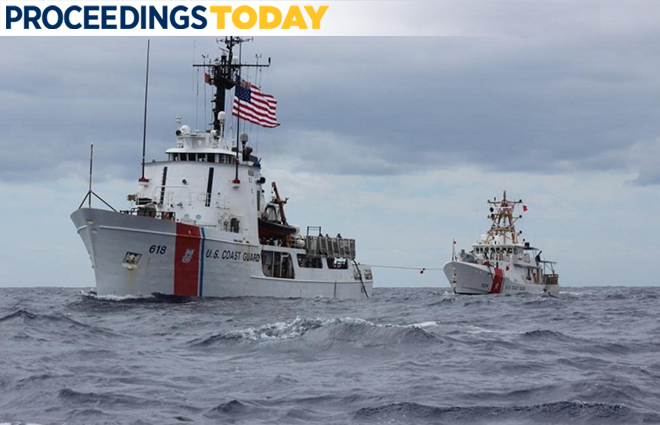
The USCGC Active (WMEC-618) was commissioned in 1966 and is still serving–a tribute to the Coast Guard’s “can do” culture.

By admitting that  Semper Paratus is an aspiration, the Coast Guard can allow itself to celebrate the truth that while the service is not  Always Ready , Coast Guardsmen embrace every task to meet their mission. That might not be the service’s aspiration, but it should be its inspiration.

Seems like I have been pointing to the US Naval Institute publications a lot recently, but it does seem they are paying more attention to the Coast Guard. Latest is “Embrace the Coast Guard’s Strengths” by LCdr. Luke Petersen, USCG. It discusses how we should view the motto, “Semper Paratus–Always Ready.”

Aspirational, Inspirational, or a curse?

Contract awarded for FRC #45-50

The primary thrust of the Acquisitions Directorate post is on what Webber class WPCs are doing in response to recent hurricanes, but it also mentions that a contract option for six more has been exercised bringing the program to 50 cutters.

The service exercised a contract option on Aug. 9 worth just over $294.4 million with Bollinger Shipyards of Lockport, Louisiana, for production of six more Sentinel-class FRCs and eight shipsets of rudders as spares. Keeping spares on hand enables greater mission readiness by minimizing operational downtime in the event that some systems need repair or replacement.

This option brings the total number of FRCs under contract with Bollinger to 50 and the total value of the contract to nearly $929 million. The contract has a potential value of $1.42 billion if options to procure all 58 cutters are exercised.

SOUTHCOM Mothership?

HOS Mystique, 250 foot Multi-Purpose Support Vessel being chartered by the Navy for SOUTHCOM

Marine Link is reporting that the Navy has awarded a $7.4M charter to Hornbeck Offshore with the work expected to be completed 14 June 2019.

“The DOD says the multi-mission support vessel will be chartered to provide proof of concept for a single vessel to meet various training, exercise, experimentation, and operational mission support requirements.”

I am going to speculate that the intent is to support the operation of Cyclone class patrol craft in the Eastern Pacific transit zone. Perhaps Webber class WPCs as well?

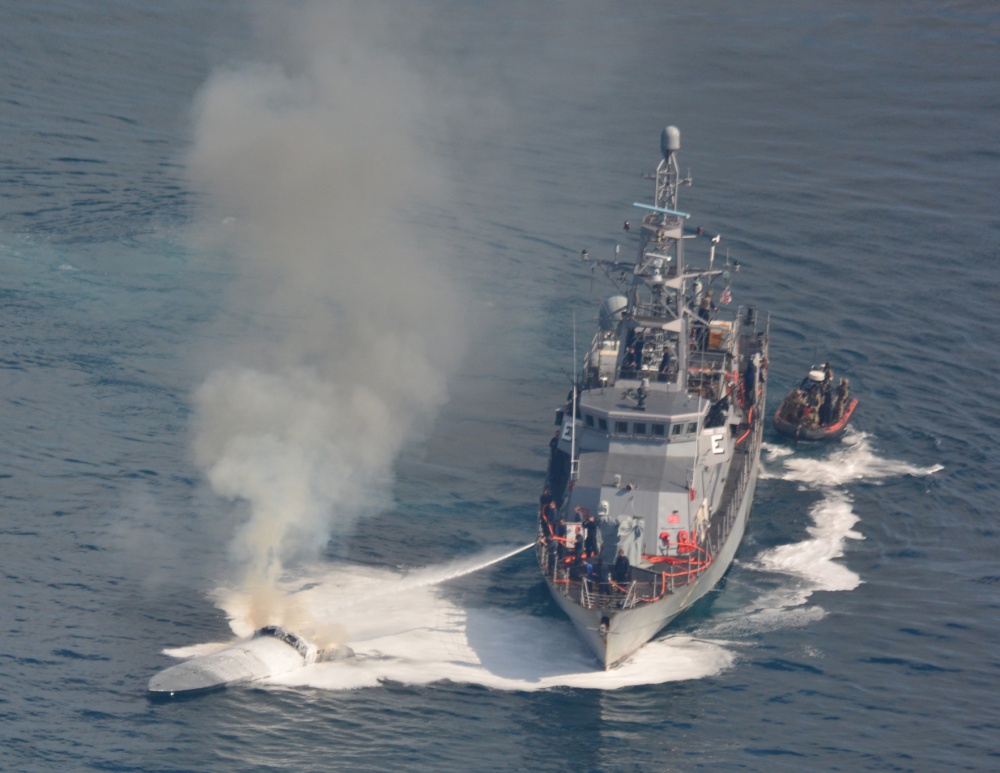
Cyclone-class patrol coastal USS Zephyr (PC 8) crew conducts ship-to-ship firefighting to extinguish a fire aboard a low-profile go-fast vessel suspected of smuggling in international waters of the Eastern Pacific Ocean April 7, 2018. Photo by Petty Officer 1st Class Mark Barney

Midshipmen and Cadets Essay Contest–USNI

In hopes I have at least one cadet (academy or OCS) in the readership, I have duplicated the following from a US Naval Institute web site

The Challenge:

This new Contest encourages Navy, Marine, and Coast Guard midshipmen, cadets, and officer candidates (Naval Academy, NROTC, Coast Guard Academy, Kings Point and State Maritime Academies, and Officer Candidate Schools) to think and write about the challenges that face the Sea Services today and in the coming decade. Some questions to consider include: What is the right mix of forces? How can the different services partner in new ways to enhance national security? How will peer competition with China and Russia impact your Navy, Marine Corps, Coast Guard, and Merchant Marine? What capabilities will tomorrow’s forces require that are not yet in the force? What could the Academies learn from NROTC or OCS and vice versa? Are naval commissioning sources preparing future officers well for what lies ahead? And what lessons from the past should guide your futures?

Prior Publication: Your essay must be original and not previously published (online or in print) or being considered for publication elsewhere.

Submission Guidelines:

  • Email essay as a Microsoft Word attachment to essay@usni.org by 31 October 2018.
  • Include Midshipmen and Cadets Essay Contest on subject line of email.
  • Include word count on title page of essay but do not include your name on title page or within the essay.
  • Provide a separate attachment to include biography and compete contact information — i.e., work, home, and cell phone numbers; and home mailing address.

Selection Process: The Proceedings staff members will evaluate every essay and screen the top essays to a special Essay Selection Committee of at least six members who will include two member’s of the Naval Institute’s Editorial Board and four subject experts.  All essays will be judged in the blind — i.e., the Proceedings staff members and judges will not know the authors of the essays.

Announcement of the Winners: The top three winners will be published in Proceedings magazine.

About Naval Institute Essay Contests

Essay contests have been central to the work of the Naval Institute for more than 130 years. They directly fulfill the Institute’s educational mission by encouraging writing on issues of concern to the Sea Services. They provide thought-provoking articles that spur ongoing discussion of these same issues, not only in Naval Institute media, print and digital, but also in other leading defense and national security forums.

  • Essay Publication: The top three winners will be published in Proceedings
  • Essay Awards: First Prize: $5,000; Second Prize: $2,500; Third Prize: $1,500
  • Essay Length: 2,000 word maximum (excludes endnotes/resources).
  • Essay Year: 2018