WINNER ANNOUNCEMENT – 2017 HOPLEY YEATON CUTTER EXCELLENCE AND SUPERIOR CUTTERMAN AWARDS

NSC 5 James on builders trials in the Gulf of Mexico March 30, 2015.

The 2017 “Hopley Yeaton Cutter Excellence and Superior Cutterman” awards have been announced. 

R 211106 DEC 17

FM COMDT COGARD WASHINGTON DC//CG-7//
TO ALCOAST
UNCLAS //N01650//
ALCOAST 360/17
COMDTNOTE 1650
SUBJ:  WINNER ANNOUNCEMENT – 2017 HOPLEY YEATON CUTTER EXCELLENCE AND SUPERIOR CUTTERMAN AWARDS
1. The Douglas Munro Chapter of the Surface Navy Association is honored to announce and congratulate the recipients of the 2017 Hopley Yeaton Cutter
Excellence and Superior Cutterman Awards. Each of the winners was selected from amongst a superb group of highly deserving candidates by a diverse panel of officer and enlisted Cuttermen. The winners selected for this year are:
A. Cutter Excellence Award (Large Cutter): CGC JAMES (WMSL 754)
B. Cutter Excellence Award (Small Cutter): CGC JOHN MCCORMICK (WPC 1121)
C. Superior Cutterman Award (Officer): LTJG Anna Ruth – CGC HAMILTON
D. Superior Cutterman Award (Enlisted): MK2 Jason Tribeck – CGC DILIGENCE
2. Hopley Yeaton Cutter Excellence Award (Large):
A. CGC JAMES (WMSL 754) led 22 successful drug interdictions, spearheaded hurricane relief and recovery efforts as Command Task Unit (CTU) Maria,
aggressively pursued opportunities for community involvement, and exemplified dedication to their crewmembers’ personal well-being. On their first patrol, the JAMES made an unprecedented AUF interdiction of three go-fast vessels, over 40 NM apart within a two hour window. When JIATF-S was forced to evacuate ahead of Hurricane Irma, JAMES assumed Alpha Victor (AV), taking TACON of all assets in the Eastern Pacific for a week. As AV, JAMES facilitated 61 cases through 11 partner nations, five interagency entities, 12 surface assets, and over 24 flight missions. This resulted in the interdiction of 10,881 kgs of cocaine and 747 kgs of marijuana, and set a new benchmark for WMSL capabilities.
B. Honorable Mentions for the Large Cutter Award were:
CGC ALEX HALEY
CGC CYPRESS
CGC NORTHLAND
3. Hopley Yeaton Cutter Excellence Award (Small):
A. As the first Fast Response Cutter (FRC) assigned to District 17, CGC JOHN MCCORMICK (WPC 1121) set lofty standards in crew readiness and training. This ensured JOHN MCCORMICK’s safe and timely transit of more than 6,000 NM from Key West to homeport of Ketchikan, and the crew’s rapid response to engineering and damage control casualties along the way. Upon arrival at homeport, JOHN MCCORMICK was an immediate asset to D17 where the crew conducted 77 fisheries boardings, saved 10 lives, and developed close bonds with the community.
B. Honorable Mentions for the Small Cutter Award were:
CGC BISCAYNE BAY
CGC JOSEPH TEZANOS
CGC WASHINGTON
4. Hopley Yeaton Superior Cutterman Award (Officer):
A. While serving as Combat Systems Officer aboard CGC HAMILTON, LTJG Anna Ruth led her cutter’s pursuit and boarding teams on all 19 of HAMILTON’s drug interdictions, netting over $500 million worth of cocaine in 2017. Shortly after reporting aboard, LTJG Ruth set about correcting 38 mission critical electronics casualties, ensuring the cutter’s full suite of sensors was available for its first patrol. Additionally, LTJG Ruth helped re-establish Naval Weapons Station Charleston, SC for use in ammunition onloads. LTJG Ruth served as a sought-after mentor and role-model for junior shipmates, streamlined the onboard qualification process, and promoted the afloat career path to others.
B. Honorable Mentions for the Superior Cutterman Award (Officer) were:
LCDR Amy Lockwood – CGC WAESCHE
LT Daniel Halsig – CGC CONFIDENCE
LT Paul Ledbetter – CGC SHERMAN
5. Hopley Yeaton Superior Cutterman Award (Enlisted):
A. MK2 Jason Tribeck epitomized dogged perseverance and showcased his ingenuity on numerous troubleshooting and repair efforts. MK2 Tribeck meticulously prepared DILIGENCE for AVSTAN, which earned high praise by Aviation Training Center Ship-Helo Branch throughout the inspection. His attention to detail played a critical role in his success as a government quality assurance inspector for $545K in dockside availability work. Additionally, MK2 Tribeck’s dedication and drive were on full display when he earned his Underway Engineer of the Watch (EOW) qualification, helping his shipmates through a heavy transfer season by improving the watch rotation.
B. Honorable Mentions for the Superior Cutterman Award (Enlisted) were:
MK1 Michael Hilbert – CGC HAMILTON
EM1 Shaun Ryan – CGC LIBERTY
ME1 Daniel Brooks – CGC SHERMAN
6. Awards will be presented in Washington, DC in conjunction with the January 2018 Surface Navy Association National Symposium. If a unit representative is not available to receive the Cutter Excellence Award at the symposium, the award will be sent to the winning cutter’s OPCON for presentation. The Surface Navy Association (SNA) will contact award winners to discuss and coordinate their travel and symposium arrangements. Please contact SNA at navysna@aol.com with any questions or concerns.
7. We applaud all of the deserving nominees for their phenomenal performance. There were an especially large number of nominations this year, all of which represented highly deserving candidates and made the selection of a single winner in any category especially challenging. We also thank the commanding officers and supervisors who took the time to submit high quality nominations for their deserving units and personnel, as well as ADCON units for reviewing and screening nominations.
8. RDML Michael P. Ryan, Assistant Commandant for Capability, sends.
9. Internet release authorized.

“Coast Guard Cutter John F. McCormick (WPC 1121), March 4, 2017. Coast Guard photo by Petty Officer 2nd Class Loumania Stewart”
Iranian Tanker Burning, 32 Missing after Collision off China Coast–Reuters

Reuters is reporting that a collision between a loaded Iranian owned tanker and a Chinese freighter has resulted in a fire and possibly the loss of all 32 aboard the Iranian vessel. The tanker was carrying 136,000 tons of condensate, an ultra-light crude.

There was relatively minor damage to the Chinese freighter, and apparently no serious injuries. .

Maritime Futures and the Bering Strait Region–CSIS

Above is a video of a symposium conducted by the Center for Strategic and International Studies, November 29, 2017, with Rear Admiral Michael F. McAlister, Commander, 17th Coast Guard District, as the speaker. He talked about:

  • The Arctic as he sees it now and his concerns for the future.
  • Working relationship with counterparts in Russia, China, Canada, and other Artic nations.
  • Some of the topics were a traffic management scheme jointly proposed with Russia for the area around the Bering Strait.
  • Prospect of increased Illegal, Unregulated, and Unreported Fishing in the Arctic.
  • Differences in pollution response regulations and planning compared to how it is done in the lower 48.
  • Improved communications among Arctic Coast Guard Forum nations.
  • Extending Maritime Domain Awareness to include groups outside the Coast Guard such as environmental groups and native villages.
As an aside he also mentioned a program I was not aware of, that the Coast Guard seconds officers to think-tanks like CSIS.

Thanks to Lee for bringing this to my attention.

Video–“Coast Guard Readiness: How Far Can We Stretch Our Nation’s Only Multi-Mission, Military Force?”

Above is the video of the Senate Subcommittee hearing for which I provided the Commandant’s prepared remarks earlier.

Participating Senators I noted were:

  • Dan Sullivan, Sub-Committee chair (R, Alaska)(Lt.Col., US Marine Corps Reserve)
  • Gary Peters, ranking member (D, Michigan)(LCdr. US Navy Reserve, Supply Corps)
  • Bill Nelson, ranking member of the Commerce Committee (D, Florida)(Capt. US Army Reserve)(NASA Scuttle payload specialist)
  • Roger Wicker, Chairman of the Seapower sub-committee (R, Mississippi)(Lt.Col. ret. USAF reserve)
  • Richard Blumenthal (D, Connecticut) (USMC Reserve 1970 to 1976 discharges as Sargent)
  • Brian Schatz (D, Hawaii)
  • Ed Markey (D, Mass.) (Spec4, US Army Reserve, 1968-73)
  • Jim Inhofe (R, Oklahoma) (Spec4, US Army, 1956-1958)
  • Maria Cantwell (D, Washington)

You can also check out the original post from the Senate Committee on Commerce, Science, and Transportation. (Same video is available there, but the meeting does not actually start on that version of the video until minute 36.) There you can also find the written statements of the other three witness who constituted the second panel. The Commandant was the sole witness on the first panel.

This was something of a love fest for the Coast Guard with repeated praise for the people and actions of the Coast Guard.

This hearing was reputedly about how the Coast Guard had been impacted by the unusually severe Hurricane season. There is not a lot new here but there were some interesting remarks.

Polar Icebreaker Contracts

The intention is to Contract for the first Icebreaker and then employ block buy for the next two (28m). To me this seems to negate most of the advantage of a block buy. I don’t believe we will or should buy one and then wait until we have tried it out before contracting for the next two. That would necessitate a delay of at least five years during which we would still have the nightmare scenario of our only heavy icebreaker having no rescue if it should break down in the ice–certainly not an impossibility even with a new ship. If we are going to contract for the remaining two before testing the first, we might as well block buy all three.

First of class is always the most expensive. If the shipyard gets a block buy they know that initial improvements in productivity can be amortized over the entire block buy quantity. In some cases, in order to win the whole project, the shipyard will cut the price of the first ship substantially knowing they will make a profit over the entire project.

If we buy one and then block buy the second and third, we have paid for improvements to the winning yard with the first contract and minimized the chances for a competitive bid for numbers two and three.

Legislation has capped DOD participation in icebreaker procurement, so the bulk of icebreaker procurement costs will come out of the Coast Guard budget.

Authorization

There was a lot of discussion about the need to have the Coast Guard Authorization Bill signed into law, still not approved. You can see it here.

Other topics

There was a discussion of the high cost of the Coast Guard response to the recent series of Hurricanes.

Representative Sullivan spent a lot of time, discussing and advocating for an eleven mile road from King Cove  (population estimate–989) to Cold Bay, Alaska (population estimate–122) which has an all-weather airport with two runways, one 10,180 feet and one 6285 feet in length. The Coast Guard connection is that the road would minimize or eliminate the necessity for the Coast Guard to Medivac emergencies from King Cove by helicopter, which is frequently hazardous. It is a Federal issue, because the road would run through a Federal reserve. The Commandant fully supported the desirability of completing the proposed single lane gravel road as a means of minimizing the requirement for helicopter medivac.

Video Breakdown

28m Domestic icebreakers–Design work on new domestic icebreakers is expected to start in 2030. That sounds a bit late to me. Mackinaw was commissioned in 2006 so if that is what he is really talking about, that makes sense, but the 140 foot icebreaking tugs are a different story. The first for of these will be 51 years old in 2030. More than  half of them have already completed in-service which was expected to add 15 years to their service life. Morro Bay, at least, is expected to reach the end of her service life in 2030, and considering how long it takes us to build a ship we really need to start the process not later than 2025.

45m Western Pacific Fisheries Protection–They have not seen much risk of Illegal, Unregulated, or Unreported fishing. 

51m Inland River Tenders

56m We may need to replace the 52 ft MLBs with something larger than the 47 foot MLB sometime in the future, but their end of life is not yet apparent

58m Coast Guard Museum in New London

60m Sexual Assault in the CG

1h02m Puerto Rico/Virgin Islands continuing commitment and its effects on drug seizures and alien migrant interdiction.

1h05m Vessel homeporting

1h08 CG center of expertise, particularly in regard to clean up spills in ice and fresh water

1h16m Army Corp of Engineers dredging backlog.

1h17m  Second Panel begins.

1h19m Medivac from King Cove

1h31m Mr Smithson regarding Deepwater Horizon experience, unified approach, investment in mitigation.


MEDICAL DOCUMENTATION OF ASBESTOS AND LEAD EXPOSURES ON COAST GUARD CUTTERS CONSTRUCTED PRIOR TO 1991

The Coast Guard is directing the documentation of possible exposure to asbestos and lead on ships that were built before 1991, which of course means most of them.

HEALTH, SAFETY AND WORK-LIFE SERVICE CENTER TECHNICAL DIRECTIVE 2017-009, HSWLSCTD 2017-009 14 December 2017

This TD applies to all Coast Guard members currently and previously assigned to CG cutters that were constructed prior to 1991. Documentation is for the purpose of identifying potential exposure to low levels of asbestos and lead below the Medical Surveillance Action Level (MSAL) required for enrollment into OMSEP. Medical documentation of these exposures may facilitate the processing of future Veterans Administration disability claims.

This is primarily aimed at active duty personnel, but an entry on the Coast Guard Retired Facebook page indicates an intention to also document possible exposure of those no longer on active duty.

Thanks for Coming By

Statistically 2017 was the best year yet for this blog. We had 215,180 views and 54,412 visits. Both represent a least modest increases over previous years. I have wondered occasionally, if I was running out of things to say, but there is always seems to be something new. Fortunately, I get a lot of help from readers who share their expertise and experience in the comments.

There were 259 posts this year, growing the total archive for this blog to 1,935 posts.

We continue to have an international readership. The US Is of course the largest with 158,165 views but, aside from the US, 15 countries had more than 1,000 views and 40 had more than 200. Aside from the US, the top 10 were the UK (8,807), Philippines, Canada, Japan, Australia, Spain, Netherlands, Ireland, Chile, and Germany (1,976). We even had a few readers from Russia (#16 with 968 views) and China (#30.Hong Kong SAR China with 294 views and #33 China with 282).

The next statistic (top posts of 2017) is a bit deceptive in that, because of the way the blog is structured, most of the time, posts are read on the homepage. The figures below are for the times a post has been accessed directly.

  1. What Does It Take to Sink a Ship (March 2011)(4,086 views)
  2. If They Ditch the LCS, Perhaps the OPC as Frigate (April 2017)
  3. Three Nations Share German OPV Design (April 2014)
  4. Administration Considers Cancelling NSC#9 (March 2017)
  5. Case for the Five Inch Gun (November 2012)
  6. ALaMO–Making the 57mm Round Smart (April 2016)
  7. Battle of the Paracel Islands, 16 January 1974 (September 2017)
  8. New 40 mm Gun (October 2016)
  9. What Might Coast Guard Cutters Do in Wartime, Part 2, Coast Guard Roles (February 2012)
  10. National Security Cutter as Navy Patrol Frigate (August 2010)(759 views)

I would also like to particularly thank Center for International Maritime Security (CIMSEC) “Next War Blog”Eaglespeak, and Thinkdefence, for linking to this website and bringing more readers here.

Thanks for the interest.

I wish you all a happy New Year with just the right blend of adventure, excitement,  romance, and a sense of belonging.

Chuck


Drilling for Oil in Alaskan Arctic Resumes

© National Geographic Stock/ James P. Blair /WWF (Note, this may or may not be the facility in question–Chuck)

MarineLink reports that

“Italian oil producer Eni this week began drilling a new well in U.S. waters off the north coast of Alaska, becoming the first company to do so since 2015, federal regulators said on Wednesday.
“The oil and gas firm is working from an artificial island in the Beaufort Sea about three miles off Oliktok Point in the Arctic Ocean…The project could result in 20,000 barrels a day of oil production…”
 –
This should add urgency to research into dealing with oil spills in the ice covered water. Perhaps also more justification for revitalizing the icebreaker fleet.

Acoustic Systems from Our Canadian Friends

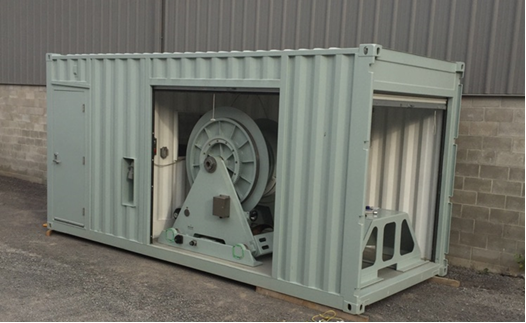
TRAPS containerized active/passive towed array from GeoSpectrum Technologies.

We talked about the possibility of using TRAPS earlier. I had an email discussion with a GeoSpectrum Technologies representative, Geoff Lebans. He tells me the Canadian Navy will test TRAPS from a Kingston class ship in March. 

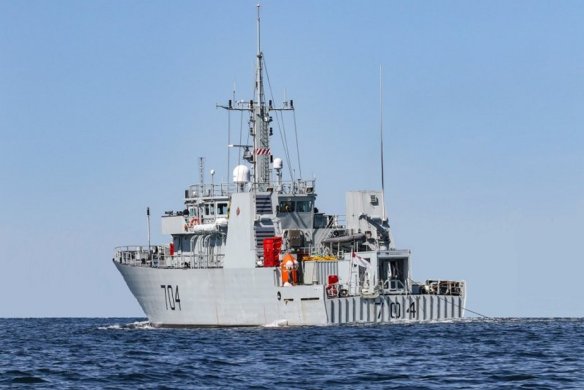
The Kingston class are a little smaller and slower than the 210 foot WMECs, but they have regularly assisted the Coast Guard in drug interdiction.

Would love to see how effective this system might be in detecting semi-submersibles.

The Coast Guard has expressed an interest in having unmanned systems providing networked sensors and GeoSpectrum makes a much smaller towed acoustic directional sensor that they believe would work with the Liquid Robotics™ Wave Glider™ and other small autonomous vehicles. Frankly, I could see the drug cartels putting a bounty on recovery of unmanned surface vessels and their sensors. Still the Navy might also be interested in this sort of network for ASW and they could probably fund the program out of loose change they might find in the sofa. Forth Fleet would probably more than happy to test it in the Eastern Pacific and cutters could probably deploy them.

TRAPS_towed_reel-able_Active_Passive_Sonar

TRAPS, towed reel-able Active Passive Sonar, deployed from HMCS Shawinigan, a 970 ton Kingston-class coastal defense vessel (photo added 7/03/2020)

Hopefully the Canadians will send their TARPS equipped ship down to the Eastern Pacific transit zones. If they do not, it might make a good Coast Guard R&D project to mount one on the back of a WMEC and use it to help define competitive contract requirements.

An acoustic system like this should be good for detection of something like a semi-submersible out to at least the first convergence zone, well beyond the visual and radar horizon. Mounted in a container they could be placed on WMECs bound for the Eastern Pacific and then transferred to the OPCs as they replace the MECs.

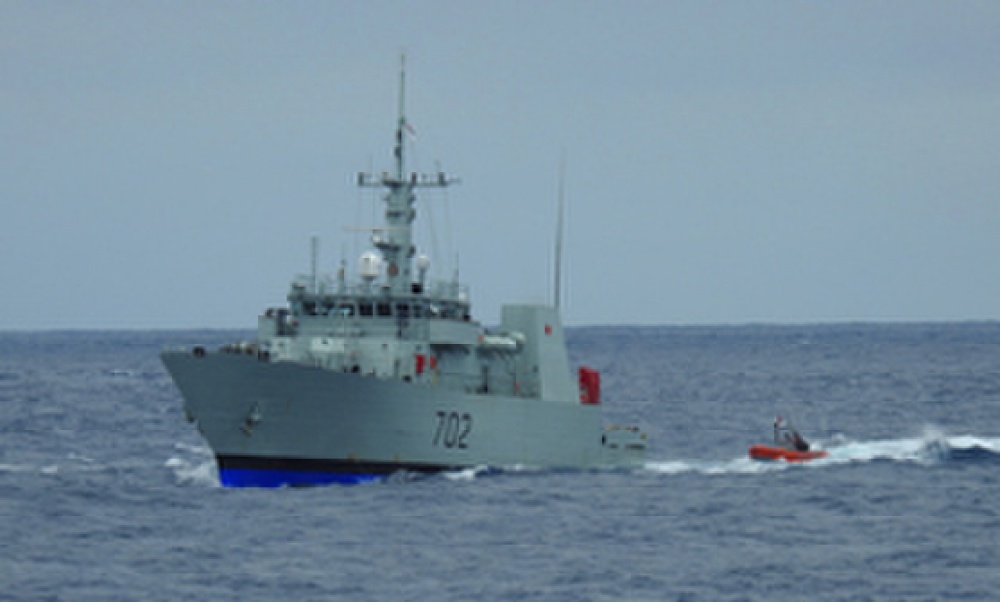
HMCS Nanaimo, a Royal Canadian Navy maritime coastal defense vessel operating in support of Operation Martillo


Naval War College Stockton Center Updates, Expands Law of Naval Operations Handbook

The Naval War College has updated and expanded its Law of Naval Operations Handbook. Below is their press release quoted in full including a link to download the handbook. Thanks to Bryant’s Maritime Consulting Blog for bringing this to my attention.

Story Number: NNS171221-08Release Date: 12/21/2017 10:54:00 AM  By Daniel S. Marciniak

NEWPORT, R.I. (NNS) — The U.S. Naval War College Stockton Center for the Study of International Law has announced the release of an updated and revised version of “The Commander’s Handbook on the Law of Naval Operations,” Dec. 20.

Last updated in 2007, the handbook is one of the preeminent legal resources addressing international law and naval operations, and is a joint-service effort coordinated among the U.S. Navy, Marine Corps and Coast Guard.

The revision updates and expands upon various topics regarding the law of the sea and law of war. In particular, the handbook:

– Updates the history of U.S. Senate consideration of the U.N. Convention on the Law of the Sea, to include its 2012 hearings;

– Emphasizes that islands, rocks and low-tide elevations are naturally formed and that engineering, construction and land reclamation cannot convert their legal status;

– Provides more detail on U.S. sovereign immunity policy for Military Sealift Command chartered vessels and for responding to foreign requests for health inspections and medical information;

– Removes language indicating that all U.S. Navy and Coast Guard vessels under command of a noncommissioned officer are auxiliary vessels;

– Emphasizes that only warships may exercise belligerent rights during international armed conflicts;

– Adds a description of U.S.-Chinese bilateral and multilateral agreements promoting air and maritime safety;

– Updates the international law applicable to vessels seeking a place of refuge;

– Updates the description of vessels assimilated to vessels without nationality;

– Provides detailed descriptions of the five types of international straits;

– States the U.S. position on the legal status of the Northwest Passage and Northern Sea Route;

– Updates the list of international duties in outer space;

– Updates the law regarding the right of safe harbor;

– Adds “honor” as a law of war principle;

– Adds information about weapons reviews in the Department of the Navy;

– Updates the law regarding unprivileged enemy belligerents;

– Includes information about the U.S. position on the use of landmines;

– Expands on the discussion of the International Criminal Court;

– Updates the law of targeting.

The handbook will serve as the benchmark for the law of naval warfare and maritime security and be a vital resource for commanders, practitioners and academics.

The handbook can be downloaded and viewed at http://usnwc.libguides.com/ld.php?content_id=38386466.

For more information, visit www.navy.mil, www.facebook.com/usnavy or www.twitter.com/usnavy.

Passing the Messenger by Drone

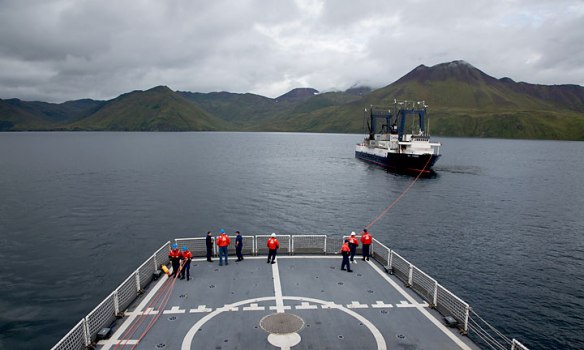
uscgc-alex-haley-unak-tow-d

MarineLink brings word that at least one company is looking at using drones to pass the messenger between a towing vessel and the vessel to be assisted.

With KOTUG’s drone solution, the messenger line would be delivered to a predetermined location with object recognition software. Instead of picking up the heaving line of the assisted ship, the messenger line of the tug will be brought to the assisted ship in a more controlled manner. This will allow the tug to safely sail beside the assisted ship instead of in front of the assisted ship.