There is a new ALCOAST that addresses short range unmanned air system. I have reproduced it below.
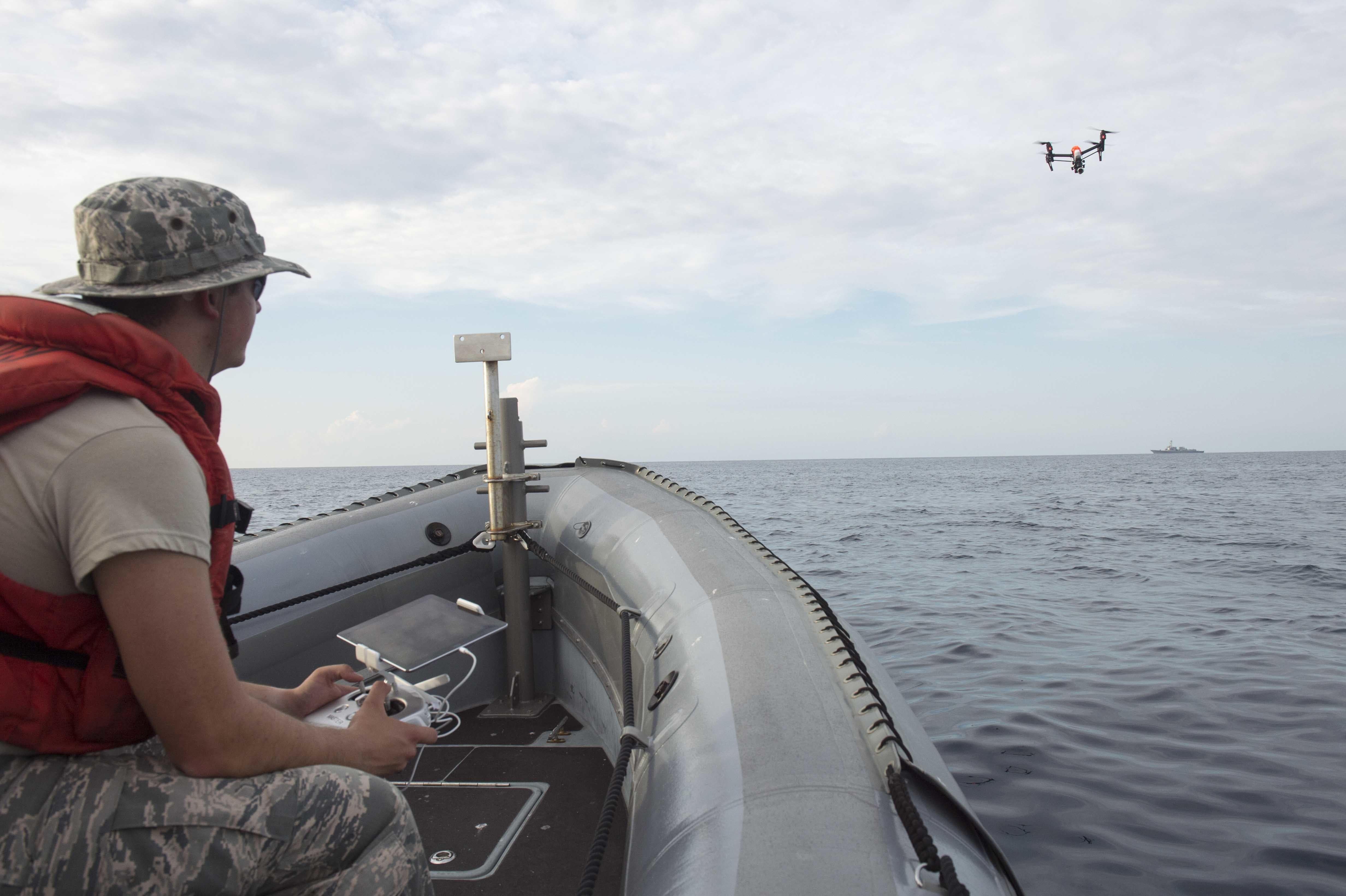
These are the commonly available battery powered “drones” that generally cost a few hundred to a few thousand dollars. They must weigh less than 55 pounds (25 kilos). Unless restrictions are waived by the FAA, they can generally only be operated below 400 feet AGL (above ground level) during hours of day light and civil twilight.
R 051700Z JAN 18
FM COMDT COGARD WASHINGTON DC//CG-7//
TO ALCOAST
UNCLAS //N03710//
ALCOAST 004/18
SUBJ: AUTHORIZED USE OF COAST GUARD UNMANNED AIRCRAFT SYSTEMS (UAS)
A. SMALL UNMANNED AIRCRAFT SYSTEMS, 14 CFR Part 107
B. COAST GUARD AIR OPERATIONS MANUAL, COMDTINST M3710.1 (SERIES)
C. COMDT (CG-7) memo 3700 of 15 May 2017
1. Short-Range UAS (SR-UAS) constitutes one of the most significant
new and emerging technologies available to the Coast Guard today.
In support of the COMDT’s strategic commitment to invest in new
technologies, the Office of Aviation Forces (CG-711) is leveraging
opportunities to deliver this new technology to the field. Pursuant
to REF C, COMDT (CG-711) established the Group-1 UAS Prototype Program
Initiative (GUPPI) as a mechanism for testing SR-UAS use in the fleet
while simultaneously developing a sustainable Program of Record (PoR).
GUPPI will develop and test potential capability solutions to
integrate, train, and standardize this technology.
2. The USCG recognizes that small, hand-launched SR-UAS have the
potential to be a highly effective and affordable tool for many
missions. In the future, SR-UAS may supplement or even replace
legacy capabilities in order to meet existing mission requirements.
GUPPI will assist units in identifying mission requirements which
are more effectively met through the use of SR-UAS. Ice
reconnaissance, post-storm survey, pollution response, antenna tower
inspection, search and rescue, and law enforcement are a small
sample of the potential uses of SR-UAS.
3. GUPPI is a pilot program that will provide SR-UAS capabilities to
meet the operational commander’s needs at the deck-plate level,
employing properly trained personnel to test potential SR-UAS
capability solutions. Simultaneously, SR-UAS remote pilots will
generate the doctrine, training, and TTP necessary to validate a
long-term PoR. The GUPPI team, consisting of FAA-certified remote
pilots within COMDT (CG-711), will equip six fleet units with SR-UAS
and assist unit personnel with obtaining the necessary training and
certification to operate the device for authorized missions.
As operations progress and mature through 2018-2019, GUPPI membership
will expand and authority to approve SR-UAS operations will be
disseminated and delegated down to the appropriate level. This
initiative will sunset once a formal PoR has been established to
fund and sustain the SR-UAS fleet. To understand our customers’
needs most effectively, I request that units forward any internally-
identified UAS requirements up their respective chains of command
for consideration by the mission managers and COMDT (CG-711).
4. In August 2016, REF (A) established a viable certification method
and operating procedures for both public and private operators to
operate SR-UAS within the National Air Space. GUPPI was founded to
explore potential avenues for Coast Guard operation of SR-UAS and
will likely incorporate large elements for REF (A) into REF (B).
Unit personnel interested in obtaining their Part 107 Remote Pilot
certification are encouraged to visit the COMDT (CG-711) SR-UAS
Portal Page for further guidance: https://cg.portal.uscg.mil/units/
cg711/SR-UAS/default.aspx Units interested in participating in
GUPPI shall route their request to COMDT (CG-711) through the
appropriate chain of command for consideration.
5. In addition to GUPPI, units are authorized to contract select UAS
services from commercial vendors in order to obtain cost effective
near-term solutions to current capability gaps. Units are reminded
that the USCG should not acquire any property or retain any property
rights in the UAS or associated hardware, or technology under these
service contracts.
a. Notify COMDT (CG-711) and the next level chain of command prior
to initiating any UAS contract obligations.
b. Coast Guard units are authorized to seek photo or video imagery
services from commercial UAS operators, in accordance with established
contracting procedures.
The following apply for any UAS services:
1) The UAS may be used for photo or video imagery in support of infra-
structure inspections, environmental observation, pollution response,
post-storm survey, ice survey, communications support, and public relations.
Commercial UAS support for other missions, including law enforcement,
intelligence, defense operations, or search and rescue requires explicit
COMDT (CG-711) and chain of command approval.
2) The UAS shall not be used to collect any Personally Identifiable
Information (PII).
3) CG units contracting for UAS services, and their servicing legal
offices, will ensure that the contract specifies that the commercial
UAS operator shall be solely responsible for the operation of the UAS
and compliance with applicable FAA laws and regulations.
4) CG units contracting for UAS services or flying organic UAS shall
contact the nearest CG AIRSTA and District (DM) to ensure that CG manned
aircrews are aware of the UAS operations and have a plan to deconflict
the airspace.
c. Use of commercial UAS for missions not listed here or for any uses
other than capturing photo or video imagery requires further review
by COMDT (CG-711) and shall be forwarded for consideration.
6. Units may also partner with local, State, or Federal government
agencies that operate UAS to obtain information from their UAS
operations in support of Coast Guard operations.
7. SR-UAS will require specific operator qualifications, airworthiness
certifications, and spectrum authority, at a minimum. SR-UAS
operations could subject the USCG to liability for any associated
damage, injury, or death. GUPPI is addressing these challenges
and policies by identifying a controlled, risk-mitigated, environment
for SR-UAS operational development.
8. The U.S. Army, Navy, and Marine Corps ceased all use of the prolific,
industry-standard DJI SR-UAS products on 02 August, 2017. This
manufacturer of SR-UAS was found to have significant cyber security
concerns, and current USCG policy is in alignment with our DoD
counterparts. The Office of the Secretary of Defense plans to release
DoD-wide guidance shortly on which COTS systems will be authorized by
the DoD.
9. The Research and Development Center and the Coast Guard Academy
currently have authorization from COMDT (CG-711) for UAS use in support
of education and research activities. Units may request GUPPI team
support through their chain of command in support of field missions.
Unless specifically provided in this ALCOAST, all other access to SR-UAS
by fleet units remains prohibited.
10. POC is CDR Daniel Broadhurst, COMDT (CG-7114).
11. RDML M.P. Ryan, Assistant Commandant for Capability, sends.
12. Internet release is authorized.



 Chuck Hill's CG Blog