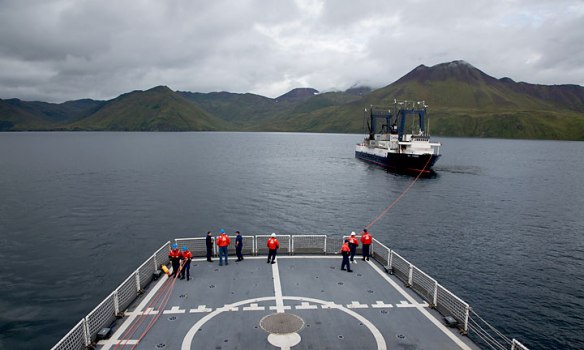
MarineLink brings word that at least one company is looking at using drones to pass the messenger between a towing vessel and the vessel to be assisted.
With KOTUG’s drone solution, the messenger line would be delivered to a predetermined location with object recognition software. Instead of picking up the heaving line of the assisted ship, the messenger line of the tug will be brought to the assisted ship in a more controlled manner. This will allow the tug to safely sail beside the assisted ship instead of in front of the assisted ship.
I normally try to stay on topic, but in view of the season, thought I would pass this along. 10,000 Japanese singing Beethoven’s Ode to Joy in German. This began in World War One when Germans being held in a Japanese POW camp sang it. It has become an annual tradition.
Looking at a new device caused me to consider how we might improve an old one, the Alidade.
SOFRESUD Intuitive Pointing Device (IPD)
NavyRecognition reports an innovation in target designation that might have some additional uses.
Performances are the following:
• Portable and mobile with full angular coverage
• Accurate and quick designation
• Day or night capability with digital zoom
• Data, audio and video recording and transmission
• All weapon and combat management systems compatible
• Optional on picatinny rails: counter-UAV & blinding non-lethal accessories
It is not really a firecontrol system, it’s an “Intuitive Pointing Device” (IPD). They refer to it as predesignation. It is really just a very sophisticated way to quickly and accurately input visual bearing and elevation, laser range, and image to a combat management system or remote weapons control station. This is seen as needed particularly for fast and/or stealthy targets and low-level surface or ground-based targets that can be seen but are difficult for radar to pick out of the clutter. Sounds particularly useful in the swarm attack scenarios the Navy has been so concerned about.
In its full configuration, the new IPD integrates many sensors to ensure all conditions capability:
– Extreme low light camera
– Uncooled IR camera
– Eye-safe laser rangefinder
– Fiber optic gyrometers
– Ambient microphone
– Display
Photo: “SOFRESUD’s IPD has a “slew to cue” capability when coupled with the remote weapon stations (such as a Nexter Narhwal or MSI Defence Seahawk) (or the Mk38 mod2/3–Chuck) vis the combat management. IPD operators can there steer and point the RWS to the exact location of the target. Optional equipment can be attached to the IDP thanks to picatinny rails: Sights, laser pointers, dazzlers…”
A Better Alidade:
I got to thinking about alternative uses for this device, including visual navigation, setting buoys, or just checking contacts for bearing drift. That, in turn, got me to think about our customary visual bearing determination device, the alidade. I don’t think they have changed since WWII.
Photo: 090113-N-9758L-040 PEARL HARBOR, Hawaii (Jan. 13, 2009) Quartermaster 3rd Class Mark Minick, assigned to the Pearl Harbor-based guided-missile cruiser USS Chosin (CG 65), looks through the telescopic alidade as the ship departs Naval Station Pearl Harbor during the Commander, Naval Surface Group Middle Pacific (MIDPAC) Surface Combatant Group Sail. (Original Navy description)
Our alidades have no low light level or IR capability or any way to measure distance. They have no electronic connection to pass either bearings or a picture of what is being looked at.
Wouldn’t it help the shipping officer in combat if he could get both an electronically transmitted visual bearing and a visual of a contact that would allow him to see the target bearing?
Visual navigation could be both quicker and more reliable if bearings could be quickly and reliably be passed electronically with the navigator able to confirm that the bearing taker is looking at the point the navigator intends.
The OOD or other bearing takers could benefit from a low light level or IR capability.
And off course the ability to point at air targets might be useful.
Ergonomics:
While the ergonomics of our alidades are very comfortable, there are potential problems with the IPD. Because it looks a lot like a gun, using it may lead to misunderstandings. There must be a protected place to put it down when not in use, but it is not illustrated. It’s probably too heavy to be used over long periods without some form of support.
If it were redesigned to rest safely on the gyro repeater and be used for bearing taking from there, it might solve some of these potential problems. Still to point to air targets you would want to be able to lift it off the stand, here a collapsible wire stock might be helpful.
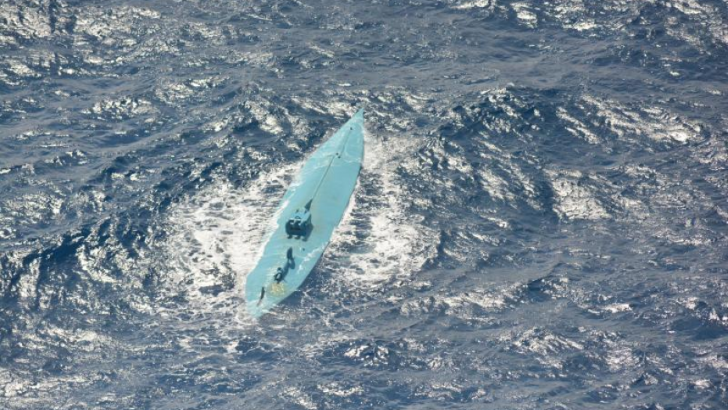
A U.S. Coast Guard cutter intercepted a self-propelled semi-submersible vessel engaged in smuggling more than 3,800 pounds of cocaine, federal officials said Sunday.
According to the U.S. Customs and Border Protection (CBP), on November 13, CBP and Marine Operations (AMO) arrested the crew during operations in international waters (I don’t think this could be true–Chuck), and all three suspects will face charges in the U.S.
“The drug cartels are relentless and extremely innovative,” National Air Security Operations Center – Corpus Christi Director Allen Durham said.
“Interdicting self-propelled semi-submersible vessels requires expertise and the right aircraft. Air and Marine Operations will continue to beat the cartels at their own game to protect our borders.”
The multi-day operation from surveillance to interception, according to CBP, involved several interagency partners including the U.S. Coast Guard and the U.S. Navy.
AMO operates maritime patrol aircraft from Corpus Christi, Texas, and Jacksonville, Florida, to conduct long-range aerial patrols and surveillance missions along the U.S. borders and in drug transit zones in Central and South America, according to CBP.
“”The drug cartels are relentless and extremely innovative,” the Corpus Christi director for the National Air Security Operations Center said earlier this month. “Interdicting self-propelled semi-submersible vessels requires expertise and the right aircraft.”
“Texas is mobilising its drug agents and prosecutors to specifically target drug submarine builders and operators, ABC America reports.”
These both appear to stem from a press release that originated in Texas from Customs and Border Protection, presumably the National Air Security Operations Center – Corpus Christi Director Allen Durham. Apparently the semi-submersible was detected by a CBP P-3.
As far as I can tell, the interdiction, which apparently occurred on November 13, actually happened off Panama.
If and when we ever get self propelled semi-submersibles going directly into the US, it will be a significant event with its possible implications for terrorism, but I don’t think we have any public knowledge of that happening yet.
The Navy Times reports Senate approval of appointment of four Pentagon Assistant Secretaries, including a retired Coast Guard Commander, Tom Harker, who will serve as Comptroller of the Navy.
“Thomas Harker of Virginia to be an Assistant Secretary of the Navy, Financial Management and Comptroller. Mr. Harker currently serves as Associate Deputy Assistant Secretary of Financial Policy for the Department of Veterans Affairs. Mr. Harker served in a mixture of operational and financial management tours before retiring from active duty as a Coast Guard commander in 2012. Since retiring from active duty, he spent two years in public accounting before returning to the Coast Guard as a civilian. His final assignment on active duty before retirement was in the Executive Office of the President’s Office of Management and Budget. Mr. Harker is a recipient of the Coast Guard Meritorious Service Medal, Commendation Medal, and Achievement Medal; the American society of military comptrollers distinguished award for business management; and the association of government accountants achievement of the year award. Mr. Harker is a graduate of the University of California and received his masters of business administration from the University of Miami.”
“His USCG career has included time as comptroller for the Integrated Support Command, business manager of the Buoy Tender Replacement Project and deputy chief for the Office of Financial Transformation and Compliance.”
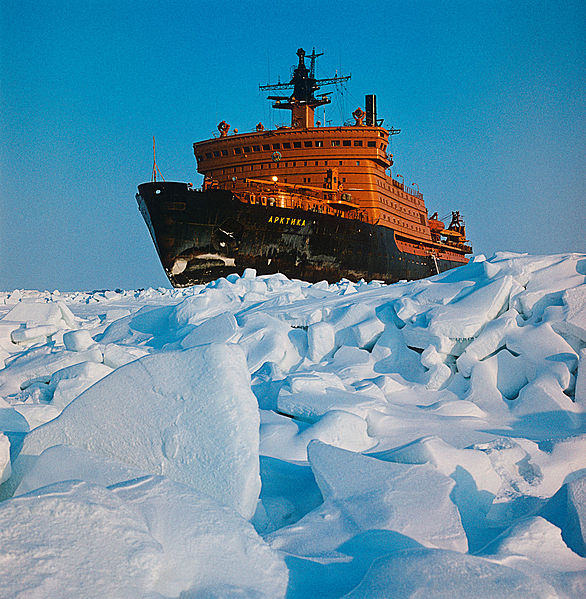
The nuclear-powered icebreaker Arktika in the Kara Sea. RIA Novosti archive, image #186141
We have had the “Bomber Gap”, the “Missile Gap”, and the “Cruiser Gap.” None of which were ever real, but they were effective in putting more money into a program.
Now we have the “Icebreaker Gap” which is real, but largely irrelevant. Hopefully it will get money for the Coast Guard.
It is certainly true that the Russians have far more Icebreakers than the US, but shouldn’t it enough that we really need these ships, regardless of what the Russians may be doing?
I hate to see fear replacing logic, but perhaps the ends justify the means. Is there a military dimension to the Russia/US icebreaker fleet comparison? Certainly neither country is going to invade the other over the poles. We are not likely to see fleets of icebreakers shooting at each other, the Russians already have plenty of missile carrying aircraft and submarines in the Arctic. But we may need to place sensors, bases, or other assets in high latitudes even when others don’t like it. That may be impossible without icebreakers. The US has fewer icebreakers than any other type of critically important vessel. We have far more carriers, SSBNs, destroyers, amphibious warfare ships, underway replenishment ships. The loss of any one of them would not mean the end of a capability. The loss of even one of our icebreakers could.
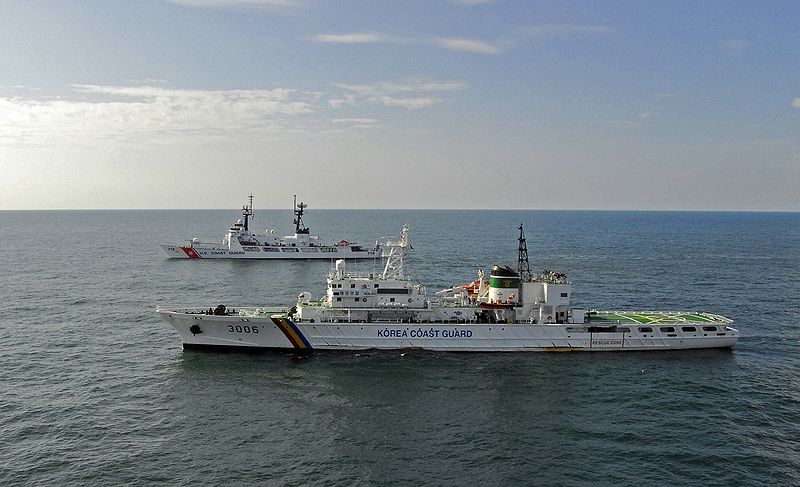
Republic of Korea Coast Guard vessel #3006 in company with U.S. Coast Guard cutter USCGC Boutwell (WHEC-719) during the North Pacific Coast Guard Forum in August 2007. This forum was created to increase international maritime safety and security in the Northern Pacific Ocean and its borders. The Boutwell worked with the Korean coast guard while on their way to Yokosuka, Japan. The Japanese coast guard is one of the six nations involved in the forum.
The Independent reports a South Korean Coast Guard vessel fired 249 warning shots when it was reportedly swarmed by 44 Chinese fishing vessels fortified with iron bars and steel mesh.




 Chuck Hill's CG Blog