There seems to be a trend in anti-ship cruise missile (ASCM) armed vessels. This may not look like a topic of interest to the Coast Guard, but it seems the former bright line between vessels designed as missile boats and those designed as patrol vessels may be disappearing. In fact, missile boats, as a class, seem to be disappearing as ASCM equipped vessels seem to be evolving into much larger corvettes which look a lot like offshore patrol vessels.
How it began:
Did a bit of a “market survey” comparing the small missile armed combatants of ten nations, built or building, as reported in my 1987 “Combat Fleets of the World” with their current fleet, built or building, mostly from Wikipedia. Checked some of the info against my current edition of “Combat Fleets” but it is already becoming out dated.
1987 to 2017 is a 30 year spread, but 1987 was 20 years after the sinking of the Eilat, and more than thirty years after the first Komars were commissioned. We have had 60 years for the type to evolve and 1987 is roughly the mid-point of that evolution.
It should be recognized that since the collapse of the Soviet Union there has been significant reduction of naval forces for many of these navies, so smaller fleets should not be a surprise.
Notation: Initial in-service dates for the first of class are in parenthesis (In the case of a class that is used by more than one nation I will use the first in-service date. ). In some cases I have included inclusive commissioning dates for the whole class. I have tried to use full load displacement only. There was sometimes conflicting information. I chose what I thought was most credible.
China
1987: 120
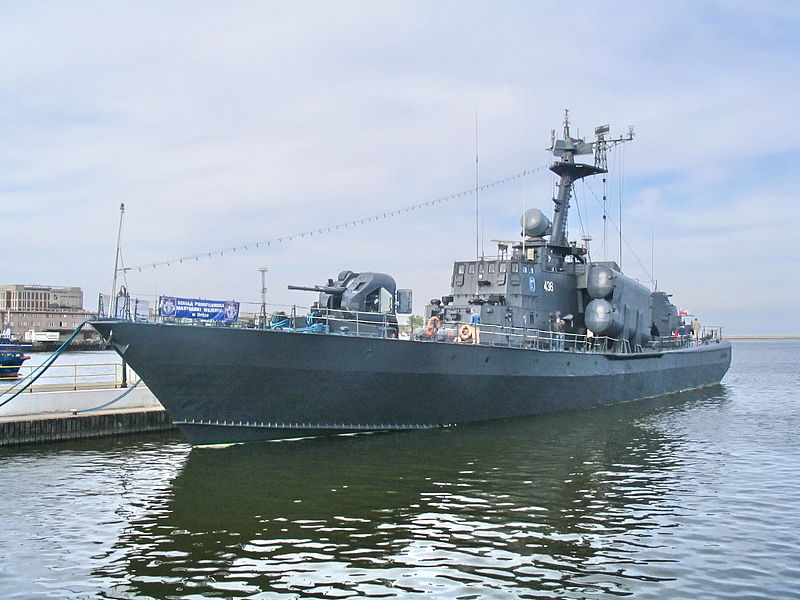
Osa 235 tons, 70 Komar 79 tons , plus over 200 torpedo boats

Osa-I class, US Navy photo
Now: 30 of an expected 40
Type 056 corvettes completed (2013) 1500 tons, 83
Type 022 fast attack craft (2004) 220 tons, 26 Type 037 class (1991) 478-520 tons.

Houbei Type 022 class fast attack craft

Type 056 corvette, credit 樱井千一
Denmark
1987: Building
StanFlex 300s (1989-1996) 450 tons, 10 Willemoses class (1976) 265 tons. They also had six Soloven class torpedo boats of 114 tons

Danish navy SF300 vessel Støren (P555), photo by Kim Storm Martin
Now: No ASCM equipped combatants of less than 6,600 tons
Finland
1987: Four Helsinki class (1981) 280 tons, four Osa class 235 tons
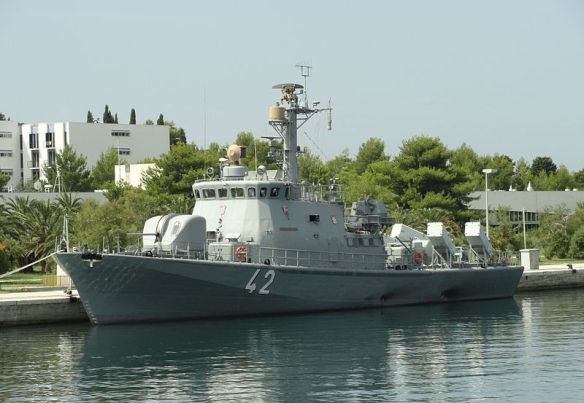
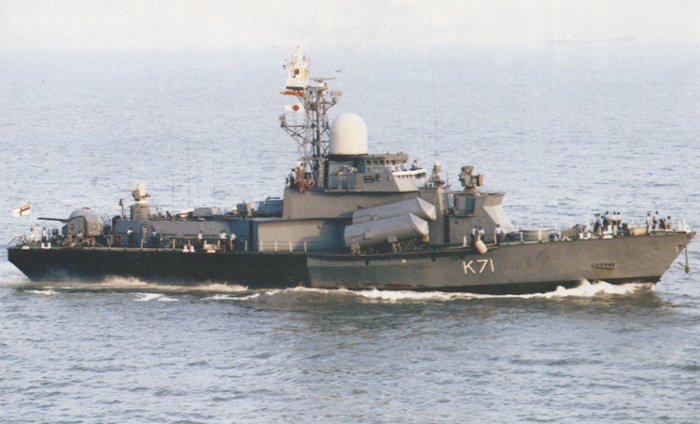
Helsinki Class now Croatian vessel RTOP-42 Dubrovnik. Photo by Saxum
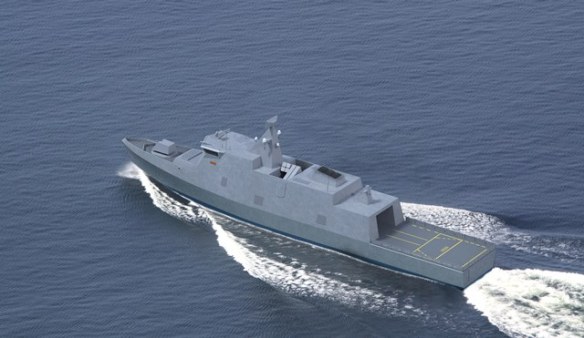
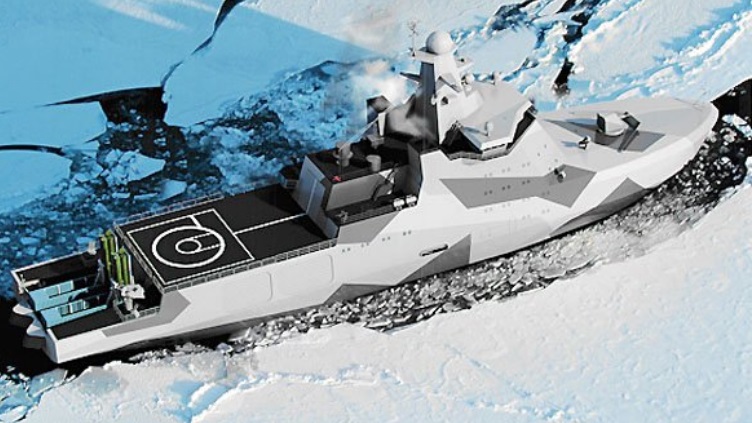
Conceptual illustration, Finland’s squadron 2020 corvette
Germany
1987: 20
type 143 (1976) 390 tons, 20Type 148 (1972) 264 tons
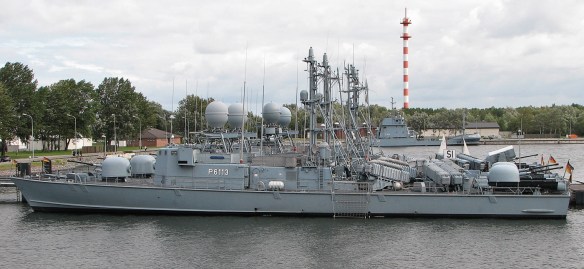
Type 143 Albatros-class boats, S63 Geier in the foreground. The third one is a Gepard-class boat. Photo by Darkone
Now: Smallest ASCM armed combatants are 1840 ton
K130 class (2008) (Five built and five more planned)

The German navy corvette Braunschweig ( F 260), lead ship of the corvette class K 130. Photo by Torsten Bätge
Greece
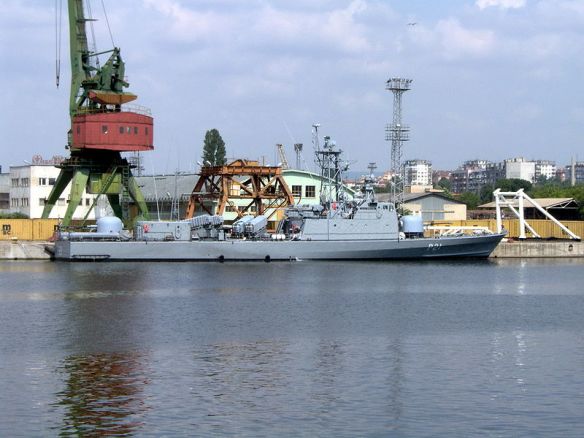
Antipliarchos Blessas (P-21), LaCombattante III class, photo by Jorge Guerra Moreno
Now 7
Roussen class (2005) 668 tons, 5 La Combattante IIIB class (1980) 429 tons, 4 La Combattante III class (1977) 425 tons, 3 La Combattante IIA class (1973) 265 tons, plus eight 25 knot gunboats (1989) 515-550 tons that could mount four Harpoon (not currently mounted).

HS Roussen, P-67 in Piraeus 2009. Photo from K. Krallis, SV1XV
India
1987: Planning the Khukri class (1989) 1,350 tons, Building Turantul class (1984) 493 tons, 3
Nanuchka class (1978) 730 tons, 14 Osa class (1960) 240 tons

Nanuchka II class corvette.
Now: 5
Kora class (1998) 1500 tons, 4 Khukri class (1989) 1,350 tons, 10 Tarantul class (580 tons)
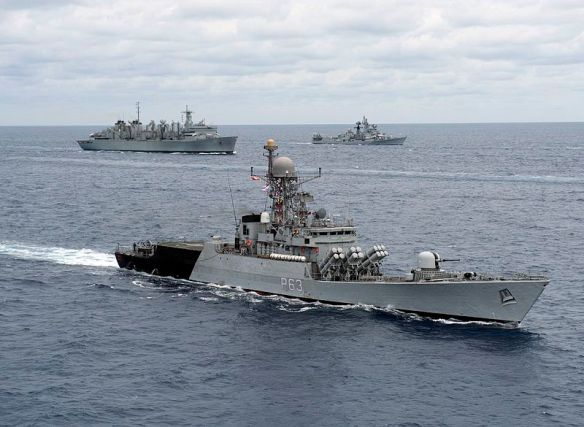
Kora class Corvette, INS Kulish (P63), US Navy Photo
Israel
1987: Planning
SAAR 5 corvettes (1994) 1,275 tons, Building
SAAR 4.5 (1980) 490 tons, 7 SAR IV (1978) 450 tons, 6 SAAR III (1969) 250 tons, 3 Grumman Mk II/M hydrofoils (1982) 103.5 tons
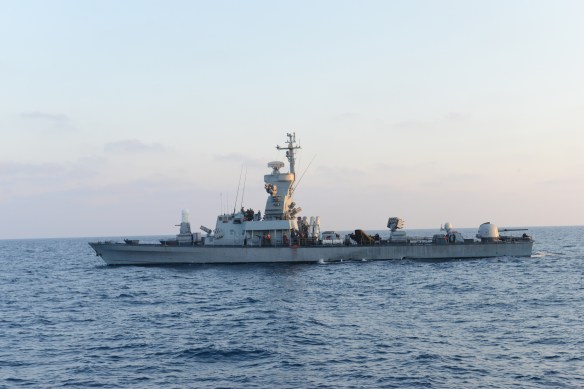
SAAR 4.5 missile boat. Israel Defense Force photo

INS Aliya in 1985. An aviation equipped unit of the SAAR 4.5 class

INS Lahav, most advanced SA’AR 5 corvette in the Israeli navy. Now equipped with MF-STAR radar and BARAK-8 Surface to Air Missiles. Photo by Ilan Rom
Norway
1987: 14
Hauk class (1977-1980) 155 tons, 6 Snogg class (1970) 140 tons, 19 Storm class (1963) 125 tons

Hauk-class patrol boats at quay in 2001. Photo by Peulle
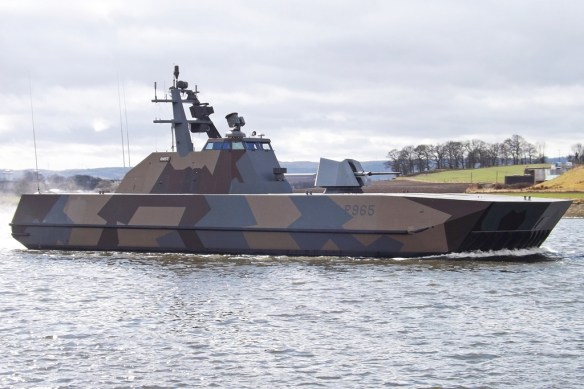
P965 KNM Gnist, a Skjold-class patrol boat of the Royal Norwegian Navy, Photo by Mark Harkin
Sweden
1987: Building Goteborg class (1990) 380 tons, 2 Stockholm class (1986) 320 tons, 17 Hugin class (1972-1981) 150 tons, 12 Spica II class (1972) 230 tons, plus 4 Spica class torpedo boats (1966) 235 tons
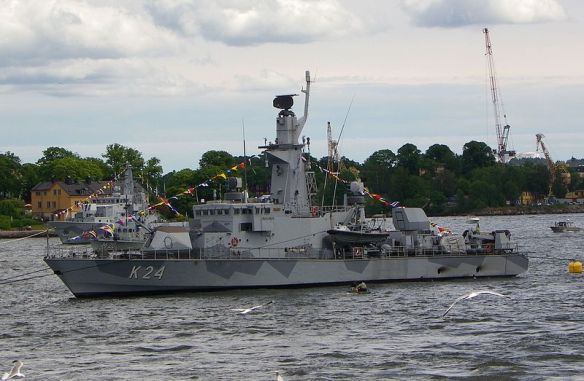
Goteborg class corvette HMS Sundsvall (1993), photo by Poxnar
Now: 5 Visby class (2008) 600 tons, 2 Goteborg class (1990) 380 tons, 2 Stockholm class (1986) 320 tons
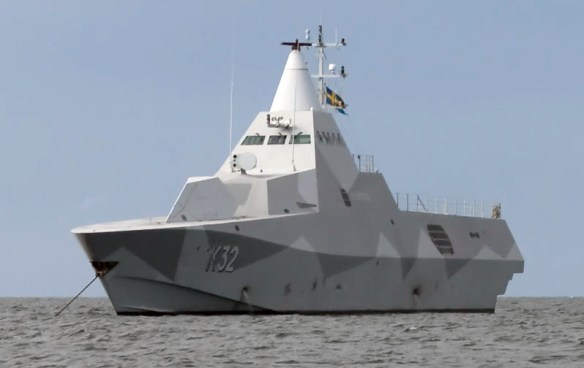
Visby class corvette HSwMS Helsingborg (K32), photo by Xiziz
USSR/Russia
1987: Building
Turantul class (1984) 549 tons and Nanuchka class (1978) 730 tons, Still retained 90 OSA (1960) 235 tons and other missile armed small combatants but none under 200 tons. (No Komar class in service.)
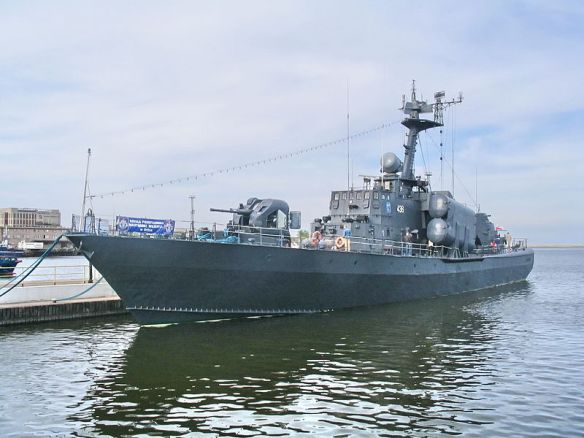
Turantul Class Corvette
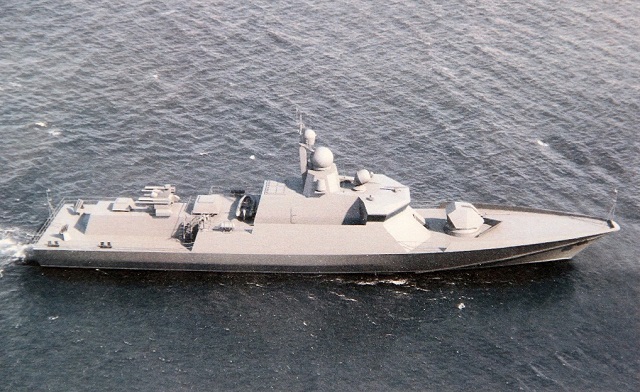
Now: Building Karakurt class (2017) 800 tons, 5 Buyan-M (2014) 949 tons. 26 Tarantul class (1984-2003) 493 tons, 12 Nanuchka class (1978-1991) 730 tons

Karakurt Class Corvette
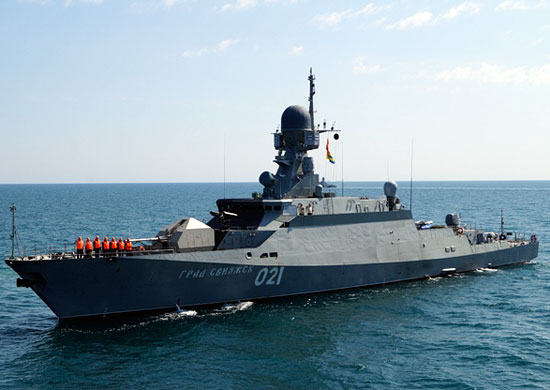
Buyan-M class corvette, Mil.RU photo
In Summary
Notably Denmark and Germany no longer have any ASCM armed combatants under 1800 tons. The latest from China, Germany, India, and Israel are between 1,500 and 2,000 tons. No indication how large Finland’s new corvette will be, but I expect it will be around 1,000 tons. Russia’s latest are 800 tons or larger. Greece and Sweden’s latest are 600 tons or larger. Many of these vessels have speeds of less than 30 knots. Only Norway is making ASCM armed combatants under 300 tons and even theirs are over 200 tons. The original concept of extremely fast, short ranged vessels of less than 100 tons and less than 100 feet in length has completely disappeared from the navies of these experienced missile boat operators.
Why have these vessels grown in size?
I believe there are several reasons:
- They want greater endurance and better seakeeping.
- They want to deploy well beyond their homeports.
- They want them to be multi-mission.
- They want air-defense capability after the demonstrated vulnerability of missile boats to helicopters and aircraft during the first Gulf War.
- The needs of networking, ESM, air-defense, ISR etc overwhelm a small crew.
- They want to be able to launch a multiple missile attack that allows several missile to arrive on top simultaneously, but they also want a second salvo in reserve. This seems to be moving the norm toward 16 missiles. This is being facilitated by the smaller size of many of the newer missiles.
- They see a need for organic aviation (either a helicopter or UAV) for over the horizon targeting.
- Because it is peacetime, the planning horizon is now about 30 years. Operating cost considerations predominate. In wartime it might make sense to make four cheap manpower intensive vessels rather than one individually more capable vessel, but in peacetime fuel and manning costs trump low initial costs and quick construction. This is part of the reason we have a “gold-plated” fleet now.









_Class_Fast_Attack_Craft.JPG)