Thought this article from the National Interest, “China’s Coast Guard: Big Problem or a Big Opportunity?” was worth a look. Specifically it is about working the possibility of working with the Chinese on dealing with the environmental effects of major oil spills.
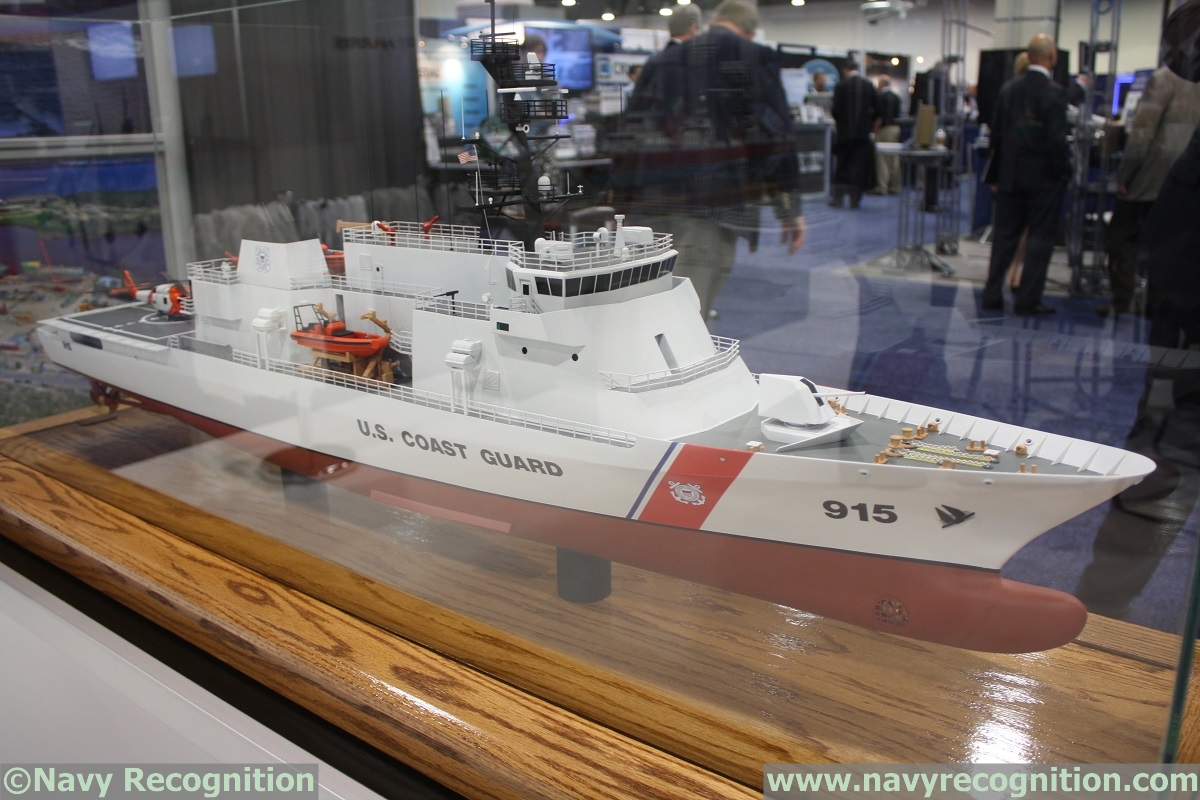
The National Fleet Plan had some clues regarding equipment that we can expect on the Offshore Patrol Cutter (OPC). Apparently there will be a lot of commonality between the Navy’s LCS and future generation frigates, the Coast Guard’s Offshore Patrol Cutters (OPC), and the Bertholf Class NSCs. My last discussion of the equipment on the OPC can be found here: “Offshore Patrol Cutters (OPC), the Other LCS” which contains information not addressed here. Generally the information below does not look much different but I will try to point out any significant differences.
Command, Control, and Communications (Ref. Section 5.5):
The recommended NTNO (Navy Type Navy Owned–Chuck)systems to meet C3 commonality and interoperability for the OPC are as follows: MIL UHF LOS 225-400 MHZ (Digital Modular Radio (DMR), ARC-210, PRC-117); MIL UHF SATCOM (DMR, ARC-210, PRC-117); Messaging (DMR SATCOM, ARC-210, PRC-117); Tactical Data Link (LINK 11; Joint Range Extension (JRE) Link-16, forwarded LINK 22); VACM (KY-100M, KY-58M, KYV-5M). (p. 22)
I am very pleased to see LINK 11, 16, and 22 on the list although this is probably a “junior edition” of these systems. These systems are becoming so ubiquitous if you don’t have them, you are more of a burden than an asset. The table on page 24 seems to indicate that the OPCs will not have an airsearch radar, but will have a multi-mode radar that will be common with Navy systems (p.50). Its not clear what that will really mean for the ship’s capabilities. As far as I can tell, the only air search on the NSCs is the EADS 3D TRS-16 which is also a multimode radar combining air search, surface search, and fire control functions. This radar is likely to be replaced by the newer EADS Cassadian TRS-4D multi-function radar.
Sensors (Ref. Section 5.6): The OPC will have a multi-mode radar, Electronic Warfare Systems, Decoy launching system, Sensitive compartmented information Network, TACAN, and CCOP (Cryptologic Carry-On Program).
The recommended systems to meet Sensor commonality and interoperability for the Offshore Patrol Cutter are as follows: TACAN; Multi-Mode Radar; IFF; SEWIP (SLQ-32/SSX-1 replacement); and MK-160 Gun System. (p. 25, 5.6.b.2)
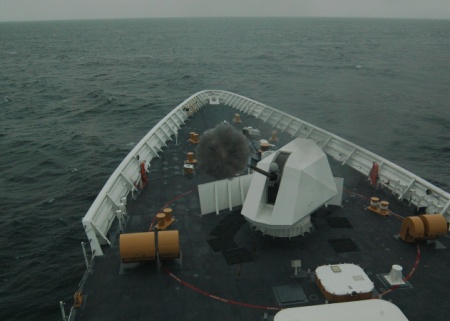
Weapon Systems: The OPC will have a 57mm, 25mm, and .50 cal guns. (It is not addressed in this document, but there have been indications that two of the .50 cal. are to be mounted in stabilized remotely controlled weapon stations. The 25mm will presumably be a Mk38 mod2 or 3) The OPCs will not incorporate either a CIWS or degaussing (p.32). (I do have reason to suspect that the OPC is fitted for upgrade to include CIWS.)
Notes on the Ship’s Signals Exploitation Equipment System and Unmanned Aircraft System, “OPC has the same space, weight and power requirements (as the NSC–Chuck) reserved but a system has not been selected.” (p. 24)
It appears the gun firecontrol system, may include only Electro-Optical control cued by the multimode radar, and that it will not include the AN/SPQ-9B which is used on the National Security Cutters (I think this may be a change). There is a note on the Gun Fire Control System: “OPC will have a fire control radar capability (MMR-presumably multimode radar–Chuck) to provide tracking information and slew of the GWS camera, but slew and fire of the GWS cannon remains under manual control.” (p.24) Hopefully, an integration of the multimode radar with the weapon 57mm and perhaps the 25mm will permit blind firing of these systems, otherwise some visibility conditions may preclude effective fire control and certainly reaction times, particularly against air targets, will not be as good as they might have been.
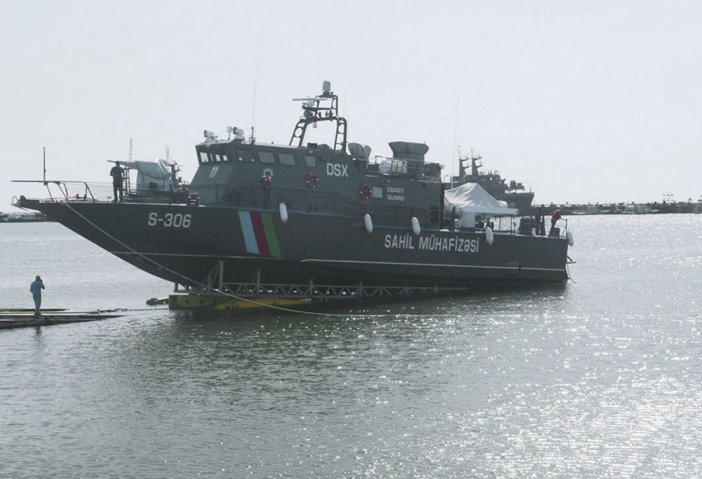
Photo: Azerbaijan Coast Guard’s first Saar 62. Source: President’s Office, Azerbaijan
We have talked about these before, but now we have more details, particularly about how they are equipped.
Janes 360 reports the launching of two new vessels for the Azerbaijan Coast Guard, the first of up to six helo deck equipped, 203 foot, 470 ton, 32 knot Sa’ar 62s based on the Israeli Sa’ar 4.5 missile boat, and a sixth 32.65 m-long, 95-ton Shaldag Mk V.
Photo: Azerbaijan Coastguard’s sixth Shaldag Mk V (Azerbaijan State Border Guard Service)
Both types use the Typhoon gun mount which is basically the same as the Mk38 mod2 used by the Coast Guard, except that, instead of using the 25 mm chain gun, these use a Soviet era 23 mm, with a higher rate of fire. Both use the Toplite Electro-Optic fire control system that is also part of the Mk38 mod2.
Most interesting, they are armed with small missile systems. the larger vessels will have an eight cell launcher for the 25 kM range Spike-NLOS.
TYPHOON MLS NLOS configuration has eight Spike NLOS missile launchers and integrated Toplite stabilized observation and target acquisition system. Photo: RAFAEL via defense-update.com
The smaller vessels have a four tube launcher for the 8 km range Spike-ER.
Azerbaijan’s neighbors on the Caspian Sea are Russia to the North, Iran to the South, and Turkmenistan and Kazakhstan on the other side of the water. They have a small navy in addition to their Coast Guard, but these will constitute a substantial reinforcement. There is appears to be a miniature naval arms race going in the Caspian Sea.
We have talked about “Future Vertical Lift” (FVL) before. It’s a program to replace several helicopters, including the H-60, with advanced aircraft with much greater speed and range.
Defense News reports that while V-280 demonstrator is expected to fly in 2017, the Army, which has the lead, doesn’t expect to fund production until in the late 2020s with the aircraft coming on line in the 2030s. But the Bell/Lockheed team that is producing the V-280 Valor, believes that there is Air Force and Navy interest that could see initial operational capability by 2025.
Meanwhile, Aero News Network reports the UAE has decided to purchase three AW609 tiltrotors, for Search and Rescue, with an option for three more. Deliveries are expected to begin in 2019. These aircraft will have twice the speed and twice the range of the helicopters they replace (275 knot maximum speed and 750 nm range).
Photo: AW609 prototype
I can’t help but think these would be awfully useful in the Arctic, and wouldn’t it be nice, if when we launch on a long range recovery mission, we could have two tilt-rotors, instead of a helicopter and a fixed wing.
The German Navy Blog, Marine Forum, reports, “7 November, ALGERIA, Polish Gdansk Shipyard launches newly-built sail training vessel EL-MELLAH … regarded as „the largest (110m x 14.5m, 3,000 sqm sails) and fastest (17 knots) sailing ships in the world“ … to be used in training of Algerian Navy cadets … delivery in fall, 2016.”
Tomorrow is Veteran’s Day and a friend and classmate sent me another reminder of the sacrifices Coasties have made in the past. It was a story about a ship lost with all hands, but it was not the Cutter Tampa, that most of us have heard about. It was a small, slow freighter built in 1923 and converted to a weather ship and transferred to the Coast Guard in 1942, USCGC Muskeget (WAG-48). Although mostly forgotten, sailing alone in U-boat infested waters, she took with her more Coasties than the Tampa, nine officers, 107 enlisted, plus a Public Health Service Officer and four US Weather Service employees.
The four Weather Service employees are to honored with presentation of purple hearts on 19 November. This will mark the first time Weather Service employees have received the purple heart. It also marks the long association between the Coast Guard and NOAA. Appropriately VAdm. Stosz, Deputy Commandant for Mission Support will be one of the speakers.
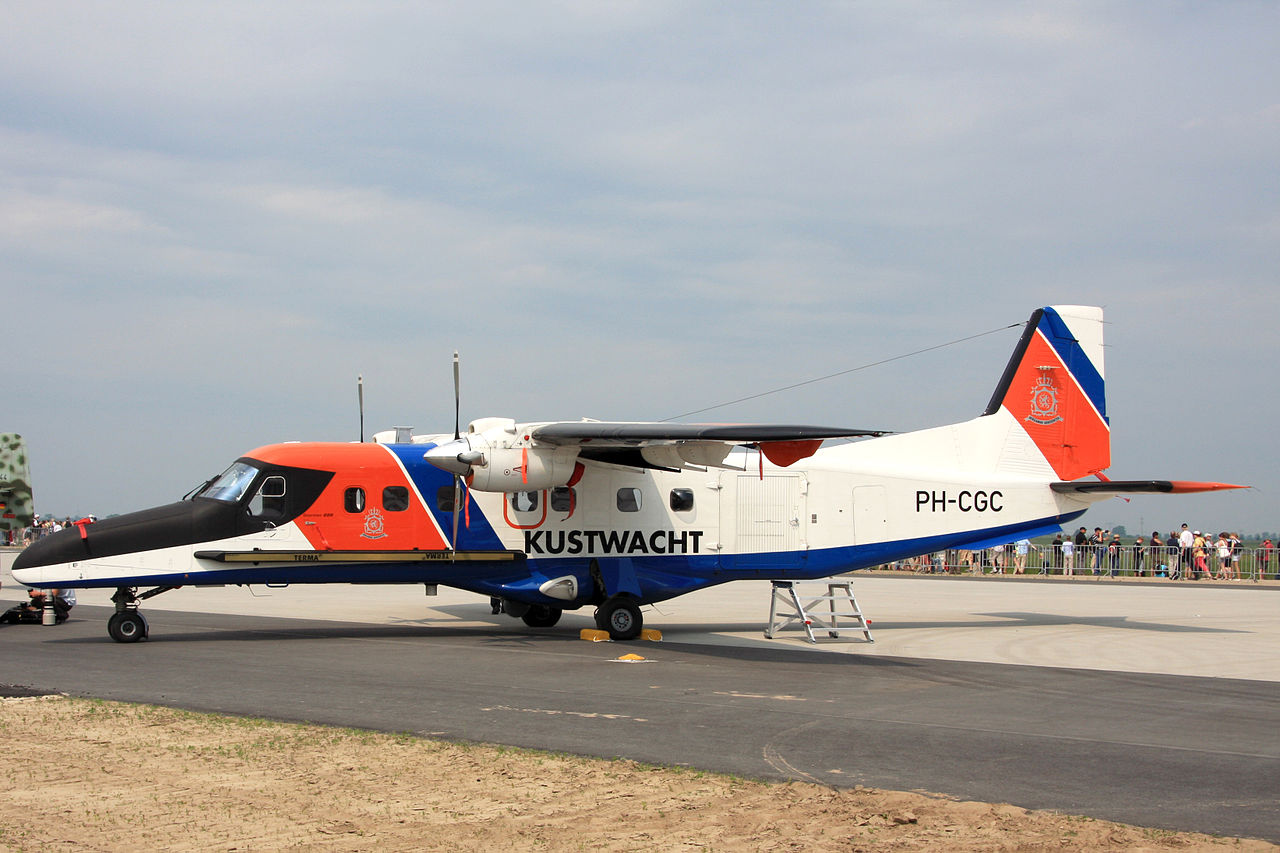
Photo: Do 228 of the Dutch Coast Guard at Berlin Schönefeld Airport. Photographer: “Wo st 01/Wikipedia”
We have a report that Venezuela is claiming a USCG aircraft violated their air space and further they suspect this may have had something to do with an upcoming election.
“Defense Minister Vladimir Padrino said Sunday the Dash-8 aircraft flew out of Curacao, a Dutch island not far off Venezuela’s Caribbean coast. He said that during a 30-minute period the plane twice entered Venezuelan airspace over the tiny archipelago of Los Monjes on Friday while performing what appeared to be a reconnaissance mission in the Gulf of Venezuela, which is also bounded by Colombia…he said the timing of the apparent maneuvers, as the country prepares for key legislative elections next month, was suspicious, recalling other U.S. military exercises that allegedly preceded a brief coup in 2002 against then President Hugo Chavez.”
Of course the USCG does not operate the Dash-8, but I suppose in the right circumstances an HC-144 might be mistaken for a Dash-8. The Dutch Caribbean Coast Guard which operates out of Curacao does operate Dash-8 aircraft, and they, like the USCG, make their aircraft with diagonal stripes as seen in the photo above.
This sort of misunderstanding is very unfortunate, because it impugns the motives of the Coast Guard. The USCG has worked effectively with Cuba, Russia, and China, and I am sure there are reasons to work with Venezuela as well, but this sort of thing gets in the way.
New London Day reporter Julia Bergman did a nice article covering an event in honor of Veterans’ Day at the Academy. Three Coast Guard Vietnam vets, two 82 foot WPB skippers and an HH-3 pilot, related their experience to the cadets. The story comes to us via “Stars and Stripes.”
A friend of the blog, Leesea, recently pointed me to the recent update of the “National Fleet Plan,” which, despite its name, does not really talk about the entire US Fleet. It is really about the Coast Guard, and how it and the Navy will cooperate to “identify additional opportunities for increased commonality and interoperability.”
I have reproduced the table of contents below. Mostly, it is what you would expect and/or hope would be included. There are potential areas of cooperation, current situation, where they hope to progress, and identification of responsible offices.
It really did not get interesting to me until it started talking about the Offshore Patrol Cutter (page 22-24 particularly).
There was one particular section that I thought might be of interest, the “Strategic Laydown” (page 54), which concerns sharing facilities, including ship homeports, with the Navy.
Plan of Action and Milestones
– Fiscal Year 2015: Process Organizational Change Request (OCR) for Coast Guard System Acquisition Integration Laboratory (CGSAIL) relocation to Navy Combat Systems Engineering Development Site (CSEDS).
– Fiscal Year 2015: Submit revised Strategic Laydown (SLD) request and OCR to homeport 3 X FRCs at Naval Base Guam to include Lessons Learned from maturing CG-7/OPNAV N51 MOA.
– Fiscal Year 2015: Process Organization Change Request to homeport 3 X Medium Endurance Cutters at Naval Station Pensacola.
– Continue to develop solutions to permanently station aviation assets at Naval Base Ventura County.
– Support feasibility studies to identify potential homeport locations for West Coast Offshore Patrol Cutters
I am planning on two follow-up posts, one about what they had to say about the OPC and one about the implications of homeporting Coast Guard ships at Navy Bases.
TABLE OF CONTENTS
Section Page No.
1. Preamble …………………………………………………. 9
2. Purpose ………………………………………………….. 9
3. National Fleet Plan Overview ……………………………….. 9
4. Plan Progression and Oversight……………………………………………………… 10
5. National Fleet Plan…………………………………………..………………………… 10
5.1. Current and Evolving Operations……………………………10
5.2. Integrated Logistics………………………………………….……………..……….. 12
5.3. Training……………………………………………………………..………………… 15
5.4. Maritime Security Cooperation…………………….……………………..………… 21
5.5. Command, Control, Communications (C3) Systems……………….….………… 22
5.6. Sensors………………………………………………………………………………… 25
5.7. Weapon Systems…………………………………………………….……….……… 26
5.8. Engineering Systems……………………………………………………….………… 28
5.9. Platforms………………………………………………………………….…………… 29
5.10. Intelligence and Information Integration …………………. 34
6. Programmatic Collaboration…………………………………………………………… 36
7. Integrated Plan of Action and Milestones…………………………………..…….….. 36
8. Navy-Coast Guard Memoranda of Understanding/Memoranda of Agreement…… 44
9. Legal Authorities ……………………………………………….………………… 48
Chartered Commonality Working Groups: Mission/Plan of Action and Milestones
Appendix A. Permanent Joint Working Group…………………………………………… 50
Appendix B. Small Boat Commonality Integrated Process Team …….. 51
Appendix C. Naval Logistics Integration………………………………………………..… 52
Appendix D. SSBN Transit Protection Systems…………………………………………. 53
Appendix E. Strategic Laydown Working Group………………………………………… 54
Appendix F. Arctic Working Group ……………………………….55
Appendix G. Maritime Security Cooperation Council ………………… 56
Glossary……………………………………………………………………………………… 57
The Navy League’s “Seapower” magazine has an article about how aging assets are impacting the Coast Guard’s mission effectiveness. You can read it on line here. (You will probably have to expand it to make it readable.)
Frankly, I have been disappointed that they had not been talking about this much earlier. There has been entirely too much happy talk about how great the new assets are without much discussion of the general decrepitude of most of the fleet. Of course this has probably been our own fault. Even in this article, there seems to be little sense of urgency. The article barely mentions the fact that the planned slow motion replacement of Medium Endurance Cutters by the Offshore Patrol Cutter will prolong the pain. After all, we don’t expect the last OPC until 2034, a fact not mentioned in the article. They refer to a “two-plus decade program” to build 91 new surface ship, but in fact the first National Security Cutter was funded in FY2001, and the roots of the program go back further still, so this is at least a three and a half decade program, that was begun at least ten years after it should have.







 Chuck Hill's CG Blog