The US Naval Institute has a post on the effectiveness of the current maritime drug interdiction efforts. My views on the problem have not changed since this post in 2010.
Protecting the Exclusive Economic Zone–CIMSEC
CIMSEC is taking a week to look at Ship Design and one of their first posts deals with Offshore Patrol Vessels. It is a two parter. You can read it here and here.
The posts include an extensive bibliography and notes that some might find interesting. This is the information on the author, “Dr. Alexander Clarke is our friend from the Phoenix Think Tank in the United Kingdom and host of the East-Atlantic edition of Sea Control.”
National Coast Guard Museum Update, Nov. 2014
There is an update on the architectural features of the planned National Coast Guard Museum accessible here.
Drilling Beyond the 200 Mile EEZ
gCaptain has an interesting discussion of the potential economic consequences of offshore drilling beyond the 200 mile EEZ. It seems UNCLOS has a provision (Article 82) that a UN agency is owed a percentage of the revenue from such drilling.
There is apparently some ambiguity in the treaty, in that it is not clear if the fee is to be based on gross or net revenues, and it is also unclear where continental shelves end, but apparently the existing provisions make it possible to claim sea floor as deep as 5,000 meters, far deeper than what I thought of as continental shelf, and an area as large as Africa (which is really much bigger than it looks on a Mercator projection, roughly four times the land area of the United States).
There is also a chart (map) of where continental shelf claims are currently being made. There are number of potentially “interesting” (eg contentious) areas being claimed.
—There are claims off Antarctica.
—There are claims between Argentina and the Falklands.
—Claims in the Arctic.
—Claims in the South China Sea. I wonder if the Chinese don’t hope to avoid fees all together by claiming it is theirs under a different status.
Greenpeace and Spain Play Bumper Boats
gCaptain reports an incident between the Spanish Navy and Greenpeace activist protesting offshore drilling near the Canary Islands. The encounter resulted in injury to one of the activists, a female Italian national, when she was thrown over the side and hit by a propeller. The Spanish Navy points out that their RHIBs have shrouded propellers.
Laser Weapon Deployed

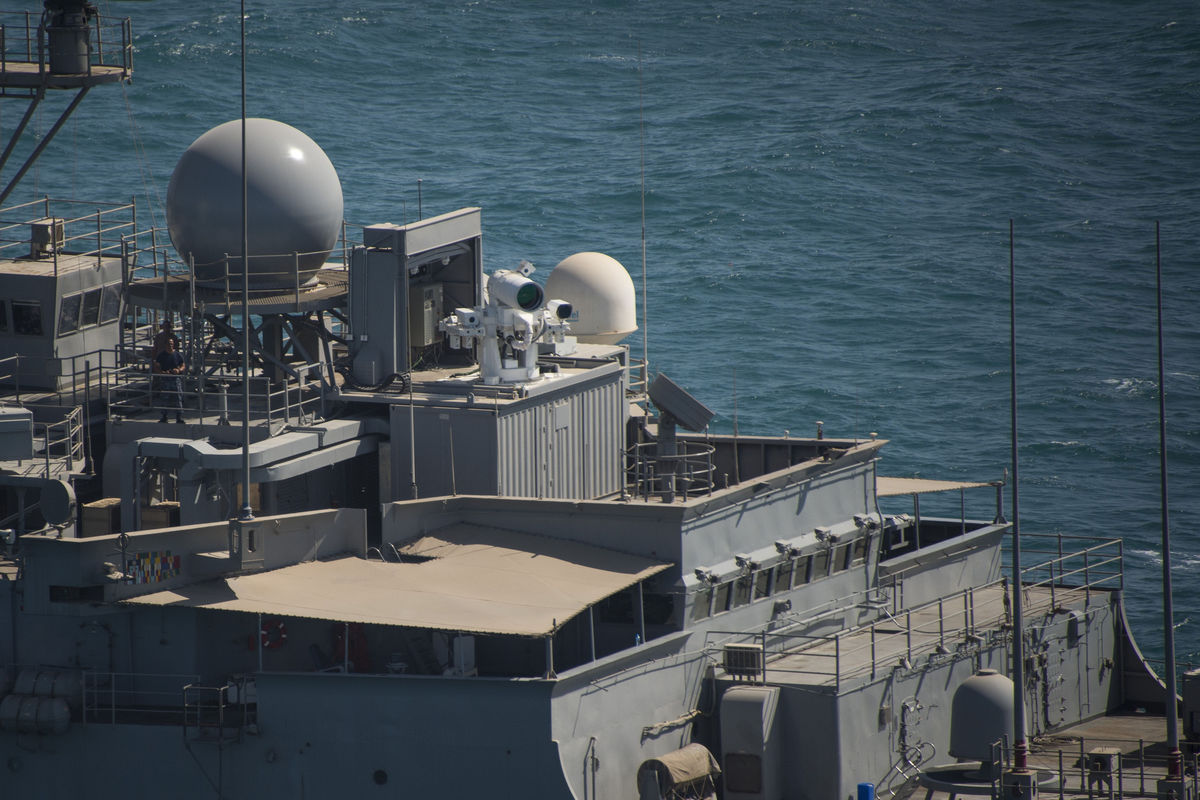
Source: U.S. Navy, Mass Communication Specialist 2nd Class Daniel M. Young via Bloomberg Click on the photo to enlarge.
Bloomberg.com is reporting the deployment of a laser weapon on the interim Afloat Forward Staging Base, Ponce, formerly LSD-15.
One of the more interesting aspects of the device from a Coast Guard perspective is that it can also be used in a non-lethal mode.
The device can emit progressively stronger beams, first to warn an adversary, and then destroy it if necessary, Chief of Naval Research Rear Admiral Matthew Klunder said at a Bloomberg Government session this year.
The laser can be adjusted to fire a non-lethal dazzling flash at an incoming vessel so they know it’s there “all the way to lethal,” Klunder said. The laser’s range is classified.
NOAA Storm Surge Map
FierceHomelandSecurity reports that NOAA has created a new interactive map showing the possible effects of worst case storm surge for Categories one through five on the East and Gulf coasts.
It might be helpful for planning. Still, after what we saw with Sandy, I have to question why no potential for flooding is shown for New York/New Jersey, or anywhere North of North Carolina? It appears the data stops at the Virginia line, but that is not apparent reading the description.
Lobbying Congress and the Administration
Would like to call attention to something retired Navy and Marine Corp flag officers are doing to lobby for better funding for the Navy. It is a letter signed by 95 retired flag officers. Perhaps it would not be unreasonable to expect the Coast Guard’s retired flag officers to do something similar.
While the Navy may be in trouble, the Coast Guard is in a far worse situation. While some of these officers may have be to an extent muzzled by the Department, there is nothing to stop their speaking out now, and if anything the situation has gotten progressively worse since they left the service.
Frankly I find it hard to understand why there is not more outcry about the Coast Guard’s budget. All I seem to see is happy talk about the wonderful new assets, while the Fleet continues to age. We really need a sense of urgency.
We Need a Mother(ship)

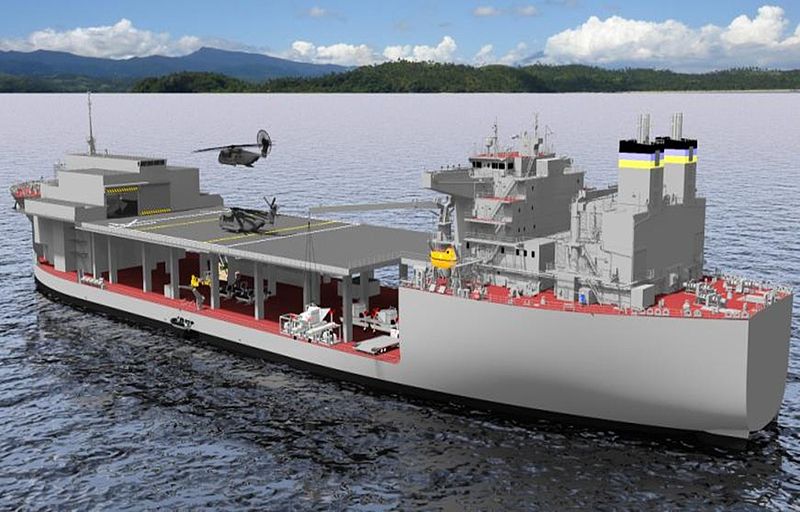
USNS Lewis B. Puller (MLP-3/AFSB-1) An artist’s conception of the Afloat Forward Staging Base. USMC Photo
Navy Times recently published an article “In war with drug trafficers, Coast Guard stretched thin.” There was a particular quote by the Commandant that caught my eye,
“Some 400 metric tons of cocaine cross U.S. borders every year — a drug trade valued at tens of billions of dollars, Zukunft said. Once upon a time, Coast Guard cutters would post a watch and wait for drug boats to get close, but now, there’s enough technology to detect them as they approach.
“The only problem: There aren’t enough ships and airplanes to catch them all.
“’We have an awareness of 80 percent, but we can only target 20 percent,’ Zukunft said. ‘We’re giving 60 percent of what we know, literally, a free pass.’”
This repeats similar comments we have heard from SouthCom. We have good information on drug trafficers, and we could catch a lot more if we just had more vessels available to respond. Note we need more vessels, not more highly capable vessels. This is part of what prompted my call for “Cutter X,” but there is another way. Instead of long endurance ships, perhaps, given support, shorter range assets could do the job.
Meanwhile, over in San Diego, NASSCO is building something that might make a useful contribution to addressing the need for more vessels by facilitating the use of less capable assets, a mothership, or Afloat Forward Staging Bases (AFSB).
“The design of the AFSB variant adds a flight deck, berthing, fuel storage, equipment storage, and repair spaces. With a rotating crew of civilian mariners and military personnel the ship can operate forward almost continuously, providing a base of operations for everything from counter-piracy/smuggling, maritime security, and mine clearing to humanitarian aid and disaster relief.”
With the exception of mine clearing, those missions are all in the Coast Guard’s wheelhouse. These or similar vessels could serve as mother ships or tenders for WPBs or WPCs extending their endurance and reach, supporting them far from their homeports and providing a base for supporting helicopters and UAVs.
We may be able to send only one or two large cutter at a time to the Eastern Pacific, but perhaps we could send six or so WPBs or WPCs.
They could also be used in responding to Natural disasters like Katrina or Sandy. They could be effectively a mobile Coast Guard group with both air and surface assets. If ice strengthened they could assume that role in the Arctic.
As big as they are, these ships have very small crews, and are relatively inexpensive to build–more than the OPC, but less than the Bertholfs. Certainly we should try the concept using Navy vessels first. In fact the first is expected to replace the USS Ponce, where it will presumably have some interaction with the six 110s serving with the Fifth Fleet.
Bering Sea Storm, One for the Record Books
gCaptain reports the Bering Sea has been hit by an unusual severe storm as a result of a rapidly forming record low.
An update at 1630 UTC Saturday said that Post-tropical Nuri remains a hurricane force low with winds ? 64 knots, a central pressure of 928mb, and significant wave heights of 31 to 48 feet in the Bering Sea. Remember, significant wave heights are calculated as the average height of the highest 1/3 of waves. Individual waves could be more than twice that size (that’s 100 feet!).
This is why we need truly substantial ships to operate in this area.