“The Fleet we Have, Want, and Need – with Jerry Hendrix,” Midrats

Sunday there will be a streaming live interview that some of you might find interesting. It is on a podcast called Midrats. There is an opportunity to contribute to the discussion both by phone and using an online discussion tool. It would not hurt to have a little Coast Guard representation there as well to clarify how he sees the role of the Coast Guard in the National Fleet. If you miss it on Sunday, it is archived on line or you can pick it up on itunes. You can also find the connection through the USNI blog or through the Eaglespeak blog.

Below is a quote in full of the program description. I don’t think they will mind my passing it along.

Please join us at 5pm EST on 9 Nov 14 for for Midrats Episode 253: “The Fleet we Have, Want, and Need – with Jerry Hendrix”

What is the proper fleet structure for the USN as we design our Navy that will serve its nation in mid-Century?

Join us for a broad ranging discussion on this topic and more with returning guest, Henry J. Hendrix, Jr, CAPT USN (Ret.), PhD.

Fresh off his recent retirement from active duty, Jerry is a Senior Fellow and the Director of the Defense Strategies and Assessments Program at the Center for a New American Security (CNAS).

A Naval Flight Officer by training, his staff assignments include tours with the Chief of Naval Operation’s Executive Panel (N00K), the Office of the Undersecretary of Defense for Policy (Force Development) and the OSD Office of Net Assessment.

His final position in uniform was the Director of Naval History.

Hendrix also served as the Navy Fellow to the Weatherhead Center for International Affairs at Harvard University. He has a Bachelor Degree in Political Science from Purdue University, Masters Degrees from the Naval Postgraduate School (National Security Affairs) and Harvard University (History) and received his doctorate from King’s College, London (War Studies).

He has twice been named the Samuel Eliot Morison Scholar by the Navy Historical Center in Washington, DC, and was also the Center’s 2005 Rear Admiral John D. Hays Fellow. He also held the Marine Corps’ General Lemuel C. Shepherd, Jr. Fellowship. He authored the book Theodore Roosevelt’s Naval Diplomacy and received a number of awards, including the United States Naval Institute’s Author of the Year and the Navy League’s Alfred T. Mahan Award for Literary Achievement.Listen in here (or use that link to pick the show up later) or visit us on iTunes.

More Lessons Learned, “Guardians of the Gulf: A History of Coast Guard Combat Operations in Support of Operation Iraqi Freedom, 2002-2004”

1024px-USCGC_Adak

Photo: USCGC Adak, part of Patrol Forces, South West Asia, note extra machinegun mount behind the pilothouse. Click on the photo to enlarge.

Not long ago we talked about the need to preserve lessons learned from atypical (usually military) Coast Guard operations like participation in the Vietnam War or operations in South West Asia. Craig Allen Jr. brought to my attention a LANTAREA historian’s publication, “Guardians of the Gulf: A History of Coast Guard Combat Operations in Support of Operation Iraqi Freedom, 2002-2004” (pdf) by William H. Thiesen, PhD, June 2009

Regarding the deployment of WPBs the study noted, “Even though the Coast Guard served a similar mission in Vietnam, there existed no operational plan to provide guidance for OIF planning and preparations.

If the Coast Guard does not yet have a contingency plan for deployment of patrol vessels there is enough detail to make a fair start on a checklist of things to be done. The experience of the WPBs deployed to the Mediterranean can leave little doubt of the Webber Class’ ability to go almost anywhere, given time to avoid bad weather.

“On May 14, the five cutters (one 378 and four 110s–Chuck) began the return trip; however, this time the smaller cutters followed Dallas across the Atlantic rather than riding on board an MSC vessel. The 5,000-mile voyage set a record as the longest transit ever completed by a 110-foot cutter. The PATFORMED fleet had performed its escort and MIO mission admirably. Moreover, the WPBs in the Mediterranean and the Arabian Gulf had set records for hours of operation with some of them deploying for over thirty days of operation.”

For the future, there might be some advantage in organizing at least a few of the Webber class in deployable divisions (3 units) and squadrons (six units) as discussed earlier, with or without augmentation since there will be several location with three or more WPCs.

C4ISR Upgrades Unfunded, Impacting Operations–DHS IG

FierceHomelandSecurity is reporting that the DHS Inspector General has found reduced funding CG funding for C4ISR upgrades has had an adverse effect on operations.

The Homeland Security Department’s inspector general said these aircraft and ships will continue to rely on obsolete technology that will also cost more to operate and maintain. And the Coast Guard hasn’t addressed how and when it will implement these upgrades in revised plans…For example, some older cutters use surface search radar systems that contain almost two-decade old technology, which should’ve been replaced 10 years ago, the report said. In another example, the Coast Guard was planning to upgrade aircraft that use 1990s video and sensor technology to provide surveillance and other functions…”For example, Coast Guard personnel aboard one legacy cutter reported experiencing problems with a malfunctioning surface search radar system, including the need to reboot the system several times a day and system breakdowns while at sea,” the report said…The IG also said that certain aircraft system’s video and mission processor overloads and must be restarted, which could take 30 minutes, if operators try to update a common operating picture with large amounts of data.

US to Sell 8 “Global Response Cutters” (FRC-A?) to Pakistan. Webber Alternative?

Pakistan’s “TheNews” is reporting, “The State Department has made a determination approving a possible Foreign Military Sale to Pakistan for GRC43M Cutters and associated equipment parts training and logistical support for an estimated cost of 350 million.”

They are to be built by Westport Shipyard, Inc. (Westport, WA), a company best known as America’s largest yacht builder. We have seen an example of this 43 meter (143 foot) class before. They were demonstrated for the Coast Guard in 2011.

This composite construction vessel is closer to the original concept of the FRC than the Webber Class, and it appears that the cost is about three quarters that of the Webber class. Claims are also made of lower maintenance and longer hull life. They are also faster. Now that the initial contract for the Webbers has run its course, perhaps it would be a good time to reevaluate these as an alternative.

Thanks to Lee for bringing this to my attention.

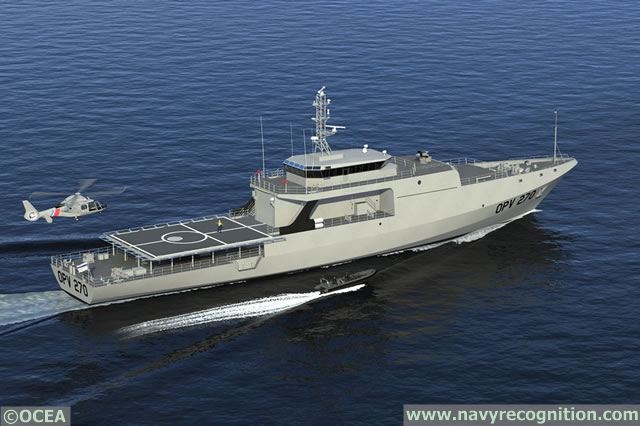
Philippine CG to Get an “MEC” and Four “PBs” from France

OCEA_OPV_270_640_001

Janes360 is reporting that the Philippine Coast Guard has inked a 90M Euro ($113M) deal for the purchase of five vessels. One is to be an 82/83 meter (270 foot) aluminum hulled patrol vessel and the other four are 24 meter (79 foot) patrol boats.

NavyRecognition, reporting on OCEA participatin in the EuroNaval trade show, has some details on the OPV 270.

“OPV 270 is a 83 m (270 ft) long marine aluminum made ship. It carries 44 crew members and can take 3 to 6 VIP passengers on board, in addition to 20 ordinary passengers. 35 survivors can also be taken on board. It can travel over 4.500 to 8.000 km at 15 knots and its maximum speed, which depends of the load, can reach 26 knots. its endurance is from 30 to 45 days.”

This earlier report by DefenseStudies includes some photographs of the 24 meter patrol boat in service with the Nigerian Navy, and a short discussion of how they are expected to be used. (Incidentally the “West Philippine Sea” is the Philippine name for the South China Sea.)

China Builds Patrol Ships–Lots of Patrol Ships

Type 056  corvette, credit  樱井千一

Type 056 corvette, credit 樱井千一

WantChinaTimes reports, “To defend its exclusive economic zone in the disputed East and South China Seas, China’s maritime law enforcement agencies have about 400 patrol vessels according to Asia Military Review, a magazine based in Bangkok…tonnages of the 400 vessels range between 1,150 and 3,400. The agencies are also set to receive 36 additional vessels.”

I would take this wit a grain of salt, but I think the real news was, “Eighteen Type 056 corvettes were constructed last year for the People’s Liberation Army Navy.”

To build 18 warships of a single class, even if they are sized between 210s and 270s is a remarkable achievement. These are assigned to the Navy, but they are used as backup for the Chinese Coast Guard.

New Mission off Somalia?

gCaptain is reporting, “The United Nations Security Council authorized naval inspections of ships off Somalia’s coast and beyond suspected of carrying illegal weapons and charcoal, a commodity that generates millions of dollars a month in revenue for militants linked to al-Qaeda.”

Possibly there will be some Coast Guard involvement in the form of detachments on US Navy ships and conceivably with the 110 foot WPBs operating out of Bahrain.

Unfortunately, it appears, that if inspections are done, it will be in a haphazard fashion. The expectation is that the ships already in the Indian Ocean doing counter piracy will also do this. But really, the places the ships need to be to do these inspections is different from where they need to be to respond to piracy attacks, because innocent ships avoid the Somali coast. The place to intercept smugglers is close to the Somali coast.

This is the kind of operation the Coast Guard specializes in. It is essentially no different from drug or migrant interdiction. It is what the Coast Guard did in Vietnam as part of Markettime.

If the Coast Guard had some built in excess capacity to respond to contingencies, they could take on this sort of operation.

The entire US Navy is excess capacity to respond to contingencies. It is not built for routine peacetime operations. It would not be a bad thing for those that decide the budgets to see building a capable Coast Guard as the same sort of insurance.

A Feast of Cabbage and Salami: Part I – The Vocabulary of Asian Maritime Disputes–CIMSEC

CIMSEC has posted an interesting article, “A Feast of Cabbage and Salami: Part I – The Vocabulary of Asian Maritime Disputes” for anyone interested in the current maritime disputes in East Asia, and, in fact, for anyone interested in international maritime law. It is apparently the first of a series and includes a wealth of links for further study.