“Coast Guard Needs Congress for Budget Bailout” –National Defense

US Capital West Side, by Martin Falbisoner

National Defense reports that the Administration’s 2020 budget request makes deep cuts in the Coast Guard budget compared to recent years, but that there is a good chance Congress will make up at least some of the difference.

You can see a brief summary of the budget submission here.

We have Congress plus up the Coast Guard’s budget in the past, particularly in terms of increasing numbers of Webber class cutters funded. The 2020 budget includes only two. This is likely to be increased to four or even six.

Congress has also added three Bertholf class NSC to the program of record and there have been suggestions that a 12th is needed to fully replace the 378 foot WHECs. If we are to get a 12th NSC, it almost has to happen in FY2020 before we OPC construction goes to two per year and before we need to fund Polar Security Cutters 2-6.

The Commandant has been talking about maintenance backlogs recently. Unfortunately maintenance does not have the highly visible job creation impact of new construction, although the dollar for dollar impact may be as great. It seldom makes the evening news, so this may be a harder sell.


Sea-Air-Space 2019 Virtual Tour

Like most of you I did not make it to the Navy League’s 2019 Sea-Air-Space Exposition, so I have found some YouTube reports that can at least provide some of the information passed along at the event. The descriptions below each video are from the YouTube description.

Day 1 video coverage at the Sea Air Space 2019 exposition. In this video we cover:
– Boeing MQ-25 Stingray aerial refueling drone with Rear Admiral Corey
– Future USVs and XLUUV/Orca programs with Captain Pete Small
– Austal USA new range of medium and large size USVs
Textron Systems CUSV with surface warfare payload
– ST Engineering range of USVs

Day 2 video coverage at the Sea Air Space 2019 exposition. In this video we cover:
– Raytheon SPY-6 radar
– Raytheon / Kongsberg NSM for USMC
– Northrop Grumman PGK for naval 5 Inch and 155mm guns
– Lockheed Martin Freedom-class lethality and survivability upgrade
– Lockheed Martin FFG(X)
– Navantia / BIW FFG(X)

Day 3 video coverage at the Sea Air Space 2019 exposition. Washington-based naval expert Chris Cavas is our guest speaker for this third and final day at Sea Air Space 2019. Cavas covers the follow topics:
– Bell V-247 Vigilant VTOL tilt-rotor UAV in U.S. Navy configuration
– Austal USA USV concepts
– Austal USA FFG(X) Frigate
– Fincantieri FFG(X) Frigate
– GD Bath Iron Works FFG(X) Frigate
– Lockheed Martin Type 26 CSC
– Lockheed Martin hypervelocity missile
– Mic drop

Sea Machines, Hike Metal to Collaborate on SAR Autonomy” –MarineLink

Marine Link reports an attempt to build an unmanned rescue vessel.

Boston-based Sea Machines Robotics announced today a new partnership with Hike Metal, a world-class manufacturer of workboats based in Ontario, Canada, to integrate Sea Machines’ SM300 autonomous vessel control system aboard commercial vessels tasked with search-and-rescue (SAR) missions.

Unmanned is “all the rage,” but once you get on scene, you never know what you will find. The victim you are attempting to help may need medical assistance, they may not be able to move to shelter provided by the boat.

Automated systems could operate like a smart cruise control on your car, navigating to a designated position and even follow the rules of the road. Automated systems can reduce manning requirements, but when the SAR vessel gets on scene, you need the versatility of a human being to respond to the unexpected.

(Writing this feels some how wrong. Am I being reactionary? Isn’t this obvious to everyone? Still felt like I had to say something. Good systems could come out of this, but full autonomy is just too much to expect.)

Small Vessel Hellfire Vertical Launch System

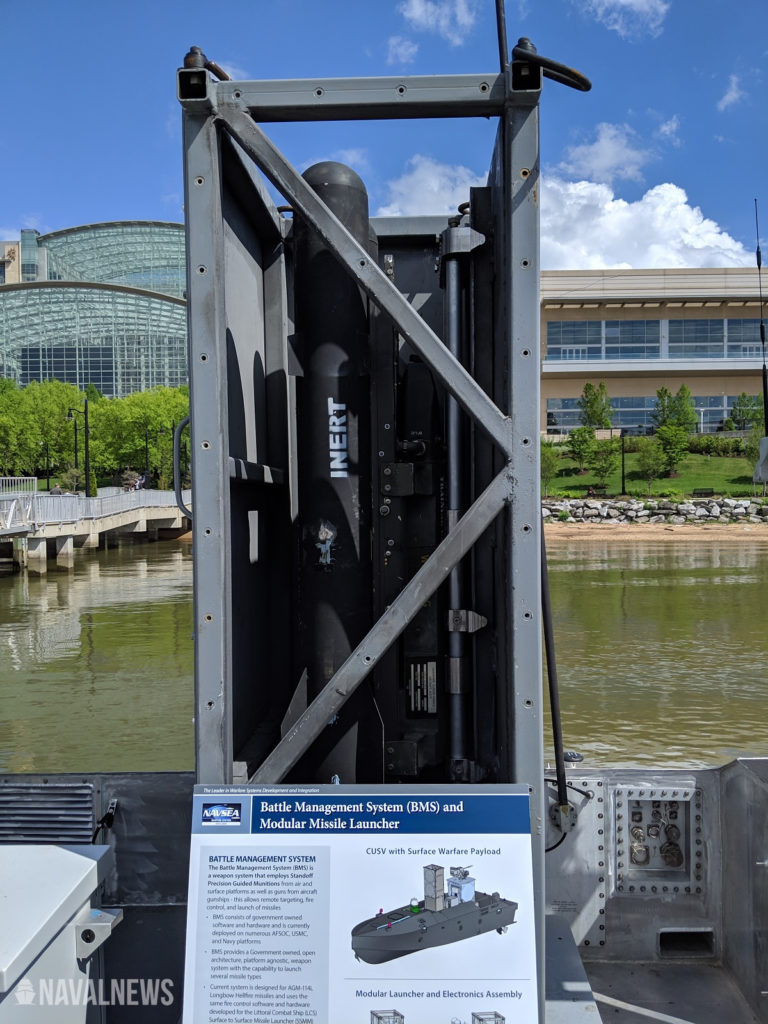
Photos: Above, Modular Missile Launcher, also seen below amidships on the Textron CUSV (Common Unmanned Surface Vehicle). Note relatively small size and innocuous appearance. 

Textron Systems’ CUSV with Surface Warfare payload at SAS 2019

Naval News reports that, at this year’s Sea-Air-Space Exposition, Textron showed one of their Common Unmanned Surface Vehicle (CUSV) craft equipped with a remote weapon station and a modular vertical launch system for the Longbow Hellfire.

I find the Hellfire VLS particularly interesting, as it might find application on Coast Guard cutters. The launcher appears to be about 2’x2’x7. The missile itself is 64″ long (1.6 meters), 7″ in diameter (17.8 cm), with a 13″ span (33 cm).

The CUSV is about 39′ (12 meters) in length. The CUSV’s load space is reportedly 20.5′ x 6.5′.

This earlier report indicates a missile shoot from a CUSV is expected in 2019. 

There would of course be concerns about how to mount these missiles on a cutter. The effects of the smoke at launch on he crew and the possible effects of the engines ingesting the smoke would have to be considered.

The planned transfer of six Webber class cutters to Bahrain, to replace the six Island class cutters assigned to PATFORSWA, might provide the incentive necessary to plan and test a Hellfire installation on this class.

“Navy Mk38 Gun Systems Gaining Co-Axial Small-Caliber Machine Gun” –Seapower

7.62 mm Chain Gun as Coax as optionally installed on 25 mm Mark 38 Mod 3. Image copyrighted by NAVSEA Dahlgren.

The Navy League’s online magazine Seapower is reporting that ” The Navy is installing a co-axial 7.62 mm machine gun on the mounts of its Mk38 chain gun systems, a Northrop Grumman official said….the addition of the co-axial Mk52 machine gun gives the gunner another “right-sized” option for countering a small target, such as pirates or terrorists on jet skis…Northrop Grumman is installing the Mk52 guns in the Mk38 under an indefinite delivery/indefinite quantity contract.”

This has been proposed for several years now, but this is the first indication it is happening. The proposed weapon, the 7.62mm Mk52, is in fact an electrically powered chain gun like the 25mm Mk242. (The article appears to be incorrect in this regard.)

The article also discusses the possibility of upgrading the Mk38 by replacing the 25mm gun with guns of 30 or 40mm.

I think the Coast Guard could make a good argument for upgrading its Mk38s to 40mm. The change would make very little difference to a DDG, also equipped with a 5″ gun and anti-ship missiles, but the Mk38 is the largest weapon available on about 75 Coast Guard cutters and these cutters could at any moment be required to face a vessel much larger than the Iranian boats the Navy has been fixated on. We already know the 30mm is a quantum leap in capability compared to the 25mm. Effectiveness is closely related to projectile weight. The 30mm projectile weighs about twice that of the 25mm. The 40mm projectile will weight three to four times as much as the 25mm. Since the rate of fire for these guns is similar, the 40mm is likely to be at least three times as effective against more difficult targets and also has a greater effective range.

Addendum:

The Coast Guard plans to install the Mk 38 on 64 Webber class and 25 Offshore Patrol cutters. The older crew served version of the Mk38 is on the remaining 378s, the 210s, and the remaining 110 foot Island class WPBs. I expect we may see the Mk38 on the Polar Security Cutters and the 87 foot Marine Protector class WPB replacement when they are built.

This would of course be less important if the vessels had something like the Long Bow Hellfire, which would be more effective than any of these guns against virtually any size targets.


“Coast Guard Polar Security Cutter (Polar Icebreaker) Program: Background and Issues for Congress, Updated May 9, 2019”

The Congressional Research Service has updated their report on the Polar Security Cutter Program. This is the first revision since the award of the contract, so there are significant changes, including a section on the selected design found on pages 5-9.

“U.S., Philippine Coast Guards Conduct Joint Search-and-Rescue Exercise” –Seapower

The U.S. Coast Guard Cutter Bertholf (left) moves in formation with Philippine coast guard vessels Batangas (center) and Kalanggaman during an exercise on May 14. U.S. Coast Guard/Chief Petty Officer John Masson

The Navy League’s Seapower is reporting that USCGC Bertholf is conducting SAR exercises with the Philippine Coast Guard.

“The crew of Bertholf also will participate in other joint events with members of the Philippine coast guard during the ship’s Manila port call. The events include a series of engagements on operational subjects such as damage control and search and rescue as well as sporting and social events. The activities are designed to improve interoperability and strengthen the ties between the two countries.”

Navy is Exercising in the Gulf of Alaska

171121-N-IA905-1120 PACIFIC OCEAN (Nov. 21, 2017) The aircraft carrier USS Theodore Roosevelt (CVN 71) which is participating in Exercise Northern Edge 2019 (U.S. Navy photo by Mass Communication Specialist Seaman Morgan K. Nall/Released)

Seventeenth District units may see a rare sight this week, as Navy units are participating in Exercised Northern Edge 2019. The US Naval Institute News Service reports,

USS Theodore Roosevelt (CVN-71) is underway in the Gulf of Alaska. The carrier will participate in the joint training exercise, Northern Edge 2019 from May 13 to 24. U.S. Navy ships participating Roosevelt with embarked Carrier Air Wing (CVW 11), guided-missile destroyer USS Russell (DDG-59), USS Kidd (DDG-100), USS John Finn (DDG-113) and fleet oiler USNS Henry J. Kaiser (T-AO-187).

“Personnel from U.S. military units stationed in the continental United States and from U.S. installations in the Indo-Pacific will participate with approximately 250 aircraft from all services, and five U.S. Navy ships. For the first time in 10 years, a Pacific Fleet aircraft carrier will be participating in the exercise,” according to a statement from the U.S. Pacific Fleet.
“Participants will serve as part of a joint task force, which will help enhance multi-service integration and exercise a wide range of joint capabilities.”

The US Pacific Fleet news release linked above is quoted below,

JOINT BASE PEARL HARBOR-HICKAM, Hawaii – Approximately 10,000 U.S. military personnel are participating in exercise Northern Edge 2019 (NE19), a joint training exercise hosted by U.S. Pacific Air Forces, on and above central Alaska ranges and the Gulf of Alaska, May 13-24.

NE19 is one in a series of U.S. Indo-Pacific Command exercises in 2019 that prepares joint forces to respond to crises in the Indo-Pacific. The exercise is designed to sharpen participants’ tactical combat skills, to improve command, control and communication relationships, and to develop interoperable plans and programs across the joint force.

Personnel from U.S. military units stationed in the continental United States and from U.S. installations in the Indo-Pacific will participate with approximately 250 aircraft from all services, and five U.S. Navy ships. For the first time in 10 years, a Pacific Fleet aircraft carrier will be participating in the exercise.

Participants will serve as part of a joint task force, which will help enhance multi-service integration and exercise a wide range of joint capabilities.

Major participating units include: U.S. Indo-Pacific Command, U.S. Pacific Air Forces, U.S. Pacific Fleet, Marine Corps Forces Pacific, Air Combat Command, Air Mobility Command, Air Force Materiel Command, U.S. 3rd Fleet, Air National Guard, Air Force Reserve and U.S. Naval Reserve.

NE19 is the largest military training exercise scheduled in Alaska this year with virtual and live participants from all over the United States exercising alongside live players.

Follow the Northern Edge Defense Visual Information Distribution Service (DVIDS) feature page for full coverage of the exercise.

Note: U.S. Navy ships participating in Northern Edge include Carrier Strike Group 9, USS Theodore Roosevelt (CVN 71) with embarked Carrier Air Wing (CVW 11), USS Russell (DDG 59), USS Kidd (DDG 100), USS John Finn (DDG 113), and USNS Henry J. Kaiser (T-AO 187).

Notably missing is any mention of Coast Guard participation, although I suspect Coast Guard units in fact are participating. Would appreciated any comments on actual Coast Guard participation.

North Korean Cargo Vessel Connected to Sanctions Violations Seized by U.S. Government

You may have seen a report that the US had seized a North Korean bulk cargo ship, the M/V Wise Honest (great name for a smuggler?). The first report I saw was from GlobalSecurity.org. It seemed to have left off a lot of details like where was it seized and by whom,

“On or about March 14, 2018, the Wise Honest was loaded with coal in Nampo, North Korea. On or about April 2, 2018, foreign maritime authorities intercepted and detained the Wise Honest. Maritime regulations require vessels like the Wise Honest engaged in international voyages to operate an automatic identification system (“AIS”) capable of providing information about the vessel to other ships and coastal authorities. However, despite its March 2018 voyage from North Korea, the Wise Honest had not broadcast an AIS signal since August 4, 2017.”

The report did mention the Coast Guard.

Mr. Demers and Mr. Berman (Assistant Attorney General for National Security and U.S. Attorney–Chuck) praised the outstanding investigative work of the FBI and its New York Field Office, Counterintelligence Division, and thanked the Department of Justice’s Money Laundering and Asset Recovery Section and Office of International Affairs; the United States Coast Guard; and the Department of State for their assistance.

This CourtHouseNews report provides more background. The ship was seized by Indonesian Authorities. and is currently en route American Samoa.