“UMS SKELDAR And Ultra Maritime Unveil UAS-Based ASW Solution At DSEI 2023” –Naval News

Two V-200 “Sea Falcon” VTOL UAV on the helideck of German Navy’s corvette Braunschweig. Note, this is a relatively small ship, about the size of a 270, with a beam of 13.28 m (43 ft 7 in), about the same as a Hamilton class 378′. Picture by Commander of the German Naval Aviation.

Naval News reports,

UMS SKELDAR and Ultra Maritime unveiled their jointly developed anti-submarine warfare (ASW) solution at DSEI 2023…The solution, a Rotary Wing UAS providing an ASW sonobuoy dispensing capability, is based on the SKELDAR V-200 Uncrewed Aircraft System (UAS) and was developed as part of a contract under the Canadian Department of National Defence’s (DND) Innovation for Defence Excellence and Security (IDEaS) program. 

This is an interesting idea. By itself, without any weapon, it may not be very useful, but it might prove a useful addition to a mix that includes ASW helicopters on standby for prosecution and ships with gear for monitoring and interpreting sonobuoy transmissions.

The Skeldar doesn’t have the endurance of the Scan Eagle, used by the Coast Guard, but it does have a much higher payload weight, 40 kg (88 pounds) compared to Scan Eagle’s 5 kg (11 pounds) and Skeldar doesn’t require separate launch and recovery equipment. (As it seems in all aircraft, there is a tradeoff between payload and fuel.)

The extra payload weight may not make much difference if you can pack everything you want into that 5 kg on the Scan Eagle, but it does open up options, larger sensors, light logistics cargo runs, and the ability to drop things.

Other than sonobuoys and weapons there are a number of things we might want to be able to drop from a UAS: buoys to measure drift for a SAR case, radios or pumps to a vessel in distress, lifejackets, or inflatable rafts.

Wikipedia reports, UMS Skeldar V-200 UAS is used by the militaries of six nations. It is used by the German Navy on their K130 Braunschweig class corvettes (pictured above), and will be used by the Belgian and Netherlands Navies on their City class mine countermeasures vessels.

This is a Canadian program. The Canadian Navy uses Skeldar, CU-176 Gargoyle in Canadian service, on their DeWolf class Arctic Offshore Patrol Ships (AOPS). If the Canadian Navy chooses to continue development of this sonobuoy drop capability, presumably they will also use the UAS on some of their frigates, or perhaps they are working toward an ASW role for their AOPS.

Tour of Bollinger’s Lockport Yard, Where FRCs Are Built

“Creating Cutters for the Next Generation of Heroes,” This banner hangs over a passageway in one of the shops at Bollinger’s Lockport shipyard.

The Navy and Coast Guard have had a lot of bad news from the ship building industry lately. Delays and cost overruns seem to the norm. Both the Polar Security Cutter and the Offshore Patrol Cutter programs are running well behind schedule. The Fast Response Cutter program has been a notable success story, delivering on time and on budget in spite of Covid, category 4 Hurricane Ida in 2021, and the recent supply chain problems. It looks like the program will soon start to wind down.

I recently had the opportunity to tour Bollinger’s Lockport, Louisiana shipyard where the Coast Guard Webber class cutters are being built. A retired Coast Guard mustang, Mark Matta, Director Program Management at the yard, explained the operation of the yard and showed me around.

Before we start looking at the yard itself, I will mention a few things I learned in the course of our conversations.

  • The Lockport yard was optimized exclusively for production of FRCs. They employed about 600 people but that is declining as the program has slowed. They are understandably concerned about the loss of talent that will occur as the program ends.
  • The ships were built in four major sections or blocks, stern, mid-body, bow, and superstructure.
  • They have a second dedicated facility at Tampa to facilitate the handover of the ships to the Coast Guard.
  • They will have a continued relationship with the FRCs because of long term sustainment and warrantee work.
  • The yard demonstrated an ability to produce a new ship every 70 days and they believe they could have improved on that rate.
  • The yard was able to deliver on time following Hurricane because, when it struck, their work was already three months ahead of schedule.
  • They are still feeling the effects of Hurricane Ida.
  • The program went into a phase II with upgrades beginning with FRC #33.
  • The ships are built to American Bureau of Shipping (ABS) warship standards and inspected by ABS.
  • Sound powered phones are still an important part of the internal communications system. The FRCs have a very extensive network of sound powered phones.
  • The Coast Guard crews are given six weeks of training prior to commissioning by a Bollinger subsidiary.
  • Extra racks and storage are being added to every berthing area.
  • The Mk38 systems on the PATFORSWA cutters have been upgraded to use the 30mm gun. Given that it, unlike the 25mm has an airburst round, it probably has a good capability against UAS. Presumably this change was made at the same time other Counter UAS systems were installed. The 30mm will also be more effective against small craft.

(Construction Zone–Photos of the yard will return shortly.)

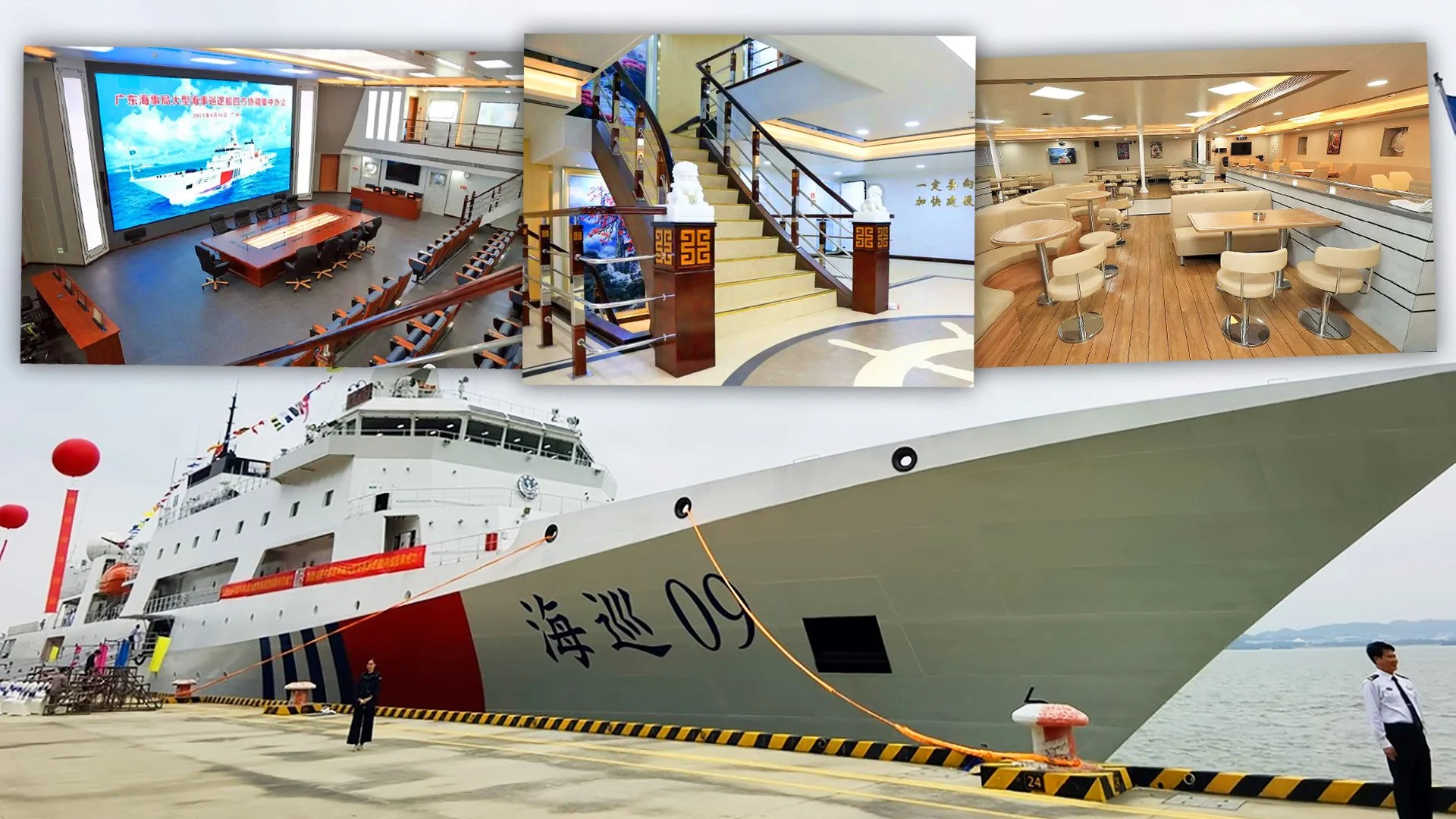
“China’s Massive New Maritime Patrol Ship Looks Like A Cruise Ship Inside” –The Drive

China Maritime Safety Administration’s Haixun-09

This came out in 2021. I missed it at the time, but it is still interesting. Have not heard any reports of the utilization of this massive ship since it was completed.

There is plenty of speculation within the post as to how the ship will be used. Note this is not China Coast Guard. The China Maritime Safety Administration was the only one of China’s five agencies with Coast Guard like missions that was not consolidated into the China Coast Guard.

Guns as Counter-UAS Weapons

A couple of videos from a The Drive post, “Gepard’s 35mm Cannons Blast Russian Drones Out Of The Sky In First-Person Video.”

TheFlakpanzer Gepard was not designed specifically for UAS. It was designed in the ’60s and fielded in the ’70s to protect against low flying aircraft like attack helicopters and the Soviet counterpart of the A-10 attack aircraft, the SU-25 Frogfoot.

The twin 35 mm guns are much more powerful weapons than the 25 and 30 mm weapons mounted on the Mk38 gun systems. Presumably in the counter UAS role they are using the “AHEAD” anti-missile rounds, rounds that might have been designed specifically to take out UAS, that fire 152, 3.3 gram tungsten metal sub-projectiles. The guns have a very high muzzle velocity (3,400 ft/sec for the AHEAD round) and a much higher rate of fire (550 rounds per minute per gun).

With the AHEAD round, the projectile weight is 1.65 lbs. (0.750 kg) compared with 0.406 lbs. (0.184 kg) for the 25mm HEI and HEI-T rounds, and 0.79 lbs. (0.362 kg) 30mm HEI-T round so the potential radius of destruction is substantially greater.

Still the 30mm with airburst ammunition should be effective, but it will probably require more rounds to get the job done and will have shorter effective range. Unless the 25mm has an airburst round it is unlikely to be effective.

It might be worth considering that while the Gepard’s firecontrol is radar, the Mk38 firecontrol is electrooptic. I can’t say unequivocally that that is a disadvantage, but it might be. Surely the drone builders will attempt to include countermeasures against both types of firecontrol.

“Test driving the Coast Guard’s new over-the-horizon cutter boat” –WorkBoat

Over the Horizon Boat V. Arnie Hammerman photo.

WorkBoat tests one of four pre-production Over the Horizon Cutter Boat Vs. It is extremely well done and extremely complementary.

A report of the contract award is here. There is a report of delivery of the first boat here.

Given the selection process, and the fact that this is the fifth iteration of the Over the Horizon Cutter Boat, we should expect that it should be a good boat, but this additional feature shows that the Coast Guard has recognized a hazard and is concerned about the health of the crews.

“This is the first Coast Guard boat to include a shock-monitoring system that provides the crew with real-time information about wave impacts on the vessel.”

Thanks to MikeB for bringing this to my attention.

C-27J Gets Minotaur

A Coast Guard C-27J Spartan crew, assigned to Coast Guard Air Station Sacramento, flies over San Francisco, California, during area of responsibility familiarization training, Monday, Feb. 6, 2018. Coast Guard photo by Lt. Scott Handlin

Below is a news release from the Acquisitions Directorate (CG-9):

Looking at the Coast Guard’s fixed wing fleet, this is the first of the 14 C-27Js to be equipped with Minotaur, but 14 of the 18 HC-144s are so equipped as are 15 C-130Js. A contract has been awarded for conversion of C-130J numbers 17 and 18 with options for conversion of numbers 19 to 22.


The Coast Guard successfully performed the first flight of the newly missionized HC-27J prototype aircraft, CGNR 2712, today at Naval Air Station (NAS) Patuxent River, Maryland. The milestone flight is part of the Coast Guard’s effort to enhance its fixed-wing surveillance aircraft fleet with improved capabilities to gather, process and transmit information during maritime patrol aircraft joint operations.

The flight was a culmination of efforts by the Coast Guard’s Aviation Projects Acquisition Center and Medium Range Surveillance Aircraft program office along with Naval Air Systems Command’s Naval Air Warfare Center Aircraft Division AIRWorks Team and the original equipment manufacturer, Leonardo Aircraft Division (LAD). The first flight of the HC-27J was a modified functional check flight and was tailored to exercise the program’s Safety of Flight and Safety of Test systems prior to fully proceeding into the flight test phase. The initial flight tests will be performed by the Naval Air Systems Command Test and Evaluation Squadron (VX-20) HC-27J test team with support from the Coast Guard and LAD at NAS Patuxent River.

The Coast Guard is in the process of missionizing 14 C-27J aircraft that were transferred from the U.S. Air Force under the National Defense Authorization Act of 2014. As originally delivered, the C-27Js were outfitted with weather radar and communications equipment. Missionization refers to the process of integrating specialized equipment, such as radar, sensors and processors, that enhance the aircraft’s effectiveness in carrying out Coast Guard missions. The Coast Guard is using Minotaur mission system architecture developed by the Navy across its fixed wing fleet to integrate the specialized components such as surface search radar and electro-optical/infrared sensors because it offers significant increases in speed and memory capability.

For more information: Medium Range Surveillance Program page and Minotaur Program page

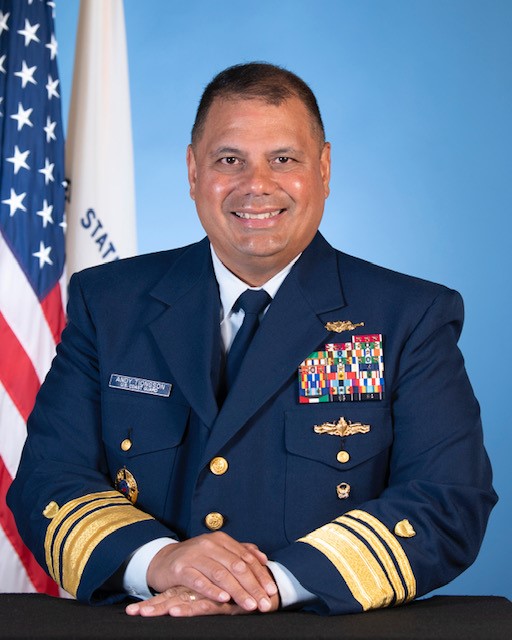
Proceedings Podcast EP. 351: USCG Pacific Area Commander on Maritime Governance

Vice Adm. Andrew J. Tiongson, Commander Coast Guard Pacific Area

The US Naval Institute has a pod cast interview of the PACAREA Commander.

Initially, there were questions about the Coast Guard’s response to the fires on Maui and Tropical Storm Hillary’s landfall in Southern California.

There was a lot of talk about the Coast Guard being a trusted partner, both internally and internationally, and the cooperative relationship the Coast Guard has developed with island nations in the Pacific, that have resulted in 13 bilateral agreements including some “enhanced” ship-rider agreements that permit the Coast Guard to act on behalf of island nations, even if there are none of their citizens aboard.

He said Harriet Lane should be in the Pacific before the end of the year.

He also talked about his potential role as Commander, Defense Force, West, under NorthCom.

There were some of surprises.

  • The Canadian Coast Guard has leased a commercial vessel and the USCG is providing a law enforcement detachment. I presume they are operating in the Western Pacific because there would be no reason to use a USCG LEDET in Canadian Waters.
  • That the House version of the budget includes four additional Webber class FRCs, three more for Guam and another for Honolulu.
  • The Coast Guard is opening a “Center for Excellence,” a regional activity center, in Hawaii, that will provide training in fisheries enforcement and environmental response for friendly nations. Should help form cooperative relationships across the Pacific.

I was also pleased to learn that VAdm. Tiongson had had a tour on USS NORMANDY (CG-60) as part of the U.S. Coast Guard – U.S. Navy exchange program. Apparently, it did not hurt his career.

The interviewer, Host Bill Hamblet, said he presumed PACAREA had the lion’s share of Coast Guard assets. VAdm. Tiongson did not answer that, but I can’t let it pass, because in my view the Coast Guard is still underrepresented in the Pacific.

About 84% of the US EEZ is in PACAREA, but LANTAREA will have 55% of the National Security Cutters. LANT has 81.5% of the WMECs (22 out of 27, counting Harriet Lane as in the Pacific), and 76% of the current 54 FRCs. Current plans are for PACAREA to have only 18 of the 65 FRC currently funded, less than 28%.

The situation may not be quite as bad as it looks, because LANTAREA assets are actually closer to the Eastern Pacific drug transit zones than PACAREA assets, so LANTAREA assets to operate frequently in the Eastern Pacific, but the asset distribution is still off, and PACAREA’s workload has been increasing with the emphasis on IUU fishing in the Pacific.

United States Exclusive Economic Zone – Pacific centered NOAA map

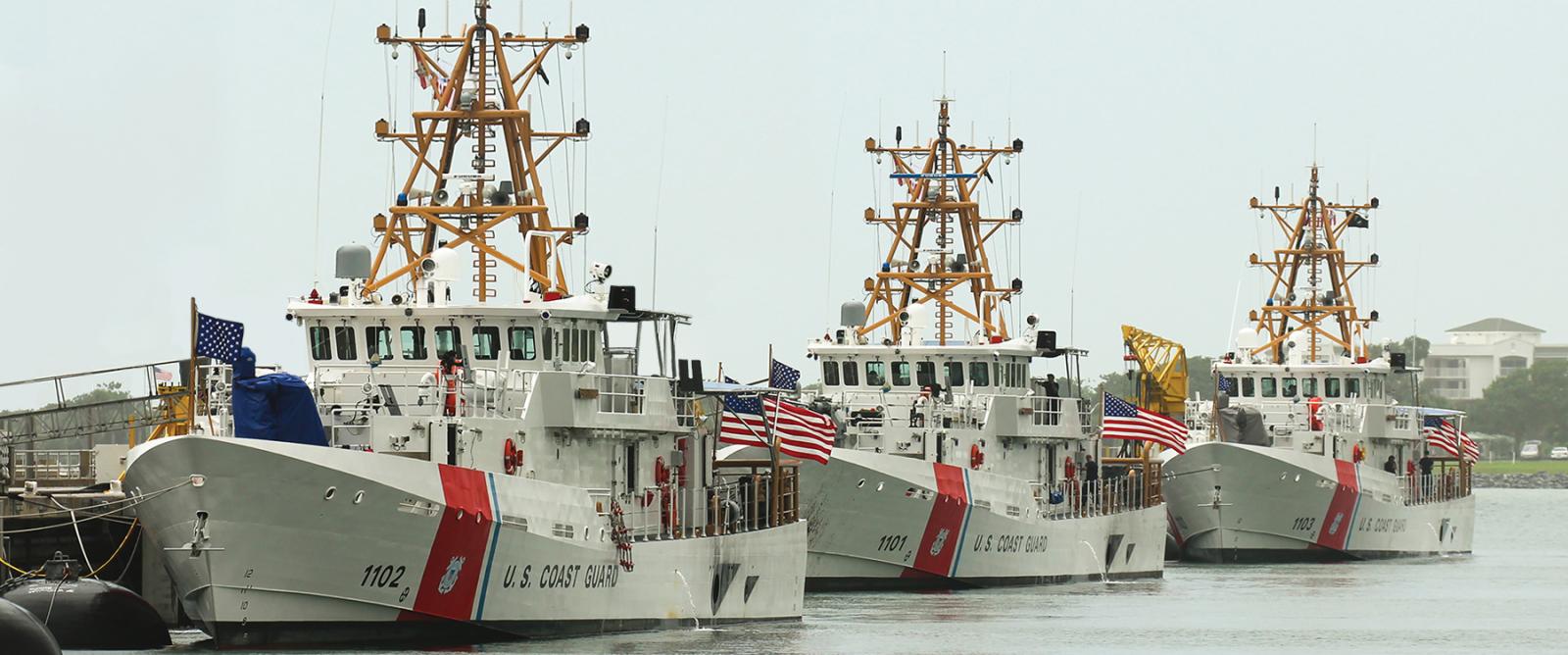
Three Articles About the Webber Class FRC

The first three fast response cutters—the USCGC Richard Etheridge (WPC-1102), Bernard C. Webber (WPC-1101), and William Flores (WPC-1103).
U.S. COAST GUARD

The September issue of US Naval Institute Proceedings has two articles about the Webber class WPCs that are currently featured articles online.

MSN shared a 1945 article by James Holmes, J. C. Wylie Chair of Maritime Strategy at the Naval War College, that seconds Cdr. Hulse proposal, “The U.S. Navy Needs Sentinel-Class Cutters to Serve as Missile Patrol Craft,

These are the right ships to help carry out U.S. maritime strategy in congested coastal terrain such as the Western Pacific, in wartime and times of tense peace alike. Denying an antagonist like China’s navy access to waters around and between Pacific islands is the strategy’s beating heart. Swarms of small, cheap, lethal surface and subsurface warships working with aircraft overhead and troops on the islands can close the straits along the first island chain, laying fields of overlapping fire that imprison Chinese sea and air forces within the island chain and bar the return home to units plying the Western Pacific. For self-defense, small surface combatants can mingle with merchant traffic amid East Asia’s cluttered maritime geography. In so doing they obscure their whereabouts and turn ambient conditions to tactical advantage. Let Chinese rocketeers try to distinguish friend from foe.

The first article by Lt. Chan suggests, 

Continuing production of fast response and national security cutters and transferring early hulls to regional allies would improve deterrence and interoperability.

This may not seem to make sense from the Coast Guard’s point of view in that USCGC Bernard C. Webber was commissioned in 2012 and the last of the 65 funded vessels of the class will be commissioned in about three years at which point the Webber will be only about 14 years old, still pretty new for a Coast Guard vessel. But looking at this from a whole of government perspective it looks a bit different. State Department hopes to gain or maintain influence with friendly nations that may not be able to afford adequate resources to patrol their waters. We also have an interest in the health of our ship building industry. There is presidency for this. Australia has twice built new patrol boats for their Western Pacific neighboring island nations. The Coast Guard would, of course, be much more receptive to the idea if funding for the replacement craft came out of someone else’s budget.

If the Navy did choose to build vessels of this class, and keep the production line going, then transfers of early model FRCs might be more readily accepted as they reach 20 or more years old.

The Second Article by Cdr. Hulse suggests,

“…the FRC’s Mk IV over-the-horizon cutter boat weighs 8,700 pounds and is stored in a notch near the stern. While this boat is highly capable for a variety of Coast Guard missions, it would not play a role for the Navy in conflict. Instead, a Navy FRC could mount a Naval Strike Missile box launcher with four tubes (8,600 pounds) at the stern, making it a formidable surface combatant. In addition, the deck forward of the pilothouse has considerable space for launching and recovering unmanned aerial vehicles (UAVs), enabling aerial surveillance and targeting. In fact, a Coast Guard FRC launched and recovered an Aerovel Flexrotor UAV while operating with the U.S. Navy’s Task Force 59 in Bahrain…with the current production line delivering four new FRCs per year to the Coast Guard at $65 million each. At that rate, the Navy could field 20 FRCs in just five years for the price of one Constellation-class frigate, which is projected to cost $1.3 billion per hull.”

The article goes into considerable detail about how the class has exceeded expectations along with cautions about what was required to make them succeed. It also suggests that the FRC could be the basis for an unmanned surface vessel.

Boots on the Ground, Navy Style:

City police forces have found they need patrolmen walking the beat who know the neighborhood and the people who live there to effectively fight crime. Armies need infantry to control and hold territory.

High end combatants can defeat their hostile counterparts to make sea control possible, but effective sea control is not possible without craft that can get into shallow water and enter every port. As Julian Corbett would said, Naval Control is not exercised by battleships.

The US Navy, forever focused on winning the big battle, has never had much enthusiasm for the craft that are the “boots on the ground” of a naval war. They tend to assume that allies and/or the Coast Guard will fill that role, or if not, they can build them when they need them and to some extent it has worked. Even so, it might have worked better if we had built and operated more of the vessels of the type before the shooting started.

In World War I, the US built hundreds of subchasers and 1000 ton destroyers. In WWII it was hundreds of PT boats that proved largely ineffective as torpedo boats but essential for the destruction of coastal traffic in both the Pacific and the Mediterranean. They were supplemented by the original LCS, Landing Craft Support, heavily armed shallow draft landing craft, nearly the same size as the FRCs. For Vietnam the Navy called on the Coast Guard and also built 170 Swift Boats and 718 Patrol Boat, River.

The U.S. Navy destroyer USS William D. Porter (DD-579) sinking after she was near-missed by a “Kamikaze” suicide aircraft off Okinawa, 10 June 1945. USS LCS(L)(3)-86 and McCool‘s LCS(L)(3)-122 are alongside, taking off her crew. Though not actually hit by the enemy plane, William D. Porter received fatal underwater damage from the near-by explosion.

Why would the Navy want these Patrol Craft?:

  • To enforce blockades
  • To counter kamikaze UAS and USV.
  • To support UAS, USV, and UUVs
  • To counter covert mine laying, arms smuggling, and intelligence agent or special forces transportation by boat.
  • To escort landing craft into an amphibious objective area. To rescue personnel from craft that are sunk. To tow disabled craft to safety. If properly equipped, to provide short range direct Naval fire support.

    Strait of Hormuz, august 6, USS Thomas Hudner, the Navy’s Lewis and Clark class cargo ship USNS Amelia Earhart and the U.S. Coast Guard’s Sentinel class cutter USCGC Charles Moulthrope, L3Harris Arabian Fox uncrewed surface vessel (USV)

If assigned to 5th Fleet, it would be logical to equip them with Hellfire/JASM or APKWS to counter Iranian drones and swarm tactics. In the Western Pacific arming with Naval Strike Missile is logical as would using the same air-search radars being used on the FRCs based in Bahrain. It might be possible to fit a Sea RAM forward, but if not, one or two remote weapon stations with an AAW capability might be enough.

A Final Note:

There is another reason we might want to have other nations to have FRCs. Since my cell phone has facial recognition, I think US Navy ships will have a hard time hiding among the traffic, particularly at the start of a conflict when their satellites are operational, and their fishing boats and merchant ships seem to be everywhere. But telling a USN FRC from a Vietnamese, Philippine, or Malaysian FRC would be quite difficult. It would complicate targeting.

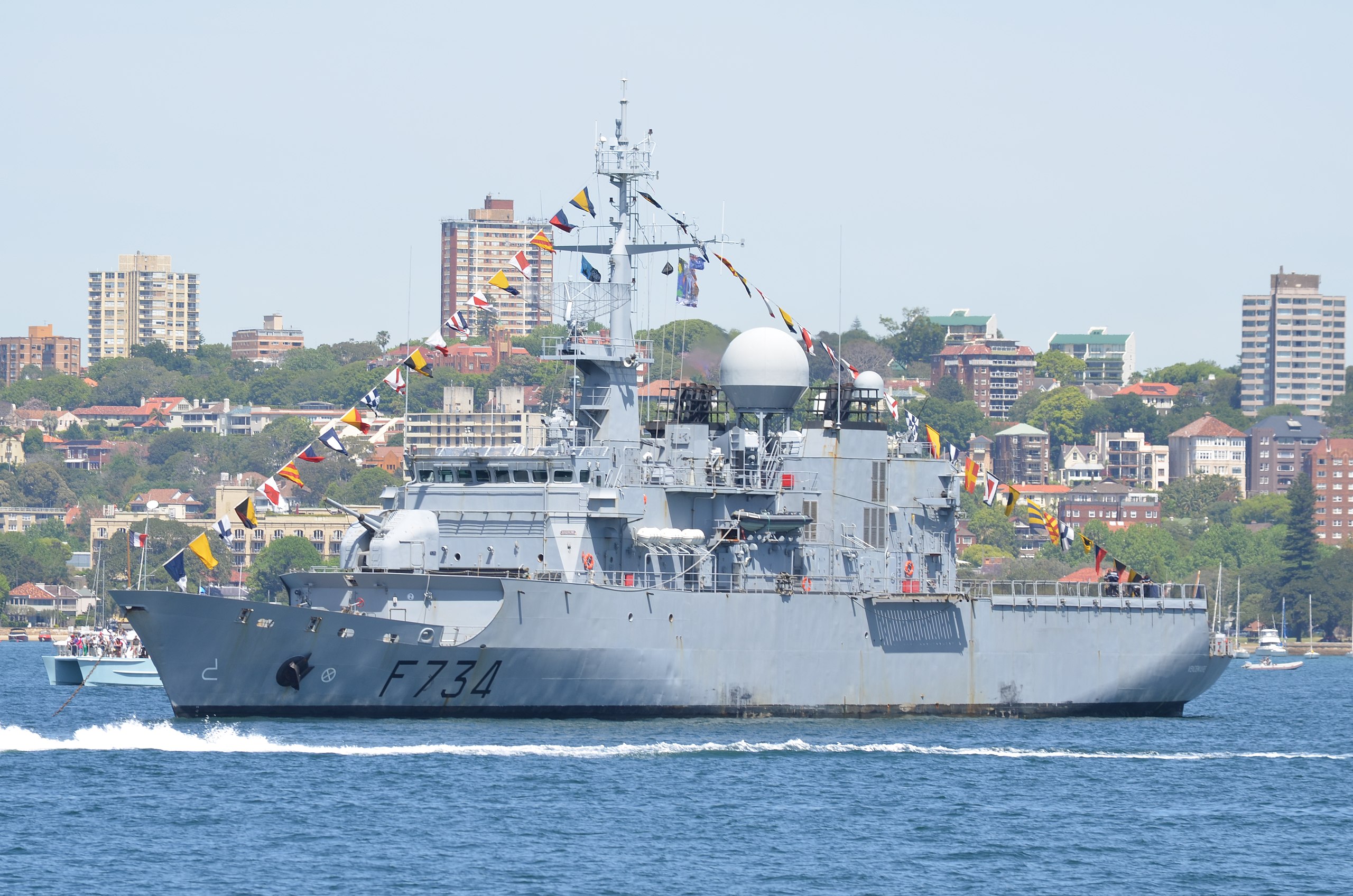
“End of NASSE Operation 2023” –Sea Waves

French frigate Vendemiaire, moored in Sydney Harbour. This 20 knot ship of the Floréal class looks a lot like a coast guard cutter. Photo by Saberwyn

Sea Waves reports the completion of a multi-national Fisheries Management exercise involving the US, Australia, New Zealand, France, and Fiji, from 20 June to 15 August.

The US Coast Guard deployed a C-130 to participate in the exercise. US vessels were involved but they were not identified. I am a bit surprised I have seen nothing from the USCG on this exercise.

The Sea Waves report appears to be a French news release. There is a New Zealand Defense Force view of the exercise here.

More on the developing relationship between Australia and France here. including an explanation of the “Pacific quadrilateral defense coordinating group* (PQUAD),” e.g., Australia, France, New Zealand, and the US, referred to in the post, as opposed to the “Quad,” e.g., Australia, India, Japan, and the US.

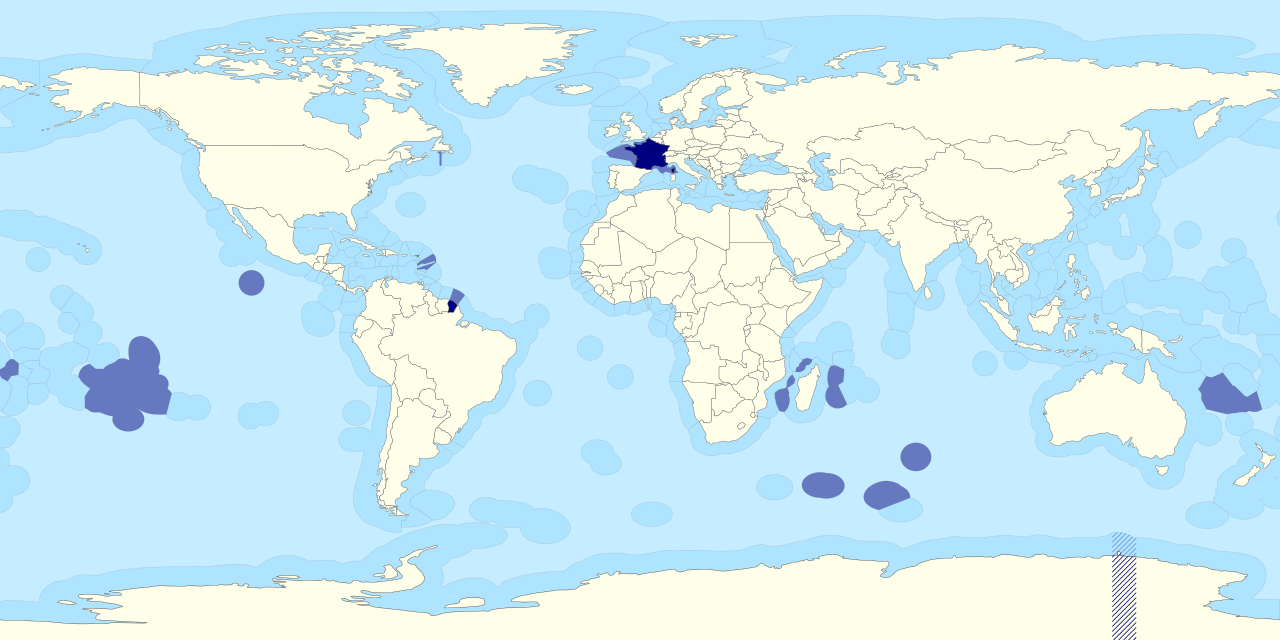
The French don’t normally have a lot of military assets in the Pacific. Much of what they have looks like coast guard, but they have the largest EEZ in the world and great strategic geography.

French Exclusive Economic Zone. Photo credit: B1mbo via Wikipedia.

This exercise is another step along the way to what appears to be inevitable international fisheries management and enforcement.

“US Coast Guard Icebreaker Sails in Proximity to Russia’s Northern Sea Route” –High North News

Nansen and Amundsen Basins Observational System (NABOS) moorings Healy is expected to visit. (Source: UAF)

High North News reports,

The US Coast Guard icebreaker Healy finds itself in unfamiliar waters as it becomes the first US government surface ship to venture into proximity of Russia’s Northern Sea Route (NSR) in the East Siberian Sea in several decades.

Russia claims the right to regulate traffic along the Northern Sea Route, a right the US does not recognize.

Healy is engaged in support of scientific research, but the Russians may view it as a challenge to their regulatory regime. The voyage, which originated in Seattle will end in Norway. Of course, Healy will then have to return to the US.

It is likely the US would like to do a Freedom of Navigation Operation through the Northern Sea route, but we have not had the facilities to do it with confidence.

Intentionally or not, Healy may be dipping a toe into the Northern Sea Route. So far, the Coast Guard is not saying.

Check out the article for a more complete discussion.

Thanks to Tups for bringing this to my attention.