Navy Merges Coastal and Riverine Forces

Some of the Navy units that the Coast Guard most commonly works with are being reorganized.

The Ports, Waterways, and Coastal Security (PWCS) mission the Coast Guard does in the US, when required outside the US, is a Navy responsibility, although they frequently seek Coast Guard assistance.

The Navy has decided to reorganize the way they do this mission, by combining at least to some extent, the organizations that do river and coastal missions.

They are also getting some new platforms to allow them to operate further from shore, including the new 85 foot patrol boat we talked about earlier.

There isn’t an exact correspondence between the way the Coast Guard defines the PWCS mission and the mission set for this new organization, but there are a lot of similarities and we can expect that there will be opportunities to train and exercise together.

LNG powered Cutter

Recently a rather ordinary looking Norwegian coast guard cutter came to the port of Hamburg and created something of a stir. This little craft KV Barentshav (also here), seemed unremarkable, but its power plant was unusual. In addition to diesel, it could be powered by Liquified Natural Gas.

It has been a long time since we saw a shift in fuel for ships, from coal to oil. Now it seems we may be seeing the beginnings of another shift. The big drivers are reduced fuel cost and reduced emissions. The Norwegians seem to be the leaders here, but the US Coast Guard is not totally unfamiliar, particularly the M side of the house. the Dec 2011 issue of Marine Safety Engineering (pdf) had an article predicting that predicted that natural gas fuel vessels were coming soon.

This issue highlights another technology that is becoming more important every day, and that is the increased use of liquefied natural gas (LNG). Whereas, we previously considered LNG as a cargo, new MARPOL regulations for reduced emissions are now making it an attractive fuel source. It is extremely clean burning and is much lower cost than similarly clean diesel fuel. Marine Safety Engineers are leading the charge in establishing the appropriate safety standards needed for LNG fueled vessels, which not only includes the vessels themselves, but also bunkering facilities and waterways risk management.

Looking at cost, a study of the possible application of this technology to the marine transportation industry is available here: http://www.cleanskies.org/?publication=natural-gas-for-marine-vessels-u-s-market-opportunities (pdf). The study notes,

Based on the current forecasts, natural gas delivered for production of LNG is now at least 70% less expensive on an energy equivalent basis than marine residual fuel and 85% less expensive than marine distillate fuel. EIA currently projects that this relative price advantage will continue, and even increase, through 2035.

LNG does require approximately twice the volume for the same energy content and the infrastructure for its distribution is still limited. Currently engines designed to burn LNG are built by Wartsila, Rolls-Royce, and Mitsubishi. Some of these engines are duel fuel, burning either LNG or conventional diesel fuel.

Considering

  • the US has ample supplies of natural gas,
  • it may be less than half the cost on a per energy unit basis,
  • that its use reduces maintenance costs,
  • LNG is more environmentally friendly, and
  • the possibility of duel fuel makes this option more practical.

Perhaps the Coast Guard may want to think about powering some of its assets with LNG. When the replacement for the 87 foot WPB is planned, it might be worth a look. They fit the profile of good candidates for LNG since they will normally return to the same base to be refueled. Extending usage to road vehicle and support equipment would amortize the cost of providing the infrastructure and make this option even more attractive.

Weapons Testing

As we have noted earlier, I believe there is a need to validate the Coast Guard’s ability to forcibly stop a medium to large vessel being used as a terrorist weapon. To do that the .50 cal., Phalanx 20mm, 25 mm, 57 mm, and 76 mm ought to be tested to confirm their ability to penetrate the side of a substantial ship, and go on to penetrate the cylinders of a truly large diesel engine (they can go to over 30 liters per cylinder).

File:US Navy 101027-N-8913A-252 Rounds from a Mk-15 Phalanx Close-in Weapon System (CIWS) from the guided-missile destroyer USS Mitscher (DDG 57) impact.jpg

(U.S. Navy photo by Mass Communication Specialist Seaman Leonard Adams/Released)

The Navy is restarting its SINKEX program. Perhaps they could be persuaded to allow some controlled testing, with the objective of developing doctrine with regard to effective ranges and choice of ammunition.

Shell Oil on the way to the Arctic

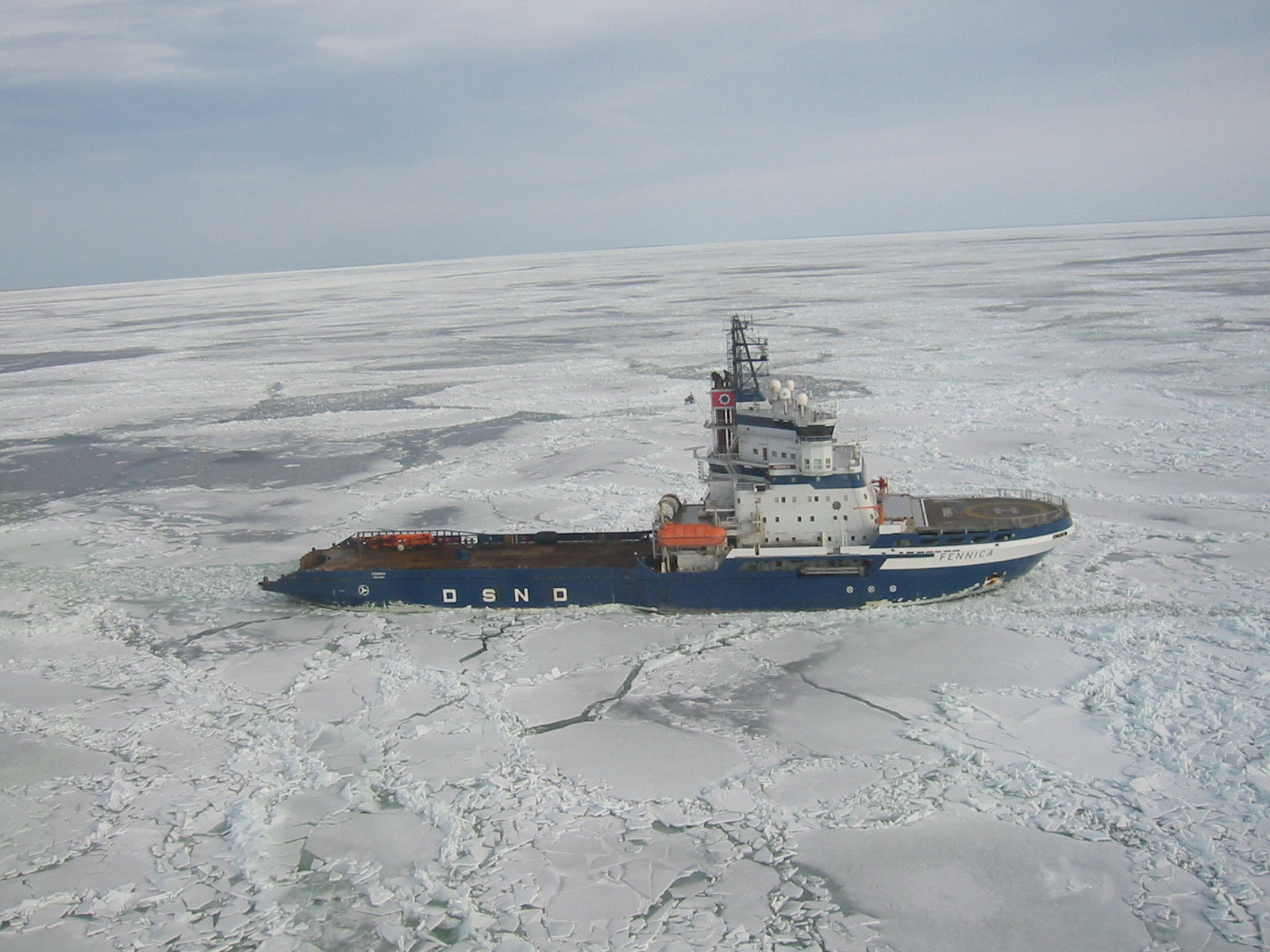
File:Icebreaker Fennica.jpg

Photo Credit: Marcusroos via Wikipedia “Finnish icebreaker Fennica in the Bay of Botnia”

Shell Oil has a fleet of roughly two dozen ships on the way to the Arctic where they are expected to drill exploratory wells in the Beaufort and Chukchi seas. The drill ships have recently left Seattle and are on the way to Dutch Harbor, where they will wait for the ice to clear. At least four of these ships are ice-class ships, as big or bigger than some of the Coast Guards earlier icebreakers, including Chouest’s M/V Nanuq (301 ft) and Aiviq (361 ft) and the Finish multipurpose icebreakers Nordica and Fennica (381 ft). Fuelfix.com provides additional detail and shows some of the preparation for the possibility of a spill.

(Thanks to Tim Colton’s Maritime Memos, he’s got lots of other good stuff including developments in the ship building industry–problems at Austal, a comment on Canada’s ship building paralysis, and advice for the Navy and Coast Guard on how to make “should-cost estimating” work.)

International Maritime Partnerships

Thought some of you might be interested in this short explanation of the standing Combined Maritime Forces (CMF) Task Forces 150, 151 and 152, that include Coast Guard members in addition to naval forces of 26 nations. These task force are intended to counter terrorism (150) and piracy (151) and to provide security in the Persian (Arabian) Gulf (152).


OPC, Design for Wartime, Build for Peacetime

As noted in the post “GAO Responds to Fleet Mix Studies, Part 1, The Report,” the Department of Homeland Security “Cutter Study” raised the possibility of an austerely equipped Offshore Patrol Cutter (OPC) possibly deleting some equipment or capabilities of the ship as currently planned including:

  • Sensitive Compartmentalized Information Facility (now referred to as the Ship’s Signals Exploitation Space or SSES)
  • Air Search and Fire Control Radars
  • Electronic Warfare Support Measures
  • Berthing space (114 instead of 122)
  • Weapons suite (e.g., 25mm gun instead of 57mm)

This got me to thinking. What do these ships really need, both for their peacetime functions and for possible wartime roles? I hope the Department’s suggestion presages a return to CNA (Center for Naval Analysis) to do a more formal evaluation of the effects of these changes. Until then, I’ll venture some comments on these proposed deletions, then go on to talk about how the ships might be equipped first for war, then for peace.

Continue reading

New Swedish WPB

Maritime propulsion is reporting the Swedish Coast Guard is getting a new class of five patrol boats, being built by Baltic Workboats AS, Estonia.

“The 52 t vessels have an LOA of 90 ft (26.5 m), beam of 20 ft (6.2 m) and draft of 5 ft (1.5 m). Unusual for its size, there is a triple pod propulsion system comprising three Volvo Penta IPS 1050 steerable pod drives with D13-800 diesels each rated at 800 hp at 2,000 rpm (Rating 4 – light commercial application).”

Lower emissions and up to 30% fuel savings are also reported.Top speed is 32 knots and range exceeds 600 nmi.

Photo: Baltic Workboats

Summer 2012 “Delivering the Goods” Available

The new addition of the Acquisition Directorate’s news letter, “Delivering the Goods” (pdf), is available here.

It is an informative issue. There are stories about

  • Developing the infrastructure to accept the first 18 Webber Class Cutters–6 to Miami, 6 to Key West, and finally 6 to San Juan
  • The 35 foot “Long Range Interceptor” LRI II boat for the National Security Cutters
  • Rescue 21 maintenance contract
  • Expected completion of the 110 Mission Effectiveness project. (Only 17 of the 49 (now really only 41) will get this treatment.)
  • There is a note about installation of the “Watchkeeper” software for inter-agency operations centers
  • A profile of the C-130 project manager
  • And, Master Chief Ayers talks about Coast Guard interest in small Unmanned Air Systems, particularly Scan Eagle.