“C4F’s Hybrid Fleet Completes Target Detection Test” –4th Fleet

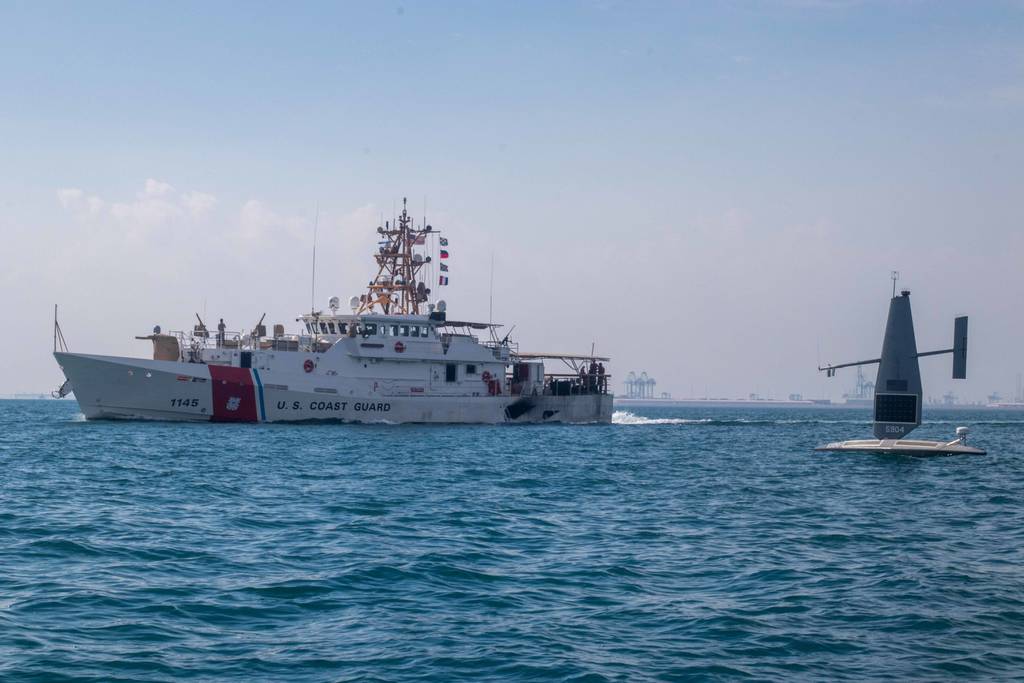
A Saildrone Explorer unmanned surface vessel operates alongside U.S. Coast Guard fast response cutter USCGC Emlen Tunnell (WPC 1145) in the Arabian Gulf, Nov. 29, during Digital Horizon 2022. (Sgt. Brandon Murphy/US Army)

Below is a 4th Fleet News Release. This development will have obvious impact on Coast Guard drug and alien migrant interdiction efforts. This is a result of extending experimentation with unmanned systems to 4th Fleet in much the same way it was done in 5th fleet.


 Oct. 17, 2023

C4F’s Hybrid Fleet Completes Target Detection Test

By USNAVSOUTH/4TH FLEET PUBLIC AFFAIRS

Joint Interagency Task Force South (JIATF-South) and Saildrone successfully completed an evaluation of the unmanned surface vessel Saildrone Voyager’s radar and electronic sensors against surface targets in the vicinity of Key West September 29, 2023.

Part of U.S. 4th Fleet’s campaign to inform the hybrid fleet, the evaluation looked at how many Saildrones the fleet would need to cover a given area of water and optimize the probability that the Saildrones would detect suspected drug runners at sea.

“This successful detection test is the completion of one small step in our campaign to inform the hybrid fleet,” said Capt. David Fowler, U.S. 4th Fleet’s Maritime Operations Center Director. “This is the type of testing and development that we can conduct even as we move toward continuous hybrid operations in the Caribbean.”

Right now continuous operations are underway with Operation Windward Stack. The U.S. 4th Fleet operation deploys long-dwell Saildrone unmanned surface vessels (USVs) to the Windward Passage in the Caribbean order to operationalize the combination of unmanned and manned systems in normal day-to-day operations.

In the coming months, other long-dwell USVs, interceptor USVs, long range UAVs, and VTOL UAVs will join the Saildrones in Operation Windward Stack. These systems will combine with traditional naval surface vessels to expand maritime domain awareness (MDA) and define combinations of unmanned and manned forces that work best for specific operations.

U.S. Naval Forces Southern Command/U.S. 4th Fleet supports U.S. Southern Command’s joint and combined military operations by employing maritime forces in cooperative maritime security operations to maintain access, enhance interoperability, and build enduring partnerships in order to enhance regional security and promote peace, stability and prosperity in the Caribbean, Central and South American region.

Learn more about USNAVSOUTH/4th Fleet at https://www.fourthfleet.navy.mil, https://www.facebook.com/NAVSOUS4THFLT and @NAVSOUS4THFLT.

“AEROVIRONMENT’S JUMP 20 MEDIUM UAS DEMONSTRATES MARITIME AUTONOMOUS TAKEOFF AND LANDING AT VESSEL SPEEDS OVER 20 KNOTS” –News Release

Below is a news release from AeroVironment reporting autonomous takeoff and landing from USNS Burlington (T-EPF-10), pictured below, at speeds of over 20 knots. I also found the video above that shows operation from a smaller vessel and provides more detail of how the unmanned aircraft is operated and supported.

CARIBBEAN SEA (Aug. 25, 2021) The Spearhead-class expeditionary fast transport ship USNS Burlington (T-EPF 10) operates off the coast of Haiti, Aug. 25, 2021. Burlington is deployed to U.S. Naval Forces Southern Command/U.S. 4th Fleet to support humanitarian assistance and disaster relief (HADR) efforts in Haiti following a 7.2-magnitude earthquake on Aug. 14, 2021. (U.S. Navy photo by Mass Communication Specialist 2nd Class Jack D. Aistrup)

Another good video here:

It appears 4th Fleet is trying to fulfill their self proclaimed role as the Fleet for Innovation.


AEROVIRONMENT’S JUMP 20 MEDIUM UAS DEMONSTRATES MARITIME AUTONOMOUS TAKEOFF AND LANDING AT VESSEL SPEEDS OVER 20 KNOTS

NOVEMBER 07, 2023

ARLINGTON, Va., November 07, 2023 – AeroVironment, Inc (NASDAQ: AVAV) today announced the company’s JUMP 20 VTOL Medium UAS exceeded expectations during the recent U.S. Naval Forces Southern Command/4th Fleet Hybrid Fleet Campaign Event (HFCE) that demonstrated human-machine teaming in the maritime domain. The JUMP 20 provided ship-based intelligence, surveillance, reconnaissance, and targeting (ISR-T) support to USFOURTHFLT and USSOUTHCOM during the week-long, at-sea exercise onboard USNS Burlington. The JUMP 20 has previously flown over 130,000 land-based hours in support of U.S. Special Operations Command combat deployments, and the expansion of JUMP 20 operations into the shipboard environment allows AeroVironment to provide these services globally.

During HFCE, JUMP 20 showcased its ability to launch and recover at vessel speeds over 20 knots, with fully autonomous flight from takeoff to landing.  The JUMP 20 requires neither launch or recovery equipment, nor personnel on the flight deck during launch and recovery, maximizing operational safety and flexibility for users. JUMP 20’s vertical takeoff and landing (VTOL) capability, and class-leading endurance and payload capacity expand the operational capabilities of U.S. and allies to compete and win in the era of great power competition.  The JUMP 20 demonstrated how uncrewed systems will support distributed operations across multiple domains, supporting national security objectives and our warfighters.

“The shipboard flight environment is dynamic and challenging. JUMP 20 is a proven combat-effective platform, and the system’s performance during HFCE illustrates the value to maritime operations.  JUMP 20’s ability to launch and land at speed, and without personnel intervention, enhances the ship’s operational effectiveness and enables operators to focus on important mission tasking,” said Shane Hastings, AeroVironment’s vice president and product line general manager for Medium UAS. “As we continue to demonstrate and prove the effectiveness of the JUMP 20 platform, we look forward to getting this capability in the hands of our sailors, Marines, and allies operating in the maritime environment.” AeroVironment JUMP 20 is deployed to U.S. and allied militaries around the world, and it can be provided on a contractor-owned / contractor-operated (COCO) basis to maximize operational flexibility.

“U.S. Coast Guard Cutter Terrell Horne returns to home port following a 52-day multi-mission patrol in the Eastern Pacific” –CG News

PERU, 10.06.2023, Courtesy Photo, USCG District 11
The crew of the U.S. Coast Guard Cutter Terrell Horne conducts a patrol in the Eastern Pacific Ocean in support of Operation Southern Shield 2023, October 2023. The Coast Guard recently completed the first high-seas boardings and inspections off the coast of Peru under a newly adopted multi-lateral agreement to monitor fishing and transshipment operations within the South Pacific Regional Fisheries Management Organization (SPRFMO) Convention Area. (U.S. Coast Guard photo)

Below is a news release from Coast Guard News. This patrol was unusual enough to draw some special attention. It is not a typical patrol craft mission. It involved the pairing of a buoy tender with a “Fast Response Cutter” (FRC) to put two units far from their homeports. The Pacific Area has done this before in the Western Pacific, but I think this may be the first time it has been done in the Eastern Pacific off the West coast of South America. Pacific Area Webber class FRCs have previously conducted drug enforcement missions in the Eastern Pacific at least as far South as Central America. We talked about portions of this multiunit deployment earlier, “Buoy Tender, FRC, C-130 Used for International Fisheries Enforcement–Operation Southern Shield.” USCGC Alder, homeported in San Franciso, was the buoy tender involved.

The emphasis of the operation was international fisheries enforcement, but USCGC Terrell Horne still managed to do a bit of drug enforcement. I look forward to seeing the report of USCGC Alder’s portion of the operation.

09.25.2023, Courtesy Photo, USCG District 11
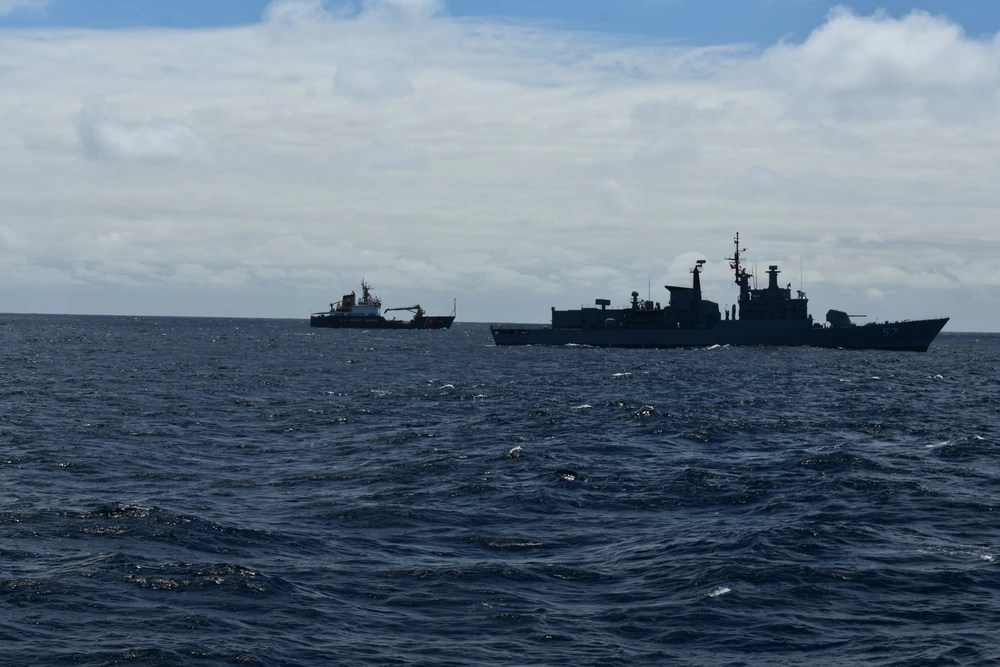
U.S. Coast Guard Cutter Alder (background) transits in formation alongside Peru BAP (Buque Armada Peruana) Bolognesi (FM-57) as it prepares for the next exercise during GALAPEX 2023, Sept.25, 2023. GALAPEX is a recurring multi-national maritime exercise led by Ecuador and included participation of delegates from Argentina, Brazil, Chile, Colombia, Costa Rica, the European Union, France, Italy, Mexico, Panama, Peru, the United Kingdom, and the United
States. (U.S. Coast Guard photo)

Nov. 8, 2023

U.S. Coast Guard Cutter Terrell Horne returns to home port following a 52-day multi-mission patrol in the Eastern Pacific

Coast Guard District Eleven

SAN PEDRO, Calif. — The U.S. Coast Guard Cutter Terrell Horne and crew returned to their home port in Los Angeles/Long Beach Tuesday after a 52-day patrol across the Eastern Pacific.

The crew of the Terrell Horne deployed in support of multiple missions, including Operations Green Flash, Albatross, Martillo, and Southern Shield, within the 11th Coast Guard District’s area of responsibility. During the patrol, Terrell Horne’s crew conducted a range of missions encompassing law enforcement, counter-drug operations, illegal, unreported, and unregulated fishing enforcement, and search and rescue operations.

“The crew of the Terrel Horne lived up to the cutter’s namesake in every way during this patrol. Operation Southern Shield allowed the cutter to showcase the versatility of the Fast Response Cutter. This operation brought a patrol boat and a buoy tender almost 4,000 nautical miles from home, conducting operations and international engagements with Mexico, Ecuador, Peru, and Costa Rica, said Chief Warrant Officer Jason Bussell, the commanding officer of the Coast Guard Cutter Terrell Horne. “The crew excelled in counter-illegal fishing missions, search and rescue, and counter-drug operations. Working alongside other Coast Guard assets, the crew was able to interdict a drug smuggling vessel and assisted in the seizure of nearly 2,000 lbs of contraband.”

The Coast Guard commissioned the Terrell Horne as the 31st Fast Response Cutter on March 22, 2019. Coast The cutter is named for Senior Chief Terrell Horne III, who died from injuries sustained while conducting maritime law enforcement operations off the California coast in December 2012. He was the executive petty officer aboard the Coast Guard Cutter Halibut at the time. For his heroic actions, the Coast Guard posthumously promoted Horne to senior chief petty officer.

For information on how to join the U.S. Coast Guard, visit GoCoastGuard.com to learn about active duty, reserve, officer and enlisted opportunities. Information on how to apply to the U.S. Coast Guard Academy can be found here.

“U.S. Coast Guard Cutter James returns from Eastern Pacific patrol after interdicting 12,909 kilograms of cocaine, 7,107 pounds of marijuana” –CG News

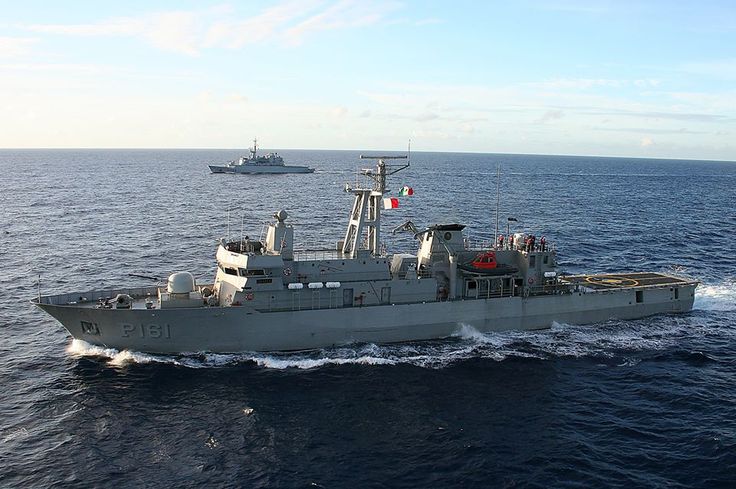
Below is a Coast Guard News release. The Mexican “Panther” Helicopter mentioned in the release is closely related to the Coast Guard’s MH-65. A sister ship of the Offshore Patrol Vessel they exercised with is pictured below.

Mexican Navy Oaxaca class patrol vessel, ARM Oaxaca, sister ship of ARM Chiapas, the Mexican Navy OPV that USCGC James exercised with. Mexican Navy photo.


Nov. 7, 2023

U.S. Coast Guard Cutter James returns from Eastern Pacific patrol after interdicting 12,909 kilograms of cocaine, 7,107 pounds of marijuana

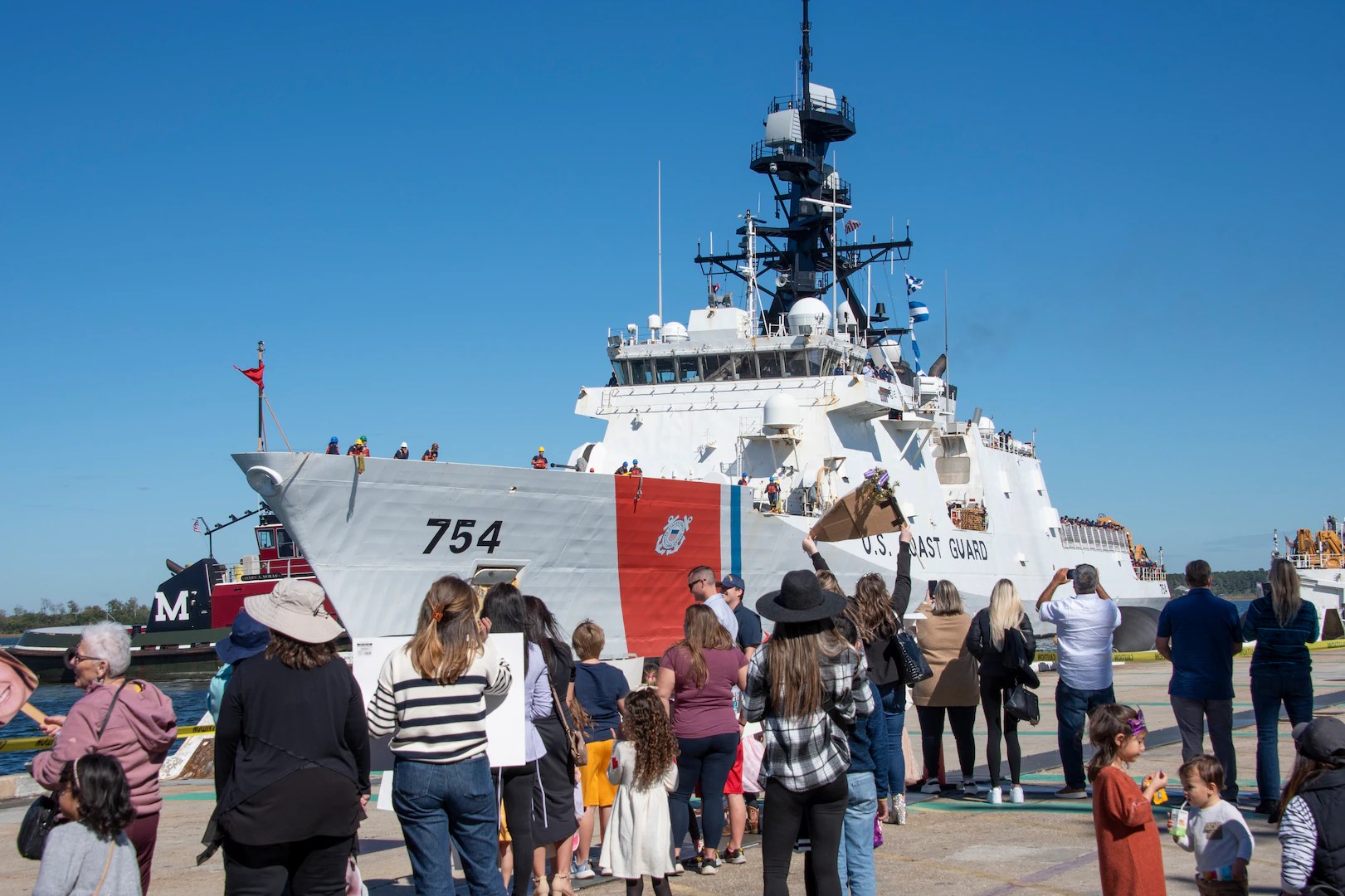
Charleston, S.C. – The crew of the U.S. Coast Guard Cutter James (WMSL 754) returned home to Charleston, Saturday, following a 113-day patrol in the Eastern Pacific Ocean.

Patrolling in support of Joint Interagency Task Force-South, James worked alongside other Coast Guard cutters, Department of Defense and Department of Homeland Security units, and international partners to conduct counter-drug operations.

During the patrol, James’ crew disrupted illegal narcotics smuggling, interdicting 12,909 kilograms of cocaine and 7,107 pounds of marijuana valued at over $380 million. While in theater, James interdicted eight drug-smuggling vessels and apprehended 23 suspected traffickers, including one low-profile vessel laden with contraband. The efforts by the crew of the James directly contributed to U.S. Coast Guard objectives to combat transnational criminal organizations and enhance regional stability and security.

James’ crew conducted multiple joint operations with foreign partner nations such as Ecuador and Mexico. James conducted a passing exercise with the Mexican navy’s ARM Chiapas. During the exercise, James practiced close quarters tactical maneuvering and landed the Chiapas’ Panther helicopter on deck. This exercise with the Mexican navy was particularly important to promote interoperability and enhance ongoing and focused partnership efforts.

While in the Eastern Pacific Ocean, James interdicted an Ecuadorian go-fast vessel laden with illicit narcotics. James executed a complex at-sea rendezvous with Isla Darwin (ECU) and transferred three suspected narcotics traffickers and 73 bales (1,742 kilograms) of cocaine. The evolution enhanced cooperation with Ecuadorian partners and supported the home-country prosecution of international crimes.

James is a 418-foot National Security Cutter. The cutter’s primary missions are counter-drug operations, and defense readiness in support of U.S. Coast Guard operations. The National Security Cutters fall under the command of the U.S. Coast Guard Atlantic Area. Based in Portsmouth, Virginia, U.S. Coast Guard Atlantic Area oversees all Coast Guard operations east of the Rocky Mountains to the Arabian Gulf. In addition to surge operations, Atlantic Area also allocates ships to deploy to the Caribbean and Eastern Pacific to combat transnational organized crime and illicit maritime activity.

For information on how to join the U.S. Coast Guard, visit GoCoastGuard.com to learn about active duty, reserve, officer, and enlisted opportunities. Information on how to apply to the U.S. Coast Guard Academy can be found here.

-USCG-

“Royal Marines snipers shoot out engines to bring drug-runners’ boat to a halt” –Forces.Net

HMS Dauntless has a Wildcat helicopter and Royal Marines sniper team from 42 Commando who provide reconnaissance, surveillance, and aerial support (Picture: Royal Navy).

Looks like the Royal Navy now has their own “Airborne Use of Force” Team to do the same sorts of things the Coast Guard has been doing.

Forces.Net reports,

A Royal Marines sniper team has brought a Caribbean drug-runners’ power boat to a “juddering halt” after shooting out its engines.

US Coast Guard personnel, working alongside the sailors and marines on board Royal Navy destroyer HMS Dauntless, were then able to seize £60m worth of cocaine, which the smugglers had been attempting to throw overboard.

Read on in the linked report. HMS Dauntless has been doing good work in cooperation with a US Coast Guard Law Enforcement Detachment. HMS Dauntless is the second of six Type 45 Guided Missile Destroyers, roughly the Royal Navy counterpart of the Burke class DDGs and almost twice as large as the National Security Cutters.

HMS Dauntless (foreground) and HMS Daring. Photo: LA(Phot) Ian Simpson/MOD

Thanks to David for bring this to my attention.

Buoy Tender, FRC, C-130 Used for International Fisheries Enforcement–Operation Southern Shield

PERU, 10.06.2023, Courtesy Photo, USCG District 11
San Francisco based USCGC Alder (WLB-216) raises the South Pacific Regional Fisheries Management Organization (SPRFMO) flag while patrolling the Eastern Pacific Ocean during Operation Southern Shield in October 2023. The Coast Guard recently completed the first high-seas boardings and inspections off the coast of Peru under a newly adopted multi-lateral agreement to monitor fishing and transshipment operations within the SPRFMO Convention Area, a region which encompasses nearly a quarter of the Earth’s high seas. (U.S. Coast Guard photo by Petty Officer 2nd Class Kenneth Honore)

Below is a District 11 news release. It came with 24 photos. I have included a few here. The captions are informative. I have edited some of the captions to include homeports and minimize duplication. I have also added a few links and the schematic below.

SPRFMO CONVENTION AREA
This schematic is available only to illustrate the Area of application of the SPRFMO Convention, which is described in legal terms in Article 5. The schematic is not part of the Convention text and has no legal status; it is not intended to reflect exactly the maritime spaces of adjoining coastal states.
PERU, 10.07.2023, Courtesy Photo, USCG District 11
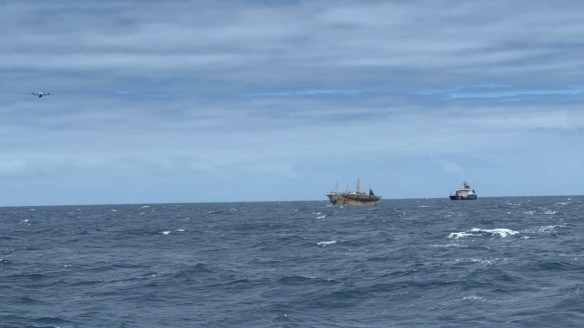
The Coast Guard Cutter Alder approaches a squid fishing vessel while CG-2007, a C-130 from Air Station Barbers Point in Hawaii, flies over (upper left) during Operation Southern Shield 2023, October 2023. The Coast Guard recently completed the first high-seas boardings and inspections off the coast of Peru under a newly adopted multi-lateral agreement to monitor fishing
and transshipment operations within the South Pacific Regional Fisheries Management Organization (SPRFMO)Convention Area. (U.S. Coast Guard photo)

LIMA, PERU, 10.06.2023, Courtesy Photo, USCG District 11
The aircrew of the Coast Guard 2007, an HC-130 based out of U.S. Coast Guard
Air Station Barbers Point, Hawaii, poses for a picture with observers from the Peruvian Navy and Air Force, in Lima Peru, October 2023. During the course of two weeks, Peruvian observers accompanied the USCG aircrew as they conducted overflights of the fishing fleet on the high seas during Operation Southern Shield 2023. (U.S. Coast Guard photo by pilot-in-charge, Lt. Zachary Hunter)

There was a Webber Class WPC involved as well. This follows the pattern of pairing a WLB with an FRC for distant operations that we have also seen in the Western Pacific.
PERU, 10.06.2023, Courtesy Photo, USCG District 11
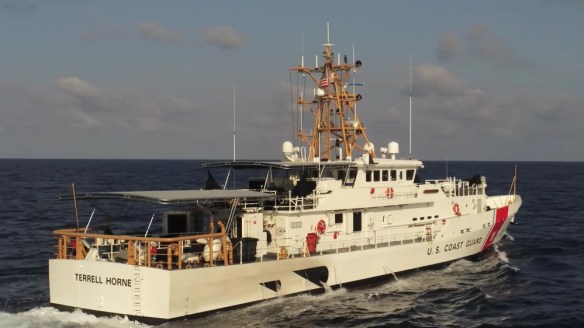
The crew of San Pedro based USCGC Terrell Horne (WPC-1131) conducts a patrol in the Eastern Pacific Ocean in support of Operation Southern Shield 2023, October 2023. (U.S. Coast Guard photo)

These operations followed an international exercise, GALAPEX 2023.

09.23.2023, Courtesy Photo, USCG District 11
Participants in GALAPEX 2023 pose for a group picture following a law enforcement boarding exercise during GALAPEX 2023, Sept. 23, 2023. Coast Guard Cutters Alder and Terrell Horne conducted a boarding of Ecuador Bae Isla Floreana as the first major exercise and introduction to GALAPEX, a recurring multi-national maritime exercise led by Ecuador and included participation with delegates from Argentina, Brazil, Chile, Colombia, Costa Rica, the European Union, France, Italy, Mexico, Panama, Peru, the United Kingdom, and the United States. (U.S. Coast Guard photo by Lt. j.g. Kimberly Byron)
09.25.2023, Courtesy Photo, USCG District 11
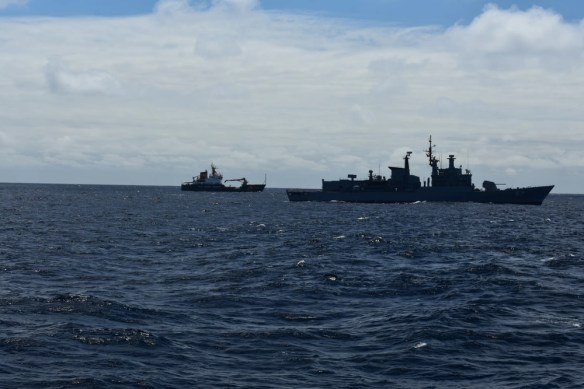
U.S. Coast Guard Cutter Alder (background) transits in formation alongside Peru BAP (Buque Armada Peruana) Bolognesi (FM-57) as it prepares for the next exercise during GALAPEX 2023, Sept.25, 2023. (U.S. Coast Guard photo)


 Oct. 16, 2023

Coast Guard Cutter crews conduct first high-seas boardings off the coast of Peru, under new SPRFMO measure

ALAMEDA, Calif. — The crews of the Coast Guard Cutters Alder, Terrell Horne and an HC-130 Hercules aircraft recently completed the first high-seas boardings and inspections, in the Eastern Pacific Ocean, under a newly adopted conservation and management measure to monitor and inspect fishing and transshipment operations at-sea in the South Pacific Regional Fisheries Management Organization (SPRFMO) Convention Area.

As part of Operation Southern Shield, the Coast Guard conducted boardings and overflights within the SPRFMO Convention Area on the high seas off the coast of Peru. For years, the Coast Guard has executed counter-illegal, unreported, or unregulated (IUU) fishing operations and participated in high seas boarding inspections (HSBI) around the globe. This operation was significant as it was timed to implement newly adopted rules in the SPRFMO Convention Area, which comprises nearly a quarter of the Earth’s high seas. The SPRFMO Commission consists of 17 members from Asia, Europe, the Americas, and Oceania, as well as two cooperating non-contracting parties. The primary species targeted in the Convention area are jack mackerel and jumbo flying squid.

Just prior to Operation Southern Shield, the Coast Guard participated in GALAPEX 2023, a recurring joint and multinational exercise hosted by Ecuador and executed in the vicinity of the Galapagos Islands. The Coast Guard conducted communications exercises, practiced counter-narcotics boarding scenarios, and hosted observers from Peru, Ecuador, and Brazil. GALAPEX culminated with full-scale exercises focused on a coordinated multinational response to counter IUU fishing. At the conclusion of the exercise, the Coast Guard patrolled south to focus on high seas boarding inspections off the coast of Peru.

“The U.S. Coast Guard remains committed to conducting combined maritime operations and exercises throughout the Eastern Pacific and will continue to capitalize on every opportunity to work with, learn from, and coordinate through our partners,” said Capt. James O’Mara, Chief of Enforcement for Coast Guard 11th District.  “The relationships our services build while planning and executing these operations are essential. The logistics required to enable these operations are significant, and it only happens with the tremendous support of partners like Ecuador and Peru.”

IUU fishing has replaced piracy as the leading global maritime security threat. Areas out on the high seas, beyond any country’s exclusive economic zone, can be exploited by fishermen engaged in IUU fishing, as they fish beyond the reach of most law enforcement entities. The Coast Guard’s actions provide inspection presence on the high seas among a distant water fishing fleet made up of more than 400 fishing and transshipment vessels. Much of the fishing in the Eastern Pacific is accomplished by these distant water fishing vessels, some which remain at sea for years at a time, and many of which are supported by transshipment vessels. The Coast Guard’s recent operation directly supported Central and South American partners and their desire to monitor and expand maritime domain awareness of fishing activity near their exclusive economic zones.

Each day during the operation a Coast Guard C-130 aircraft flew sorties over the fishing fleet on the high seas with observers from the Peruvian Navy and Air Force. The crew of the Coast Guard Cutter Terrell Horne also diverted to assist the Peruvian Navy in a search and rescue operation. The Terrell Horne located the vessel, then transported an injured fisherman back to shore to receive further medical care from local Peruvian officials.

“The U.S. Coast Guard is committed to working with our allies and partners to strengthen the international fisheries enforcement regime and stop the pervasive IUU fishing threat,” said Rear Adm. Andrew Sugimoto, commander, Coast Guard 11th District. “Operation Southern Shield is just the latest example of that commitment, and we will continue to model and support rules-based order. We applaud the SPRFMO Commission for adopting these latest inspection guidelines and hope to see additional management measures adopted in the future to ensure the sustainability of our ocean resources. Last year we operated off the Galapagos, this year off the coast of Peru, and we will continue to deploy aircraft, cutters, and personnel to support our partners and monitor these distant water fleets wherever they roam. These operations help bring like-minded countries closer together to protect vulnerable fish stocks, support the economic stability of coastal nations, the livelihoods of small-scale and artisanal fishermen, and safeguard ocean resources that fuel global populations and economies.”

Saildrones Set Sail in Support of U.S. 4th Fleet’s Operation Windward Stack” –4th Fleet

Below is a 4th Fleet News Release. Ten Saildrones will be operating in the Caribbean.

NEWS | Sept. 13, 2023

Saildrones Set Sail in Support of U.S. 4th Fleet’s Operation Windward Stack

By U.S. Naval Forces Southern Command/U.S. 4th Fleet Public Affairs

Commercial operators began deploying 10 Saildrone Voyager Unmanned Surface Vessels (USVs) out to sea today, a critical first step in U.S. 4th Fleet’s Operation Windward Stack.

Launched from Naval Air Station Key West’s Mole Pier and Truman Harbor, the Saildrones’ mission once on station is to improve maritime domain awareness, or MDA, by detecting and quantifying targets that pass within range of the Saildrones’ sensors.

Operation Windward Stack is a long-term operation of unmanned and manned forces working together, also known as a hybrid fleet, as envisioned by the Secretary of the Navy and the Chief of Naval Operations. Windward Stack is part of 4th Fleet’s unmanned integration campaign, which provides the Navy a region to experiment with and operate unmanned systems in a permissive environment, develop Tactics, Techniques, and Procedures (TTPs) against near-peer competitors, and refine manned and unmanned Command and Control (C2) infrastructure, all designed to move the Navy to the hybrid fleet.

First, operators and watchstanders at U.S. 4th Fleet will conduct tests and coordinate information flow as the solar-powered Saildrones sail into the Caribbean. “Operation Windward Stack begins with testing as we integrate the information we receive from the Saildrones into our fleet command center to further increase maritime domain awareness in the U.S. Southern Command Area of Responsibility (AOR),” said Lt. Cmdr. John Clark, U.S. 4th Fleet’s Current Operations (COPS) Director. “We will eventually have the opportunity to work through the command and control of both manned and unmanned forces operating throughout our region.”

The 10 Saildrones will serve as the initial unmanned vessels in the operation. Plans are to add additional USVs, unmanned aerial vehicles (UAVs) and manned maritime forces over the next few months to further challenge C2 integration and to expand the MDA coverage.

“We were able to demonstrate coordinated operations of manned and unmanned forces during UNITAS LXIV, a multinational maritime exercise, but that was for a relatively short time,” said Capt. David Fowler, U.S. 4th Fleet Maritime Operations Center (MOC) Director. “With Windward Stack, we’re going to coordinate these operations for many months. That is how we will truly learn what these unmanned vessels can do for us on a day-to-day basis.”

U.S. Naval Forces Southern Command/U.S. 4th Fleet supports USSOUTHCOM’s joint and combined military operations by employing maritime forces in cooperative maritime security operations to maintain access, enhance interoperability, and build enduring partnerships in order to enhance regional security and promote peace, stability and prosperity in the Caribbean, Central and South American region.

Proceedings Podcast EP. 351: USCG Pacific Area Commander on Maritime Governance

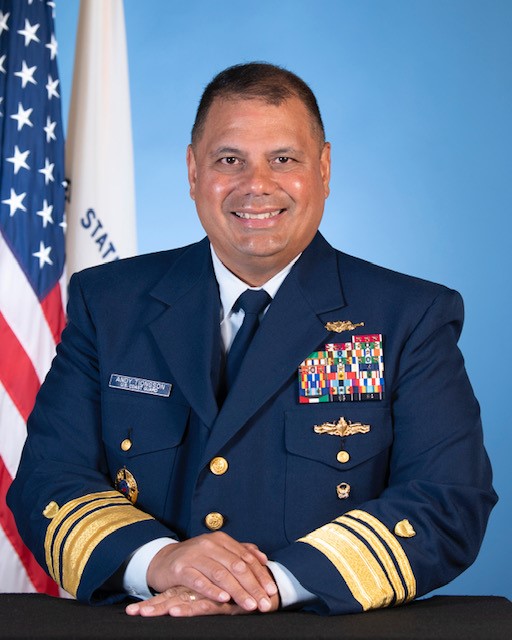
Vice Adm. Andrew J. Tiongson, Commander Coast Guard Pacific Area

The US Naval Institute has a pod cast interview of the PACAREA Commander.

Initially, there were questions about the Coast Guard’s response to the fires on Maui and Tropical Storm Hillary’s landfall in Southern California.

There was a lot of talk about the Coast Guard being a trusted partner, both internally and internationally, and the cooperative relationship the Coast Guard has developed with island nations in the Pacific, that have resulted in 13 bilateral agreements including some “enhanced” ship-rider agreements that permit the Coast Guard to act on behalf of island nations, even if there are none of their citizens aboard.

He said Harriet Lane should be in the Pacific before the end of the year.

He also talked about his potential role as Commander, Defense Force, West, under NorthCom.

There were some of surprises.

  • The Canadian Coast Guard has leased a commercial vessel and the USCG is providing a law enforcement detachment. I presume they are operating in the Western Pacific because there would be no reason to use a USCG LEDET in Canadian Waters.
  • That the House version of the budget includes four additional Webber class FRCs, three more for Guam and another for Honolulu.
  • The Coast Guard is opening a “Center for Excellence,” a regional activity center, in Hawaii, that will provide training in fisheries enforcement and environmental response for friendly nations. Should help form cooperative relationships across the Pacific.

I was also pleased to learn that VAdm. Tiongson had had a tour on USS NORMANDY (CG-60) as part of the U.S. Coast Guard – U.S. Navy exchange program. Apparently, it did not hurt his career.

The interviewer, Host Bill Hamblet, said he presumed PACAREA had the lion’s share of Coast Guard assets. VAdm. Tiongson did not answer that, but I can’t let it pass, because in my view the Coast Guard is still underrepresented in the Pacific.

About 84% of the US EEZ is in PACAREA, but LANTAREA will have 55% of the National Security Cutters. LANT has 81.5% of the WMECs (22 out of 27, counting Harriet Lane as in the Pacific), and 76% of the current 54 FRCs. Current plans are for PACAREA to have only 18 of the 65 FRC currently funded, less than 28%.

The situation may not be quite as bad as it looks, because LANTAREA assets are actually closer to the Eastern Pacific drug transit zones than PACAREA assets, so LANTAREA assets to operate frequently in the Eastern Pacific, but the asset distribution is still off, and PACAREA’s workload has been increasing with the emphasis on IUU fishing in the Pacific.

United States Exclusive Economic Zone – Pacific centered NOAA map

“USNI News Fleet and Marine Tracker: Aug. 21, 2023”

USCGC Munro (WMSL-755) escorts USNS Fisher (T-AKR-301) in the East China Sea on Aug. 12, 2023. US Navy Photo

Looking at the latest US Naval Institute “Fleet and Marine Tracker,” I am a bit surprised to see there are still 3 Navy ships operating under 4th Fleet, presumably doing drug interdiction. This is an uptick.

Again, they report on atypical Coast Guard operations:

  • Legend-class National Security Cutter USCGC Munro (WMSL-755) departed South Korea last week and is in the Korea Strait. (As I mentioned earlier, there is a possibility, cutters may encounter the new North Korean corvettes.)
  • Coast Guard Cutter USCGC Healy (WAGB-20) continues its work in the Beaufort Sea. Healy is on a five-month deployment in partnership with ONR and the National Science Foundation.
  • Coast Guard Cutter USCGC Forward (WMEC-911) is currently supporting Operation Nanook. Operation Nanook is an annual Canadian-led exercise that fosters international cooperation and shared responsibility in the Arctic and the northern Atlantic Regions. The cutter recently made a port call in Nuuk, Greenland.

You can use Control F “USCGC” if you want to quickly find the Coast Guard cutters mentioned in the USNI posts.

PATFORSWA is mentioned again.

The link in the Healy entry, “U.S., Canadian Icebreakers Conduct Operation, Rendezvous en Route to Arctic Ocean” is interesting, plus there is more in the USNI post including an “adorable” polar bear photo.

“Defending the Dutch Caribbean: An Assessment” –Geopolitical Monitor

Willemstad, Feb. 2022. The Netherlands the royal family was transported from Aruba to Curacao aboard the Holland-class offshore patrol vessel HNLMS Holland (P-84).

Geopolitical Monitor discusses the six islands of the Dutch Caribbean, part of the Kingdom of the Netherlands.

The Netherlands has been a good partner in drug interdiction operations in the Caribbean. The four ships of the Holland class are in many ways similar in size and characteristics to the Offshore Patrol Cutters. The Netherlands Navy tends to keep one of these ships in the Caribbean, and they frequently host US Coast Guard Law Enforcement teams. At least once they also hosted a Coast Guard H-65 airborne use of force helicopter.

The post talks about the Dutch Caribbean Coast Guard (DCCG, or Kustwacht Caribisch Gebied: KCG),

“…which has facilities in Aruba, Curaçao, and Sint Marteen. This agency carries out missions involving search and rescue, law enforcement, and maritime interdiction. The DCCG’s fleet includes three Damen Stan Patrol 4100 cutters (slightly smaller but similar to the Webber class–Chuck), Jaguar, Panther, and Puma, five Boston Whaler Justice 20 craft, and 12 Metal Shark Defiant interceptor vessels. In addition, in April 2022, the Dutch organization for defense equipment (Defensie Materieel Organisatie) announced that two helicopters were acquired from Bristow Helicopters and will be delivered in 2023. The DCCG currently operates two DHC-8 aircraft and two AgustaWestland AW139 helicopters.”

They even have had long range, medium altitude unmanned search aircraft assigned, something the US Coast Guard still does not have,

“The DCCG’s surveillance capabilities were expanded in late March 2022, with the arrival to Curaçao of three General Atomics MQ-9A Reaper unmanned aerial vehicles and two ground stations. The Reapers assist Dutch Caribbean military personnel in combating organized crime and illegal fishing, among other activities. They will remain in Curacao until 1 July 2023.”

The post alludes to Venezuelan’ threats to Dutch Caribbean islands that lay off the Venezuelan coast (Aruba, Curaçao, and Bonaire). While the Venezuelan military is far more powerful than the forces the Netherlands keeps in the Caribbean, it is hard to take these threats seriously since, an attack on even one of the islands, would be an attack on NATO.

On a personal note, really enjoyed a stopover in Aruba in the early 80s while it was snowing back in our Portland, Maine homeport–my wife will never let me forget.

Thanks to Lee for bringing this to my attention.