“Russia and China Sent Large Naval Patrol Near Alaska” –Wall Street Journal

The Wall Street Journal reports,

“Eleven Russian and Chinese ships steamed close to the Aleutian Islands, according to U.S. officials. The ships, which never entered U.S. territorial waters and have since left, were shadowed by four U.S. destroyers and P-8 Poseidon aircraft.”

The Russians and Chinese have been doing these joint deployments into the Bering Sea for at least a few years, and normally it has been the Coast Guard that followed them. This time the Navy sent a capable force, in addition to P-8 Maritime Patrol Aircraft they sent USS John S. McCain (DDG-56), the USS Benfold (DDG-65), the USS John Finn (DDG-113) and the USS Chung-Hoon (DDG-93).

Previous reports: 

Coast Guard Cutter Kimball encounters Russia and People’s Republic of China military naval presence in Bering Sea” –D17, Sept. 2022

“Chinese Warships Sailing Near Alaska’s Aleutian Islands Shadowed By U.S. Coast Guard” –Small Wars Journal, Sept. 2021

Chinese Navy Operating Off Alaska, Sept. 2015

http://www.state.gov/e/oes/ocns/opa/arc/uschair/258202.htm . This map of the Arctic was created by State Department geographers as part of the U.S. Chairmanship of the Arctic Council.

Why are they there?:

Russia is easy to understand. This is very close to their territory and their Pacific Fleet base in Petropavlovsk, but why the Chinese?

Russia is China’s top crude oil source, and much of that oil comes from Russia’s Arctic. In any conflict China’s energy sources are likely to be a target and the Bering Strait is the choke point on the most direct route from the Russian Arctic to Chia.

I would note that China’s excursions into the Bering Sea all seem to be toward the end of summer, which is about as nice as it gets in the Aleutians.

“Probing Palau’s Waters: Chinese Ships Are Increasingly Active in the Pacific” –Real Clear Defense

The Republic of Palau on a map of the Pacific. Credit: Encyclopaedia Britannica/Universal Images Group via Getty Images

Real Clear Defense reports on Chinese incursions into Palau’s Exclusive Economic Zone.

None of the actions sighted appear to be illegal or that much different from what the US does in the South China Sea, but they are movements we want to watch. A more detailed understanding of what they are doing might reveal illegality such as tapping into undersea cables.

Seems like the Chinese are telling us we need to station some cutters in Palau, and maybe some land based UAS.

The nearest cutters are based in Guam. It is 700 nautical miles from Guam to Palau, further than the distance between Atlanta and New York City, 50 hours at 14 knots, so Guam really isn’t in the neighborhood.

The nearest Coast Guard fixed wing search aircraft are based in Hawai’i at Barbers Point, 4500 nautical miles away. Even the new C-130J would require two fuel stops just to get to Palau.

“China to build icebreaker with submersible to reach Arctic seabed” –Interesting Engineering

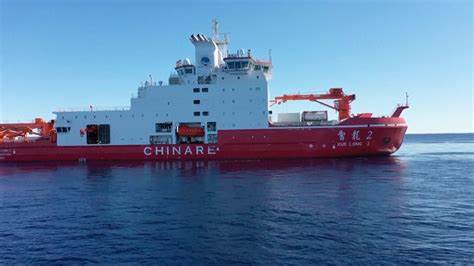
Chinese Icebreaker

Interesting Engineering has a story about China’s third polar icebreaker expected to be ready in 2025.

It appears to be a relatively light polar icebreaker,

“The proposed length of the vessel is 338 feet (103 meters) and is being built for a displacement of over 10,000 tons (9,200 tonnes). It can accommodate a crew of 80 people and travel at speeds of up to 16 knots…”

That is about the length of the Canadian Arctic and Offshore Patrol Ship, but about 50% heavier. I appears to be a bit smaller than M/V Aiviq that the Coast Guard apparently intends to buy.

Given the relatively small size, it is unlikely this is the nuclear icebreaker that has been talked about.

The article makes much of the ability to support a deepsea submersible, but it does not make clear what special provisions will be provided. Will it have a stern launch or moonpool or just cranes?

Why the submersible, when remotely operated vehicles are now so capable, is also not clear.

I think Russia has at least as much reason to be concerned about China’s icebreaker capabilities as the US, since Russia wants to monetize passage through the Northern Sea Route, and I doubt the Chinese will stand for that in the long run.

Thanks to Mike for bringing this to attention.

Coast Guard in Oceania in the News

The USCGC Oliver Henry (WPC 1140) crew arrives in Manus, Papua New Guinea, on Aug. 14, 2022, from Guam as part of a patrol headed south to assist partner nations in upholding and asserting their sovereignty while protecting U.S. national interests. The U.S. Coast Guard is participating with partners to support the Pacific Islands Forum Fisheries Agency-led Operation Island Chief and the larger Operation Blue Pacific through patrols in the Western Pacific in August and September 2022. (U.S. Coast Guard photo by SW3 Victor Villanueva, NMCB-FOUR)

A couple of recent articles about the US relations with Palau and Papua New Guinea.

Map of the exclusive economic zones in the Pacific.

There has long been interest in a US base on Manus, Papua New Guinea, but this is politically sensitive. Basing cutters there that protect an important economic resource and occasionally rescue the locals when they get in trouble, would probably be most welcome.

On the map above, Manus and Guam do not look that far apart, but Manus is 1,737.88 km (938 nautical miles) SSE of Guam. That is about the distance from Miami to New York City. 

Cutters based in Manus would be closer to parts Freely Associated States (FAS) of Palau and Federated States of Micronesia than cutters based in Guam and much closer to most non-FAS Micronesian nations. It might also be a good place to site a fixed wing forward operating base (CGAS Honolulu DET).

I am beginning to think we will see two new bases in the Western Pacific, one in American Samoa and one in Manus.

If we do end up with additional Webber class based outside Hawaii and Guam, we might need a squadron support organization similar to, and perhaps even larger than, PATFORSWA, to support all FRCs based in the Pacific South and West of Hawaii, e.g. a PATFORSWPAC.

“NATO, partners promote rules-based Arctic, free and open sea lines of communication” –The Indo-Pacific Defense Forum

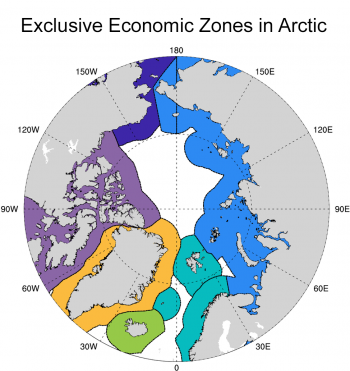
This map shows the exclusive economic zones (EEZs) within the Arctic: Canada (purple), Greenland (orange), Iceland (green), Norway (turquoise), Russia (light blue), and USA (dark blue).
Credit: DeRepentigny et al., 2020

The Indo-Pacific Defense Forum has a post which somewhat surprisingly talks about NATO concerns about the Arctic. I presume this is as a result of the recently concluded Shangri-La Dialog at which both the UK and Germany discussed future naval deployments to the Pacific. Canada pledged to increase its naval presence in the Pacific. Japan and S. Korea said they would put aside their differences and work more closely together. China also told “others” they should mind their own business and stay out of China’s backyard, defending their harassment of Western miliary units in the South China Sea.

We live in an interconnected world, and it appears the Arctic Ocean will become an important new connection between Europe and Asia. China, Russia, and Europe are particularly concerned about shaping the connection to their advantage and what that will mean in the long run is not yet clear.

An Arctic route could provide the US with an alternative to the Panama Canal for movement between the Atlantic and Pacific, but the US probably will not benefit as much from the opening of the Arctic Ocean as the Asians and Europeans. On the other hand, any traffic using the Arctic to pass between the Atlantic and Pacific will have to pass within about 32 nautical miles of the US at the Bering Strait and within less than 300 nautical miles of a US Aleutian Island. This puts the US in a good position to regulate any traffic using the Arctic for passage between the Atlantic and Pacific should we choose to do so.

The Indo-Pacific Forum post does not say much we have not heard before, but it did mention that the Chinese have, “…plans to build the world’s biggest icebreaker vessel.” Given the size of existing Russian nuclear powered icebreakers, that is going to be a very large ship.

There is a good possibility that Russian and Chinese aims in the Arctic may be in conflict. The Chinese are likely to want to transit the Arctic free of charge. The Russians will want them to pay for the privilege. The Chinese will want access to the resources of the Arctic while the Russians consider most of the Arctic to be Russian EEZ or continental shelf.

We have gotten along with the Russians pretty well in the Arctic, but we may be seeing an end to the Arctic as a zone of peace. Still, I don’t think the conflict will be between the US and Russia.

We should not forget that we may see that very large Chinese icebreaker in Antarctica.

China’s PLAN Surface and Sub Order of Battle

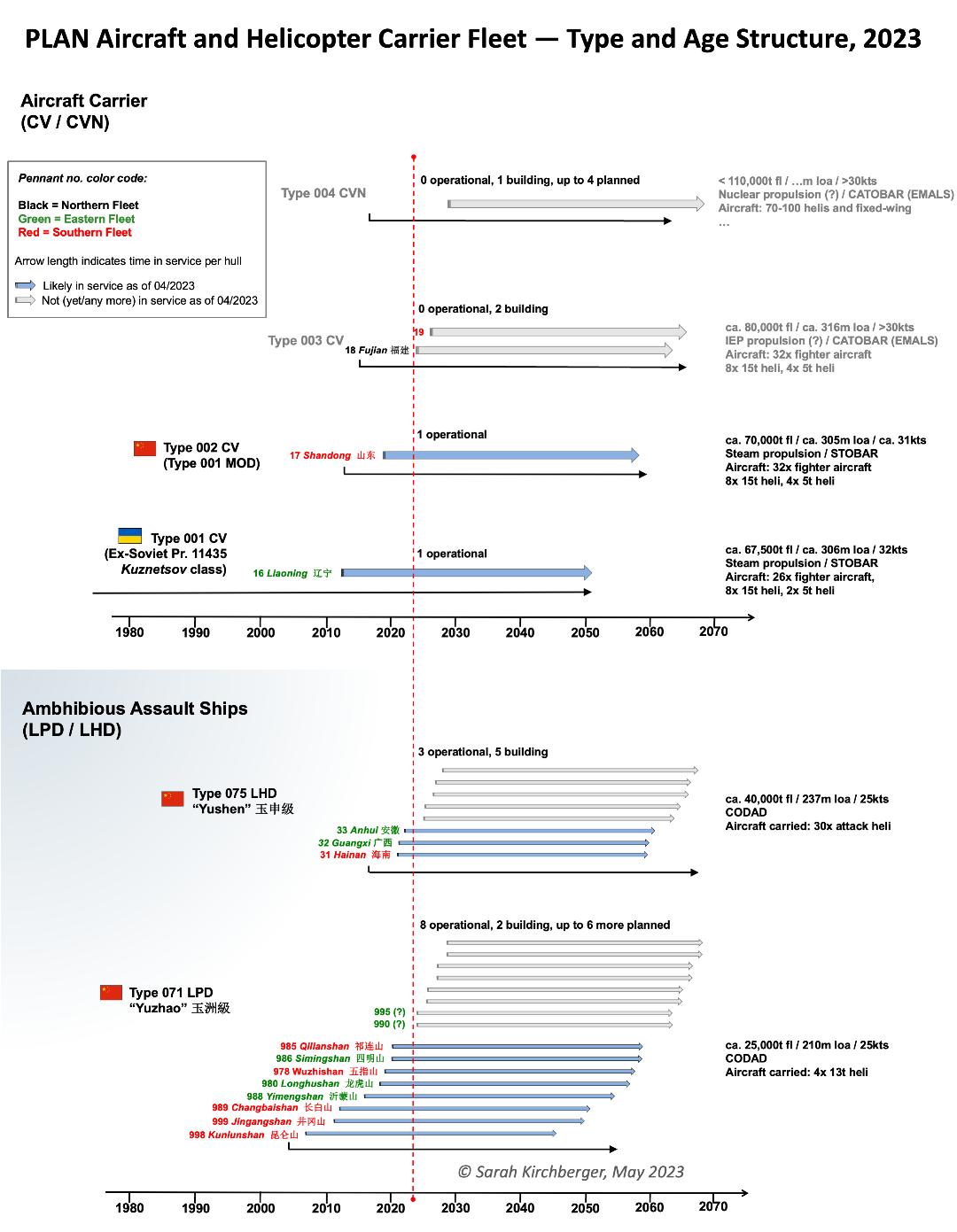
Earlier I published “Chinese Navy Submarine and Major Surface Ship Order of Battle,” that included three infographics prepared by Dr. Sarah Kirchberger that I found on the CIMSEC Internal Discussions Facebook page. At the time I noted that they did not include Chinese aircraft carriers, amphibs, and numerous frigates, corvettes, and other small combatants.

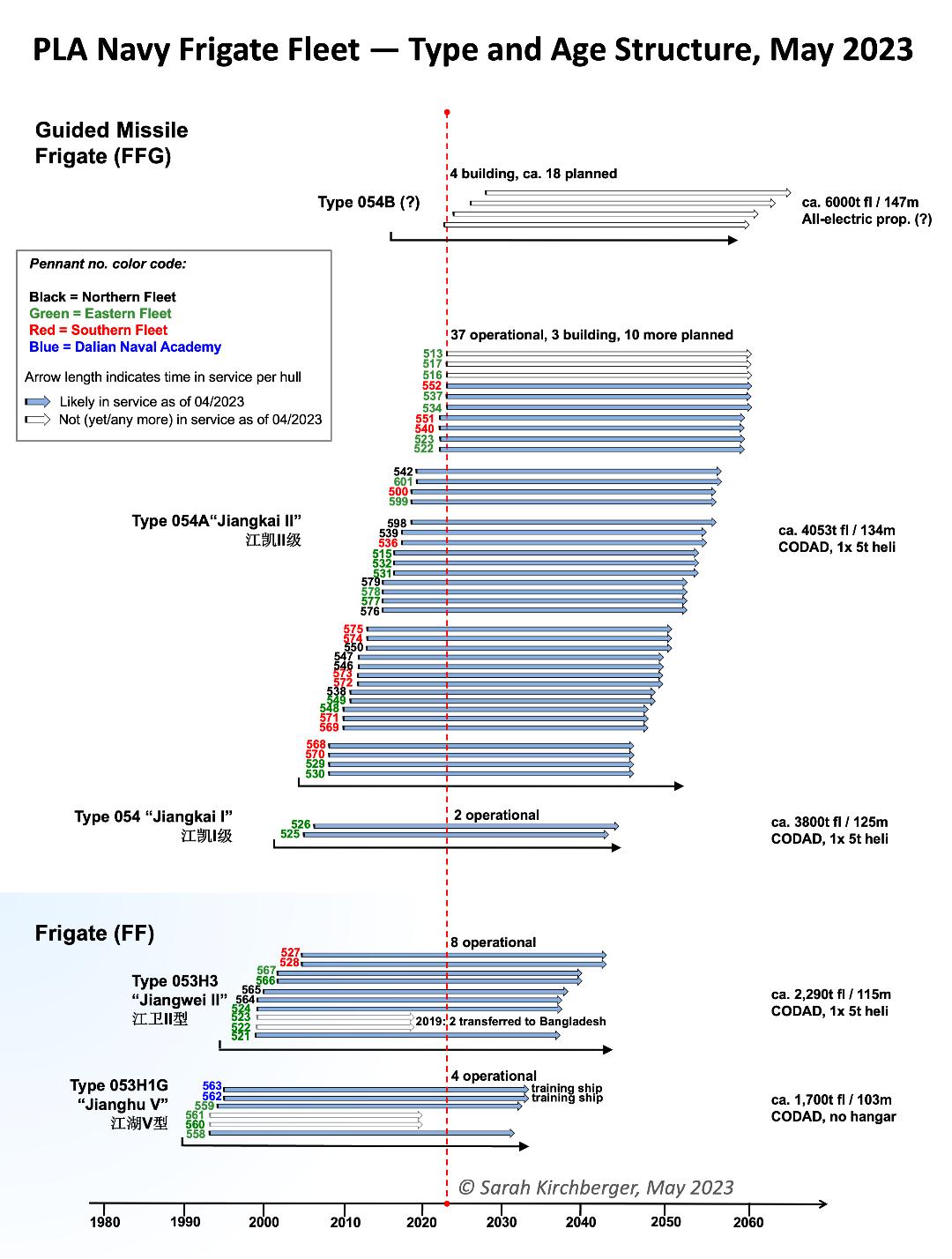
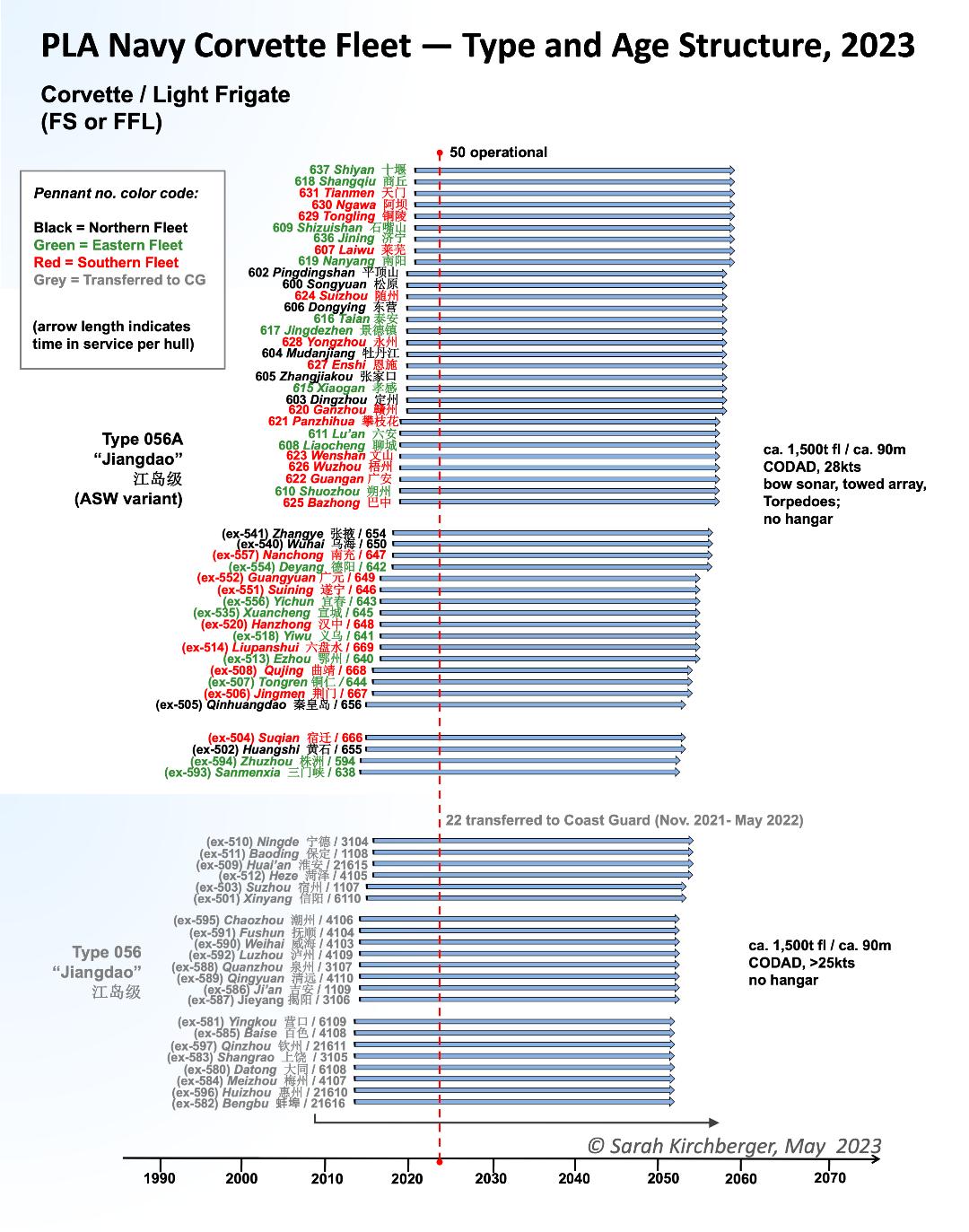
Dr. Kirchberger recently emailed me additional and updated infographics that provide a more complete picture of the People’s Liberation Army Navy’s rapid growth. I have included them all below, including updated versions of the three previously published.

Another resource available is the “Office of Naval Intelligence’s Chinese People’s Liberation Army Navy, Coast Guard, Ship Identification Guide.”

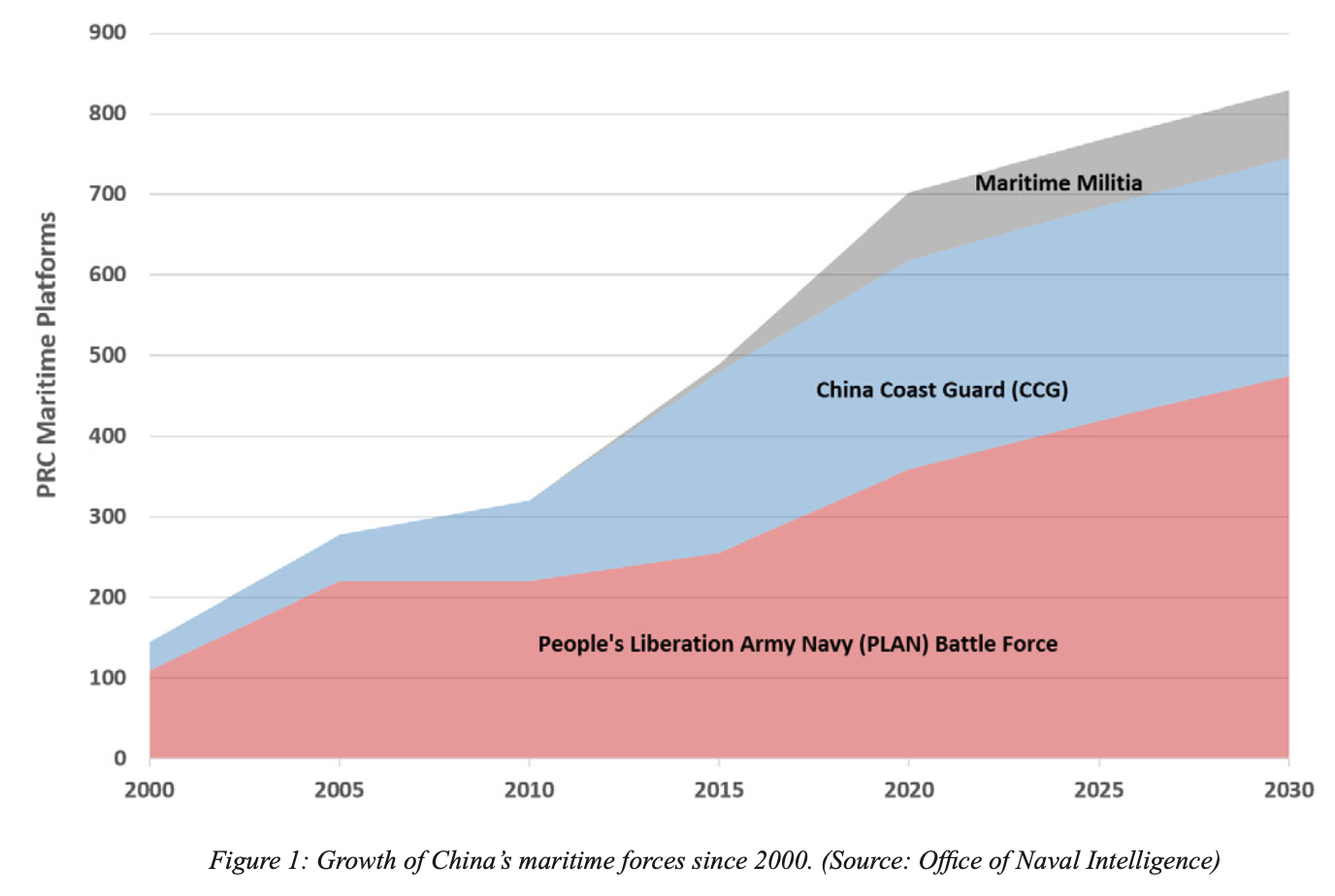
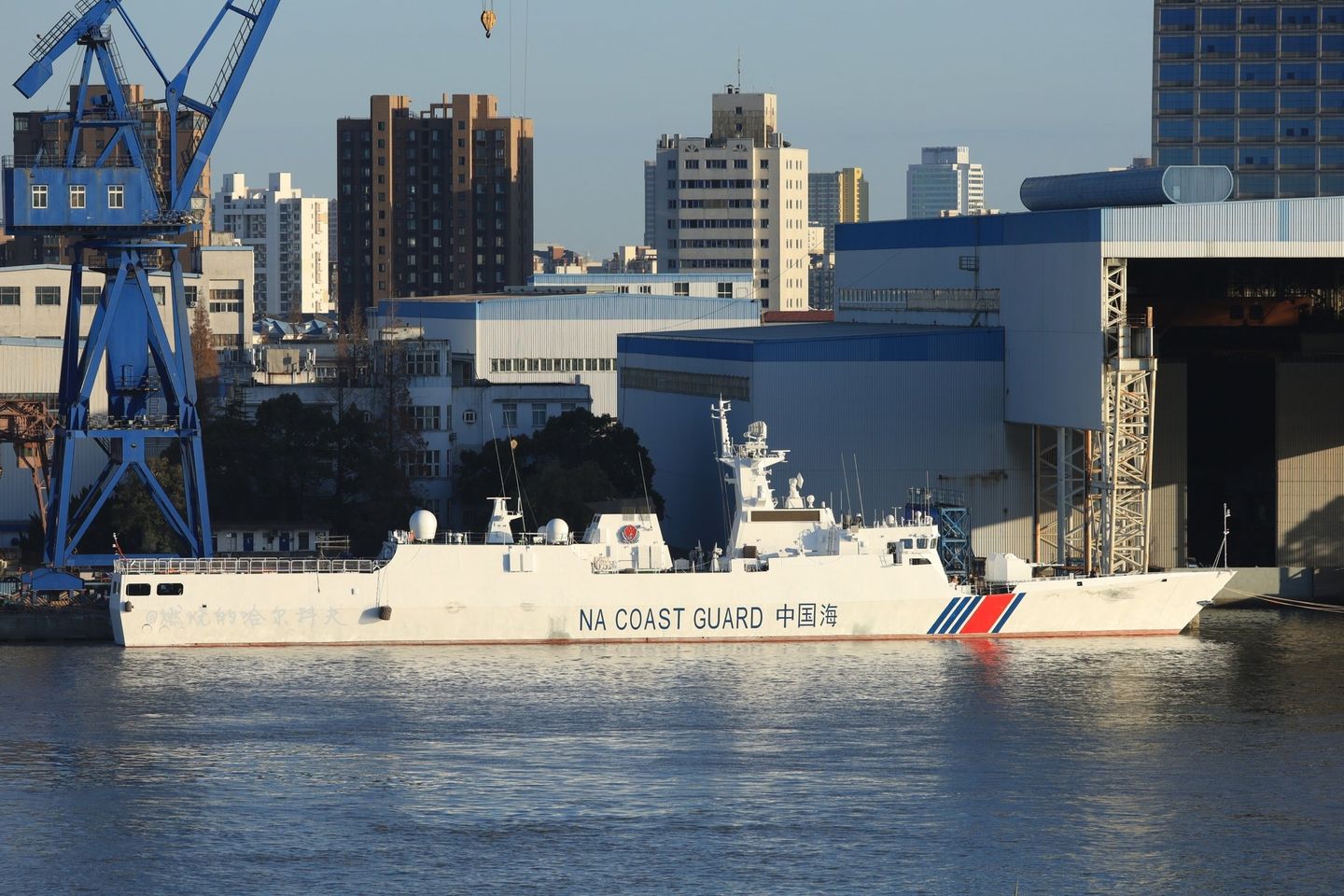
From a Coast Guard perspective, the most interesting development sighted below was the transfer of 22 Type 056 corvettes {photo above) from the Navy to the China Coast Guard. This follows the earlier transfer of four type 053H2G frigates (NATO designation Jiangwei I). In both cases heavier weapons were removed but significant gun armament remained. These added significantly to the China Coast Guard’s close in firepower. When the new China Coast Guard was formed in 2013, very few of their ships were armed with anything larger than 14.5mm machine guns.

Chinese H/PJ-17 30mm

That has changed, particularly since the China Coast Guard was absorbed into the country’s Central Military Commission (CMC), effective July 2018. The standard fit now seems to be a 76m gun and one or two 30mm H/PJ-17.

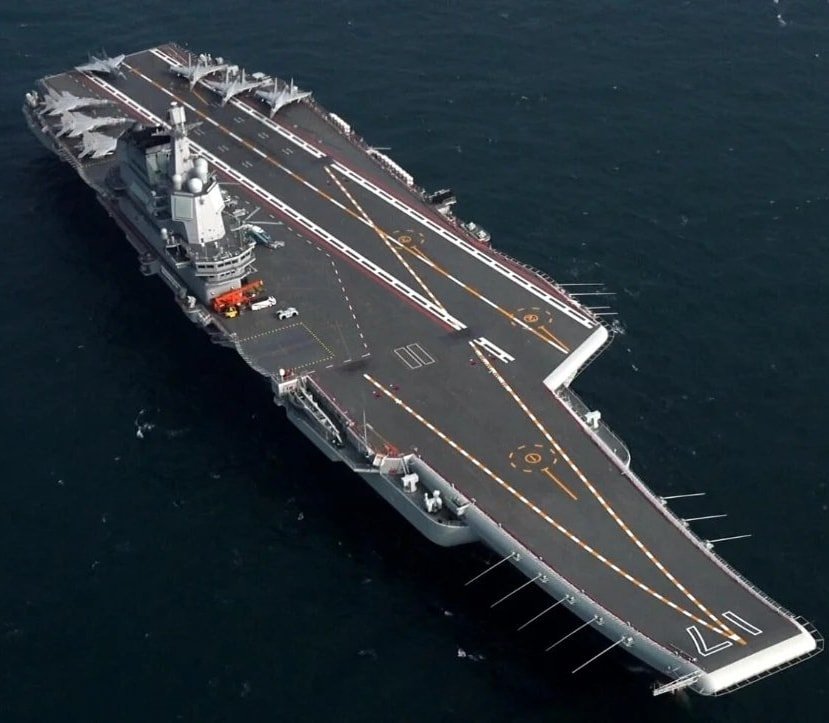
Undated photo of carrier Shandong. PLA Photo

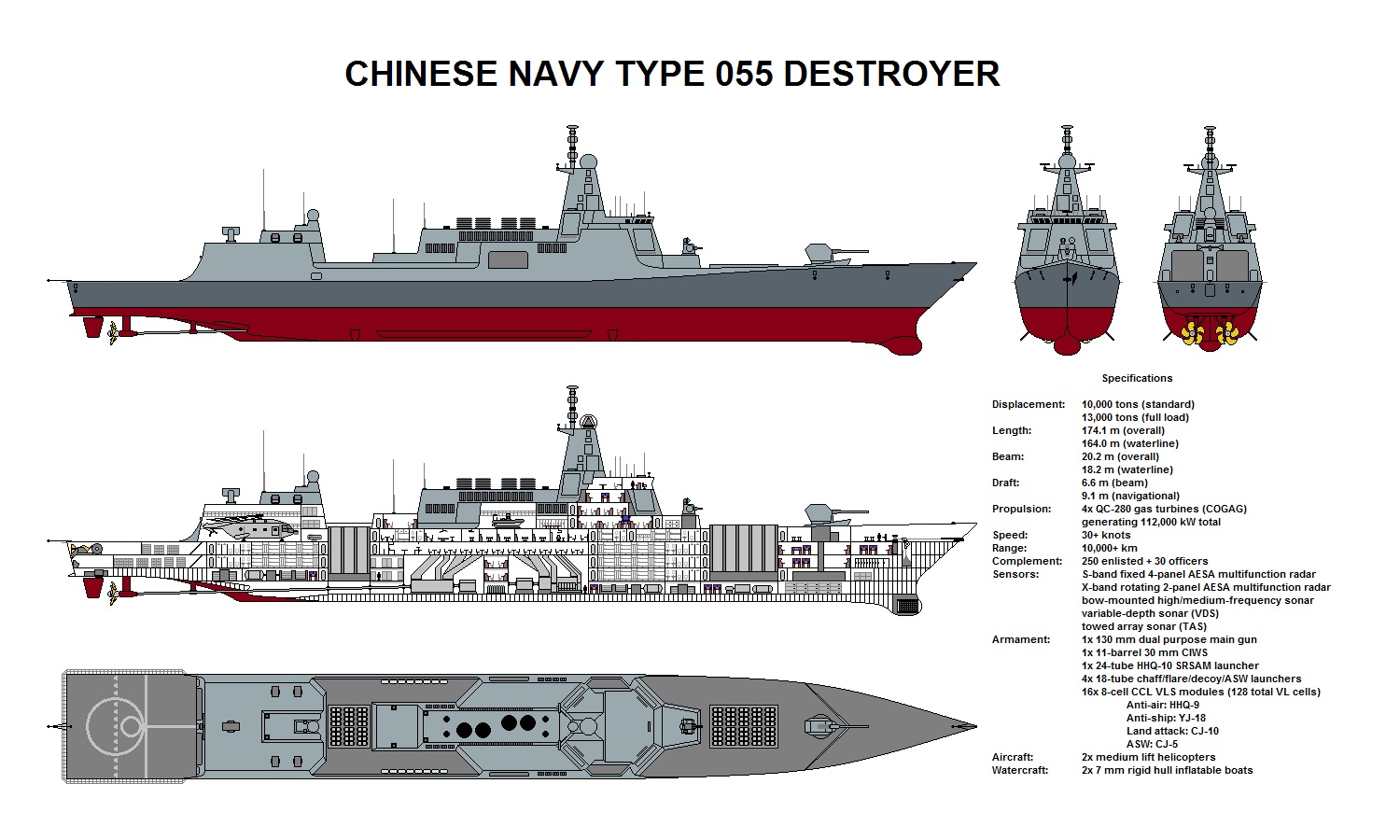
Type 055 Destroyer (Cruiser) SeaWave.com image

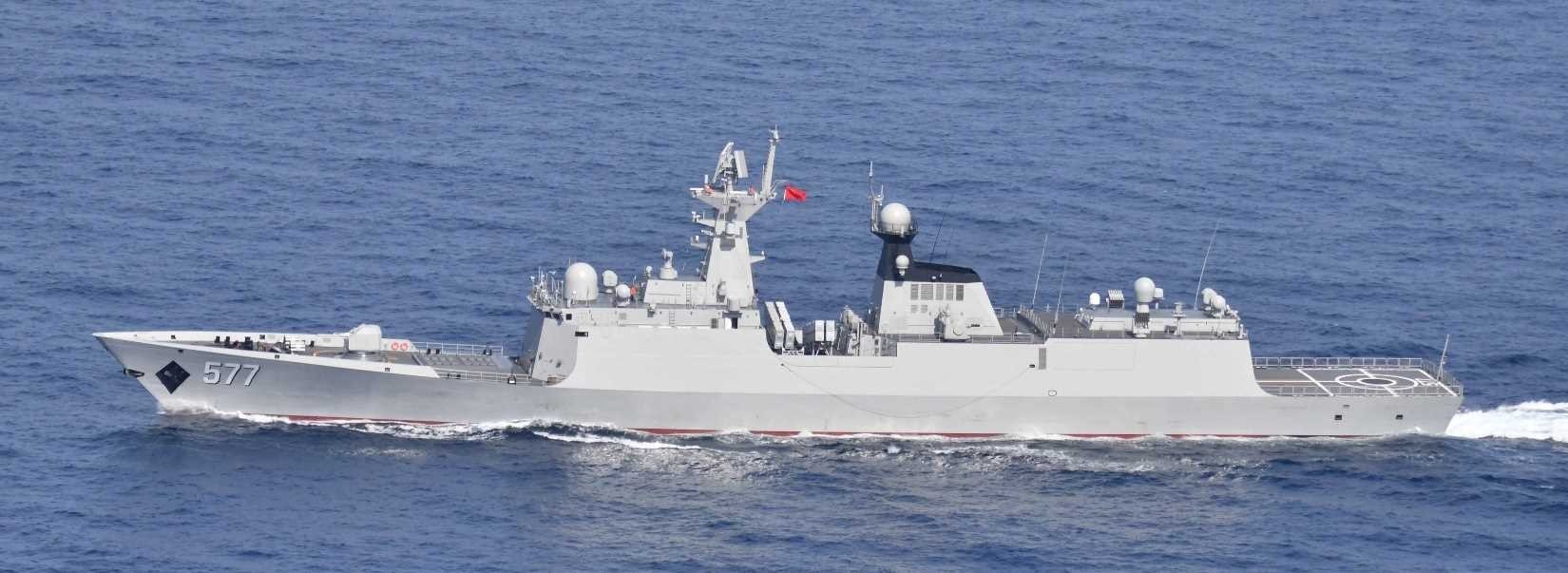
PLAN Type 054A Huanggang (FFG-577), Japanese Self Defense Force photo.

Type 056 corvette, credit 樱井千一

Image: Creative Commons.

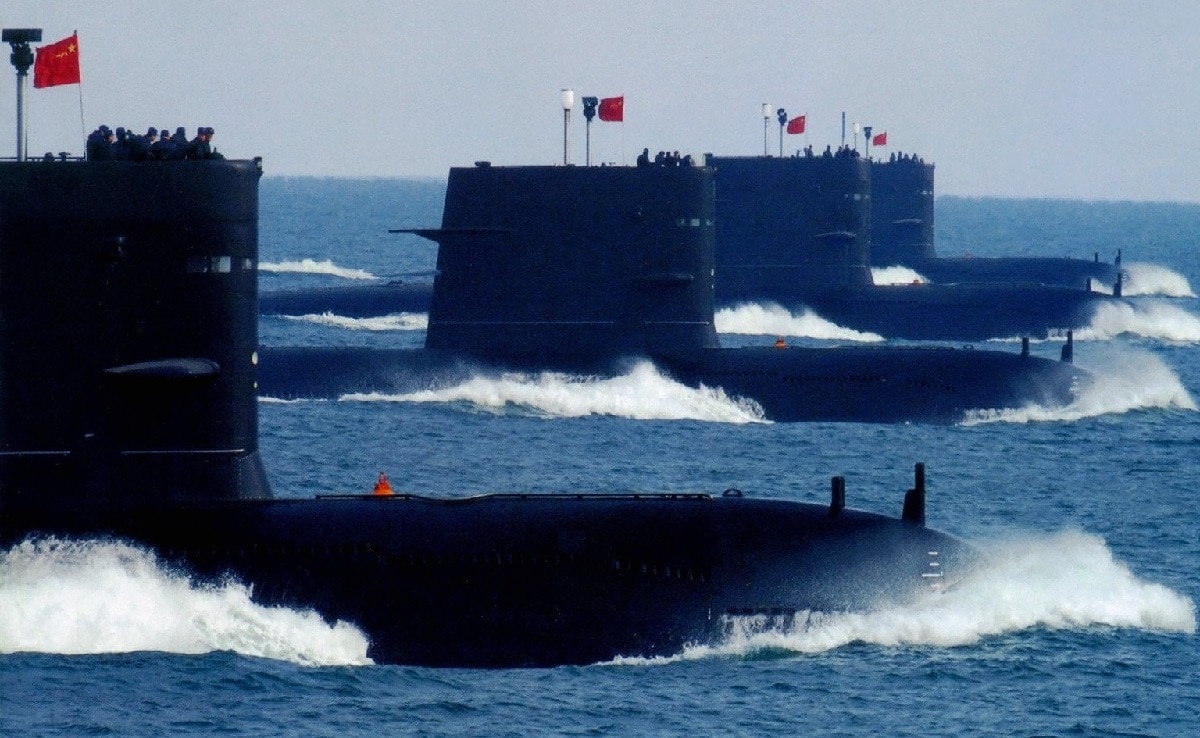
CSR Report RL33153 China Naval Modernization: Implications for U.S. Navy Capabilities—Background and Issues for Congress by Ronald O’Rourke dated February 28, 2014. Page 8 – Figure 1. Jin (Type 094) Class Ballistic Missile Submarine Source: Photograph provided to CRS by Navy Office of Legislative Affairs, December 2010.

US Sends a “Warning” to China Against Targeting the Philippine Coast Guard

CRASH AVERTED This photo taken on April 23, 2023 shows BRP Malapascua (right) maneuvering as a Chinese coast guard ship cuts its path at Second Thomas Shoal in the Spratly Islands. AFP PHOTO

A Reuters report, “U.S. issues guidelines on defending Philippines from South China Sea attack” indicates the US would consider an attack on the Philippine Coast Guard grounds for invoking the Mutual Defense Treaty between the US and the Philippines.

There was more to it than that, but certainly the recent confrontations between the Philippine CG and China CG and maritime militia must have prompted this clarification.

Perhaps less obvious, is that, apparently, it would also activate the treaty if a US Coast Guard vessel were attacked in the South China Sea.

“The guidelines said the bilateral treaty commitments would be invoked if either is attacked specifically in the South China Sea and also if coast guard vessels were the target.”

China Coast Guard in the Russian Arctic?

Chinese Coast Guard officials observed the April 25 anti-terror exercise conducted by FSB Coast Guard in the Kola Bay north of Murmansk. Photo: Murmanski Vestnik

The Barents Observer has an interesting article, “Russia’s Coast Guard cooperation with China is a big step, Arctic security expert says,” that seems to portend a China Coast Guard presence in the Arctic, perhaps shepherding their fishing vessels.

“The Russia-China memorandum signed in Murmansk opens for joint efforts to combat terrorism, illegal migration, fighting smuggling of drugs and weapons, as well as stopping illegal fishing. The deal was signed by top leaders with FSB Border Guards and the Chinese Coast Guard.”

It may be noteworthy that this meeting was not in Asia, in one of Russia’s Pacific ports. It was in Europe, in Murmansk, on the Kola Peninsula, home of the Russian Arctic Fleet.

This agreement may turn out to be a first step toward joint China and Russia exploitation of Russia’s, as yet unrecognized, extensive continental shelf claims in the Arctic extending all the way to the North Pole and beyond into areas also claimed by Canada and Denmark (from Greenland).

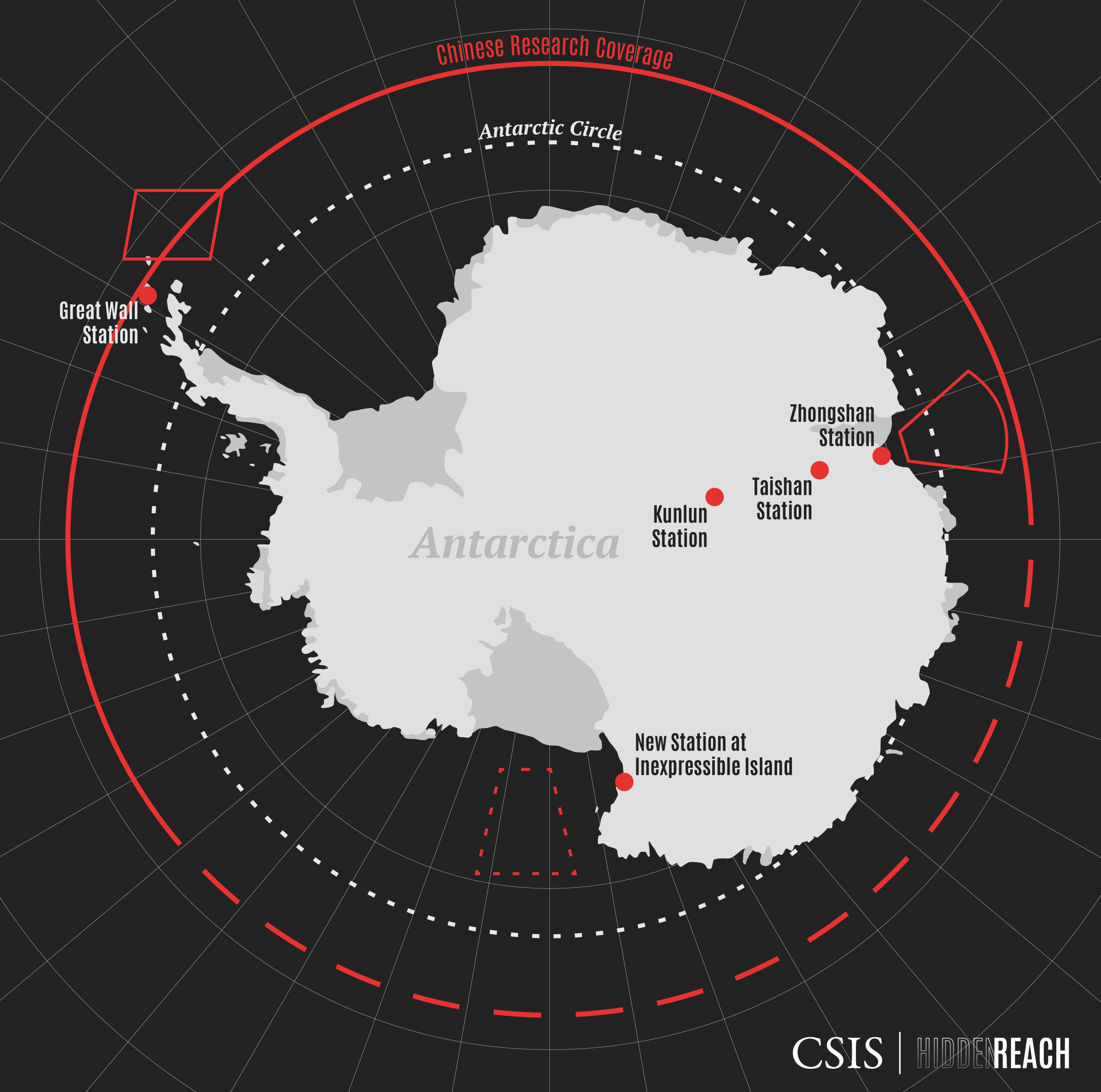
“Frozen Frontiers, China’s Great Power Ambitions in the Polar Regions” –CSIS

Adapted from a 2021 Chinese environmental evaluation report submitted to the Secretariat of the Antarctic Treaty. Source CSIS

The Center for Strategic and International Studies (CSIS) has an excellent overview of Chinese interests in the polar regions.

Chinese activities in the Arctic have gotten a lot of coverage, but their activities in Antarctic have been underreported and are, I believe, of much greater concern long term. Their coverage of China’s efforts in Antarctic is at the end of post. It is less extensive than that of China’s Arctic activities, but is perhaps the best I have seen.

China’s activities in the Arctic are just a part of their progress toward making Russia a client state. The relationship is not one of equals, it is very unbalanced, akin to Fascist Italy’s relationship to Nazi Germany. Ultimately Russia will be a victim of China’s determination to recover any territory that was once part of China. There is a lot of Asian Russia that China thinks should be theirs.

China is pouring assets into Antarctic, including potentially dual use facilities. They are setting themselves up to claim parts of the continent once the current treaty expires. This is probably going to put them in conflict with the US and some of our allies.

Chinese Navy Submarine and Major Surface Ship Order of Battle

Image: Creative Commons.

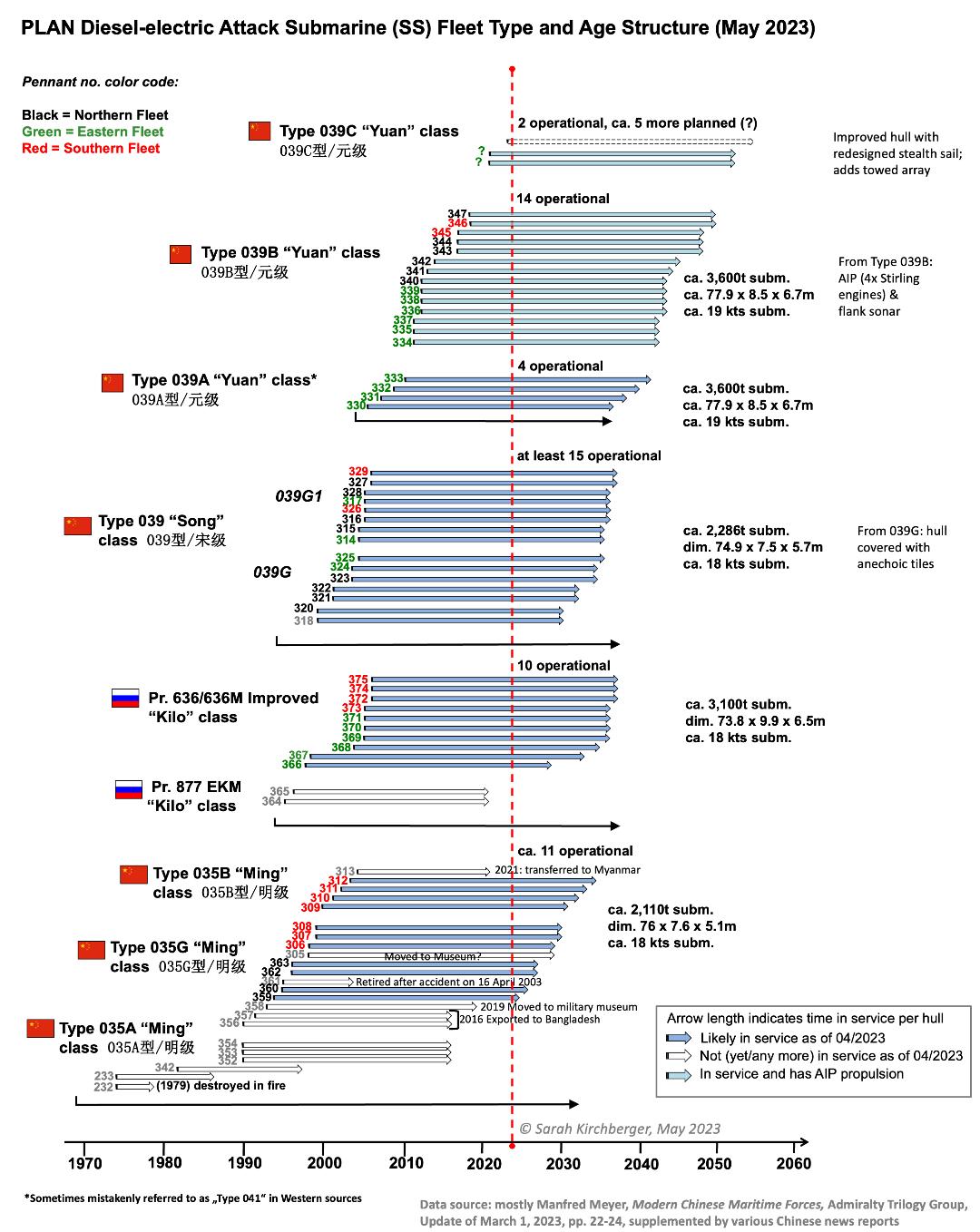
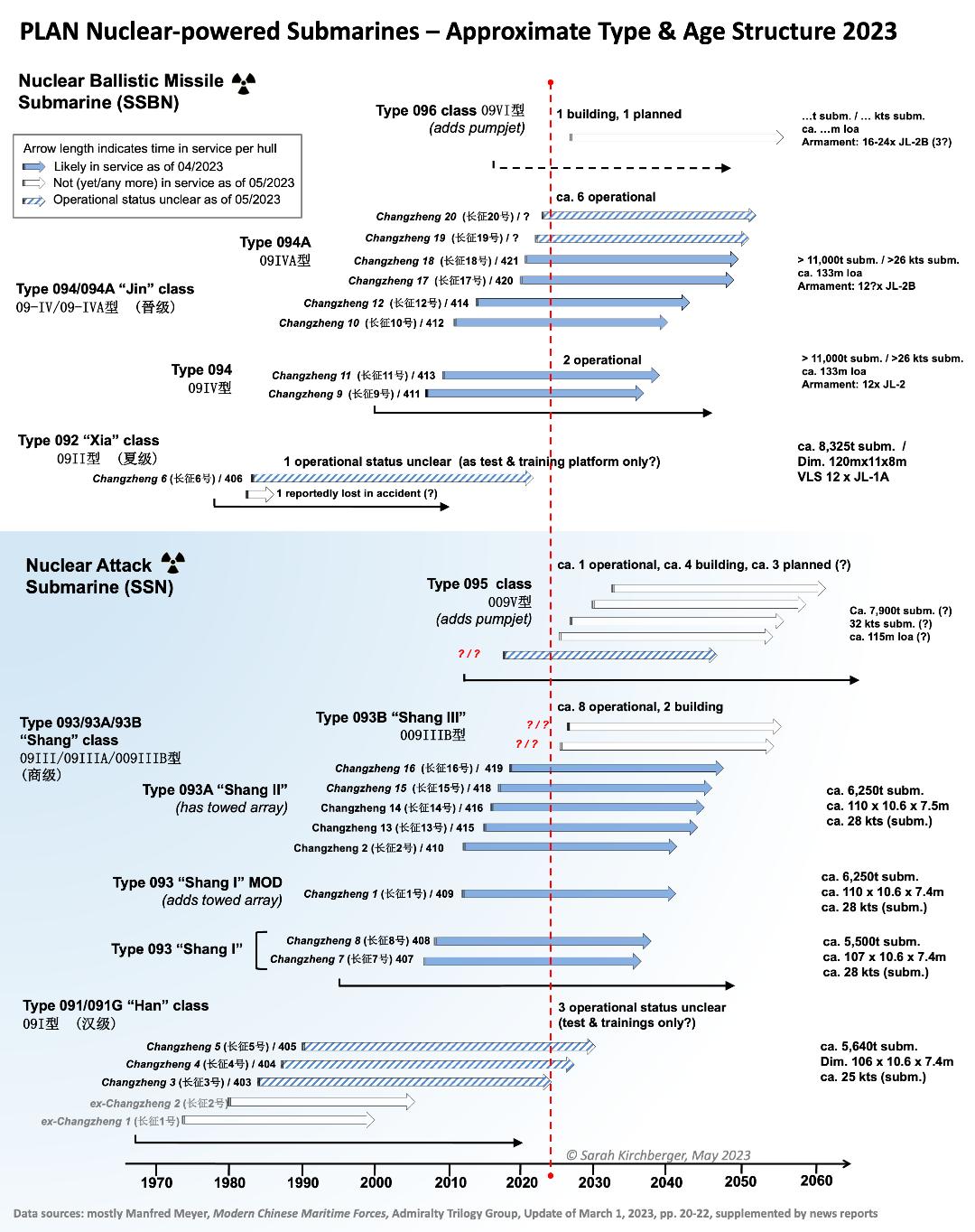
Below are some info-graphics provided by Sarah Kirchberger on the CIMSEC Internal Discussions Facebook page. I wanted to share them with you. (Not included in the listings are Chinese aircraft carriers, amphibs, and numerous frigates, corvettes, and other small combatants.) I have also provided her notes included with the three Facebook posts, but first some observations.

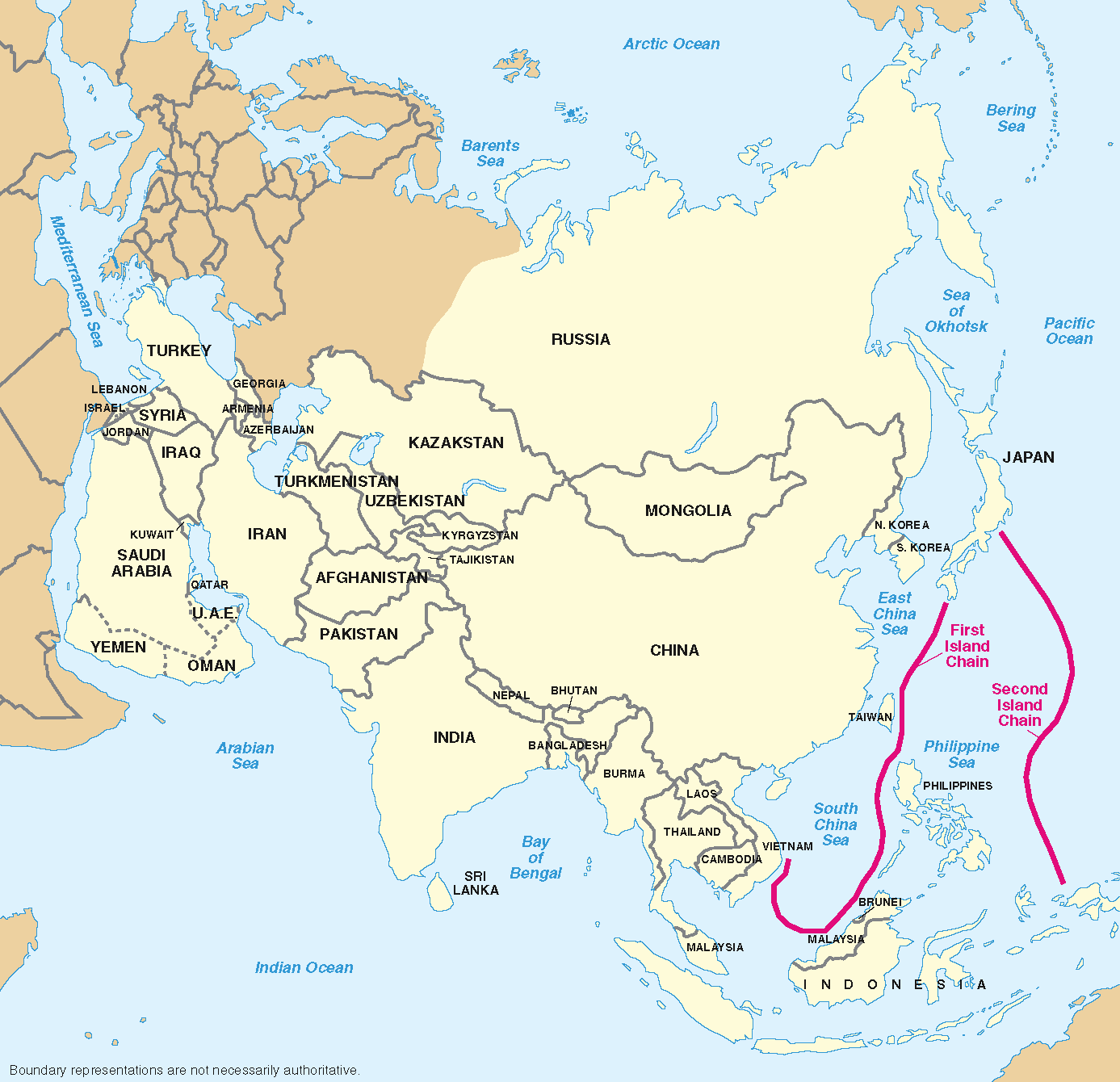
Geographic Boundaries of the First and Second Island Chains. Image:China Report 2006.pdf. DOD.

What does this have to do with the Coast Guard?

My expectation is that, if there is a major prolonged conflict with the Chinese, that the primary theater of operations will be inside and around the “First Island Chain” with Taiwan the critical center (Think Malta in the Mediterranean during WWII). The Chinese surface fleet is not likely to make significant operations outside this area. Chinese conventional submarines will also concentrate in this area but will also operate in the Straits that access the South and East China Seas.

The Chinese will make air and missile attack out to at least the “Second Island Chain,” including Guam.

The Chinese will want to attack US logistics and underway replenishment ships outside the Second Island Chain, both for the direct effect of reducing logistics available and for the secondary effect of drawing off units from the primary theater of action.

In the initial phase, the Chinese merchant and fishing fleets might be used to lay mines or even directly attack unarmed logistics and underway replenishment ships using containerized weapon systems supported by satellite targeting. (They might also launch cruise missiles into US ports as an opening salvo.) The Coast Guard Maritime Domain Awareness systems and cargo tracking programs will have a role in neutralizing the Chinese Merchant and distant fishing fleets.

The Chinese will operate at least some of their nuclear submarines (SSNs) (which would have difficulty dealing with USN SSNs) outside the Second Island Chain, perhaps as far East as the US West Coast. While MSC has been told not to expect escorts, the benefits of cutters with embarked Navy (probably Navy Reserve) ASW helicopters (and ultimately towed array systems) within effective helicopter range of a dispersed group of logistics ships to provide at least minimal ASW protection and rescue for the crews of the ships that are inevitably sunk, will quickly become evident. The cutters would hopefully be aided by Navy P-8 maritime patrol aircraft and any combatants making the transit trans-Pacific.

(None of the above reflects anything official, it is just the logic of the geography and the capability of the participants.)

Incidentally the format use below would be a good way for the Coast Guard to present its plans for major cutters.

Now to the Kirchberger posts:


After a long pause in making these info graphics, here is an overview of the *approximate* type and age structure of Chinese nuclear-powered submarines. I am decidedly less confident than with the surface fleet graphs about the accuracy of the information, which is why it took so long. Basically, I have decided to just visualize the data given in Manfred Meyer’s book ‘Modern Chinese Maritime Forces’ (March 2023 update) with some minor adjustments based on cross-checking with own research in Chinese newspaper reports. Despite the caveat, the graph might be useful to some, therefore posting it. I will periodically update as more information becomes available.

Blue arrow means boat is (most likely) in service as of April 2023, white means not yet or not any more in service, but may already be launched. Striped means: status unknown.

Feel free to use and republish (unaltered) with attribution. In case you find mistakes, I’d appreciate a note so I can make corrections during the next round!

Here is now also a visual overview of the PLA Navy’s conventionally powered submarine fleet. Blue arrow means boat is most likely in service as of April 2023, white arrow means not yet, or not any more, but may already be launched. The teal color indicates boats equipped with a (Stirling) AIP. Does not include test submarines (such as the Type 032), the unknown type sailless submarine, nor midget submarines.

Feel free to use and republish (unaltered) with attribution. In case you find mistakes, I’d appreciate a note so I can make corrections during the next round!

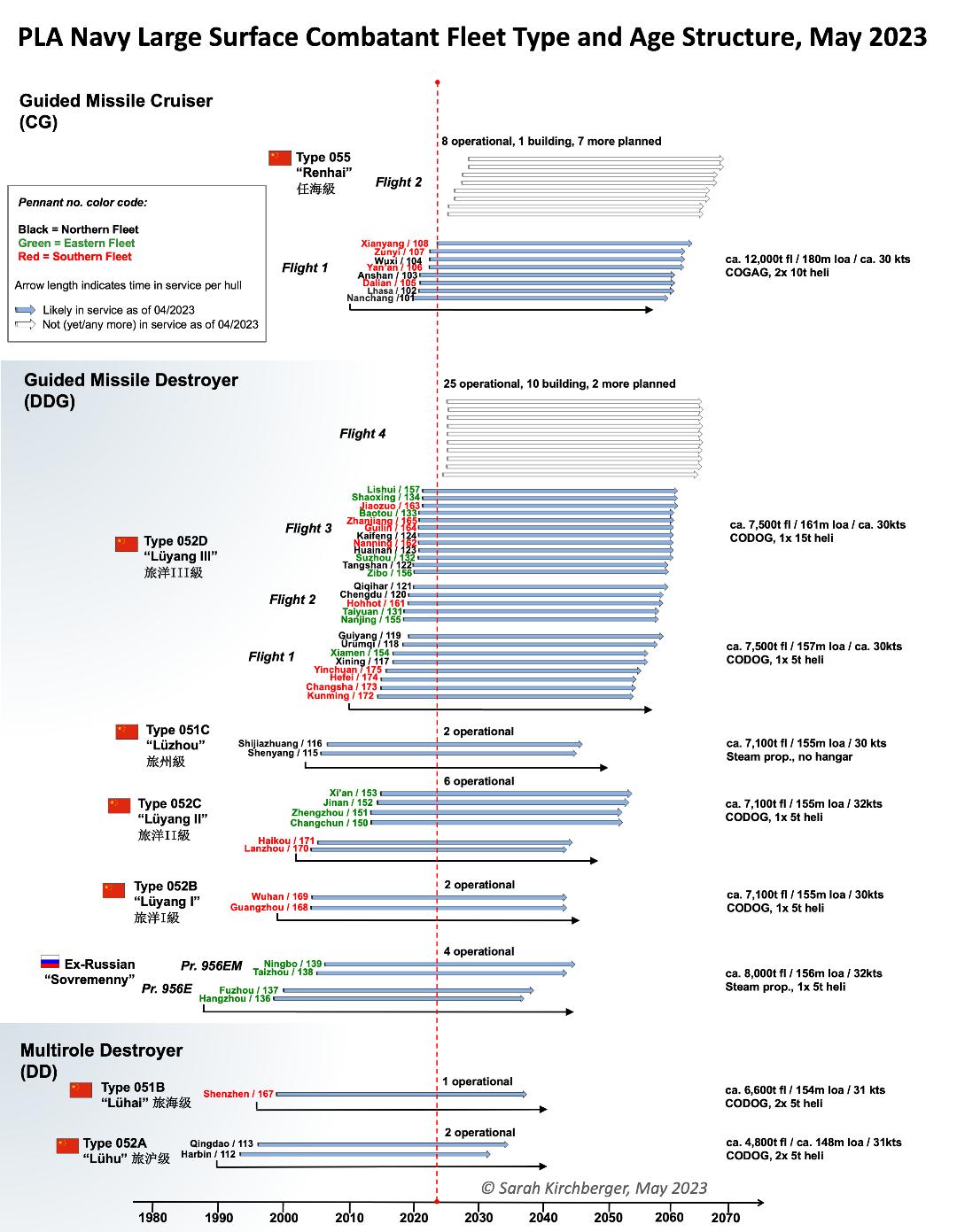
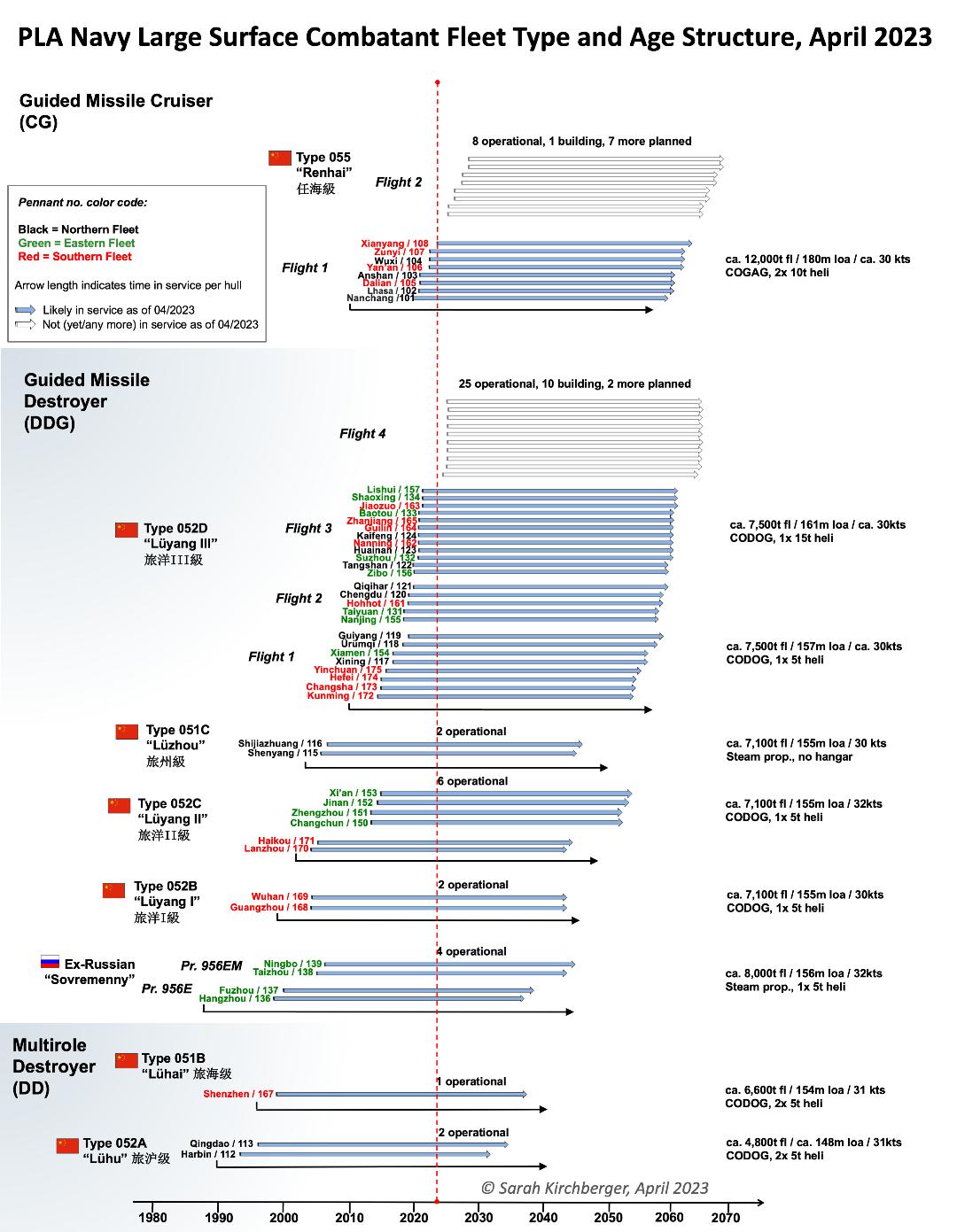
The speed of naval shipbuilding in China is such that it is easy to overlook that China has earlier this year commissioned the eighth and last of Flight 1 of its new cruiser, the Type 055 (never mind that the PLAN refers to it as a destroyer – at >12,000t full load, 180m length, and given its armament, it looks like a cruiser more than a destroyer).

Since the lead ship entered service in early 2020, China has commissioned altogether 8 of these Type 055 cruisers within a timespan of just 3 years! Further, 8 more are apparently already in the works, for a class of at least 16.
Here is an updated graphic overview of the type and age structure of China’s large surface combatants. Arrows indicate maximum time in service from commissioning until decommissioning – program start and build start is therefore not shown. 40 years per hull may be a bit long (30 years is common practice in most advanced navies), but in practice some navies have operated their surface combatants that long, so I choose to give the maximum conceivable length.
It is interesting to see how the arms embargo since 1989 initially disrupted naval shipbuilding, leading to multiple classes of just one or two hulls being built next to a Russian import, and how mass production finally took off from the Type 052D onward.
The Chinese official newspaper Global Times commented on the completion of the Type 055 class here: https://www.globaltimes.cn/page/202304/1289571.shtml
Feel free to use and reproduce this graph for non-commercial purposes (with attribution) and please let me know in case of mistakes so I can make corrections during the next iteration!