“New Trend: Transatlantic Narco Submarines” –Covert Shores

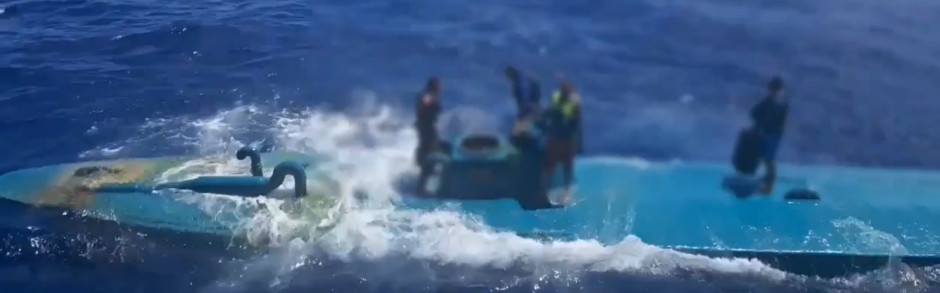
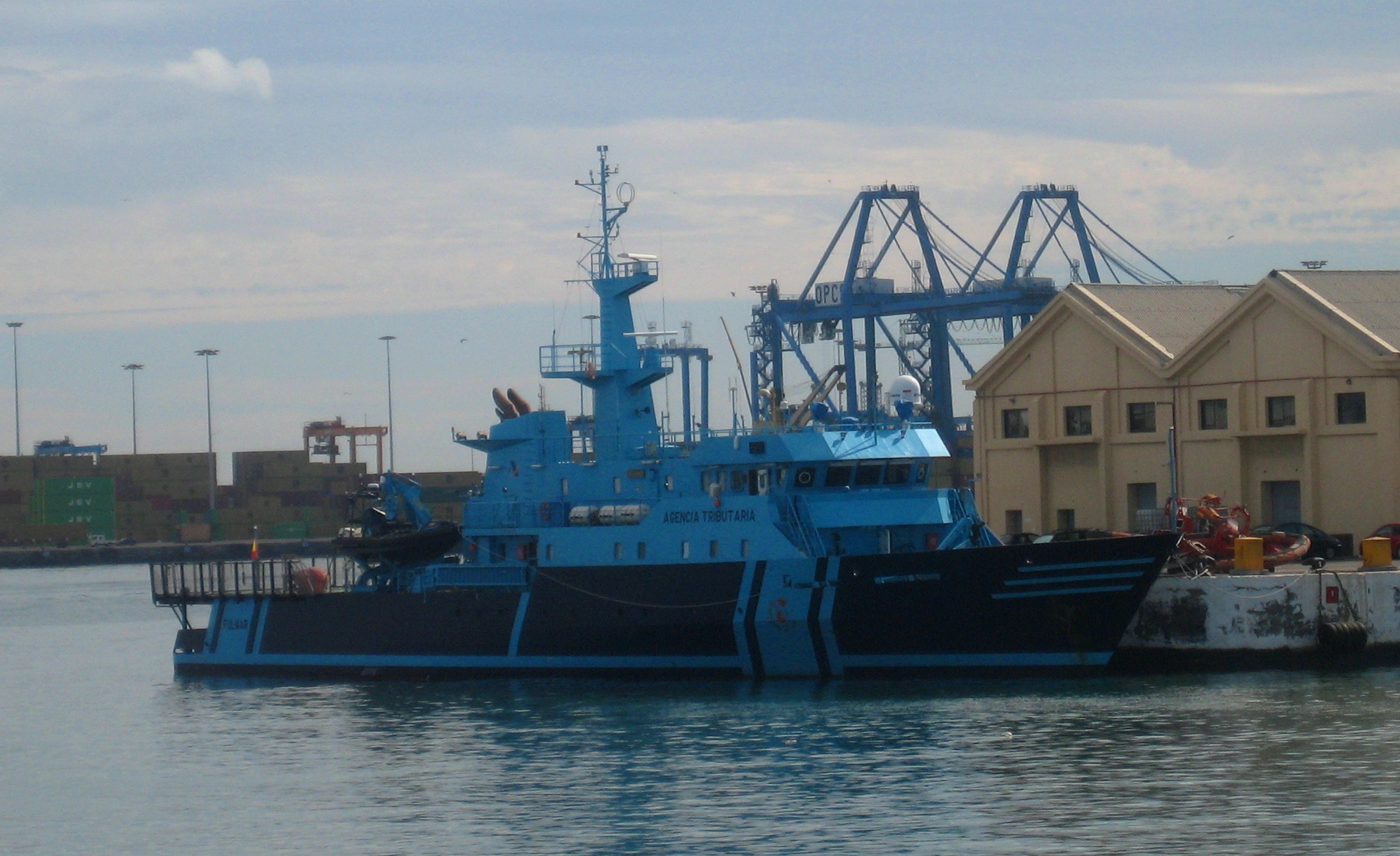
On June 26, 2024 Spanish police aboard SVA Fulmar interdicted a narco submarine 200 miles from the Canary Islands. The vessel was carrying 900kg of cocaine. The 4 crew scuttled the vessel before being rescued and arrested.–Covert Shores.

Covert Shores reports what appears to be a trend that self-propelled semi-submersibles are being used to transport cocaine directly from Latin America to Europe based on three interceptions beginning, one in March and two in June.

The use of internal diesel engines rather than outboards should not be surprising, considering they are much more fuel efficient that outboards, for the long distances involved.

Spanish Tax Agency vessel SVA Fulmar. 20 Nov. 2007. Photo credit: Outisnn via Wikipedia

“How Does Sweden and Finland Joining NATO Affect the U.S. Coast Guard?” –By Peter Ong

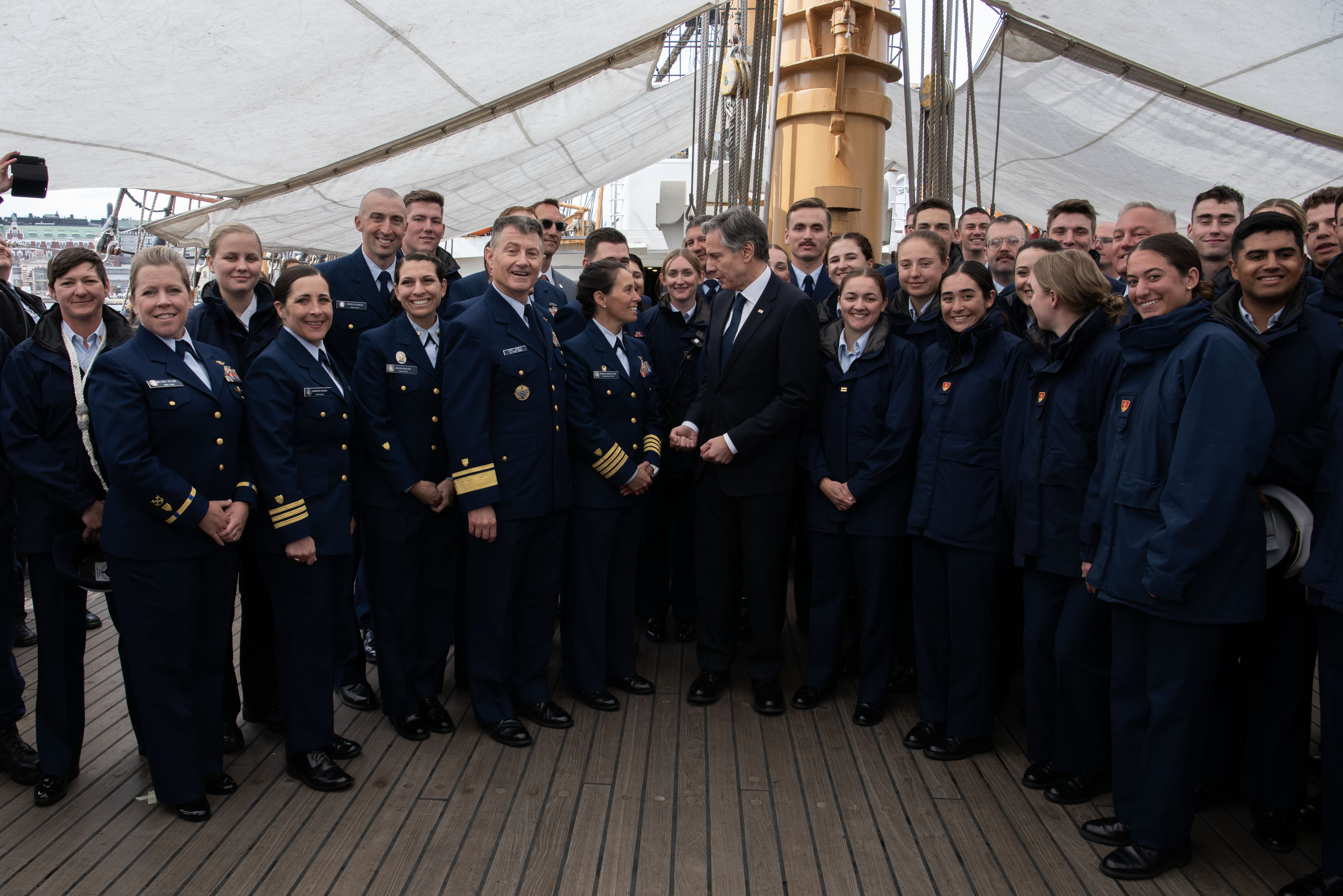
U.S. Secretary of State Antony Blinken, middle, takes a photo with the USCGC Eagle’s crew during a reception aboard the cutter, June 2, 2023, in Helsinki, Finland. Eagle is a tall ship used as a training platform for future Coast Guard Academy officers as well as a vessel utilized for establishing and maintaining domestic and international relationships. (U.S. Coast Guard photo by Petty Officer 3rd Class Carmen Caver)

Guest author Peter Ong provides a look at the continuing relationship between the Coast Guard and new NATO members Sweden and Finland. 

With the war in Ukraine affecting current economic and security situations in 2022-2024 Europe, the North Atlantic Treaty Organization (NATO) welcomed its two newest members, Finland and Sweden, both Arctic nations. Finland became a member of NATO on 4 April 2023. Sweden joined NATO on 7 March 2024.

NATO’s European members and when they joined the NATO alliance. Source: Wikipedia

I sent a media inquiry to the USCG’s Headquarters, Public Affairs Office, Washington D.C., asking how Sweden and Finland becoming NATO’s newest members might influence the U.S. Coast Guard in terms of icebreaking, cutter designs, exercises, training, enforcement, and maritime security.

The USCG replied, “From a regional perspective, this will increase cooperation and improve interoperability.  Information sharing, exercises, and operations will be much easier to coordinate with all the Nordics now in NATO.”


U.S. Coast Guard Petty Officer 1st Class Arthur Flaherty, a boatswain’s mate assigned to the USCGC Hamilton (WMSL 753), prepares to transfer Hamilton crewmembers onto the Swedish Coast Guard vessel Amfitrite in the Baltic Sea, Oct. 31, 2022. Hamilton was on deployment in the U.S. Naval Forces Europe area of operations. (U.S. Coast Guard photo by Petty Officer 3rd Class Alejandro Rivera)

The United States Coast Guard has a history of visiting and working with partner Baltic nations to improve relationships, training, interoperability, communications, intelligence, and coordination. Even before they entered NATO the US Coast Guard had a long-standing relationship with Sweden and Finland through the Arctic Coast Guard Forum.

U.S. Coast Guard Lt. Cmdr. Tanya Kuprak, engineering officer aboard USCGC Hamilton (WMSL 753), gives a tour of the engine room to Swedish Coast Guard members while underway in the Baltic Sea, Oct. 30, 2022. Hamilton was deployed with U.S. Naval Forces Europe and U.S. Sixth Fleet. (U.S. Coast Guard photo by Petty Officer 3rd Class Alejandro Rivera)

Recent interactions include:

United States’ relationship with Finland has benefitted in the area of model testing and consulting on the current Great Lakes icebreaker, Mackinaw, regarding its design and Azipod propulsion.

” Unlawful Boarding Of The Merchant Vessel St. Nikolas In The Gulf Of Oman” –Naval News

Picture from Atlantique 2 MPA showing tanker St. Nikolas escorted by Iranian Navy patrol vessel. EMASOH picture.

Naval News reports,

Yesterday, on the 11th of January, the merchant vessel St. Nikolas was boarded by armed personnel southeast of the Strait of Hormuz, off the coast of Oman. The boarders were reported to be wearing military style black uniforms with black masks. The Company Security Officer (CSO) of the shipping company also reported that the vessel had altered course towards Iranian territorial waters and communications had been lost. Acting on initial external information, EMASoH sent out a French maritime patrol aircraft Atlantique 2 that rapidly located the ship, which was escorted by two Iranian Navy patrol vessels. The Atlantique 2 continued to monitor the ship’s movement until she entered Iranian territorial waters. She is now at anchor near Bandar Abbas.”

Have to say, my first reaction was, who or what is EMASoH? Wikipedia has the answer, European Maritime Awareness in the Strait of Hormuz. EMASoH is a,

 “…French-led maritime monitoring mission with the goal to protect maritime flows through the Strait of Hormuz. It is headquartered at the French naval base in Abu Dhabi and comprises a diplomacy track (EMASoH) and a military track (AGENOR).[1] The mission has 9 participating countries including Belgium, Denmark, France, Greece, Italy, the Netherlands, Norway, and, with political support, Germany and Portugal. These are all European countries, however EMASOH is not initiated by the European Union.”

The situation there is confusing. I have a hard time keeping up with the players. Looks like the Europeans are about to create their own naval defensive coalition to defend shipping in the Red Sea. Wonder if it will be under AGENOR?

“Arctic Security: Patrolling NATO’s High North” –YouTube

Thought I would share this video. Found it on a SeaWaves post, Patrolling Greenland on Denmark’s HDMS Triton. HMDS Triton a Thetis class patrol frigate. These ships do Coast Guard type work in or near the Arctic. It is a type of ship that you will not find in the Coast Guard fleet, but one that we may want to add in the future. It is ice strengthened. As a ship that operates in an area where icing is common. its ground tackle (anchor handling equipment) is below the foc’sle deck, and its boats and boat handling gear can be enclosed. The crew is relatively small (I think they are double crewed to get more underway time), but additional berthing is available, and weapons can be added using the Stanflex system.

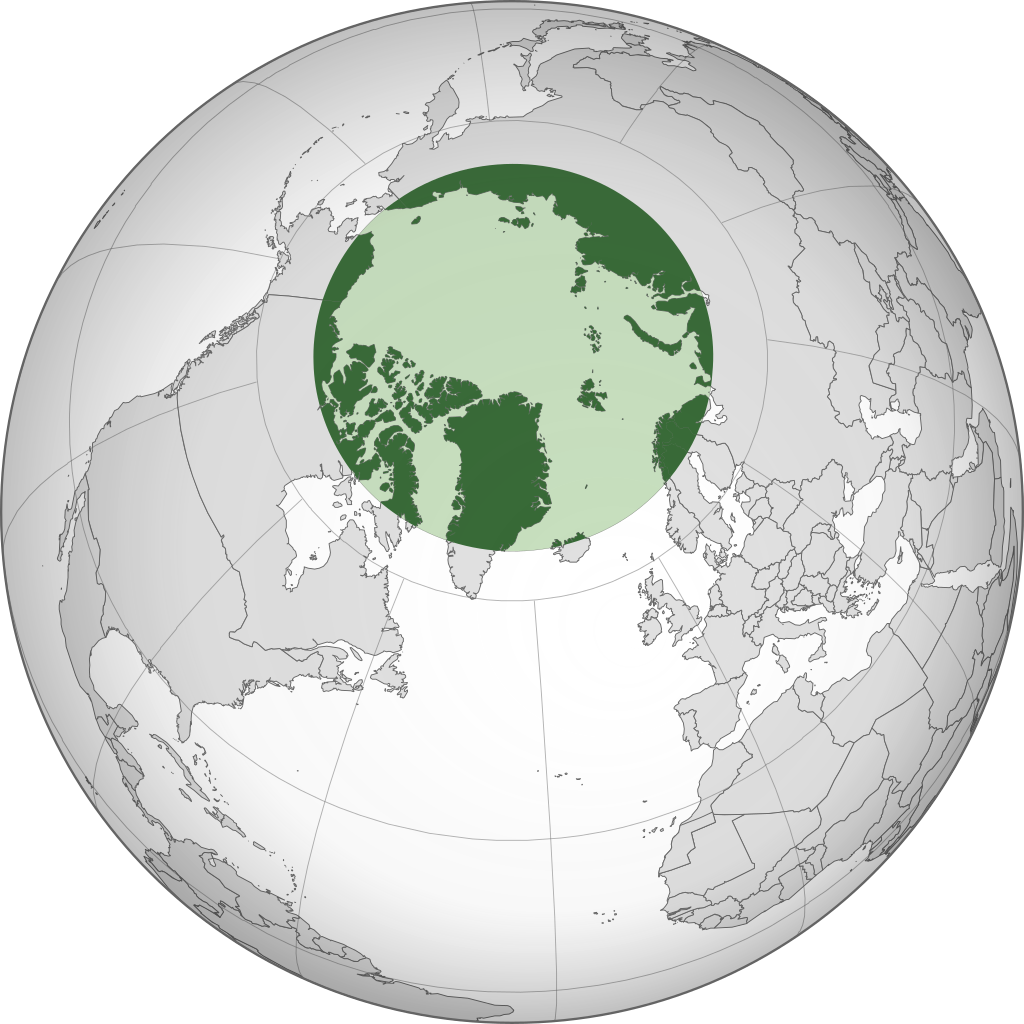
Arctic (orthographic projection) with national borders and land highlighted. Credit Heraldry, Isochrone, via Wikipedia, 23 July 2023.

The Thetis class ships are now over 30 years old. They are to be replaced by a new class, currently referred to as MPV-80 (multi-purpose vessel, 80 meter).

OMT MPV-80 technical specifications

Below is the narrative that accompanied the YouTube video.


The Arctic region is the gateway to the North Atlantic. For NATO and its Allies, maintaining a strong presence here is vital to protect trade, transport and communication links between North America and Europe.

As climate change causes the polar ice caps to melt and the sea levels to rise, new sea routes are beginning to emerge, which could present a threat to Euro-Atlantic security. Greenland is considered by scientists to be ground zero for climate change. Along with the Faroe Islands, it forms part of the Kingdom of Denmark and is therefore under Danish military protection. That protection falls to the Joint Arctic Command, or JACO, a Danish-led operational command with a central headquarters in Nuuk, Greenland’s capital.

Join the Danish Armed Forces in Greenland, at sea, in the air and on land, to discover more about how security might be affected in this region and learn about the capabilities and experience NATO Ally Denmark has in the North Atlantic area.

“Analysis: Royal Navy deploys seven ships on underwater infrastructure patrols” –Navy Lookout

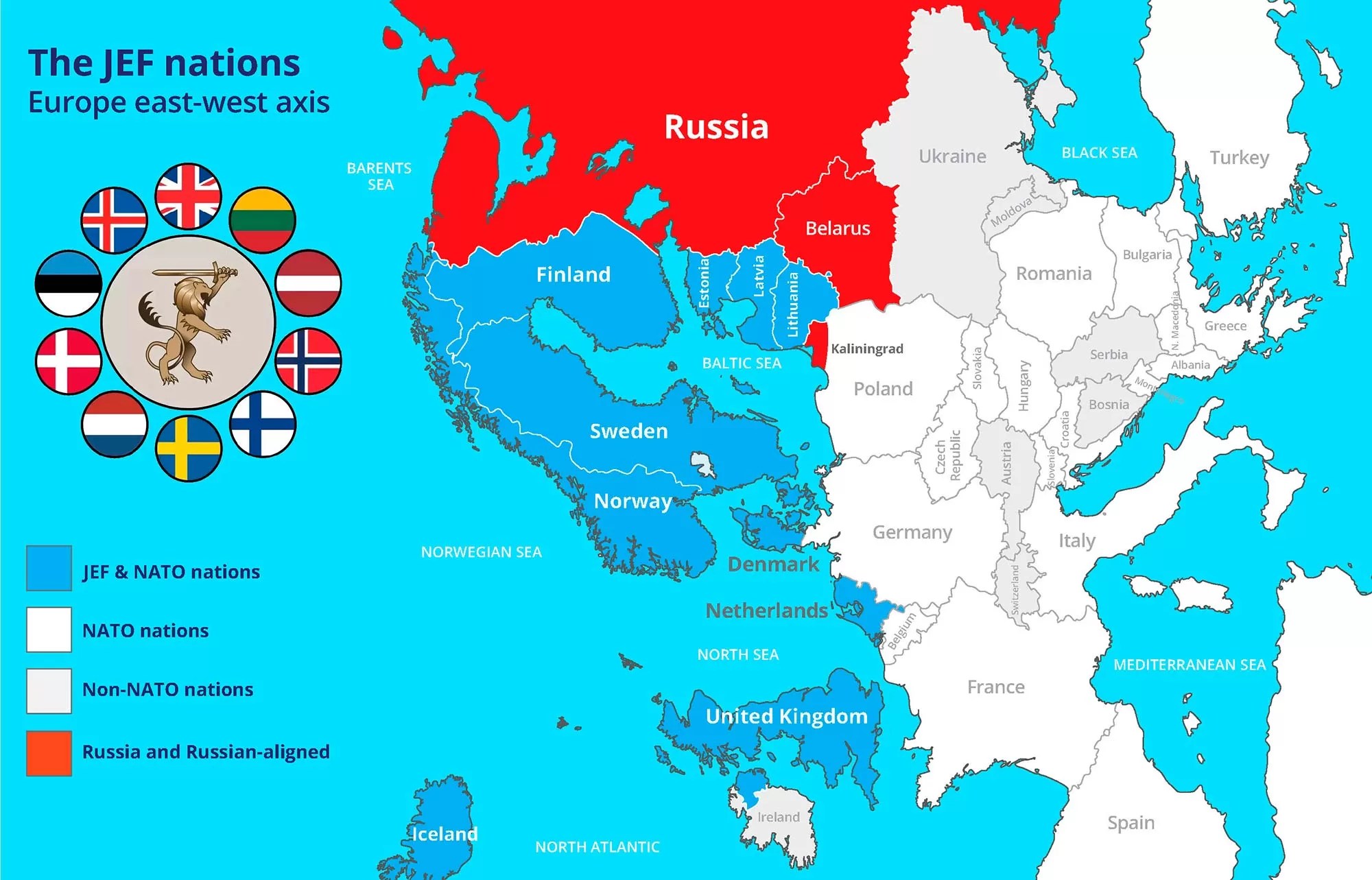
Joint Expeditionary Force nations.

Ever since the Nord Stream pipelines were damaged, in September 2022, there has been a lot of talk about the need to protect Critical Undersea Infrastructure (UCI) including concern about the possibility of damaging or surreptitiously tapping into undersea cables.

Some US agency is likely to get this job. Frankly I don’t see this as a job for the Coast Guard since we have very little underwater surveillance capability, but I may be wrong. The Coast Guard would probably at least be asked to report suspicious activity that might be recognized by Maritime Domain Awareness systems and if there is damage to a pipeline, the Coast Guard would certainly be called in to deal with the pollution.

Still, it may be interesting to see what the Europeans are doing. Navy Lookout reports,

“On 28th November Defence Ministers from the Joint Expeditionary (JEF) nations agreed to activate a ‘Response Option’. This will take the form of a Royal Navy-led effort to bolster the security of undersea infrastructure and deter hybrid threats. Since the destruction of the NordStream pipeline in September 2022 and the attack on the Baltic Connector pipeline in October 2023, there has been increasing concern about underwater Russian activity. The Defence Secretary described this as “This historic and unprecedented agreement”. It has certainly been a long time since the UK conducted multi-lateral military activity in the European area that was not done under the auspices of NATO.”

Interestingly, the effort will include two Royal Navy River class Batch One Offshore Patrol Vessels, HMS Severn and HMS Tyne, that are the British equivalent of US Coast Guard Medium Endurance Cutters, except that they do not include flight decks. There was no mention of whether they might be equipped with Unmanned Undersea Vehicles.

Thanks to Lee for bringing this to my attention. 

“France’s DGA Orders 7 New OPV For The French Navy” –Naval News

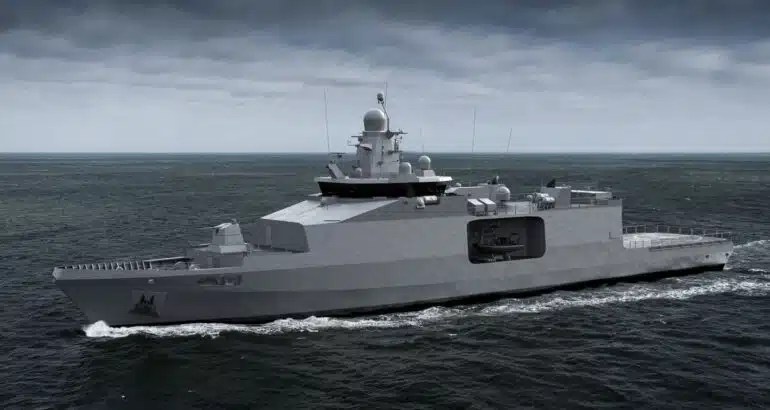
Artist impression of the Patrouilleur Hauturier OPV underway. Naval Group image.

Naval News reports,

The French defense procurement agency (DGA) ordered on 17 November 2023 seven new offshore patrol vessels (OPV) as part of the “Patrouilleurs Hauturiers” program for the French Navy (Marine Nationale).

These “second rank” ships will have missions similar to USCG cutters. We heard about the requirement for these ships and the vessels they would replace three years ago. At that time ten ships were expected. Since then, the requirement was reduced to six and now seven. France has been building several different classes of large patrol vessels (here, here, and here).

This new class of Patrouilleurs Hauturiers (offshore patrol vessels) are expected to displace 2400 tons full load, have a range of 6,000 miles, and have accommodations for up to 84 personnel (passengers and crew). They are expected to mount the new 40mm gun.

“Orizzonte Sistemi Navali Signs Contract For New Italian Navy OPVs” –Naval News

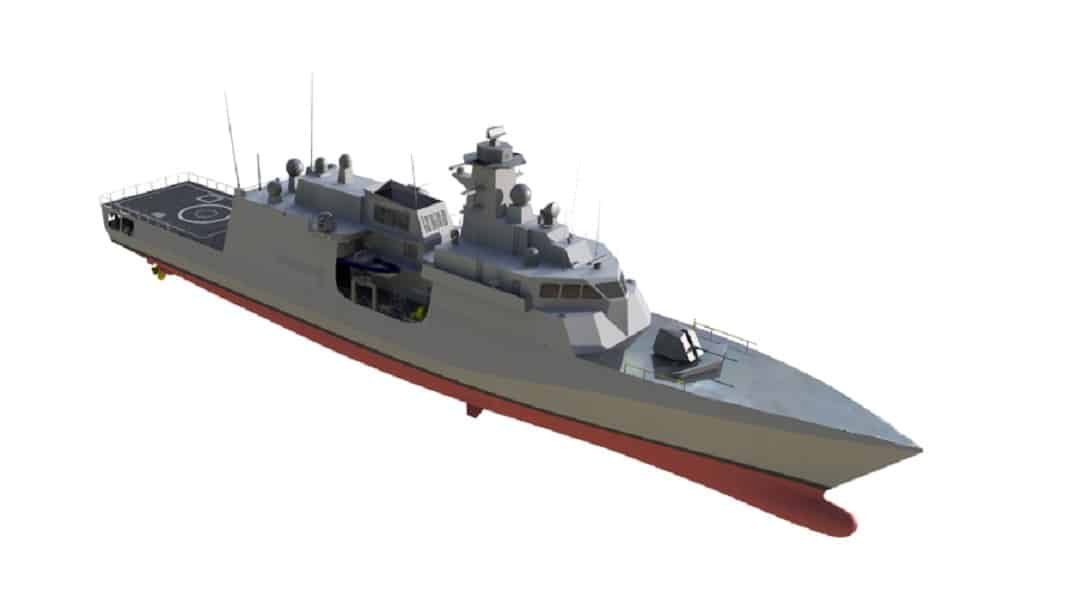
Drawing of the OPV by Fincantieri

Naval News reports,

As part of the Italian Navy OPV (Offshore Patrol Vessel) acquisition programme Orizzonte Sistemi Navali (OSN), the joint venture between Fincantieri and Leonardo… has signed a contract with the Italian Secretariat General of Defence and National Armaments Directorate for the construction of three next generation patrol vessels, with the options for a further three units and infrastructural upgrades required for the naval bases in Augusta, Cagliari and Messina, where the vessels will be based.

Fincantieri is the parent company of the Marinette based shipyard that has been building Freedom class LCS and will be building the US Navy’s new frigates. That shipyard also built USCGC Mackinaw, the 16 Juniper class WLBs, and the 14 Keeper class WLMs.

I am a little surprised by this. It had been reported that the six ships of the Sirio class and Cassiopea class would be replaced by 3,000 ton units of the European Patrol Corvette (EPC) program. This “PPX” program would be the third Italian Navy “patrol” vessel class being built concurrently along with the EPC and the Thaon di Revel class (also known as PPA for ‘Pattugliatore Polivalente d’Altura – Multipurpose Offshore Patrol Vessel’).

The description looks like a pretty typical modern, medium size OPV with an approximate length of 312′ (95 meters), a displacement of 2,300 tons and accommodations for 97. It appears the probable armament is a 76mm gun and a pair of 20 to 30mm mounts (probably the new Lionfish 30mm). That is a size the US Coast Guard might consider for operating in Atlantic Area, if we wanted to increase the total number of larger patrol cutters above the 36 currently planned.

No information was provided about the speed or range. Italian Navy ships tend to have relatively short range because they are designed to operate in the Mediterranean. I would guess range will be about 4,000 miles at about 14 knots. Speed will probably be about 24 knots.

“Greece Receives First Island Class Patrol Vessels From The U.S.” –Naval News

(Since today is the 4th of July) As part of 5th Fleet’s PATFORSWA, crewmembers aboard the U.S. Coast Guard cutter USCGC Adak (WPB-1333) raised the American flag.  U.S. Coast Guard photo by Seaman Frank Iannazzo-Simmons

Naval News reports that four of the six PATFORSWA 110 foot Island Class WPBs are being transferred to the Greek Navy, and it goes on to speculate they may ultimately get all six.

“The four Island-class boats that will join soon the Greek naval fleet are the former Wrangell (WPB-1332), Adak (WPB-1333), Monomoy (WPB-1326) and Aquidneck (WPB-1309).”

The boats are to be refurbished and are expected to be equipped with a 20mm remote weapon station (RWS), the LIONFISH 20 by Leonardo, new “surveillance radar, electro-optical sensor (Naval News verified that it will be a Miltech Hellas product), communications equipment and machine guns will be installed as well.”

The post notes that former US Coast Guard Island class cutters now also serve with Pakistan (Pakistan Maritime Security Agency), Georgia (Georgian Coast Guard), Costa Rica (Costa Rican Coast Guard), and Ukraine (Ukrainian Navy) in addition to the Greek Navy.

Additional transfers can be expected in the future.

“US Coast Guard Legend class Hamilton visits Latvia amid tensions with Russia” –NavyRecognition

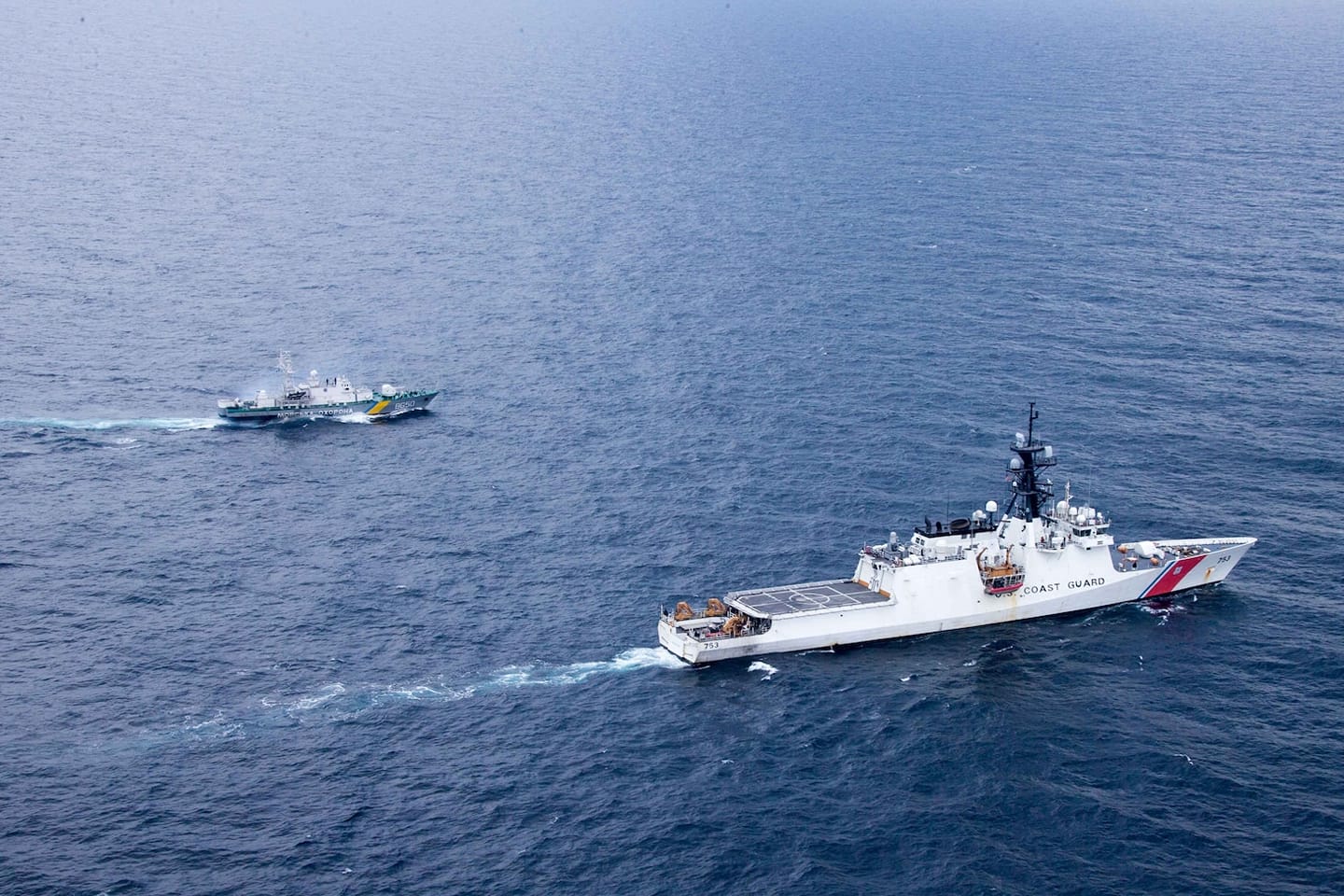
USCGC Hamilton and Ukraine CG on previous voyage.

Navy Recognition reports,

“According to information published by the US DoD on November 17, 2022, the Legend-class national security cutter (NSC) USCGC Hamilton (WMSL 753) arrived in Riga, Latvia for a port visit…Prior to arriving in Riga, Hamilton conducted multiple operations with allies and partners in the Baltic Sea, including a series of at-sea engagements with Swedish, Finnish, Estonian, and Lithuanian maritime and naval forces.”

“USCGC Mohawk (WMEC 913) arrives in Lisbon, Portugal”–Navy.mil–and Two More FRCs for PATFORSWA

USCGC John Scheuerman (WPC-1146) and USCGC Clarence Sutphin Jr. (WPC-1147) enroute PATFORSWA

Below is a Navy news release reporting the arrival of USCGC Mohawk in Lisbon. Somewhat surprisingly there is no mention of the two Webber class cutters pictured in an attached photo (above) and no photo of Mohawk.

Looking closely at the photo above, you can see they have the Counter Drone upgrades seen on other FRCs that have been assigned to PATFORSWA.

Obviously this is the last pair of Fast Response Cutters (FRCs) being transferred to Patrol Forces SW Asia (PATFORSWA). They were escorted across the Atlantic by Mohawk. Can’t believe I did not see the gorgeous photo below earlier. Perfect for 4th of July.

The USCGC Mohawk (WMEC 913), USCGC John Scheuerman (WPC 1146), and USCGC Clarence Sutphin Jr. (WPC 1147) sail in formation in the Atlantic Ocean, June 22, 2022. The John Scheuerman and the Clarence Sutphin Jr. are the 46th and 47th Sentinel-class fast response cutters, respectively. They will become the fifth and sixth FRC’s to be homeported in Manama, Bahrain. (U.S. Coast Guard photo by Petty Officer 3rd Class Jessica Fontenette)


USCGC Mohawk (WMEC 913) arrives in Lisbon, Portugal

29 June 2022

From U.S. Naval Forces Europe-Africa Public Affairs

LISBON, Portugal – The Famous-class medium endurance cutter USCGC Mohawk (WMEC 913) arrived in Lisbon, Portugal for a scheduled port visit, June 29, 2022.

This port visit marks the first stop for Mohawk, while employed by U.S. Sixth Fleet in the U.S. Naval Forces Europe and Africa (NAVEUR-NAVAF) area of operations. During the visit, Mohawk leadership will meet government leaders and military maritime counterparts, while the crew enjoys the rich cultural history of Portugal.

“It is a tremendous privilege to be here in Lisbon,” said Cmdr. Andrew Pate, commanding officer aboard USCGC Mohawk (WMEC 913). “Like the United States, Portugal has a rich and deep maritime history and combined maritime operations provide a critical opportunity to improve interoperability with our partners, and prove that we are stronger together.”

Earlier this month, Adm. Linda Fagan, commandant of the U.S. Coast Guard, visited Lisbon and met with Ambassador Randi Charno Levine and Portugal’s Chief of Naval Staff, Adm. Henrique Eduardo Passaláqua de Gouveia e Melo. Fagan is also the first woman, and first mother, to lead any of the U.S. Armed Forces.

Portugal has a long maritime history and their navy boasts 705 years of continuous service.

“Portugal is an important ally of the United States and plays a pivotal role in the security and cohesion of the Alliance,” said Rear Adm. Chase Patrick, director of maritime headquarters, U.S. Naval Forces Europe and Africa. “Mohawk’s visit to Portugal demonstrates our shared goals for regional peace and stability.”

Mohawk is the 13th and last of the Famous-class cutters. It is named for the Algonquin tribe of Iroquoian Indians who lived in the Mohawk Valley of New York. Mohawk is the third cutter to bear the name. Mohawk’s parent command is U.S. Coast Guard Atlantic Area.

The U.S. Coast Guard Atlantic Area command oversees all domestic Service operations east of the Rocky Mountains, including the Arctic, Atlantic, Gulf of Mexico, Caribbean, and out-of-hemisphere operations in Europe, Africa, and Southwest Asia. Atlantic Area is responsible for coordinating and deploying cutters, aircraft, pollution response equipment, and thousands of personnel throughout the globe to ensure resources, equipment, and personnel are available to support the Coast Guard’s statutory missions.

For over 80 years, U.S. Naval Forces Europe-U.S. Naval Forces Africa (NAVEUR-NAVAF) has forged strategic relationships with allies and partners, leveraging a foundation of shared values to preserve security and stability.

Headquartered in Naples, Italy, NAVEUR-NAVAF operates U.S. naval forces in the U.S. European Command (USEUCOM) and U.S. Africa Command (USAFRICOM) areas of responsibility. U.S. Sixth Fleet is permanently assigned to NAVEUR-NAVAF, and employs maritime forces through the full spectrum of joint and naval operations.