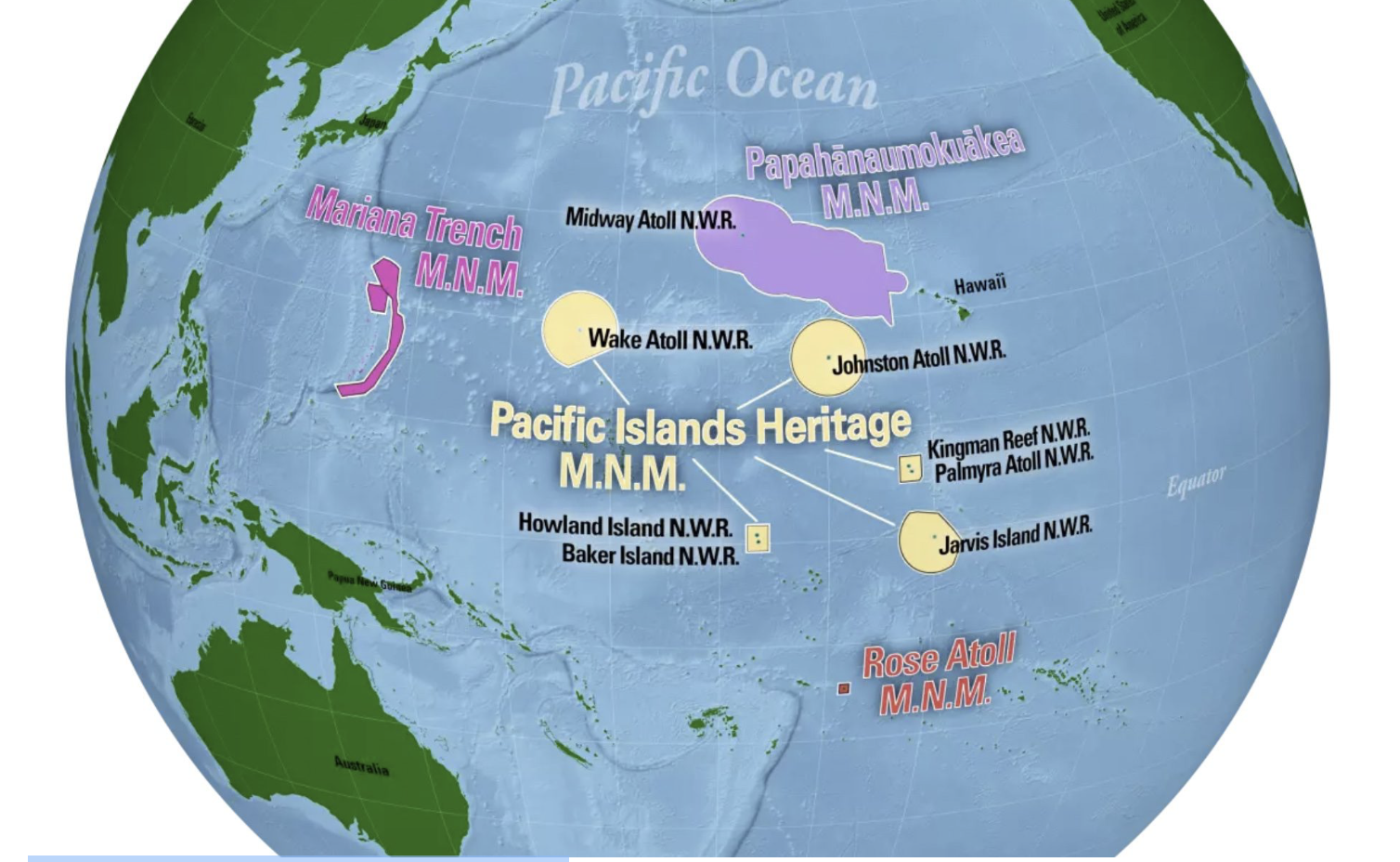
“Trump Administration Opens Pacific Remote Islands Marine Monument to Commercial Fishing” –gCaptain

Pacific Remote Islands Marine Monument. Map courtesy U.S. Fish and Wildlife Service

gCaptain reports,

President Donald Trump signed a proclamation on Thursday opening the Pacific Remote Islands Marine National Monument (PRIMNM) to commercial fishing, marking a substantial change in U.S. fishing policy.

The proclamation specifically permits U.S.-flagged vessels to conduct commercial fishing operations within 50 to 200 nautical miles of the PRIMNM’s boundaries. This decision affects an expansive marine protected area spanning approximately 495,189 square miles in the central Pacific Ocean – a region nearly five times the size of all U.S. National Parks combined.

This would seem to provide additional justification for a Coast Guard base and cutters (presumably Webber class WPCs) in American Samoa to provide additional safety for US fishermen and to keep unwelcome foreign fishermen out.

“U.S. Coast Guard cutter arrives in Papua New Guinea, embarks law enforcement officers to conduct joint maritime patrol” –News Release

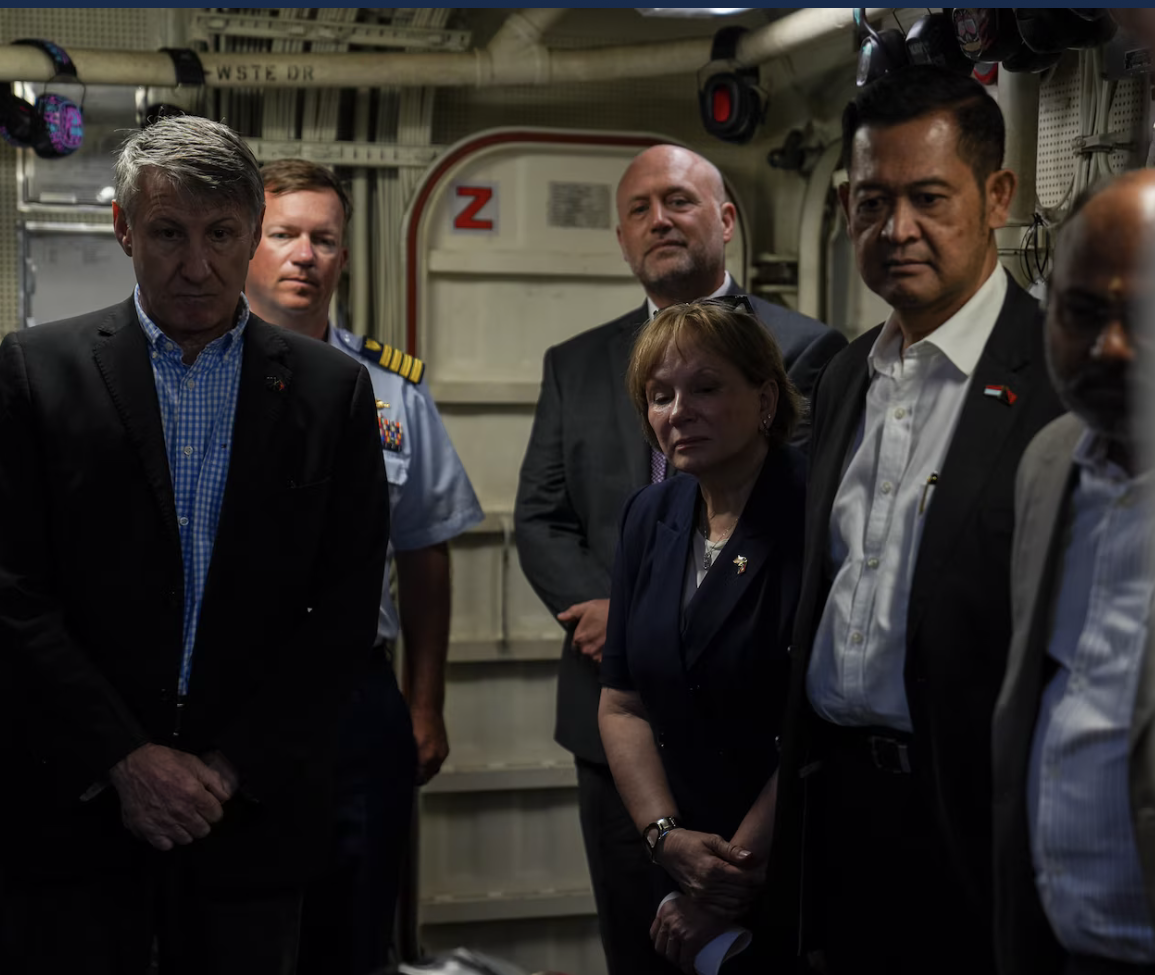
Officials from multiple agencies stand in the engine control room of the Coast Guard Cutter Midgett (WMSL 757) in Papua New Guinea Mar. 6, 2025. Papua New Guinea lies in the heart of key shipping routes, where freedom of navigation for the transport of global goods and fisheries and deep-sea resources abounds. The Coast Guard and Papua New Guinea collaborate to mitigate shared maritime challenges and threats, promoting regional security and stability within Oceania. (U.S. Coast Guard photo by Petty Officer 3rd Class Jennifer Nilson)

Below is a Coast Guard news release.

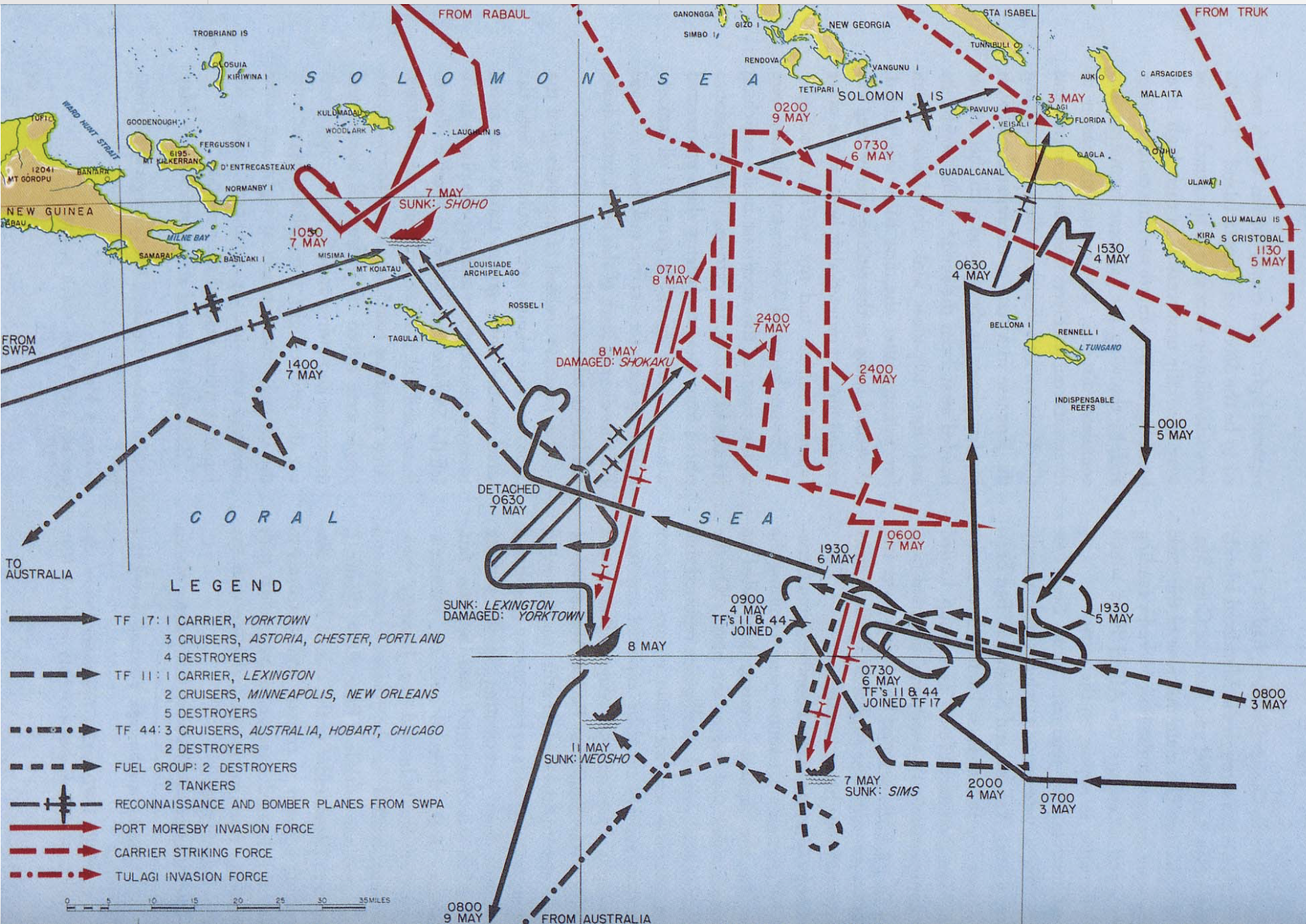
For those with an interest in World War II history. The Battle of the Coral Sea turned back a Japanese force that had planned to attack Port Moresby on the East end of New Guinea.

Battle of Coral Sea. United States Army Center of Military History. The Campaigns of MacArthur in the Pacific, Volume I. Reports of General MacArthur., p. 48, Plate 14. Port Moresby, NewGuinea is in the upper left; Guadalcanal, Tulagi and other Solomon Islands in the upper right; Australia to the South and West

March 12, 2025

U.S. Coast Guard cutter arrives in Papua New Guinea, embarks law enforcement officers to conduct joint maritime patrol

PORT MORESBY, Papua New Guinea — At the invitation of the Papua New Guinea government, the U.S. Coast Guard Cutter Midgett (WMSL 757) arrived in Port Moresby, Thursday, to embark Papua New Guinean law enforcement officers. This visit directly supports Papua New Guinea’s leadership in the Pacific Islands and its commitment to maritime security, specifically in combatting illegal, unreported, and unregulated fishing.

Midgett’s presence reinforces the U.S. Coast Guard’s commitment to deeper relations with Pacific Island nations and regional stability. This collaborative effort marks the first time a national security cutter, the U.S. Coast Guard’s most capable law enforcement cutter, will conduct bilateral maritime law enforcement operations in Papua New Guinea’s Exclusive Economic Zone (EEZ), under the existing bilateral agreement that was singed in May 2023.

This joint patrol will represent a tangible demonstration of the bilateral agreement between the United States and Papua New Guinea, strengthening maritime governance within the Pacific and deterring illegal activities within Papua New Guinea’s EEZ to promote the sustainable use of marine resources.

Midgett, commissioned in 2019 and homeported in Honolulu, is the eighth Legend-class national security cutter. These 418-foot vessels are equipped with advanced technology and a range of capabilities, making them ideally suited to support a wide range of missions, including maritime security, law enforcement, and search and rescue operations. Midgett’s deployment to Oceania highlights the United States’ enduring commitment to promoting a peaceful, secure, prosperous, and resilient Pacific Islands region.

Cutter Midgett has been busy in the Western Pacific

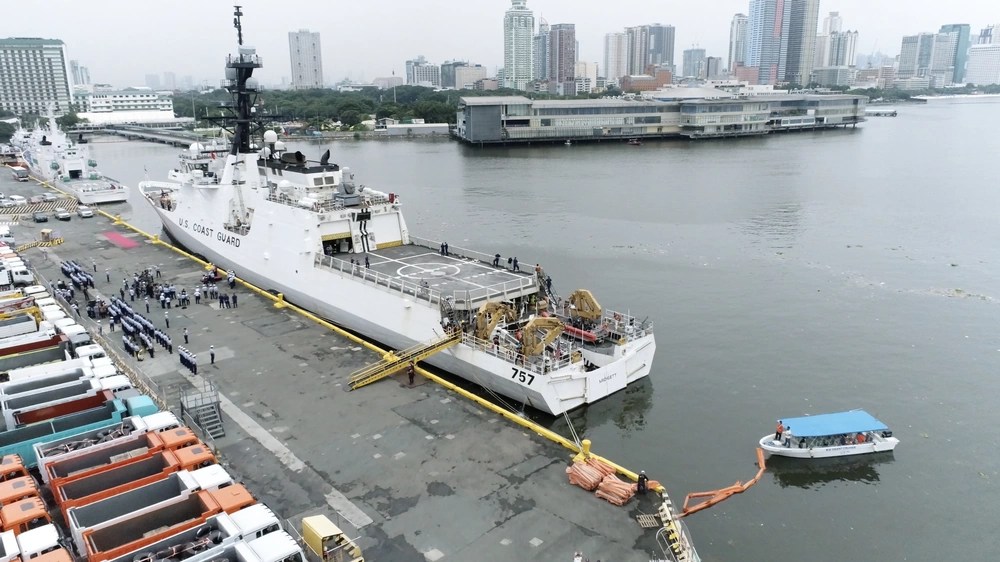
The U.S. Coast Guard Cutter Midgett (WMSL 757) moors in Manila, Philippines, Aug. 30, 2022. Midgett’s crew will engage in professional exchanges and capacity building exercises with the Philippine Coast Guard, and partner nations, and will patrol and conduct operations as directed while deployed on a months-long Western Pacific patrol under the tactical control of Commander, U.S. 7th Fleet. Philippine Coast Guard photo

Two news releases for Coast Guard News, “U.S. Coast Guard cutter visits New Zealand, conducts training and promotes maritime governance” and “U.S. Coast Guard cutter visits Tuvalu, strengthens partnerships and promotes regional security.”


Feb. 21, 2025

U.S. Coast Guard cutter visits New Zealand, conducts training and promotes maritime governance

WELLINGTON, New Zealand – U.S. Coast Guard Cutter Midgett (WMSL 757) recently concluded a month-long engagement with New Zealand, strengthening ties with the Royal New Zealand Navy (RNZN) and reinforcing the U.S. Coast Guard’s commitment to Oceania. The engagements included professional exchanges, bilateral maritime law enforcement trainings, and enhanced cooperation between the two nations in support of a peaceful, secure, prosperous, and resilient region.

During Midgett’s transit from Honolulu to Wellington, three RNZN members experienced operations aboard the cutter as part of an exchange program with the Coast Guard.

While in Wellington, Midgett’s crew participated in several events with the RNZN, the Rescue Coordination Centre New Zealand (RCCNZ), the New Zealand Maritime Police, and members of the local community. These events included a reception hosted by the RNZN, visits to the RCCNZ and the Maritime Police Base, a community event with Waka Ama’s outrigger canoes, and ship tours for more than 200 people.

The Coast Guard is an instrument of national power that bridges the divide between defense, diplomacy, and law enforcement, and creates opportunities to further national objectives and priorities. These engagements provided invaluable opportunities for personnel from both nations to interact, discuss experiences, and learn about roles in their services and communities. “The integration of our New Zealand partners into our crew was seamless and highly beneficial,” said Capt. Matthew Rooney, commanding officer of Midgett. “The professional exchanges and shared experiences, along with the friendships forged and sea stories shared, will undoubtedly enhance our ability to operate together in the future.”

The Coast Guard values New Zealand’s active engagement in international security efforts. This partnership is vital to countering destabilizing behavior in the Pacific that undermines mutual prosperity, economic well-being, and the health of the marine ecosystem. This visit builds on the Memorandum of Agreement signed with the RNZN in 2023, allowing both nations to share experiences and knowledge to cultivate best practices. The Coast Guard looks forward to continuing this partnership, based on mutual respect and shared values, to promote security and prosperity in the Indo-Pacific region.

Commissioned in 2019, Midgett is the eighth Legend-class national security cutter and is homeported in Honolulu. National security cutters are 418-feet long, 54-feet wide, and have a 4,600 long-ton displacement. They have a top speed of more than 28 knots, a range of 12,000 nautical miles, an endurance of up to 90 days and can hold a crew of up to 170.


Feb. 21, 2025

U.S. Coast Guard cutter visits Tuvalu, strengthens partnerships and promotes regional security

FUNAFUTI, Tuvalu – The U.S. Coast Guard Cutter Midgett (WMSL 757) recently concluded a successful engagement in Tuvalu, conducting joint bilateral maritime law enforcement shiprider operations and strengthening partnerships to combat illegal, unreported, and unregulated fishing in the region. This partnership underscores the U.S. Coast Guard’s unwavering commitment to maintaining a secure and prosperous Indo-Pacific, leveraging its operational expertise to enhance cooperation and strengthen its trusted partnership with Tuvalu.

During the three-day operation, Midgett participated in three at-sea boardings, including two bilateral inspections within Tuvalu’s exclusive economic zone, the first in over a decade, and one Western and Central Pacific Fisheries Commission high-seas inspection. Midgett also deployed its ScanEagle unmanned air system to enhance maritime domain awareness and support the joint effort. These joint operations provided valuable opportunities for both Tuvalu and U.S. Coast Guard personnel to exchange expertise, share best practices, and strengthen interoperability. Following the shiprider operations, Midgett hosted 13 distinguished visitors from Tuvalu, including representatives from the Fisheries Department, Maritime Police, and the Tuvalu government. Discussions focused on the positive impact of the joint boardings, emphasizing the importance of maritime security cooperation in the region.

“This operation was a tremendous success on multiple levels,” said Capt. Matthew Rooney, commanding officer of Midgett. “Not only did we work alongside our partners in Tuvalu to conduct critical maritime law enforcement operations, but the experience also provided invaluable training for our crew. From the deck plate level all the way up to command and control, integrating with our Tuvaluan counterparts was seamless and incredibly beneficial for all involved. We learned a great deal from each other, and this experience will undoubtedly pay dividends in future operations.”

The partnership between Midgett and Tuvalu underscores the U.S. Coast Guard’s commitment to supporting Pacific Island nations in their efforts to safeguard their sovereignty and manage their maritime resources effectively. A secure and prosperous Indo-Pacific requires working closely with partners such as Tuvalu to promote maritime governance.

Bilateral maritime efforts enhance governance among regional partners, improving interoperability, and strengthening readiness.

Midgett, commissioned in 2019 and homeported in Honolulu, Hawaii, is the eighth Legend-class National Security Cutter. These 418-foot vessels are equipped with advanced technology and a range of capabilities, making them ideally suited to support a wide range of missions, including maritime security, law enforcement, and search and rescue operations. Midgett’s deployment to Oceania highlights the United States’ enduring commitment to promoting a peaceful, secure, prosperous, and resilient Pacific Islands region.


“Sails on an OPV? Vessel Design, with French Flair” –MarineLink

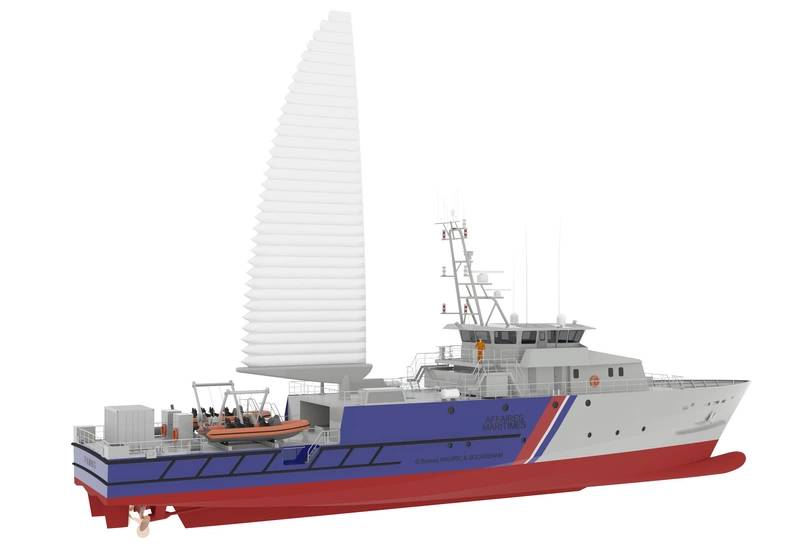
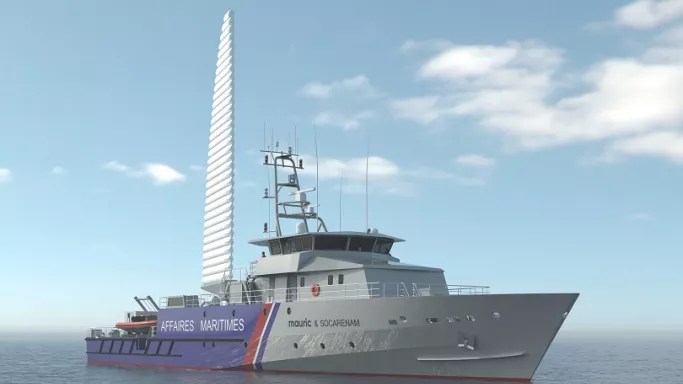
3D rendering of the PAMNG. Image ©MAURIC

Marine Link reports a contract for construction of a small Offshore Patrol Vessel (OPV) for the French Directorate General for Maritime Affairs, Fisheries and Aquaculture (DGAMPA).

I have been seeing reports of sails of various sorts being added to merchant vessels in order to reduce fuel consumption, but this is the first time I have seen this applied to a modern OPV.

It is just part of their efforts to make the ships fuel efficient while minimizing emissions,

The wind-assisted propulsion solution, combined with diesel-electric hybrid propulsion and IMO TIER III compliant engines, are designed to position the vessel “at the forefront of maritime ecological transition,” wrote DGAMPA.

As with all vessel designs, there is not a silver-bullet solution to increased efficiency, and this vessel will also have a hull design optimized through computational fluid dynamics, enhanced insulation with optimized energy management, photovoltaic panels, and an active trim control system.

Based on some modest experience with sailing craft, the sail may also have the effect of steadying the ship, slowing the roll and making it more comfortable as well. In addition, with the mast apparently stepped a bit aft of amidships, and the sail aft of that, it appears that the ship would drift with its head into the wind and seas rather than broadside as most ships do.

Rendering of the PAMNG. Image ©MAURIC

54m OPV Main Particulars

  • Crew: 16 persons
  • Duration: 12 days, up to 200 days at sea per year
  • Length: 53.7 m
  • Construction: Steel hull, aluminum superstructure
  • Propulsion: Diesel-electric hybrid system with wind assisted propulsion
  • Maximum speed: 17 kts
  • Endurance: 3,600 nm at 12 kts
  • Nautical equipment: 2 semi-rigid boats of 6.50m (speed: 35 kts)

Main Missions

  • Protection of national interests
  • Maritime fisheries surveillance and control
  • Environmental regulations compliance
  • Pollution and navigation monitoring
  • Assistance to persons
  • Public service missions and representation of French Maritime Affairs Administration

USINDOPACOM Exercises & Engagements

INDOPACOM Defense Forum Special Features has a post that includes the map above that shows where “Exercise, Joint Combined Exchange or Training Teams” are located.

On the linked post, you can hover over the dots, and it will list activities in that location. Coast Guard is associated with dots identified as Solomon Islands, Federated States of Micronesia (FSM), Guam, Palau, Papua New Guinea, and Australia. It should have included the Marshall Islands as well. All these are also associated with Operation Blue Pacific.

Federated States of Micronesia, the Marshall Islands, and Palau are Compact of Free Association states. Guam and the Northern Mariana Islands are US territory.

The same post also has a different map that shows the location of DOD units normally located in the AOR (area of operations) that may be of interest.

“U.S. Coast Guard Cutters return home after successful Central American deployment” –D11 News Release

USCGC Forrest Rednour (WPC 1129) and Blackfin (WPB 87317) in Costa Rica

Below is a District 11 news release. Did an earlier post on this unusual deployment.

The 800 operational hours claimed for each vessel works out to 33.3 operational days out of 49 deployed, so I presume that means about 16 days in transit, there and back.

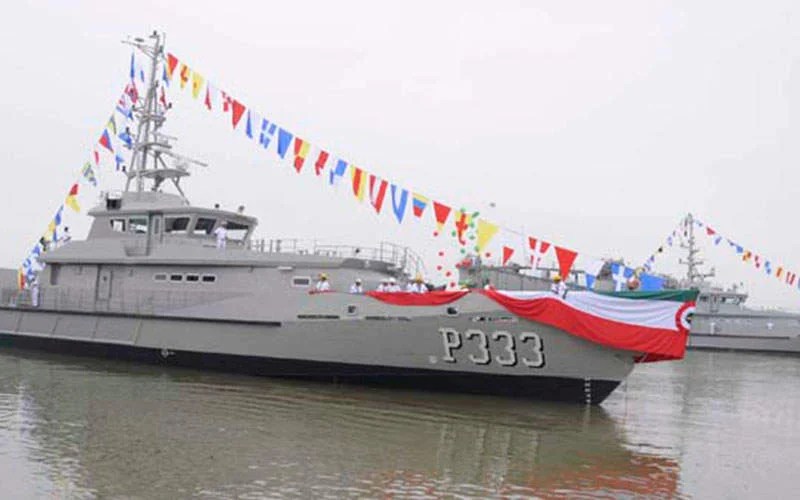
The Mexican Navy vessel mentioned, ARM PALENQUE, the third of ten Tenochtitlan-class patrol vessels, looks a lot like a Webber class Fast Response Cutter. It is also a Damen design, but a bit smaller (a Stan Patrol 4207 vs 4708 for the FRC). Damen has been very successful with this design. More than 50 have been built for more than a dozen agencies. (USCGC Blackfin and the other Marine Protector class patrol boats are also based on a Damen design.)

Mexican Navy ARM Palenque (PC-333) at launching March 2014. Credit Secrtaria de Marina.


June 10, 2024

U.S. Coast Guard Cutters return home after successful Central American deployment

SAN PEDRO, Calif. — U.S. Coast Guard cutters Forrest Rednour and Blackfin have returned to their homeports after a 49-day deployment in Central America, where they played a crucial role in multiple operations.

During this period, both cutters demonstrated outstanding readiness and operational capability, significantly contributing to international cooperation, search and rescue missions, and efforts to combat criminal activities. This deployment was part of a broader strategy to enhance regional security and strengthen partnerships. Throughout the mission, Forrest Rednour covered over 8,200 miles and logged 800 operational hours, while Blackfin covered over 8,300 miles and also logged 800 operational hours.

“The amount of effort and commitment from both crews during this 49-day deployment was remarkable,” said Rear Adm. Andrew Sugimoto, commander, Coast Guard District 11. “Their readiness and professional exchanges provided an invaluable experience to our partner nations and crews. The enthusiasm to lead multiple engagements with several international maritime organizations helped strengthen ties and fortify continued collaboration between all.”

Key Achievements:

Search and Rescue Exercises (SAREX):

  • Manzanillo, Mexico: Blackfin led a successful SAR operation, including helicopter rescue exercises with the Mexican Navy.
  • Puerto Quetzal, Guatemala: Hosted tours and conducted SAR exercises with the Guatemalan Navy, building stronger maritime partnerships.
  • La Union, El Salvador: Rednour led a SAR exercise and joint operations with the Salvadoran Navy, marking the first U.S. vessel visit to this port in two years.

Partnership and Training:

  • Amapala, Honduras: Engaged in discussions and training on maritime law enforcement and security with the Honduran Navy and Merchant Marine.
  • Golfito, Costa Rica: Shared knowledge on maritime governance with the Costa Rican Coast Guard, enhancing mutual understanding.
  • Rodman, Panama: Provided damage control and medical evacuation training to Panamanian forces, marking the first U.S.-Panama Coast Guard engagement in over two years.
  • PASSEX with ARM PALENQUE: Forrest Rednour and Blackfin conducted a passage exercise (PASSEX) with the Mexican Navy’s ARM PALENQUE. This included formation steaming, code exercises, and a crew exchange to enhance mutual operational understanding and cooperation.

“This patrol was truly an amazing experience and a testament to the incredible devotion to duty that the crews of the Forrest Rednour and Blackfin have,” said Lt. Kevin Ng, commanding officer of Coast Guard Cutter Forrest Rednour. “Both crews adapted and overcame several challenges leading up to and during the patrol, but never took their eyes off the main objective. As a result, the Coast Guard was able to strengthen the valuable relationships that the United States has with our international partners throughout Central America and unify our efforts to address critical maritime security initiatives in the Eastern Pacific. Thank you to crews on a job well done, District 11 and Sector Los Angeles/Long Beach for the coordination, and the families and friends of the crew for all of the support; the success of this historic patrol could not have been accomplished without them all.”

“I could not be prouder of both crews for the incredible amount of hard work they have dedicated to making this historic patrol possible. The success of this Surface Action Group is a testament to the Coast Guard’s ability to overcome dynamic challenges in the completion of unprecedented mission sets. It also signifies the Coast Guard’s steadfast commitment to advancing our vital maritime partnerships in the Eastern Pacific. The international relationships formed and strengthened during this deployment have set the groundwork for future engagements which I look forward to watching,” said Lt. j.g. James Morrison, commanding officer of Coast Guard Cutter Blackfin.

Commissioned in 2018, the Coast Guard Cutter Forrest Rednour is one of the Coast Guard’s Sentinel-class fast response cutters homeported in San Pedro, California. Sentinel-class cutters are 154 feet long and 25 feet wide and have a 353 long-ton displacement. They have a top speed in excess of 28 knots and a range of 2,500 nautical miles. They can hold a crew of up to 24. The namesake of the Forrest Rednour is Petty Officer 2nd Class Forrest O. Rednour, who heroically rescued survivors from the torpedoed USAT (US Army Transport–Chuck) Dorchester during World War II and was posthumously awarded the Navy and Marine Corps Medal.

Commissioned in 2000, the USCGC Blackfin is one of the Coast Guard’s Marine Protector-class patrol boats homeported in Santa Barbara, California. Marine Protector-class patrol boats are 87 feet long and 19.5 feet wide and have a 100 long-ton displacement. They have a top speed of 25 knots and a range of 900 nautical miles. They can hold a crew of up to 10. The Blackfin is equipped with advanced electronics and navigation systems for multi-mission operations, including search and rescue, law enforcement, and homeland security. The Blackfin shares the name of the USS Blackfin (SS-322), a submarine that participated in World War II and the Korean War.

“U.S. Coast Guard Cutter Munro holds a change of command ceremony” –News Release

Royal Navy vessel HMS Spey (P234) (foreground) conducts coordinated ship maneuvers with U.S. Coast Guard Cutter Munro (WMSL 755) Sept. 17, 2023, in the South China Sea. Munro is deployed to the Indo-Pacific to advance relationships with ally and partner nations to build a more stable, free, open and resilient region with unrestricted, lawful access to the maritime commons. (U.S. Navy photo by Chief Petty Officer Brett Cote)

Below is a news release. Routine change of command, but the Munro’s recent activities are interesting for their variety, three very different activities in widely dispersed areas, Eastern Pacific, Western Pacific, and far Northern Pacific. More info in these earlier news releases:


 May 31, 2024

U.S. Coast Guard Cutter Munro holds a change of command ceremony

SAN DIEGO — The U.S. Coast Guard Cutter Munro (WMSL 755) held a change of command ceremony Thursday in San Diego.

Vice Adm. Andrew J. Tiongson, Commander, U.S. Coast Guard Pacific Area, presided over the ceremony in which Capt. James O’Mara IV relieved Capt. Rula Deisher as Munro’s commanding officer.

Deisher served as Munro’s commanding officer from May 2022 to May 2024, sailing over 73,000 nautical miles to 17 ports, including eight foreign countries during patrols in the Bering Sea, Western Pacific, and Eastern Pacific.

Most recently, Munro and the crew were responsible for the interdiction and seizure of illegal narcotics worth an estimated $460 million in wholesale value and over $2 billion in street value while patrolling the Eastern Pacific Ocean in support of the Joint Interagency Task Force-South. Munro’s crew also supported Operation Southern Shield during their recent patrol by conducting 16 fisheries boardings in the Southern Pacific Regional Fisheries Management Organization convention area, upholding the maritime rules-based order.

During Munro’s Western Pacific patrol, the cutter and crew hosted multiple engagements with foreign partners, including a discussion about the SAPPHIRE agreement with Japanese Coast Guard officers, a subject matter expert exchange, an at-sea engagement with the Korea Coast Guard, and participated in CARAT Brunei, where Munro worked alongside the Royal Brunei Navy in professional subject matter expert exchanges, leadership conferences, and an at-sea engagement.

While patrolling the Bering Sea, Munro conducted 24 fisheries boardings and two search-and-rescue cases, including the medical evacuation of a critical patient from Dutch Harbor, Alaska, to Anchorage, Alaska.

“To the crew of Munro, thank you,” said Deisher. “I am so proud of your endless dedication and care toward each other and our mission. This crew is phenomenal, and it has been an honor and privilege to sail with them and learn from them.”

Deisher’s next assignment is to serve as the Seventeenth District’s Response Division chief.

O’Mara, the incoming commanding officer, brings a wealth of experience to Munro.

Reporting from the Coast Guard’s Eleventh District as the Enforcement Branch chief, O’Mara oversaw assets across 1,000 miles of shoreline from the California-Oregon state line to the Mexico border and 73 federal waterways. He also worked closely with the Department of Defense Joint Interagency Task Forces and the Department of Homeland Security Joint Task Force West to conduct effective drug and law enforcement interdiction efforts across the Eastern Pacific.

Munro will be O’Mara’s seventh ship and fourth command, following previous commands aboard the Coast Guard Cutters Active (WMEC 618), Farallon (WPB 1301), Monomoy (WPB 1326), and Narwhal (WPB 87335).

The change of command ceremony, a time-honored tradition, is a significant event conducted before the assembled company of a command. It confirms to the unit’s men and women that the authority of command is maintained. The ceremony symbolizes a transfer of total responsibility, authority, and accountability from one individual to another, marking a new chapter in the command’s history.

Commissioned in 2017, Munro is one of four Coast Guard Legend-class national security cutters homeported in Alameda. National security cutters, measuring 418 feet long and 54 feet wide, boast a top speed of over 28 knots, a range of 12,000 nautical miles, endurance of up to 90 days, and can hold a crew of up to 170. The advanced technologies of the national security cutter class ships support the national objective of maintaining the security of America’s maritime boundaries and providing long-range search and rescue capabilities.

“The huge, resource rich territory China will snatch while the West dithers” –The Telegraph

The Telegraph has an opinion piece by retired Royal Navy Commander and former CO of the Ice Patrol Vessel HMS Endurance, Tom Sharpe OBE.

He feels, as I do, that we are headed for conflict over claims to Antarctica. It is after all, the last land area on earth where no nation exercises sovereignty.

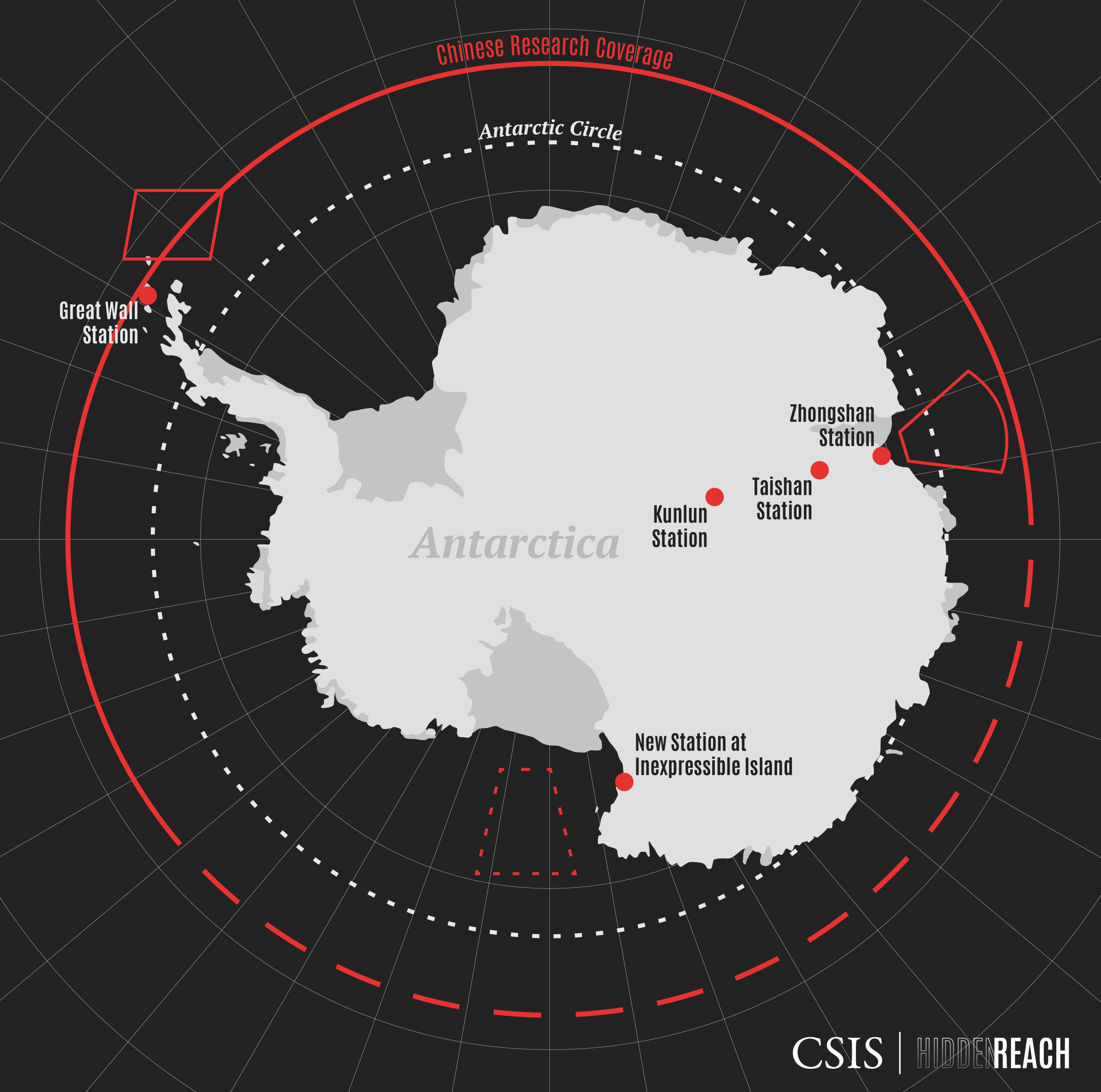
China’s presence in the Antarctic is growing rapidly and, as they have shown in the South China Sea, they may choose not to accept the decisions of international courts.

Adapted from a 2021 Chinese environmental evaluation report submitted to the Secretariat of the Antarctic Treaty. Source CSIS

What this boils down to is that, after courts make their decisions, we may have to fight in Antarctic to make those decisions stick.

We don’t seem to have given much thought to the possibility of combat in and around Antarctica, but I believe it is a real possibility, perhaps not soon, but beginning in 2048 when the Antarctic Treaty comes up for renegotiation. 24 years may seem to be a long way off, but we are building now the assets that will be available in 2048.

By then the rapidly growing Chinese presence in Antarctic, as well as their Navy are likely to be in a very strong position. We are already seeing the Chinese apparently establishing dual use (civilian and military) facilities in Antarctica.

In the interim, we can expect China and perhaps others to try to skirt the rules to strengthen their presence. We need to monitor and challenge any gray zone operations.

Command Structure:

These are the Unified Combatant Commander’s Areas of Responsibility.

There is an obvious reason that Antarctica does not seem to be on anyone’s radar. Looking at who is potentially responsible for operations in the Antarctic, it is a hodgepodge. Various parts of the Continent might fall under SOUTHCOM, AFRICOM, and INDO-PACOM.

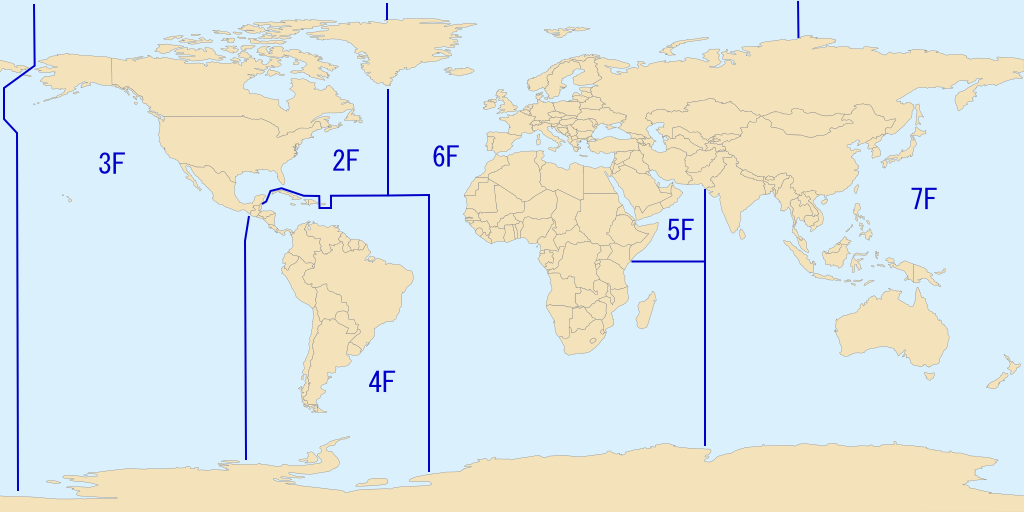
US Navy Fleet Organization

3rd Fleet, 4th Fleet, 6th Fleet, and 7th Fleet all have a nominal slice, but none of these commands consider the area their primary concern.

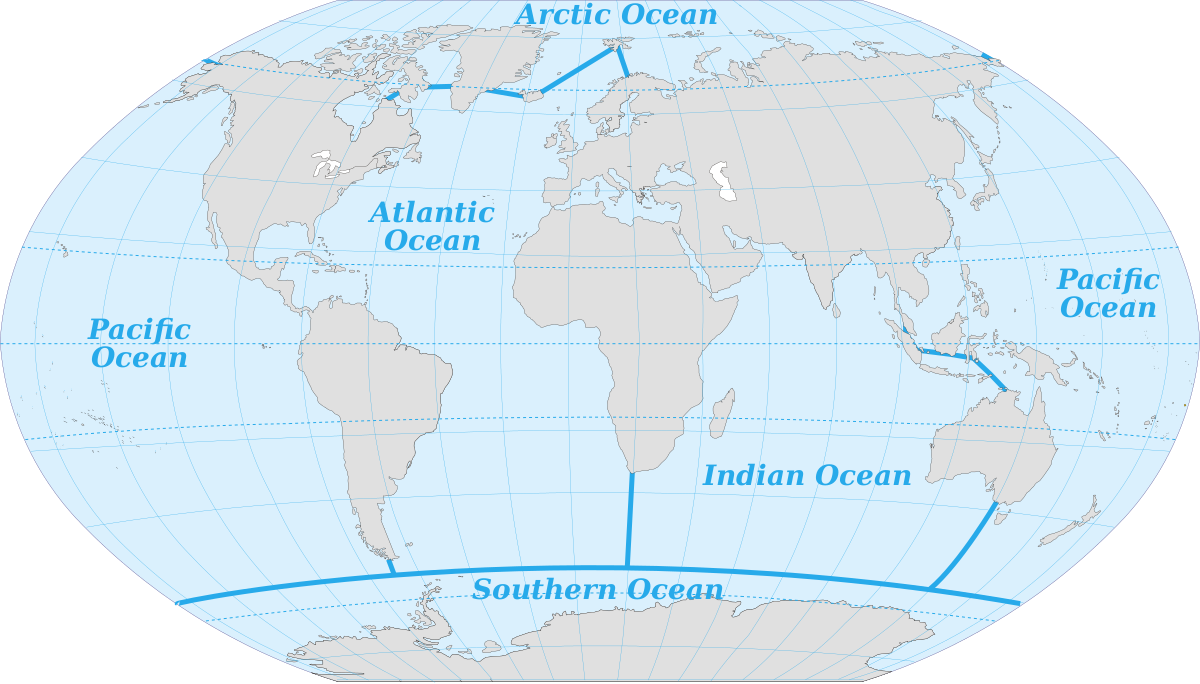
World map of oceans : English version. By Pinpin via Wikipedia.

There is no single national command authority that covers all of Antartica or the Southern Ocean. Really no one is in responsible for the area below 60 degrees South.

It seems likely that in the near term, Southern Ocean fisheries will require some protection. The only nation I have heard of doing fisheries protection in the Southern Ocean outside their own EEZ is New Zealand.

The Coast Guard currently operates the only US polar icebreakers. At some point the Coast Guard may become involved in fisheries protection in the Southern Ocean. If there is conflict in Antarctica, Coast Guard assets will likely be needed to gain access.

Related: