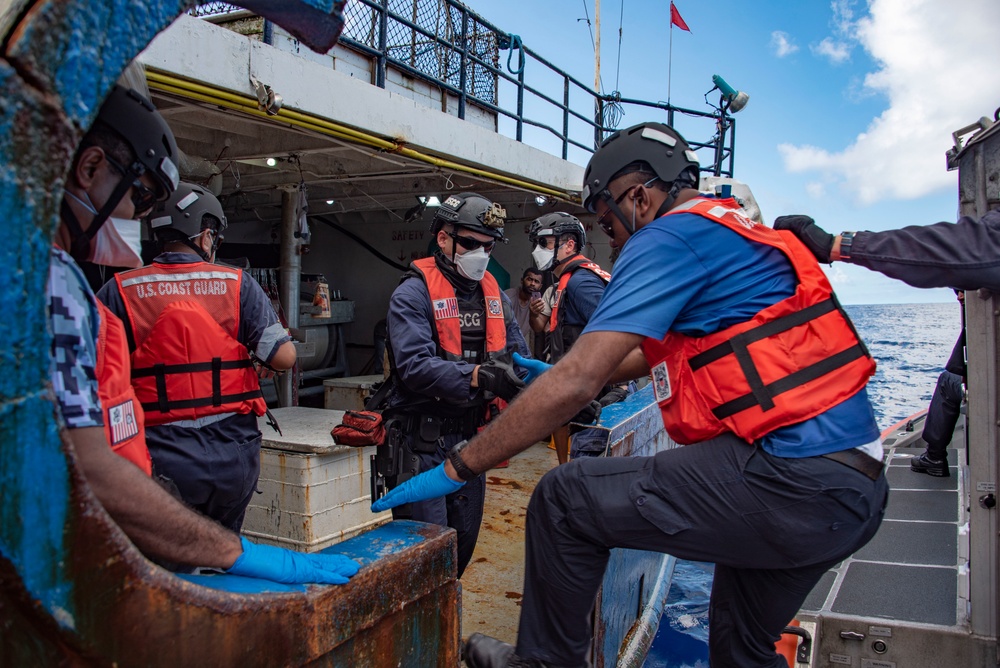
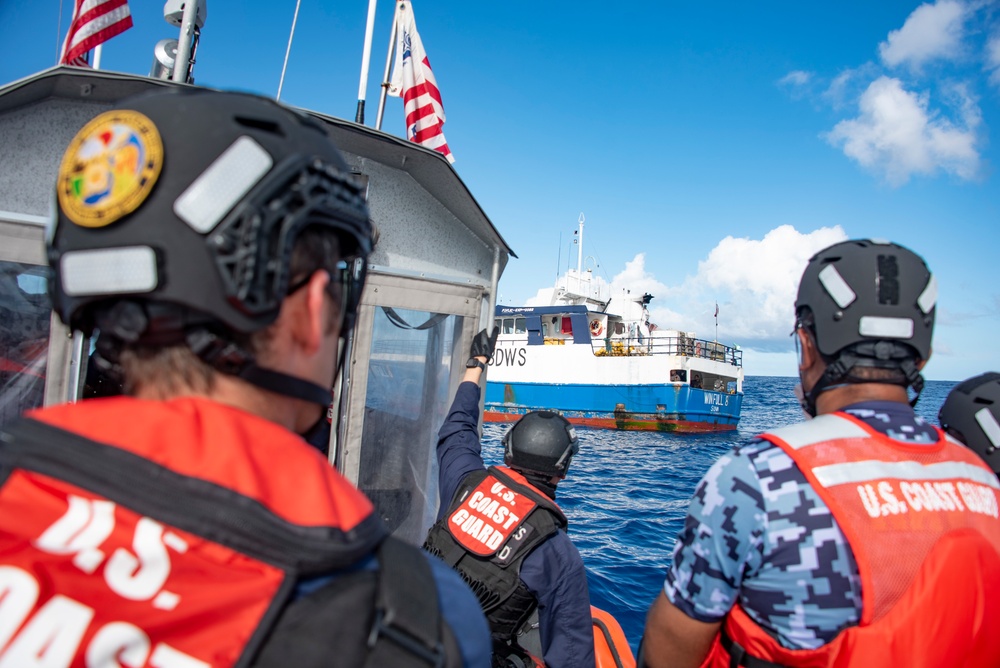
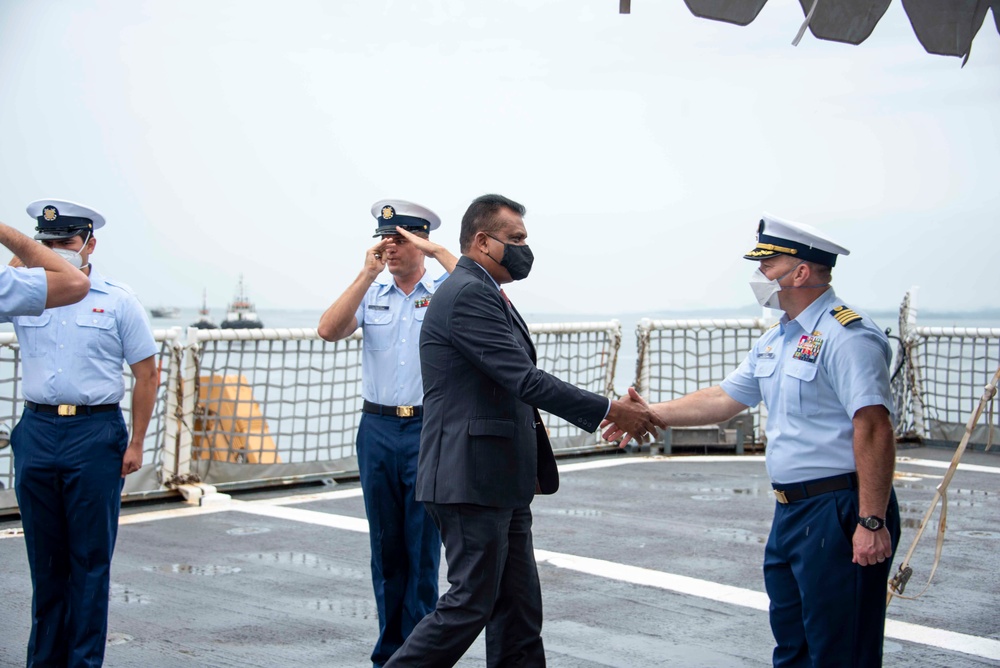
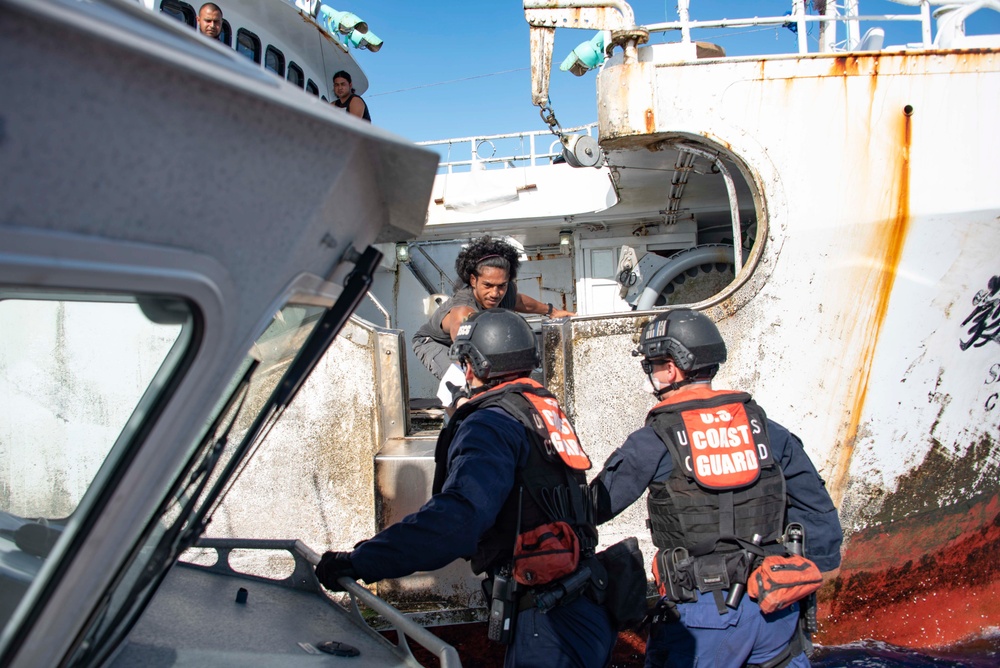
“U.S. Coast Guard Cutters return home after successful Central American deployment” –D11 News Release

USCGC Forrest Rednour (WPC 1129) and Blackfin (WPB 87317) in Costa Rica

Below is a District 11 news release. Did an earlier post on this unusual deployment.

The 800 operational hours claimed for each vessel works out to 33.3 operational days out of 49 deployed, so I presume that means about 16 days in transit, there and back.

The Mexican Navy vessel mentioned, ARM PALENQUE, the third of ten Tenochtitlan-class patrol vessels, looks a lot like a Webber class Fast Response Cutter. It is also a Damen design, but a bit smaller (a Stan Patrol 4207 vs 4708 for the FRC). Damen has been very successful with this design. More than 50 have been built for more than a dozen agencies. (USCGC Blackfin and the other Marine Protector class patrol boats are also based on a Damen design.)
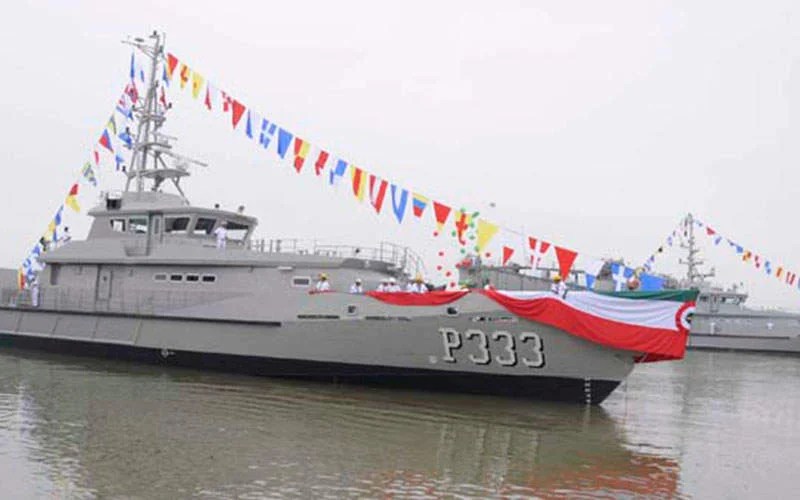
Mexican Navy ARM Palenque (PC-333) at launching March 2014. Credit Secrtaria de Marina.


June 10, 2024

U.S. Coast Guard Cutters return home after successful Central American deployment

SAN PEDRO, Calif. — U.S. Coast Guard cutters Forrest Rednour and Blackfin have returned to their homeports after a 49-day deployment in Central America, where they played a crucial role in multiple operations.

During this period, both cutters demonstrated outstanding readiness and operational capability, significantly contributing to international cooperation, search and rescue missions, and efforts to combat criminal activities. This deployment was part of a broader strategy to enhance regional security and strengthen partnerships. Throughout the mission, Forrest Rednour covered over 8,200 miles and logged 800 operational hours, while Blackfin covered over 8,300 miles and also logged 800 operational hours.

“The amount of effort and commitment from both crews during this 49-day deployment was remarkable,” said Rear Adm. Andrew Sugimoto, commander, Coast Guard District 11. “Their readiness and professional exchanges provided an invaluable experience to our partner nations and crews. The enthusiasm to lead multiple engagements with several international maritime organizations helped strengthen ties and fortify continued collaboration between all.”

Key Achievements:

Search and Rescue Exercises (SAREX):

  • Manzanillo, Mexico: Blackfin led a successful SAR operation, including helicopter rescue exercises with the Mexican Navy.
  • Puerto Quetzal, Guatemala: Hosted tours and conducted SAR exercises with the Guatemalan Navy, building stronger maritime partnerships.
  • La Union, El Salvador: Rednour led a SAR exercise and joint operations with the Salvadoran Navy, marking the first U.S. vessel visit to this port in two years.

Partnership and Training:

  • Amapala, Honduras: Engaged in discussions and training on maritime law enforcement and security with the Honduran Navy and Merchant Marine.
  • Golfito, Costa Rica: Shared knowledge on maritime governance with the Costa Rican Coast Guard, enhancing mutual understanding.
  • Rodman, Panama: Provided damage control and medical evacuation training to Panamanian forces, marking the first U.S.-Panama Coast Guard engagement in over two years.
  • PASSEX with ARM PALENQUE: Forrest Rednour and Blackfin conducted a passage exercise (PASSEX) with the Mexican Navy’s ARM PALENQUE. This included formation steaming, code exercises, and a crew exchange to enhance mutual operational understanding and cooperation.

“This patrol was truly an amazing experience and a testament to the incredible devotion to duty that the crews of the Forrest Rednour and Blackfin have,” said Lt. Kevin Ng, commanding officer of Coast Guard Cutter Forrest Rednour. “Both crews adapted and overcame several challenges leading up to and during the patrol, but never took their eyes off the main objective. As a result, the Coast Guard was able to strengthen the valuable relationships that the United States has with our international partners throughout Central America and unify our efforts to address critical maritime security initiatives in the Eastern Pacific. Thank you to crews on a job well done, District 11 and Sector Los Angeles/Long Beach for the coordination, and the families and friends of the crew for all of the support; the success of this historic patrol could not have been accomplished without them all.”

“I could not be prouder of both crews for the incredible amount of hard work they have dedicated to making this historic patrol possible. The success of this Surface Action Group is a testament to the Coast Guard’s ability to overcome dynamic challenges in the completion of unprecedented mission sets. It also signifies the Coast Guard’s steadfast commitment to advancing our vital maritime partnerships in the Eastern Pacific. The international relationships formed and strengthened during this deployment have set the groundwork for future engagements which I look forward to watching,” said Lt. j.g. James Morrison, commanding officer of Coast Guard Cutter Blackfin.

Commissioned in 2018, the Coast Guard Cutter Forrest Rednour is one of the Coast Guard’s Sentinel-class fast response cutters homeported in San Pedro, California. Sentinel-class cutters are 154 feet long and 25 feet wide and have a 353 long-ton displacement. They have a top speed in excess of 28 knots and a range of 2,500 nautical miles. They can hold a crew of up to 24. The namesake of the Forrest Rednour is Petty Officer 2nd Class Forrest O. Rednour, who heroically rescued survivors from the torpedoed USAT (US Army Transport–Chuck) Dorchester during World War II and was posthumously awarded the Navy and Marine Corps Medal.

Commissioned in 2000, the USCGC Blackfin is one of the Coast Guard’s Marine Protector-class patrol boats homeported in Santa Barbara, California. Marine Protector-class patrol boats are 87 feet long and 19.5 feet wide and have a 100 long-ton displacement. They have a top speed of 25 knots and a range of 900 nautical miles. They can hold a crew of up to 10. The Blackfin is equipped with advanced electronics and navigation systems for multi-mission operations, including search and rescue, law enforcement, and homeland security. The Blackfin shares the name of the USS Blackfin (SS-322), a submarine that participated in World War II and the Korean War.

“Combating Transnational Drug Flows,” A Conversation with the Deputy Director of Joint Interagency Task Force –South

The US Naval Institute brings us this video from the Center for Strategic and International Studies.

The accompanying article provides a brief overview, but I really recommend watching the entire interview. It is excellent. It even touches on Illegal, Unregulated, Unreported fishing.

There is an acknowledgement that resources made available for interdiction have declined even while seizures are up (as is the traffic in illegal drugs), but there is also good news in the successes of partner nations.

Again, there is no substitute for watching the interview.

“Allies, partners tap into technology to monitor maritime domain” –Indo-Pacific Defense Forum

Winkel Tripel projection, WGS84 datum, central meridian : 150°E. Source Wikipedia Commons, Author: Eric Gaba

The Indo-Pacific Defense Forum reports,

“Maritime domain awareness (MDA) in the Indo-Pacific is moving from an abstract aspiration to a functional collective security approach for managing the region’s dynamic offshore spaces,” noted an April 2023 article in PacNet, a publication of Pacific Forum, a Hawaii-based foreign policy research institute. “Much of the cost-savings in maritime enforcement activities is due to emerging technologies including access to satellites that provide clearer and more accurate images, as well as artificial intelligence and big data platforms dedicated to vessel tracking, prediction, and anomaly detection.”

There are fusion centers in India, Singapore and Vanuatu. These fusion centers would be useful in wartime, but they are essentially a cooperative exchange of information among maritime law enforcement agencies. In addition to its importance in countering IUU and drug smuggling, better maritime domain awareness may give warning of a terrorist attack. Shouldn’t the US Coast Guard have a fusion center in Alameda under Pacific Area? Probably should be one on the West coast of South America too.

Buoy Tender, FRC, C-130 Used for International Fisheries Enforcement–Operation Southern Shield

PERU, 10.06.2023, Courtesy Photo, USCG District 11
San Francisco based USCGC Alder (WLB-216) raises the South Pacific Regional Fisheries Management Organization (SPRFMO) flag while patrolling the Eastern Pacific Ocean during Operation Southern Shield in October 2023. The Coast Guard recently completed the first high-seas boardings and inspections off the coast of Peru under a newly adopted multi-lateral agreement to monitor fishing and transshipment operations within the SPRFMO Convention Area, a region which encompasses nearly a quarter of the Earth’s high seas. (U.S. Coast Guard photo by Petty Officer 2nd Class Kenneth Honore)

Below is a District 11 news release. It came with 24 photos. I have included a few here. The captions are informative. I have edited some of the captions to include homeports and minimize duplication. I have also added a few links and the schematic below.

SPRFMO CONVENTION AREA
This schematic is available only to illustrate the Area of application of the SPRFMO Convention, which is described in legal terms in Article 5. The schematic is not part of the Convention text and has no legal status; it is not intended to reflect exactly the maritime spaces of adjoining coastal states.

PERU, 10.07.2023, Courtesy Photo, USCG District 11
The Coast Guard Cutter Alder approaches a squid fishing vessel while CG-2007, a C-130 from Air Station Barbers Point in Hawaii, flies over (upper left) during Operation Southern Shield 2023, October 2023. The Coast Guard recently completed the first high-seas boardings and inspections off the coast of Peru under a newly adopted multi-lateral agreement to monitor fishing
and transshipment operations within the South Pacific Regional Fisheries Management Organization (SPRFMO)Convention Area. (U.S. Coast Guard photo)

LIMA, PERU, 10.06.2023, Courtesy Photo, USCG District 11
The aircrew of the Coast Guard 2007, an HC-130 based out of U.S. Coast Guard
Air Station Barbers Point, Hawaii, poses for a picture with observers from the Peruvian Navy and Air Force, in Lima Peru, October 2023. During the course of two weeks, Peruvian observers accompanied the USCG aircrew as they conducted overflights of the fishing fleet on the high seas during Operation Southern Shield 2023. (U.S. Coast Guard photo by pilot-in-charge, Lt. Zachary Hunter)

There was a Webber Class WPC involved as well. This follows the pattern of pairing a WLB with an FRC for distant operations that we have also seen in the Western Pacific.

PERU, 10.06.2023, Courtesy Photo, USCG District 11
The crew of San Pedro based USCGC Terrell Horne (WPC-1131) conducts a patrol in the Eastern Pacific Ocean in support of Operation Southern Shield 2023, October 2023. (U.S. Coast Guard photo)

These operations followed an international exercise, GALAPEX 2023.

09.23.2023, Courtesy Photo, USCG District 11
Participants in GALAPEX 2023 pose for a group picture following a law enforcement boarding exercise during GALAPEX 2023, Sept. 23, 2023. Coast Guard Cutters Alder and Terrell Horne conducted a boarding of Ecuador Bae Isla Floreana as the first major exercise and introduction to GALAPEX, a recurring multi-national maritime exercise led by Ecuador and included participation with delegates from Argentina, Brazil, Chile, Colombia, Costa Rica, the European Union, France, Italy, Mexico, Panama, Peru, the United Kingdom, and the United States. (U.S. Coast Guard photo by Lt. j.g. Kimberly Byron)

09.25.2023, Courtesy Photo, USCG District 11
U.S. Coast Guard Cutter Alder (background) transits in formation alongside Peru BAP (Buque Armada Peruana) Bolognesi (FM-57) as it prepares for the next exercise during GALAPEX 2023, Sept.25, 2023. (U.S. Coast Guard photo)


 Oct. 16, 2023

Coast Guard Cutter crews conduct first high-seas boardings off the coast of Peru, under new SPRFMO measure

ALAMEDA, Calif. — The crews of the Coast Guard Cutters Alder, Terrell Horne and an HC-130 Hercules aircraft recently completed the first high-seas boardings and inspections, in the Eastern Pacific Ocean, under a newly adopted conservation and management measure to monitor and inspect fishing and transshipment operations at-sea in the South Pacific Regional Fisheries Management Organization (SPRFMO) Convention Area.

As part of Operation Southern Shield, the Coast Guard conducted boardings and overflights within the SPRFMO Convention Area on the high seas off the coast of Peru. For years, the Coast Guard has executed counter-illegal, unreported, or unregulated (IUU) fishing operations and participated in high seas boarding inspections (HSBI) around the globe. This operation was significant as it was timed to implement newly adopted rules in the SPRFMO Convention Area, which comprises nearly a quarter of the Earth’s high seas. The SPRFMO Commission consists of 17 members from Asia, Europe, the Americas, and Oceania, as well as two cooperating non-contracting parties. The primary species targeted in the Convention area are jack mackerel and jumbo flying squid.

Just prior to Operation Southern Shield, the Coast Guard participated in GALAPEX 2023, a recurring joint and multinational exercise hosted by Ecuador and executed in the vicinity of the Galapagos Islands. The Coast Guard conducted communications exercises, practiced counter-narcotics boarding scenarios, and hosted observers from Peru, Ecuador, and Brazil. GALAPEX culminated with full-scale exercises focused on a coordinated multinational response to counter IUU fishing. At the conclusion of the exercise, the Coast Guard patrolled south to focus on high seas boarding inspections off the coast of Peru.

“The U.S. Coast Guard remains committed to conducting combined maritime operations and exercises throughout the Eastern Pacific and will continue to capitalize on every opportunity to work with, learn from, and coordinate through our partners,” said Capt. James O’Mara, Chief of Enforcement for Coast Guard 11th District.  “The relationships our services build while planning and executing these operations are essential. The logistics required to enable these operations are significant, and it only happens with the tremendous support of partners like Ecuador and Peru.”

IUU fishing has replaced piracy as the leading global maritime security threat. Areas out on the high seas, beyond any country’s exclusive economic zone, can be exploited by fishermen engaged in IUU fishing, as they fish beyond the reach of most law enforcement entities. The Coast Guard’s actions provide inspection presence on the high seas among a distant water fishing fleet made up of more than 400 fishing and transshipment vessels. Much of the fishing in the Eastern Pacific is accomplished by these distant water fishing vessels, some which remain at sea for years at a time, and many of which are supported by transshipment vessels. The Coast Guard’s recent operation directly supported Central and South American partners and their desire to monitor and expand maritime domain awareness of fishing activity near their exclusive economic zones.

Each day during the operation a Coast Guard C-130 aircraft flew sorties over the fishing fleet on the high seas with observers from the Peruvian Navy and Air Force. The crew of the Coast Guard Cutter Terrell Horne also diverted to assist the Peruvian Navy in a search and rescue operation. The Terrell Horne located the vessel, then transported an injured fisherman back to shore to receive further medical care from local Peruvian officials.

“The U.S. Coast Guard is committed to working with our allies and partners to strengthen the international fisheries enforcement regime and stop the pervasive IUU fishing threat,” said Rear Adm. Andrew Sugimoto, commander, Coast Guard 11th District. “Operation Southern Shield is just the latest example of that commitment, and we will continue to model and support rules-based order. We applaud the SPRFMO Commission for adopting these latest inspection guidelines and hope to see additional management measures adopted in the future to ensure the sustainability of our ocean resources. Last year we operated off the Galapagos, this year off the coast of Peru, and we will continue to deploy aircraft, cutters, and personnel to support our partners and monitor these distant water fleets wherever they roam. These operations help bring like-minded countries closer together to protect vulnerable fish stocks, support the economic stability of coastal nations, the livelihoods of small-scale and artisanal fishermen, and safeguard ocean resources that fuel global populations and economies.”

“U.S. Coast Guard Forces Micronesia Sector/Guam’s Fast Response Cutters bolster Pacific Partnership Strategy and strengthen Pacific Island Country relations” –USCG Forces Micronesia/Sector Guam

The Sentinel-class fast response cutter USCGC Oliver Henry (WPC 1140) crew arriving in Port Moresby for a port visit on Aug. 23, 2022, following a patrol in parts of the Coral Sea, the Solomon Islands and PNG Exclusive Economic Zones. The U.S. Coast Guard was conducting a routine deployment in Oceania as part of Operation Blue Pacific, working alongside Allies, building maritime domain awareness, and sharing best practices with partner nation navies and coast guards. (U.S. Coast Guard photo by USCGC Oliver Henry)

Below is a news release from U.S. Coast Guard Forces Micronesia/Sector Guam. Webber class cutters there are developing a new norm for Coast Guard assistance to Pacific Island nations. It is not clear if this is now the norm, or if this was an unusual period, but from June 21 to August 3, there was only one day (June 17) that they did not have an FRC underway for at least part of the day. This is what I believe should be the norm and probably the reason FRCs are so frequently based in groups of three or six. Typically three ships would be, one underway, one in maintenance, and one in workup/standby (I don’t know if they are employing standby). 

On the other hand, none of these patrols was more than 16 days long and the shortest only five, which suggest why, given the long transit distances, we need some cutters with greater endurance in the Western Pacific (I would say three to have one underway at all times and be able to surge two when needed).

Thanks to Paul for bringing this to my attention.

Aug. 18, 2023

U.S. Coast Guard Forces Micronesia Sector/Guam’s Fast Response Cutters bolster Pacific Partnership Strategy and strengthen Pacific Island Country relations

SANTA RITA, Guam — In a robust display of maritime commitment, U.S. Coast Guard Forces Micronesia/Sector Guam’s Fast Response Cutters conducted four patrols over 44 days, enhancing safety and prosperity in the Pacific Islands region while combatting illicit maritime activity, including illegal, unregulated, and unreported fishing and the illegal and unsafe transport of passengers.

The crews of USCGC Frederick Hatch (WPC 1143), USCGC Myrtle Hazard (WPC 1139), and USCGC Oliver Henry (WPC 1140):

– Conducted seven boardings and five observation reports.
– Completed over 20 training evolutions.
– Qualified 18 new shipboard members.
– Supported the investigation into the transport of 11 people aboard an overloaded vessel transiting to Guam from the Commonwealth of the Northern Mariana Islands on an illegal charter following their rescue by DoD partners.
– Supported operations such as Operation Blue Pacific, Operation Rematau, Operation Nasse, and Operation Koa Moana.

“Our Fast Response Cutter crews exhibit both efficacy and presence as a consistent and trusted partner in the region. Our Pacific Island Country partners’ warmth and regard for the Coast Guard is a testament to the strong connections we have nurtured over the years. It is our commitment to the people of the Pacific Island Countries to protect Oceania and its resources for them from undue strategic competition that would undermine those relationships and destabilize the region,” said Cmdr. Greg Sickels, deputy sector commander of U.S. Coast Guard Forces Micronesia/Sector Guam.

Operational Achievements and Highlights

– USCGC Frederick Hatch (June 21 – July 2 and July 18 – Aug. 3): Enhanced international relations, streamlined boarding processes, qualified new personnel, and improved communication with FSM Maritime Police.

– USCGC Myrtle Hazard (July 3 – 16): Strengthened connection with CNMI, ensured maritime law enforcement presence in less patrolled areas, and enhanced collaboration with customs and public safety departments.

– USCGC Oliver Henry (July 18 – 23): Increased U.S. presence, enforced fishing regulations, and fostered crew readiness with weapons proficiency and collaboration.

These accomplishments underscore the U.S. Coast Guard’s pivotal role in promoting maritime governance, ensuring good relations, and fostering strategic competition in the Pacific Islands region. The U.S. Coast Guard remains a consistent and reliable partner, working collaboratively with Pacific Island Countries to achieve shared objectives and bolster regional security.

Operation Rematau, an integral part of Operation Blue Pacific, is spearheaded by the U.S. Coast Guard Forces Micronesia/Sector Guam. This initiative fosters security, safety, sovereignty, and economic prosperity throughout Oceania. Rematau translates to “people of the deep sea” and embodies the Coast Guard’s unwavering commitment to safeguarding the people of this region.

The U.S. Coast Guard actively exercises 12 bilateral maritime law enforcement agreements with Pacific Island Countries, reinforcing maritime law enforcement operations and domain awareness in the region. In October 2022, the Service, on behalf of the U.S., signed the first enhanced bilateral agreement with the Federated States of Micronesia. This landmark agreement builds on the existing shiprider arrangement, allowing the U.S. Coast Guard to conduct boardings in the FSM’s exclusive economic zone with prior approval working with the FSM National Police, but without an FSM officer physically present. This expansion significantly amplifies the FSM’s capacity to protect its sovereignty and resources across an area spanning 1 million square miles and more than 600 islands. Boardings have already been conducted under this enhanced shiprider agreement, attracting interest in similar arrangements from other nations in the area.

In May 2023, the U.S. signed a new bilateral agreement with Papua New Guinea, richly endowed with natural resources like gold, copper, oil, and natural gas. While its formal sector focuses on exports of these commodities, most of its people rely on subsistence agriculture. As of 2020, agriculture, forestry, and fishing reportedly account for nearly 19 percent of PNG’s GDP. The agreement aligns with the PNG government’s efforts to safeguard their islands and 1.2 million square miles of EEZ, which are vital to their economic well-being. Recently ratified by their parliament, this partnership, at the request of the Papua New Guinea government, further extends the reach and impact of maritime law enforcement efforts. In line with this initiative, a U.S. Coast Guard cutter from Guam will be collaborating with Papua New Guinea to enact their new agreement shortly, continuing to foster security and collaboration across the Pacific.

U.S. Coast Guard Forces Micronesia/Sector Guam comprises more than 300 members based in Guam and the Commonwealth of the Northern Mariana Islands spread across shoreside and afloat units committed to maritime safety, security, and stewardship in Oceania.

For more information on the U.S. Coast Guard Forces Micronesia Sector/Guam’s operations and achievements, please visit the official DVIDS account at https://www.dvidshub.net/unit/USCG-FMSG.

“US to Deploy Coastguard Ship to Papua New Guinea” –The Defense Post

The USCGC Oliver Henry (WPC 1140) crew arrives in Manus, Papua New Guinea, on Aug. 14, 2022, from Guam as part of a patrol headed south to assist partner nations in upholding and asserting their sovereignty while protecting U.S. national interests. The U.S. Coast Guard is participating with partners to support the Pacific Islands Forum Fisheries Agency-led Operation Island Chief and the larger Operation Blue Pacific through patrols in the Western Pacific in August and September 2022. (U.S. Coast Guard photo by SW3 Victor Villanueva, NMCB-FOUR)

(Sorry, this is a couple of weeks old.)

The Defense Post reports,

US Defense Secretary Lloyd Austin on Thursday announced the deployment of a US Coastguard ship to Papua New Guinea, as Washington seeks to boost its military footprint in the region amid fierce competition for influence with China…“A US Coastguard cutter will be here in August,” Austin said as he became the first Pentagon boss to visit Papua New Guinea.

Again, the Coast Guard is being used as an instrument of foreign policy. That is not a bad thing, but it is a fact.

It is not like the Coast Guard has not been there before. The photo is from 2022, but the US and Papua New Guinea are seeking closer, mutually beneficial ties.

For Papua New Guinea this means improvements to dual use (military and civilian) infrastructure (ports and airfields), increased economic activity, and help with preventing IUU fishing.

For the US, the diplomatic activity is prompted by Chinese attempts to obtain influence in Oceania that seemed to have been demonstrated when the Soloman Islands failed to respond to a request for a routine replenishment stop for USCGC Oliver Henry (pictured above).

Thanks to Paul for bringing this to my attention. 

“Indonesia, Malaysia, Philippines renew commitment to cooperation” –Indo-Pacific Defense Forum

Coast guard leaders and personnel from member states of the Association of Southeast Asian Nations participate in the June 2023 ASEAN Coast Guard Forum in Jakarta, Indonesia. IMAGE CREDIT: Indonesian Maritime Security Agency

The Indo-Pacific Defense Forum reports,

“Joint sea and air patrols conducted by Indonesia, Malaysia and the Philippines under the 2017 Trilateral Cooperative Arrangement (TCA) continue to demonstrate success and remain critical to Indo-Pacific maritime security, according to officials and analysts. The three countries agreed in June to build on their cooperative efforts going forward.

“Regular patrols, coordination and intelligence sharing established by the TCA are known as INDOMALPHI. The patrols have successfully countered threats including piracy and terrorism with no reported threat events in the first six months of 2023, according to Indonesia’s Ministry of Defense. This compares to 99 reports of piracy and armed robbery in 2017 in the patrol area.”

This sort of cooperation might lead to my proposed Combined Maritime Security Task Force. They don’t need the US Coast Guard to do it, but US participation might add some much-needed gravitas, if they have to face down the Chinese.

“U.S. Coast Guard participates in multilateral search and rescue drill off Palau” –News Release

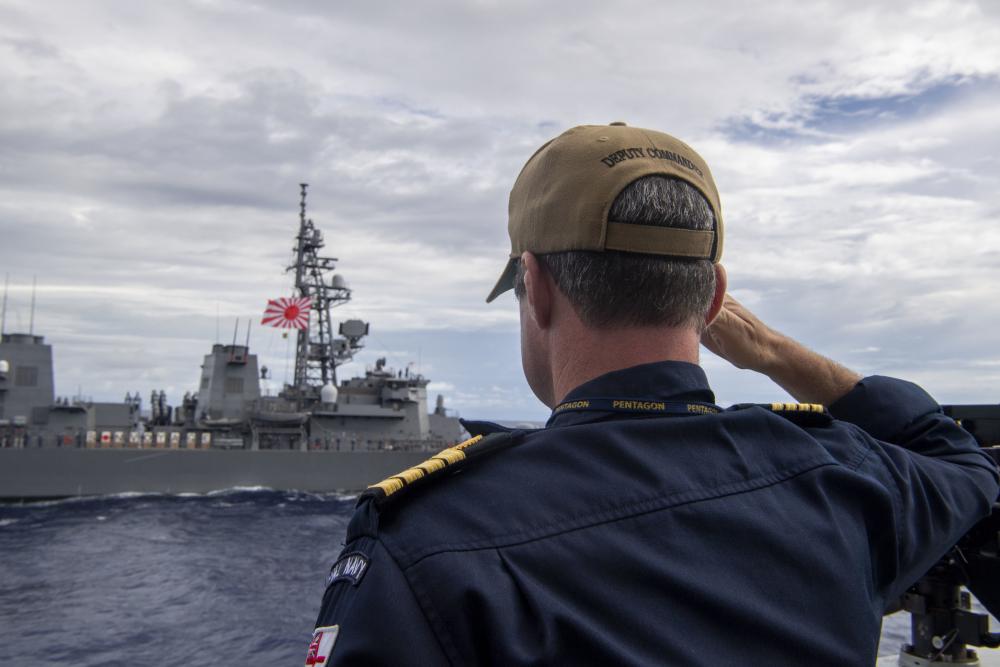
PACIFIC OCEAN (July 19, 2022) – Capt. Charles Maynard of the Royal Navy, serving as deputy mission commander of Pacific Partnership (PP22), renders honors as Japan Maritime Self-Defense Force (JMSDF) ship JS Kirisame (DD 104) passes Navy River Class vessel HMS Tamar (P233) during a multilateral search and rescue exercise (SAREX) coordinated with the U.S. Navy, Republic of Palau, U.S. Coast Guard, Japan Maritime Self-Defense Force and Royal Navy in support of PP22. Now in its 17th year, Pacific Partnership is the largest annual multinational humanitarian assistance and disaster relief preparedness mission conducted in the Indo-Pacific. (U.S. Navy photo by Mass Communication Specialist 2nd Class Brandie Nuzzi)

Below is a press release reporting a multinational SAR exercise involving units from the United Kingdom, Japan, and the Republic of Palau as well as the US Navy and Coast Guard. (46 photos here)

There are some noteworthy aspects to this exercise.

Re the USCG: First that there is a Coast Guard liaison officer to the Compact of Free Association States, Lt. Cmdr. Field Cassiano. Second, USCGC Myrtle Hazard, commissioned just over a year ago has conducted “sovereignty and fisheries patrols with five Pacific island nations.” She has been very busy. 

Re growing Allied interest: The participation of Britain and Japan is relatively new.

The UK has recently shown renewed interest in the Pacific after decades with virtually no forces in the Pacific. The Royal Navy vessel in the exercise, HMS Tamar, is one of two River Class Batch II Offshore Patrol Vessels that have embarked on a five year deployment to the Indian and Pacific Oceans. There are plans to permanently deploy a task force to the area and there is also a growing partnerships between the UK and Japan.

Since WWII, Japan has generally kept a low profile in international affairs but with the emergence of an agressive and overtly hostile China, Japan has started to assume a leadership role in the region. She has transferred offshore patrol vessels to several nations in SE Asia. For the first time, Japan is starting to maket weapons internationally. I found it interesting that the Japanese participant in the SAR exercise was a destroyer rather than a Japan Coast Guard vessel. I have yet to see any evidence, the Japan Coast Guard is taking on an expeditionary role, as the US Coast Guard has done.

News Release

U.S. Coast Guard Forces Micronesia / Sector Guam

U.S. Coast Guard participates in multilateral search and rescue drill off Palau

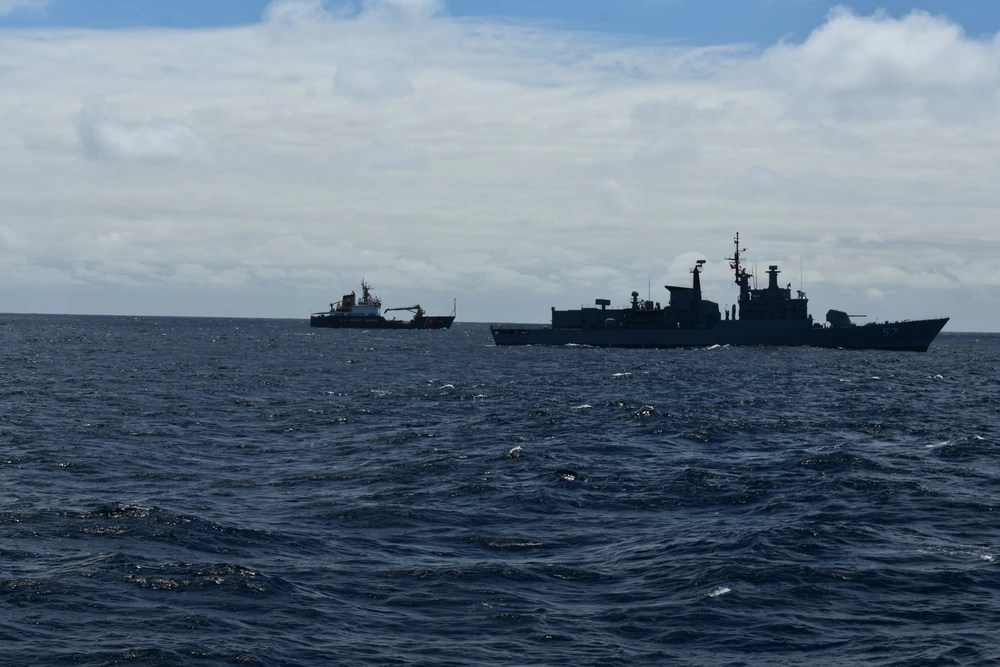
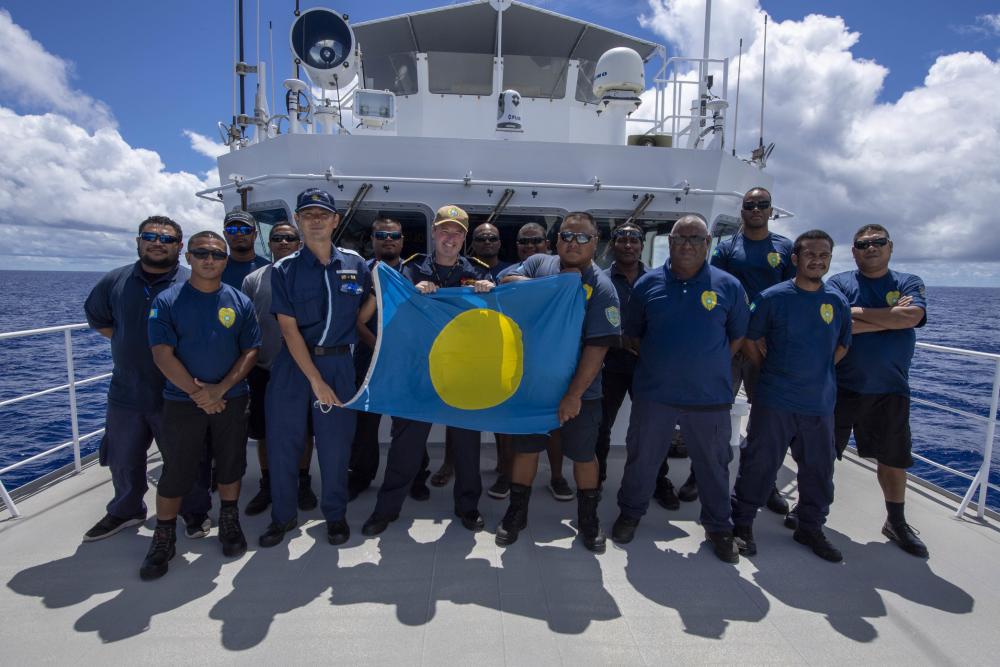
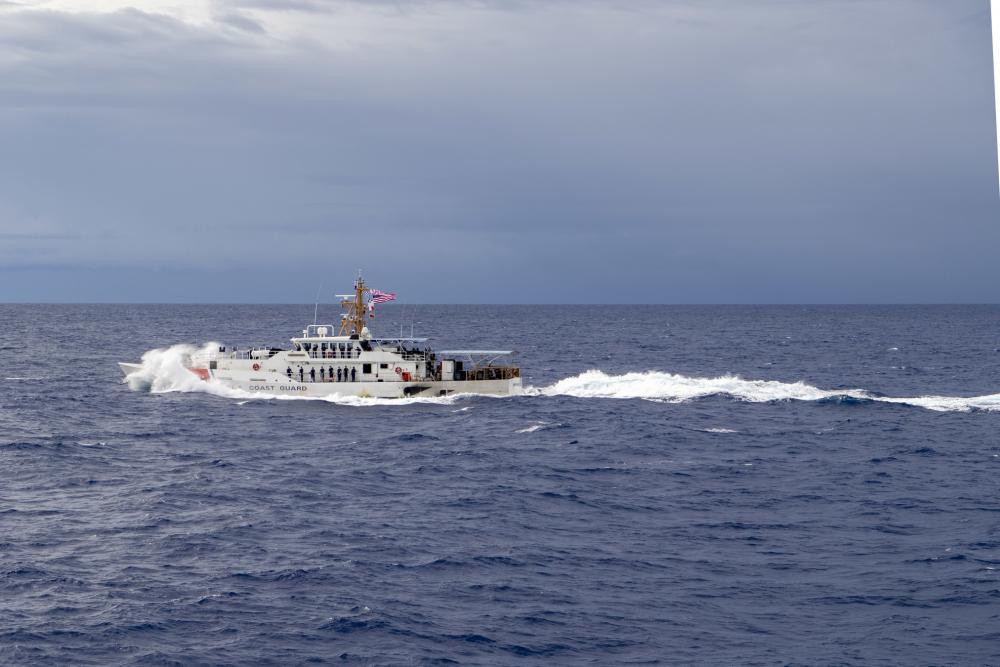
Royal Navy River Class vessel HMS Tamar (P233) sailors conduct boat operations with the USCGC Myrtle Hazard (WPC 1139)  Charles Maynard of the Royal Navy, serving as deputy mission commander of Pacific Partnership (PP22), center left, takes a photo with the crew of Palau Patrol Ship PPS Kedam Capt. Charles Maynard of the Royal Navy, serving as deputy mission commander of Pacific Partnership (PP22), renders a honors as Japan Maritime Self-Defense Force (JMSDF) ship JS Kirisame (DD 104) passes
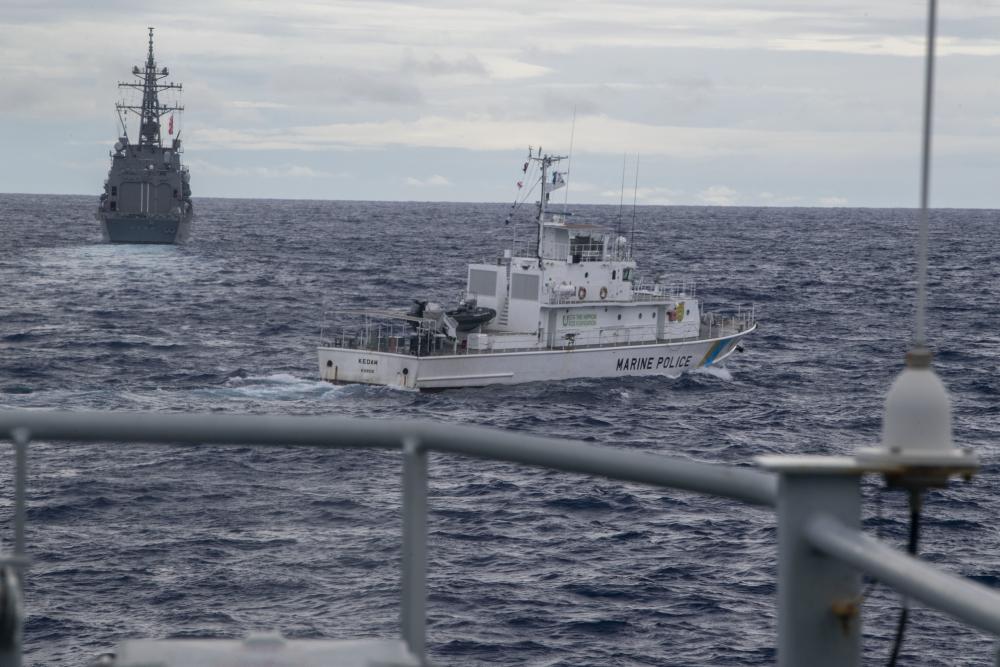
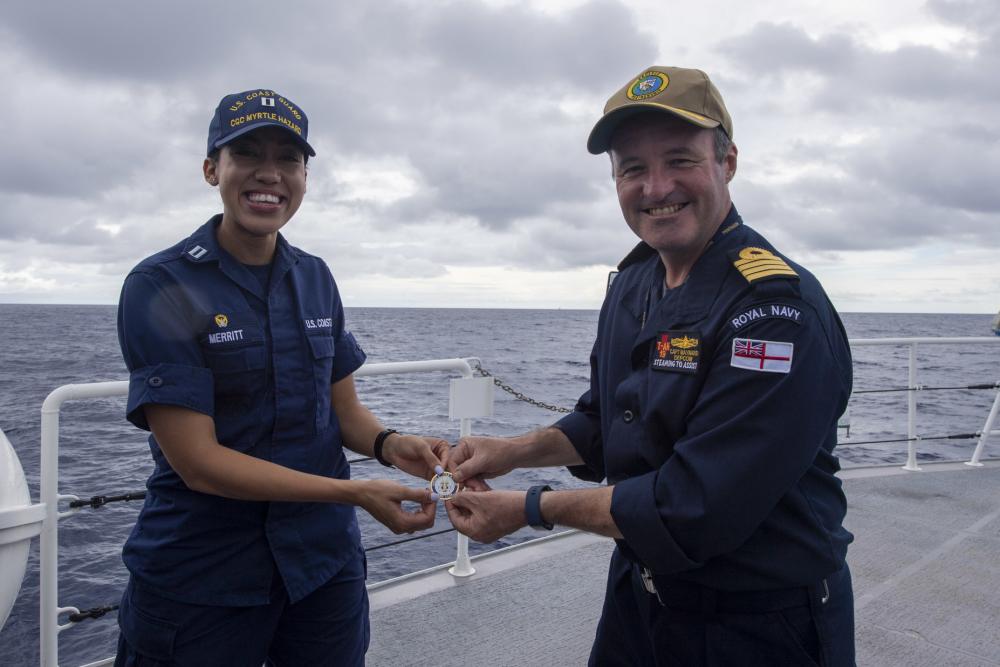
Japan Self-Defense Force (JMSDF) ship JS Kirisame (DD 104), front left, Palau Patrol Ship PPS Kedam, center, and Royal Navy River Class vessel HMS Tamar (P233) transit the Pacific Ocean during a multilateral search and rescue exercise (SAREX) Capt. Charles Maynard of the Royal Navy, serving as deputy mission commander of Pacific Partnership (PP22), right, receives a U.S. Coast Guard challenge coin from Lt. Jalle Merritt, commanding officer of USCGC Myrtle Hazard (WPC 1139)  USCGC Myrtle Hazard (WPC 1139) transits the Pacific Ocean during a multilateral search and rescue exercise (SAREX) coordinated with the U.S. Navy, Republic of Palau, U.S. Coast Guard, Japan Maritime Self-Defense Force and Royal Navy in support of Pacific Partnership 2022

Editors’ Note: To view more or download high-resolution photos click on the images above. Photos courtesy Petty Officer 2nd Class Brandie Nuzzi, USN.

SANTA RITA, Guam — In a bid to strengthen relationships and interoperability, the U.S. Coast Guard conducted a multilateral search and rescue drill alongside longtime partners from the United Kingdom, Japan, and the Republic of Palau in late July.

“We thrive on these opportunities, and we all came away with a deepened appreciation for the work of our respective agencies,” said Lt. Cmdr. Field Cassiano, Coast Guard liaison officer to the Compact of Free Association States. “Anyone who spends time in the Pacific is no stranger to the region’s vast distances and limited resources. Evolutions like this provide invaluable face-to-face interaction and enable us to work through challenges before an incident or crisis.”

Such events range from something akin to the search for Amelia Earhart to the far more common activity of a small skiff of fishers gone missing. It could also include a large-scale response for a disabled cruise ship or search and rescue of the crew of a commercial vessel like the car carrier Cougar Ace which heeled over at sea before being towed into port in 2008.

In this drill, the USCGC Myrtle Hazard (WPC 1139) crew, with support from the U.S. Coast Guard Fourteenth District and U.S. Coast Guard Forces Micronesia / Sector Guam, worked with the crews of the Palau Patrol Ship PPS Kedam, the Japan Maritime Self-Defense Force ship JS Kirisame (DD 104), and Royal Navy River Class vessel HMS Tamar (P233).

“Thoughtful planning led to realistic scenarios that were positively challenging, which demanded teamwork, shared vision, and high-level navigational expertise,” said Lt. Jalle Merritt, commanding officer of USCGC Myrtle Hazard. “It is fully in the realm of possibility that our partners and we will be called upon to support those in need, in heavy weather, near reefs, with a limited time to respond. Through drills such as those conducted this week, our multinational maritime response team remains ready to not only meet but exceed the needs of those our team serves.”

With decades of experience and one of the largest maritime rescue regions in the world, the U.S. Coast Guard in the Pacific works together with partners and neighbors to provide life-saving coverage throughout the region. The United States maintains several formal agreements with partners under strict compliance with international laws and regulations. These agreements include Search and Rescue (SAR) agreements with Japan, Australia, and the Republic of Palau, among other regional nations.

Historically, the U.S. Coast Guard and Palau hold regular search and rescue engagements to improve cooperation and processes between the Service and counterparts in Palau. This drill, one facet of Pacific Partnership 22, comes on the heels of a very successful humanitarian assistance and disaster relief workshop with 120 personnel trained.

Charles Maynard of the Royal Navy, serving as deputy mission commander of PP22, was on hand to oversee the exercise, part of PP22’s Palau phase.

The coordination between partner nations during PP22 enhanced understanding and cooperation and prepared those involved to respond in the case of a natural disaster or other humanitarian assistance and disaster relief scenario. Pacific Partnership contributes to regional stability and security through exchanges that foster enduring partnerships, trust, and interoperability between nations.

Now in its 17th year, Pacific Partnership is the most extensive annual multinational humanitarian assistance and disaster relief preparedness mission conducted in the Indo-Pacific.

The Myrtle Hazard is the 39th Sentinel-class fast response cutter. The ship arrived in Guam and commissioned along with its sister ships, Oliver Henry and Frederick Hatch, in July 2021. In the time since, the crew has participated in Operation Blue Pacific, conducting sovereignty and fisheries patrols with five Pacific island nations.

For more U.S. Coast Guard Forces Micronesia/Sector Guam news visit us on DVIDS or subscribe! You can also visit us on Facebook at @USCGSectorGuam.

-USCG-

“U.S. aims at PRC in new illegal fishing policy framework” –Indo-Pacific Defense Forum

Fijian law enforcement officers and U.S. Coast Guard personnel from USCGC MUNRO board a Chinese-flagged vessel off the coast of Fiji in April 2022 during patrols to counter illegal, unreported and unregulated fishing. IMAGE CREDIT: PO1 Nate Littlejohn, U.S. COAST GUARD

Indo-Pacific Defense Forum passed along an Associated Press report on US efforts to forge an international consensus to combat Illigal, Unreported, Unregulated (IUU) fishing, including  poor labor and environmental practices, first by applying a standard nationally,

It was expected to be followed quickly by new rules from the U.S. National Oceanic and Atmospheric Administration expanding the definition of illegal fishing to include related labor abuses, a first step to the eventual blacklisting of flag states that fail to comply.

Followed by work on an international treaty.

Significantly subsidies are now seen as unfair trade practice with disasterous impact on fish stocks. China has used subsidies to build the world’s largest fishing fleet, and they use it for more than just catching fish.

President Biden’s administration’s announcement came as the World Trade Organization (WTO) heralded a historic agreement, reaching a deal during its June 2022 conference in Geneva, Switzerland, to curb IUU fishing, reduce the strain on dwindling fishing stocks, and ensure more transparency and accountability through improved conservation and management measures. The WTO deal explicitly prohibits subsidies, considered by environmentalists to be the biggest contributing factor to depleting fish populations globally.

“Coast Guard Cutter Stratton returns to Alameda following 97-day South Pacific patrol” –News Release

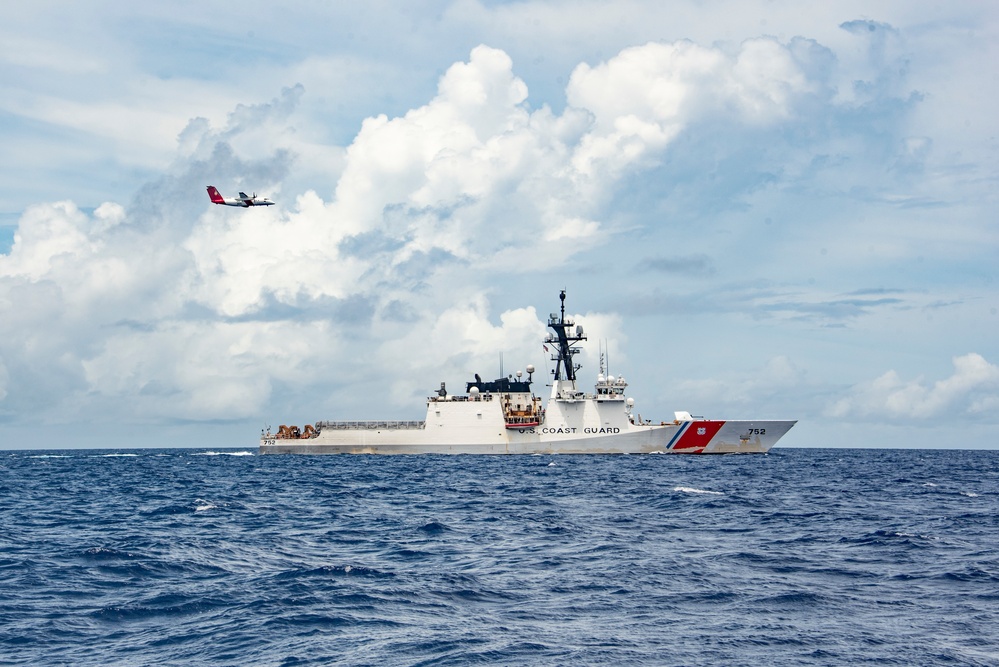
U.S. Coast Guard Cutter Stratton (WMSL 752) participates in a exercise with the Australian maritime surveillance aircraft in the South Pacific Ocean, Feb. 23, 2022. The Stratton is currently underway conducting exercises and operations with partner nations in the South Pacific region. (U.S. Coast Guard photo by U.S. Marine Corps Sgt. Sarah Stegall)

Just a news release, but it is about one of those increasingly common long deployments to the Western Pacific. Notable are the use of the small unmanned air system, presumably Scan Eagle, shiprider program with Fiji, and laying the ground work for a shiprider program with Papua New Guinea.

220130-N-CD319-1014 SOUTH PACIFIC OCEAN (Jan. 30, 2022) The Arleigh Burke-class guided-missile destroyer USS Sampson (DDG 102) participates in Divisional Tactics (DIVTAC) formations with U.S. Coast Guard Cutter Stratton (WMSL 752) and British Royal Navy ship HMS Spey (P 234). Sampson is positioned to conduct lifesaving actions in support of disaster relief efforts in Tonga. The ship is operating in support of the Australian Defence Force (ADF). The Australian Government response is coordinating closely with France and New Zealand under the FRANZ partnership, alongside Fiji, Japan, United Kingdom and the United States to assist Tonga in its time of need. Sampson is on a scheduled deployment in the U.S. 7th Fleet area of operations to enhance interoperability with alliances and partnerships while serving as a ready-response force in support of a free and open Indo-Pacific region. (U.S. Navy photo by Mass Communication Specialist 3rd Class Tristan Cookson)

News Release

March 21, 2022
U.S. Coast Guard Pacific Area

Coast Guard Cutter Stratton returns to Alameda following 97-day South Pacific patrol

Photo of CGC Stratton Photo of CGC Stratton Photo of boarding
Photo of boarding Photo of Fiji press event Photo of boarding

Editors’ Note: Click on images above to download high resolution versions. Additional photos are available here.

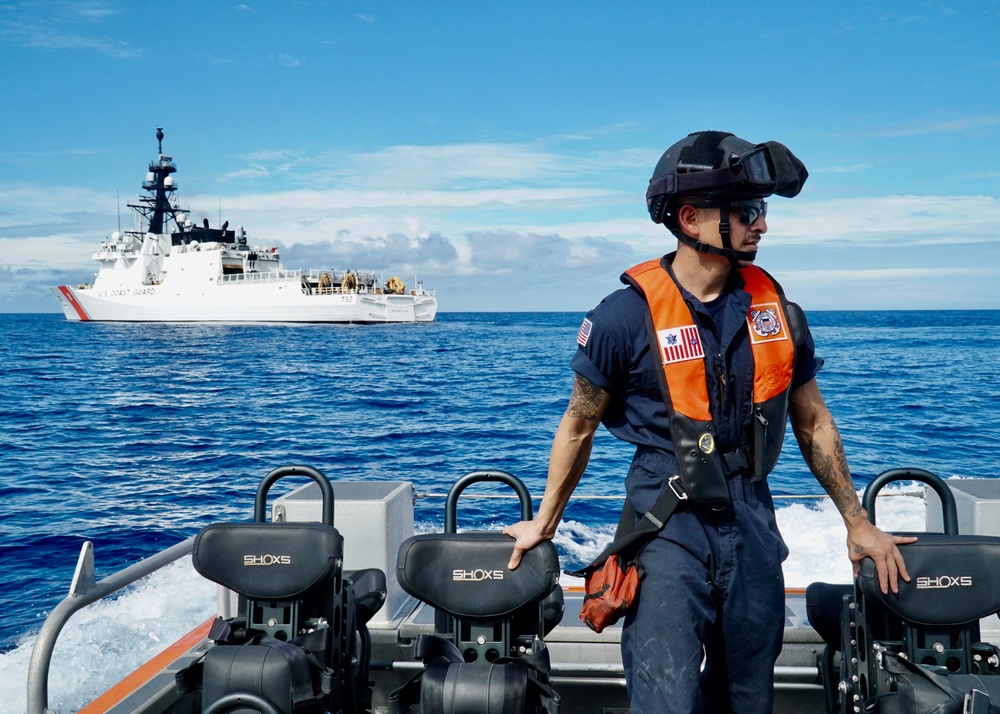
ALAMEDA, Calif. — The crew of Coast Guard Cutter Stratton (WMSL 752) returned to Alameda Saturday after completing an Operation Blue Pacific Patrol in the south Pacific.

While underway, Stratton’s crew worked with Pacific partner nations, including Fiji, France, New Zealand, Papua New Guinea, Australia, and the United Kingdom on an array of missions and prioritized combating Illegal, Unreported, and Unregulated fishing on the high seas or in partner nations’ exclusive economic zones.

In the effort to combat IUU fishing, Stratton teams boarded 11 vessels during the 20,348-mile patrol and found 21 violations.

“Our collaboration with our partners and utilization of our shiprider agreements gave us the ability to accomplish our mission of combatting illegal, unreported, and unregulated fishing in order to maintain regional stability and protect the fishing industry,” said Capt. Steve Adler, Stratton’s commanding officer. “By bringing aboard shipriders from Fiji, we were able to patrol their exclusive economic zones to better assist them in enforcing their maritime laws.”

In February, Stratton embarked three shipriders from Fiji with representatives from the Fiji Revenue and Customs Services, the Fiji Ministry of Fisheries, and the Republic of Fiji Navy, who led bilateral enforcement efforts for Stratton to patrol their exclusive economic zones.

There is a shared interest for both Fiji and the United States, as well as other partner nations, to protect fisheries as they provide a renewable source of food and income to the Pacific nations.

The Stratton crew also used small Unmanned Aircraft Systems to increase the ship’s capabilities and further extend the cutter’s patrol area.

“Stratton’s capacity for employing cutting edge technology like sUAS, gives the Coast Guard the upper hand in the fight against IUU fishing,” said Cmdr. Charter Tschirgi, Stratton’s executive officer. “The vast area covered during patrols like these displays the reach the Coast Guard has and the length we will go to assist our partners in the Pacific.”

Stratton visited multiple countries while deployed, including Tahiti, Fiji, and Papua New Guinea. While in Suva, Fiji, Stratton hosted a joint media engagement with the Fijian Permanent Secretary for Ministry of Defense, Manasa Lasuma, and the Fijian Permanent Secretary for the Ministry of Foreign Affairs, Yogesh Karan. While anchored in Port Moresby, Papua New Guinea, Stratton also hosted an engagement and law enforcement demonstration in conjunction with U.S. Ambassador Erin McKee and representatives of Papua New Guinea: Chief Inspector Christopher Smith, Terry Udu, Moses Teng, Hiribuma Dabuma, MAJ Norbeth Fehi, and Ivan Salonica. This discussion and demonstration of law enforcement operations and regional partnerships helped facilitate a future signing of a bilateral shiprider agreement between Papua New Guinea and the United States.

“Communicating with our allies face-to-face is extremely valuable,” said Ensign Alexander Mastel, Stratton’s public affairs officer. “With IUU fishing replacing piracy as the leading global maritime security threat, it is more important than ever to join efforts in ensuring economic security in the Pacific.”

While on patrol, Stratton’s crew also participated in multiple joint exercises with partners in the region. These included a formation sailing with the HMS Spey, a tactical maneuvering drill with HMS Spey and USS Sampson, a joint patrol with an Australian Border Force patrol aircraft, fueling-at-sea with New Zealand’s newest replenishment vessel HMNZS Aotearoa, and joint steaming with the French Naval vessel FMS Arago and Fijian Patrol vessel Savenaca.

“Partnerships across the Pacific are the key to success in combatting illegal, unreported, and unregulated fishing. I am extremely proud of the crew for demonstrating tremendous success in partnering and operating with our regional partners and allies across Oceania, including navies and law enforcement officials from French Polynesia, Fiji, Papua New Guinea, New Zealand, Australia, and the United Kingdom,” said Adler. “Only by building these continued relationships and joint operations with patrols like Stratton’s Operation Blue Pacific will we be able to truly make a difference and impact against the global problem of IUU fishing. By training with our partners, we further our interoperability and cooperation, ultimately advancing a peaceful, free and open Indo-Pacific.”