“Head of Royal Canadian Navy Outlines Ottawa’s Pacific Strategy” –USNI

This is starting to get a little old, but I am trying to catch up.

US Naval Institute reports on a Center for Strategic and International Studies (CSIS) interview with Vice Adm. Angus Topshee, Commander, Royal Canadian Navy, Chief of the Naval Staff, that discusses their Navy’s increased emphasis on the Pacific.

I have included the video of the interview above.

Three AOPSs at pier before the commissioning ceremony for HMCS Margaret Brooke (AOPV-431). Canadian Navy photo

He discusses operating with the Coast Guard for drug interdiction, icebreaking, and fisheries beginning about time 9:00. The new Arctic Offshore Patrol Ships are expected to play important roles in these activities.

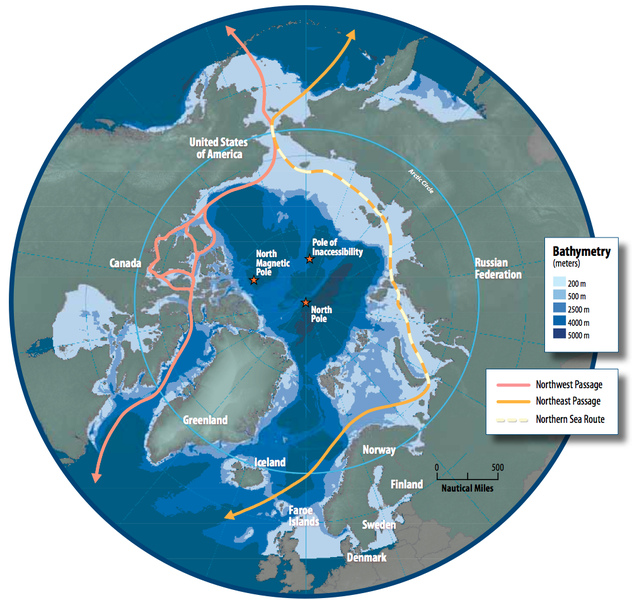
Map of the Arctic region showing shipping routes Northeast Passage, Northern Sea Route, and Northwest Passage, and bathymetry, Arctic Council, by Susie Harder

He explains why he does not see the NW Passage (which includes Alaskan waters) as a future international trade route (12:30).

He anticipates an end to the moratorium on fishing in the Arctic (14:30).

Discusses response to “Gray Zone” threats to undersea infrastructure (15:30).

Discussed war in Ukraine (19:00). Re sinking of Moskva, “Cruise missiles should not sink ships” (20:30). Drones (21:00). AI (24:50).

Where will they concentrate their efforts–Indo-Pacific (27:00). AOPS will be used for Fisheries in the Western Pacific.

Artic is an expeditionary theater, you have to bring everything with you, because there are no port facilities (29:00). Looking to create dual use facilities.

Recruiting (31:30). National Shipbuilding program (35:30), Technology sharing.

“Allies, partners tap into technology to monitor maritime domain” –Indo-Pacific Defense Forum

Winkel Tripel projection, WGS84 datum, central meridian : 150°E. Source Wikipedia Commons, Author: Eric Gaba

The Indo-Pacific Defense Forum reports,

“Maritime domain awareness (MDA) in the Indo-Pacific is moving from an abstract aspiration to a functional collective security approach for managing the region’s dynamic offshore spaces,” noted an April 2023 article in PacNet, a publication of Pacific Forum, a Hawaii-based foreign policy research institute. “Much of the cost-savings in maritime enforcement activities is due to emerging technologies including access to satellites that provide clearer and more accurate images, as well as artificial intelligence and big data platforms dedicated to vessel tracking, prediction, and anomaly detection.”

There are fusion centers in India, Singapore and Vanuatu. These fusion centers would be useful in wartime, but they are essentially a cooperative exchange of information among maritime law enforcement agencies. In addition to its importance in countering IUU and drug smuggling, better maritime domain awareness may give warning of a terrorist attack. Shouldn’t the US Coast Guard have a fusion center in Alameda under Pacific Area? Probably should be one on the West coast of South America too.

“U.S. Coast Guard Cutter Harriet Lane arrives at new homeport in Pearl Harbor” –News Release

USCGC Harriet Lane arrives Pearl Harbor. USCG Photo.

Below is a news release from CG News (more photos there). As part of the prototype SLEP, her 76mm Mk75 gun and Mk92 fire control system have been removed. The AN/SLQ-32 has been retained. It appears there are now additional communications antenna in place of the fire control system, and a 25mm Mk38 gun weapon system is mounted on a bandstand in place of the 76mm.


Dec. 13, 2023

U.S. Coast Guard Cutter Harriet Lane arrives at new homeport in Pearl Harbor

HONOLULU – U.S. Coast Guard Cutter Harriet Lane (WMEC 903) and crew arrived at its new homeport at Joint Base Pearl Harbor-Hickam, Wednesday, after transiting more than 8,000 nautical miles over 36-days from Portsmouth, Virginia.

The Harriet Lane is U.S. Coast Guard Pacific Area’s newest Indo-Pacific support cutter and spent more than 15 months in a Service Life Extension Program (SLEP) in Baltimore, Maryland, to prepare for the transition in missions and operations. Following reconstitution of the crew in July and returning to Portsmouth in August, the crew went through an extensive dockside period, ensuring the cutter was ready for the transit from the Atlantic Ocean to the Pacific Ocean.

“Re-homeporting U.S. Coast Guard Cutter Harriet Lane is indicative of the Coast Guard’s commitment to the Indo-Pacific – the most dynamic region in the world,” said Rear Admiral Brendan McPherson, deputy commander, U.S. Coast Guard Pacific Area. “Harriet Lane will work by, with, and through allies and partners within the Indo-Pacific region to promote capacity building and model good maritime governance.”

“The crew and I look forward to building partnerships in Oceania to enhance our capabilities, strengthen maritime governance and security while promoting individual sovereignty,” said Cmdr. Nicole Tesoniero, commanding officer of the Harriet Lane. “We plan to build upon many decades of enduring support, operating in concert with the needs of our partners.”

Harriet Lane and crew departed Coast Guard Base Portsmouth, November 2023, and during the transit, the crew conducted trainings for upcoming operations along with professional development for crewmembers. Harriet Lane transited through the Panama Canal, and had port calls in Golfito, Costa Rica and San Diego.

Harriet Lane, commissioned in 1984, is a 270-foot medium endurance cutter now homeported in Honolulu to support Coast Guard missions in the Pacific region. The service’s medium endurance cutter fleet supports a variety of Coast Guard missions including search and rescue, law enforcement, maritime defense, and protection of the marine environment.

“US Coast Guard Seeks Bigger Role to Search, Board Vessels in Pacific” –gCaptain

PERU, 10.07.2023, Courtesy Photo, USCG District 11
A Coast Guard boarding team member catches a view looking aft across the deck of a squid jigger vessel during a boarding inspection, with Coast Guard Cutter Alder in the background, during Operation Southern Shield 2023, October 2023. The Coast Guard recently completed the first high-seas boardings and inspections off the coast of Peru under a newly adopted multi-lateral agreement to monitor fishing and transshipment operations within the South Pacific Regional Fisheries Management Organization (SPRFMO) Convention Area. (U.S. Coast Guard photo)

gCaptain gives us a sort of status report on the Coast Guard’s emerging role in Western Pacific international fisheries enforcement.

“Coast Guard hosts Pacific Quadrilateral Coordinating Group on Oahu” –CG News

Below is a news release from Coast Guard News. Looks like Western Pacific fisheries is finally getting the attention it has deserved. The “Pacific Quad” mentioned here (Australia, France, New Zealand, and the US) should not be confused with “The Quad” (Australia, India, Japan, and the US) which is an informal military association.

I am still hoping to see my “Combined Maritime Security Task Force, Pacific” formed.

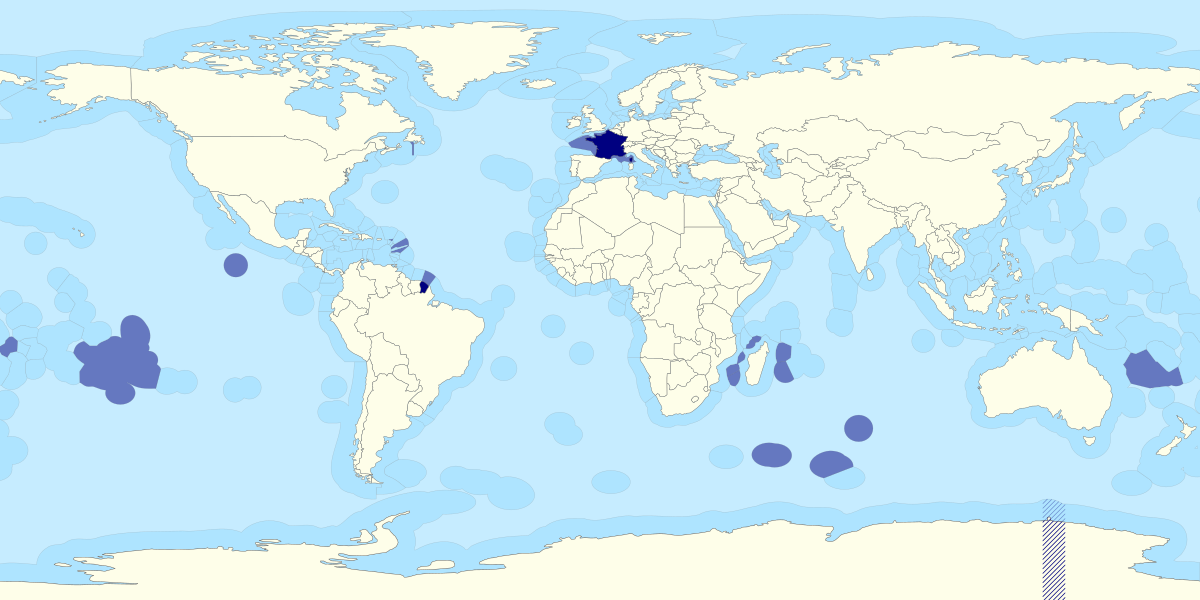
Territory of France and its Exclusive Economic Zone. (Antarctic territorial claims in lighter tone). Credit B1mbo via Wikipedia.

If you are wondering why France is in this group, take a look at their Exclusive Economic Zone, above.


Nov. 3, 2023

Coast Guard hosts Pacific Quadrilateral Coordinating Group on Oahu

HONOLULU — The U.S. Coast Guard recently hosted the Pacific Quadrilateral Defense Coordinating Group from Oct. 9 to 11, 2023, focusing on enhancing maritime security in the Pacific.

The meeting gathered leaders from Australia, France, New Zealand, the United States, and the Forum Fisheries Agency. Rear Adm. Michael Day, U.S. Coast Guard District 14 commander, emphasized the importance of this collaboration, particularly in the context of regional challenges such as climate change and security.

“These face-to-face meetings and continued cooperation among our nations are not just strategic imperatives; they are lifelines to the people of the Blue Pacific,” said Day.

He further highlighted the impact of this collaboration, emphasizing the human element and recognizing the responsibilities of the larger nations in the Pacific, “We acknowledge the historical context, and while we do not seek to rewrite the past, we are committed to a future where the sovereignty and livelihoods of Pacific Island Countries are safeguarded. Climate change, followed by regional tensions, looms large as challenges we all face, and our shared responsibility is to address these threats. Our commitment to combating illegal fishing and ensuring maritime safety is not just about security; it’s about ensuring a sustainable and secure future for the communities who call the Pacific home.”

The Pacific QUAD was established in 1998, and brings together defense and security agencies from Australia, France, New Zealand and the United States in a mutual commitment to partnering with the Pacific Island countries to collectively enhance regional security.

During the meeting, discussions covered various topics, including their annual report, training programs, tactical calendar, information sharing and support for the Forum Fisheries Agency operations. Additionally, three new principals joined the group. Brig. Gen. Yann Latil (France), Air Comm. John Haly (Australia), and Brig. Gen. Andy Shaw (Aotearoa New Zealand).

The Pacific QUAD’s mission is to combat illegal fishing in the Southwest Pacific and collaborate closely with Pacific Island nations. The group operates at both a strategic and operational level, with annual and biannual meetings, respectively.

This year, examples of their collaboration included: an agreement with New Zealand, joint gatherings and strengthening cooperation with Australian Maritime Security Advisors, a successful search and rescue operation, and an international mass rescue exercise, highlighting the positive impact of their efforts on regional stability and maritime safety.

The Pacific QUAD, consisting of New Zealand, the United States, France, and Australia, annually rotates its principal chairmanship position as part of its collaborative approach. Last year, Air Commodore Darryn Robert Webb of New Zealand handed over the role to Rear Adm. Michael Day, who has now passed it to Brig. Gen. Yann Latil, the commander of French Forces New Caledonia. Latil is expected to transfer the responsibility to Air Commodore John Haly, the Australian Joint Operations Command, Director General Operations and Plans (J3), next year. This rotation underscores the ongoing commitment of the Pacific QUAD nations to regional stability and cooperation.

“After a very successful meeting in Honolulu this year, I am happy to take over the American coordination of the Pacific Quad’s work and I look forward to hosting my fellow principals and their teams in Noumea next year,” said Brig. Gen. Yann Latil, the commander of French Forces New Caledonia.

U.S. Coast Guard District 14, covering a vast area in the Central and Western Pacific, plays a crucial role in maritime safety, resource protection, security and national defense through partnerships and international engagement.

Getting Real About the “Global Coast Guard” –USNI

210524-G-N0146-0073 ARABIAN GULF (May 24, 2021) – Patrol boat USCGC Maui (WPB 1304) and fast response cutter USCGC Robert Goldman (WPC 1142) transit the Arabian Gulf en route to Bahrain, May 24. Robert Goldman and USCGC Charles Moulthrope (WPC 1141) are the newest additions to Patrol Forces Southwest Asia (PATFORSWA), which is comprised of six 110′ cutters, the Maritime Engagement Team, shore side support personnel, and is the Coast Guard’s largest unit outside of the U.S. playing a key role in supporting Navy security cooperation, maritime security, and maritime infrastructure protection operations in the U.S. 5th Fleet area of operations. (U.S. Coast Guard photo by Seaman Logan Kaczmarek)

The October issue of US Naval Institute Proceedings has a “Nobody asked me, but…” commentary from Commander Kevin Duffy, U.S. Coast Guard (Retired), about making the Coast Guard’s international engagement more effective and more agile. Among the comments is an explanation of why we have not seen the PATFORSWA model replicated in other areas.

He recommends the Coast Guard:

  • Change its culture and messaging around international missions and engagement.
  • Grow overseas training teams and unchain them from DoD processes and funding.
  • Formalize and improve personnel policies related to overseas assignments, offices, and career paths.

Check out the post for more detail.

“Papua New Guinea leads joint maritime operations with U.S. Coast Guard” –Coast Guard News

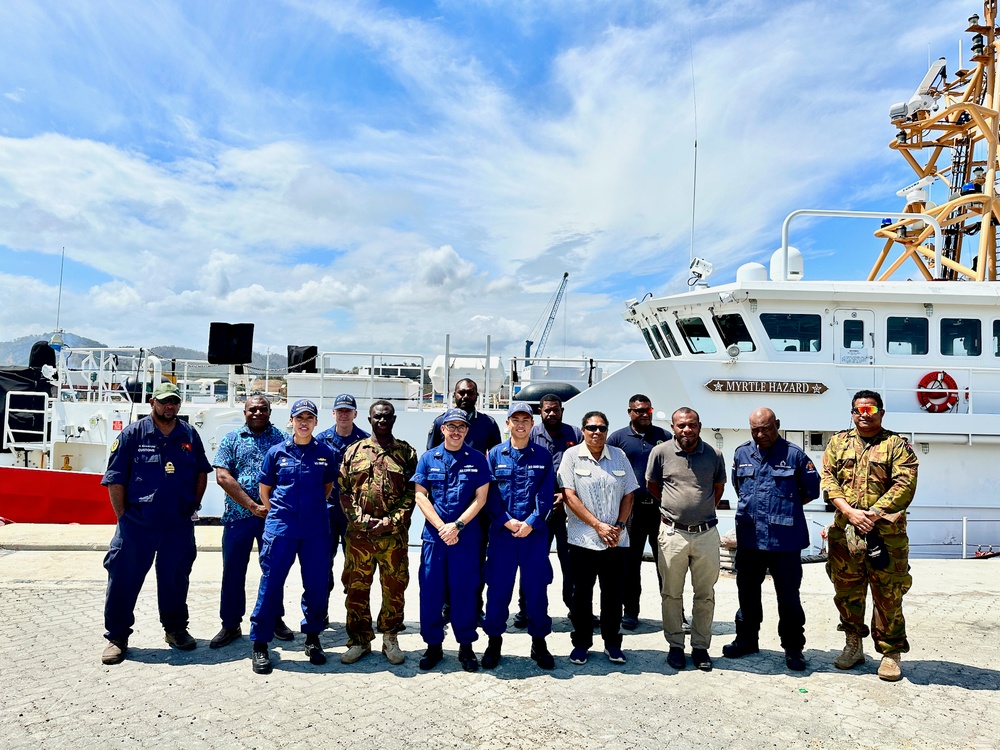
USCGC Myrtle Hazard (WPC 1139) hosts operational planning and subject matter exchange with partners in Port Moresby, Papua New Guinea

The USCGC Myrtle Hazard (WPC 1139) command stand for a photo with partners from the Papua New Guinea Defense Forces, Customs Services, National Fisheries Authority, and Department of Transport’s maritime security division following an operational planning and subject matter exchange with partners in Port Moresby, Papua New Guinea on Aug. 22, 2023. The U.S. Coast Guard is in Papua New Guinea at the invitation of the PNG government to join their lead in maritime operations to combat illegal fishing and safeguard maritime resources following the recent signing and ratification of the bilateral agreement between the United States and Papua New Guinea. (U.S. Coast Guard photo by Chief Warrant Officer Sara Muir) 

Passing along this from Coast Guard News. Like the fact that the Papua New Guinea government is taking the lead on this. We are helping them build capacity not doing the job for them.


Aug. 23, 2023

Papua New Guinea leads joint maritime operations with U.S. Coast Guard

Editor’s Note: For more images, please click here

PORT MORESBY, Papua New Guinea — Papua New Guinea (PNG) has invited the USCGC Myrtle Hazard (WPC 1139) to join their lead in maritime operations to combat illegal fishing and safeguard maritime resources during August 2023.

This collaborative effort marks the first time a joint patrol effort will be executed at sea since the signing and ratification of the recent bilateral defense agreement between PNG and the United States, which allows the U.S. to embark shipriders from PNG agencies aboard the ship to conduct at sea boardings on other vessels operating in the exclusive economic zone (EEZ) under their national agency authority. This is the U.S. Coast Guard vessel deployment first announced during Secretary of Defense Austin’s engagement with Prime Minister James Marape in July.

PNG’s lead in this mission aligns with their sovereign rights to protect the EEZ and emphasizes the country’s commitment to maritime domain awareness, fisheries regulation enforcement, and sovereignty protection. The PNG government requested the U.S. Coast Guard’s participation to utilize the platform and crew of the Guam-based 154-foot Fast Repones Cutter, currently on an expeditionary patrol, to expand coverage of the heavily trafficked maritime EEZ.

“Through our recent operational planning and subject matter exchange, the partnership between the Papua New Guinea Defence Force and the U.S. Coast Guard reached new heights. The spirit of collaboration and shared mission to ensure regional maritime security reflects our nations’ aligned values and commitment. This initiative fosters growth in our bilateral relationship and paves the way for innovative approaches to safeguard our waters and the sustainable use of our ocean resources. Working alongside the U.S. Coast Guard is an honor, and PNGDF eagerly anticipates our cooperative efforts’ continued growth and success,” said Commodore Philip Polewara, the Acting Chief of the PNG Defence Force.

The PNG-led patrol aims to observe activity and conduct boardings to reduce illegal fishing and illicit maritime activities in PNG’s EEZ. It’s part of a long-term effort to counter illegal maritime activity and safeguard the sustainable use of maritime resources.

This collaboration is vital to Operation Blue Pacific and augments ongoing efforts by the Pacific Islands Forum Fisheries Agency and Western and Central Pacific Fisheries Commission. It underscores the recent bilateral agreement, signed in May and ratified in the last few weeks, enabling the Myrtle Hazard crew to work collaboratively within PNG’s legal framework and strengthen relations with agencies with shared objectives.

The USCGC Oliver Henry (WPC 1140) crew was the first U.S. Coast Guard Fast Response Cutter to call on port in Papua New Guinea during their southern expeditionary patrol in the fall of 2022 to build relations, conduct engagements, and resupply.

The USCGC Myrtle Hazard’s crew is building on the work of their colleagues – already engaging with the PNG Defense Force through exchanges in the northern part of the country on this patrol, bolstering cooperation and understanding. This activity included subject matter exchanges with the PNG Defense Force Patrol Vessel Ted Diro crew and a port call in Rabaul, where the team engaged with the local community at the Rabaul Yacht Club. Additionally, the advance team and cutter crew conducted operations planning and subject matter exchanges across agencies in Port Moresby and ship tours for the embassy team and partners.

“We are deeply honored to collaborate with the Papua New Guinea Defense Force, Papua New Guinea Customs Services, Papua New Guinea National Fisheries Authority, and the Department of Transport’s Maritime Security Division at the invitation of the Papua New Guinea Government,” said Lt. Jalle Merritt, commanding officer of the USCGC Myrtle Hazard. “Our shared mission reflects PNG’s leading role in regional security, and we are committed to supporting their goals in this significant undertaking.”

For more information about this patrol and other related activities, please contact Chief Warrant Officer Sara Muir at sara.g.muir@uscg.mil or the respective agencies in Papua New Guinea.

“U.S. Coast Guard Forces Micronesia Sector/Guam’s Fast Response Cutters bolster Pacific Partnership Strategy and strengthen Pacific Island Country relations” –USCG Forces Micronesia/Sector Guam

The Sentinel-class fast response cutter USCGC Oliver Henry (WPC 1140) crew arriving in Port Moresby for a port visit on Aug. 23, 2022, following a patrol in parts of the Coral Sea, the Solomon Islands and PNG Exclusive Economic Zones. The U.S. Coast Guard was conducting a routine deployment in Oceania as part of Operation Blue Pacific, working alongside Allies, building maritime domain awareness, and sharing best practices with partner nation navies and coast guards. (U.S. Coast Guard photo by USCGC Oliver Henry)

Below is a news release from U.S. Coast Guard Forces Micronesia/Sector Guam. Webber class cutters there are developing a new norm for Coast Guard assistance to Pacific Island nations. It is not clear if this is now the norm, or if this was an unusual period, but from June 21 to August 3, there was only one day (June 17) that they did not have an FRC underway for at least part of the day. This is what I believe should be the norm and probably the reason FRCs are so frequently based in groups of three or six. Typically three ships would be, one underway, one in maintenance, and one in workup/standby (I don’t know if they are employing standby). 

On the other hand, none of these patrols was more than 16 days long and the shortest only five, which suggest why, given the long transit distances, we need some cutters with greater endurance in the Western Pacific (I would say three to have one underway at all times and be able to surge two when needed).

Thanks to Paul for bringing this to my attention.

Aug. 18, 2023

U.S. Coast Guard Forces Micronesia Sector/Guam’s Fast Response Cutters bolster Pacific Partnership Strategy and strengthen Pacific Island Country relations

SANTA RITA, Guam — In a robust display of maritime commitment, U.S. Coast Guard Forces Micronesia/Sector Guam’s Fast Response Cutters conducted four patrols over 44 days, enhancing safety and prosperity in the Pacific Islands region while combatting illicit maritime activity, including illegal, unregulated, and unreported fishing and the illegal and unsafe transport of passengers.

The crews of USCGC Frederick Hatch (WPC 1143), USCGC Myrtle Hazard (WPC 1139), and USCGC Oliver Henry (WPC 1140):

– Conducted seven boardings and five observation reports.
– Completed over 20 training evolutions.
– Qualified 18 new shipboard members.
– Supported the investigation into the transport of 11 people aboard an overloaded vessel transiting to Guam from the Commonwealth of the Northern Mariana Islands on an illegal charter following their rescue by DoD partners.
– Supported operations such as Operation Blue Pacific, Operation Rematau, Operation Nasse, and Operation Koa Moana.

“Our Fast Response Cutter crews exhibit both efficacy and presence as a consistent and trusted partner in the region. Our Pacific Island Country partners’ warmth and regard for the Coast Guard is a testament to the strong connections we have nurtured over the years. It is our commitment to the people of the Pacific Island Countries to protect Oceania and its resources for them from undue strategic competition that would undermine those relationships and destabilize the region,” said Cmdr. Greg Sickels, deputy sector commander of U.S. Coast Guard Forces Micronesia/Sector Guam.

Operational Achievements and Highlights

– USCGC Frederick Hatch (June 21 – July 2 and July 18 – Aug. 3): Enhanced international relations, streamlined boarding processes, qualified new personnel, and improved communication with FSM Maritime Police.

– USCGC Myrtle Hazard (July 3 – 16): Strengthened connection with CNMI, ensured maritime law enforcement presence in less patrolled areas, and enhanced collaboration with customs and public safety departments.

– USCGC Oliver Henry (July 18 – 23): Increased U.S. presence, enforced fishing regulations, and fostered crew readiness with weapons proficiency and collaboration.

These accomplishments underscore the U.S. Coast Guard’s pivotal role in promoting maritime governance, ensuring good relations, and fostering strategic competition in the Pacific Islands region. The U.S. Coast Guard remains a consistent and reliable partner, working collaboratively with Pacific Island Countries to achieve shared objectives and bolster regional security.

Operation Rematau, an integral part of Operation Blue Pacific, is spearheaded by the U.S. Coast Guard Forces Micronesia/Sector Guam. This initiative fosters security, safety, sovereignty, and economic prosperity throughout Oceania. Rematau translates to “people of the deep sea” and embodies the Coast Guard’s unwavering commitment to safeguarding the people of this region.

The U.S. Coast Guard actively exercises 12 bilateral maritime law enforcement agreements with Pacific Island Countries, reinforcing maritime law enforcement operations and domain awareness in the region. In October 2022, the Service, on behalf of the U.S., signed the first enhanced bilateral agreement with the Federated States of Micronesia. This landmark agreement builds on the existing shiprider arrangement, allowing the U.S. Coast Guard to conduct boardings in the FSM’s exclusive economic zone with prior approval working with the FSM National Police, but without an FSM officer physically present. This expansion significantly amplifies the FSM’s capacity to protect its sovereignty and resources across an area spanning 1 million square miles and more than 600 islands. Boardings have already been conducted under this enhanced shiprider agreement, attracting interest in similar arrangements from other nations in the area.

In May 2023, the U.S. signed a new bilateral agreement with Papua New Guinea, richly endowed with natural resources like gold, copper, oil, and natural gas. While its formal sector focuses on exports of these commodities, most of its people rely on subsistence agriculture. As of 2020, agriculture, forestry, and fishing reportedly account for nearly 19 percent of PNG’s GDP. The agreement aligns with the PNG government’s efforts to safeguard their islands and 1.2 million square miles of EEZ, which are vital to their economic well-being. Recently ratified by their parliament, this partnership, at the request of the Papua New Guinea government, further extends the reach and impact of maritime law enforcement efforts. In line with this initiative, a U.S. Coast Guard cutter from Guam will be collaborating with Papua New Guinea to enact their new agreement shortly, continuing to foster security and collaboration across the Pacific.

U.S. Coast Guard Forces Micronesia/Sector Guam comprises more than 300 members based in Guam and the Commonwealth of the Northern Mariana Islands spread across shoreside and afloat units committed to maritime safety, security, and stewardship in Oceania.

For more information on the U.S. Coast Guard Forces Micronesia Sector/Guam’s operations and achievements, please visit the official DVIDS account at https://www.dvidshub.net/unit/USCG-FMSG.

“Coast Guard Cutter Bertholf returns home after 120-day Bering Sea patrol” –Coast Guard News

Aerial view of Kotzebue, Alaska, U.S. U.S. Army Corps of Engineers, photographer not specified or unknown

Below is a US Coast Guard News report. This was a “Bering Sea Patrol” or what we used to call an Alaska Patrol or ALPAT, but it actually went further North than the Bering Sea.

Northwest Arctic Borough Alaska incorporated and unincorporated areas Kotzebue highlighted. From Wikipedia by Rcsprinter123

When we used to do ALPATs, we spent a lot of time around Dutch Harbor and out toward Adak. We might have gone as far North as the Bering Strait but didn’t spend much time there. Going North of the Berring Strait, which is on the Arctic Circle, was very rare, and we made no port calls at Nome (just south of the Strait) or at any location North of the Strait.
In this case, Bertholf made a port call at Kotzebue (population about 3,100) which is not really in the Bering Sea, it is in the Chuckchi Sea, North of the Bering. Note Bertholf had to anchor out in the Sound. There was no place for them to moor. You can see virtually all of the town in the photo above. It is above the Arctic Circle. It is a tiny town, but it has become important for the Coast Guard as the location for a seasonally deployed Helicopter detachment. (I have not seen any report of a detachment being deployed to Kotzebue this year.)
Despite a lot of talk about the increasing importance of the Arctic, so far, US Navy Pacific Fleet surface ships operating North of the Aleutians, are very rare. They may have operated in the vicinity of Dutch Harbor during an exercise, but I think it is fair to say we are more likely to see Russian and Chinese warships. We did in 2021 and 2022.

Aug. 3, 2023

Coast Guard Cutter Bertholf returns home after 120-day Bering Sea patrol

ALAMEDA, Calif. – The Coast Guard Cutter Bertholf (WMSL 750) and crew returned to homeport, Thursday, to Coast Guard Island after a 120-day Bering Sea patrol in support of United States national security, U.S. fishing fleet safety and prosperity, and the protection of U.S. living marine resources.

While patrolling the Bering Sea, Bertholf’s crew members conducted 15 boardings of commercial fishing vessels, ensuring compliance with federal fisheries laws, and preserving the highly valuable U.S. living marine resources. These boardings also ensure that the U.S. fishing fleet have sufficient safety equipment to survive in the event of an at-sea emergency.

In a demonstration of the strong trusted partnership between Japan and the United States, Bertholf conducted major at-sea and shore side engagements with the Japan Maritime Self Defense Force (JMSDF) training ships Kashima and Hatakaze. During the at-sea engagement, Bertholf, Kashima and Hatakaze executed multiple formations, and during a farewell pass, the JMSDF personnel displayed a highly impressive drumline performance on their flight deck.

Afterward, the three ships moored up together in Dutch Harbor, Alaska, and continued to build relationships and shape partnerships. These engagements included reciprocal ship tours, a baseball game, a fun run up local mountain Ballyhoo, and a Dutch Harbor beach bonfire.

The next day, the Japanese and U.S. crews came together with the Unalaska community and officials from the Qawalangin Tribe during the 81st anniversary of the World War II Battle of Dutch Harbor ceremony to commemorate the lives lost, the community impacts, and to recognize the healing and partnership that has been built in the decades that followed. Rear Adm. Konno, JMSDF Training Squadron Commander, Rear Adm. Moore, commander of U.S. Coast Guard Seventeenth District, and Mayor Tutiakoff presided over the ceremony and exchanged official gifts.

Additionally, Bertholf crew guarded the boundary line between the U.S. and Russian Exclusive Economic Zone (EEZ), ensuring that the fish in U.S. waters were protected from illegal, unreported and unregulated fishing from foreign nations.

Later in the patrol, Bertholf and crew anchored in Kotzebue Sound and engaged in several events with the community members of Kotzebue, Alaska, including a color run and a softball game. In addition, Bertholf’s law enforcement operators engaged with local fishermen and fish processors to establish positive relationships and ensure awareness of boater safety regulations and salmon skiff exemptions in the region.

“Our accomplishments during this patrol would not have been possible without the amazing crew that we have aboard,” said Capt. Billy Mees, Bertholf commanding officer. The entirety of the crew and their families have my utmost respect for the sacrifices they make for their country.”

The Bertholf returned home on the eve of the 15th anniversary of its commissioning date; August 4th, 2008, which also coincides with the Coast Guard’s 233rd birthday. Since then, Bertholf has truly lived up to the storied past of her namesake, Commodore Ellsworth P. Bertholf, the first Commandant of the U.S. Coast Guard, and its motto, Legends Begin Here.

“Indonesia, Malaysia, Philippines renew commitment to cooperation” –Indo-Pacific Defense Forum

Coast guard leaders and personnel from member states of the Association of Southeast Asian Nations participate in the June 2023 ASEAN Coast Guard Forum in Jakarta, Indonesia. IMAGE CREDIT: Indonesian Maritime Security Agency

The Indo-Pacific Defense Forum reports,

“Joint sea and air patrols conducted by Indonesia, Malaysia and the Philippines under the 2017 Trilateral Cooperative Arrangement (TCA) continue to demonstrate success and remain critical to Indo-Pacific maritime security, according to officials and analysts. The three countries agreed in June to build on their cooperative efforts going forward.

“Regular patrols, coordination and intelligence sharing established by the TCA are known as INDOMALPHI. The patrols have successfully countered threats including piracy and terrorism with no reported threat events in the first six months of 2023, according to Indonesia’s Ministry of Defense. This compares to 99 reports of piracy and armed robbery in 2017 in the patrol area.”

This sort of cooperation might lead to my proposed Combined Maritime Security Task Force. They don’t need the US Coast Guard to do it, but US participation might add some much-needed gravitas, if they have to face down the Chinese.