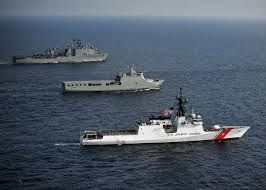
Canadian Coast Guard (also) Undermanned and Underfunded

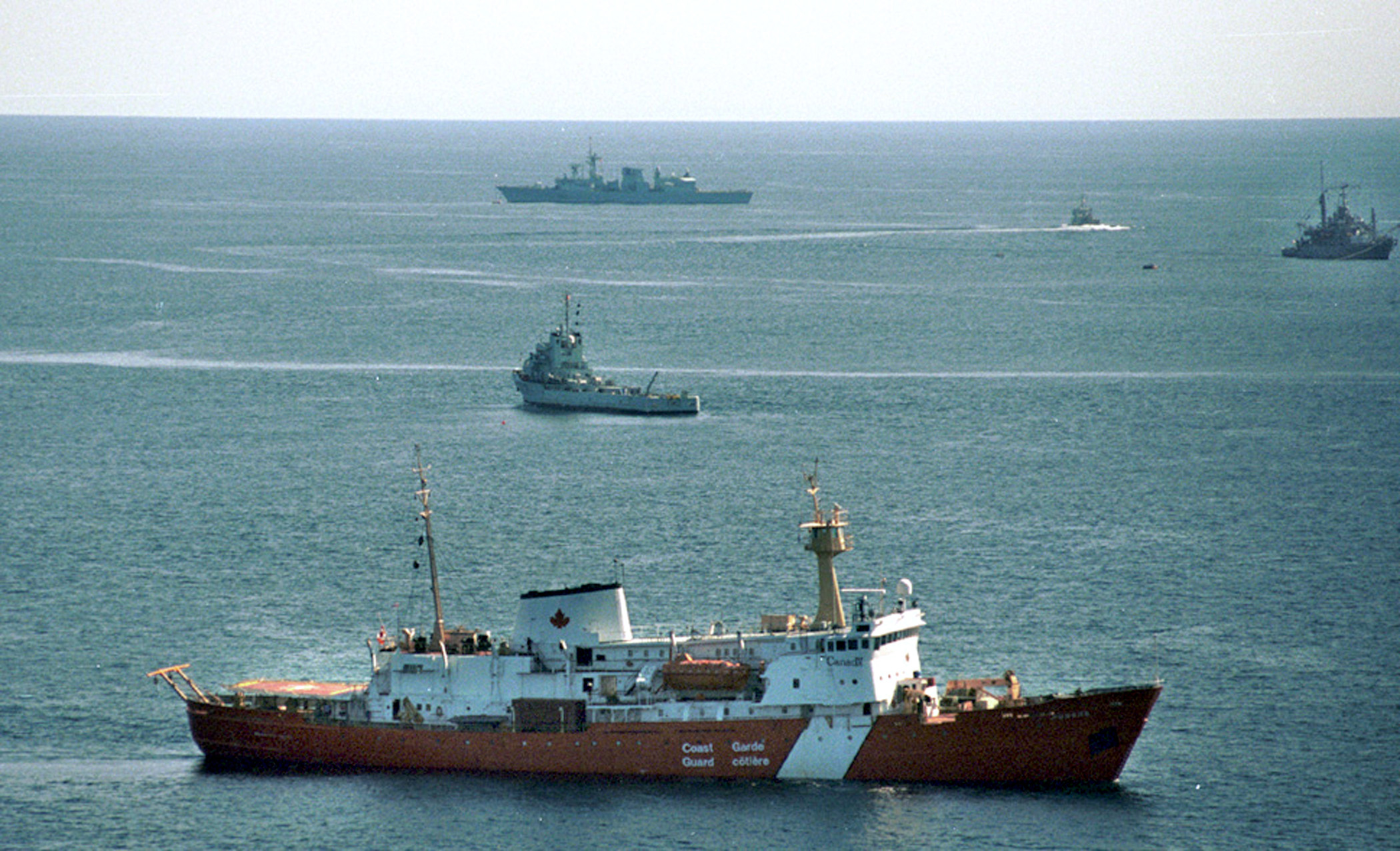
980914-N-8492C-005 PEGGYÕS COVE, Nova Scotia (Sept. 14, 1998) Ð- Canadian Coast Guard Cutter CCGV Hudson (front) conducts Laser Line Scanning (LLS) operations with the lasted in US Navy developed high-tech equipment at the crash site of SwissAir Flight 111. US Navy photo by PhotographerÕs Mate 1st Class Todd P. Cichonowicz. (RELEASED)

980914-N-8492C-005
PEGGYÕS COVE, Nova Scotia (Sept. 14, 1998) Ð- Canadian Coast Guard Cutter CCGV Hudson (front) now the oldest major vessel in the Canadian Coast Guard, conducts Laser Line Scanning (LLS) operations with the latest in US Navy developed high-tech equipment at the crash site of SwissAir Flight 111. US Navy photo by PhotographerÕs Mate 1st Class Todd P. Cichonowicz. (RELEASED)

Professional Mariner has reported that a Transport Canada report found the Canadian Coast Guard ” …fleet is undermanned and desperately in need of new ships” and “that unplanned maintenance on aging Coast Guard vessels skyrocketed in 2014.”

My first reaction was of course that they have the same problems we do, but looking at the history of Canadian Coast Guard ship building it is apparent that while none of their ships are over 53 years old, with those built in the 80s the largest group, so maybe they are slightly better off. On the other hand, there was almost no large ship construction in the 1990s or later so they are facing block obsolescence.

I took a look at the documents. I have to admit, I did not read them all. They cover all modes and aspects of transportation. Volume One (pdf) is the basic report and it is 286 pages, and Volume Two (pdf) is the Appendices and it is 230 pages. However, I did use the search function to find every mention of Coast Guard and there were some interesting aspects.

For one thing, the Canadian Coast Guard is partially funded by user fees. The report then goes on to both complain that the user fees have not been raised since established and consequently have not kept up with rising demand and costs, and then also points out that user fees tend to make Canada less competitive. There is not a clear recommendation on this point.

“The government introduced user fees to recover part of the costs for navigation services, which have not changed since 1998. Approximately 15 to 30 percent of the Canadian Coast Guard’s operating costs ($27 million out of $190 million) are recovered from industry (see Figures 9 and 10); icebreaking fees are separate.”

They have a strong justification for the Coast Guard in claiming its inadequacies hurt Canada’s economic competitivenes.

“The underfunding of the Coast Guard seriously hampers its ability to discharge its mandate, which adversely affects Canada’s international competitiveness and trade. (p.13)”

The report finds that the Canadian Coast Guard’s lack of law enforcement authority (and implicitly weapons to back up that authority) results in inefficiencies.

“The Canadian Coast Guard As noted above, the Canadian Coast Guard is responsible for the safe and efficient movement of ships in Canadian coastal and inland waters. Canada is unusual in having a civilian coast guard. In other northern jurisdictions, such as Denmark, Greenland, Norway, Iceland, Finland, and Russia, and in the United States, the coast guard is a military or security organization. As a civilian body, the Canadian Coast Guard does not have the authority to enforce international and national laws and regulations pertaining to the sea, the environment, and sovereignty without RCMP officers present, even though Canadian Coast Guard vessels and staff may be the best placed to respond to critical events and detect illegal activity. This has resulted in an inefficient enforcement regime. Canada has also been slow to use maritime transport to promote development and strengthen sovereignty. Canada must ensure that it meets the challenges of increased maritime traffic in the Arctic, the St. Lawrence, the Great Lakes, the Seaway, the Pacific and the Atlantic. Because of existing governance arrangements and inadequate funding, the Canadian Coast Guard is not currently well equipped to do so.” (p.220)

The report found that current ship building plans including the requirement to buy Canadian would not addressing the problem of an aging fleet.

“As noted above and as depicted in Figures 1, 2 and 3, the Canadian Coast Guard fleet is aging, which has implications for maintenance as well as procurement. Given that 29 percent of the large vessels are more than 35 years old and close to 60 percent of small vessels are older than the design life of 20 years, it is not surprising that the number of major systems repairs required is increasing, vessel days are decreasing, and the number of ships out of service is increasing over time. The decrease in 2009 was as a result of money dedicated for repairs paid by the Economic Action Plan. Indeed, for such a critical piece of transportation infrastructure, the Canadian Coast Guard is not receiving the political attention, or the administrative and financial resources it requires. In 2014, the Commissioner of the Environment and Sustainable Development found that the Canadian Coast Guard’s icebreaking presence in the Arctic is decreasing, while vessel traffic is increasing.26 In response, the Canadian Coast Guard, Transport Canada, and the Canadian Hydrographic Service are currently advancing the Northern Marine Transportation Corridors Initiative to support responsible marine development, enhance marine navigation safety, and guide future Arctic investments.27 In addition, the 2015 Report of the Independent Review of the M/V Marathassa Fuel Oil Spill Environmental Response Operation found that the Canadian Coast Guard lacked adequate staff to respond in any part of its region at any time.28 Not only is it understaffed, but its fleet is one of the oldest in the world and urgently requires renewal (individual ships average nearly 34 years of age).29 Without such renewal it will have to pull ships from service, further reducing reliability. However, under the National Shipbuilding and Procurement Strategy, which requires the Canadian Coast Guard to purchase ships from Canadian shipyards, it can only replace one ship a year, at most. At that rate, the median age of the fleet will not decrease. Other strategies, such as outsourcing or leasing, are not part of the strategy and thus cannot be deployed to meet short-term requirements. (p.221)

There may be beaurocratic power grab here, in that Transport Canada seems to want the Canadian Coast Guard transferred under it purview rather than the Department of Fisheries and Oceans. In fact the Canadian Coast Guard had been an agency of the Department of Transportation until 1994 when it was moved to Fisheries and Oceans.

“We have been concerned for some time that the separate and distinctive roles of Transport Canada and the Canadian Coast Guard [make for] a less than efficient model for a coordinated and timely response to a maritime emergency. The situation is further compounded by CCG having been placed under the administration of the Department of Fisheries and Oceans whose role has little in common with that of CCG.” “p.231)

The Canadian Coast Guard is organizationally a mid-point between the single agency multiple tasked broad authority USCG model and the multiple specialized agencies UK model. In some respects it also incorporates elements that would correspond to duties performed in the US by NOAA and National Marine Fisheries. Apparently it, like the USCG has had a problem fitting in any one department because of its multiple missions. While it is under the Department of Fish and Oceans, since 2005 it has been designated a “special operating agency” with greater autonomy.

Notably the prevailing Canadian attitude seems to be that, if anything, the CCG needs to be given weapons and law enforcement authority, bringing it closer to the USCG model, so perhaps it is an endorsement of sorts, for the way the USCG is structured.

Perhaps the USCG needs to be a “special operating agency” or “independent agency” as it is called in the US, as well; after all, there are already 27 (or more) of them, but that is a topic for another day.

Thanks to Lee for bringing this to my attention.

Argentine Coast Guard Sinks Chinese Fishing Vessel

This Video does not appear to show the sinking of the fishing vessel. Speckles on the hull of the F/V seen at time 0:20 and 0:50 may be bullet holes. The video does appear to show the participants.  

We have reports (here and here) that the Argentine Coast Guard (Prefectura Naval Argentina (PNA)) fired on and sank a Chinese fishing vessel (F/V), the Lu Yan Yuan Yu 010, believed to have been fishing illegally, after the F/V failed to stop after shots were fired across its bow and it allegedly attempted to ram the Coast Guard vessel. The crew reportedly was rescued, without fatalities, four by the Argentine vessel and the rest of the crew by another Chinese F/V.

ArgentineCutter

Photo by Diegoventu: PNA Doctor Manuel Mantilla (GC-24), a sistership of the Argentine vessel involved.

The PNA vessel seen in the video, Prefecto Durbes (GC-28) is one of five offshore patrol vessels (OPVs) built in Spain for Argentina. The Mexican Navy also has six similar vessels with larger flight decks and more powerful engines. In size they slot between the Reliance Class and the Bear Class, being 67 meters (220 feet) overall. Unlike the Reliance class, they have a hangar for their version of the H-65.

In addition to machine guns, these ships are reportedly armed with a Bofors 40mm/70, but looking at the video, the location where the gun was mounted (on the platform forward of the bridge and one deck above the foc’sle) is vacant. This suggest that the damage was probably done by .50 cal. machine guns. We know from our Vietnam experience that .50 cal. can sink fishing vessels, but the ranges are very short. Looking at the video the ships appeared to be no more than 300 yards apart.

It is a bit surprising no casualties were reported, although the reports say no fatalities, they do not say no injuries so that is still a possibility. Did the crew of the OPV order the Chinese crew to abandon before sinking the F/V, or did they perhaps tell them where they were not going to shoot so that the crew could assemble safely? It does not sound like it. We have only this statement from an Argentine representative that after actions by the Chinese vessel,  “…the order was given to fire on different sections of the vessel, damaging it,” It is unlikely, but not impossible, the crew helped the ship sink to destroy any evidence of wrong doing.

Sensor Hosting Autonomous Remote Craft (SHARC)

These little Unmanned Surface Vehicles (USVs) may be one way to enhance our Maritime Domain Awareness. They have already traveled a million nautical miles.

NavyRecognition has the story.

I could see a line of these in the Eastern Pacific, used to detect drug smuggling semi-submersibles.

Perhaps we will also see them used to cue Anti-Submarine Warfare Continuous Trail Unmanned Vessels.(ACTUV) or maritime patrol aircraft to the presence of submarines. It might not be too expensive to provide a line of them covering an entire trans oceanic route.

There will almost certainly be a war time role for launching these or something similar. Maybe a role for our buoy tenders.

Document Alert: World Wide Threat Assessment of the US Intelligence Community, 2/9/16

We have a statement for the record (pdf) from James R. Clapper, Director of National Intelligence, dated February 9, 2016. Perhaps it is the nature of the beast, but there is no good news, and much that is bad.

Smuggling of every type appears to be on the rise including drugs and people. We can expect an increase in illegal immigration as a result of violence, poverty, and disorder in Latin America and particularly Cuba and Central America.

It is a relatively compact document. There are sections on Terrorism (pp 4-6), transnational organized crime (pp 11-12), Arctic (p 13), Environmental Risks and Climate Change (pp 13-14), health (including potential pandemics) (pp 14-15), and Global Displacement, “These 60 million consist of approximately 20 million refugees, 38 million internally displaced persons (IDPs), and approximately 2 million stateless persons, also according to UNHCR statistics.” (p.15)

There are also regional assessments including one on Latin America and the Caribbean (pp 28-29).

There is no regional assessment for the US. In terms of direct terrorist threats to the US, while there is a recognition of an aspiration on the part of various groups to attack the US, but the emphasis seems to be on “homegrown violent extremists” (HVEs) and there is nothing about the possibility of a maritime attack on the US. Is that because none exist?

Rebuttal to Economic Case Against OPVs

Toro_air_view

Photo: Chilean Navy photo of OPV Toro, 2012

A German blogger I worked with earlier on a project for CIMSEC, Sven Ortmann, has written a post contending that building dedicated Offshore Patrol Vessels (e.g. Coast Guard cutters) does not make sense, that it is more economical to have a navy’s warships, augmented as necessary by law enforcement officers, perform these peacetime functions. He is planning to publish the post, 24 December at 6:00PM Eastern, at his Defense and Freedom Blog here.

Sven asked if I would like to write a rebuttal, and this is the product of that query.

Terminology:

For the purposes of this post, I will lump fisheries, law enforcement, and SAR together as coast guard work, or for brevity CG work.

I would contend at least some OPVs are really warships, and on the other hand, that navy auxiliaries, not normally considered warships, might also be used also be used to perform CG work, as the British Royal Navy has done, but for the sake of avoiding repeated long explanations I will lump the ships that might do this work into two categories as Sven has done: “warships” and “OPVs.”

The Contentions: Sven’s argument is based on a number of questionable assumptions. I will try to address each of these.:

  • That OPVs are not warships and that they have no value in wartime.
  • That if a nation builds a proper sized navy, it will include enough warships to also do CG work.
  • That those warships will be in geographic positions that will allow them to do CG work.
  • That a Navy crew, supplemented as necessary by a law enforcement team, can do CG work as effectively as a crew whose primary task is CG work.

Waesche Carat 2012

US Navy photo

That OPVs are not warships and that they have no value in wartime. “What do you need in war (and for deterrence of war)? Combat capability. Warships are built for it, OPVs are mere targets in combat.”

This assumes OPVs have no role in wartime. The truth of this statement depends a great deal on:

I did an earlier post which examines what Coast Guard cutters, and by extention, what OPVs might do in wartime, “What Might Coast Guard Cutters do in Wartime? Part 2, Coast Guard Roles.”  Their potential missions include Maritime Security, Blockade/Quarantine, Sea Control, Administrative Escort, Combat SAR, Deception, Special Warfare support, Naval Surface Fire Support. and with suitable modification, MCM and ASW. I would add that in the case of China’s very large OPVs, they might also be used as Attack Transports, being equipped, as they are, with extra accommodations, a number of boats, and facilities for large helicopters.

Why China Is Building The World's Largest "Coast Guard" Cutter

Image from FoxtrotAlpha, “Why China is Building the World’s Largest ‘Coast Guard’ Cutter”

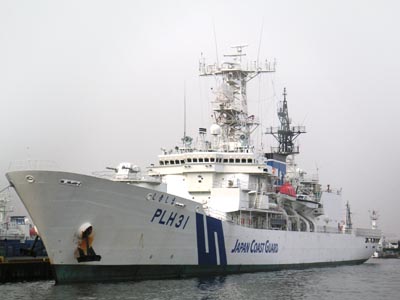
Photo: Japanese Coast Guard Cutter Shikishima, this class of two are currently the largest offshore patrol vessels in the world. China is building even larger OPVs. Photo from Japanese Wikipedia; ja:ファイル:JapanCoastGuard Shikishima.jpg

In many cases the only difference between what people see as OPVs and frigates or corvettes is how the ship is equipped.  If an OPV is upgraded and people start to see it as a frigate, is it no longer an OPV? I don’t don’t think so. Offshore Patrol is a job to do, rather than a type of vessel, though a certain type of vessel is typically used as an OPV. World wide, the typical vessel built to perform OPV duties is 1500 to 2500 tons, has a medium caliber gun, some machine guns, and a helicopter deck. Some are better equipped than others. Some even include anti-ship cruise missiles Usually they don’t have some of the more sophisticated equipment found on warships, because of both initial cost and manning requirements, but given some time, frequently they can be upgraded.

ProposedPolishCorvette

Photo: Spanish BAM, Meteoro Class OPV

That if a nation builds a proper sized navy it will include enough warships to also do CG work. “Scenario A: A fleet with warships, no OPVs. Result: Enough warships for war’s needs, enough ships for policing and rescue.”

This is what I believe Sven suggests is the best choice, but it assumes there are enough warships for marine policing and rescue, but this is not necessarily the case.

We must ask how many ship-days we need to effectively perform the CG work. Then we must ask how many ship-days the navy will have remaining after maintenance, work-up, exercises, and out of area deployments.

PacificEEZ

EEZs in the Pacific (partial)

A nation’s wealth, its perception of threat, and the size of its EEZ are not necessarily proportionate.

Germany is a wealthy nation, with a potential great power adversary relatively close at hand. It has a substantial navy and a relatively small EEZ. Consequently using a small part of their navy a small part of the time may be sufficient to perform CG tasks.

Comparing the total number of cruisers, destroyers, frigates, corvettes LCS, and OPVs, Germany has about 20. The US has a lot more, about 140, or seven times the number, but the US EEZ is 197 times larger than that of Germany. Additionally, while the German Navy’s primary operating area is near or within their territorial sea and EEZ, the US Navy’s primary operating areas are far from US Waters. The circumstances are very different. The US could not be able to build a proportionately large number of pure warships to also patrol its EEZ.

SLNS-SamuduraSriLanka

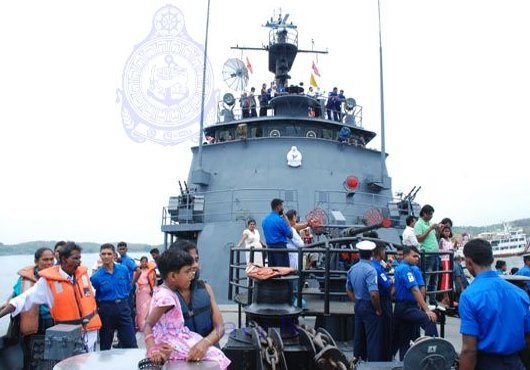
SLNS-Samudura, SriLanka

Photo: Former USCGC Courageous (WMEC-622)

There are other nations that feel relatively little threat and see little need for a navy, but have relatively large EEZs that are a major source of economic prosperity. They need to patrol their waters, they may very rationally build OPVs and they can mitigate any apprehension about their naval position by giving their OPVs more warlike capabilities.

That those warships will be in geographic positions that will allow them to do CG work. “Why the warships’ manning and fuel expenses are sunk costs? Simple; the warship would be out at sea for training anyway. Warship fuel and manning expenses may be (slightly or very much) greater in this case, but they’re sunk costs!” This assumes that policing and SAR does not interfere with the warship’s training and missions.

CG missions tend to require wide distribution of assets. Warships tend to operate in teams that are geographically concentrated. During workup they need to use the services of training facilities which are in only a few areas.

The US chooses to regularly deploys virtually all of its Navy ships far from the US EEZ as soon as they are fully worked up. If instead they hung around the US, they might be able to perform some CG missions, but it would require a change of national priorities. As it is, there are very few Navy vessels available to conduct counter-drug operations in the Forth Fleet Area (Latin America/Caribbean), and we very seldom see US Navy ships in Alaskan Waters

If we took the resources to maintain the Coast Guard’s offshore fleet and diverted it to additional Navy vessels,

  • first, there would be fewer of them, because of their higher cost and greater manning requirement
  • second, because of their more complex nature they would be available few days per ship because of the additional training they require.

I suspect Sven’s position is largely influenced by the frequent argument that OPVs should be used for counter piracy operations off Samalia. Actually we agree that using warships that are deployed to the area for other reasons, to do counter-piracy is perfectly reasonable.

On the other hand, if a nation wanted to keep its high cost navy units close to home where they can be used for defense, but it also felt an obligation to participate in counter-drug or counter-piracy operations far from any serious threat, OPVs are a relatively cheap way to fulfill the obligation without the diversion of more expensive assets.

I will note that OPVs also tend to become obsolete more slowly than more sophisticated warships. Currently the average age of USCG OPVs is over 40 years, while the average age of USN ships is about 14 years. This was not good policy, but it was possible because of the less sophisticated requirements of the OPV’s missions. In some cases frigates or corvettes are stripped of obsolete weapons and sensors and become OPVs as has been done by Spain, Portugal, and Italy.

Photo: Ship of the Spanish Navy Infanta Cristina, commissioned in 1980 as corvette with pennant F-34; in 2000 she was reclassified as oceanic patrol ship, pennant P-77, by José María Casanova Colorado, importé par Takashi kurita

That a Navy crew, supplemented as necessary by a law enforcement team, can do CG work as effective as a crew whose primary task is CG work. This will depend very much on the support provided by the command team on the ship, but I believe there is more of a tendency for those who view themselves first and foremost as warriors to view the CG missions as a distraction. They are less likely to view their career success as tied to the way they do these peacetime missions. The larger and more powerful the warship, the less likely they are to assign priorities to CG missions. This suggests a separate service, like the USCG, but at least navy officers assigned to smaller ships and OPVs that are dedicated to CG missions must feel greater pressure to succeed in these missions than those assigned to ships where these missions are well down the priority list.

121203-G-XX000-001_CPO Terrell Horne

There is another advantage to ships that are clearly intended for peacetime missions. The perception that the US Coast Guard cutters are law enforcement and search and rescue assets rather than military units, make them welcome in many places where Navy ships are not. This has opened doors for the Coast Guard that are closed to Navy ships.

File:Bad Bramstedt (BP24).jpg

Photo: German Police Coastguard ship Bad Bramstedt (BP24), by Hans Hillewaert

In conclusion. Sven’s prescription may be right for Germany, but for other nations different circumstances including EEZ size and threat perception may make OPVs a good choice. But even Germany has seen the need for at least three small OPVs (pictured above, as Sven pointed out to me).