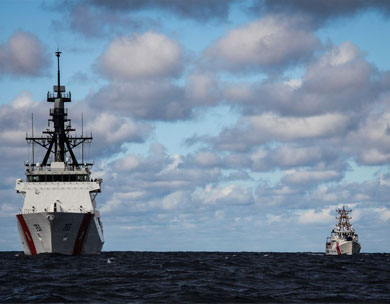
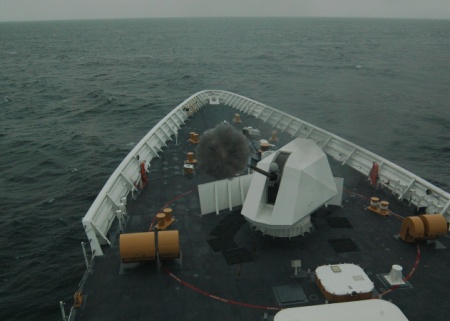
WHY THE COAST GUARD NEEDS LRASM IN PEACETIME–CIMSEC

This is an expanded version of an earlier piece that was posted here. I rewrote it for the CIMSEC blog in hopes it would find a larger audience. Hopefully it is a clearer than the original. 

The Coast Guard has a problem. It is not currently equipped to perform one of its missions, and it appears no other agency is prepared to cover the deficiency. The Long Range Anti-Ship Missile (LRASM) may be a possible solution.

The Mission

One of the Coast Guard’s peacetime missions is Ports, Waterways and Coastal Security (PWCS).

“The PWCS mission entails the protection of the U.S. Maritime Domain and the U.S. Marine Transportation System (MTS)…prevention and disruption of terrorist attacks… Conducting PWCS deters terrorists from using or exploiting the MTS as a means for attacks on U.S. territory, population centers, vessels, critical infrastructure, and key resources.”

The Shortfall

Implicit in this mission is that the service should have the capability to forcibly stop a non-compliant ship, any ship, of any size. If a crew is motivated by simple greed, a .50 caliber machine gun is probably enough to convince them to take their chances in court rather than resist, but if the crew is motivated by a fanatical, or even suicidal belief in a cause, they become much harder to stop.

Terrorist targets are limited only by their imagination. They might include something like the Mumbai attack, an assault on a bridge, an LNG tanker or facility, a nuclear power plant, a passenger ship, an SSBN departing on patrol, or they might use a vessel to bring in a nuclear weapon.

The Coast Guard is an armed force at all times, but it is certainly not heavily armed. In fact, in terms of stopping a recalcitrant merchant ship, the Coast Guard seems relatively less capable now than they were eighty years ago.

This is because of the rapid growth in the size of merchant ships. Even the largest cutters with their 57 mm and 76 mm guns are far less capable of stopping today’s over 100,000 ton merchant vessels than the cutters of the 1930s, with their 5″ guns were against ships that were typically well under 10,000 tons.

Worse yet, the units that would actually be on scene to attempt to stop and board a ship suspected of being under the control of terrorists is unlikely to include any of the larger cutters because they seldom remain near harbor entrance. Rather, they are frequently sent well off shore.

The Coast Guard simply does not have the capability to deal with a terrorist attack using a medium to large sized merchant ship, and it currently appears that there is no other organization capable of answering this threat in the 30 or more port complexes terrorists might find worthwhile targets.

Our Friends

Navy surface forces, in U.S. waters, are too geographically concentrated. Navy ships tend to be either in homeport, working up in specific geographic areas, deployed, or in transit to deploy. There are no Navy surface warships homeported in the Gulf of Mexico, on the East Coast north of the New Port News/Norfolk complex, in Alaska, or on the West coast between San Diego and Puget Sound with weapons equal to or better than those on cutters. For many ports, the nearest Navy surface vessel is hundreds of miles away.

Air Force, Navy, Marine, and Army Air are not on standby around the U.S. armed with anti-ship weapons. Of the Air Force, only some strategic aircraft are training for the anti-shipping mission. Fighters and attack aircraft do not. The author suspects the U.S. would not get a timely response from the Air Force to a no notice requirement to stop a maritime target. Units that are not trained for an anti-shipping role cannot be easily pressed into that mission.

A Possible Solution

LRASM, with an over 200 nautical mile range and the ability to strike selected locations on a target ship, could possibly provide an answer. If the U.S. fielded LRASM on all nine National Security Cutters (NSC) and 25 Offshore Patrol Cutters (OPC) currently planned, its over 200 mile range could cover virtually all of these ports, and likely have a weapon on target within 20 minutes of launch.

How It Might Work

The Coast Guard is developing a Maritime Domain Awareness system. Most likely, it will tap into the Navy’s system and over the horizon radars.

When the maritime domain awareness system detects the approach of a suspicious vessel, a small patrol vessel (WPB or WPC) is assigned to intercept it and conduct a boarding to determine the vessel’s nature and intent.

When the patrol vessel is assigned the intercept, a larger cutter that may be at some distance, but within range, would be directed to provide support in the form of a LRASM launch if necessary.

The patrol craft will transmit video, position, course, and speed during its approach which will allow the start of mission planning for an LRASM launch should it become necessary. The results of the patrol craft’s attempt to board will allow determination of hostile intent.

Once a determination of hostile intent has been made, and deadly force authorized, the supporting cutter can launch its weapon. The patrol craft will continually update the supporting cutter before and during the flight of the LRASM. Navy, Joint, and/or Allied procedures would be used to call for a strike, and should also work with other service’s assets if they are available.

LRASM_TSL_Concept_Lockheed_Martin
LRASM topside launcher concept. The size and weight are comparable to launchers for Harpoon. Photo: Lockheed Martin.

Is It Affordable?

It is likely cutters could be equipped to carry eight missiles, but for peacetime purposes, two per ship would almost certainly meet the Coast Guard’s needs. Since some ships will always be in maintenance with ammunition removed, and others may be deployed where carrying the weapons would be counterproductive. The Coast Guard is unlikely to ever require more than about 50 missiles to meet its peacetime needs. A very rough estimate of LRASM unit cost would be something on the order of $2M to $5M each. That means the total cost of the missiles is likely between $100M and $250M. Adding launchers, control systems, and installations to cost would almost certainly be less than $500M. These costs would be spread over several years. This gives only an order of magnitude estimate, but it is several orders of magnitude less than the cost of other systems being deployed to protect the U.S. from attack.

Since the missiles, their launchers, and control systems are Navy type/Navy Owned equipment, the Navy would be responsible for paying for them. The cost of adding another four missiles per year for the Coast Guard to the Navy’s buy for LRASM could be lost in the rounding errors in the Navy budget.

For the Coast Guard, the program would probably require no more than 150 additional billets ashore and afloat. Not insignificant, but doable.

Conclusion

If the LRASM performs as advertised, its combination of range, warhead, and intelligent targeting may allow the Coast Guard’s small, but widely distributed force to effectively cover virtually the entire U.S. coast.

LRASM_Surface_Launch_72617-300x233

Late addition, LRASM deck mount launcher successful test. 
Alaska, FY2017 Budget, Homeports

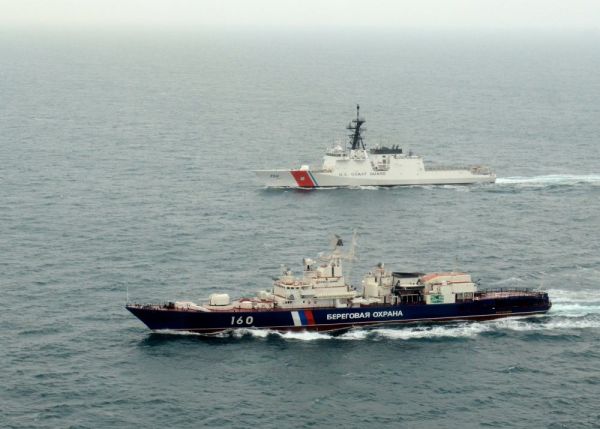
Bertholf-and-Vorovsky

Some interesting little notes from Alaska Dispatch News here and http://politicalnews.me/ here.

From the first:

“…in the appropriations bill passed out of committee Thursday, Murkowski secured language directing the Coast Guard to consider basing a national security cutter near the Arctic. The bill also directs the Coast Guard to station two offshore patrol cutters in Kodiak and appropriated $325 million for fast-response cutters, two of which are scheduled to be stationed in Ketchikan in 2017.”

From the second:

  • CG Base Kodiak: Murkowski secured $22 million for upgrades to CG Base Kodiak to support future OPC homeporting and current NSC operations.

  • Search and Rescue: Murkowski secured language directing the Secretary of Homeland Security to report on the plans of the Coast Guard to ensure long-term search and rescue capabilities in the Arctic.

  • Response Capabilities: Murkowski inserted an amendment directing the Secretary of Homeland Security to report on the Coast Guard’s plans to ensure it is capable of conducting its response missions throughout the Bering Sea and Arctic Ocean.

I think we could make a good case for homeporting two or even three OPCs in Kodiak, but don’t think we will see any NSCs homeported in Alaska.

Replacing the 110s in Alaska with the more seaworthy Webber class as quickly as possible also makes a lot of sense. We might want to put a couple at Dutch Harbor as well.

Thanks to Daniel for bringing this to my attention. 


FY2017 Budget

NSC&FRC

It is still a long way from being a law, but you can see the bill as it currently stands here.

I would like to note that while the FY2017 budget bill includes $95M for  long lead time materials for the tenth National Security Cutter, most of the cost will fall in FY2018 when we will also be funding the OPC and FRC programs, and maybe an icebreaker.

Are they really thinking ahead? If they are going to fund a 10th NSC, they need to do it this year.

Senate Homeland Security Appropriations–Plus Up

MarineLog is reporting:

The homeland security measure provides $10.4 billion for the d Coast Guard, an increase of $292 million above the FY2017 requested level.

“This level supports a robust USCG operating expenses budget, including a grant program for commercial fishing safety, purchase of additional response boats, and funds for the National Coast Guard Museum,” says the Committee. “This bill also provides necessary increases for acquisitions, including funding long lead time materials for a tenth National Security Cutter, continuing activities associated with the Offshore Patrol Cutter, two additional Fast Response Cutters (for six total), and support for multiple sustainment efforts and program offices such as the C-130J, C-27J, and HH-65. The measure also includes program management and personnel costs associated with the Polar Icebreaker Recapitalization Project in addition to funding in the Senate FY2017 Department of Defense Appropriations Bill.”

The Defense Appropriations Bill includes $1B for the Navy to build a new Icebreaker for the Coast Guard. We will have more to say about this later.

Commandant, “Bullish”

IMG_4135

Following from the Navy League magazine, “Seapower.” It is from an article, “Service Chiefs Stress Partnerships, Need to Accelerate Acquisition,” by Otto Kreisher:

Zukunft was surprisingly “bullish” on the Coast Guard’s condition, noting that his procurement budget doubled in the current year, enabling the service to expand its National Security Cutter program to nine ships, to build 58 Fast Response Cutters and upgrade its command-and-control and fixed-wing aircraft systems. He said the Coast Guard this summer would award the biggest ship construction program in its history, for the Offshore Patrol Cutters.

Nice to see the Offshore Patrol Cutters getting closer, but it has taken a long time. We should note that this summer’s award for the OPC is not that big a contract, but it is a start.

We have had one good year. Congress’ largess (it certainly was not the executive) appears due mostly (but not entirely) to Huntington Ingalls Industries’ influence. Still it does create a precedence for larger, more reasonable, AC&I appropriations. Hopefully we will see the same sort of funding in FY2017. A tenth Bertholf is a possibility, If not, maybe we can move some of the OPC funding forward. Perhaps selection of the OPC builder will give us another strong advocate in Congress. I would hate to see funding levels go back to where they were before. Even $2B annually is not really anything like generous.

Thanks to Daniel for bringing this to attention.

ALaMO–Making the 57mm Round Smart

NSCfires57mm

The Navy has a program call “Navy’s Advanced Low Cost Munition Ordnance” or “ALaMO”

Justification as provided to Congress is here. The proposed budget includes $5.759M in FY2017, $25.984M in FY2018, and $24.982M in FY2019. The round is expected to be operational in 2020 (about the time the first OPC comes out).

“Advanced Low Cost Munition Ordnance (ALaMO) significantly increases 57mm MK 110 Gun Mount lethality and effectiveness against Fast Attack Craft and Fast In-Shore Attack Craft (FAC/FIAC). The 57mm ALaMO funding supports non-recurring engineering, design verification testing, environmental qualification, hazard classification, insensitive munitions and developmental testing. ALaMO will be qualified for USN use at the conclusion of the program.”

A US Naval Institute News story, “Wrapup: HASC Passes FY2017 Defense Bill With Reagan-Era Spending Levels,” indicates House Armed Services Committee interest in speeding up the program.

“A provision in the bill notes interest in the Navy’s Advanced Low Cost Munition Ordnance (ALaMO), a 57mm guided projectile that could be used on the LCS, and requests information on what it would take to achieve initial operational capability by 2019.”

Sounds like the Coast Guard should have a few of these rounds as well, both for small, fast, highly maneuverable targets, and to target specific areas on larger targets. We had some indication this was coming before.

Document Alert: Cutter Procurement–Another Report to Congress

Once again, the Congressional Research Service’s Ronald O’Rourke has revised his “Coast Guard Cutter Procurement: Background and Issues for Congress” with the new edition issued April 15. This has got to be a hot topic because previous revisions were issued March 22, January 27, and December 14, 2015. That is four revisions in four months, on average every six weeks, but the latest is only 24 days after the previous edition. I have begun to sense, we may have turned a corner. The tone of the reports has changed over these four months, from, how long will it take us to reach the “Program of Record” (POR), to consideration of, if we should perhaps go beyond the POR.

The NSC, OPC, and FRC programs pose several issues for Congress, including the following:

“whether to fund the acquisition of a 10th NSC in FY2017;

“whether to fund the acquisition of four FRCs in FY2017, as requested, or some other number, such as six, which was the number projected for FY2017 under the Coast Guard’s FY2016 budget submission;

“whether to use annual or multiyear contracting for procuring FRCs;

“whether to use annual or multiyear contracting for procuring OPCs;

“planned procurement quantities for NSCs, OPCS, and FRCs;

“the cost, design, and acquisition strategy for the OPC;

“initial testing of the NSC; and

“rotational crewing of the NSC.”

The latest revision includes three substantial Appendices:

  • Appendix A. Planned NSC, OPC, and FRC Procurement Quantities (pp 17-22)
  • Appendix B. Funding Levels in AC&I Account (pp 23-26)
  • Appendix C. Additional Information on Status and Execution of NSC, OPC, and FRC Programs from March 2016 GAO Report (pp 27-34)

Appendix C is entirely new and appears to have been the reason for the revision.

Appendix A (p. 17-22) is a fairly detailed discussion of the results of the Fleet Mix Study and asks why we so seldom hear that the program of record is not enough to assure the Coast Guard to successfully accomplish its assigned missions.

The Fleet Mix Study was made public in 2012 long after its completion in 2009. It is due for a reexamination and the Commandant has said another will be done. When that happens, we seriously need to look at more than just more of the same assets. We need to look at additional technology, equipment, and weapons that might allow us to accomplish these missions without a major increase in personnel.

Looking at “Table A-3. Force Mixes and Mission Performance Gaps” (document page 18) I would note that if we get to Fleet Mix Analysis Phase 1 (FMA-1, an increase over the POR including 9 Bertholf class NSCs, 32 OPCs and 63 Webber Class FRCs, for a total of 104 vessels), we will have addressed all the “Very High Risk Gaps” found in the Fleet Mix Study that included SAR capability, “Defense Readiness Capacity,” and “Counter Drug capacity.” What will remain are “High” or lower risks in Ports, Waterways, and Coastal Security (PWCS) and Living Marine Resources (LMR), and a low to very low risk to the Alien Migrant Interdiction Operations (AMIO) mission. This total of more than 40 NSCs and OPCs certainly should not be out of the question, after all the Coast Guard has included over 40 ships larger than a thousand tons for the last several decades.

Still, I would note that, no matter how many ships we have, the Ports, Waterways, and Coastal Security (PWCS) mission will always be at risk, unless weapons are available to quickly and reliably stop terrorists’ exploitation of a larger merchant vessel to make an attack. Guns alone are simply not up to the task. I have identified two weapons that might address this threat, (1) equipping our WPCs and possibly WPBs with light weight torpedoes that target a ships propellers or (2) equipping our larger ships with the Long Range Anti-Ship Missile (LRASM) which might allow our larger cutter to effectively support our smaller cutters and respond to an attack, even if the large cutter 200 miles from the targeted port. Either would also make our ships much more capable of making a meaningful contribution to Defense Readiness.

9th NSC as D17 Flagship–CIMSEC

The Coast Guard Cutter Stratton from Alameda, Calif., steams near an ice floe in the Arctic Ocean during Operation Arctic Shield 2014 Sept. 14, 2014. (Coast Guard photo courtesy of Cutter Statton)

CIMSEC has a post, “DESIGNATE THE 9TH NATIONAL SECURITY CUTTER AN ARCTIC FLAGSHIP,” which suggest essentially two related actions regarding the recently funded ninth Bertholf class National Security Cutter (NSC).

  • Homeport it in Kodiak, and
  • Ice-strengthen the hull.

As usual, the benefits of cutting transit time by basing ships in Kodiak are overstated because the need to transit south for training and yard period is neglected. Individual training is also easier and less expensive if the ship is located near training facilities.

I find the case for ice strengthening a bit more interesting, but do we really want to redesign a ship that now benefits from the maturity of its design?

The author also touts the advantages of light icebreaking done by an ice-strengthened NSC, perhaps not realizing that icebreaking is already done by 225 foot buoy tenders, four of which are homeported in Alaska, including one in Kodiak.

It really looks like the OPC would be a better choice for homeporting in Alaska, being simpler and already planned to be ice-strengthened, but it is also true that the ninth NSC will be finished at least a couple of years before the first OPC and probably several years before an OPC will be homeported in Kodiak.

LRASM for Ports, Waterways, and Coastal Security

Lockheed Martin supplied Navy Recognition with the first image showing a deck-mounted quadruple Long Range Anti-Ship Missile (LRASM) launcher. According to our source, this "top side" launcher graphic is a notional concept that could be used on an appropriately sized surface vessel, such as the Arleigh Burke class (DDG 51) or Littoral Combat Ship (LCS) classes.

Discussion on an earlier post suggesting the Coast Guard might want to fit our new major cutters “for but not with” Long Range Anti-ship Missiles (LRASM) has prompted me to rethink the suggestion and advocate for equipping them with the missile in peacetime.

One of the Coast Guard’s peacetime missions is of course Ports, Waterways and Coastal Security (PWCS).

“The PWCS mission entails the protection of the U.S. Maritime Domain and the U.S. Marine Transportation System (MTS) …prevention and disruption of terrorist attacks… Conducting PWCS deters terrorists from using or exploiting the MTS as a means for attacks on U.S. territory, population centers, vessels, critical infrastructure, and key resources.”

I have been concerned that the Coast Guard has not had adequate weapons to deal with a terrorist attack using a medium to large sized merchant ship, and currently I don’t believe there is any other organization capable of answering this threat in the 30 or more port complexes terrorists might find worthwhile targets, in a timely manner. Navy surface forces are too geographically concentrated. The over 200 nautical mile range and the ability to strike selected locations on a target ship suggest LRASM could possibly provide an answer.

If we had LRASM on all National Security Cutters (NSC) and Offshore Patrol Cutters (OPC), in perhaps a dozen ports on the Atlantic, Pacific, and Gulf coasts, Honolulu and Kodiak, its over 200 mile range fired from cutters, including possibly those in port, could cover all of these ports (except Guam), and have a weapon on target within about 20 minutes of launch.

To effectively counter the threat, I think we need to get a weapon on target within an hour of positive identification of the threat. This would require improved coordination between units. In addition to providing a datum, course, and speed, presumably an intercepting unit, boat or aircraft, would need to transmit a photograph of the target to be incorporated in the missiles memory and aim points would be chosen some time during mission planning. We would need to coordinate with air traffic control. A command decision to authorize use of the weapon and updates on the target position course and speed would also be needed. Because we might have 40 minutes or less from threat identification to launch, these steps would likely have to proceed in parallel with mission planning progressing prior to authorization.

New units appear to be on the way to developing the kind of common tactical picture we need to facilitate both decision making and targeting. We could start developing the capability with the National Security Cutters based at Alameda (San Francisco Bay) and Charleston, SC, even if the system could not be completed until the last OPCs are delivered in about 2034.

AN-SPQ-9B, the NSC’s Air-Search Radar/Firecontrol Gets New Capability

Defense Industry Daily reports that the AN-SPQ-9B, the firecontrol system and secondary air-search on the Bertholf class National Security Cutters, is being modified to provide a Periscope Detection and Discrimination (PDD) capability.

The post also provides additional background information on the sensor.

Interestingly, the post also notes that the radar has a “Cooperative Engagement Capability” or CEC (See the April 24/12: CEC entry) which means that ships and aircraft can share a common tactical picture and weapons launched from one unit can be controlled by a different unit. If we ever get long range missiles, this could be useful.

Hopefully the Offshore Patrol Cutter will have either this system or a better replacement.