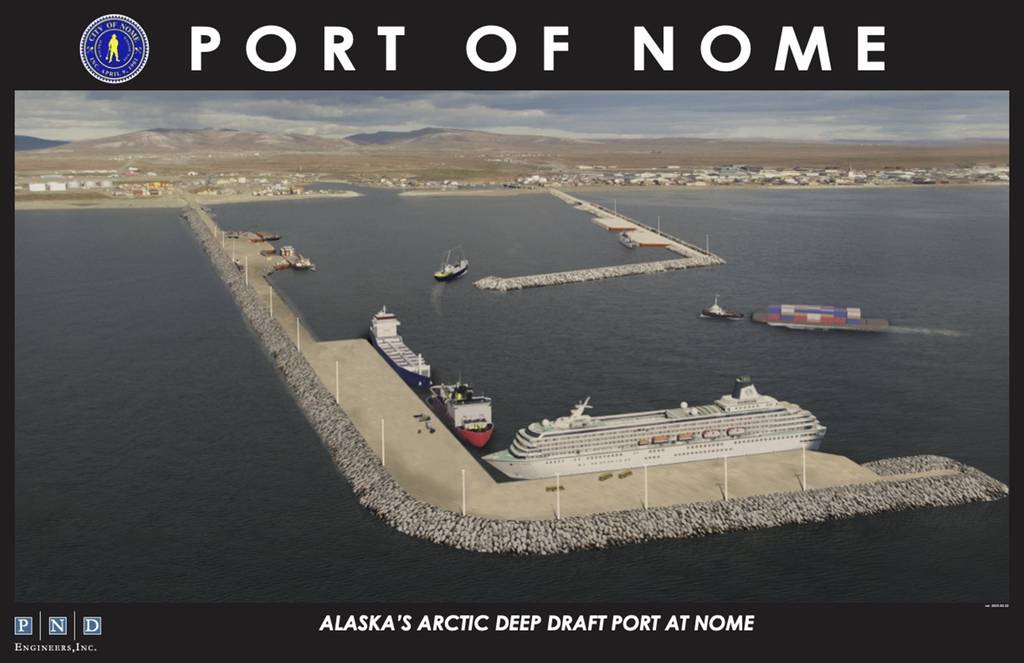
This rendering provided by the City of Nome shows how the Port of Nome, Alaska, will appear following an expansion project that will cost more than $600 million. Shipping lanes that were once clogged with ice for much of the year along Alaska’s western and northern coasts have relented thanks to global warming, and the nation’s first deep water Arctic port should be operational in Nome by the end of the decade. (PND Engineers Inc./City of Nome via AP)
Workers will dredge a new basin 40 feet (12.2 meters) deep, allowing large cruises ships, cargo vessels, and every U.S. military ship except aircraft carriers to dock, Port Director Joy Baker said.
Nome in red. Adapted from Wikipedia’s AK borough maps by en:User:Seth Ilys.
We have been talking about a deepwater port in the area for some time,
Nome isn’t actually in the Arctic, despite the fact that the US government defines the Arctic to include the Bering Sea. The Arctic Circle runs just a little North of Nome, essentially at the Bering Strait. The Bering Strait connects the Pacific with the Arctic Ocean and is about 44 nautical miles (82 kilometers) wide at its narrowest point. Whoever controls the Bering Strait can regulate traffic between the Pacific and the Arctic Oceans. Having a nearby deepwater port would certainly help, if it were desirable to regulate that traffic. Nome is within 160 nautical miles of the Russian side of the Strait.
Traffic through the Strait has increased and the possibility of a cruise ship disaster in the Arctic is probably a District 17 nightmare, but I think the probability is low that large numbers of CG units will be based at Nome. As noted earlier, I don’t think we will see either large patrol cutters (unless it is the Alex Haley) or FRCs based there but moving one of the Juniper class seagoing buoy tenders there, with its light icebreaking capability might make sense. A medium icebreaker might be a possibility, but that is a very long shot.
As I have noted before, the US Navy’s Pacific Fleet surface ships have not really shown much interest in operating in the Arctic. Their “Arctic” exercises have been in the Gulf of Alaska or little, if at all, North of the Aleutians.
We might see Air Force and Marines in the area in time of War. Airpower and/or shore based anti-ship missiles could control surface traffic through the Strait. Those forces would have to be supplied, which would mean logistics shipping to what we now know will be the deepwater port at Nome. The shipping would presumably require naval protection, air and/or surface.
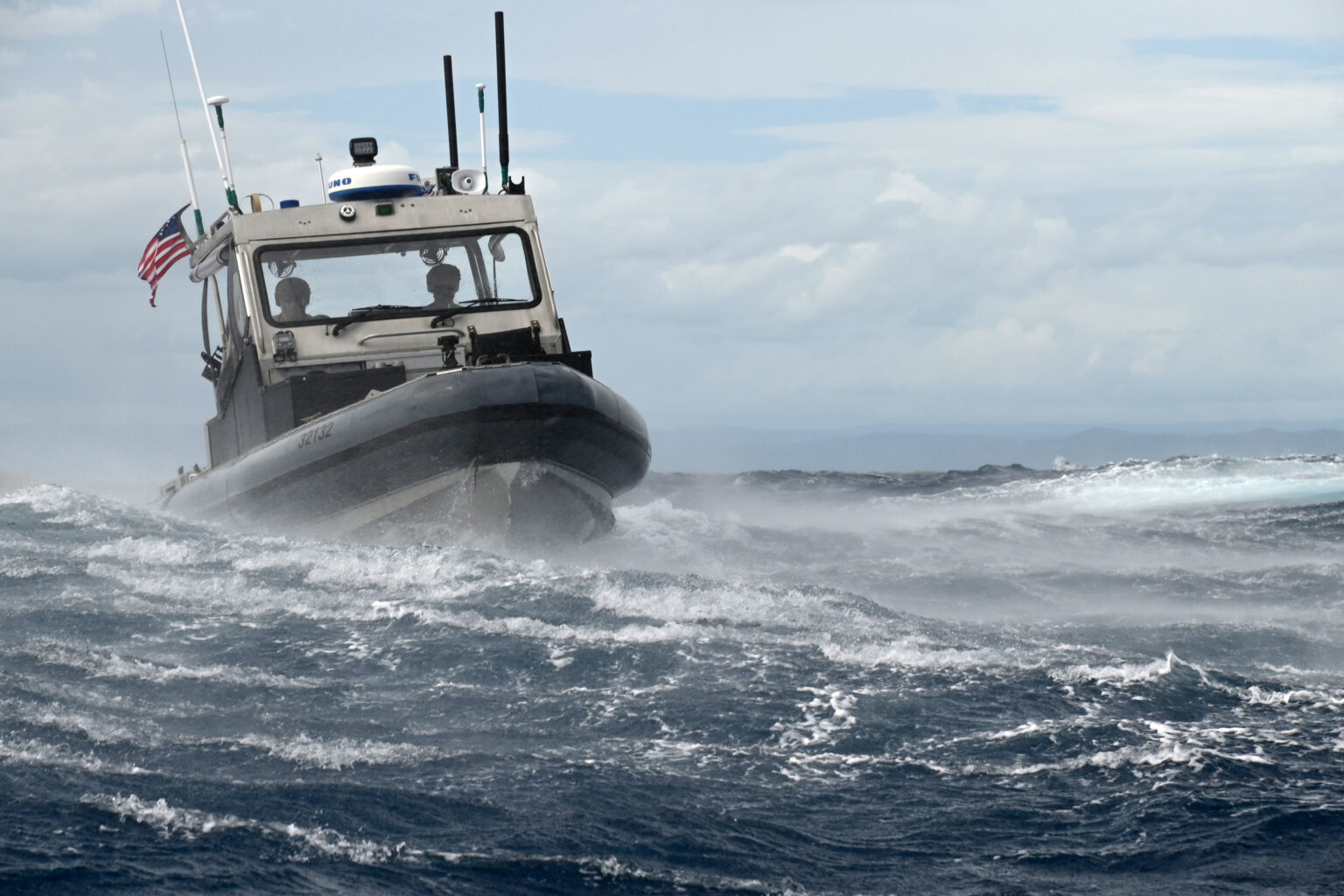
Coast Guardsmen from Port Security Unit 307 conduct seaward security for Department of Defense assets and personnel at Naval Station Guantanamo Bay, Cuba, April 25, 2022. During the nine-month deployment, unit operations focused on maritime defense, providing more than 30,000 hours of around-the-clock waterside and shore side anti-terrorism and force protection. U.S. Coast Guard by photo by Lt. Cmdr. Glenn Sanchez.
Coast Guard completes mission at Naval Base Guantanamo Bay
By Lt. Cmdr. Jeannie Shaye, Coast Guard Public Affairs Officer
NAVAL BASE GUANTANAMO BAY, Cuba — U.S. Coast Guard Port Security Unit (PSU) 305 members conducted a casing of the colors ceremony at Naval Base Guantanamo Bay Tuesday, marking the end of the Coast Guard’s 21-year mission supporting Joint Task Force Guantanamo (JTF-GTMO).
Coast Guard Commandant Adm. Linda Fagan presided over the historical ceremony and presented a Coast Guard Unit Commendation award to the men and women of PSU 305.
Port Security Units are part of the Coast Guard’s deployable specialized forces and have served JTF-GTMO as the Maritime Security Detachment (MARSECDET) in support of Operation Enduring Freedom for over 21 years. The Virginia-based PSU 305 was the first PSU deployed to Guantanamo Bay in 2002 in support of Operation Enduring Freedom, and this tour completes their fifth unit deployment.
“Thanks to the quiet resolve and careful watch of our Port Security Units for the past 21 years, the work our Nation has conducted here has been done safely and securely,” said Fagan during the ceremony.
Coast Guard PSUs and Maritime Safety and Security Teams have provided maritime anti-terrorism force protection for JTF-GTMO since 2002 as a part of the Global War on Terror.
There have been 39 unit rotations to Guantanamo Bay since the Coast Guard began supporting the mission. The men and women assigned to the MARSECDET collectively provided over 200,000 underway hours conducting around-the-clock waterside patrols and over 50,000 hours of shoreside anti-terrorism and force protection defense security to Department of Defense assets and personnel at Naval Station Guantanamo Bay.
Upon the conclusion of the JTF-GTMO mission, PSUs will continue to remain an agile expeditionary force provider that play a critical role in protecting strategic maritime operations in an environment of increasing global competition. In addition, PSUs will participate in national-level joint and combined exercises to increase readiness and proficiency for the full spectrum of PSU capabilities.
“This is an exciting time for the PSU community,” said Capt. Matthew Michaelis, Pacific Area Deputy Chief of Operations. “As the focus shifts from a long-standing enduring mission, we look forward to supporting future missions that align with their diverse set of capabilities. Our PSUs recently completed three joint DoD exercises and are preparing for additional exercises overseas with DoD and some of our trusted partners. The increased focus on interoperability will better prepare our PSUs to deploy in a joint or multi-lateral environment as they were designed, while also creating opportunities to evolve and uncover new and novel ways for their employment.”
PSUs are Coast Guard Reserve-staffed units that support our nation with well-equipped, trained, and organized expeditionary forces that can rapidly deploy worldwide for anti-terrorism and force protection operations or in defense of high-value assets. Eight PSUs are strategically positioned throughout the country and assigned to the Coast Guard Pacific Area commander in Alameda, Calif.
JTF-GTMO is a U.S. Southern Command task force responsible for the safe, humane, legal care and custody of law of armed conflict detainees; collection and dissemination of intelligence; and supporting military commissions, periodic review boards, and habeas review.
The MARSECDET responsibilities were turned over in May to servicemembers assigned to the Naval Station Guantanamo Bay’s Navy Harbor Patrol Unit and Marine Corps Security Forces.
Following the ceremony, PSU 305 members will return home to Joint Base Langley-Eustis, Va.
The first Air Force Research Lab video above talks about a new weapon, but it is also recognition of a new threat.
Let’s talk about what is wrong with the scenario in the video, how the Coast Guard could use this new weapon, along with the “Rapid Dragon” delivery system, and why the Coast Guard not only could, but should be the agency to use this weapon against this particular threat.
“Conventional cruise missiles or hypersonic cruise missiles, low-radar cross-section cruise missiles, cruise missiles from Russia, cruise missiles from China, potentially other countries. Cruise missiles that can be launched from undersea, from 100 miles-plus off the coast. Cruise missiles from on the sea. … Cruise missiles from the air. Cruise missiles from commercial vehicles launched out of a container that can be masked as part of the commercial ship. (emphasis applied–Chuck)
The video shows a ballistic missile being preped for launch from a container. That is possible, but cruise missiles are more likely. In any case, potential actions to stop the launch would be the same.
In the video we see a Navy P-8 Maritime Patrol Aircraft monitoring the activities of a suspicious container ship. Presumably the war has not started since they don’t call for an Air Force fighter to bring in the weapon until the P-8 sees a launcher being elevated for missile launch. This is really too late to call the Air Force. Before the Air Force can get a fighter on scene, the missiles will have been launched. The aircraft monitoring the ship’s activity should be able to immediately initiate countermeasure. The P-8 Poseidon is capable of carrying Anti-Ship Cruise missiles of 725 kg (1,598 lb). It might be able to deploy the QUICKSINK weapon seen in the video which is based on a 2,000 pound bomb. It could certainly deploy a similar weapon based on the 1000 pound bomb. The problem is that, at this stage in the run-up to war, P-8s should be looking for submarines that might also launch cruise missiles, and fighter aircraft don’t have the endurance to loiter on scene waiting for something to happen. They would also be needed to intercept any cruise missiles that are launched.
In the actual sinking, this was a big bomb used against a small ship, but the key to its effectiveness what where it exploded.
The weapon is discussed here, “Air Force destroys target vessel with ship-killing JDAM.” It clearly is intended to exploit the non-compressibility of water to allow a weapon that would not normally immediately sink a ship, if it hit above the waterline, to break the ship in half.
“In a September 2021 interview with Military.com, Meeks said one of the bomb’s modifications was a redesigned nose plug. This is intended to keep the bomb from veering off in an unintended direction if it hits the water before the target, which Meeks likened to skipping a stone across the surface of a pond.”
There is additional information about the seeker here, including how it works (GPS to get to the general area, then radar, and imaging IR), expected cost (substantially less than $1M for the all up rounds bought in quantity), and range (15 miles, potentially more with range extending wing kits).
As I have pointed out numerous times, no other non-nuclear weapon equals a modern torpedo’s ability to sink a ship. Apparently the Air Force agreed and decided to develop a weapon that would kill a ship in the same way a modern torpedo does, by detonating under water, preferably below the keel, rather than by directly hitting the target above the waterline. Looking at the videos, it appears the bomb enters the water, almost vertically, close to the port side. We see the familiar lift of the center section as we have seen many times when a Mk48 torpedo is used against a surface target, after which the ship breaks in half. For comparison, here is a destroyer hit by a Mk48, and a Mk48 torpedo’s warhead contains far less explosive than a 2000 pound bomb.
The Launch Platforms:
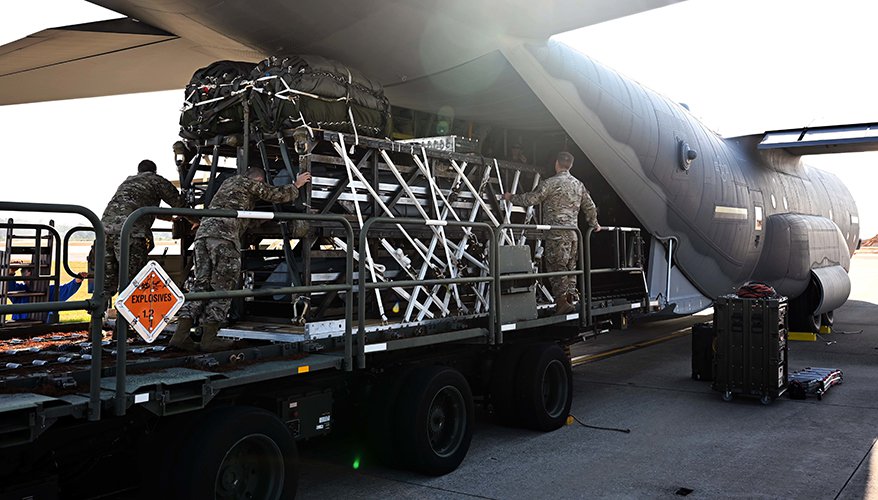
The weapon can be used on a wide variety combat aircraft. The video shows and F-35 and the actual test was done with an F-15, but there is no reason this could not In fact be dropped from a Coast Guard fixed wing using the “Rapid Dragon” concept.
It is not that the Coast Guard will necessarily be the only ones doing this mission, but the Coast Guard does seem to be particularly well suited for the purpose.
If we are to keep watch on vessels off the US coast in the run up to war, you want aircraft with long endurance. You want excellent communications. You want good electro optics so that you can watch what is happening on a ship from outside the range of shoulder launched air defense systems (MANPAD). You get all that with Coast Guard fixed wing aircraft equipped with the Minotaur system. Using Air Force’s QUICKSINK modified JDAM from the Rapid Dragon launcher means we can have a single unit that can remain on station for an extended period, observe the actions of target of interest, communicate effectively, and if necessary promptly eliminate a threat while freeing other assets like the P-8 and fighters to do jobs only they can do.
It would not be necessary for the Coast Guard to store the weapons or arm the aircraft if a agreement could be reached allowing DOD facilities to load the Rapid Dragon and weapons. Actually targeting would be done by DOD assets anyway. It appears this mission could be performed, even to our smallest fixed wing, the HC-144.
Is it doable?:
A recent report suggests that it is. Lt. Gen. James Slife, who leads Air Force Special Operations Command said, “It doesn’t require any aircraft modifications, it doesn’t require any special aircrew training.”
Might be of interest to compare the amount of ordanance used in this SINKEX. It should be recognized that this retired USN frigate was probably a larger, more resilient target than the one used in the “QUICKSINK” demonstration, but I suspect, if QUICKSINK had been used agains the frigate, the results would have been the same, though it probably would have taken the two halves of the ship longer to sink.
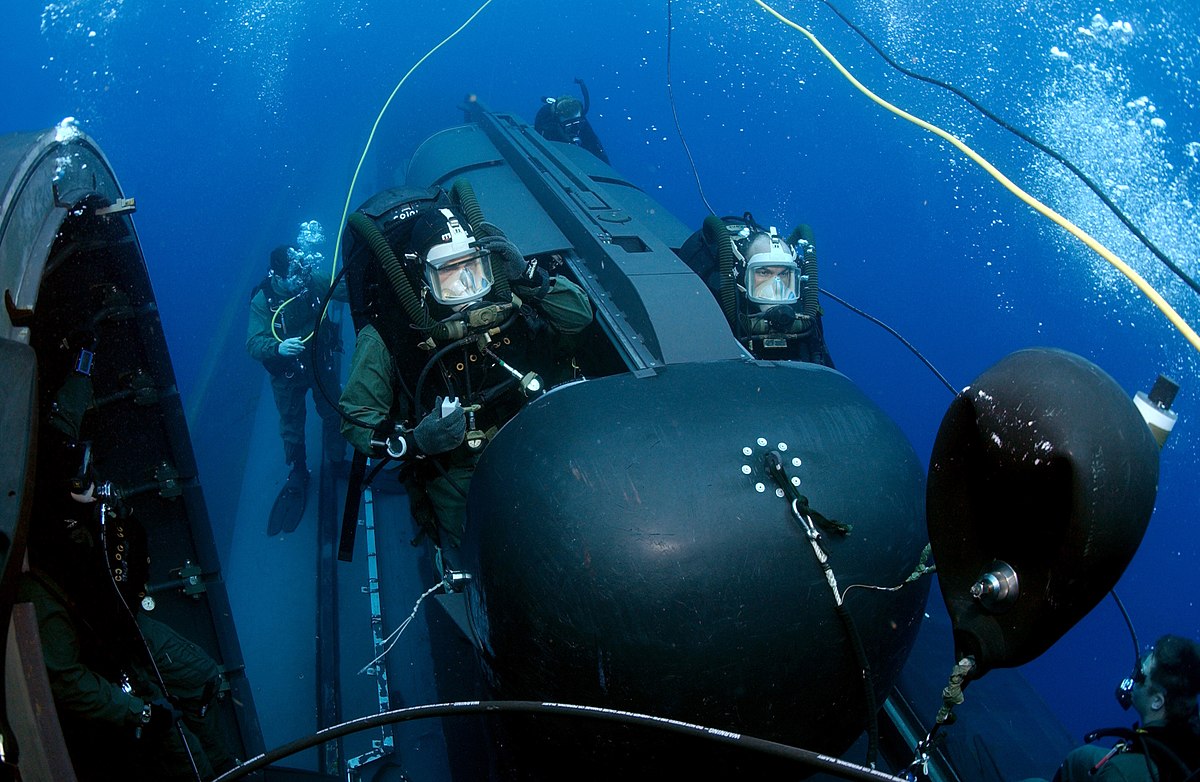
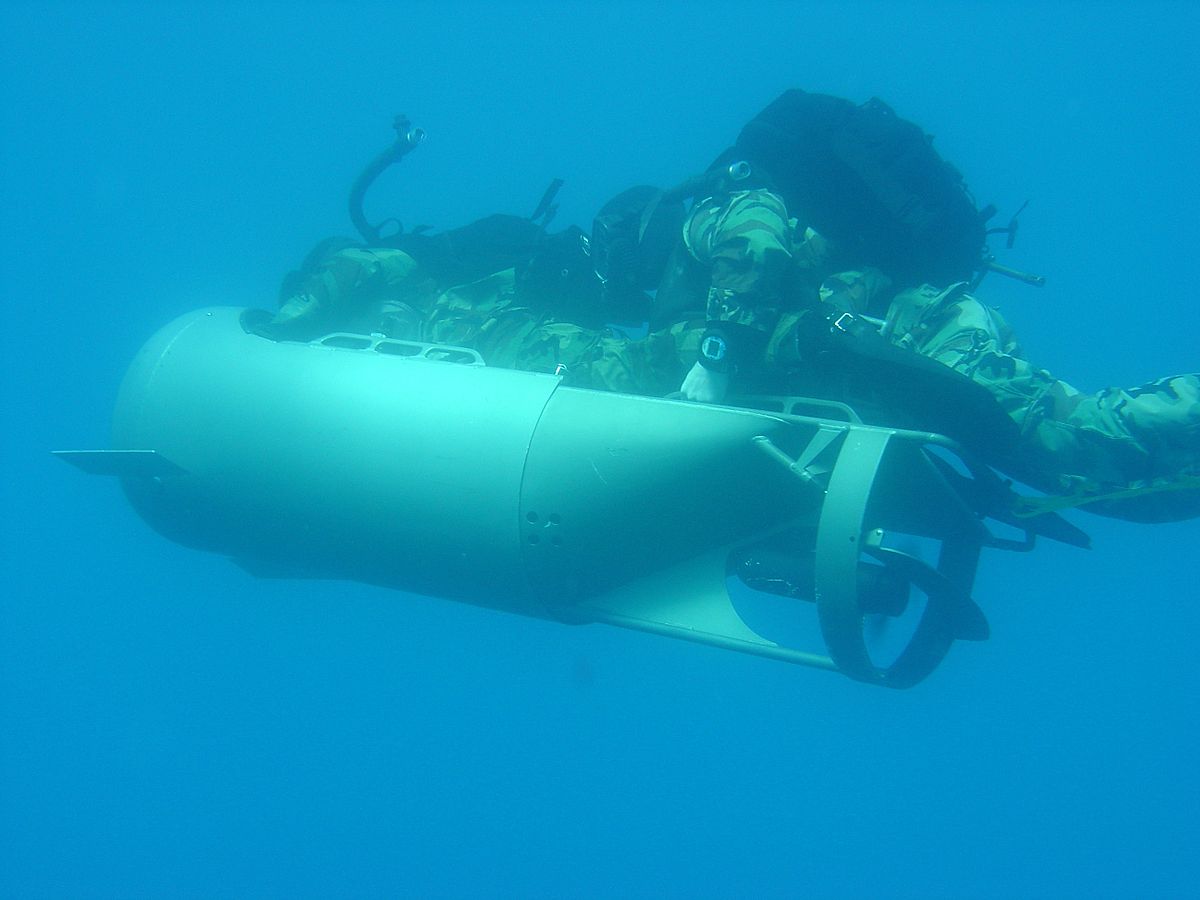
Atlantic Ocean (May 5, 2005) – Members of SEAL Delivery Vehicle Team Two (SDVT-2) prepare to launch one of the team’s SEAL Delivery Vehicles (SDV) from the back of the Los Angeles-class attack submarine USS Philadelphia (SSN 690) on a training exercise. The SDVs are used to carry Navy SEALs from a submerged submarine to enemy targets while staying underwater and undetected. SDVT-2 is stationed at Naval Amphibious Base Little Creek, Va., and conducts operations throughout the Atlantic, Southern, and European command areas of responsibility. U.S. Navy photo by Chief Photographer’s Mate Andrew McKaskle (RELEASED)
Naval Undersea Warfare Center (NUWC) Division Newport’s Argus Expeditionary Maritime Defense System team recently partnered with the U.S. Coast Guard Research and Development Center to evaluate capabilities that could aid the Coast Guard’s detection efforts, particularly with counter-unmanned undersea vehicle missions.
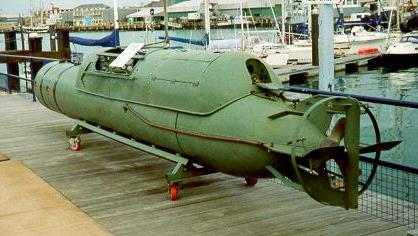
Italian Manned Torpedo. Photographed 1998, Submarine Museum, Gosport.
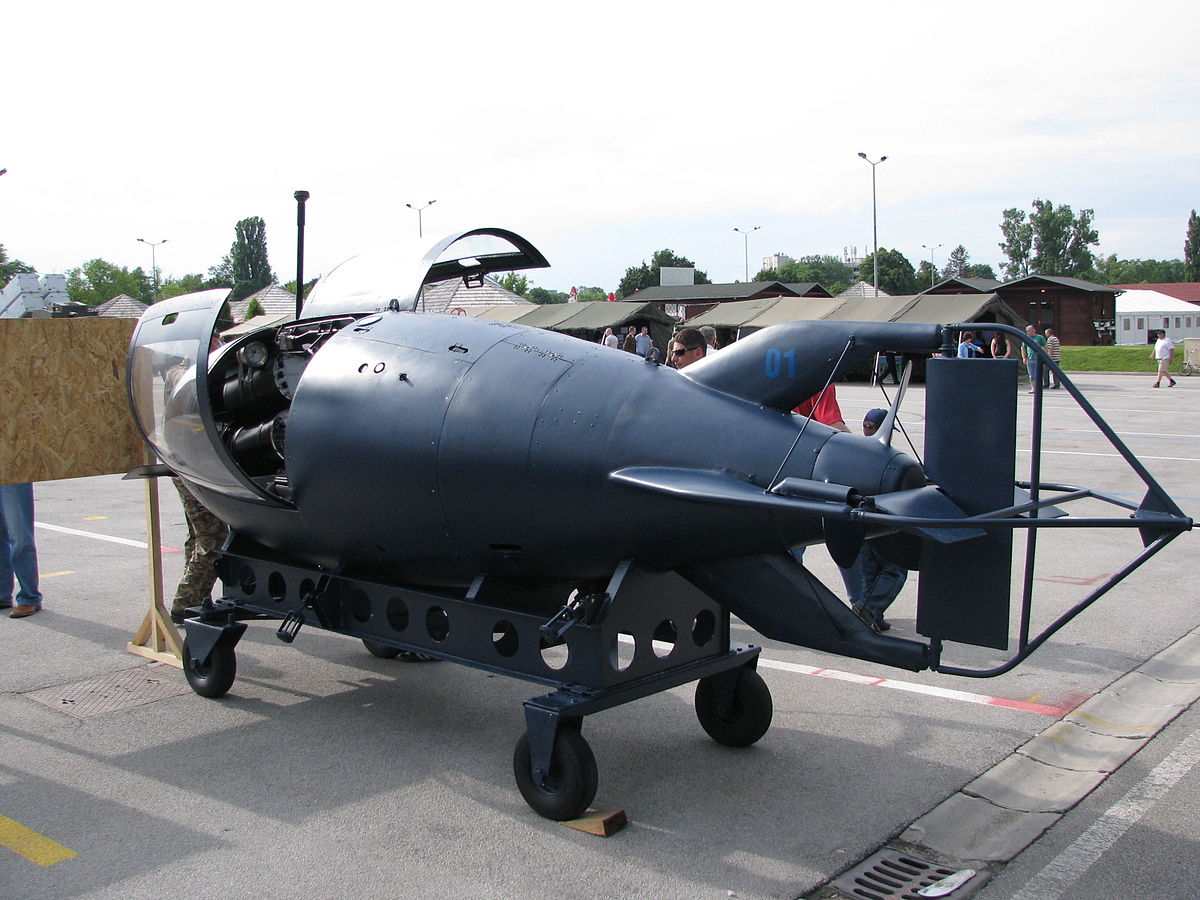
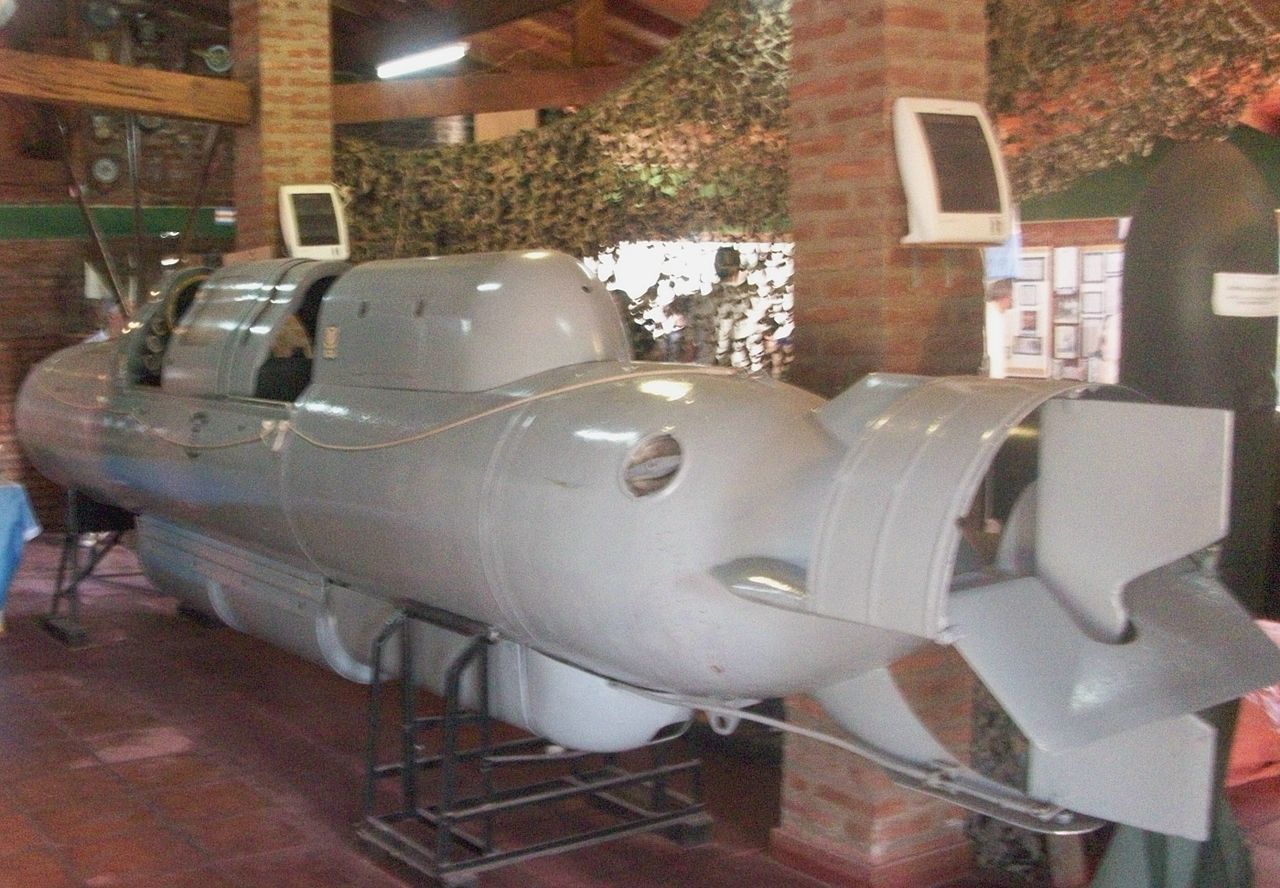
Countering Unmanned Underwater Vehicles is perhaps a new area of interest for the Coast Guard, but underwater threats to shoreside facilities and harbors are not new. The most successful of the threat organizations was Italy’s 10th Assault Vehicle Flotilla, Decima Flottiglia MAS. They used a variety of surface and subsurface craft, including the one pictured above, in more than a dozen operations, to sank or damaged five warships (totalling 72,000 tons) and 20 merchant ships (totalling 130,000 GRT). These included the Heavy Cruiser HMS York (lost after being wrecked and run aground to keep her from sinking) and severe damage to battleships HMS Valiant (out of service for seven months) and HMS Queen Elizabeth (out of service for a year and a half).
There are lots of successor organizations out there including all of the “axis of evil” usual suspects. After all, swimmer delivery vehicles are a lot easier to build than submarines and diver propulsion devices are available commercially.
The increased challenge presented by UUVs is that they may be harder to detect, and once you identify a threat, how do you eliminate it?
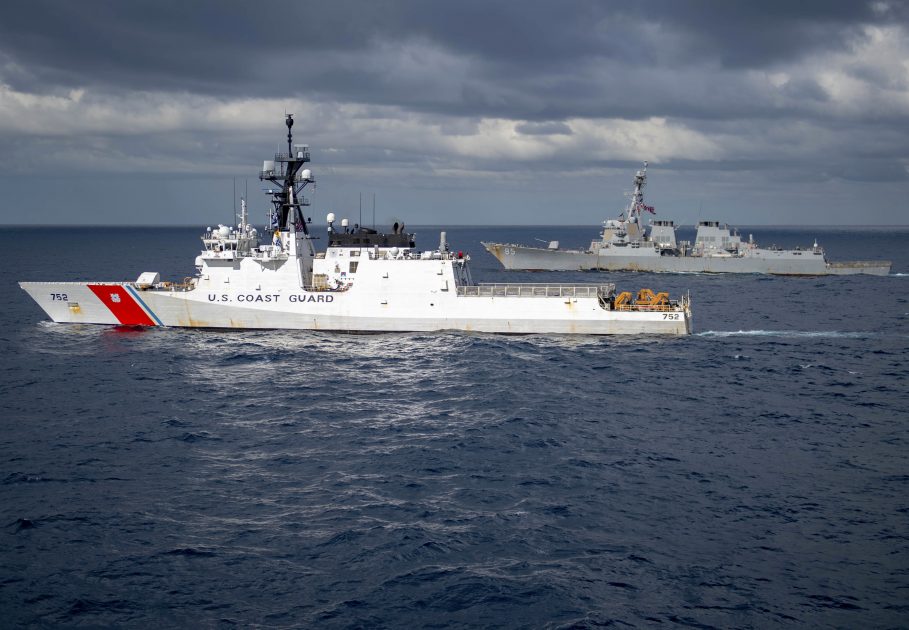
USCGC Stratton (WMSL-752), left, and the U.S. Navy Arleigh Burke-class guided-missile destroyer USS McCampbell (DDG-85) maneuver in formation during Talisman Sabre 2019 on July 11, 2019. US Navy Photo
Currently the CIMSEC web site is migrating to a new server so it is off line, but they have provided something a shorthand critique of how some think the Navy has fallen short, since the collapse of the Soviet Union.
The Coast Guard still has Defense Readiness as one of its eleven missions. We in the Coast Guard are highly dependent on the Navy helping us know what needs doing, but I don’t think we should fail to think for ourselves.
This short five page outline of what the Navy has been doing wrong may be helpful because we have probably been making some of the same mistakes, not just in our preparation to fight a “near peer” major conflict, but in our response to the terror threat, and perhaps in our on-going war with drug smugglers.
“Currently the Coast Guard provides approximately 50 reservists to NECC’s Maritime Expeditionary Security Groups 1 and 2, and Maritime Security Squadrons (MSRON). These Coast Guardsmen deployed with the MSRONs to Djibouti as integrated members of the staff since 2013. The integration in the MESF has been so seamless that the commander of the next MSRON unit deployed to Djibouti will be a Coast Guard officer.”
Scale model of a MK VI patrol boat launching a pair of JAGM missiles. This was displayed on Lockheed Martin’s booth during Sea Air Space 2021 This illustration replaced the original 8/19/2021.
Lockheed has new vertical launchers for JAGM, the missile that is replacing the Hellfire. Presumably it can also use the Hellfire. They seem particularly appropriate for Coast Guard applications, being small enough to mount 16 missiles atop the deckhouse of the Navy’s 85 foot MkVI patrol boat. They have a small foot print and are probably pretty light. They can be mounted in multiples of quad missile launchers; each quad launcher appears to be no more than 2′ x 3′ x 8′ tall. (That is my estimate, but I think if anything they are probably smaller. The missile itself is 7.1″ in diameter and 71″ long. For reference beam of the MkVI is only 20’6″.)
The Hellfire/JASM can successfully engage a large spectrum of potential maritime terrorist threats from small fast highly maneuverable craft (with one hit) to larger ships (assuming multiple hits), helicopters, drones, and some fixed wing aircraft.
There are two naval versions, one for mounting directly on deck and one for mounting below decks with just the muzzles above deck.
These would be an excellent addition to the Webber class being sent to replace the 110s in PATFORSWA. Probably could fit one or two quad launchers forward of the deckhouse on the Webber class on either side of the 25mm Mk38.
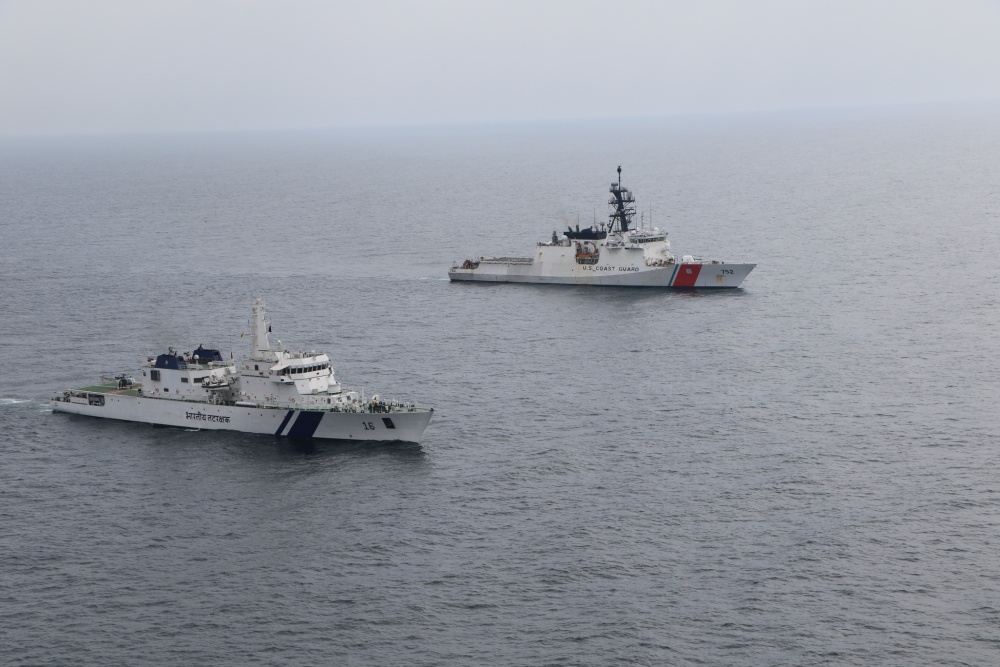
Coast Guard Cutter Stratton (WMSL 752) sales alongside the Indian coast guard ships Abheed and Shaurya (16) Aug. 23, 2019, while transiting in the Bay of Bengal off the coast of Chennai, India. The Stratton is participating in a professional exchange with the Indian coast guard that includes operational exercises at sea and on shore. (U.S. Coast Guard photo by Petty Officer 3rd Class Stephen Esterly)
Small Wars Journal makes the case for designating the Coast Guard to maintain expertise in and conduct maritime stability operations.
Historically, the United States military is regularly involved in some sort of stability operation despite the military preference for high intensity conflict. … The United States risks losing some of the lessons learned if it does not develop a holistic and complementary Joint Force that can both dominate a peer enemy and conduct stability operations at and below the level of armed conflict. Competition means that forces will be employed across the spectrum of operations with equal emphasis. Designating specific services to conduct stability as a primary mission is one means of ensuring a Joint Force that is equally capable across the spectrum. The Coast Guard is uniquely suited to a lead role in maritime focused stability operations. As a military force that is resident within the inter-agency, the Coast Guard provides a presence that is “instantly acceptable because of their worldwide humanitarian reputation.” This forward presence dovetails with the Department of Homeland Security mission of “safeguarding the American people” by pushing the boundaries of U.S. law enforcement into regions and countries where it can mentor and develop partner capabilities in the areas it is needed most.
It quotes the Coast Guard Strategic Plan 2018-2022.
“The Coast Guard plays a critical role in strengthening governance in areas of strategic importance. We mature other nations’ inherent capabilities to police their own waters and support cooperative enforcement of international law through dozens of robust bilateral agreements. Our leadership on global maritime governing bodies and our collaborative approach to operationalize international agreements drives stability, legitimacy and order. As global strategic competition surges, adversaries become more sophisticated and the maritime environment becomes more complex. The Coast Guard provides a full spectrum of solutions, from cooperation to armed conflict.”
The post states,
“At its heart the primary stability tasks fall into seven military missions and activities: protecting civilians, security sector reform, support to security cooperation, peace operations, foreign humanitarian assistance, counterinsurgency, and foreign internal defense.”
It then goes on to describe how the Coast Guard has done each of these tasks in the past.
What we may be seeing here is a preview of the roles the Coast Guard may be expected to perform when the expected Tri-Service Strategy is published.
Thanks to Geoff for the “White Hull Diplomacy” portion of the title.
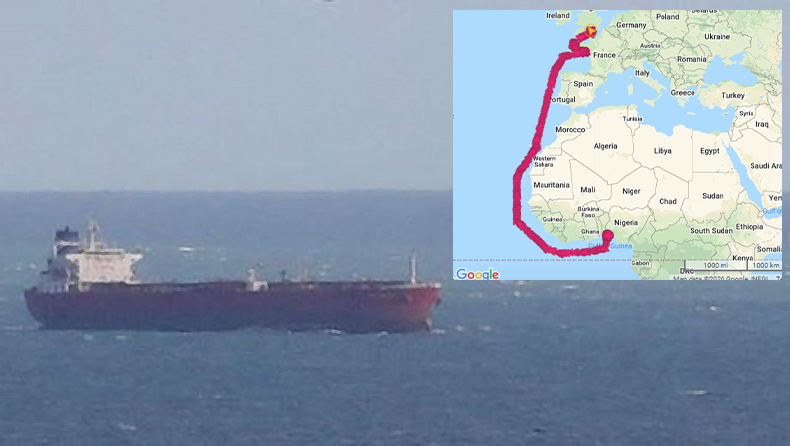
LLOYD’S LIST INTELLIGENCE DATA CONFIRMS THAT THE VESSEL LEFT LAGOS ON OCTOBER 6, WHERE THE STOWAWAYS ARE THOUGHT TO HAVE BOARDED.
The Drive reports on the recapture of the 42,000-gross-tonnage Liberian-registered tanker Nave Andromeda.
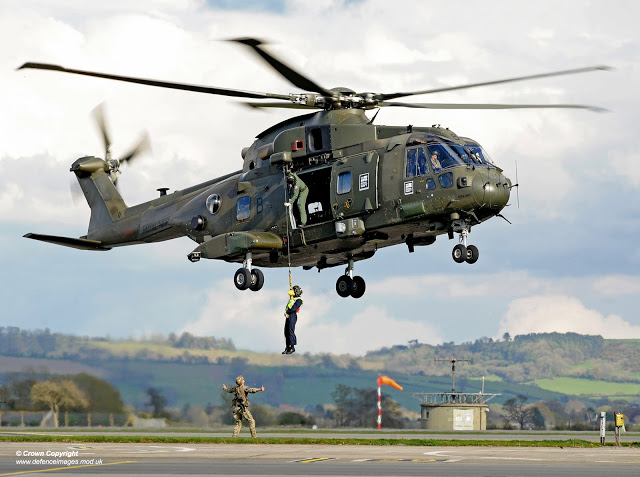
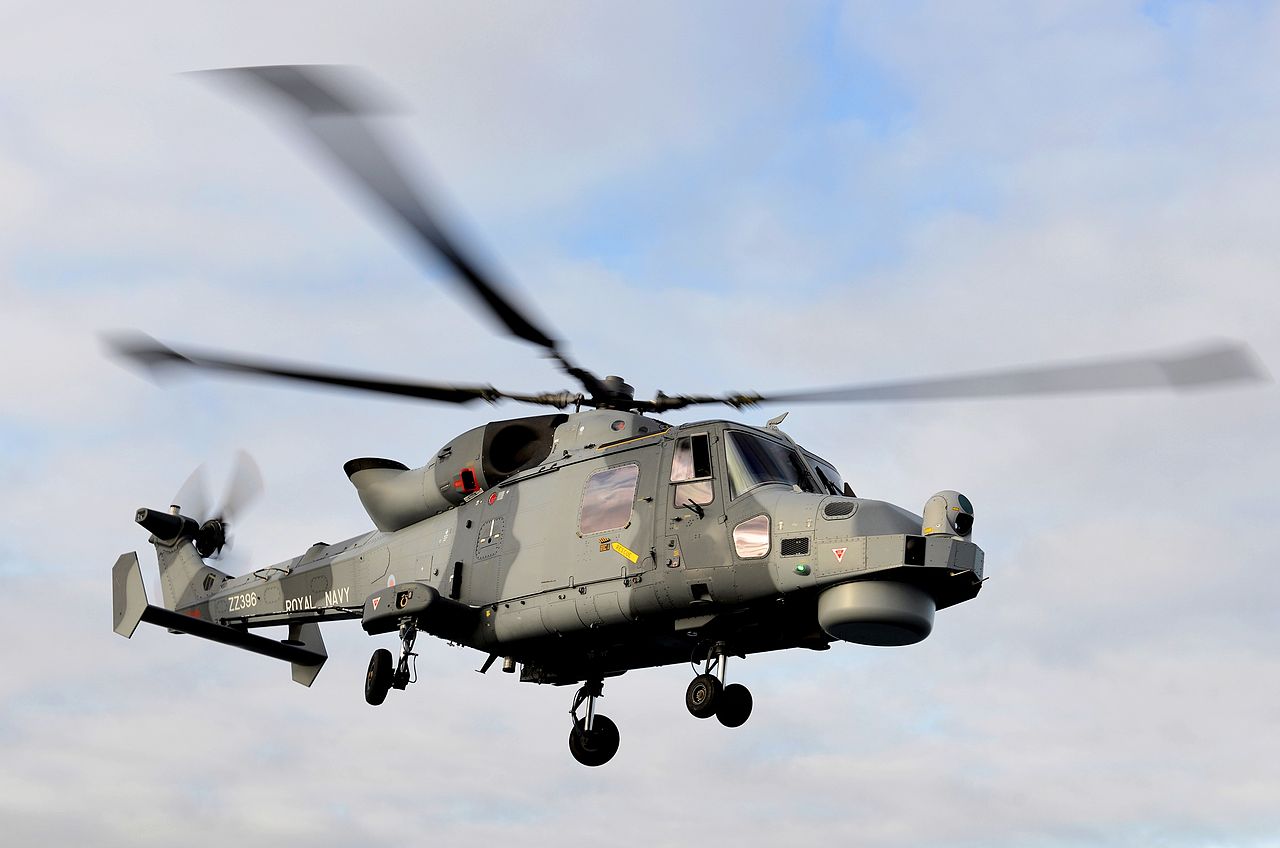
While this incident did not involve terrorists that might have had weapons capable of bringing down a helicopter, in this and a previous incident the Royal Navy’s Special Boat Service used not one, but four helicopters to land a team on the ship. Apparently the team, probably consisting of 16 members, was transported on two Merlin helicopters while Wildcat helicopters provided over-watch.
I have reproduced my comments on these topics below.
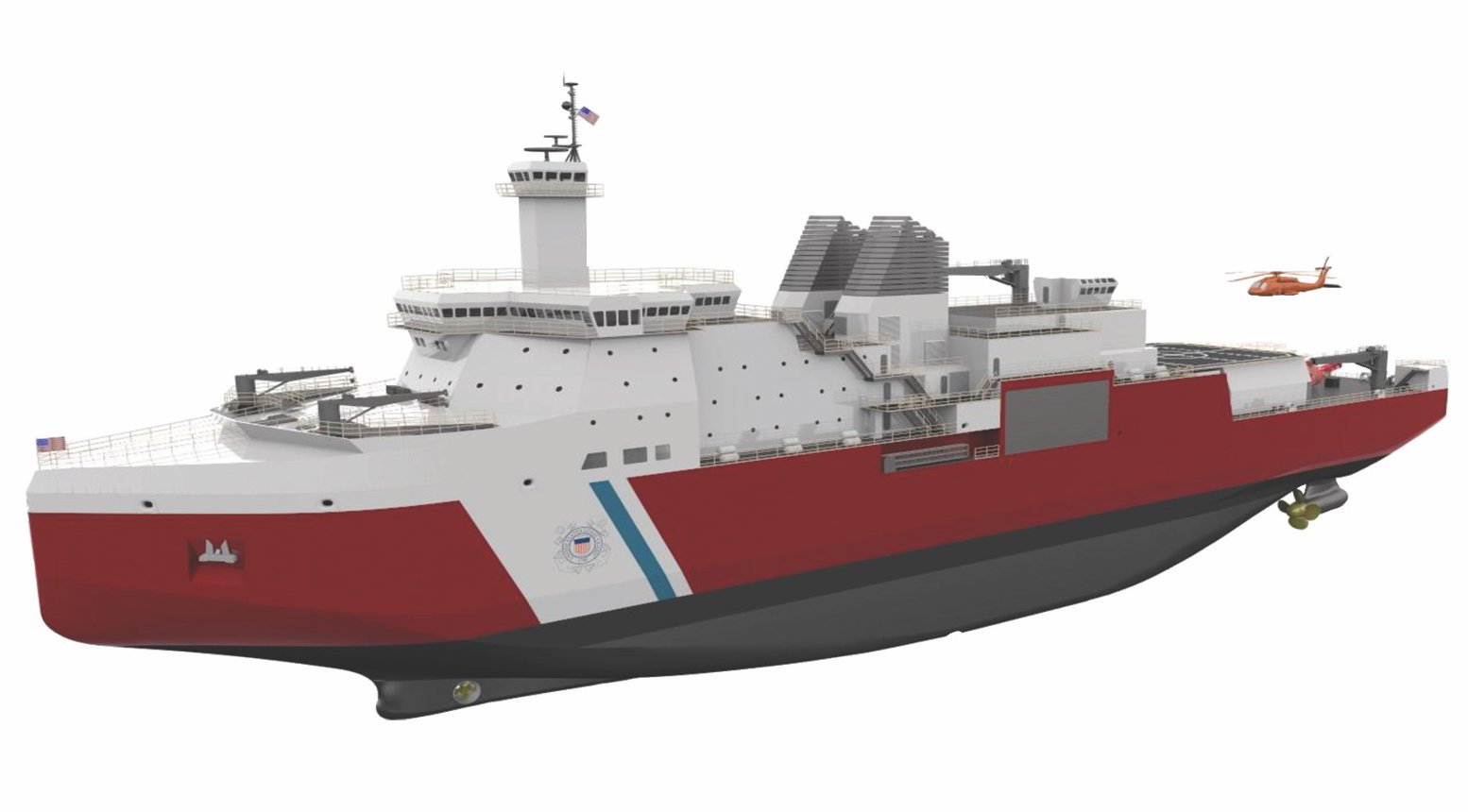
In regard to arming the Polar Security Cutters (the author seemed fixated on cruise missiles. We did discuss this topic earlier here)
There are limits to what we want to put on ships bound for Antarctica, since they have to be open for inspection. On the other hand if we ever do have a near peer conflict involving the Arctic or Antarctic, these will become rare and essential naval auxiliaries. As such they will probably operate with other vessels, including more powerful warships if appropriate, but that does not mean they should not be able to defend themselves against the possibility of leakers. We need to make provision for last ditch defense with systems like SeaRAM.
Meanwhile the fact that they are law enforcement vessels means they should be able to forcibly stop any private or merchant vessel regardless of size. So far it seems they will have at most, 25mm Mk38 Mod3 guns.
The follow on Medium Icebreakers or Arctic Security Cutters, which are unlikely to go to Antarctica, are more likely to be more heavily armed from the start.
Coast Guard ASW(comments were generally surprisingly adverse):
It is a fact that in WWII most U-boats were sunk by aircraft, but about a third (about 230) were sunk by surface vessels, primarily those of our allies Britain and Canada.
Even when surface vessels did not sink U-boats, they often performed valuable service in blocking access to convoys and in rescuing mariners from sunken ships.
US Naval vessels only sank about 38 U-boats. Coast Guard cutters and Coast Guard manned Navy ships were involved in sinking a disproportionate number of those (ten) for various reasons. Most of the US Navy effort went into the Pacific and most of the USN effort in the Atlantic at least through mid-1943, was in escorting high speed troop convoys than largely avoided contact with U-boats.
Circumstances we will face in any near peer conflict may be very different.
The advantages provided by code breaking in WWII are unlikely.
The advantages provided by radar equipped aircraft detecting U-boats charging their batteries or transiting the Bay of Biscay on the surface during the night no longer exists.
The Chinese surface and air threat would divert the most capable USN assets from ASW tasks.
Unlike the Japanese during the Pacific campaign, the Chinese are likely to make a concerted effort to disrupt our logistics train.
We simply do not have enough ASW assets.
Augmenting Coast Guard cutters to allow them to provide ASW escort and rescue services for ships that are sunk by hostile subs, in lower threat areas, is a low cost mobilization option that can substantially increase the number of escorts at low cost.
This could be facilitated by augmenting cutter with USN Reserves. Navy reserve ASW helicopter squadrons could be assigned to fly from cutters.
LCS ASW modules could be placed on cutters and manned by reactivated Navy reservists with LCS ASW module experience.
Our few US merchant ships need to be protected and when inevitably, some are sunk, we need someone to rescue those mariners, because they have become a rare and precious commodity.
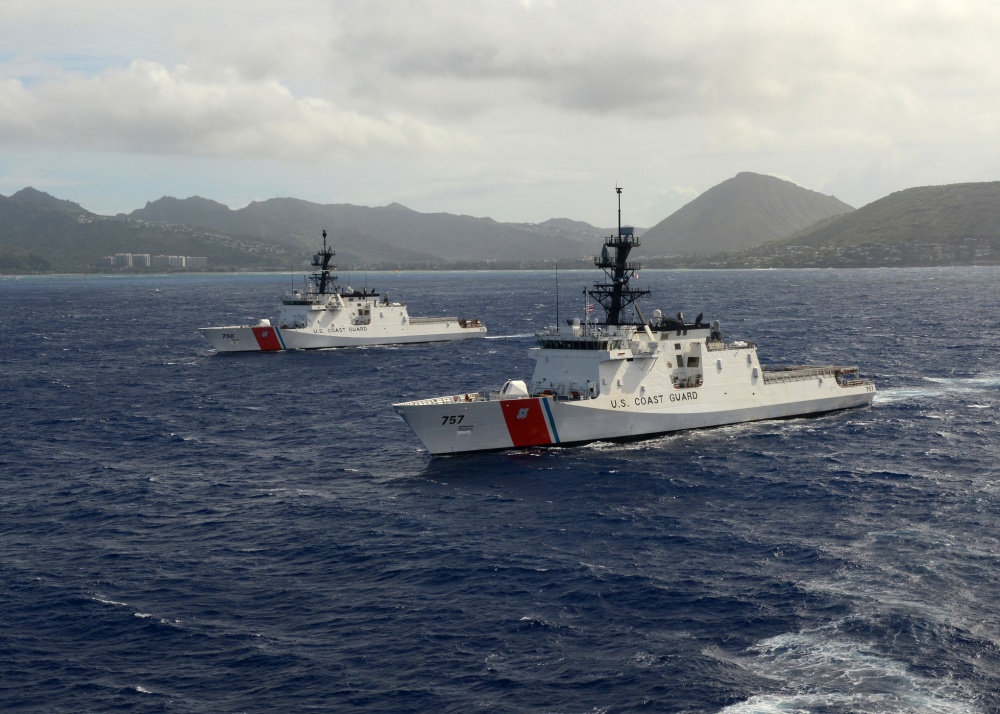
The crews of the Coast Guard Cutters Midgett (WMSL 757) and Kimball (WMSL 756) transit past Koko Head on Oahu, Hawaii, Aug. 16, 2019. The Kimball and Midgett are both homeported in Honolulu and two of the newest Coast Guard cutters to join the fleet. (U.S. Coast Guard photo by Petty Officer 3rd Class Matthew West/Released)
In answer to this comment from James M
Add : For (millions)
ASIST : 6.263
Mk 32 SVTT : 3.237
SLQ-25 Nixie: 1.727
AN/SRQ-4 LAMPS III: 4.625
VDS/MFTA combo: 14.802
ASW Combat Suite: 33.684
64.338 total. I am sure something could be arrived at for less. I look at this as what it takes to fit out an NSC the whole way. For one, OPC will never fit that VDS/MFTA on its stern. At best it would be a Nixie, maybe a container towed sonar we don’t yet use, and the mods for MH-60R. It would be good to know the plan for MUSV as it might help the equation. After all, the 64.338 would buy 2 MUSVs without payload. It could also buy an additional FRC.
So, we could equip ASW equip all eleven projected Bertholf class National Security Cutters (NSC) for less than the cost of a single frigate.
Why do you believe the VDS/MFTA would not fit on the Offshore Patrol Cutter? It is fully as large as the NSCs and does not have the boat launch ramp cut into the stern. They are also substantially larger than the LCSs.






 Chuck Hill's CG Blog
