CBP Coastal Interceptor Vessel, First of 52

NewCoastalInterceptorVesselPhotoCBP-59862

New Coastal Interceptor Vessel Photo CBP

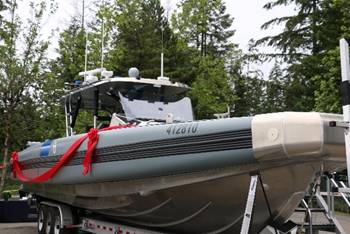
MarineLink reports Customs and Border Protection’s (CBP) Air and Marine Operations (AMO) has acquired the first of a planned 52 Coastal Interceptor Vessels (CIV), that look a lot like Coast Guard Response Boat, Small.

“AMO marine interdiction agents will operate the CIV in offshore coastal waters to combat maritime smuggling and protect U.S. ports from acts of terrorism.”

This sounds a lot like duplication of Coast Guard Missions. But then they do not do the other Coast Guard missions.

Webber Class WPC Homeports

FRC-graphic

Click on the graphic to enlarge

The Acquisitions Directorate has a story on the commissioning of the 17th Webber class WPC, USCGC Donald Horsley (WPC-1117).

Included in the post was the graphic above, which gives us an indication of where future cutters will be homeported:

  • Ketchikan, AK
  • San Pedro, CA
  • Pascagoula, MS
  • Atlantic Beach, NC
  • Cape May, NJ

One more WPC is expected to go to San Juan, so in about six months we should see a Webber class go to Ketchikan. Certainly its improved sea keeping compared to the 110s will be appreciated.

This is not, I’m sure, a complete list of future homeports, given that we expect 41 more of this class. I’m not privy to the home porting plan or how many will be in each port, but this looks like it will cover at least the next 18 months. It may cover a much longer period if more than one Webber class will be assigned to some of these ports, and that seems likely.

I would note that these homeports look good from a Ports, Waterways, and Coastal Security perspective. Ketchikan and the inland passage has a lot of cruise ship traffic. San Pedro is near the huge Los Angeles port complex and the strategic ports of Long Beach and Port Hueneme. Pascagoula based ships potentially protect the ports of the Eastern Gulf of Mexico including the eastern approaches to the Mississippi River port complex and the strategic port of Gulf Port, MS. Atlantic Beach, NC is close to Cape Lookout and Cape Hatteras, but it is also close to the strategic ports of Morehead City, Sunny Point, and Wilmington. WPCs in Cape May, NJ could provide protection for Delaware Bay, including the strategic port of Philadelphia.

If any of our readers has access to the homeporting plan, and it is public knowledge, I would appreciate the information.

China Lake Spike–the $5000 Missile

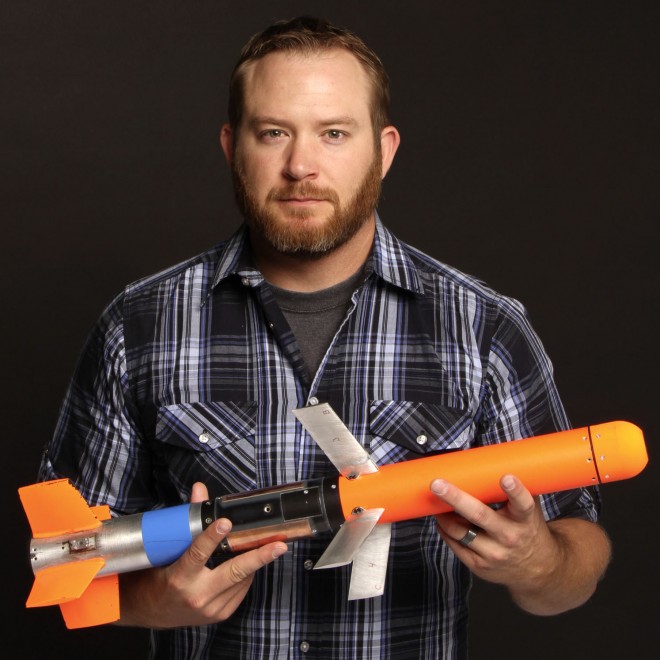
We have talked about the need for a small missile to deal with small, fast, highly maneuverable threats, with less chance of collateral damage than is inherent in using guns.  We have talked about Hellfire, Brimstone, Griffin, and guided 70mm rockets. Now it appears there is now an even smaller and much cheaper weapon that seems almost ideal for this end of the target spectrum. It has been in development for quite a while, but appears ready for production. Its range and precision appear to be much better than the machine guns we are currently using.

The Naval Air Warfare Center Weapons Division at China Lake has developed a very small missile called “Spike,” and the price is right–a marginal coast for each additional missile of only about $5000. This should not be confused with the Israeli missile family also called Spike. The following from the Wikipedia entry on the system:

Spike was designed by the U.S. Navy, with assistance from DRS Technologies, and is proclaimed to be “the world’s smallest guided missile.” Initially made to be carried by U.S. Marines, with three missiles and the launcher able to fit in a standard backpack, it weighs 5.4 lb (2.4 kg), is 25 in (640 mm) long, and 2.25 in (57 mm) in diameter. The warhead weighs about 1 lb (450 gr) and employs the Explosively Formed Projectile (EFP) effect, made to penetrate before detonating. It is powered by a small rocket motor that gives it a range exceeding 2 mi (3.2 km), making it safer and more accurate than rocket propelled grenades (RPGs). The missile is directed to its target by either an electro-optical (EO) or semi-active laser (SAL) seeker; the EO camera is similar to a basic cellphone camera, containing a 1-megapixel video camera that allows the shooter to select the area to engage in a fire-and-forget mode. The EO seeker cannot operate at night, so the SAL would have to be used. A third targeting mode is inertial, meaning the user can “snap and shoot” at a target without needing to lock on out to 200 meters. Both the Spike missile and reusable launcher each cost $5,000 and weigh 10 lb (4.5 kg) loaded, compared to 49 lb (22 kg) for a Javelin missile and fire control unit.

It has an unusual development history, being developed in house, quickly, at low cost, in response to a “rapid development capabilities” (RDC) program. Consequently the government now owns the design and can be assembled by contractors with no prior missile manufacturing experience and uses Commercial Off the Shelf (COTS) components.

It is included in the FY2017 Navy budget along with Griffin and Javalin as program element 3342: “Griffin Missile” intended to develop and deliver Counter-Swarm Small Boat defense capabilities for the Surface Fleet. (It is also interesting to see that this program still anticipates the use of the Griffin missile system (GMS) by the LCS even though the Long Bow Hellfire has already been selected to arm these ships.)

The missile is reportedly also effective against UAVs, helicopters, and some general aviation aircraft, so it should offer a degree of defense against attacks using these types of platforms.

Where should we have them? The six WPBs stationed in Bahrain and the two force protection units at King’s Bay and Bangor that escort SSBNs as they transit from homeport to deepwater come to mind as perhaps the highest priority, but we have at least 30 ports that need protection. Total distribution of the systems might be slightly more than 200 including ultimately one for each of the  37sectors, 58 Webber class WPCs, 73 Marine Protector class 87 foot WPBs, plus 34 larger ships.

If the reported costs are correct a unit might be outfitted with a shoulder launcher and three missiles for as little as $20,000. If so, 200 weapon sets would cost only $4M and they would presumably be paid for by the Navy over several years.

Of course, if we are going to use their semi-active laser homing capability at night, we will need to get past current restrictions on the use of lasers.

More info here (pdf).

SPIKEnavy-5-lb-missle-inline-660x660

U.S. Navy photo. Spike Missile Visual Demonstration by Lead Technician Jonathon Pooley

ALaMO–Making the 57mm Round Smart

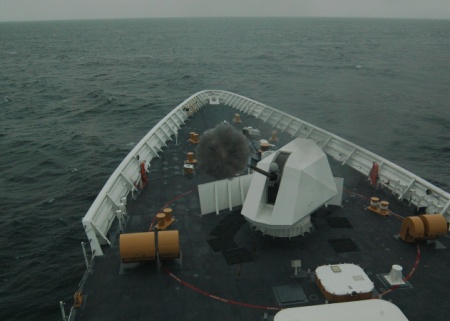
NSCfires57mm

The Navy has a program call “Navy’s Advanced Low Cost Munition Ordnance” or “ALaMO”

Justification as provided to Congress is here. The proposed budget includes $5.759M in FY2017, $25.984M in FY2018, and $24.982M in FY2019. The round is expected to be operational in 2020 (about the time the first OPC comes out).

“Advanced Low Cost Munition Ordnance (ALaMO) significantly increases 57mm MK 110 Gun Mount lethality and effectiveness against Fast Attack Craft and Fast In-Shore Attack Craft (FAC/FIAC). The 57mm ALaMO funding supports non-recurring engineering, design verification testing, environmental qualification, hazard classification, insensitive munitions and developmental testing. ALaMO will be qualified for USN use at the conclusion of the program.”

A US Naval Institute News story, “Wrapup: HASC Passes FY2017 Defense Bill With Reagan-Era Spending Levels,” indicates House Armed Services Committee interest in speeding up the program.

“A provision in the bill notes interest in the Navy’s Advanced Low Cost Munition Ordnance (ALaMO), a 57mm guided projectile that could be used on the LCS, and requests information on what it would take to achieve initial operational capability by 2019.”

Sounds like the Coast Guard should have a few of these rounds as well, both for small, fast, highly maneuverable targets, and to target specific areas on larger targets. We had some indication this was coming before.

Document Alert: Cutter Procurement–Another Report to Congress

Once again, the Congressional Research Service’s Ronald O’Rourke has revised his “Coast Guard Cutter Procurement: Background and Issues for Congress” with the new edition issued April 15. This has got to be a hot topic because previous revisions were issued March 22, January 27, and December 14, 2015. That is four revisions in four months, on average every six weeks, but the latest is only 24 days after the previous edition. I have begun to sense, we may have turned a corner. The tone of the reports has changed over these four months, from, how long will it take us to reach the “Program of Record” (POR), to consideration of, if we should perhaps go beyond the POR.

The NSC, OPC, and FRC programs pose several issues for Congress, including the following:

“whether to fund the acquisition of a 10th NSC in FY2017;

“whether to fund the acquisition of four FRCs in FY2017, as requested, or some other number, such as six, which was the number projected for FY2017 under the Coast Guard’s FY2016 budget submission;

“whether to use annual or multiyear contracting for procuring FRCs;

“whether to use annual or multiyear contracting for procuring OPCs;

“planned procurement quantities for NSCs, OPCS, and FRCs;

“the cost, design, and acquisition strategy for the OPC;

“initial testing of the NSC; and

“rotational crewing of the NSC.”

The latest revision includes three substantial Appendices:

  • Appendix A. Planned NSC, OPC, and FRC Procurement Quantities (pp 17-22)
  • Appendix B. Funding Levels in AC&I Account (pp 23-26)
  • Appendix C. Additional Information on Status and Execution of NSC, OPC, and FRC Programs from March 2016 GAO Report (pp 27-34)

Appendix C is entirely new and appears to have been the reason for the revision.

Appendix A (p. 17-22) is a fairly detailed discussion of the results of the Fleet Mix Study and asks why we so seldom hear that the program of record is not enough to assure the Coast Guard to successfully accomplish its assigned missions.

The Fleet Mix Study was made public in 2012 long after its completion in 2009. It is due for a reexamination and the Commandant has said another will be done. When that happens, we seriously need to look at more than just more of the same assets. We need to look at additional technology, equipment, and weapons that might allow us to accomplish these missions without a major increase in personnel.

Looking at “Table A-3. Force Mixes and Mission Performance Gaps” (document page 18) I would note that if we get to Fleet Mix Analysis Phase 1 (FMA-1, an increase over the POR including 9 Bertholf class NSCs, 32 OPCs and 63 Webber Class FRCs, for a total of 104 vessels), we will have addressed all the “Very High Risk Gaps” found in the Fleet Mix Study that included SAR capability, “Defense Readiness Capacity,” and “Counter Drug capacity.” What will remain are “High” or lower risks in Ports, Waterways, and Coastal Security (PWCS) and Living Marine Resources (LMR), and a low to very low risk to the Alien Migrant Interdiction Operations (AMIO) mission. This total of more than 40 NSCs and OPCs certainly should not be out of the question, after all the Coast Guard has included over 40 ships larger than a thousand tons for the last several decades.

Still, I would note that, no matter how many ships we have, the Ports, Waterways, and Coastal Security (PWCS) mission will always be at risk, unless weapons are available to quickly and reliably stop terrorists’ exploitation of a larger merchant vessel to make an attack. Guns alone are simply not up to the task. I have identified two weapons that might address this threat, (1) equipping our WPCs and possibly WPBs with light weight torpedoes that target a ships propellers or (2) equipping our larger ships with the Long Range Anti-Ship Missile (LRASM) which might allow our larger cutter to effectively support our smaller cutters and respond to an attack, even if the large cutter 200 miles from the targeted port. Either would also make our ships much more capable of making a meaningful contribution to Defense Readiness.

Mandatory Electronic Data Exchange for International Shipping Adopted by IMO

BairdMaritime reports,

“Mandatory requirements for the electronic exchange of information on cargo, crew and passengers have been adopted by the International Maritime Organisation (IMO), as part of a revised annex to the Convention on Facilitation of International Maritime Traffic (FAL).

“The IMO has said the change will help make procedures for a ship’s arrival, stay and departure from port easier once the FAL takes effect on January 1, 2018.”

This should of course facilitate commerce, but it is also an important part of the Maritime Domain Awareness System.