“Top Ten Navies by Aggregate Displacement, 1 January 2024” –Analysis and diagram by Phoenix_jz

Two years ago, I did a post with a similar title from the same source. Somehow, I missed the 2023 edition. As I said in the earlier post, I don’t know , but the data appears to be credible, and it looks like readers are checking his figures. 

It is very difficult to read the tonnages at the bottom of the graph unless you are using a computer and click on the graph to see it in a larger size. 

The creator’s notes and some additional comments are below. 


Hello all!

Well, 2024 is upon us, and as such so is the third edition of my top ten navy list. For those unfamiliar, here are links to 2022 and 2023, with a general explainer of the whole concept in the 2022 version.

The long and short of it is that this graph reflects a personal tracker I keep of almost every large and moderately sized navy, and calculates the aggregate displacement of these navies. It’s not a perfect way to display the size of navies – far from it in fact – but it is at least more representative than counting numbers of hulls alone, in my opinion.

To break down what each of these categories mean;

  • Surface Warships is an aggregate of all above-water warships and major aviation and amphibious assault platforms. This category includes CVNs, CVs, CVLs, LHDs, LHAs, LPDs, CGs, DDGs, FFGs, corvettes, OPVs, CPVs, lighter patrol craft, and MCM vessels.
  • Submarines is what it says on the tin – SSBNs, SSGNs, SSNs, SSKs, and for select nations where applicable (and where information is available), special purpose submarines. Please note dedicated training submarines are counted separately.
  • AORs includes all major fleet replenishment vessels (coastal vessels do not count, however).
  • Other Auxiliaries is a very wide net that essentially captures everything else. Special mission ships, support vessels, minor amphibious assault vessels (LSDs, LSTs, LCAC’s, LCM’s, LCU’s), training vessels, tugs, coastal support vessels, hydrography ships – all essential parts of navies, but generally often paid less attention to as they’re not as flashy as the warships proper.

Interesting trends in data that I thought I would share for various navies, and thoughts and observations otherwise;

The USN is, unsurprisingly, still top dog by a huge margin. In spite a net decommissioning of five ships this year, the USN has grown overall by about 32,000 tons – four ‘cruisers’, two SSNs, four LCS, and five patrol craft decommissioned against the introduction of three destroyers, an SSN, five LCS, and a replenishment ship. It is worth noting that 2023 is the first year since 2010 that the USN has commissioned three destroyers in a year, though a repeat performance in the next couple years is unlikely – these ships were launched in 2020 and 2021, and only one destroyer per year was launched in 2022 and 2023.

No one will be surprised to hear that the PLAN has grown for the nth consecutive year, adding the final Type 055 batch I and the remaining Type 054A Batch V, for almost 50,000 tons of new surface combatants. Much of the remaining increase in displacement for this year (which totaled nearly 90,000 tons) reflected a steady pace of modernization in mine warfare, landing forces, and logistical support/other auxiliaries. As with last year, the number of minor patrol craft continue to plummet as the PLAN continues to divest many of its obsolescent brown-water combatants, or relegates them to training duties.

Moving on to ongoing construction, progress on the new destroyer batches continues at pace. At least two Type 055 Batch II appear to be under construction, and the overall number of Type 052D Batch IV appears to be at least ten. The first ship actually launched at the very end of 2022 (at Jiangnan), and two further have been launched by the same yard as well as three at Dalian. Two more remain under construction at each yard. The first of these ships to be launched appears to be on trials and will likely commission this coming year. The Type 054A program of the navy appears to have finally wrapped up (construction of the hull for the China Coast Guard continues), and the Type 054B program has continued at pace if not scale – two ships were launched this year, but modules of further units have been scarce. Rounding things out for major surface vessels, a new Type 075 LHD was launched this past December. Conspicuously absent has been sightings of any modules for new carriers. Considering Fujian (Type 003) began construction at some point from 2015 to 2017, one has to wonder if we will see China launch another carrier before the end of the decade.

Perhaps most consequential of all, however, has been the completion of new production facilities at Bohai and a resumption of Type 093 SSN launches. The first of the new Type 093B launched in 2022, and has been followed up by two more launches this year (possibly up to three). A sustained pace of two submarines a year, or even just three submarines every two years, would quickly add up could see anywhere from nine to eleven new SSNs launched by the end of 2027, and in service by early 2030s. Only time will tell what the actual drumbeat of production will be.

Russia’s VMF woes in the Black Sea have continued unabated, except less at sea and largely fueled by the Franco-British SCALP cruise missile. The most dramatic loss by far was the destruction of the Project 636.3 ‘Improved’ Kilo Rostov-on-Don in drydock at Sevastopol, but similar attacks claimed the destruction or constructive loss of a Karakurt-class corvette (under construction, not in service) and two Ropucha-class LSTs. The infamous TB-2 made a brief return to destroy a Serna-class LCU, and two other LCU’s may have finally become the first victims of Kamikaze USVs this past November, for a total of 11,407 tonnes lost.

In regards to the more regular cycle of commissioning and decommissioning, one frigate, one MCM vessel, and three corvettes were brought into service, as well as a new SSGN, SSBN, and SSK each. Against this a corvette, SSGN, SSBN, and SSK were decommissioned. Overall, in spite of losses the VMF managed a net gain of 6,324 tonnes of surface warships and submarines. Anyone who checks against my figures from last year will note that the increase in the VMF’s overall tonnage this year is far more substantial, due to the auxiliary category. Though some of this was from new vessels, this was mostly down to a badly needed overhaul and reorganization of that part of my tracker, particularly for the tug fleet. Did you know the Russian navy tug fleet displaces more than either the Argentine or Canadian navies? Now you do! Seriously – it would be the 20th largest navy in the world by itself.

As a final note on the VMF – it is worth remembering that ships commissioned in the Russian navy are not always actually in service, as ships can often languish in near-terminal refits or simply be left inactive without a formal decommissioning. Almost half the remaining Projekt 877 Kilo’s, for example, appear to be inactive at this point (5 of 10).

(In comments the author noted the following, “Russian naval losses during the war have totalled 13 vessels for 29,870 tonnes. Quite a bit – but also only about 1.4% of their current overall tonnage.” –Chuck)

The British Royal Navy observes a second year of marginal reduction in overall tonnage (-2,640t, or -0.3%), losing another Type 23 frigate as well as the last Echo-class survey ship. Against this the RFA brought into service the first MROSS, ProteusProteus represents a considerable increase in subsurface capability, though the loss of a frigate with no replacement ship to replace it for another thee to four years is painful, especially given how many of the remaining eleven ships are deep in LIFEX/Post-LIFEX refits. With that said, their new frigate programs are moving on steadily. Steel was cut on two new frigates this year – the future HMS Birmingham (4th Type 26) and HMS Active (2nd Type 31), bringing the total construction volume to five frigates building and one fitting out.

The JMSDF continues to grow, albeit at a more moderate pace this year (+6,530t, or +0.9%), inducting a new Mogami-class frigate and Taigei-class attack submarine, while shifting another Oyashio-class from the active fleet to a training role. Two more FFM were launched this year, though surprisingly they have not started construction on the next pair. This past November, it was announced that the Mogami-class FFM would be curtailed at 12 units (of 22 planned), and followed on by an evolution of the design known as FMF-AAW. The FMF-AAW will feature greater air and surface warfare capabilities. Twelve such ships are planned.

The Indian Navy’s growth in 2023 was far less dramatic than in 2022, but still noteworthy (+9,200t, or +1.5%), as adding a new conventional attack submarine and destroyer to the fleet has finally pushed them over the 600,000-tonne line.

The Marine Nationale grew by almost 9,000 tonnes (2.1%) this year, largely down to the retirement and replacement of a patrol ship, nuclear attack submarine, and tugs with an equal number of replacements. Though it is worth noting that the new attack submarine is not fully operational yet – that will happen in 2024 – so technically the MN’s attack submarine fleet is really four boats at this point in time.

The saga of eight and ninth place swapping around continues, as the ROKN has managed to move back to the position of eighth largest navy in the world. In 2023 they added a net 15,374t (+4.3%), commissioning four Daegu-class frigates, a second KSS-III class attack submarine, an MCM vessel and a pair of LCACs, against the decommissioning of two corvettes and five PKM’s.

In contrast, the Marina Militare continues to feel the bite from the two FREMM sold to Egypt, as well as delays in brining the LHD Trieste into service – intended for 2023 but again pushed back, now to the spring of 2024. The first PPA ‘Light+’, Raimondo Montecuccoli, was brought into service in 2023 – an OPV on paper, but light frigate in practice. Against this one of the elderly Maestrale-class frigates, Zeffiro, was retired, as was one of the fleet’s AORs (Vesuvio) and a water tanker (Bormida), resulting in a real drop of 7,073 tonnes (-1.9%). The drop seen versus the chart versus last year is more dramatic (totals 16,632 tonnes), which reflects both cleaning up data on old auxiliary platforms for which information is scarce, and correcting some minor sheet errors, which totaled 9,559 tonnes.

The outlook should be looking up in the future – as previously mentioned, the LHD Trieste should enter service this year, as should the fourth and fifth PPA. The first of two replacement FREMM (GPe) was launched in late 2023 and a second will follow this spring, with both being slated to enter service in 2025 alongside the sixth PPA and second Vulcano-class replenishment ship – barring any delays.

Finally, the Indonesian Navy saw another year of growth, adding a net 9,930 tonnes (+3.1%), with another hospital ship commissioned, a new survey ship, corvette, and two new MCM vessels and FACs each, as well as several patrol boats. The TNIAL continues a steady program of domestic construction of patrol craft, and construction is ongoing on two Iver Huitfelt derivative frigates, with the keel of the first vessel laid down this past August. They have also cut steel on a new hydrography ship, which will launch in Indonesia and complete fitting out in Germany.

What comes next in terms of major platforms for the TNIAL is somewhat up in the air. As with the year prior, there has been no progress made on the procurement of six FREMM from Italy, despite a contract being signed two and a half years ago (June 2021). In spite of this, they have expressed interest in procuring two PPA to bolster their patrol fleet. In the interest of expediting procurement, they are looking at two ‘Light+’ configuration vessels currently fitting out at Muggiano – Marcantonio Colonna (due for delivery to the MMI in the latter half of 2024) and Ruggiero di Lauria (due for delivery to the MMI in mid-2025). According to the General Manager of Fincantieri’s Naval Vessels Division, Dario Deste, a contract for the two vessels could be signed in the first half of 2024.

(In answer to a question the author added this in the comments–Chuck)

No.11 to 20 are as follows for 1 January 2024;

  • 11: Turkey – 297,298t
  • 12: Taiwan – 268,958t
  • 13 Egypt – 232,046t
  • 14: Spain- 229,373t
  • 15: Germany – 226,655t
  • 16: Australia – 224,074t (decided to add the National Support Squadron, which added about 30kt)
  • 17: Greece – 189,184t
  • 18: Brazil – 162,29t
  • 19: Chile – 161,404t
  • 20: Argentina – 138,620t
(A reader, , added this–Chuck)

Listed by ranking for this year:

Nation Change from 2023 (tonnes) 2023 Ranking Change from 2022 (tonnes) 2022 Ranking
United States +55,658 1st +250,308 1st
China +93,567 2nd +99,299 2nd
Russia + 211,333 3rd +166,682 3rd
United Kingdom -2,640 4th -5,815 4th
Japan +6,530 5th +23,790 5th
India +9,200 6th +62,349 6th
France +8,925 7th +12,145 7th
South Korea +15,374 9th +7,153 8th
Italy -16,632 8th -3,452 9th
Indonesia -70 10th +17,709 10th

Probably not surprising given all these nations are competing more or less with each other, but the rankings have basically remained the same except for Italy and South Korea trading places in 2023, then reverting to their 2022 places again this year. Nobody previous top 10 navy has left the club either.

However, do note that not all of the year-to-year tonnage differences are due to actual changes in fleet size/composition. As Phoenix mentioned in his post, the Russians in particular got a huge tonnage jump this year because he changed the way he counts auxiliaries, and given the discrepancy between his reported +32k figure for the USN and the numbers, there’s probably some math correction involved there too.


“Royal Marines snipers shoot out engines to bring drug-runners’ boat to a halt” –Forces.Net

HMS Dauntless has a Wildcat helicopter and Royal Marines sniper team from 42 Commando who provide reconnaissance, surveillance, and aerial support (Picture: Royal Navy).

Looks like the Royal Navy now has their own “Airborne Use of Force” Team to do the same sorts of things the Coast Guard has been doing.

Forces.Net reports,

A Royal Marines sniper team has brought a Caribbean drug-runners’ power boat to a “juddering halt” after shooting out its engines.

US Coast Guard personnel, working alongside the sailors and marines on board Royal Navy destroyer HMS Dauntless, were then able to seize £60m worth of cocaine, which the smugglers had been attempting to throw overboard.

Read on in the linked report. HMS Dauntless has been doing good work in cooperation with a US Coast Guard Law Enforcement Detachment. HMS Dauntless is the second of six Type 45 Guided Missile Destroyers, roughly the Royal Navy counterpart of the Burke class DDGs and almost twice as large as the National Security Cutters.

HMS Dauntless (foreground) and HMS Daring. Photo: LA(Phot) Ian Simpson/MOD

Thanks to David for bring this to my attention.

“US, Japan coast guards formally expand cooperation” –PAC AREA News Release / “Royal Navy and US Coast Guard to Forge Closer Bonds”

Ships from the U.S. Coast Guard and Japan Coast Guard conducted exercises near the Ogasawara Islands of Japan, Feb. 21, 2021. The U.S. Coast Guard Cutter Kimball and Japan Coast Guard Ship Akitsushima, two of the respective services’ newest and most capable vessels, operated alongside helicopters and unmanned aerial vehicles to practice interdicting foreign vessels operating illegally inside Japanese waters. (U.S. Coast Guard photo courtesy of the Coast Guard Cutter Kimball/Released)

The Coast Guard has been busy increasing its international visibility. Below is a news release concerning increased cooperation with the Japanese Coast Guard that came out yesterday. Today, I see a SeaWaves report, also dated yesterday that,

“The Royal Navy and US Coast Guard have vowed to work more closely to fight crime and protect the planet. The two services already combine to stop drugs traffickers in the Caribbean and Middle East, assist each other with operations in the polar regions, run exchange programs for sailors and frequently work and train side-by-side around the globe.”

The new relationship with the Royal Navy includes expanded personnel postings that began back in 2014.

There are also plans to build on already successful exchange programs, which allows USCG engineers to work with the Royal Navy but will soon also allow pilots and aircrew to do the same. (emphasis applied–Chuck)

Perhaps we are not too far from exercising something like my proposed “Combined Maritime Security Task Force Pacific” with a US Coast Guard Cutter, a Japanese Coast Guard Cutter, and a Royal Navy River Class OPV working with navies and coast guards of SE Asia to protect their EEZ. Perhaps the Indian Coast Guard will join as well.

News Release

May 19, 2022
U.S. Coast Guard Pacific Area

US, Japan coast guards formally expand cooperation

US, Japan coast guards formally expand cooperation US, Japan coast guards formally expand cooperation

Editors’ Note: Click on images to download high resolution version.

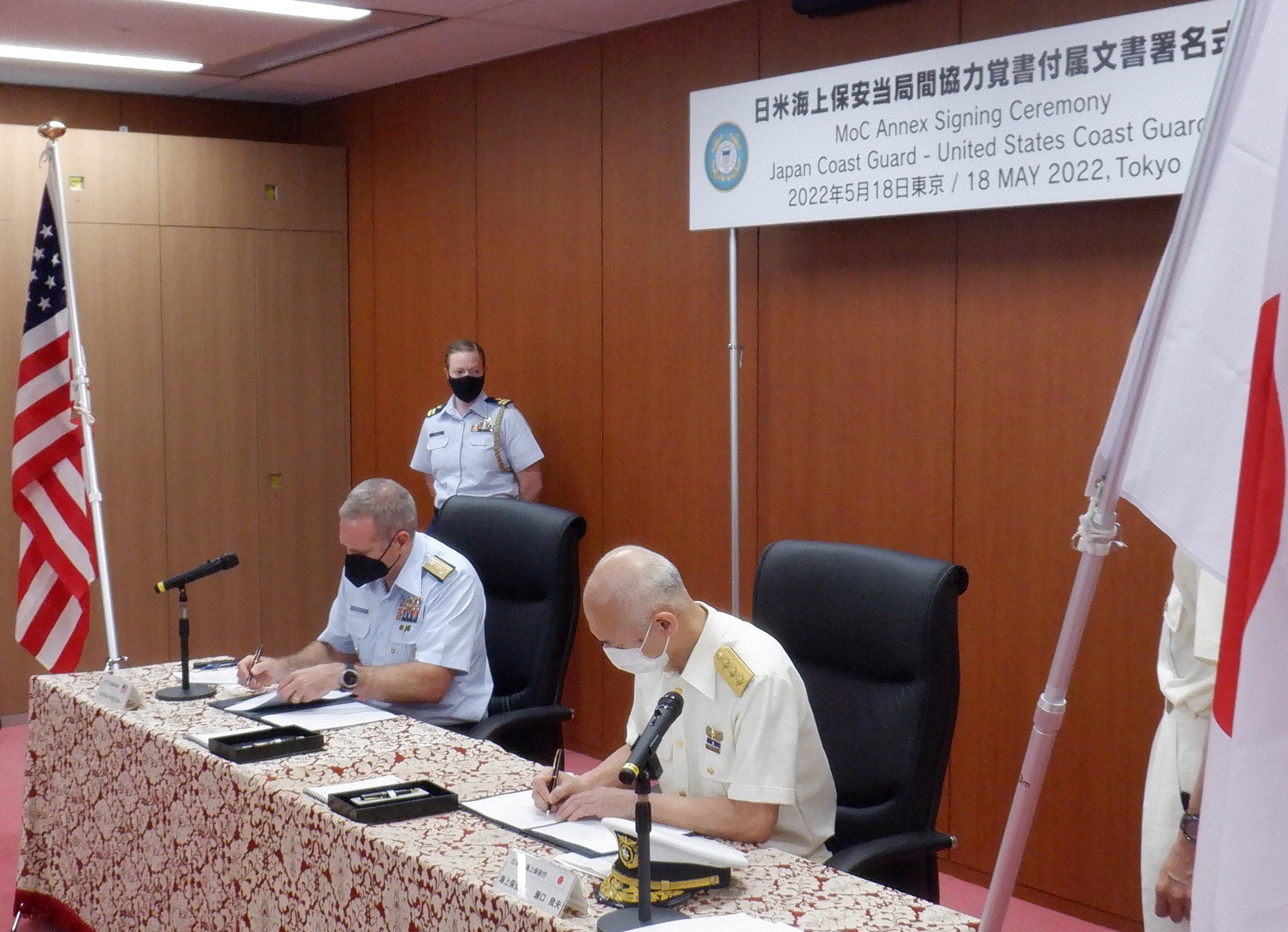
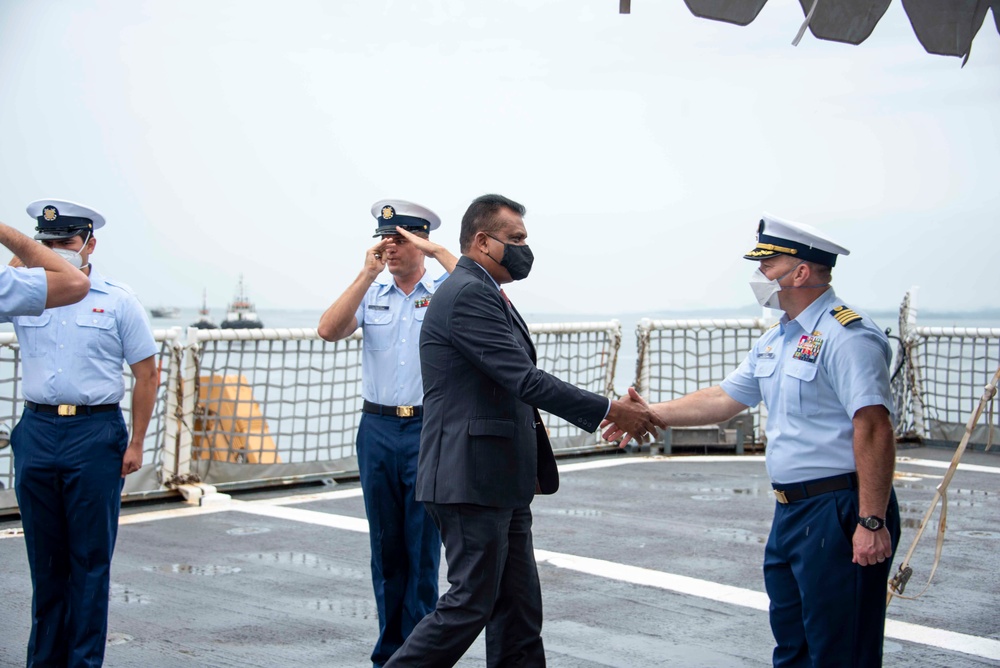
TOKYO — The United States and Japan coast guards formally expanded cooperative agreements and established a new perpetual operation during a ceremony Wednesday in Tokyo.

Vice Adm. Michael McAllister, commander of U.S. Coast Guard Pacific Area, and Vice Adm. Yoshio Seguchi, Japan Coast Guard vice commandant for operations, represented their respective services during the historic document signing ceremony and celebration at Japan Coast Guard Headquarters.

Although a memorandum of cooperation between the sea services has existed since 2010, strengthened relationships, increasing bilateral engagements and continued focus on maintaining a free and open Indo-Pacific necessitated expansion of the memorandum.

The new operation’s name, SAPPHIRE, is an acronym for Solid Alliance for Peace and Prosperity with Humanity and Integrity on the Rule of law based Engagement, and it honors the gem regarded as an emblem of integrity and affection found throughout the Indo-Pacific.

Operation Sapphire encompasses all the annual interactions between the Japan and U.S. coast guards, with the goal of increasing interactions over time.

To formalize the expanded cooperation, annexes were added to the existing memorandum of cooperation outlining Operation Sapphire to include standard operating procedures for combined operations, training and capacity building, and information sharing.

“We rely on our partners, allies, and like-minded nations to achieve our shared missions,” said McAllister. “As evidenced by this agreement, our relationship with the Japan Coast Guard is stronger than ever, and I am looking forward to many more decades of partnership and collaborative operations in the Indo-Pacific.”

“We will conduct smooth cooperation in the fields of joint operation, capacity building and information sharing by this agreement” said Seguchi. “Sapphire embodies the rule-of-law based engagement between the coast guards, and we will expand the principle of Free and Open Indo-Pacific to other nations.”


“Coast Guard Cutter Stratton returns to Alameda following 97-day South Pacific patrol” –News Release

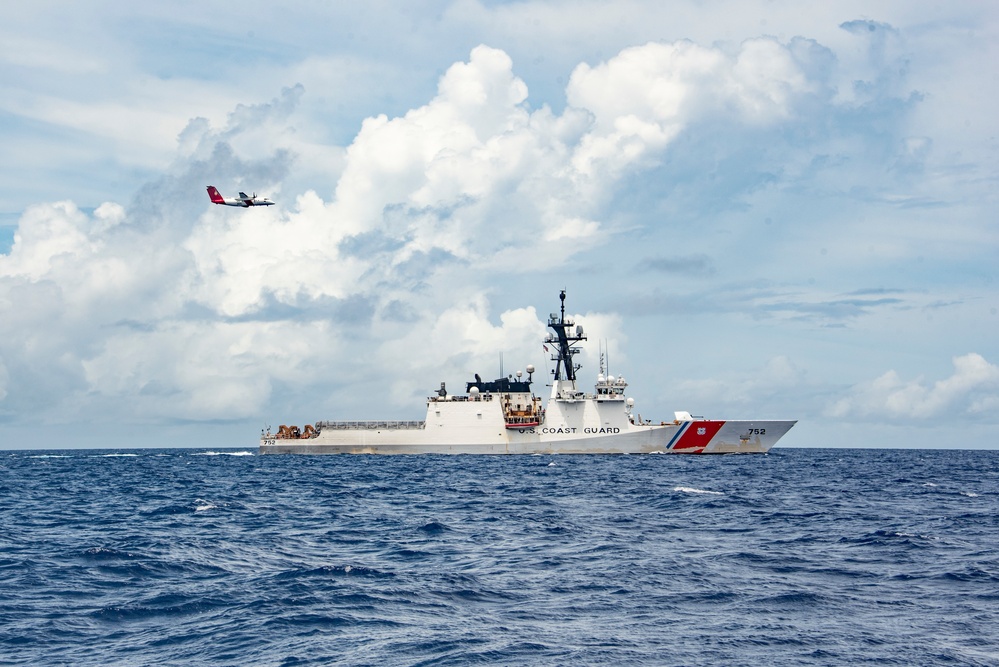
U.S. Coast Guard Cutter Stratton (WMSL 752) participates in a exercise with the Australian maritime surveillance aircraft in the South Pacific Ocean, Feb. 23, 2022. The Stratton is currently underway conducting exercises and operations with partner nations in the South Pacific region. (U.S. Coast Guard photo by U.S. Marine Corps Sgt. Sarah Stegall)

Just a news release, but it is about one of those increasingly common long deployments to the Western Pacific. Notable are the use of the small unmanned air system, presumably Scan Eagle, shiprider program with Fiji, and laying the ground work for a shiprider program with Papua New Guinea.

220130-N-CD319-1014 SOUTH PACIFIC OCEAN (Jan. 30, 2022) The Arleigh Burke-class guided-missile destroyer USS Sampson (DDG 102) participates in Divisional Tactics (DIVTAC) formations with U.S. Coast Guard Cutter Stratton (WMSL 752) and British Royal Navy ship HMS Spey (P 234). Sampson is positioned to conduct lifesaving actions in support of disaster relief efforts in Tonga. The ship is operating in support of the Australian Defence Force (ADF). The Australian Government response is coordinating closely with France and New Zealand under the FRANZ partnership, alongside Fiji, Japan, United Kingdom and the United States to assist Tonga in its time of need. Sampson is on a scheduled deployment in the U.S. 7th Fleet area of operations to enhance interoperability with alliances and partnerships while serving as a ready-response force in support of a free and open Indo-Pacific region. (U.S. Navy photo by Mass Communication Specialist 3rd Class Tristan Cookson)

News Release

March 21, 2022
U.S. Coast Guard Pacific Area

Coast Guard Cutter Stratton returns to Alameda following 97-day South Pacific patrol

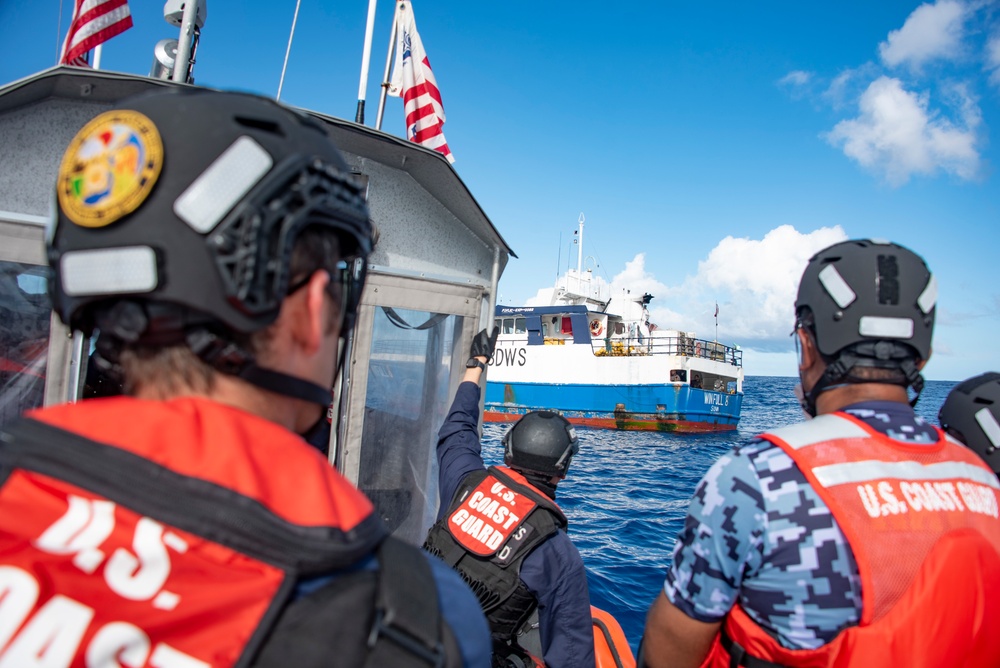
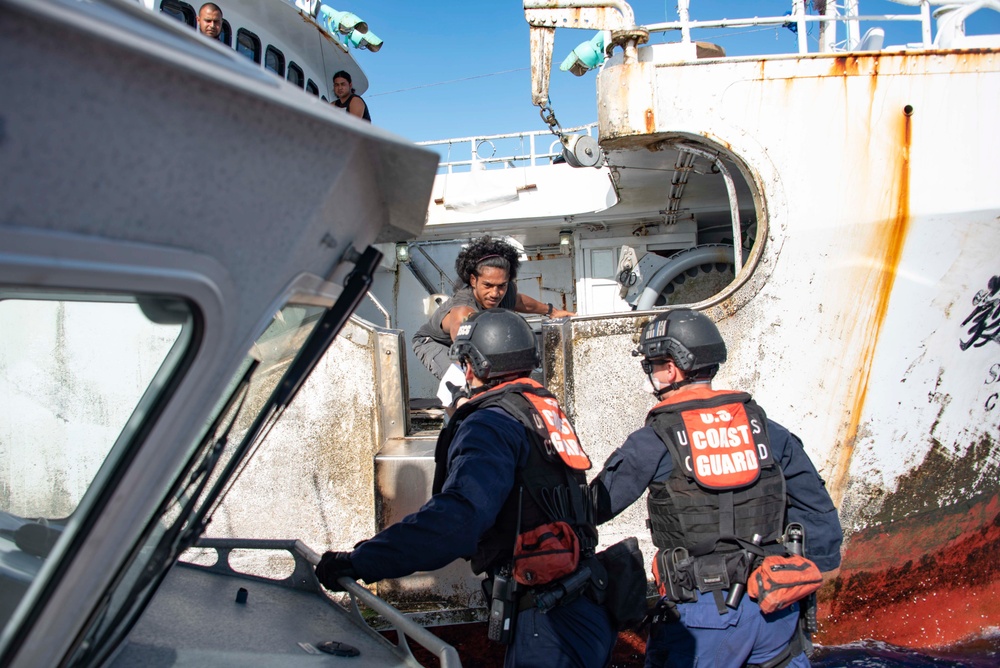
Photo of CGC Stratton Photo of CGC Stratton Photo of boarding
Photo of boarding Photo of Fiji press event Photo of boarding

Editors’ Note: Click on images above to download high resolution versions. Additional photos are available here.

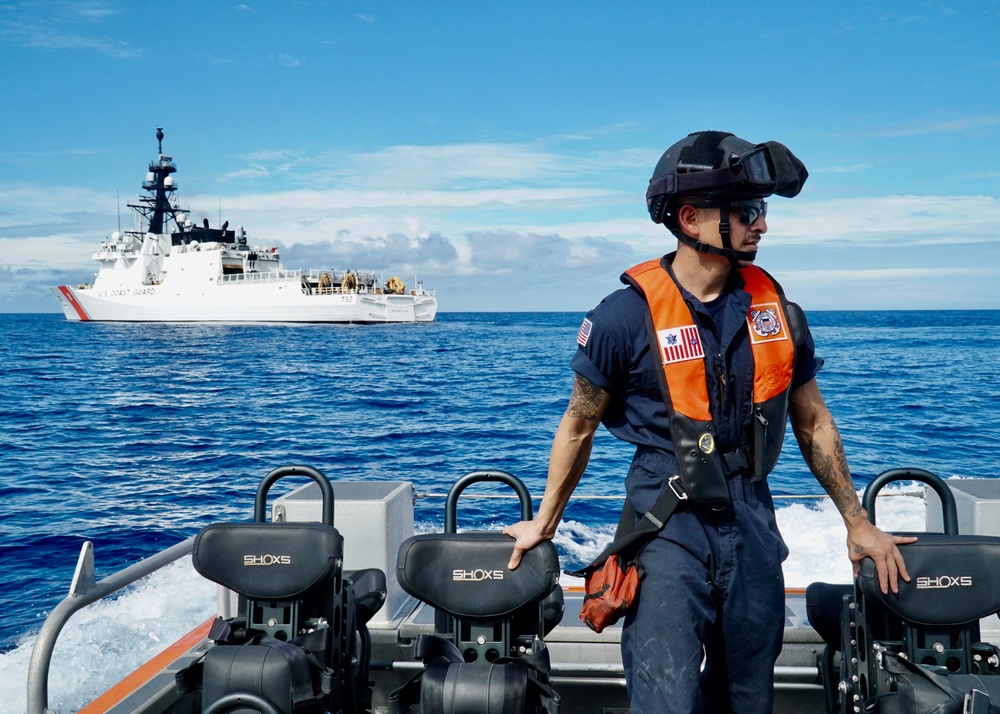
ALAMEDA, Calif. — The crew of Coast Guard Cutter Stratton (WMSL 752) returned to Alameda Saturday after completing an Operation Blue Pacific Patrol in the south Pacific.

While underway, Stratton’s crew worked with Pacific partner nations, including Fiji, France, New Zealand, Papua New Guinea, Australia, and the United Kingdom on an array of missions and prioritized combating Illegal, Unreported, and Unregulated fishing on the high seas or in partner nations’ exclusive economic zones.

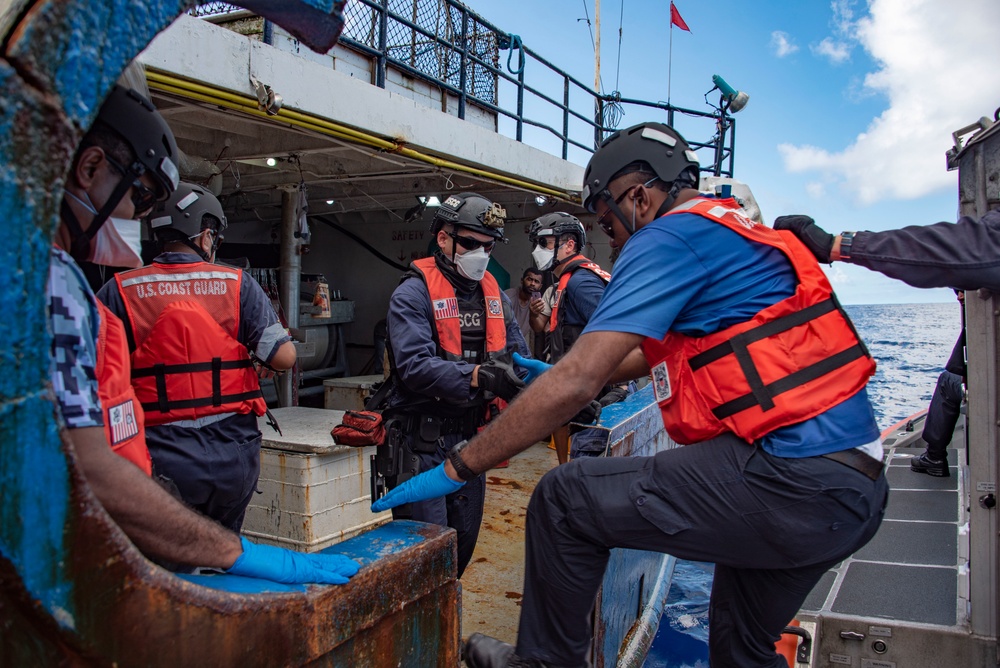
In the effort to combat IUU fishing, Stratton teams boarded 11 vessels during the 20,348-mile patrol and found 21 violations.

“Our collaboration with our partners and utilization of our shiprider agreements gave us the ability to accomplish our mission of combatting illegal, unreported, and unregulated fishing in order to maintain regional stability and protect the fishing industry,” said Capt. Steve Adler, Stratton’s commanding officer. “By bringing aboard shipriders from Fiji, we were able to patrol their exclusive economic zones to better assist them in enforcing their maritime laws.”

In February, Stratton embarked three shipriders from Fiji with representatives from the Fiji Revenue and Customs Services, the Fiji Ministry of Fisheries, and the Republic of Fiji Navy, who led bilateral enforcement efforts for Stratton to patrol their exclusive economic zones.

There is a shared interest for both Fiji and the United States, as well as other partner nations, to protect fisheries as they provide a renewable source of food and income to the Pacific nations.

The Stratton crew also used small Unmanned Aircraft Systems to increase the ship’s capabilities and further extend the cutter’s patrol area.

“Stratton’s capacity for employing cutting edge technology like sUAS, gives the Coast Guard the upper hand in the fight against IUU fishing,” said Cmdr. Charter Tschirgi, Stratton’s executive officer. “The vast area covered during patrols like these displays the reach the Coast Guard has and the length we will go to assist our partners in the Pacific.”

Stratton visited multiple countries while deployed, including Tahiti, Fiji, and Papua New Guinea. While in Suva, Fiji, Stratton hosted a joint media engagement with the Fijian Permanent Secretary for Ministry of Defense, Manasa Lasuma, and the Fijian Permanent Secretary for the Ministry of Foreign Affairs, Yogesh Karan. While anchored in Port Moresby, Papua New Guinea, Stratton also hosted an engagement and law enforcement demonstration in conjunction with U.S. Ambassador Erin McKee and representatives of Papua New Guinea: Chief Inspector Christopher Smith, Terry Udu, Moses Teng, Hiribuma Dabuma, MAJ Norbeth Fehi, and Ivan Salonica. This discussion and demonstration of law enforcement operations and regional partnerships helped facilitate a future signing of a bilateral shiprider agreement between Papua New Guinea and the United States.

“Communicating with our allies face-to-face is extremely valuable,” said Ensign Alexander Mastel, Stratton’s public affairs officer. “With IUU fishing replacing piracy as the leading global maritime security threat, it is more important than ever to join efforts in ensuring economic security in the Pacific.”

While on patrol, Stratton’s crew also participated in multiple joint exercises with partners in the region. These included a formation sailing with the HMS Spey, a tactical maneuvering drill with HMS Spey and USS Sampson, a joint patrol with an Australian Border Force patrol aircraft, fueling-at-sea with New Zealand’s newest replenishment vessel HMNZS Aotearoa, and joint steaming with the French Naval vessel FMS Arago and Fijian Patrol vessel Savenaca.

“Partnerships across the Pacific are the key to success in combatting illegal, unreported, and unregulated fishing. I am extremely proud of the crew for demonstrating tremendous success in partnering and operating with our regional partners and allies across Oceania, including navies and law enforcement officials from French Polynesia, Fiji, Papua New Guinea, New Zealand, Australia, and the United Kingdom,” said Adler. “Only by building these continued relationships and joint operations with patrols like Stratton’s Operation Blue Pacific will we be able to truly make a difference and impact against the global problem of IUU fishing. By training with our partners, we further our interoperability and cooperation, ultimately advancing a peaceful, free and open Indo-Pacific.”

“Coast Guard Cutter Stratton visits Fiji during Operation Blue Pacific patrol” –D14 News Release

The Coast Guard Cutter Stratton passes underneath San Francisco’s Bay Bridge, June 12, 2019. U.S. Coast Guard photo by Petty Officer 1st Class Matthew S. Masaschi.

Below is a D14 news release regarding a type of operation we now see more frequently. Stratton has been away from home for 50 days and is still heading West. At least the crew is getting to see some exotic places. Hopefully COVID restrictions are not keeping the from going ashore.

The ships mentioned in the release, that Stratton has been working with are of interest. HMNZS Aotearoa is an ice capable underway replenishment ship. HMS Spey is a Royal Navy Offshore Patrol Vessel, one of two sent into Pacific and Indian Oceans.


News Release

U.S. Coast Guard 14th District Hawaii and the Pacific

Coast Guard Cutter Stratton visits Fiji during Operation Blue Pacific patrol

Editors’ Note: Click on images to download a high-resolution version.

SUVA, Fiji — The crew of the Coast Guard Cutter Stratton visited Fiji in February after being underway for 50-days in the Pacific combating illegal, unreported, and unregulated (IUU) fishing.

During the visit, Capt. Stephen Adler, the Stratton’s commanding officer, met with members of the Fijian media to discuss the Coast Guard’s partnership with Fiji and their combined effort to protect fisheries resources.

“Our relationships with our partner nations are more important than ever in combating illegal, unreported, and unregulated fishing,” said Adler. “We are pleased to work with our Fijian partners to maintain maritime sovereignty and security throughout the region.”

While in the country, the Stratton’s crew welcomed aboard three Fijian ship riders who, with the assistance of Stratton’s law enforcement boarding teams, will ensure compliance with applicable Fijian fishing laws within Fiji’s exclusive economic zone.

The Coast Guard’s mission to combat IUU fishing is essential in protecting maritime governance and a rules-based international order to ensure a free and open Indo-Pacific.

Bilateral shiprider agreements are a force multiplier for both Fiji and the Coast Guard because they allow Fijian law enforcement personnel to observe, protect, board, and search vessels suspected of violating laws or regulations within Fijian waters with the support of Coast Guard personnel and vessels.

Speaking recently during a visit to Fiji, Secretary Antony J. Blinken, the U.S. Secretary of State, stated “On security, just this week three shipriders from Fiji are joining the crew of the U.S. Coast Guard Cutter Stratton to conduct patrols in support of maritime sovereignty and security. The United States is proud that several of Fiji’s future leaders are being trained in our military academies.”

The fisheries industry is a significant source of food and income throughout the Pacific. Protecting this renewable resource is a priority for the United States and Pacific Island Countries as IUU fishing in the Pacific has global impacts and effects.

Recently IUU fishing has replaced piracy as the leading global maritime security threat and has the potential to have a global effect if unchecked.

Prior to visiting Fiji, the Stratton’s crew had been working with British, Australian, New Zealand, and French allied naval forces as well as the U.S. Navy in support of the Tongan government following the volcanic eruption on Jan 15th.

The crew also conducted a number of drills and exercises with allied partners including helicopter operations with the Armed Forces in French Polynesia, fueling at sea with the Royal New Zealand Navy Ship Aotearoa, and multiple maneuvering exercises with the Royal Navy HMS Spey.

The Stratton’s crew plans to visit Papua New Guinea as representatives of the Coast Guard and United States. Both the United States and Papua New Guinea are interested in signing a bilateral agreement to codify the two states’ strategic partnership in the Pacific and enable the Coast Guard to better assist Papua New Guinea in protecting the island nation’s sovereignty over its EEZ against IUU fishing.

The Stratton is a 418-foot national security cutter capable of extended, worldwide deployment in support of homeland security and defense missions. NSCs routinely conduct operations throughout the Pacific and Atlantic oceans; their unmatched combination of range, speed, and ability to operate in extreme weather provides the mission flexibility necessary to conduct vital strategic missions.

Operation Blue Pacific is an overarching multi-mission Coast Guard endeavor, promoting security, safety, sovereignty, and economic prosperity in Oceania while strengthening relationships between partner nations in the Pacific.

Royal Navy Deploys Two OPVs for Five Years to No Base in Particular

We have deployed cutters to the Western Pacific for months at a time, and PATFORSWA kept its 110s operating out of Bahrain for years, but the Royal Navy seems to be doing something different and I believe remarkable.

Naval News reports they are sending a pair of River Batch II class ships, HMS Tamar and HMS Spey, well beyond the Suez. It sounds all very 18th Century Star Trek, “Our Five Year Mission, Proceed into the Indian and Pacific Oceans and act in the Queen’s Interests.” (No, not a real quote.)

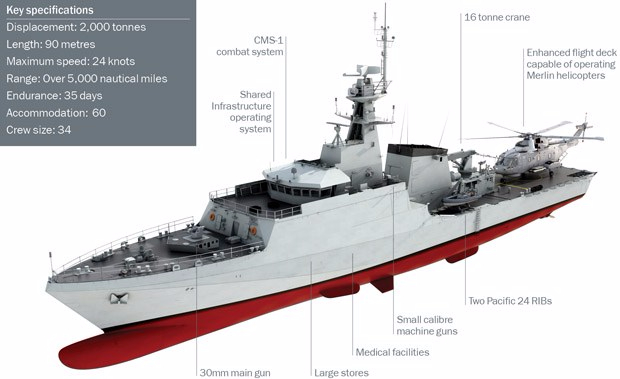
If these ships were in the US Coast Guard we would see them as MECs. They are slightly larger and faster than the 270s, but are not as well equipped in some respects. They are armed only with a 30mm gun and no helicopter hangar. I don’t believe they have any ESM/ECM. Their crew is also considerably smaller, smaller in fact than that of a 210. (I have seen various numbers for the crew size, 34 in the infographic above, 58 in Wikipedia, 46 as reported below, but all well below the 75 common on a 210 or the 100 typical of a 270.)

“Each ship is crewed by 46 sailors, with half the crew trading places with shipmates from the UK every few weeks.”

The Royal Navy actually has considerable experience keeping OPVs deployed for long periods with austere support.

We might even see one of these helping with drug interdiction in the Eastern Pacific, more likely they will be countering piracy and drug or arms trafficing in the Indian Ocean or capacity building in East Africa or SE Asia. Maybe we could make a multi-national Freedom of Navigation transit of the Taiwan Strait.