The US Naval Institute Proceedings’ September 2018 issue has an article recommending installation of Naval Strike Missiles (NSM) on the Bertholf class National Security Cutters (NSC) and the Argus class Offshore Patrol Cutters (OPC), “Distribute Lethality to the Cutters,” by LCdr. Daniel M. Wilshire, USCG. Its outside the paywall; you can just click on the link.
He makes some good points.
The Navy does not have enough ships.
The Coast Guard is building 36 likely candidates.
Using deck mounted canister launchers it should not be too difficult to mount NSM on cutters.
The systems would be Navy owned and we could use Navy training.
Arming cutters for combat, including missiles is not new.
If there is a major conflict, cutters may find themselves in combat, whether they are prepared for it or not.
These are not a replacement for Navy construction.
We should not wait for the outbreak of war before arming cutters
In conclusion he says.
“The prospect of great power conflict once again looms. Though the time and nature of that conflict is not clear, one thing is certain: when the next war breaks out, Coast Guard cutters will go into harm’s way as they have done in nearly every major conflict since 1790, not only because every ship will be needed, but because doing so is part of the Coast Guard’s history and culture. Procurement and training decisions made today will dictate whether the Coast Guard enters that conflict with the weapons needed to best help deter or defeat a peer competitor. Failing to put antiship cruise missiles on the 36 cutters of the NSC and OPC classes, cutters that will serve for the next 50-plus years, is an omission that the Navy, the Coast Guard, and the nation can ill-afford.”
My only comment would be:
First, I would prefer to see the longer ranged, heavier Long Range Anti-Ship Missile used instead of NSM, as I believe it is better suited for our peacetime anti-terrorism mission as well as being a more effective weapon in wartime.
Second, while it is probably a more complex change, reviving the Coast Guard’s Wartime Anti-Submarine Warfare Mission would probably be an even more important addition to the “National Fleet” than an expanded anti-surface capability. While it probably would contribute nothing to our peacetime anti-terrorism mission, long range acoustic sensors might help our counter-drug effort.
Twenty-five nations, 46 surface ships, five submarines, 17 land forces, more than 200 aircraft, and 25,000 personnel participated in the latest RIMPAC exercise. Nations represented included Australia, Brunei, Canada, Chile, Colombia, France, Germany, India, Indonesia, Israel, Japan, Malaysia, Mexico, Netherlands, New Zealand, Peru, Republic of Korea, Republic of the Philippines, Singapore, Sri Lanka, Thailand, Tonga, United Kingdom, United States and Vietnam.
180710-G-ZV557-1313 PACIFIC OCEAN (July 10, 2018) Crewmembers aboard the USCGC Bertholf (WMSL 750) check the flight deck July 10, 2018, alongside the flight crew of the a U.S. Navy HSC-4 Black Knight MH-60 helicopter 15 miles south of Oahu, Hawaii, while in support of RIMPAC 2018. Photo by Petty Officer 2nd Class David Weydert
And the Coast Guard was there. USCGC Bertholf even headed one of the Task Groups. But I have yet to see any stories from the Coast Guard about Coast Guard participation.
Consequently there is not a lot I can say about what the Coast Guard did. Can’t help but think this was a missed opportunity.
All we seem to have are Navy photographs with their captions.
RIMPAC 2018 will also be the first time that US Coast Guard Maritime Security Response Team West (MSRT-W) participates in RIMPAC SOCAL. US Navy Photo
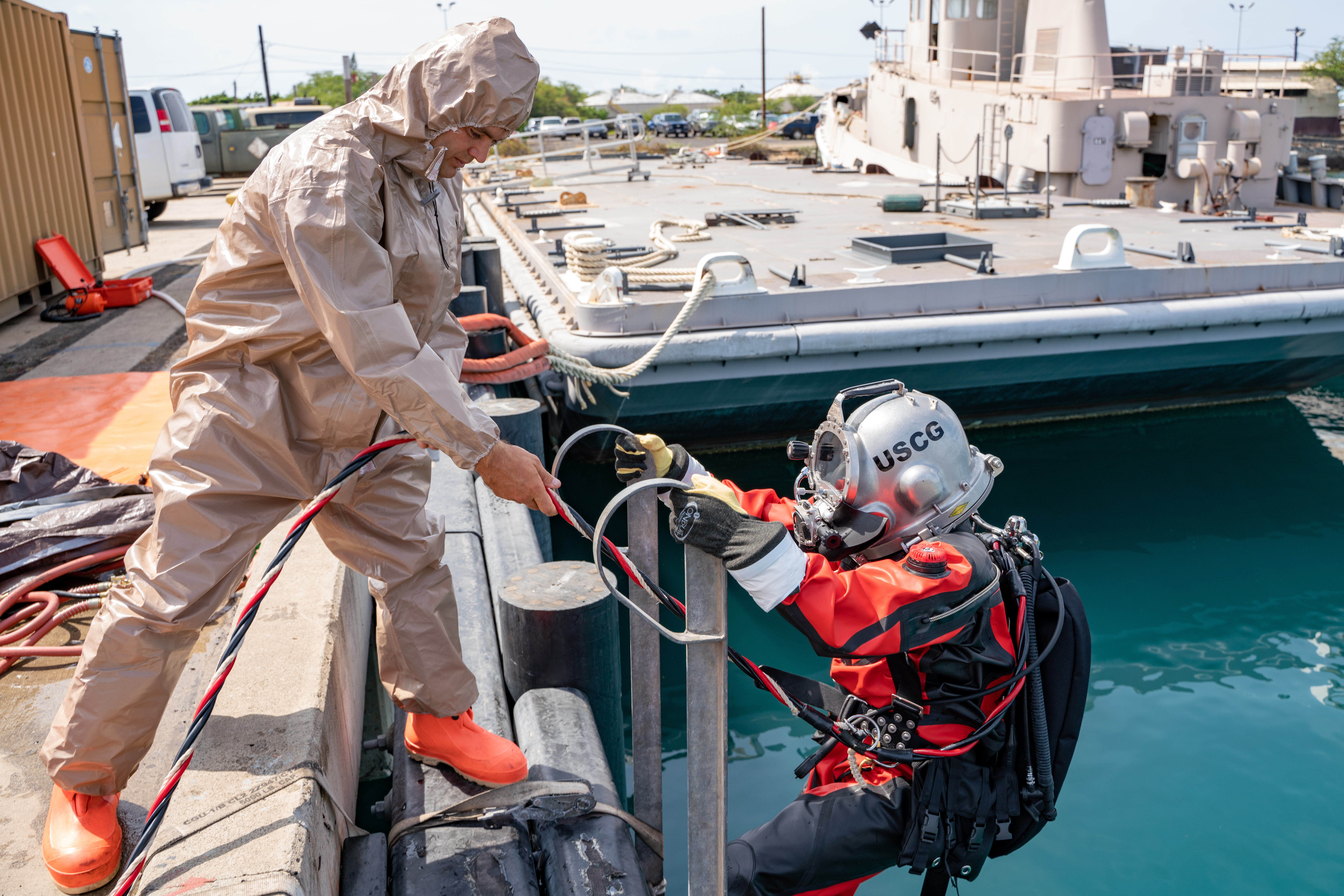
180710-N-CW570-1068 JOINT BASE PEARL HARBOR-HICKAM, Hawaii (July 10, 2018) U.S. Coast Guardsmen assigned to Regional Dive Locker Pacific conduct diving operations during a decontaminated water diving symposium at Joint Base Pearl Harbor-Hickam during Rim of the Pacific (RIMPAC) exercise, July 10, 2018. (U.S. Navy photo by Mass Communication Specialist 1st Class Arthurgwain L. Marquez/Released)
The Sinking Exercises
One of the highlights of RIMPAC is always the ability to test ordnance against an actual ship in a Sink-EX. This time there were two target ships, the former USS Racine (LST-1191) and a frigate, the formerUSS McClusky (FFG 41).
The Racine Sink-EX
This RIMPAC was a bit unusual, in that US Army and Japanese ground units participated in the Racine Sink-EX.
Using targeting from a US Army Gray Eagle drone and AH-64E team, the former Racine was hit by four Japan Ground Self Defense Force surface to surface missiles, a Naval Strike Missile fired from a US Army vehicle with a Palletized Load System (PLS), five HIMAR artillery rockets were fired (no indication how many hits), a Harpoon missile fired by an Australian P-8 Maritime Patrol Aircraft, and another Harpoon and a torpedo from a US submarine.
Photo By Master Chief Petty Officer Brian Brannon | 180712-N-HO130-2002 PACIFIC MISSILE RANGE FACILITY BARKING SANDS, Hawaii (July 12, 2018) Members of the Japan Ground Self-Defense Force (JGSDF) fire a Japanese Type 12 Surface-to-Ship Missile (SSM-12) at the ex-USS Racine (LST-1191), positioned at sea, during a sinking exercise, July 12, at Pacific Missile Range Facility Barking Sands on the island of Kauai, Hawaii, during the Rim of the Pacific (RIMPAC) exercise. This marks the first time the U.S. Army and JGSDF have participated in a sinking exercise during RIMPAC. (U.S. Navy photo by Master Chief Mass Communication Specialist Brian Brannon/Released)
The McClusky Sink-EX
We don’t have a video of the McClusky Sink-EX. An early report indicated that she was sunk by fire from “from a ship and an aircraft.”
Subsequently we learned that the Singapore Navy, presumably RSS Tenacious (71) which has space for up to 24 Harpoons, fired two Harpoons at the decommissioned FFG and that unlike most Harpoon strikes, these hit at the waterline, causing the ship to sink earlier than expected. (Really I think all anti-ship cruise missiles should be programmed to strike the waterline–perhaps a terminal dive. Usually their detonations let in air rather than water, damaging the target rather than sinking it.)
“In all, six Harpoons were successfully shot between the two SINKEX events, according to manufacturer Boeing.”
I presume this means two surface launched by the Singapore Navy and two air launched against the FFG and one sub launched and one air launched by the Australian P-8 against the LST.
An Air Force launched LRASM was originally planned to be used against Racine, but I have seen no indication one was launched during the exercise.
Innovation Fair
The Naval Institute reported on a new RIMPAC program, the “Innovation Fair.” While apparently it included a lot of high-tech presentations; it was a simple low-tech “why didn’t I think of that” good idea that won the prize, and it looks like something the Coast Guard could use, a floating and reflective damage control (DC) bag.
Royal Malaysian Navy Sub-Lieutenant Chan Jun Kwan, assigned to frigate KD Lekiu (FFG 30), displays a damage control floating bag concept developed by his crew during the inaugural Rim of the Pacific (RIMPAC) exercise innovation fair. US Navy photo.
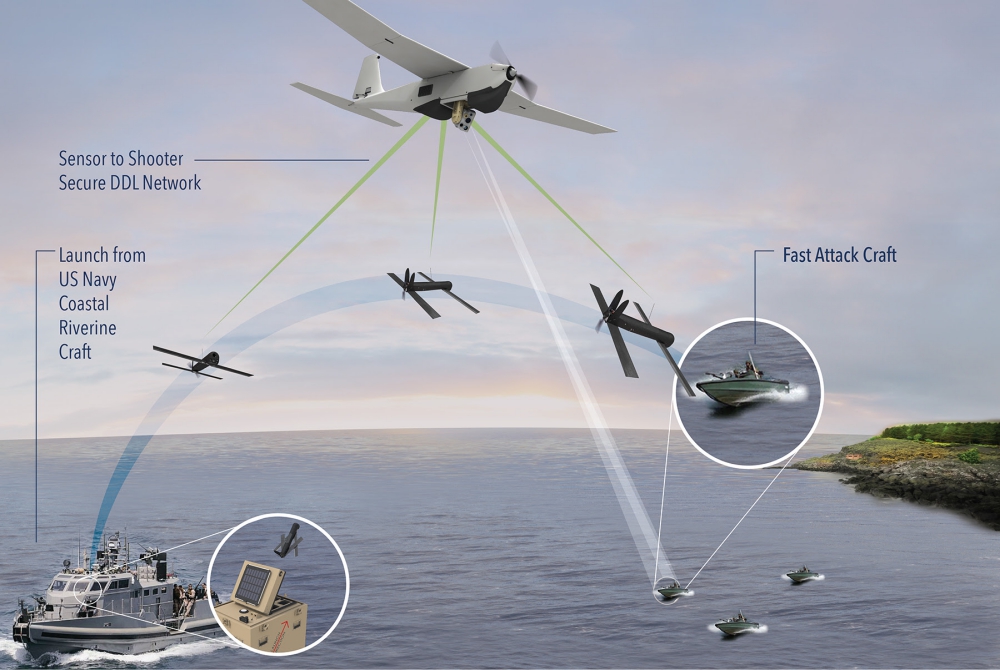
AeroVironment recently conducted a demonstration for the Navy, of how its systems might counter swarming Fast Inshore Attack Craft (FIAC). If the combination of systems works as advertised, it may be exactly what the Coast Guard needs to counter the small, fast, highly maneuverable end of the terrorists surface vessel attack threat spectrum. It is also small enough that it might fit on something as small as a Response Boat-Medium (RB-M). It would certainly fit on a WPB.
It appears to be precise and have minimal chance of collateral damage. It also has a man in the loop, allowing an attack to be aborted or redirected. It is also supposed to have a capability against other drones, presumably smaller, slower ones at low altitude. The combination consists of a Puma UAS to provide target detection, classification, and targeting, and the Switchblade “Lethal Miniature Aerial Missile System” (LMAMS). Switchblade is a missile but a very different one. It is an electric-powered, propeller driven, suicide drone.
The Puma and Switchblade both use the same control system.
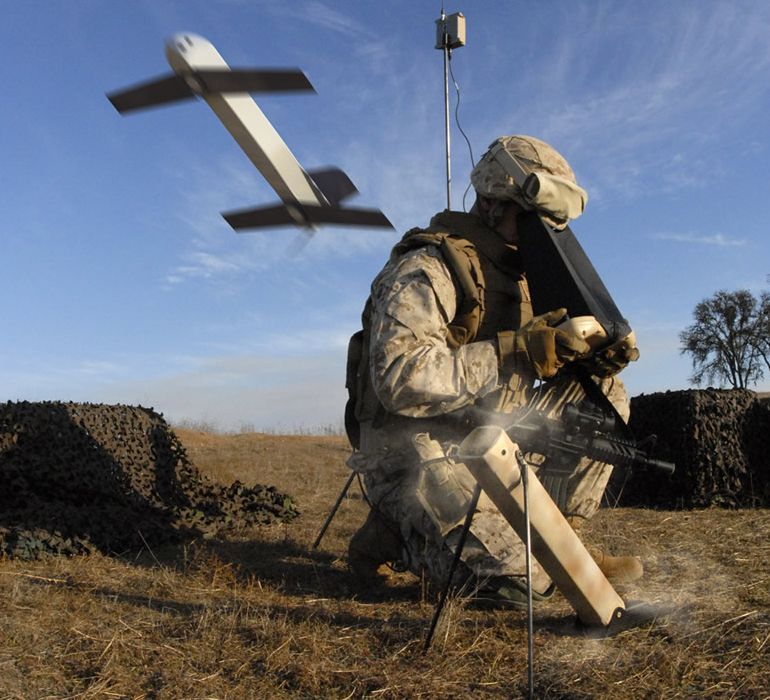
The Switchblade, seen being launched in the photo below, is very small. It is less than two feet long and weighs less than six pounds. The manufacturer’s data sheet is here.
Switchblade loitering munition
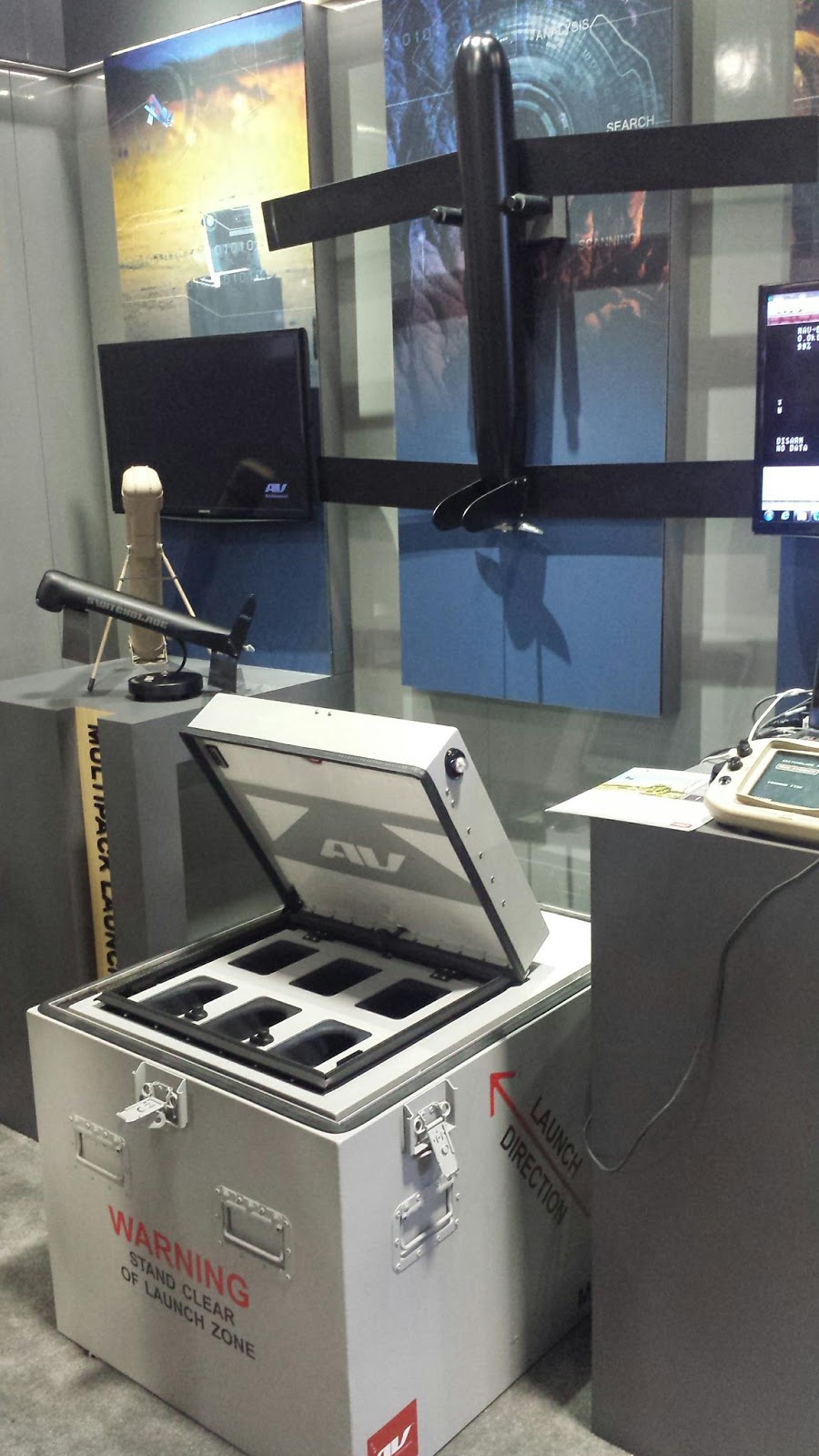
They have introduced a six-pack launch system. It weighs only 160 pounds fully loaded and is only 28″ wide, 34″ deep, and 28″ tall.
AeroVironment six cell Switchblade Launcher
Where might we use these? While these systems might become ubiquitous, if they work as advertised, there are a couple of units that stand out as having the most immediate need.
After three decades without a significant air threat, the Army has realized they might actually need a surface to air weapon. As a result they have embarked on a program to provide Short Range Air Defense (SHORAD) against cruise missiles as well as manned aircraft. In addition they want to provide protection from rockets, artillery, and mortars (RAM) and Unmanned Air Systems (UAS), hopefully in the same launcher. The program of record is called Integrated Fire Protection Capability.
This Multi-Mission Launcher somewhat emulates the Mk41 VLS, in that it is intended to launch several different missiles for different purposes. It has launched AIM-9 Sidewinder (repurposed as an surface to air missile) , the Tamir (interceptor for the Israeli Iron Dome system), the Lockheed Miniature Hit to Kill (MHTK) Missile, an Army developed missile, and the Hellfire.
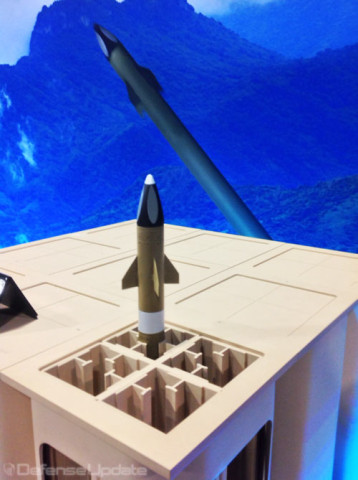
The Miniature Hit to Kill (MHTK) missile designed to counter Rocket, Artillery and Mortar (RAM) threats as well as some unmanned aircraft might be use against projectiles fired at a cutter or an asset we are protecting. Cost is only about $16K per round.
“The missile is 27 inches long, two inches in diameter (actually only 40mm or 1.6″–Chuck) and weighs 5 pounds “at launch,” he added. The semi-active missile has no warhead, using kinetic energy — or thrust — instead to take out a target. “It’s really a bullet hitting a bullet,” which is the bread and butter capability in Lockheed’s missile technology. One launcher can fit 36 of the missiles, Delgado said, and two launchers can fit onto a single truck.”
As a very small system, MKTK can be quad-packed. Photo: Defense-Update
The Navy is apparently showing some interest in this program. Since the Army developed multi-mission launcher is not a vertical launch system I presume it has to be pointed. This is somewhat complicates installation, but I can’t help but believe something, launcher or interceptors, will come out of this program that may be of interest to the Coast Guard in the future.
Late Addition:
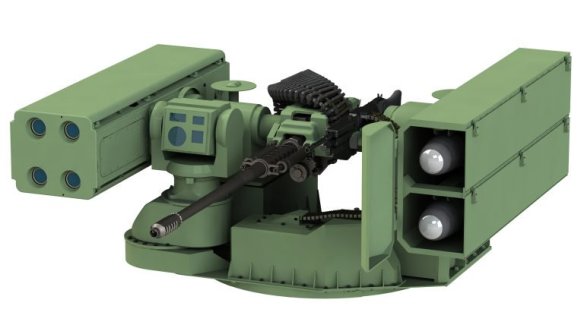
Photo: Multipurpose remote weapon station chosen for the Striker Short Range Air Defense System. Moog Reconfigurable Integrated-Weapons Platform (RiwP) turret:: 4 Stinger missiles on one side, two Hellfires on the other, with a 30 mm autocannon and coaxial 7.62 mm machinegun in between (Leonardo DRS)
The US Naval Institute News Service is reporting the Naval Strike Missile has been selected to provide the long range surface to surface capability for the Littoral Combat Ships (LCS) and presumably the new frigate as well. This is no surprise since the other two candidates had dropped out of the competition, “…Boeing Harpoon Block II Plus and the Lockheed Martin Long-Range Anti-Ship Missile (LRASM) were both withdrawn by their respective companies from the competition last year. Both Boeing and Lockheed complained that Navy requirements for the OTH missiles did not value the networking capability of their offerings, several sources confirmed to USNI News.”
There are a couple of points to look at here.
The initial contract is for $14,856,016. This reportedly includes, “…encanistered missiles (EM) loaded into launching mechanisms (LM); and a single fire control suite (FCS). This contract consists of EMs (tactical, telemetered and inert operational); FCSs; LMs; mission support equipment, training equipment and courses; engineering services; and travel and other direct costs. This contract includes options which, if exercised, would bring the cumulative value of this contract to $847,611,857.” So it appears the initial contract includes at least one full ship set. The cumulative value is 57 times greater. There are only 52 Small Surface Combatants planned including both LCSs and the projected frigates (FFGs). Given that we would expect the price to go down in a quantity buy, it looks like these missiles may also go on other platforms as well.
We don’t know how many missiles will go on each platform, but Raytheon seems to indicate each LCS will support two quad launchers. While reportedly launchers are available for one, two, three, four, or six missiles, all the installations so far have been in the quad format. “USNI News understands the Thursday award buys about a dozen missiles.” Presumably some missiles will be expended in tests.
Raytheon Image
NSM is smaller than Harpoon, comparing NSM vs surface launched Harpoon.
Weight: 900 lb (410 kg) vs 1,523 lb (691 kg) with booster
Length: 13 ft (3.95 m) vs 15 ft (4.6 m)
Warhead: 276 lb (125 kg) vs 488 pounds (221 kg)
Range: 100 nmi (185 km) vs in excess of 67 nmi (124 km)
It is in targeting where the NSM’s superiority shines compared to the legacy Harpoons..
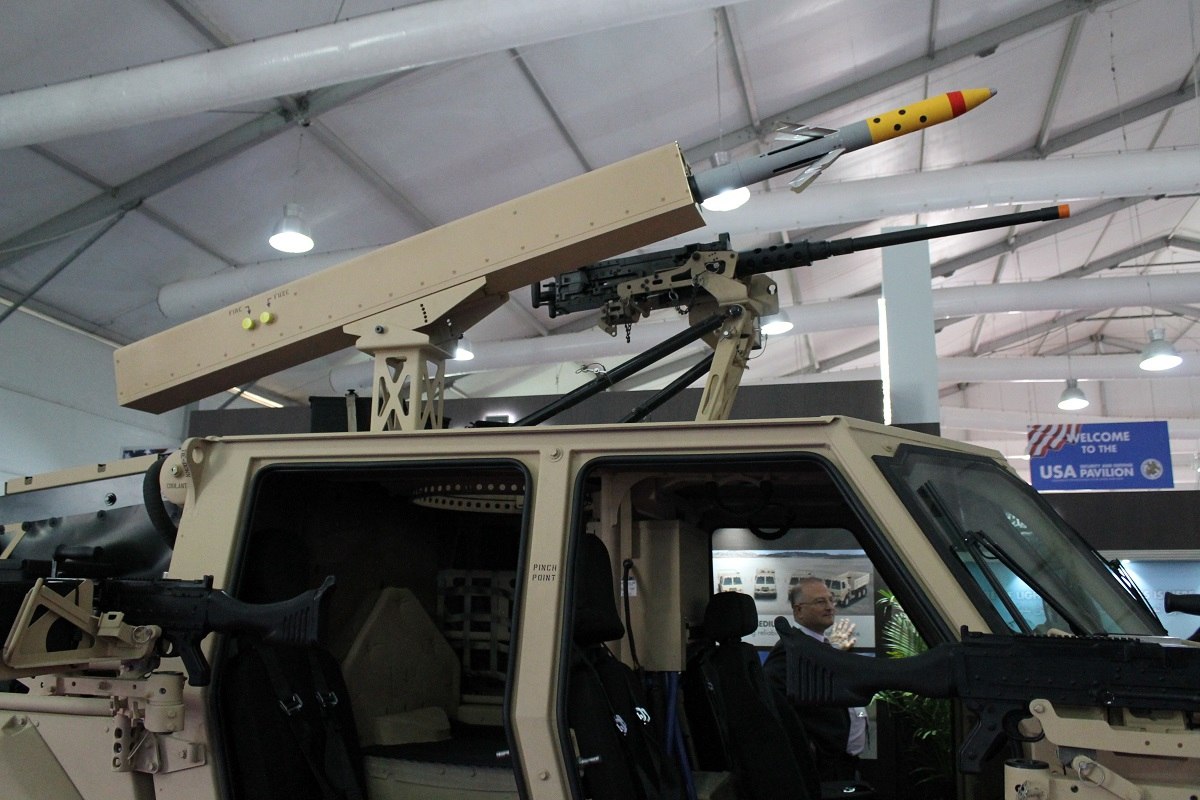
Fletcher Launcher for Advanced Precision Kill Weapon System (APKWS)–Arnold Defense showcased its new rocket launcher for non-air applications at SOFEX 2018 on an Oshkosh S-ATV. (Jen Judson/Staff)
I did a post on this system earlier, Guided Weapons Made Easy, but I had almost forgotten about it, and that would be a shame, because this may be exactly what we need give our small units both precision and a much heavier punch.
APKWS is an upgrade to the long serving (and very numerous) 70 mm Hydra rocket, that adds passive laser homing. Reportedly BAE is working up to providing 20,000 APKWS kits a year.
Current range for this system is about eight kilometer, probably enough for us, but there is also mention of an improved motor to extend the range. Reportedly the seeker is good for up to 14 km, so a motor upgrade might push the range out that far.
The launcher seems to have similar footprint to a .50 caliber machine gun. The empty launcher weighs only 30 pounds and the individual missiles 32 pounds. If it can fit on a light land vehicle, its likely it will fit on many of the Coast Guard’s smaller patrol assets.
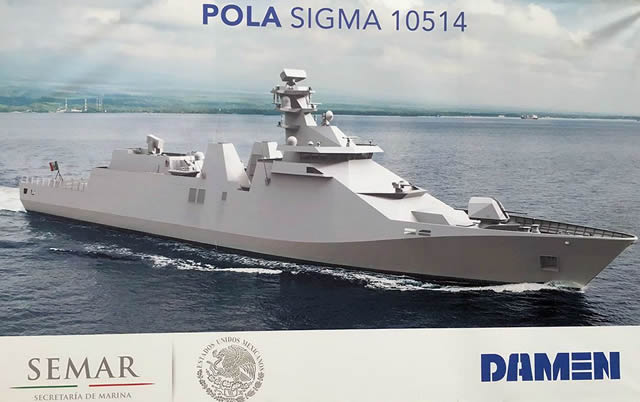
Photo: Sigma 10514 in Mexican Navy configuration, fitted with a BAE Systems Bofors 57Mk3 57mm main guna 12.7mm remote weapon system right behind it. The Mexican Navy opted for the Smart Mk2 radar by Thales. The Mexican “Long Range Patrol Vessel” will not be fitted with VLS cells but a Raytheon RAM launcher will be fitted on top of the helicopter hangar.
How much would it cost to turn one of our new construction cutters into a minimally capable frigate with at least some capability for anti-submarine, anti-surface, and self defense anti-air warfare?
I don’t have a definitive answer but we did get a good indication along with more information about Mexico’s new long range patrol vessel, a Damen 10514 design, that is close enough to our own Offshore Patrol Cutter requirements, that I thought it might have been an OPC contender.
Earlier we had an indication regarding the addition of VLS and Evolved Sea Sparrow Missiles (ESSM) when Chile ordered $140.1M worth of equipment to arm three ships. Plus we had an earlier post based on a 2009 Congressional Budget Office study (apparently no longer available on line) that suggested costs to replace the Phalanx on NSCs with SeaRAM and to add 12 Mk56 VLS and associated equipment, which could have provided up to 24 ESSM ($68M/ship).
The Defense Security Cooperation Agency has issued a news release concerning the sale of weapons for the new Mexican patrol vessel, and the shopping list is a pretty extensive, including anti-surface, anti-air, and anti-submarine weapons.
Mexico –Harpoon Block II Missiles, RAM Missiles and MK 54 Torpedoes
Media/Public Contact: pm-cpa@state.gov
Transmittal No: 17-63
WASHINGTON, Jan. 5, 2018 – The State Department has made a determination approving a possible Foreign Military Sale to Mexico of RGM-84L Harpoon Block II surface launched missiles, Block II Rolling Airframe Missile (RAM) tactical missiles and MK 54 Mod 0 lightweight torpedoes for an estimated cost of $98.4 million. The Defense Security Cooperation Agency delivered the required certification notifying Congress of this possible sale today.
The Government of Mexico has requested to buy six (6) RGM-84L Harpoon Block II surface launched missiles, twenty-three (23) Block II Rolling Airframe Missile (RAM) tactical missiles and six (6) MK 54 Mod 0 lightweight torpedoes. Also included are eight (8) MK 825 Mod 0 RAM Guided Missile Round Packs (GMRP) tri-pack shipping and storage containers; RAM Block 2 MK 44 Mod 4 Guided Missile Round Pack (GMRP); two (2) MK 32 Surface Vessel Torpedo Tubes (SVTT) triple tube launchers; two hundred and fifty (250) rounds of AA98 25 mm high explosive and semi-armor piercing ammunition; seven hundred and fifty (750) rounds A976 25mm target practice and tracer ammunition; four hundred and eighty (480) rounds of BA22 57mm high explosive programmable fuze ammunition; nine hundred and sixty (960) rounds of BA23 57mm practice ammunition; containers; spare and repair parts; support and test equipment; publications and technical documentation; personnel training and training equipment; U.S. Government and contractor representatives’ technical assistance; engineering and logistics support services; installation services; associated electronics and hardware to control the launch of torpedoes; and other related elements of logistics and program support. The estimated cost is $98.4 million.
This proposed sale will support the foreign policy and national security of the United States by helping to improve the security of a strategic partner. Mexico has been a strong partner in combating organized crime and drug trafficking organizations. The sale of these ship-based systems to Mexico will significantly increase and strengthen its maritime capabilities. Mexico intends to use these defense articles and services to modernize its armed forces and expand its existing naval and maritime support of national security requirements and in its efforts to combat criminal organizations.
Mexico intends to use the weapon systems on its Mexican Navy Sigma 10514 Class ship. The systems will provide enhanced capabilities in effective defense of critical sea lanes. The proposed sale of these systems and support will increase the Mexican Navy’s maritime partnership potential and align its capabilities with existing regional navies. Mexico has not purchased these systems previously. Mexico will have no difficulty absorbing this equipment into its armed forces.
The proposed sale of this equipment will not alter the basic military balance in the region.
The equipment will be provided from U.S. stocks. There are no known offset agreements proposed in connection with this potential sale.
Implementation of this proposed sale will require annual trips to Mexico involving U.S. Government personnel and contractor representatives for technical reviews, support, and oversight for approximately two years.
There will be no adverse impact on U.S. defense readiness as a result of this proposed sale.
This notice of a potential sale is required by law and does not mean the sale has been concluded.
All questions regarding this proposed Foreign Military Sale should be directed to the State Department’s Bureau of Political Military Affairs, Office of Congressional and Public Affairs, pm-cpa@state.gov.
The big ticket items certainly made the head lines, but the ammunition for the 57mm is not cheap.
Fortunately for the Coast Guard, the Navy generally pays for our ammunition and weapon systems. The cost to the Coast Guard is installation and integration, plus primarily long term personnel and training costs.
If you want to look primarily at the frigate proposals as well as the proposed weapons modules for the LCS which might also be applicable to the icebreaker, there is this composite video.
The Tanker was probably 20 times as large as the fishing vessel and had a crew on board and operating pumps to address flooding. USCGC ANACAPA began the operation at 13:00 and the RYOU-UN MARU sank at 18:15. It appears that the F/V may have been hit 100 times by 25mm projectiles, and at one point the ANACAPA used a hose to pour water into the fishing vessel.
.
On the video, the Libyan patrol boat fires no more than 20 rounds from its 30mm and I believe it was less than 15. At no time was there sustained fire directed at the tanker. The longest burst was perhaps four rounds.
At the end of the video, the tanker is pumping water, but it is also upright with no significant list and it appears to be making way. I am positive the tanker is underway at least as late as five minutes into the five minute 44 second video.
Perhaps things happened later, but if they recorded the opening shots, it seems they would have recorded the sinking.
This might have been an attempt at deception by the Libyans to discourage smuggling.
It might have been that the patrol boat skipper had been instructed to sink the tanker, and when he failed, he lied about the result of the attack.
It may be that a government information officer simply assumed that because they fired at the ship, that it was sunk. Capsized and sunk does make a much better story than shot at, was annoyed, and sailed away.
It is not impossible the entire thing was theater staged with the cooperation of the tanker, although I think that very unlikely.
Certainly the tanker’s owners may have reasons not to debunk the story.
They don’t want to confirm they were smuggling.
The report may discourage competing smuggling organizations.
They may even rename and reflag the tanker and file a bogus insurance claim.
Certainly, there was nothing in the video to indicate that this ship was sunk.
A final note. The patrol boat is seen firing into both sides of the tanker. If you want to sink a ship, it is usually better to concentrate as much damage as possible on one side. It is more likely to make the ship list and ultimately capsize. As the list increases holes initially made above water start to submerge and take on water.







 Chuck Hill's CG Blog