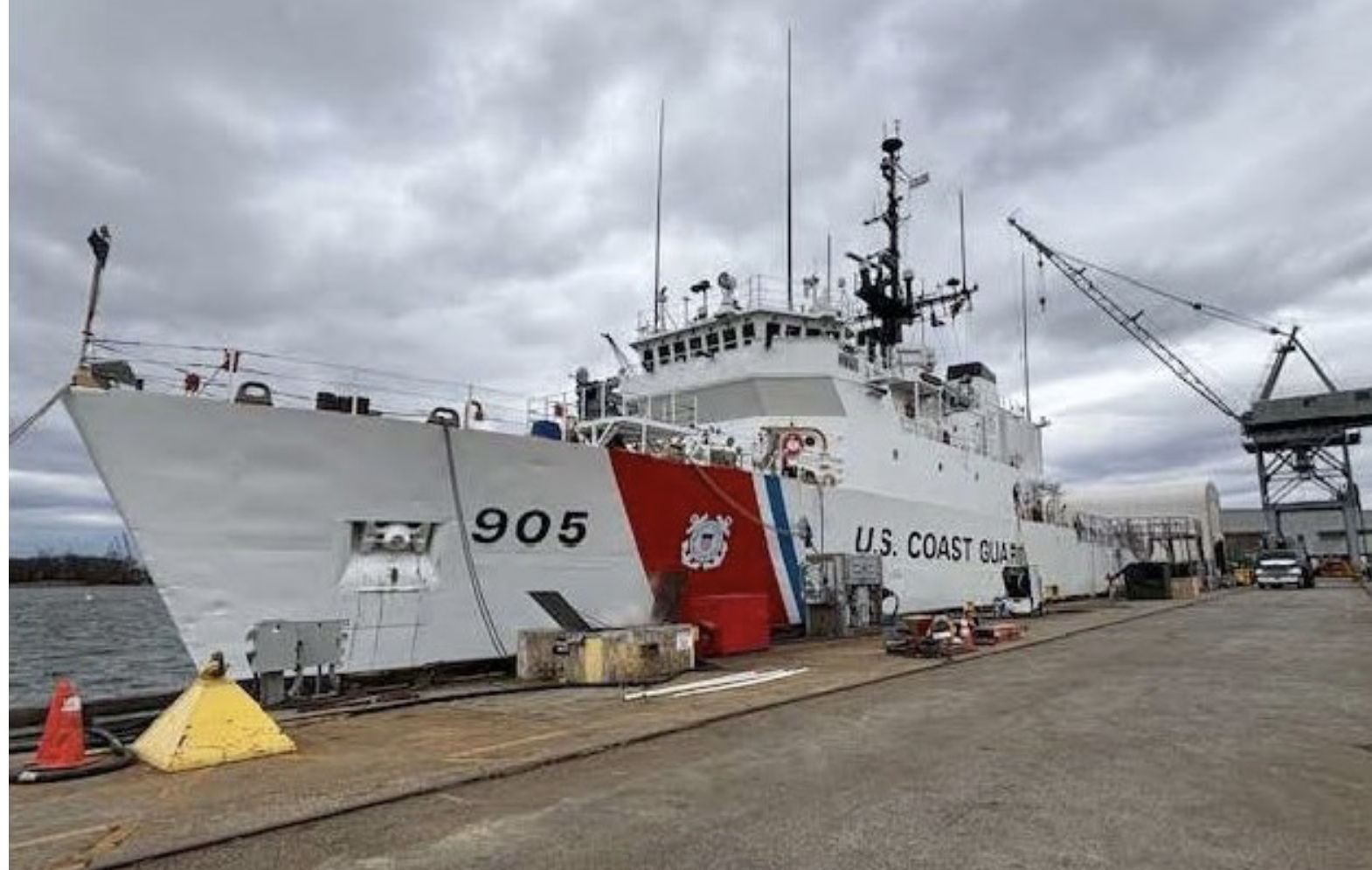
“Ex-US Coast Guard Cutter Steadfast Arrives In Malaysia” –Naval News

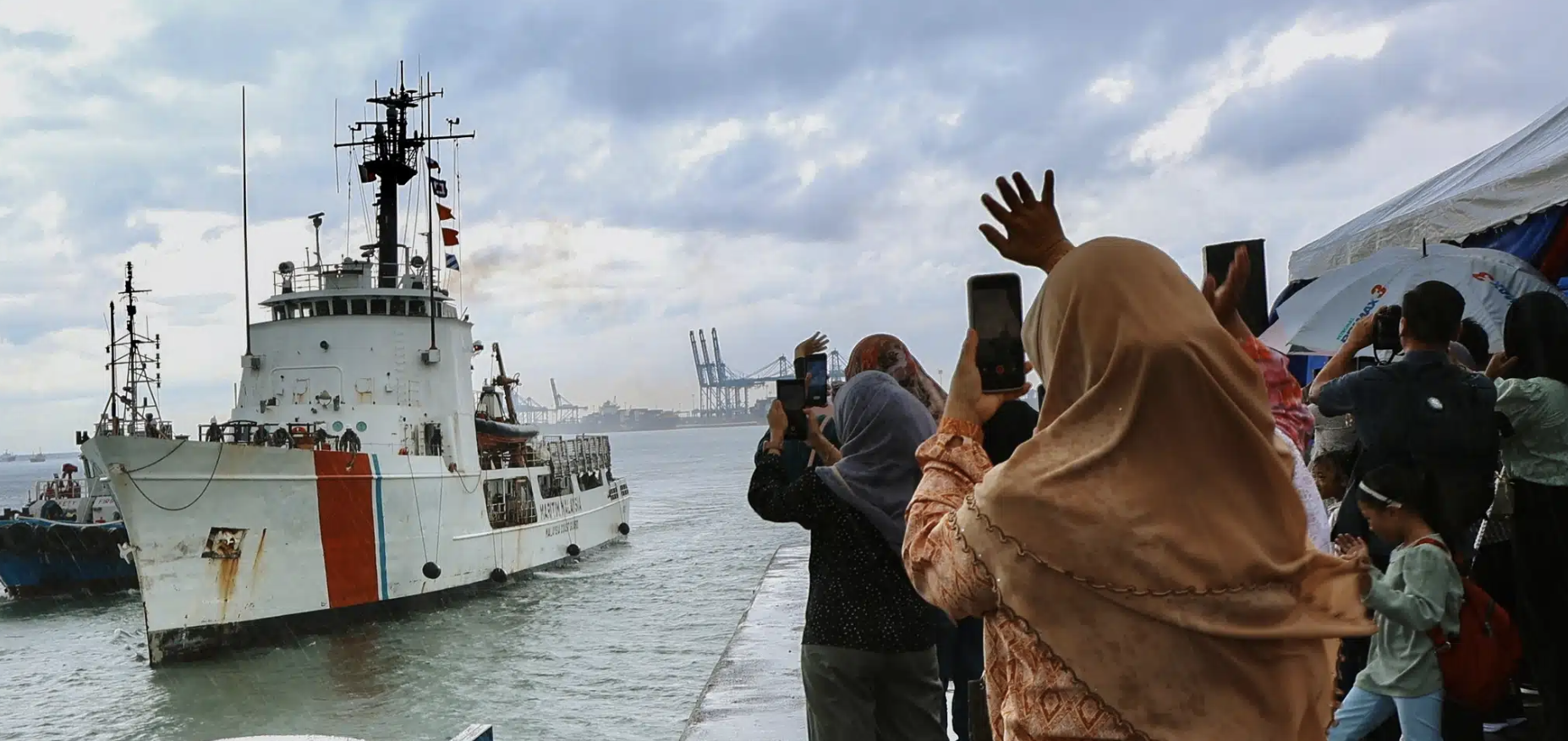
The ex-U.S. Coast Guard cutter Steadfast arriving at the National Hydrographic Centre, Port Klang on November 4, 2025 (U.S. Embassy Kuala Lumpur)

Naval News reports,

“The former United States Coast Guard cutter Steadfast arrived in Malaysia on 4 November, completing a 10,600 nautical mile journey from Baltimore to begin its service with Malaysia’s coast guard, the Malaysian Maritime Enforcement Agency.”

Look at the picture. This ship, the former USCGC Steadfast was commissioned 7 October,  1968. She is over 57 years old and her Malaysian crew has just completed a voyage from Baltimore, across the Atlantic, through the Straits of Gibraltar, across the Mediterranean, through the Suez Canal, down the length of the Red Sea, through the Gulf of Aden, across the Indian Ocean, and through the Strait of Malacca.

How did that happen? The Coast Guard has been recapitalizing its fleet and as a result a lot of vessels became excess property. Rather than incur the cost of scrapping these now over age ships, the Coast Guard has set up a command at Curtis Bay that works with the Coast Guard Yard to prepare these ships for transfer to the navies and coast guards of friendly nations making sure the ships are seaworthy and the crews are adequately trained.

The twelve Hamilton class cutters have been transferred to five different nations.

Two 210 foot Medium Endurance Cutters, Courageous and Durable, were decommissioned in September 2001. Courageous was transferred to Sri Lanka in 2004 and Durable was transferred to Colombia in 2003. Since March 2023 five more WMEC210s have been decommissioned or placed in “in commission, special” status. Steadfast is the first of these five to be transferred to another user.

“The United States announced at the end of October that it plans to provide another retired cutter to the Malaysian Maritime Enforcement Agency.”

22 of the Island class WPBs have been transferred to eight different nations including five to Ukraine where at least one was sunk in combat.

9 of the Marine Protector class 87 foot WPBs have been transferred to Lebanon (2), Uraguay (3), Malta (2), and Yemen (2).

I visited the Coast Guard Yard in August 2024 with the intention of writing a post. I was very impressed, but other priorities got in the way. I have regretted not telling their story ever since.

I was told that from March to July 2024 a decommissioned arrived at the yard every nine days.

This is an important story and it deserves more attention.

“Coast Guard Cutter Spencer completes service life extension program” –CG-9

Coast Guard Cutter Spencer, at Coast Guard Yard in Baltimore, prepares for sea trials at the conclusion of its service life extension work. U.S. Coast Guard photo.

Below is a news release from the Acquisition Directorate (CG-9).

As can be seen in the accompanying photo, the 76mm Mk75 gun and Mk92 fire control systems have been removed, replaced by a 25mm Mk38, presumably a Mod3. The AN/SLQ-32 antennas remain. There is now, apparently, no multi-function/air search radar capability.

All six ships chosen for SLEP were “B Class” 270s built by Robert Derecktor Shipyard. Unlike the four “A Class” ships they are able to operate MH-60 helicopters.

USCGC Spencer had been home-ported in Portsmouth VA, but I suspect she like USCGC Harriett Lane will be transferred to the Pacific Area.


Coast Guard Cutter Spencer completes service life extension program

Coast Guard Cutter Spencer, a 270-foot Famous-class medium endurance cutter, departed Coast Guard Yard in Baltimore on March 8, 2025, having successfully completed its 20-month service life extension program (SLEP).

Managed by the Coast Guard’s In-Service Vessel Sustainment (ISVS) Program, the SLEP ensures mission readiness, improves reliability and reduces maintenance costs of the Coast Guard’s operational fleet. The program extends the service life of legacy cutters by replacing obsolete, unsupportable or maintenance-intensive systems, enabling the cutter to continue meeting mission demands in the most cost-effective manner.

The SLEP for the medium endurance cutters includes updates and replacements of electrical power generation and distribution systems, main diesel propulsion engines, and gun weapon systems. Spencer is the first of six medium endurance cutters scheduled to receive all major system overhauls including new main propulsion engines. This intensive work, which began in July 2023, will allow the cutter to operate for an additional decade, sustaining operational capability as the Coast Guard transitions to the offshore patrol cutter (OPC) fleet.

“These cutters have been essential for Coast Guard operations for over four decades, conducting missions from drug interdiction and fisheries enforcement to search and rescue,” said Kenneth King, ISVS program manager. “Investing in their sustainment is critical to ensuring these cutters remain operationally relevant and capable of executing the service’s most demanding missions until the next generation – the OPCs – are fully deployed.”

Five additional medium endurance cutters – Legare, Campbell, Forward, Escanaba and Tahoma – will complete SLEPs by 2030. Seneca and Harriet Lane previously served as prototypes for the electrical and structural work but did not receive new engines. Harriet Lane also served as the prototype for the MK38 gun weapon system.

For more information: In-Service Vessel Sustainment Program page and Offshore Patrol Cutter Program page

“Coast Guard to send 3 more cutters to Guam, has no plans to escort Philippine ships” –Stars and Stripes

A U.S. Coast Guard boat crew and boarding team from U.S. Coast Guard Cutter Oliver Berry (WPC 1124) approaches a foreign fishing vessel to conduct a joint boarding inspection with members of the Western and Central Pacific Fisheries Commission on the high seas in Oceania, Sept. 22, 2024. U.S. Coast Guard Cutter Oliver Berry’s crew recently completed a 45-day patrol in Oceania in support of Operation Blue Pacific, promoting security, safety, sovereignty, and economic prosperity in the region.

Stars and Stripes reports,

The Coast Guard will double its Guam fleet to six cutters but doesn’t plan to accompany the Philippine coast guard as it struggles to maintain territorial claims in the South China Sea, the service’s Pacific-area commander said Friday.

This is based on a video news conference by Pacific Area Commander Vice Adm. Andrew Tiongson speaking from Japan.

“The Coast Guard will not escort Philippine resupply missions to the BRP Sierra Madre, a grounded warship garrisoned by Filipino troops at the Second Thomas Shoal in the South China Sea, according to Tiongson.”

The Philippines has not asked for escorts, Tiongson said. “We do advise, and we do assist,” he said. “We provide what we would do in this situation.”

He also said, “It’s possible we may get another Indo-Pacific support cutter,” using the description applied to USCGC Harriet Lane, recently arrived in the Pacific Area to support operations in the Western Pacific.

There is more in the article.

Atlantic Area Cutter Back in the Eastern Pacific Drug Transit Zone

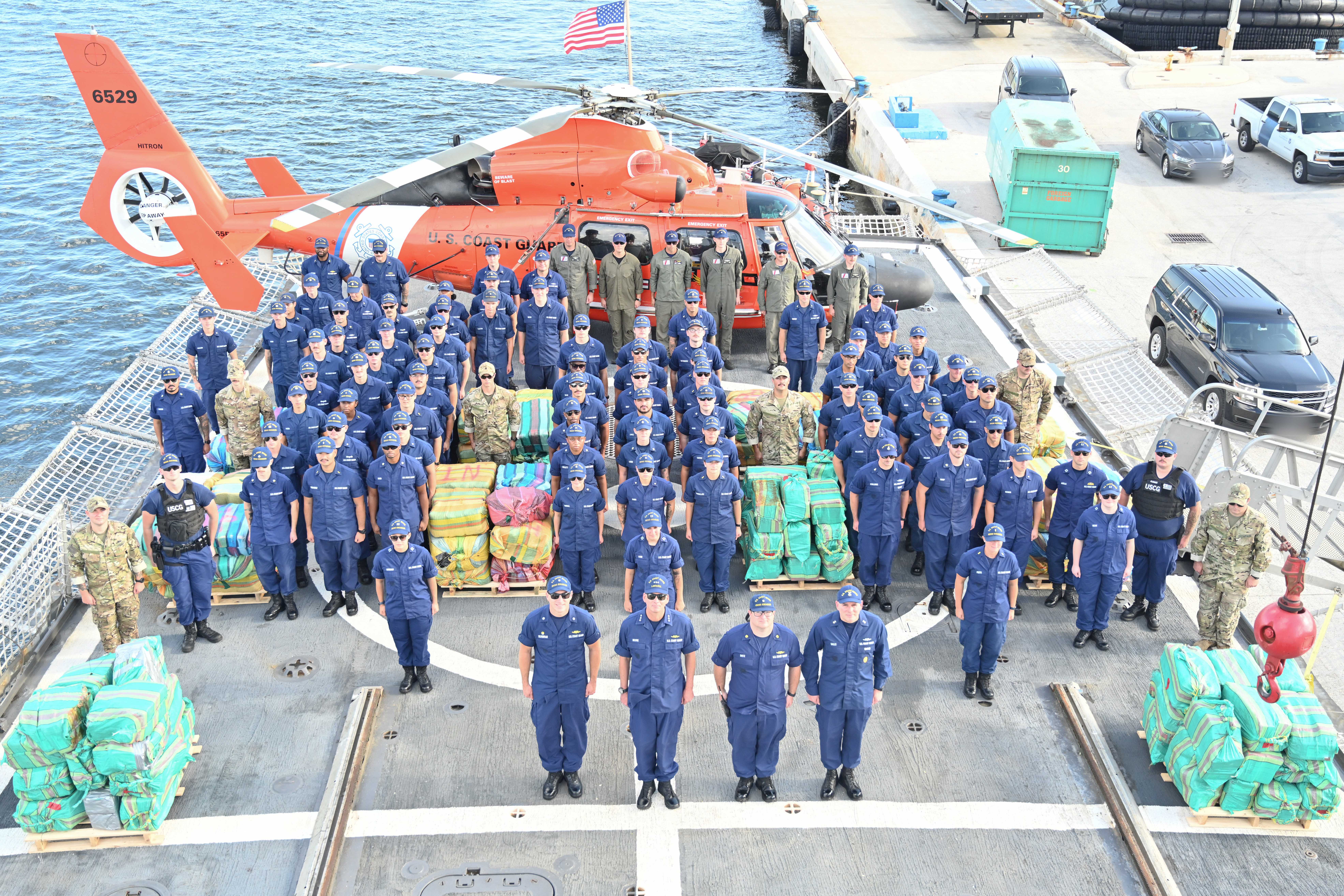
The crew of Coast Guard Cutter Escanaba (WMEC 907) poses for a group photo on the cutter’s flight deck during a contraband offload, Aug. 23, 2024, alongside select personnel from Coast Guard Cutters Spencer (WMEC 905), Legare (WMEC 912), Coast Guard Helicopter Interdiction Tactical Squadron, Pacific Area Tactical Law Enforcement Team, and Coast Guard Atlantic Area Command while moored to the pier in Fort Lauderdale, Florida. Escanaba conducted a 46-day counter-drug patrol in the Eastern Pacific Ocean. (U.S. Coast Guard photo by Petty Officer 2nd Class Brandon Hillard)

Below is a news release from Coast Guard News.

Two things of note in what would normally be a routine report:

First, despite the fact that most Atlantic Area cutters are closer to the Eastern Pacific drug transit zone than those based on the West coast, recently they have been too busy with migrant interdiction to do drug enforcement in the Pacific. This patrol marks a return to previous practice of having LANTAREA cutters, as well as those from the Pacific Area, working the drug problem in the Pacific.

Second, reading the caption of the photo above, you may note that the crew included “...select personnel from Coast Guard Cutters Spencer (WMEC 905), Legare (WMEC 912)…” Spencer and Legare are at the Coast Guard yard as the first and second of six Bear class WMEC270s that will receive full Service Life Extension Program (SLEP) upgrades.  The crews are reassigned after the ships enter SLEP, so it appears some were temporarily assigned to Escanaba to make up for shortfalls in the crew. The shortfalls may have been exacerbated because the patrol was over the summer transfer season.


 Aug. 29, 2024

Coast Guard Cutter Escanaba completes 46-day counter-drug patrol in Eastern Pacific Ocean

PORTSMOUTH, Va. — The crew of the Coast Guard Cutter Escanaba (WMEC 907) returned home to Portsmouth, Wednesday, following a 46-day counter-drug patrol in the Eastern Pacific Ocean.

While deployed, crew members supported the Coast Guard Eleventh District, headquartered in Alameda, California, and Joint Interagency Task Force – South, headquartered in Key West, Florida.

During the patrol, Escanaba’s crew disrupted illegal narcotics smuggling, interdicting 3,408 pounds of cocaine and 4,418 pounds of marijuana valued at nearly $50 million during two separate interdictions. The drugs were offloaded in Port Everglades, Florida on Aug. 23. Additional information about Escanaba’s drug offload, including photos and video, can be found here.

Escanaba’s drug seizures contributed directly to furthering Coast Guard objectives to combat transnational criminal organizations and enhance regional stability and security.

While at sea, Escanaba’s crew was assisted by members of Helicopter Interdiction Tactical Squadron (HITRON), based in Jacksonville, Florida and members of Tactical Law Enforcement Team (TACLET) Pacific – Law Enforcement Detachment (LEDET) 107, based in San Diego, California.

HITRON crew members delivered air support for the use of force and enhanced long-range detection capabilities while deployed aboard Escanaba. The TACLET Pacific LEDET supplied skilled boarding personnel critical for mission execution and served as a force multiplier for other law enforcement activities.

“The crew of Escanaba and our shipmates from HITRON and TACLET are to be commended for executing a demanding mission with professionalism and precision,” said Cmdr. Jared Silverman, commanding officer of Escanaba. “In concert with the Coast Guard’s partner agencies and with support from Joint Interagency Task Force – South, the accomplishments of Escanaba serve as a reminder of how vital this mission is.”

Escanaba is a 270-foot, Famous-class medium-endurance cutter homeported in Portsmouth, Virginia. The cutter’s primary duties are counter-narcotics operations, migrant interdiction, living marine resources protection, and search and rescue in support of U.S. Coast Guard operations throughout the Western Hemisphere.

For information on how to join the U.S. Coast Guard, visit GoCoastGuard.com to learn about active duty, reserve, officer, and enlisted opportunities. Information on how to apply to the U.S. Coast Guard Academy can be found here.

For more, follow us on Facebook, Instagram and X.

WMEC 270 SLEP / USCGC Legare Begins Service Life Extension Program at Coast Guard Yard

The Coast Guard Cutter Legare (WMEC 912) weighs anchor near the Statue of Liberty in New York City, New York, March 17, 2024. (U.S. Coast Guard photo courtesy of Legare)

The Acquisitions Directorate (CG-9) website includes a photo of USCGC Legare (WMEC-912) and the caption “270- foot medium endurance cutter Legare begins service life extension program at Coast Guard Yard.” Normally clicking on the caption would lead to a post expanding on the title, but in this case, it takes you to the In-Service Vessel Sustainment Program page. That page gives us this information about the 270 SLEP.

“Service life extension program for the 270-foot medium endurance cutters involves targeted system replacement to address system reliability, supportability, obsolescence and in­teroperability. This work will include upgrades or replacements to the electrical power generation and distribution system as well as the main propulsion engines. The mission is to facilitate continued operations during transition to the offshore patrol cutter by extending the service life of 270-foot cutters for up to 10 years. Work began on one prototype vessel at the Coast Guard Yard in July 2021 and on the second cutter in April 2022. Full production is scheduled to begin in 2023.”

The intention is not to SELP all 13 WMEC270s, rather they did two limited prototype SLEPS (Seneca, WMEC-906, and Harriet Lane, WMEC-903), and plan to do six full production SLEPs. These 270s should be the last WMECs in commission as they are replaced by Argus class Offshore Patrol Cutters. Harriet Lane’s most visible change was removal of her 76mm Mk75 gun and Mk92 fire control system. A 25mm Mk38 remote weapon station was mounted on the bow on an elevated position. This change is to be applied to all subsequent 270 SLEPs.

Spencer, (WMEC-905) was the first full production 270 SLEP. Spencer was the first 270 to receive new engines. Spencer’s old engines were to be remanufactured and reinstalled on a subsequent WMEC270 SLEP, presumably the newly arrived Legare.

This is a long process. Work on Harriet Lane lasted 15 months, so I expect we will have at least one 270 in the Yard being SLEPed for the next five years.

The Félix Éboué class, a Modern, Minimalist, Medium Endurance Cutter

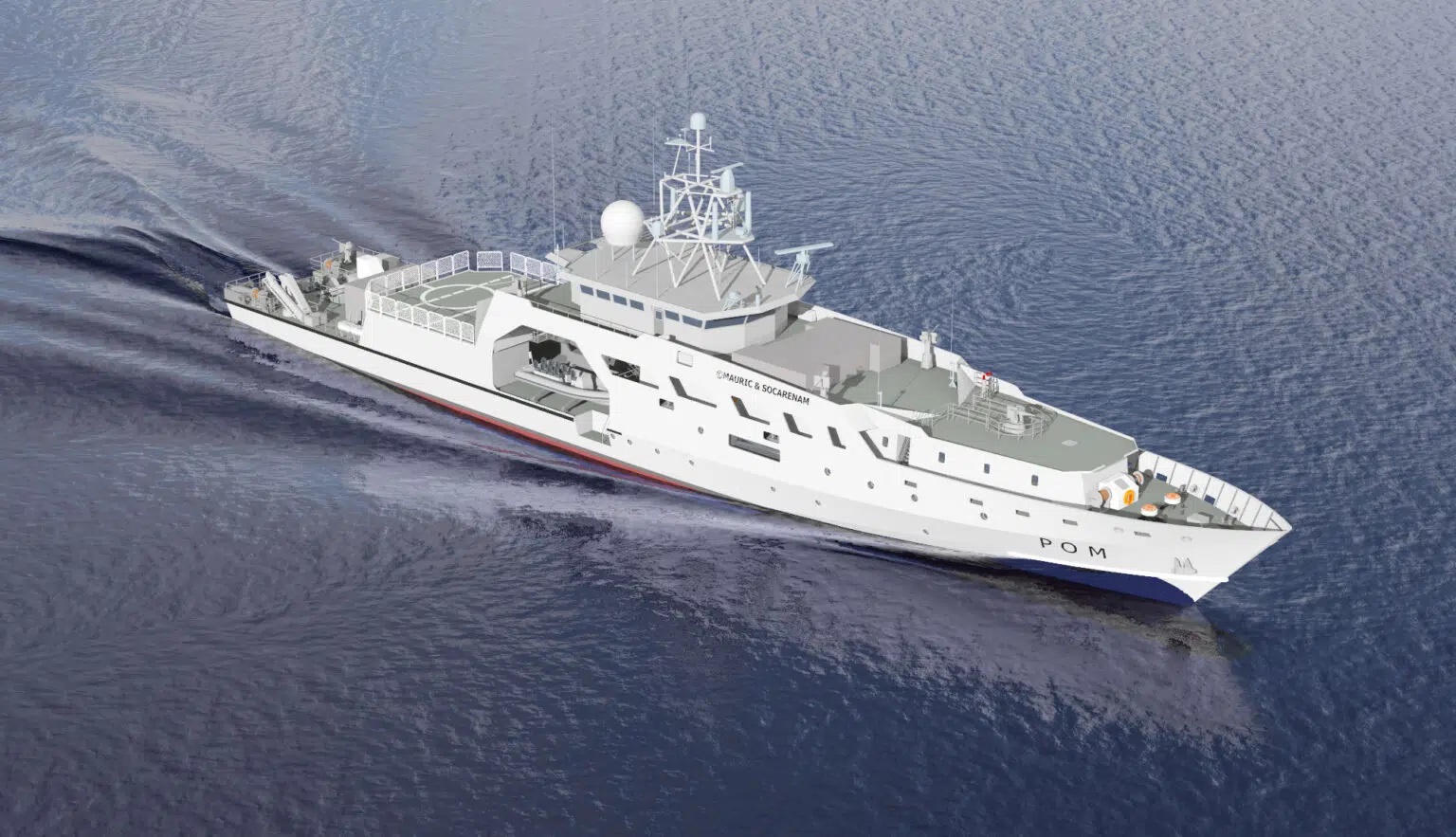
An artist’s rendering, Félix Éboué class or Patrouilleurs Outre-mer (POM)

The Offshore Patrol Cutter (OPC) is described as, “…a capability bridge between the national security cutter, which patrols the open ocean in the most demanding maritime environments, and the fast response cutter, which serves closer to shore.”

That may have been the intention, but that is not what we got.

While the National Security Cutter is better than the WHECs they replaced in almost every way, the OPCs are not only better than the WMECs they will replace, but they are also, in every way except maximum speed, better than the WHECs as well. Instead of a high/low mix of cutters, they all turned out high end. We should not be surprised the OPCs construction and operating costs approach those of the NSCs.

Construction costs are typically proportional to displacement. The OPCs’ displacement is 98% that of the NSC and 1232.8% (more than 12 times) that of the Fast Response Cutters.

This would not be a bad thing, if we had enough NSCs and OPCs to meet our large patrol cutter needs, but I don’t think we will ever get there.

We are expected to ultimately end up with only 36 large patrol cutters, fewer than we have had in decades and fewer than other Coast Guards with far smaller EEZs.

A new fleet mix study has been completed, but the results have not been made public (Why not? This is not transparency). I suspect it shows a need for substantially more than 36 large patrol cutters.

If we look at the previous “Fleet Mix Study,” now over a dozen years old, which minimized requirements because it did not consider “High Latitude regions of the ice shelf and Deployable Operations Group (DOG),” and assumed that NSCs would use the “Crew Rotation Concept” that was expected to allow them to operate 230 days per year, to meet all statutory requirements, the study indicated the Coast Guard needed 66 large cutters, 30 more than currently planned, and 91 FRCs.

If we want significantly more large patrol cutters than currently planned, perhaps we need a smaller, cheaper alternative to the OPCs that requires a smaller crew and are more economical to operate. In previous posts, I have referred to this alternative as (Cutter X).

Thinking Ahead: 

Getting funding for more than two OPCs per year is probably unrealistic. The last OPC is not expected to be commissioned until 2038, 14 years from now. If we continue to build only two large patrol cutter a year, will not be able to grow the fleet until after 2038 and then it will grow slowly because the National Security Cutters will start aging out.

We might not be able to continue to build OPC sized patrol cutter after 2038. The Coast Guard will want to build Arctic Security Cutters (or perhaps Arctic Patrol Cutters). Both the Juniper class WLBs and Keeper class WLMs will need to be replaced.

(Where is our long-range shipbuilding plan?)

If we started in the next year of two, we could be producing true medium endurance cutters in significant numbers before the planned completion of the OPC program. On a 3 for 1 or even 2 for 1 exchange for the last few OPCs, if we tried, we could start to grow the fleet perhaps as early as 2032.

That is why the Félix Éboué class is worth a look. It is, what I believe may be, the absolute minimum fully capable Offshore Patrol Vessel. It covers all the bases. It is good enough for most operating areas. That is not to say, there are no good reasons for some add–ons, but I think it is a kind of benchmark. It is also a good representation of Cutter X. There are reasons we might want to go bigger, but before you increase the quality of the individual cutters, first we need to have enough.


The French Experience

France, like the US has a huge Exclusive Economic Zone (EEZ), the largest in the world, 11,691,000 km2 (4,514,000 sq mi). The US EEZ is 11,351,000 km2.

Unlike the US, the French don’t have a coast guard that operates ocean going ships to enforce laws and protect sovereignty. The French Navy does this, and uses a fleet of Offshore Patrol Vessels, some of which are referred to as frigates.

The Félix Éboué class is their newest class of OPVs. They are intended specifically to patrol the waters of French overseas territories in the Pacific and Indian Oceans. They will be based, two each, at NouméaTahiti and La Réunion. They replace the P400 class, which are slightly larger than the Webber class WPC, which were found to be inadequate.

I have found some very good photos of the second ship of the class being fitted out, that show details I had not seen before, and would like to share them. I will also bring forward some of my earlier commentary with updates, so as to consolidate information on this interesting class.

Comparison with Webber class WPC (FRC):

Below is a comparison between the FRC and the Félix Éboué class (POM) that was included in an earlier post, updated with information about the propulsion system on the French ships.

French overseas patrol vessel (POMs) Auguste Bénébig. Photo: http://www.meretmarine.com

Like an FRC:

I always thought these looked like oversized Webber class, the proportions are similar, and the much larger POM is not much more complicated than the Webber class. The crew of the POM is 30, only six more than that of the FRC. Both have a bridge with a 360-degree view positioned well aft, minimizing vertical acceleration. Both have an 8 meter boat in a stern ramp. The armament is similar with four .50 cal. machine guns and a single medium caliber gun in the bow, a 20mm on the POM and a 25mm on the FRC. The POM uses slightly less powerful diesel engines, 2x ABC 16V DZC medium speed diesels 3.7MW each @ 1,000rpm, for a total of about 9924 HP compared to 11,600 for the FRC. (I am told the POM’s engines are also more economical and simpler to maintain.) But the French ships still manage to make 24 knots, a couple of knots more than claimed for the OPC. With similar crew and systems, they should not cost much more than the FRCs to operate.

Unlike an FRC:
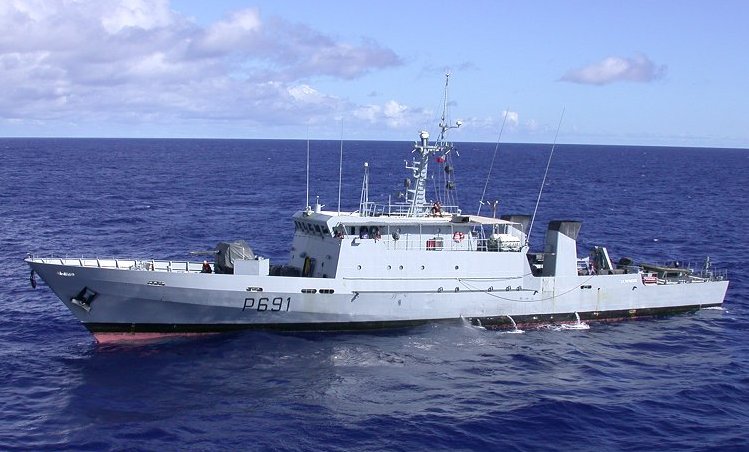
P400 patrol ship Tapageuse at sea near Tahiti (18 June 2003). Photographer: Jean-Michel Roche

While they would have been thinking of their existing 373 ton P400 class pictured above, it might appear to us that they wanted a ship to do the same sorts of missions the Webber class Fast Response cutters (FRC) are doing out of Guam, but they recognized that these ships would be far from any major naval base and that they would need to travel great distances and would be exposed to extreme weather conditions, so they needed to be larger (1300 tons vs 353 tons for the FRC) and have greater range (5500 miles vs 2500) and endurance (30 days vs 5 days).

Having chosen a larger hull, they took advantage of the greater volume and deck space to add a second RHIB, a multimode radar, space for 29 passengers (roughly a platoon of Marines), a sickbay, a dive locker, space for a 20 foot containerized mission module, a flight deck and hangar for a 700-kilogram-class rotor-blade drone (not yet deployed), and a holding area for up to six prisoners.

Some sources also indicate the French ships also have electric motors that would allow them to cruise on the ship’s service generators and secure the main propulsion engines, but I have seen no specifics.

The Photographs: 

The second of the French Navy’s six new overseas patrol vessels (POM), the Teriieroo a Teriierooiterai, which will be based in French Polynesia and has been named in tribute to a Companion of the Liberation native of this Pacific territory, Photo: http://www.meretmarine.com

The Teriieroo at Teriierooiterai fitting out at the end of July, 2023 in Boulogne. Photo: http://www.meretmarine.com

Stern ramp for 8 meter RHIB. French Navy overseas patrol vessel (POM), Teriieroo a Teriierooiterai, fitting out 2023. Photo: http://www.meretmarine.com

Second 8 meter RHIB and davit (only) on starboard side. French Navy overseas patrol vessel (POM), Teriieroo a Teriierooiterai, fitting out 2023. Photo: http://www.meretmarine.com

Aliaca aerial drone on its launch catapult. French Navy overseas patrol vessel (POM), Teriieroo a Teriierooiterai, fitting out 2023. Photo: http://www.meretmarine.com

Recovery System for Unmanned Air System, French Navy overseas patrol vessel (POM), Teriieroo a Teriierooiterai, fitting out 2023. Photo: http://www.meretmarine.com

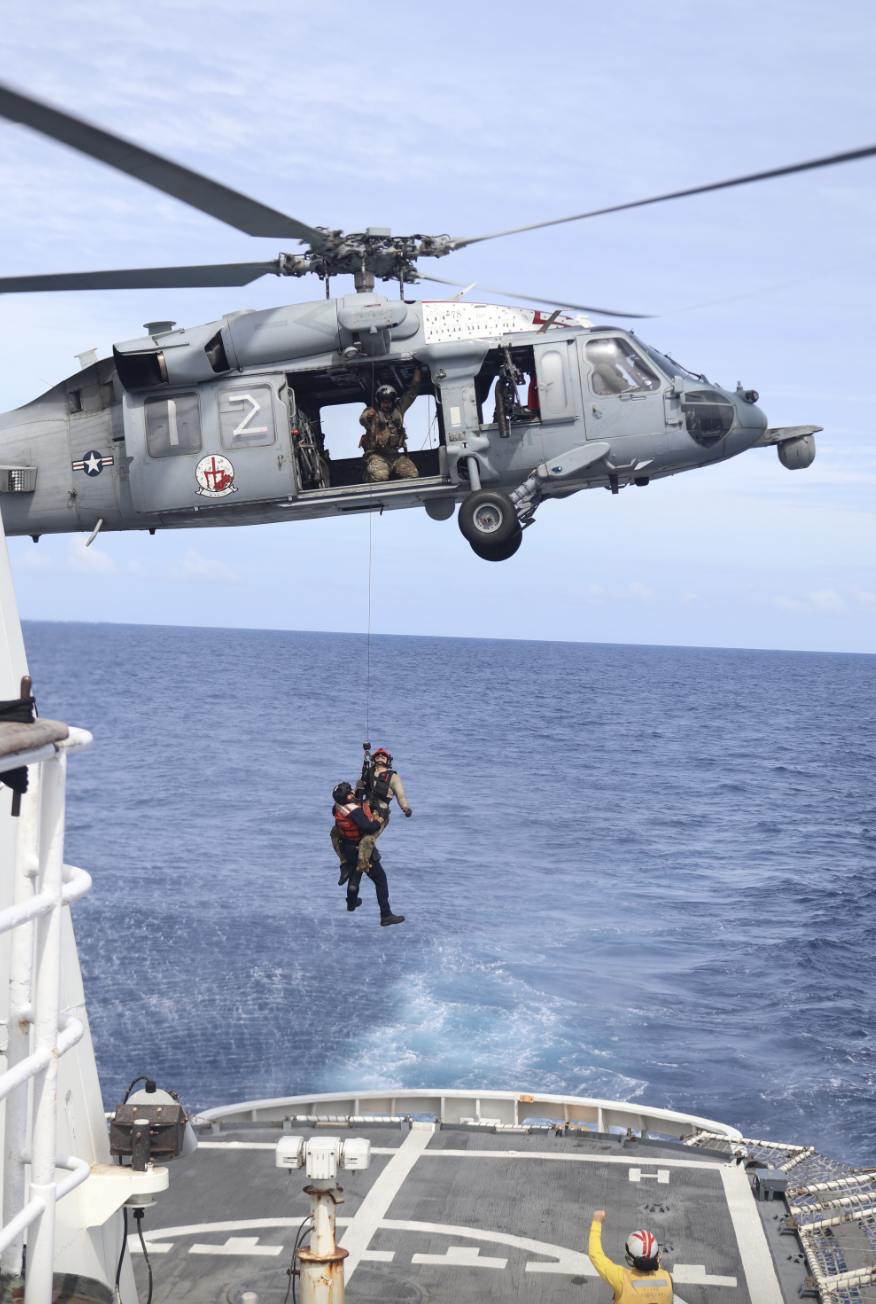
Changing of the Guard, WPC for WMEC

USCGC ALERT departing Astoria

Passing this along from the “Coast Guard Sea Duty Veterans” Facebook page. The post was by Bill James.


On Friday, 10 May, Cutter ALERT sailed beneath the Astoria-Megler bridge, crossed the Columbia River Bar, and proceeded south enroute to her new homeport of Cape Canaveral, Florida.
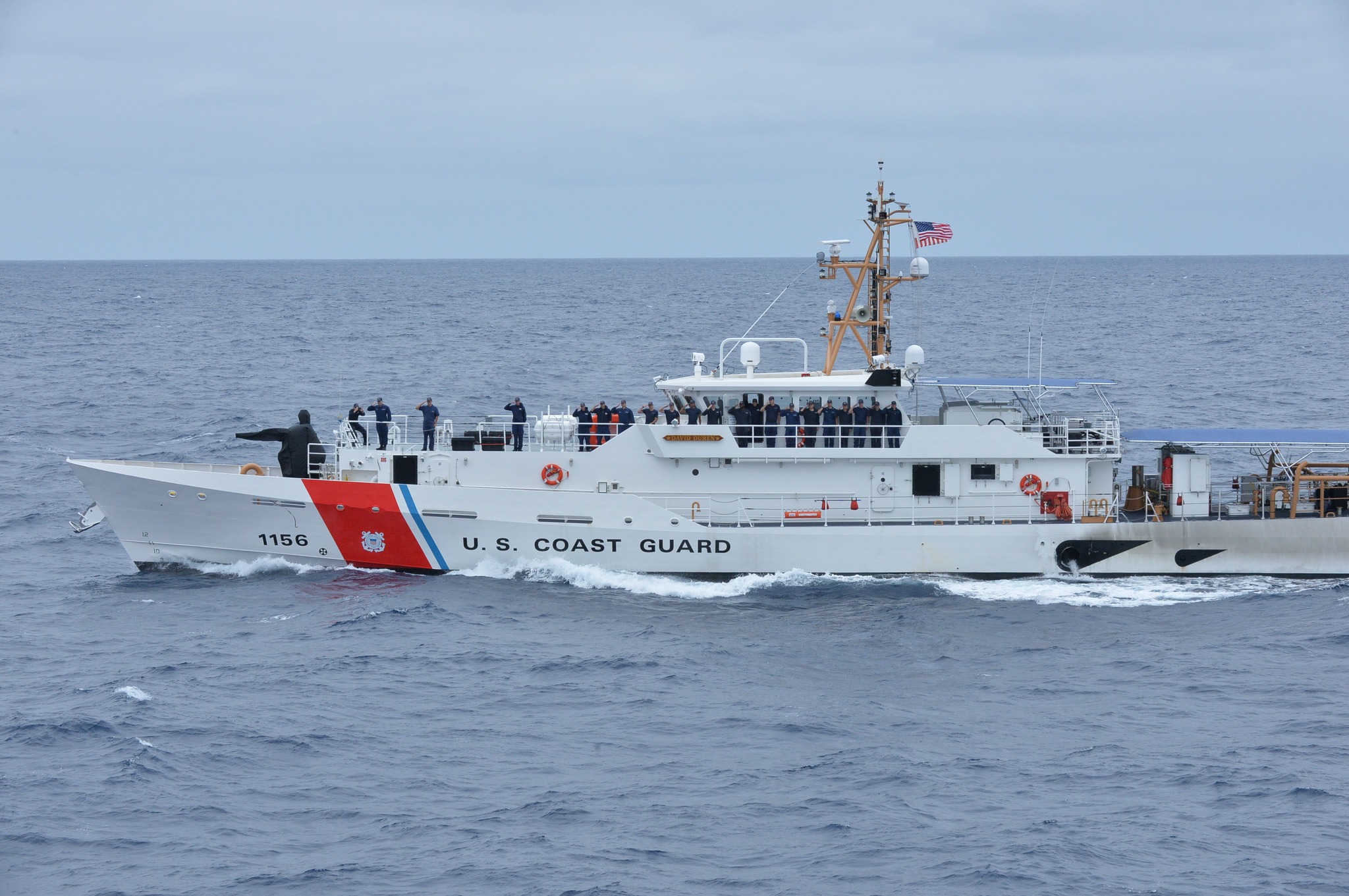
Simultaneously, the newly built CGC DAVID DUREN, one of the two 154’ USCG Sentinel Class cutters proceeded northward on its journey from Key West to its new homeport of Astoria, OR.
This Thursday, 16 May, the two cutters passed close abroad in the Eastern Pacific Ocean. DAVID DUREN rendered passing honors and ALERT returned the salute, thereby properly relieving ALERT’s 30-year watch to the first of two Sentinel Class Cutters to be stationed in Astoria.

USCGC DAVID DUREN (WPC-1156) Renders Passing Honors

“U.S. Coast Guard Cutter Active returns home from Eastern Pacific patrol; one life saved, $50.8M worth of cocaine interdicted” –CG News Release

The USCGC Active (WMEC 618) crew rescue a solo sailor stranded on a disabled vessel in the Eastern Pacific Ocean near the Galapagos Islands, Apr. 13, 2024. Active’s crew diverted over 200 nautical miles at high speed to conduct the search and rescue operation for the sailor whose sailboat was disabled and adrift at sea after a pod of whales damaged the boat. U.S. Coast Guard photo by U.S. Navy Midshipman Caden Dale.

Below is a Coast Guard News Release. With the exception of the SAR case mentioned in the photo above, the cruise seems to have been pretty typical of an Eastern Pacific drug interdiction patrol, but I would point out that Active’s homeport, Port Angeles, is further away from the patrol area than the homeports of most other cutters that might have this assignment. It is counter-intuitive, but East coast ports are generally closer to the patrol area than West coast ports. For Example, Charleston is closer to the patrol area than San Diego, and much closer than Alameda or Port Angeles.

There is a troubling detail in this release.  Active was “the sole U.S. surface asset operating in the region for 28 days in support of Joint Interagency Task Force-South’s counter-narcotics campaign.”


May 3, 2024

U.S. Coast Guard Cutter Active returns home from Eastern Pacific patrol; one life saved, $50.8M worth of cocaine interdicted

PORT ANGELES, Wash. — The U.S. Coast Guard Cutter Active (WMEC 618) and crew returned home to Port Angeles Friday after completing a 54-day multi-mission patrol in support of a Joint Interagency Task Force-South (JIATF-S) counternarcotics patrol in the Eastern Pacific Ocean.

During the patrol, Active’s crew interdicted 3,858 pounds of cocaine worth an estimated $50.8 million in a coordinated effort involving both airborne and surface units, resulting in a safe and successful interdiction.

In addition to the cocaine interdiction, Active’s crew disrupted two other smuggling events while serving as the sole U.S. surface asset operating in the region for 28 days in support of Joint Interagency Task Force-South’s counter-narcotics campaign. Throughout the deployment, the cutter patrolled over 12,000 nautical miles, a distance roughly equivalent to five spans of the continental U.S.

“Any interdiction at sea is challenging, with a variety of factors at every step, and no two are ever the same,” said Cmdr. Adam Disque, Active’s commanding officer. “The cases we encountered on this patrol were particularly difficult, and the crew fought through obstacles at every turn, working extremely hard to accomplish this mission. I could not be more proud of the team as they fully embodied our cutter’s nickname, ‘The Li’l Tough Guy’.”

On April 12, Active received notification of a single-handed sailor in distress more than 300 nautical miles northeast of the Galapagos Islands. The sailor’s boat was disabled, and he was adrift at sea after reporting a pod of whales damaged his sailboat.

Active diverted over 200 nautical miles at high speed to conduct a search and rescue operation. Upon arrival, the crew safely embarked the mariner and brought him back to shore.

“This sailor was very fortunate that we happened to be in the area; he was far from normal shipping lanes and well out of range for any coastal rescue system,” said Petty Officer 3rd Class Gordon Smith, an Active crewmember who participated in the search planning. “It was fortunate that we were able to find him relatively quickly and get him on board before the weather or situation deteriorated.”

Active’s two pursuit boats were supplemented by an MH-65E helicopter and aircrew from the Helicopter Interdiction Tactical Squadron (HITRON) to respond in a multi-mission environment on the high seas. HITRON, based in Jacksonville, Florida, conducts airborne use of force to stop vessels suspected of breaking U.S. and international laws on the high seas.

During this patrol, specialized law enforcement members from the Coast Guard’s Pacific Tactical Law Enforcement Team and the Maritime Security and Response Team – West deployed aboard to support their mission and augment Active’s crew.

Active regularly patrols international waters off southern Mexico and Central America to combat transnational organized crime in the Western Hemisphere, specifically the smuggling of narcotics.

Active, a 57-year-old medium endurance cutter, is homeported in Port Angeles. The multi-mission cutter falls under the operational command of the Coast Guard Pacific Area Commander. Patrolling from the northernmost part of the contiguous United States to the equator, Active is critical in conducting search and rescue, counter-narcotics law enforcement, living marine resource protection, and homeland defense operations.

“Media Advisory: U.S. Coast Guard Cutter Harriet Lane is scheduled to return to home port following inaugural Operation Blue Pacific Patrol in Oceania” –CG News

Australian Royal Navy personnel stand in formation on a pier as the U.S. Coast Guard Cutter Harriet Lane (WMEC-903) and crew prepare to moor at HMAS Cairns, Queensland, Australia, March 7, 2024. The Harriet Lane and crew had a five-day port call in Cairns during its inaugural 2024 Operation Blue Pacific patrol in Oceania. (U.S. Coast Guard photo by Petty Officer 2nd Class Ty Robertson)

Below is a Coast Guard News release. The release has some videos including interaction with children in Port Vila, Vanuatu (very cute).

One thing that caught my eye was the use of the plural in this statement, “The Coast Guard plans to use medium endurance cutters (emphasis applied–Chuck) for responsibilities in Hawaiian waters, as well as an increase Coast Guard presence throughout the Indo-Pacific and Oceania.”

Was this just a misstatement by the PAO or does this mean we will see more WMECs in 14th District?

I would also note that Harriet Lane apparently made this patrol without a helicopter. Barbers Point does fly H-65s, but last I heard, they only have three. Did the cutter at least have a Scan Eagle?


April 4, 2024

Media Advisory: U.S. Coast Guard Cutter Harriet Lane is scheduled to return to home port following inaugural Operation Blue Pacific Patrol in Oceania

Editor’s Note:  Media should RSVP by Monday, April 8 by 4 p.m. to Petty Officer 2nd Class Ryan Fisher at ryan.m.fisher@uscg.mil
Imagery of Harriet Lane’s patrol can be found here: Operation Blue Pacific 

Who: U.S. Coast Guard Rear Adm. Michael Day, commander U.S. Coast Guard Fourteenth District, and Cmdr. Nicole Tesoniero, commanding officer U.S. Coast Guard Cutter Harriet Lane (WMEC 903).

What: U.S. Coast Guard Cutter Harriet Lane and crew are expected to return to home port after their inaugural Operation Blue Pacific patrol in Oceania. Media are invited to watch Harriet Lane and crew moor at Pearl Harbor and families be reunited after being away for more than 70 days. Media will be able to hear remarks from Day and Tesoniero regarding Operation Blue Pacific and the increased Coast Guard presence in Oceania.

Where: Joint Base Pearl Harbor-Hickam, 1000 North Rd, Honolulu, Hawaii, 96860

When: Tuesday, April 9 at 10 a.m.  

Harriet Lane and crew partnered alongside allies and several Pacific Island countries from January to April 2024. Among those countries were Samoa, Fiji, Vanuatu, Australia, Papua New Guinea, Nauru and Marshall Islands. The focus was on advising and sharing best practices, along with bolstering our partners’ capabilities to promote and model good maritime governance in the region.

Harriet Lane and crew expanded U.S. Coast Guard presence in Oceania alongside Pacific Island countries exercising bilateral maritime law enforcement agreements with shiprider provisions to strengthen maritime domain awareness and support efforts to combat illegal fishing activities with partners with whom we have existing relationships.

The Harriet Lane is U.S. Coast Guard Pacific Area’s newest Indo-Pacific support cutter and spent more than 15 months in a Service Life Extension Program (SLEP) in Baltimore, Maryland, to prepare for the transition in missions and operations.

The Coast Guard plans to use medium endurance cutters for responsibilities in Hawaiian waters, as well as an increase Coast Guard presence throughout the Indo-Pacific and Oceania. The ship is especially suited for longer-range six-to-eight week joint operational and training patrols in the Pacific, taking pressure off shorter range Hawaii-based cutters more suited to service closer to home port.

Commissioned in 1984, Harriet Lane is a 270-foot medium endurance cutter homeported in Pearl Harbor, Hawaii, to support Coast Guard missions in the Pacific region. The service’s medium endurance cutter fleet supports a variety of Coast Guard missions including search and rescue, law enforcement, maritime defense, and protection of the marine environment.

“Vanuatu police, aided by US Coast Guard, say Chinese vessels violated fishing laws” Reuters

USCGC Harriet Lane arrives Pearl Harbor. USCG Photo.

Reuters reports,

“Six Chinese fishing boats were found to be violating Vanuatu’s fisheries law after being inspected by local police who were on board the first U.S. Coast Guard boat to patrol the waters of the Pacific Islands nation, Vanuatu police and officials said.”

Nice to see positive results from USCGC Harriet Lane‘s first Pacific law enforcement deployment. (In just over a month, Harriet Lane will turn 40 years old.)

Notably,

“Last year, a Coast Guard vessel on patrol for illegal fishing was refused access to Vanuatu’s port.”